


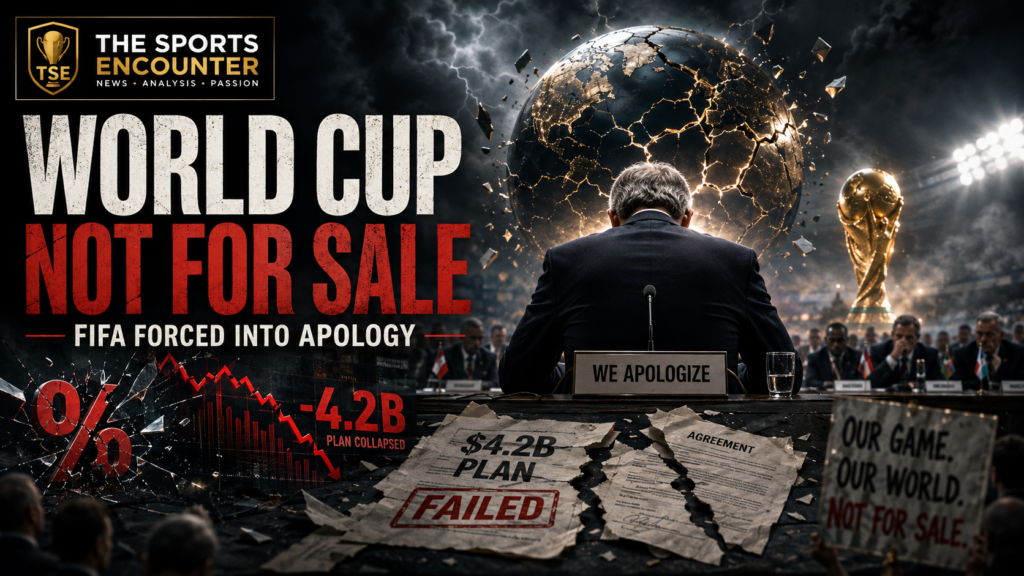
FIFA has apologized to its 211 member associations after Gianni Infantino’s attempt to bring private investors into the commercial heart of the World Cup collapsed under a global football revolt.
The apology came after a crisis meeting in Rabat, Morocco, where FIFA’s senior leadership presented a united public front and reaffirmed its support for Infantino despite growing pressure over the abandoned proposal.
The plan would have sold approximately 20% of a new FIFA commercial-rights company to outside investors, raising an estimated $4.2 billion while placing the new entity’s total valuation near $20 billion.
That proposal is now dead.
The anger it created is not.
UEFA, Concacaf, the Asian Football Confederation, domestic leagues and several national associations have challenged the way FIFA handled the process. The central complaint was never limited to the financial value of the deal. It concerned who had the authority to make such a decision, why elected football bodies were not properly consulted, and how private investors could gain influence over assets built around the World Cup.
FIFA’s apology acknowledged that the process should have been handled differently and that its members should not have felt excluded.
The statement was intended to calm the crisis.
Instead, it revealed the size of the institutional damage now facing Infantino.
FIFA World Cup Selloff Crisis at a Glance
| Key Issue | What Happened |
|---|---|
| Proposed transaction | FIFA considered selling about 20% of a new commercial-rights entity to private investors. |
| Estimated amount raised | Approximately $4.2 billion. |
| Estimated company valuation | About $20 billion. |
| Status of the proposal | Permanently withdrawn after widespread opposition. |
| FIFA’s response | Apologized to member associations and promised a review of the process. |
| Infantino’s position | FIFA’s management board publicly reaffirmed its support for him. |
| Main opposition | UEFA, Concacaf, the AFC, European leagues and several national federations. |
| Election impact | Several European associations have withdrawn support for Infantino’s 2027 re-election. |
| Potential leadership challenge | No confirmed rival candidate has emerged. |
| Possible Extraordinary Congress | Could be requested if at least 43 FIFA associations submit a formal written demand. |
TL;DR
- FIFA apologized to its 211 member associations over the handling of its abandoned World Cup commercial stake-sale proposal.
- The plan sought to raise approximately $4.2 billion by selling a 20% stake in a new commercial entity.
- UEFA, Concacaf and the AFC strongly criticized the process and lack of consultation.
- FIFA withdrew the proposal after opposition threatened to fracture the international game.
- Senior FIFA leaders publicly reaffirmed support for Gianni Infantino following a crisis meeting in Morocco.
- Several European football associations have withdrawn support for his re-election.
- Former Portugal international Luis Figo has called for Infantino to resign.
- Infantino retains significant backing in Africa, Asia and smaller football nations.
- No formal challenger has entered the March 2027 FIFA presidential election.
- The crisis now concerns governance, trust and leadership rather than the abandoned transaction alone.
What FIFA Actually Apologized For
FIFA’s letter to its members did not describe the original commercial idea as inherently illegitimate.
Its apology focused on the process.
The governing body accepted that the FIFA Council and member associations had felt excluded and that the proposal should have been handled through a more consultative structure.
That distinction matters.
FIFA is not saying that seeking outside investment was automatically wrong. It is admitting that a plan affecting some of football’s most valuable commercial assets was advanced without sufficient involvement from the organizations that formally govern the international game.
Those assets include rights connected to the World Cup and other FIFA competitions.
The Sports Encounter had already identified the governance problem when it examined why FIFA’s World Cup investment plan was collapsing.
The financial proposal became politically unsustainable because the process appeared to move faster than the consent required to legitimize it.
The Rabat Meeting Was Designed to Show Control
FIFA’s senior leadership gathered in Morocco with the organization under its greatest internal pressure of Infantino’s presidency.
The resulting statement emphasized unity.
FIFA Secretary General Mattias Grafstrom and members of the management board reaffirmed their full support for the president. Infantino, in return, expressed full support for Grafstrom and FIFA’s administration.
The language was deliberate.
Senior officials had already broken ranks in public and private. Chief Operating Officer Kevin Lamour reportedly told staff they had been deceived over a project he described as belonging to one person. Carlos Cordeiro resigned as a senior adviser and questioned why FIFA would sell part of its most valuable commercial asset while holding substantial reserves and no debt.
The Sports Encounter followed those internal fractures in its report on the resignations and revolt inside FIFA.
Rabat therefore had one immediate purpose: stop the impression that FIFA’s administration was turning against its president.
The statement achieved that visually.
It did not erase what senior officials had already said.
The Apology Does Not Rebuild Trust by Itself
FIFA has promised to review what went wrong.
Its critics are asking a harder question.
Who will conduct that review, and will it have the authority to examine decisions made at the highest level?
An internal review may identify communication failures, poor sequencing and inadequate consultation. Those findings would address procedure.
The larger issue concerns leadership judgment.
A proposal worth billions of dollars did not appear in isolation. It required advisers, commercial analysis, legal work, investor discussions and internal coordination.
Football stakeholders now want to know how far the project progressed before the FIFA Council and wider membership understood its full implications.
The crisis has therefore moved beyond one failed transaction.
It has become a test of whether FIFA’s governance structure can challenge its own president before outside pressure makes retreat unavoidable.
UEFA’s Opposition Went Far Beyond Europe Protecting Its Power
FIFA’s defenders may portray the resistance as another political fight between the global governing body and Europe.
That explanation is too narrow.
UEFA’s 55 associations unanimously rejected the proposal and warned that FIFA had crossed a line by treating football’s global competitions as assets that could be partly transferred into private hands.
UEFA welcomed the withdrawal but said rebuilding trust had only begun.
The Sports Encounter documented the confrontation in its report on UEFA’s threatened boycott and the deepening selloff crisis.
Concacaf also rejected the plan, despite representing the region that had just hosted the 2026 World Cup.
Our earlier report on Concacaf’s opposition to FIFA’s commercial proposal showed that the resistance was not confined to European football.
The AFC also objected to the proposal being presented as a near-completed decision without adequate consultation.
When three powerful confederations challenge the same process, the issue becomes institutional rather than regional.
FIFA’s Strongest Defense Is Also Its Most Revealing
FIFA’s statement reminded critics that Infantino is the only official directly elected by all 211 member associations.
That point is constitutionally important.
It is also politically revealing.
Infantino does not need the unanimous support of Europe’s largest football nations to remain president. Every national association holds one vote, regardless of population, football history, commercial power or competitive success.
San Marino’s vote carries the same formal weight as Brazil’s, Germany’s, Argentina’s or Spain’s.
That structure protects smaller associations from domination by richer football nations.
It also rewards presidents who build durable support through development funding, political relationships and direct engagement with countries that rely heavily on FIFA assistance.
The Sports Encounter explored that strategy in its analysis of Infantino’s growing reliance on smaller football nations.
Why Infantino May Still Survive the Crisis
Infantino faces serious criticism, but criticism alone does not remove a FIFA president.
He retains several structural advantages.
No Confirmed Challenger
The election is scheduled for March 2027, yet no candidate has officially built a global campaign capable of defeating him.
Potential replacements require more than visibility. They need nominations, regional alliances, financial support and enough confidence among associations to challenge an incumbent who controls strong relationships throughout world football.
Support Across Africa and Asia
Leading African administrators have sent messages of support, while Qatar, Kuwait, Lebanon, Sri Lanka, Indonesia and the Philippines have publicly backed Infantino despite the AFC’s broader criticism.
Morocco also moved quickly to support him after the proposal was withdrawn.
FIFA Development Funding
Many smaller associations rely on the official FIFA Forward development program to fund facilities, administration, youth football and national-team infrastructure.
That does not mean their votes are purchased.
It does mean FIFA’s presidency has direct importance to their ability to operate.
Why the Crisis Still Threatens His Re-Election
Infantino’s support may remain broad, but the political cost of backing him has increased.
Several European associations, including Wales, Serbia and Sweden, have withdrawn their support. Others may follow before the election.
UEFA has openly said it no longer has confidence in his leadership. Concacaf has expressed the same position, while Canadian Prime Minister Mark Carney has publicly questioned whether Infantino should remain in office.
Former Portugal star Luis Figo has called for his resignation.
Laura McAllister, a UEFA vice president, has described the controversy as a leadership crisis rather than a simple commercial mistake.
Those voices will not automatically decide the election.
They can make it harder for associations to support Infantino without explaining why.
Could FIFA Face an Extraordinary Congress?
FIFA’s statutes allow an Extraordinary Congress to be called if at least 43 member associations submit a formal written request.
That threshold represents slightly more than one-fifth of FIFA’s membership.
Reaching it would require opposition to move from public criticism into coordinated institutional action.
UEFA has 55 associations, meaning Europe could theoretically reach the threshold alone.
Political unity over a statement does not guarantee agreement over calling a Congress, removing a president or supporting the same replacement candidate.
The possibility remains important because it gives FIFA’s critics a formal route beyond press releases and public condemnation.
Whether they use it will reveal how serious the opposition truly is.
The 64-Team World Cup Debate Makes the Governance Fight Bigger
The abandoned stake sale is not FIFA’s only controversial proposal.
European Leagues has also criticized the short period provided to assess a possible expansion of the 2030 World Cup from 48 to 64 teams.
The organization represents more than 1,300 clubs and has warned FIFA against making disruptive unilateral decisions that affect players, competitions and domestic calendars.
The Sports Encounter previously examined whether a 64-team World Cup would improve the competition or deepen football’s scheduling crisis.
The connection between the two controversies is clear.
Stake sales, competition expansion and new commercial structures all affect the balance of power between FIFA, confederations, leagues, clubs, players and supporters.
The current revolt is therefore about more than stopping a single investment plan.
It concerns whether FIFA can continue making transformative decisions before the wider game has meaningful time to evaluate them.
Morocco’s Support Creates Another Political Question
Morocco was among the first associations to support Infantino after the proposal collapsed.
The country will co-host the 2030 World Cup with Spain and Portugal and hopes to stage the final.
That timing produced reports suggesting Infantino may have linked support to the allocation of the title-deciding match.
FIFA has firmly denied the claim.
A spokesperson said it was false and misleading to suggest the president had promised Morocco the final and added that the decision would be made in due course.
No verified evidence currently establishes that such a promise was made.
The allegation still demonstrates how quickly governance concerns can affect every major decision surrounding the World Cup.
When trust weakens, routine political support begins to look transactional even without proof.
What the Apology Must Produce to Matter
FIFA’s apology will have limited value unless it leads to structural change.
A credible response should include:
- A clear timeline explaining how the proposal was developed
- Disclosure of which FIFA bodies approved each stage
- Transparent information about potential investors and advisers
- Clarification of the rights and competitions that would have entered the new entity
- A formal consultation process for future commercial restructuring
- Independent governance review rather than internal reassurance alone
- Reasonable assessment periods for member associations and stakeholders
- Clear limits on private influence over football competitions
Without those steps, the apology risks becoming crisis language rather than reform.
The Sports Encounter Verdict
Gianni Infantino survived the first phase of the World Cup selloff crisis.
He withdrew the proposal before UEFA’s boycott threat could become reality, secured a public declaration of support from FIFA’s management and retained important allies across Africa, Asia and smaller associations.
Survival is not the same as recovery.
FIFA’s apology confirms that its members were excluded from a process involving billions of dollars and the commercial future of the World Cup.
The organization now wants the football world to treat withdrawal as resolution.
Its critics see the withdrawal as evidence that the proposal should never have advanced so far.
The Sports Encounter’s earlier analysis of how the World Cup stake plan became a leadership crisis identified trust as the central issue.
That remains unchanged.
Infantino may still win another term because FIFA elections are decided by 211 individual associations rather than the loudest confederations, richest leagues or most famous football nations.
His opponents now have their own problem.
They have anger, public momentum and institutional arguments.
They do not yet have a unified candidate.
Until that changes, Infantino remains politically wounded but structurally difficult to remove.
Frequently Asked Questions
Why did FIFA apologize to its member associations?
FIFA accepted that its Council members and national associations had felt excluded from the process surrounding the proposed World Cup commercial stake sale.
What was FIFA planning to sell?
FIFA considered selling approximately 20% of a new entity that would manage valuable commercial rights connected to the World Cup and other competitions.
How much money would the deal have raised?
The proposed transaction was expected to raise approximately $4.2 billion.
Has FIFA permanently abandoned the proposal?
Yes. FIFA has said the proposal has been withdrawn and will not proceed.
Does FIFA’s leadership still support Gianni Infantino?
Yes. FIFA’s management board publicly reaffirmed its full support for Infantino following the crisis meeting in Rabat.
Why are UEFA and Concacaf opposing Infantino?
Both confederations criticized the lack of consultation, transparency and proper governance surrounding the proposed transaction.
Could Infantino be removed before the 2027 election?
An Extraordinary FIFA Congress could be requested if at least 43 member associations formally demand one, although no coordinated removal effort has yet been confirmed.
Who could challenge Infantino in the FIFA election?
Several football figures have been discussed as possible candidates, but no official challenger has yet emerged.
When is the next FIFA presidential election?
The election is scheduled for March 2027.
Where can readers follow the wider crisis?
Readers can follow The Sports Encounter’s continuing coverage through its reports on the Morocco crisis meeting and international pressure on Infantino.