


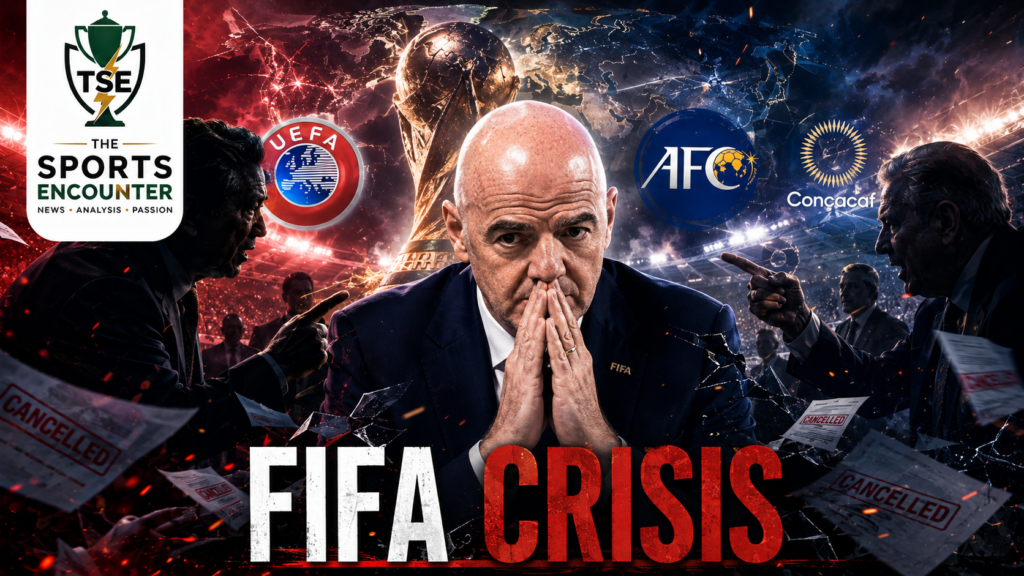
Gianni Infantino’s FIFA presidency has entered its most dangerous phase yet after three of world football’s six continental confederations jointly accused him of breaking trust “through deception” over the abandoned plan to sell a stake in the commercial rights to the World Cup.
UEFA, the Asian Football Confederation and CONCACAF issued an extraordinary open letter on August 10 demanding a fully independent investigation into how FIFA developed and pursued the proposal to sell 20 percent of the World Cup commercial business to private investors.
The language was unusually direct for organizations that remain formally inside FIFA’s governance structure.
They accused Infantino of placing himself above the collective authority that entrusted him with leadership.
They questioned the legitimacy of FIFA’s handling of the crisis.
They criticized last week’s emergency meeting in Morocco.
And while they stopped short of formally demanding a change of president, their message left little ambiguity about how badly the relationship has deteriorated.
“When trust is broken through deception, when an individual places himself above the collective that entrusted him with authority, that duty has been abandoned.”
The intervention follows nearly two weeks of escalating rebellion over Infantino’s failed attempt to separate part of FIFA’s most valuable commercial asset and sell a minority stake to private investors.
The proposed transaction was expected to raise approximately $4.2 billion from the sale of a 20 percent interest in World Cup commercial rights before FIFA abandoned the plan following resistance from member associations and confederations. :contentReference[oaicite:2]{index=2}
The Sports Encounter has been tracking the crisis from its beginning, including FIFA’s claim that critics were attempting to undermine Infantino, the earlier emergency effort to contain the fallout, and the growing revolt that has transformed a commercial-policy dispute into a question about who should lead world football.
What UEFA, AFC and CONCACAF Said
| Issue | Position of UEFA, AFC and CONCACAF |
|---|---|
| World Cup stake-sale proposal | They say the process represented a fundamental breach of trust |
| Infantino’s leadership | They accuse him of acting above the collective football structure |
| Review of the crisis | They demand a fully independent investigation with no FIFA control |
| Morocco emergency meeting | They criticize the lack of meaningful elected representation |
| Future FIFA proposals | They want guarantees that similar commercialization plans cannot be introduced without proper consultation |
| Potential response | Boycotts of FIFA competitions and alternative events are reportedly being considered |
This Is No Longer UEFA vs FIFA
That distinction may be the most important development in Monday’s letter.
UEFA has been the most visible center of resistance throughout the crisis.
Infantino spent years as UEFA’s general secretary before winning the FIFA presidency in 2016, and political friction between FIFA and European football has periodically accompanied his presidency.
A purely European rebellion could therefore have been framed as another institutional power struggle.
The AFC and CONCACAF signing the same letter changes the geometry.
Asia represents the largest confederation geographically and one of FIFA’s deepest pools of member associations.
CONCACAF governs North America, Central America and the Caribbean, the same region that just hosted the 2026 World Cup.
Their joint participation means the criticism now crosses continents, commercial markets and political blocs.
Three confederations are effectively telling FIFA’s president that confidence in the way he exercised authority has broken down. :contentReference[oaicite:3]{index=3}
The Words “Through Deception” Are the Real Breaking Point
Football organizations regularly disagree over money.
They disagree over competition calendars.
They fight over player release.
They dispute tournament formats and revenue distribution.
Calling the president of the world governing body deceptive belongs in a different category.
The wording attacks governance rather than policy.
If the dispute were only about whether selling 20 percent of World Cup commercial rights was financially wise, FIFA could change the proposal and continue.
The confederations are saying the problem lies in how authority was exercised.
That makes retreat much harder.
How a $4.2 Billion Commercial Plan Became a Leadership Crisis
The controversy began with a proposal to place World Cup commercial rights into a structure capable of attracting private investment.
FIFA explored selling approximately 20 percent of that commercial interest, with the transaction expected to raise around $4.2 billion.
Supporters of the concept could argue that monetizing part of the World Cup business might release capital for football development.
Opponents saw something much more fundamental.
The World Cup is FIFA’s most valuable global property.
Commercial rights from broadcasting, sponsorship and licensing provide the financial engine behind much of FIFA’s activity.
Giving private investors an ownership interest, even a minority position, raises difficult questions about control, future revenue, investor influence and whether football’s premier tournament should be treated as an asset capable of partial privatization.
The political problem intensified because confederations and national associations said they had not been adequately consulted.
FIFA eventually abandoned the plan after resistance grew. :contentReference[oaicite:4]{index=4}
Abandoning the Sale Did Not End the Crisis
This may have been Infantino’s biggest miscalculation.
Once FIFA withdrew the proposal, the organization appeared to believe the substantive problem had been removed.
Its critics had already moved beyond the proposal itself.
They wanted to know:
- Who developed the structure?
- Who authorized negotiations?
- Which advisers and investors were involved?
- How far had the process advanced?
- Why were major football stakeholders not fully consulted?
- What governance checks were used?
- Could a similar proposal be revived later?
Monday’s demand for an independent review shows that withdrawing the plan was no longer enough.
The Confederations Want FIFA Removed From the Investigation
That demand is particularly damaging institutionally.
UEFA, AFC and CONCACAF are not asking FIFA to review its own decision-making and report back.
They want an external process in which FIFA has no controlling role.
The implication is obvious.
They do not trust the institution under its current leadership to investigate itself credibly.
Reuters reports that the letter called for an inquiry into what the confederations described as a “profound failure of judgement.” :contentReference[oaicite:5]{index=5}
The Morocco Meeting Failed to Restore Trust
FIFA attempted to stabilize the situation during an emergency meeting in Morocco last week.
Infantino emerged from that gathering with public declarations of unity from parts of the FIFA structure.
The new letter directly challenges the legitimacy of that process.
UEFA, AFC and CONCACAF criticized the fact that only one elected official was reportedly present at the meeting.
That matters because FIFA’s governance is supposed to operate through elected associations, confederations, the FIFA Council and Congress.
A meeting dominated by executives or administrators cannot easily substitute for broad political consent.
The critics are effectively arguing that FIFA answered a crisis about excessive presidential authority with a meeting that reinforced the same concern. :contentReference[oaicite:6]{index=6}
FIFA Has Chosen Counterattack Rather Than Concession
FIFA’s response to the wider criticism has increasingly focused on the motives of Infantino’s opponents.
On August 8, the organization warned of what it described as a “concerted and ongoing effort” to undermine both FIFA and its president.
It argued that any challenge to leadership should take place through FIFA’s statutes and democratic procedures rather than media pressure or institutional maneuvering. :contentReference[oaicite:7]{index=7}
That defense creates a sharp divide.
FIFA’s position emphasizes electoral legitimacy.
The three confederations emphasize institutional trust and accountability between elections.
Those arguments are related but not identical.
A president can be democratically elected and still face a political revolt before his term ends.
Infantino’s 10-Year Presidency Is Now Part of the Argument
Infantino was first elected FIFA president on February 26, 2016, during the organization’s attempt to recover from the corruption crisis that had consumed the previous leadership. FIFA itself has repeatedly framed his presidency around reform, transparency and institutional rebuilding. :contentReference[oaicite:8]{index=8}
That history makes the current accusations especially damaging.
Infantino came to power promising that FIFA had learned from the governance failures of the past.
His critics are now using the language of trust, collective authority and independent oversight against him.
The political symbolism is difficult to miss.
From UEFA General Secretary to FIFA President
Infantino’s rise was closely connected to European football.
UEFA formally endorsed his FIFA candidacy in January 2016 when he was still its general secretary. :contentReference[oaicite:9]{index=9}
He won the FIFA presidency a month later after receiving 115 votes in the second ballot at the Extraordinary FIFA Congress in Zurich. :contentReference[oaicite:10]{index=10}
Ten years later, the organization that helped launch him into FIFA’s most powerful office has become the strongest institutional force challenging his authority.
That reversal gives the crisis an unusually personal political dimension.
The 2027 Election Changes Everything
Infantino has already announced that he intends to seek another term.
The election is scheduled for March 18, 2027, at the 77th FIFA Congress in Rabat, Morocco. :contentReference[oaicite:11]{index=11}
Until the stake-sale controversy, the question appeared to be how much opposition he might face.
The question is now whether a credible rival can consolidate the growing anti-Infantino coalition.
Lise Klaveness Has Become the Most Visible Potential Challenger
Norwegian Football Federation president Lise Klaveness took the conflict further on August 7 by publicly calling for Infantino to resign immediately.
She argued that he no longer possessed the institutional trust required to lead FIFA through the crisis. :contentReference[oaicite:12]{index=12}
Klaveness has long been one of the most outspoken governance critics in international football.
Her name is increasingly discussed as a possible presidential candidate.
That remains political speculation rather than a confirmed campaign.
The significance lies in the emergence of a recognizable figure around whom dissatisfied associations could theoretically organize.
Could UEFA, AFC and CONCACAF Actually Remove Infantino?
Not simply by issuing a letter.
FIFA’s president ultimately derives electoral authority from its 211 member associations, not directly from the confederations.
That distinction protects Infantino.
A confederation president can criticize him while some of that confederation’s individual national associations continue supporting him.
Reuters reports that this fragmentation already exists.
Mexico has publicly supported Infantino despite belonging to CONCACAF.
Several Asian federations also remain supportive despite the AFC joining the criticism.
CAF has issued backing on behalf of its African membership, while a number of South American associations have also publicly supported him. :contentReference[oaicite:13]{index=13}
The Numbers Still Give Infantino a Path
Reuters reports that almost 70 of FIFA’s 211 member associations have publicly indicated support for Infantino, while roughly a dozen have either withdrawn previous backing or said they will not vote for him. :contentReference[oaicite:14]{index=14}
That means neither side can claim the election is decided.
Public declarations are also not the same as secret ballots months from now.
Football politics can move quickly when funding, development programs, tournament access and confederation relationships enter the equation.
The Boycott Threat Could Be Far More Dangerous Than the Letter
Reuters reports that UEFA, AFC and CONCACAF have threatened to boycott FIFA tournaments unless they receive assurances that comparable commercialization schemes cannot be proposed again without proper consultation. :contentReference[oaicite:15]{index=15}
If implemented, that would create an unprecedented sporting crisis.
UEFA alone contains many of the world’s strongest national teams.
Add Asian nations and CONCACAF members and FIFA competitions could lose a massive share of their competitive and commercial value.
A boycott threat is easier to announce than execute.
National federations would face enormous pressure from players, broadcasters, sponsors and governments.
Still, its existence demonstrates how far relations have deteriorated.
The Possibility of Alternative Competitions Raises the Stakes Again
The three confederations are also reportedly examining whether competitions could be staged among themselves if the confrontation continues. :contentReference[oaicite:16]{index=16}
No formal breakaway tournament has been announced.
The idea alone matters.
FIFA’s authority rests heavily on its unique ability to organize globally recognized international competitions.
If confederations begin seriously designing alternatives, even as negotiating leverage, they challenge that monopoly.
Ironically, FIFA and the six confederations issued a joint statement in 2021 threatening sanctions against clubs and players involved in an unauthorized European Super League. That declaration emphasized the importance of recognized competition structures and football’s established pyramid. :contentReference[oaicite:17]{index=17}
Five years later, some of those same institutions are contemplating what football might look like if their relationship with FIFA becomes unworkable.
CONCACAF’s Position Is Particularly Awkward
CONCACAF’s involvement carries special political weight because the United States, Canada and Mexico just hosted the 2026 World Cup.
Infantino had spent years cultivating close relations throughout the region and publicly praised CONCACAF’s role in preparing the tournament.
As recently as September 2025, CONCACAF President Victor Montagliani publicly praised Infantino’s global leadership. :contentReference[oaicite:18]{index=18}
That makes CONCACAF joining an accusation of deception less easy to dismiss as longstanding hostility.
Asia’s Position Is More Complicated
The AFC signing the letter does not mean every Asian association has turned against Infantino.
Reuters specifically notes that several Asian nations continue to support him. :contentReference[oaicite:19]{index=19}
This distinction could become decisive in 2027.
Confederations can establish political direction.
Member associations cast FIFA presidential votes.
Infantino’s survival strategy may therefore depend on separating individual associations from the public position of their confederation leadership.
Africa Remains His Strongest Institutional Shield
CAF has publicly backed Infantino on behalf of its 54 members.
That is enormously important.
Africa represents roughly one quarter of FIFA’s entire voting membership.
A unified CAF bloc would give Infantino an enormous base before votes from Asia, CONCACAF, South America or Oceania are counted. :contentReference[oaicite:20]{index=20}
Whether all 54 associations ultimately vote as a bloc cannot be assumed.
The declaration nevertheless gives Infantino breathing room.
CONMEBOL Is Also Not Joining the Revolt
South America’s position further complicates any narrative that global football has unanimously rejected Infantino.
FIFA has highlighted supportive statements from CONMEBOL and individual South American federations.
Argentina, Paraguay, Ecuador and Bolivia were among those publicly backing the president during the latest round of controversy. :contentReference[oaicite:21]{index=21}
The result is a football world divided across and within confederations.
FIFA’s Crisis Is Becoming a Constitutional Test
The dispute increasingly asks a fundamental governance question.
How powerful should the FIFA presidency be?
FIFA’s Congress is officially the organization’s supreme legislative body.
The FIFA Council provides strategic oversight.
Confederations organize continental football.
National associations ultimately elect the president.
The stake-sale controversy has exposed tension between those formal structures and the practical authority accumulated around FIFA’s executive leadership.
The Independent Review Could Become the Decisive Battle
The commercial proposal itself is dead.
The investigation is now the battlefield.
If FIFA agrees to a genuinely external review, investigators could examine decision-making, consultation procedures, legal advice and commercial negotiations.
That carries obvious political risk for Infantino.
If FIFA refuses, critics can argue that the organization is unwilling to subject its leadership to independent accountability.
Neither option is comfortable.
The Crisis Has Also Become Entangled With Separate Allegations
FIFA’s increasingly defensive posture follows separate media reporting about payments made by UEFA to a former employee during Infantino’s time as UEFA general secretary.
Infantino has denied wrongdoing, and FIFA has rejected the allegations as unfounded and defamatory.
UEFA has confirmed that a payment was made but said it complied with staff policies in force at the time. :contentReference[oaicite:22]{index=22}
Those allegations are separate from the World Cup stake-sale dispute and should not be treated as proof of misconduct in the current governance crisis.
The political effect, however, is cumulative.
Infantino is now defending his leadership on several fronts simultaneously.
Why FIFA’s “Undermining” Argument May Not Be Enough
FIFA is correct about one narrow institutional point.
Presidential leadership ultimately changes through FIFA’s constitutional mechanisms.
Criticism alone does not remove a president.
The weakness in that defense is political.
An election does not eliminate the need for accountability between elections.
If three confederations representing a large share of world football believe trust has been broken, repeatedly pointing to electoral legitimacy may not repair the underlying relationship.
This Is the Biggest Test of Infantino’s Authority Since 2016
Infantino inherited a damaged FIFA.
The institution he took over was still recovering from one of the biggest corruption scandals in sports history.
His administration subsequently expanded competitions, increased development funding, built stronger commercial revenues and presided over the expansion of the World Cup.
FIFA’s own 10-year review credits his presidency with reform, transparency and development. :contentReference[oaicite:23]{index=23}
That record forms the strongest case his supporters can make.
The current crisis attacks the governance principle at the center of that legacy.
Infantino’s World Cup Success Has Not Protected Him
The timing is remarkable.
Only weeks ago, FIFA completed the expanded 48-team World Cup across the United States, Canada and Mexico.
Infantino had spent the tournament celebrating its scale, commercial value and global reach.
Earlier in 2026, he predicted an economic impact measured in tens of billions of dollars and described the tournament as the biggest sporting show on the planet. :contentReference[oaicite:24]{index=24}
A successful World Cup would normally strengthen a FIFA president approaching re-election.
Instead, the proposed commercialization of that same tournament’s future rights has become the threat to his presidency.
The Politics of the 2027 Vote Have Changed Completely
Before this crisis, Infantino could reasonably expect the advantages enjoyed by almost every incumbent FIFA president.
Development funding creates relationships.
Personal diplomacy matters.
Small associations possess the same presidential vote as football’s biggest countries.
Incumbents know those associations intimately.
Infantino has spent a decade building those ties.
Any challenger must now convert institutional anger into individual votes.
That is much harder than winning headlines.
What Happens If No Serious Challenger Emerges?
Infantino could survive even while relations with powerful confederations remain badly damaged.
That possibility should not be underestimated.
FIFA presidential elections are not popularity contests among European clubs, players or supporters.
They are elections among national football associations.
If opposition remains fragmented, Infantino could retain enough votes to win another term.
The result would leave FIFA with a president who had survived electorally while potentially losing the confidence of several of the organizations responsible for running continental football.
That could produce years of institutional conflict.
What Happens If the Opposition Finds One Candidate?
That is the scenario most dangerous to Infantino.
An opposition coalition requires:
- a credible candidate;
- support across more than Europe;
- a governance platform;
- assurances on development funding;
- support from smaller federations;
- an alternative commercial strategy;
- a guarantee that FIFA will not return to instability.
Criticism alone will not win the presidency.
A coalition needs a replacement capable of persuading associations that changing leadership will not threaten their financial or sporting interests.
Why Lise Klaveness Is Interesting but Not Yet the Answer
Klaveness possesses several characteristics that make her politically significant.
She is a serving federation president.
She has governance credibility.
She has been willing to challenge FIFA publicly.
She represents a break from the traditional profile of FIFA leadership.
None of that guarantees sufficient support outside Europe.
A successful FIFA candidate must build relationships throughout Africa, Asia, the Caribbean, Central America, Oceania and South America.
The contest would be global from the first day.
TSE Analysis: The Real Threat to Infantino Is Not the Letter. It Is the Coalition Behind It.
Presidents survive hostile statements all the time.
Infantino can dismiss criticism.
FIFA can attack the media.
CAF can reaffirm its support.
Individual associations can promise votes.
The dangerous development is institutional coordination.
UEFA alone has influence.
UEFA plus CONCACAF creates a transatlantic political bloc.
Add the AFC and opposition begins to resemble something capable of challenging FIFA’s internal balance.
The coalition remains incomplete.
Asia is divided.
CONCACAF is divided.
South America has not joined it.
Africa currently supports Infantino.
That is why describing him as finished would be premature.
Describing his authority as seriously damaged is increasingly difficult to avoid.
The Boycott Question Could Force a Resolution Before 2027
The election is seven months away.
Football may not be able to wait that long.
If UEFA, AFC and CONCACAF move from boycott threats to concrete action, the crisis becomes operational.
Players and national teams would immediately become involved.
Sponsors would demand clarity.
Broadcasters would confront contractual uncertainty.
Hosts of upcoming FIFA competitions would need answers.
That pressure could force compromise, resignation, an independent inquiry or some new governance arrangement long before the presidential vote.
FIFA Is Now Fighting for More Than Infantino
The organization’s credibility is also at stake.
FIFA has spent the post-2015 era insisting that governance reforms transformed the institution.
The current dispute tests whether those reforms work when the subject of scrutiny is the sitting president.
An independent system matters most when investigating powerful people.
If it only functions when power is not threatened, the reform claim becomes weaker.
What an Independent Review Would Need to Answer
| Question | Why It Matters |
|---|---|
| Who originated the World Cup investment proposal? | Establishes responsibility |
| How far did negotiations progress? | Shows whether it was exploratory or near execution |
| Which investors were approached? | Clarifies commercial interests |
| What authority approved the process? | Tests FIFA governance procedures |
| When were confederations informed? | Tests consultation claims |
| What financial assumptions supported the $4.2B valuation? | Tests the economic logic |
| Why was the proposal abandoned? | Determines whether governance or economics killed it |
| Could it be revived? | Central to boycott threats |
The Football World Is Divided, Not United Against Infantino
This is another important correction to some of the more dramatic interpretations of the crisis.
Three confederations have challenged him.
Others have not.
CAF is supporting him.
CONMEBOL has not joined the revolt.
Mexico has broken with CONCACAF’s wider line.
Several Asian associations have broken with the AFC position.
Nearly 70 FIFA member associations have publicly backed him, according to Reuters. :contentReference[oaicite:25]{index=25}
That is not institutional collapse.
It is a political war.
The Stakes Are Higher Because the World Cup Is FIFA’s Crown Jewel
If this dispute had emerged from a minor development program, it might never have threatened the presidency.
The World Cup changes everything.
Its commercial rights finance global football.
Its ownership carries symbolic weight.
Its revenues support FIFA’s development model.
Any proposal that allows private capital into that structure touches questions much bigger than corporate finance.
Who owns football’s biggest tournament?
Who controls its future revenues?
Who has authority to decide?
Those questions explain why the backlash became so intense.
What Comes Next?
The immediate pressure points are now clear.
- Whether FIFA accepts a fully independent review.
- Whether UEFA, AFC and CONCACAF formalize boycott plans.
- Whether alternative competitions move beyond preliminary discussion.
- Whether more national associations withdraw support for Infantino.
- Whether CAF and CONMEBOL remain behind him.
- Whether Lise Klaveness or another figure announces a presidential candidacy.
- Whether Infantino changes strategy from confrontation to reconciliation.
Each development will shape the 2027 election.
Final Verdict: Infantino Still Has the Votes to Fight, but He No Longer Controls the Political Narrative
Gianni Infantino has survived football politics for a decade.
He took control of FIFA when the organization was emerging from catastrophe.
He expanded its competitions.
He increased its commercial scale.
He oversaw the first 48-team World Cup.
He built relationships across FIFA’s 211 associations.
Those assets remain powerful.
Monday’s letter revealed the cost of the stake-sale crisis.
Three confederations no longer describe the issue as a disagreement over commercialization.
They describe it as a breach of trust.
They want FIFA excluded from the investigation.
They are discussing boycotts.
They are exploring alternative competitions.
And their language strongly suggests that confidence in Infantino personally has been damaged.
The president still possesses significant support.
He remains in office.
He remains a candidate for 2027.
Africa remains an important political base.
Parts of Asia, CONCACAF and South America continue backing him.
That means the presidency has not slipped from his hands.
The nature of the fight has changed.
The Sports Encounter’s assessment: Infantino is no longer facing isolated criticism. He is facing the early architecture of a multinational opposition coalition. Whether that coalition can turn institutional anger into enough FIFA votes will decide if the most serious crisis of his 10-year presidency becomes a temporary rebellion or the beginning of its end.
For official information on FIFA governance, competitions and the organization’s leadership structure, visit FIFA.
Frequently Asked Questions
Why are UEFA, AFC and CONCACAF criticizing Gianni Infantino?
The three confederations accuse the FIFA president of breaking institutional trust over the abandoned proposal to sell a 20 percent stake in World Cup commercial rights to private investors.
What did they accuse Infantino of?
Their open letter said trust had been broken “through deception” and accused an individual leader of placing himself above the collective football structure.
What was FIFA’s World Cup stake-sale proposal?
FIFA explored selling approximately 20 percent of the commercial rights business connected to the World Cup to private investors in a transaction expected to raise about $4.2 billion. The plan was later abandoned following opposition.
Has FIFA cancelled the proposal?
Yes. FIFA withdrew the stake-sale plan, but critics are now demanding an independent investigation into how it was developed and pursued.
What investigation do UEFA, AFC and CONCACAF want?
They are calling for a fully independent review in which FIFA would have no controlling role.
Are UEFA, AFC and CONCACAF calling for Infantino to resign?
The joint letter stops short of directly demanding his resignation, although its criticism of his leadership is severe. Norwegian federation president Lise Klaveness has separately called for him to step down.
Is Lise Klaveness running for FIFA president?
No confirmed candidacy has been announced in the sources reviewed. She is widely discussed as a possible challenger and has openly called for Infantino’s resignation.
When did Gianni Infantino become FIFA president?
Infantino was first elected on February 26, 2016 at the Extraordinary FIFA Congress in Zurich.
Is Gianni Infantino running for re-election?
Yes. He announced in April 2026 that he intends to stand in the 2027 FIFA presidential election.
When is the next FIFA presidential election?
The election is scheduled for March 18, 2027 during the 77th FIFA Congress in Rabat, Morocco.
Does Infantino still have support?
Yes. CAF has backed him, CONMEBOL has not joined the revolt, and several individual associations in Asia, CONCACAF and South America have also publicly supported him.
How many FIFA associations support Infantino?
Reuters reports that almost 70 of FIFA’s 211 associations have publicly indicated support, although that number could change before the 2027 election.
Could UEFA, AFC and CONCACAF boycott FIFA tournaments?
Reuters reports that the confederations have threatened to boycott FIFA competitions unless they receive assurances that similar commercialization plans will not be pursued without proper consultation.
Could they organize competitions outside FIFA?
The three confederations are reportedly examining that possibility, although no formal alternative tournament has been announced.
Why is this crisis so serious for FIFA?
It involves the World Cup, FIFA’s most valuable competition, and has expanded from a commercial dispute into a challenge over presidential authority, governance and institutional trust.