
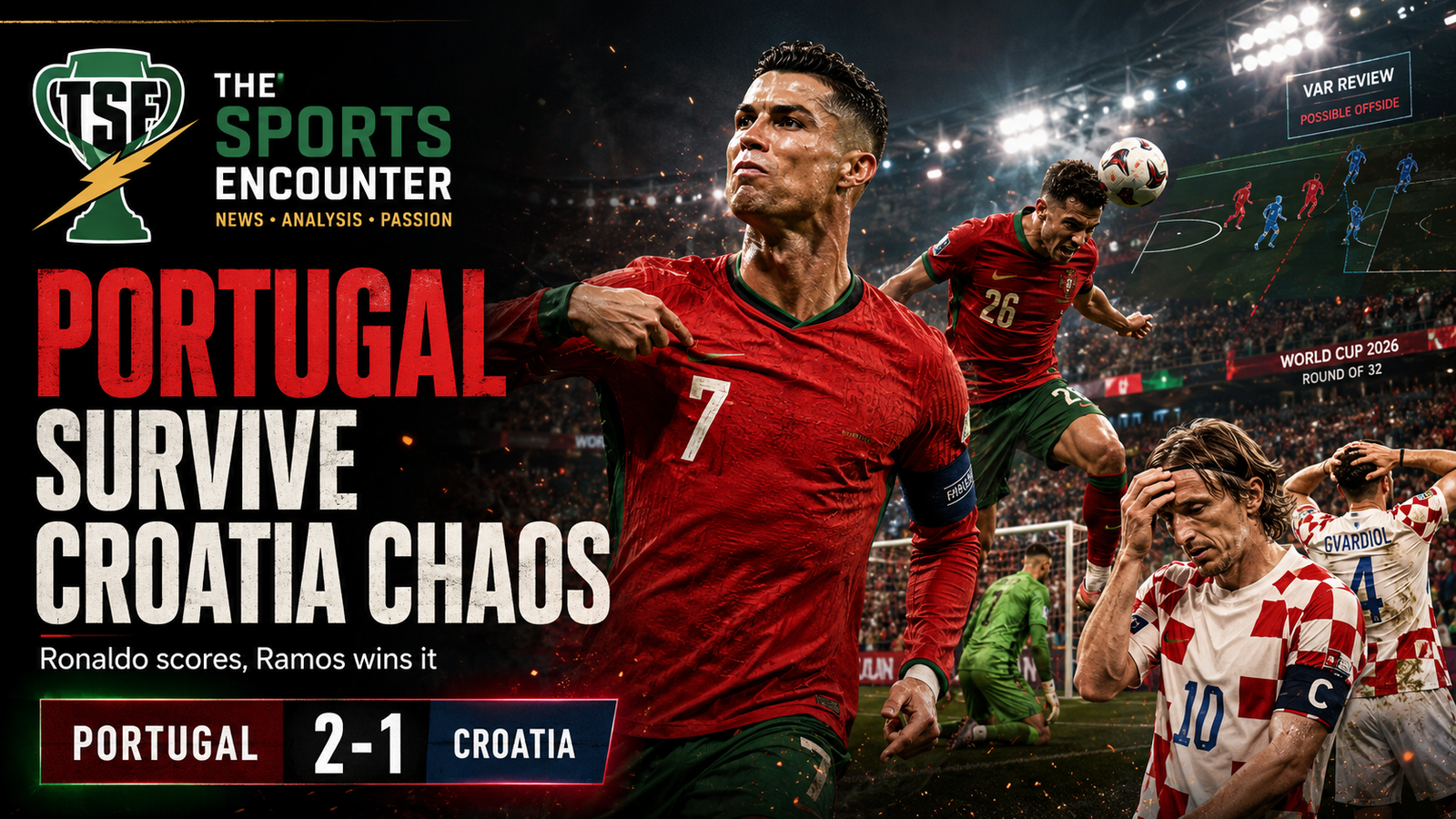
Portugal Edge Croatia After VAR Drama, Four Disallowed Goals and Late Ramos Winner
Portugal survived one of the wildest knockout matches of FIFA World Cup 2026, beating Croatia 2-1 after four disallowed goals, Ronaldo’s historic penalty, and Gonçalo Ramos’ stoppage-time winner set up a Round of 16 clash with Spain.

Toronto did not get a clean knockout match. It got tension, noise, disputed decisions, four disallowed goals, one Cristiano Ronaldo penalty, a Gonçalo Ramos rescue act, and a Croatian farewell that felt painful before the final whistle even settled.
Portugal beat Croatia 2-1 in a wild FIFA World Cup 2026 Round of 32 match that swung from control to panic and back again. Ivan Perišić gave Croatia the lead early in the second half. Ronaldo pulled Portugal level from the penalty spot in the 68th minute. Ramos then delivered the winner deep in stoppage time, heading Portugal into the Round of 16 and sending Croatia home from a tournament that may have closed Luka Modrić’s World Cup story.
Portugal now face Spain in the Round of 16, setting up one of the biggest knockout matches of the tournament. For full tournament context and related coverage, follow The Sports Encounter’s FIFA World Cup 2026 coverage hub and our preview of Portugal vs Croatia: Ronaldo and Modrić Walk Into One More World Cup Knife Edge.
Match Summary
| Detail | Information |
|---|---|
| Match | Portugal vs Croatia |
| Competition | FIFA World Cup 2026, Round of 32 |
| Venue | Toronto Stadium |
| Final Score | Portugal 2-1 Croatia |
| Croatia Scorer | Ivan Perišić 53’ |
| Portugal Scorers | Cristiano Ronaldo 68’ pen, Gonçalo Ramos 90+4’ |
| Key Moment | Ramos stoppage-time winner |
| Major Talking Point | Four disallowed goals and late VAR controversy |
| Next Match | Portugal vs Spain, Round of 16 |
| Red Cards | None |
| Yellow Cards | Rúben Dias, Luka Modrić, Ivan Perišić |
Portugal Start With Control, But Not Enough Damage
Portugal looked sharper in the first half than they had during parts of the group stage. Rafael Leão gave them speed on the left, Pedro Neto kept asking questions from the right, and Bruno Fernandes found pockets where Croatia had to keep shifting across the pitch.
The problem was familiar: Portugal had possession and territory, but not enough clean punishment.
Neto repeatedly delivered dangerous balls into the box. Ronaldo hovered between center-backs, waiting for the one cross that would drop perfectly. Fernandes got looks at goal. Leão carried threat with every direct run. Still, Croatia survived the pressure because Portugal’s final contact kept missing the required sharpness.
That gave Croatia exactly what they needed: time.
Zlatko Dalić’s team did not dominate the opening half, but it stayed alive. Croatia absorbed pressure, trusted its experienced core, and waited for the match to slow down enough for Modrić, Mateo Kovačić, and Perišić to influence it.
Croatia Strike First and Change the Mood
Croatia came out after halftime with better energy and more courage. Dalić changed the tone by introducing Igor Matanović, and Croatia suddenly looked more direct, more aggressive, and more willing to attack Portugal’s defensive spaces.
The breakthrough came in the 53rd minute. Josip Stanišić sent the ball across from the right, and Perišić arrived at the back post with the calm of a player who has lived through too many major tournament nights to panic. His finish beat Diogo Costa and gave Croatia a 1-0 lead.
For a few minutes, Portugal looked rattled.
Croatia thought they had another when Matanović finished clinically, only for the offside flag to cut the celebration short. Petar Sučić then forced Costa into an important save. Portugal had controlled much of the first half, but Croatia’s second-half surge gave the game a different smell.
This was no longer Portugal managing a knockout tie. This was Portugal trying to avoid another painful exit.
Ronaldo’s Night: Historic Goal, Limited Influence, Big Debate
Cristiano Ronaldo finally got his World Cup knockout goal.
His 68th-minute penalty made it 1-1, and the moment carried history. At 41, Ronaldo became the oldest player to score in a World Cup knockout match. It was also his first goal in the knockout stage of the tournament, a strange missing piece in a career stacked with records.
The finish was cold. Ronaldo stepped up, sent Dominik Livaković the wrong way, and brought Portugal level.
Yet the rest of his performance needs a balanced reading. Ronaldo still gave Portugal penalty-box gravity. Croatia had to know where he was. But his overall involvement remained limited, and Reuters reported that the penalty was his only touch inside the opposition box before Roberto Martínez substituted him late in the game.
That substitution will be debated, but it worked. Martínez replaced Ronaldo with Rúben Neves to stabilize a midfield that had lost control for stretches of the second half. Ramos later scored the winner. Portugal advanced. The coach got the result.
Was Ronaldo’s Disallowed Goal the Wrong Call?
Ronaldo also had a goal ruled out before his penalty. He controlled a ball over the top and lifted it beyond Livaković, but the assistant’s flag went up for offside and VAR upheld the decision.
From some replay angles, the call looked extremely tight. Many fans felt Ronaldo had timed his run well. That is why the moment has already become one of the major talking points of the match.
Still, as per expert opinion, it cannot be called a confirmed wrong decision. The offside check stood, and live reports stated that VAR confirmed Ronaldo was just beyond the last defender when the pass came.
That does not mean the controversy will disappear. In a match packed with disallowed goals, every marginal call felt bigger than the last.
Was This the World Cup Match With the Most Disallowed Goals?
Yes, based on available post-match reporting, this was an extraordinary outlier.
The Guardian reported that Portugal vs Croatia had four disallowed goals, the first time in World Cup history that a match featured that total. Croatia had the most painful one at the end, when Joško Gvardiol appeared to score a last-second equalizer. VAR ruled it out for offside after the ball touched Matanović on the way through, placing Gvardiol in an offside position.
That decision triggered anger from Croatia’s players, staff, and fans. Bottles reportedly came onto the pitch after the final ruling. Dalić later criticized the refereeing but also admitted Croatia could not use it as an excuse.
The emotional truth for Croatia is simple: they were close enough to believe, but not clean enough to survive.
Ramos Steps Into the Moment
Ramos entered the match with Portugal needing legs, movement, and a different reference point in the box. In stoppage time, he gave them everything.
Leão created the chance from the left, and Ramos attacked the delivery with the hunger of a forward who knew the entire tie had opened for one second. His header in the 90+4th minute gave Portugal a 2-1 lead and turned Martínez’s late changes from a gamble into a winning decision.
It was not a perfect Portugal performance. Far from it. But knockout football often rewards teams that keep one more punch in reserve.
Ramos supplied it.
Croatia Leave With Pride, Pain and a Closing Era
Croatia’s exit hurts because they showed enough in the second half to imagine another outcome.
Perišić was excellent after halftime. Sučić gave them energy. Matanović changed the physical profile of the attack. Modrić, at 40, still tried to pull Croatia through the storm with rhythm and nerve.
But this may be the end of Croatia’s golden World Cup generation. They reached the 2018 final, finished third in 2022, and built one of the most respected tournament identities in modern football. In 2026, they leave without a medal and with the frustration of a match that felt decided by inches, reviews, and missed control.
For more Croatia context, read The Sports Encounter’s earlier feature on how Croatia found their knockout pulse as Ghana survived defeat.
Cards and Discipline
Portugal had one confirmed yellow card, with Rúben Dias booked in the 17th minute for a foul on Ante Budimir.
Croatia had two confirmed yellow cards. Luka Modrić was booked in the 59th minute, and Ivan Perišić received a late yellow card in stoppage time.
No red cards were confirmed in the available match-feed data.
What Comes Next for Portugal?
Portugal move into a Round of 16 clash with Spain, and that match will test them in a very different way.
Spain’s 3-0 win over Austria showed control, width, pressing discipline, and a sharper edge in the final third. Portugal have more individual knockout experience, but Spain look more balanced right now. Ronaldo’s role, Ramos’ impact, Leão’s direct running, and Martínez’s timing with substitutions will all sit under a brighter spotlight.
For related reading, see The Sports Encounter’s coverage of Spain finally breaking their World Cup knockout curse and our latest World Cup 2026 match reports.
Portugal survived Croatia. Spain will ask tougher questions.
The Sports Encounter’s World Cup 2026 coverage focuses on fixtures, team news, match analysis, fan stories, tournament trends, and the biggest talking points from football’s global stage.




Breaking News
South Africa Beat Zimbabwe by 43 Runs as Pretorius’ 94 and Fortuin Four-For Take Control of Tri-Series Race
Lhuan-dre Pretorius smashed 94 from 51 balls before Bjorn Fortuin claimed 4/24 as South Africa defeated Zimbabwe by 43 runs in Windhoek and strengthened their position in the Namibia T20I Tri-Series.

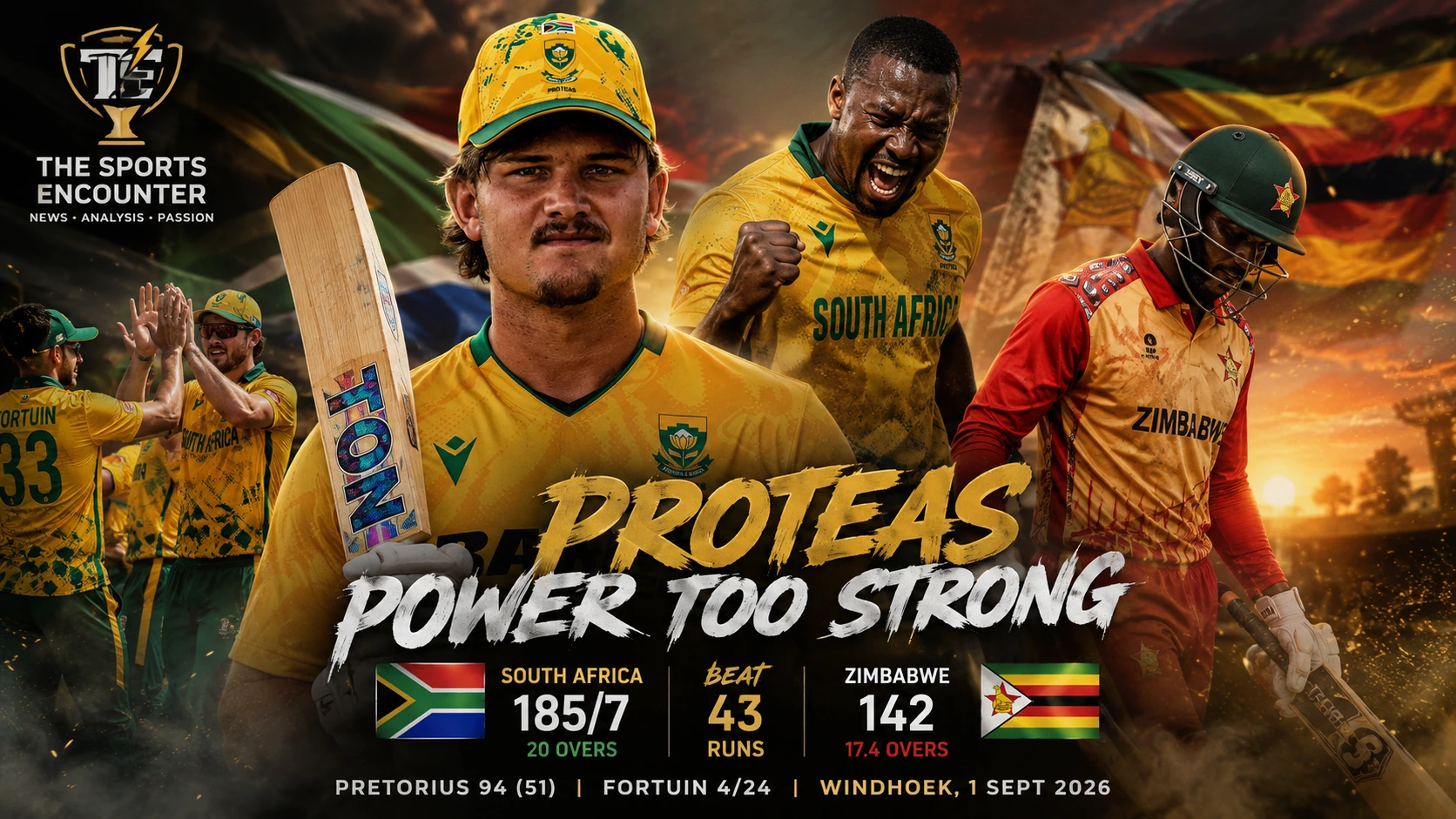
Lhuan-dre Pretorius fell six runs short of his maiden T20I century, but South Africa still found more than enough elsewhere to beat Zimbabwe by 43 runs in Windhoek and move into a commanding position in the 2026 Namibia T20I Tri-Series.
Pretorius hammered 94 from 51 balls as South Africa reached 185 for seven after choosing to bat at the Namibia Cricket Ground on September 1. Zimbabwe then collapsed to 54 for seven before Sikandar Raza’s 45 and resistance from the lower order dragged them to 142 in 17.4 overs.
Bjorn Fortuin finished with a career-best 4 for 24 and Duan Jansen took 3 for 21 as South Africa completed their second victory over Zimbabwe in three days.
The scoreline looks comfortable. The match itself revealed something more useful about both teams.
South Africa left runs on the field after appearing capable of passing 200, yet their bowlers made that wastefulness irrelevant. Zimbabwe did the opposite. Their bowlers recovered superbly at the death, only for another top-order collapse to leave Raza and the tail trying to rescue a chase that had effectively been lost inside eight overs.
That imbalance, rather than the final 43-run margin, explains why the two sides are leaving Windhoek with very different problems to solve.
By The Sports Encounter Editorial Desk
Published: September 1, 2026
Updated: September 1, 2026
South Africa vs Zimbabwe: Match 4 at a Glance
| Match Detail | Information |
|---|---|
| Competition | Namibia T20I Tri-Series 2026 |
| Match | Zimbabwe vs South Africa, Match 4 |
| Date | September 1, 2026 |
| Venue | Namibia Cricket Ground, Windhoek |
| Toss | South Africa won the toss and elected to bat |
| South Africa | 185/7 in 20 overs |
| Zimbabwe | 142 all out in 17.4 overs |
| Result | South Africa won by 43 runs |
| Player of the Match | Lhuan-dre Pretorius, 94 from 51 balls and 2 catches |
| Best Bowling | Bjorn Fortuin, 4/24 |
| Zimbabwe Top Scorer | Sikandar Raza, 45 from 33 balls |
| Points | South Africa 2, Zimbabwe 0 |
The result gives South Africa two wins from three matches after their campaign began with a surprising defeat to Namibia. The ICC’s official post-match report confirmed that South Africa now sit on two victories, while Zimbabwe and Namibia each have one.
The tournament has been more competitive than the Full Member labels might suggest. Our complete South Africa-Zimbabwe-Namibia tri-series preview highlighted before the opening match that all three teams entered Windhoek with very different strengths and vulnerabilities.
Pretorius Finally Turned a Start Into Something Substantial
South Africa’s first two matches had offered glimpses of Lhuan-dre Pretorius without giving him the innings his talent had threatened.
This time, he stayed.
Pretorius and Jordan Hermann attacked the powerplay without turning it into a reckless six-over sprint. South Africa reached 59 without loss after six overs and moved to 68 before Hermann was dismissed for 28 from 25 balls.
Pretorius reached his half-century from 27 deliveries.
More importantly, he kept going.
Dewald Brevis arrived and immediately increased the pressure on Zimbabwe. The pair added 86 for the second wicket, moving South Africa from 68 for one to 154 for two.
Brevis struck 41 from 27 balls with two fours and three sixes before Brad Evans removed him.
That innings extended an excellent individual tournament for a batter who had already carried South Africa with 75 when Namibia stunned the Proteas in the opening match.
Brevis also arrived in Namibia after a productive franchise spell. Earlier in August, he struck an unbeaten 55 at Lord’s as London Spirit overwhelmed Birmingham Phoenix.
Pretorius, however, owned this innings.
He scored 94 from 51 deliveries at a strike rate of 184.31, hitting 12 fours and three sixes.
Fifteen boundaries meant 66 of his 94 runs came without requiring Zimbabwe’s fielders to complete a play.
He also occupied enough time to allow South Africa’s other hitters to attack around him.
The Missing Century Should Not Hide Pretorius’ Biggest Improvement
The most interesting part of Pretorius’ innings came in his explanation afterward.
He said Heinrich Klaasen had spoken to him earlier in the day and encouraged him to give himself around 15 deliveries because his scoring ability would allow him to recover the tempo later.
That advice could prove more valuable to Pretorius than the six runs separating him from a century.
His hitting power has never been particularly difficult to identify. The harder challenge for young attacking batters is learning that T20 aggression does not require every phase of an innings to be played at maximum speed.
Pretorius demonstrated that balance here.
He still scored at 184.31.
Yet his innings lasted 51 balls.
Those two numbers together tell the story better than the missed hundred.
His ability to sustain an innings was also evident earlier this year in franchise cricket. Pretorius produced another aggressive fifty when MI London faced London Spirit at Lord’s, but international cricket increasingly requires him to convert those bursts into match-defining innings.
Against Zimbabwe, he did.
Zimbabwe’s Final Five Overs Prevented a 200-Plus Total
South Africa were 154 for one early in the 16th over.
A total beyond 200 looked entirely realistic.
Zimbabwe’s bowlers changed the final shape of the innings.
Brevis fell for 41. Connor Esterhuizen made two. Rubin Hermann managed one. Eathan Bosch scored three. Pretorius eventually departed for 94 at the end of the 19th over.
South Africa lost six wickets for 31 runs after reaching 154 for one.
Wessly Madhevere produced the best spell of his T20I career, taking 3 for 20 from three overs.
He removed Jordan Hermann, Rubin Hermann and Bosch and gave Zimbabwe exactly the kind of middle-to-late-innings intervention they needed.
Evans added 2 for 33, including the wickets of Brevis and Pretorius, while Newman Nyamhuri conceded only five from the final over.
Zimbabwe captain Sikandar Raza was right to highlight that phase afterward.
His bowlers had faced two set South African batters and the realistic prospect of chasing well above 200. Instead, they restricted the target to 186.
That should have given Zimbabwe a genuine route into the match.
Zimbabwe Lost the Chase Before Raza Could Properly Begin It
A target of 186 at Windhoek required aggression.
It did not require seven wickets to disappear for 54 runs.
Ben Curran fell for four in the second over.
Brian Bennett made 13 before Fortuin removed him at 33 for two.
Two deliveries later, Madhevere departed for a duck.
Innocent Kaia briefly counterattacked with 18 from 11 balls, but Jansen bowled him to leave Zimbabwe 43 for four.
The next passage destroyed the chase.
Ryan Burl made one.
Tadiwanashe Marumani was trapped lbw first ball.
Brad Evans scored two.
Zimbabwe were suddenly 54 for seven after 8.1 overs.
That collapse was particularly frustrating because only 24 hours earlier, Zimbabwe had shown the opposite quality during their five-run thriller against Namibia.
In that match, Burl and Evans rebuilt the innings after Zimbabwe had fallen to 101 for six, adding an unbeaten 94 for the seventh wicket before the bowlers survived Namibia’s remarkable late response.
Against South Africa, no comparable partnership arrived early enough.
Bjorn Fortuin Found the Wickets Zimbabwe Could Least Afford
Fortuin did more than collect four wickets.
He removed batters at moments when Zimbabwe were trying to establish some form of control.
Bennett was the first.
Madhevere followed almost immediately.
Raza was the crucial wicket.
By then Zimbabwe were effectively playing for survival, but their captain had begun to give the innings some shape.
Raza struck five fours and two sixes during his 45 from 33 balls.
He was Zimbabwe’s only top-order batter to remain long enough to put sustained pressure back on South Africa.
Fortuin eventually had him stumped by Connor Esterhuizen at 105 for nine.
The South African captain completed figures of 3.4 overs, one maiden, four wickets for 24 runs.
Those were career-best T20I figures.
His performance also carried extra weight because South Africa are using this tournament to test leadership and depth. As our tri-series preview explained, Fortuin has been entrusted with an experimental squad rather than merely handed a ceremonial captaincy.
Duan Jansen Broke the Middle of Zimbabwe’s Batting Order
Fortuin produced the headline bowling figures, but Duan Jansen damaged the section of Zimbabwe’s innings from which a recovery might otherwise have begun.
His first wicket was Kaia.
Then came consecutive wickets in his second over.
Burl was caught and bowled for one before Marumani was trapped lbw from the next delivery.
Jansen finished with 3 for 21 from four overs at an economy rate of 5.25.
That spell meant Zimbabwe could never establish the Raza-Burl combination they would have wanted through the middle overs.
South Africa’s attack also shared responsibility well.
Prenelan Subrayen dismissed Curran. Nqabayomzi Peter removed Evans. Kwena Maphaka went wicketless but provided four overs of left-arm pace around the wicket-taking spells elsewhere.
For a South African squad missing many established internationals, that distribution of responsibility is one of the more useful outcomes of this tournament.
Raza and Zimbabwe’s Tail Made the Score Respectable
Zimbabwe could easily have disappeared for fewer than 100.
Instead, the final four batters added enough resistance to turn a possible humiliation into a 43-run defeat.
Wellington Masakadza made 11 from seven before being run out.
Newman Nyamhuri then provided the most substantial lower-order contribution with 27 from 25 balls.
He and Raza added 39 for the ninth wicket, carrying Zimbabwe from 66 for eight to 105 for nine.
Debutant Kundai Matigimu then joined Nyamhuri for another 37 runs for the final wicket.
Matigimu finished unbeaten on 11 from seven deliveries, including a six.
Nyamhuri was eventually caught by Bosch off Fortuin for 27, ending the innings at 142 after 17.4 overs.
Those late runs did not seriously threaten South Africa, but they may matter in a tournament where net run rate can still influence qualification.
Raza also took encouragement from the mentality shown by his lower order.
Zimbabwe have demonstrated similar resilience before. During their July series against Bangladesh, they opened with a 32-run victory built around another collective bowling performance, although their batting inconsistency returned when Bangladesh leveled that series in the second T20I.
The pattern remains recognizable in Windhoek. Zimbabwe can produce excellent passages of cricket. Connecting those passages across 40 overs remains the problem.
South Africa Are Strong Favorites for the Final, But Qualification Is Not Yet Mathematically Certain
There is one important qualification detail worth clearing up.
Post-match commentary suggested South Africa had already secured their place in the September 6 final.
The current standings do not make that mathematically certain yet.
South Africa have four points from three matches.
Zimbabwe have two points from three.
Namibia have two points from two.
The official ICC tournament schedule confirms that Namibia still have league matches remaining against both Zimbabwe and South Africa.
A scenario remains possible in which all three teams finish on four points. Net run rate would then become decisive.
South Africa’s 43-run victory therefore carries additional value because it improves their position substantially without yet making every possible permutation irrelevant.
Zimbabwe’s task is much clearer.
They must beat Namibia in their final league match and then watch the remaining result and net run rate.
Namibia still control their own route because they have two matches left.
That keeps alive the competitive balance that made their earlier victory over South Africa and Zimbabwe’s subsequent win over Namibia so important.
South Africa Have Changed the Story of Their Tournament
The opening defeat to Namibia created an immediate question around this South African squad.
They were young, missing many established stars and had just been beaten for the second time in two men’s T20Is against their northern neighbors.
Three days later, the tournament looks very different.
South Africa have beaten Zimbabwe twice.
Brevis has produced consistently destructive batting.
Pretorius has now converted his talent into a career-best international innings.
Fortuin and Jansen have produced career-best bowling figures.
The younger players are taking responsibility rather than waiting for absent senior names to define the team.
That development is especially relevant because these three countries will jointly host the 2027 ODI World Cup. The tournament is part of a broader attempt to increase meaningful African international cricket, something the ICC and the three national boards have openly supported.
The Sports Encounter has been following that wider story throughout the series, from our broader examination of international cricket through the Celebration of 5000 ODIs project to the emerging regional competition in Windhoek.
South Africa’s squad may be experimental.
The lessons coming from it are becoming increasingly serious.
Full South Africa Batting Scorecard
| Batter | Runs | Balls | 4s | 6s | Strike Rate |
|---|---|---|---|---|---|
| Lhuan-dre Pretorius | 94 | 51 | 12 | 3 | 184.31 |
| Jordan Hermann | 28 | 25 | 1 | 2 | 112.00 |
| Dewald Brevis | 41 | 27 | 2 | 3 | 151.85 |
| Connor Esterhuizen | 2 | 3 | 0 | 0 | 66.66 |
| Rubin Hermann | 1 | 3 | 0 | 0 | 33.33 |
| Eathan Bosch | 3 | 3 | 0 | 0 | 100.00 |
| Duan Jansen | 3* | 4 | 0 | 0 | 75.00 |
| Bjorn Fortuin | 2 | 4 | 0 | 0 | 50.00 |
| Extras | 11 | 1 bye, 5 leg byes, 5 wides | |||
| Total | 185/7 in 20 overs | ||||
Zimbabwe Bowling
| Bowler | Overs | Runs | Wickets | Economy |
|---|---|---|---|---|
| Wessly Madhevere | 3 | 20 | 3 | 6.66 |
| Brad Evans | 4 | 33 | 2 | 8.25 |
| Newman Nyamhuri | 4 | 30 | 1 | 7.50 |
| Sikandar Raza | 4 | 36 | 0 | 9.00 |
| Kundai Matigimu | 2 | 29 | 0 | 14.50 |
| Wellington Masakadza | 3 | 31 | 0 | 10.33 |
Full Zimbabwe Batting Scorecard
| Batter | Runs | Balls | 4s | 6s | Strike Rate |
|---|---|---|---|---|---|
| Brian Bennett | 13 | 8 | 1 | 1 | 162.50 |
| Ben Curran | 4 | 6 | 1 | 0 | 66.66 |
| Innocent Kaia | 18 | 11 | 1 | 1 | 163.63 |
| Wessly Madhevere | 0 | 2 | 0 | 0 | 0.00 |
| Sikandar Raza | 45 | 33 | 5 | 2 | 136.36 |
| Ryan Burl | 1 | 3 | 0 | 0 | 33.33 |
| Tadiwanashe Marumani | 0 | 1 | 0 | 0 | 0.00 |
| Brad Evans | 2 | 3 | 0 | 0 | 66.66 |
| Wellington Masakadza | 11 | 7 | 2 | 0 | 157.14 |
| Newman Nyamhuri | 27 | 25 | 1 | 1 | 108.00 |
| Kundai Matigimu | 11* | 7 | 0 | 1 | 157.14 |
| Extras | 10 | 2 byes, 8 wides | |||
| Total | 142 all out in 17.4 overs | ||||
South Africa Bowling
| Bowler | Overs | Runs | Wickets | Economy |
|---|---|---|---|---|
| Bjorn Fortuin | 3.4 | 24 | 4 | 6.54 |
| Duan Jansen | 4 | 21 | 3 | 5.25 |
| Prenelan Subrayen | 2 | 22 | 1 | 11.00 |
| Nqabayomzi Peter | 2 | 29 | 1 | 14.50 |
| Kwena Maphaka | 4 | 33 | 0 | 8.25 |
| Eathan Bosch | 2 | 11 | 0 | 5.50 |
What Comes Next in the Namibia T20I Tri-Series?
Zimbabwe next face Namibia in a match that could determine whether Raza’s side remains alive in the final race.
South Africa still have one league match remaining against Namibia.
The final will be played in Windhoek on September 6 between the top two teams after the double round-robin stage.
South Africa are now in the strongest position.
Zimbabwe still have a route.
Namibia still have control over theirs.
Four matches have therefore produced exactly what this tournament needed: three teams still carrying something meaningful into the closing phase.
Frequently Asked Questions
Who won South Africa vs Zimbabwe in the Namibia T20I Tri-Series 2026?
South Africa defeated Zimbabwe by 43 runs in Windhoek on September 1, 2026.
What was the South Africa vs Zimbabwe final score?
South Africa scored 185 for seven from 20 overs. Zimbabwe were bowled out for 142 in 17.4 overs while chasing 186.
How many runs did Lhuan-dre Pretorius score against Zimbabwe?
Pretorius scored a career-best 94 from 51 balls, hitting 12 fours and three sixes at a strike rate of 184.31.
Who was Player of the Match in South Africa vs Zimbabwe?
Lhuan-dre Pretorius was named Player of the Match for his 94 from 51 balls. He also took two catches during Zimbabwe’s chase.
What were Bjorn Fortuin’s bowling figures?
Fortuin took a career-best four wickets for 24 runs from 3.4 overs, including the wickets of Brian Bennett, Wessly Madhevere, Sikandar Raza and Newman Nyamhuri.
How many wickets did Duan Jansen take?
Duan Jansen claimed three wickets for 21 runs from four overs. His wickets were Innocent Kaia, Ryan Burl and Tadiwanashe Marumani.
How many runs did Sikandar Raza score?
Zimbabwe captain Sikandar Raza top-scored for his team with 45 from 33 balls, including five fours and two sixes.
Did Wessly Madhevere take three wickets?
Yes. Madhevere produced career-best T20I bowling figures of three wickets for 20 runs from three overs as Zimbabwe restricted South Africa to 185 after the Proteas had threatened a total beyond 200.
Have South Africa qualified for the tri-series final?
South Africa are in a very strong position with four points from three matches, but the official ICC standings after this match still leave a mathematical scenario in which all three teams can finish on four points. Net run rate could therefore still become relevant.
When is the Namibia T20I Tri-Series final?
The final is scheduled for September 6, 2026, at the Namibia Cricket Ground in Windhoek. The top two teams after the double round-robin league stage will qualify.
Breaking News
Man City Agree £125m Enzo Fernández Deal as Deadline Day Redraws Premier League’s Midfield Power
Manchester City have agreed a £125 million fee with Chelsea for Enzo Fernández in a deadline-day move that would equal the British transfer record and reshape the Premier League title race.

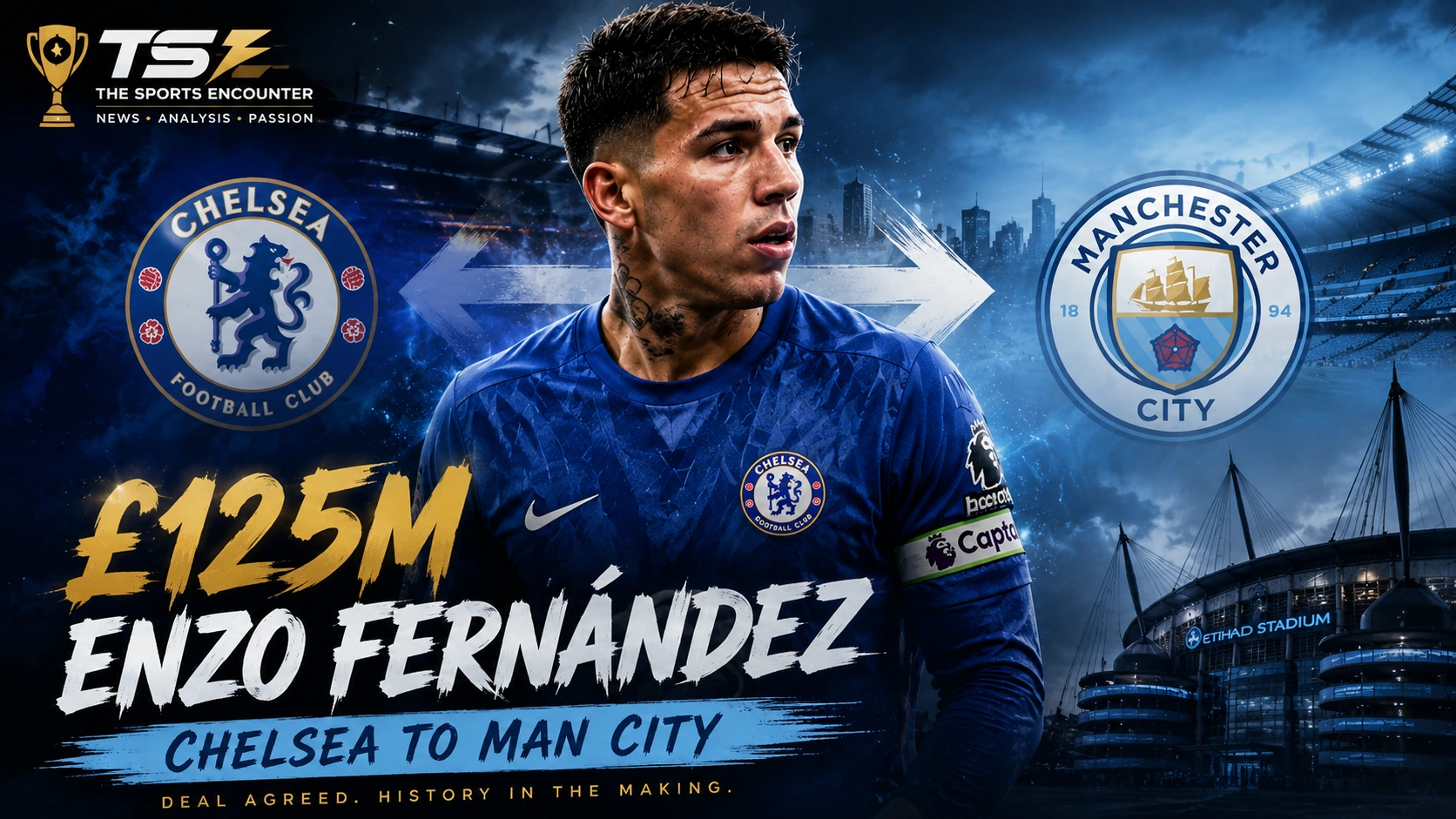
Manchester City have agreed a £125 million fee with Chelsea for Enzo Fernández in a deadline-day move that would equal the British transfer record and take one of Chelsea’s most influential midfielders directly to a Premier League title rival.
The agreement has cleared the biggest financial obstacle to the Argentina international moving to the Etihad Stadium before the summer transfer window closes at 11:00 PM BST on September 1. Formal completion and club confirmation remained pending at the time of publication.
The fee would match the £125 million Liverpool paid Newcastle United for Alexander Isak and move Fernández above Morgan Rogers, Florian Wirtz and Elliot Anderson among the most expensive transfers in Premier League history.
Yet the more interesting part of the deal sits beyond another enormous number.
City are rebuilding the center of their team after losing the midfield structure that defined the final years of the Pep Guardiola era. Chelsea, meanwhile, are preparing to sell a player who produced 15 goals and seven assists in all competitions last season after spending heavily themselves on Morgan Rogers and another wave of young talent.
Deadline day has therefore produced something more consequential than a superstar changing shirts. One Premier League contender is transferring proven midfield control directly to another.
By The Sports Encounter Editorial Desk
Published: September 1, 2026
Updated: September 1, 2026
Enzo Fernández to Manchester City: Deal at a Glance
| Detail | Current Position |
|---|---|
| Player | Enzo Fernández |
| Age | 25 |
| Current club | Chelsea |
| Destination | Manchester City |
| Agreed fee | £125 million |
| Reported dollar value | Approximately $169 million |
| Record position | Would equal British transfer record |
| Current status | Fee agreed, formal completion pending |
| Manchester City manager | Enzo Maresca |
| Chelsea manager | Xabi Alonso |
| Premier League transfer deadline | September 1, 11:00 PM BST |
The Premier League officially confirms that the 2026 summer transfer window closes at 11:00 PM BST on September 1. Clubs that reach an agreement close to the deadline can submit a deal sheet and receive additional time to complete certain documentation.
£125 Million Buys City Something Their Midfield Has Been Missing
Manchester City’s interest makes considerably more sense when viewed through what has happened to their midfield over the past few months.
Rodri left for Barcelona after one of the most decorated spells of any midfielder in Premier League history. The Sports Encounter examined the scale of that departure in our analysis of Rodri leaving Manchester City after winning 14 major trophies.
Bernardo Silva has also departed, removing another player who understood how to manipulate pressure, slow matches down, speed them up and keep City’s positional structure intact.
Those departures created a problem that could never realistically be solved with one direct replacement.
City responded by spending heavily on Elliot Anderson and adding 18-year-old Ayyoub Bouaddi from Lille. Anderson brought Premier League experience, ball recovery and progression. Bouaddi gives Maresca a technically gifted midfielder whose ceiling could be exceptionally high.
Fernández offers something between those profiles.
He is 25, already accustomed to the Premier League, experienced in Champions League football and comfortable receiving possession when opponents press aggressively. He can operate deeper, move forward into attacking positions and play through pressure rather than simply circulating the ball around it.
That flexibility matters for Maresca.
The early weeks of the season have already shown him experimenting with City’s midfield structure. During the 4-1 victory over Crystal Palace, Marc Guéhi operated unusually high alongside Anderson as City distributed the responsibilities once concentrated around Rodri.
Fernández would give Maresca another way to solve that problem without asking one midfielder to imitate Rodri.
The Maresca Connection Makes This More Than a Deadline-Day Gamble
Fernández would also be working with a manager who already knows his game.
Maresca coached Chelsea during the 2024/25 season and moved Fernández into more advanced areas rather than restricting him to the base of midfield.
The effect was significant.
Fernández finished that campaign with nine goals and 17 assists in all competitions. Last season, he followed with 15 goals and seven assists, making him Chelsea’s second-highest scorer behind João Pedro.
Across the 2024/25 and 2025/26 seasons combined, Fernández produced 24 goals and 24 assists.
Those numbers challenge the older idea of Fernández as primarily a deep-lying distributor.
Maresca has already seen how dangerous he can become when given permission to arrive around the penalty area instead of beginning every attack from beside the center-backs.
At City, the question becomes where those attacking instincts fit alongside Phil Foden, Rayan Cherki, Elliot Anderson and Erling Haaland.
City have enough creators.
What Fernández potentially adds is a midfielder capable of linking the first phase of possession with the final one while surviving the physical intensity between them.
That is why this transfer has more tactical logic than the headline fee initially suggests.
Manchester City’s Summer Has Become a Complete Midfield Reset
The scale of City’s recruitment would have seemed extraordinary even by their standards a few years ago.
Anderson arrived for a reported £116 million. Bouaddi followed in another major deal. Fernández would now cost £125 million.
Those three midfield moves alone underline how aggressively City have responded to the end of the Guardiola era.
The Sports Encounter’s ranking of the Premier League’s most expensive transfers already contained Anderson among the top five.
Fernández would enter the list at the very top alongside Isak.
That also means City would have two players among the most expensive midfielders English football has ever seen operating in the same rebuild.
The strategy carries obvious risk.
Large fees compress patience. Anderson cannot spend two years slowly becoming comfortable at City. Fernández would arrive with the expectation that he can influence a title race immediately.
Maresca inherited a club still expected to challenge for every major competition, which is why our 2026/27 Premier League title-contender analysis identified City’s managerial transition and midfield reconstruction as the two major variables surrounding their season.
The transfer market has now supplied Maresca with enough expensive answers.
His next challenge is making them fit together.
Chelsea Are Giving Up a Proven Player After Building Around Morgan Rogers
The Chelsea side of the agreement is just as interesting.
Fernández has developed into one of their most productive players, yet Chelsea spent £117 million this summer to sign Morgan Rogers from Aston Villa.
That deal already indicated where Xabi Alonso wanted to direct the next stage of Chelsea’s attack.
Rogers scored on his competitive debut during Chelsea’s 3-2 opening-weekend victory over Fulham, operating effectively alongside Cole Palmer and João Pedro.
Before the season began, The Sports Encounter argued that Chelsea’s £117 million investment in Rogers left Alonso with very few excuses after another expensive summer.
Selling Fernández changes that equation again.
Chelsea would be removing an established midfield creator just as the new attacking structure begins taking shape.
The financial return is enormous. A £125 million sale would generate one of the largest transfer fees ever received by an English club.
Footballistically, Chelsea must decide who replaces Fernández’s ability to move the ball through midfield, contribute goals and remain comfortable when possession becomes congested.
Rogers can provide creativity further forward.
Moisés Caicedo offers defensive control.
Neither performs precisely the same combination of jobs.
Chelsea’s Transfer Model Is Entering Another Phase
There is another layer to Chelsea’s willingness to conduct such a large sale.
The club’s recruitment model has increasingly involved acquiring young players early, developing them and maintaining enough squad depth to sell valuable assets without immediately dismantling the team.
Geovany Quenda arrived this summer after Chelsea had secured his future well in advance. Andrey Santos moved to Manchester United in another significant transaction, while Marc Guiu has now completed a permanent transfer to RB Leipzig.
The Sports Encounter previously examined Manchester United’s £50 million agreement for Andrey Santos, another example of Chelsea turning a crowded midfield into substantial transfer income.
RB Leipzig have officially confirmed that Marc Guiu has joined the Bundesliga club from Chelsea on a contract until 2031.
Fernández would operate on an entirely different financial scale, but the principle is connected.
Chelsea appear increasingly willing to sell high-value players when the price reaches a level they consider difficult to reject.
The danger is obvious. A recruitment model can generate excellent balance-sheet results while still weakening the football team if too many proven players leave at once.
Alonso now has to ensure this deal belongs to the first category.
Why the British Transfer Record Keeps Moving
The £125 million figure also says something uncomfortable about the Premier League market itself.
Alexander Isak reached that number when Liverpool signed him from Newcastle in 2025.
Then Morgan Rogers moved for £117 million.
Elliot Anderson cost approximately £116 million.
Florian Wirtz’s Liverpool package could reach £116.5 million.
Now Fernández is potentially arriving at City for another £125 million.
These are no longer isolated transactions separated by several transfer cycles.
They are clustering together.
Our earlier analysis of the five biggest Premier League transfer packages found a potential combined value of £589.5 million. Fernández would force that ranking to be rewritten again barely six weeks later.
The accelerating market reflects the Premier League’s financial strength, but it also reflects something more specific: clubs are paying extraordinary premiums for players who already understand elite European football and require minimal adaptation.
Fernández fits that profile almost perfectly.
City know his league.
Maresca knows his game.
Fernández knows the manager.
The £125 million payment therefore reduces sporting uncertainty while dramatically increasing financial expectation.
Gabriel Jesus Leaves Arsenal for Barcelona on the Same Deadline Day
Fernández is dominating the English market, but deadline day has produced significant movement elsewhere.
Barcelona have officially completed the signing of Gabriel Jesus from Arsenal.
The Brazilian striker has signed a three-year contract running until June 30, 2029. Barcelona confirmed the agreement directly, ending Jesus’ four-year spell in north London.
The official Barcelona announcement states that Jesus made 123 appearances for Arsenal, scoring 32 goals and contributing 22 assists.
He was also part of the Arsenal squad that won the 2025/26 Premier League title.
His departure continues a summer of change for the champions, who had entered the new season trying to turn last year’s breakthrough into sustained domestic dominance. The Sports Encounter explored that challenge in our feature asking whether Mikel Arteta can turn Arsenal’s title into the beginning of a dynasty.
Deadline Day Shows How Quickly the Premier League Has Changed
The timing is particularly striking because the Premier League season is already underway.
Most clubs have played two matches while still making decisions capable of changing their first-choice lineups.
City have already shown signs of adapting under Maresca.
Chelsea have already shown signs of Alonso’s new attacking structure.
Arsenal have started their title defense with two victories.
Aston Villa have started poorly while reconstructing a squad that lost several important players.
All of those teams are now changing again.
The Sports Encounter’s complete Premier League 2026/27 preview identified transfers and managerial changes as two of the forces most likely to reshape the season.
Two matchweeks later, that process is still happening.
Deadline day therefore carries more significance than the usual sequence of medicals, private jets and hurried paperwork.
Coaches are adjusting plans they have already used competitively.
Players are leaving teammates with whom they started the season only days ago.
Title rivals are effectively trading pieces while the championship is already in motion.
What Happens Next With Enzo Fernández?
An agreed fee does not by itself complete a transfer.
Fernández must still pass through the remaining medical, contractual and registration procedures before Manchester City can formally announce him as their player.
The Premier League window closes at 11:00 PM BST on Tuesday.
If clubs reach an agreement late enough that all paperwork cannot be completed by that time, Premier League rules allow them to submit a deal sheet between 9:00 PM and 11:00 PM. That can provide another two hours to complete the required domestic documentation.
International registration requirements operate separately through FIFA’s Transfer Matching System.
For that reason, the accurate position at publication is simple:
Manchester City and Chelsea have agreed the £125 million fee. Fernández’s transfer is progressing toward completion, but formal club confirmation remains the final step.
The Sports Encounter Verdict: City Are Buying Certainty at an Extraordinary Price
The easiest reaction to £125 million is to ask whether Enzo Fernández is worth £125 million.
That question rarely produces a useful answer because transfer fees now reflect timing, leverage, contract position, replacement difficulty, Premier League wealth and the identity of the buyer as much as pure football ability.
City’s real calculation is more practical.
They lost Rodri.
They lost Bernardo Silva.
Guardiola left.
A new manager inherited a midfield carrying years of tactical memory that could not simply be preserved by keeping the same formation.
City have responded by rebuilding aggressively around Anderson, Bouaddi and now potentially Fernández.
Fernández already understands Maresca’s football. He already understands English football. He has played under title pressure, Champions League pressure and World Cup pressure.
That reduces the adaptation risk considerably.
Chelsea’s calculation runs in the opposite direction. They are accepting enormous financial value while trusting Alonso and the club’s latest group of expensive young players to replace the football Fernández leaves behind.
That is what makes this deadline-day agreement so compelling.
The £125 million figure will dominate the headline.
The Premier League table will eventually decide which club understood the deal better.
Frequently Asked Questions
Has Enzo Fernández signed for Manchester City?
Manchester City have agreed a £125 million fee with Chelsea for Enzo Fernández. Formal completion and confirmation of the transfer were still pending at the time of publication.
How much will Manchester City pay for Enzo Fernández?
The agreed fee is £125 million, approximately $169 million. If completed on those terms, the transfer would equal the British record.
What is the British transfer record?
The current record is £125 million, the fee Liverpool paid Newcastle United for Alexander Isak in 2025. Fernández would equal that figure if his Manchester City transfer is completed at the agreed price.
Why do Manchester City want Enzo Fernández?
City are rebuilding their midfield following major departures including Rodri and Bernardo Silva. Fernández offers Premier League experience, passing under pressure, creativity and the ability to operate in deeper or more advanced midfield positions.
Has Enzo Fernández worked with Enzo Maresca before?
Yes. Maresca coached Fernández at Chelsea during the 2024/25 season. Fernández produced nine goals and 17 assists in all competitions during that campaign.
How did Enzo Fernández perform for Chelsea last season?
Fernández scored 15 goals and recorded seven assists in all competitions during the 2025/26 season, finishing as Chelsea’s second-highest scorer.
When does the Premier League summer transfer window close?
The 2026 Premier League summer transfer window closes at 11:00 PM BST on Tuesday, September 1. Clubs that submit a valid deal sheet before the deadline can receive additional time to complete certain paperwork.
Did Gabriel Jesus join Barcelona on transfer deadline day?
Yes. Barcelona officially confirmed the permanent signing of Gabriel Jesus from Arsenal. The Brazilian has signed a contract through June 30, 2029.
Has Marc Guiu left Chelsea?
Yes. RB Leipzig officially confirmed the signing of Marc Guiu from Chelsea. The Spanish striker has agreed a contract with the Bundesliga club through 2031.
Would Enzo Fernández become Manchester City’s most expensive signing?
A completed £125 million transfer would place Fernández at the very top end of City’s historical spending and alongside the British transfer record. It would also make him more expensive than City’s £116 million summer acquisition of Elliot Anderson.
Breaking News
Carlos Alcaraz Returns with a Win as Travis Scott and Nike Turn His US Open Comeback Into a Cultural Event
Carlos Alcaraz returned to singles after four months out and beat Roman Safiullin in straight sets while debuting a Travis Scott x Nike look that brought fashion, celebrity and elite tennis together at the US Open.


Carlos Alcaraz returned to Grand Slam singles competition on Monday and immediately reminded New York why his presence matters far beyond the scoreline.
The defending US Open champion defeated Roman Safiullin 6-4, 6-4, 6-4 on Arthur Ashe Stadium in his first singles match since April, completing a controlled first-round victory after a four-month absence caused by a right wrist injury.
But the return carried another layer.
Alcaraz walked onto court in a new Travis Scott x Cactus Jack x Nike look that transformed his comeback into part tennis match, part fashion launch and part cultural event.
Travis Scott watched from Alcaraz’s player box.
The Spaniard wore a brown ombré tank top, matching shorts and a special edition of the Nike Vapor 12 featuring Cactus Jack branding and Scott’s signature reverse Swoosh.
The shoes, reported as the Travis Scott x Cactus Jack x Nike Zoom Vapor 12 HC in a pale ivory and cacao colorway, are expected to receive a wider release later this year.
Then Alcaraz did the more important part.
He won.
The official ATP Tour match report confirmed that the 23-year-old defeated Safiullin in two hours and 22 minutes, saving five of six break points and producing a 95 mph forehand winner during a performance that became increasingly convincing as the match progressed.
The US Open’s official tournament coverage also highlighted the unusual challenge facing Alcaraz this fortnight: no man has won the US Open in the hard-court era without playing at least one North American hard-court tournament between Wimbledon and New York.
Alcaraz vs Safiullin: Match at a Glance
| Category | Carlos Alcaraz | Roman Safiullin |
|---|---|---|
| Result | Won | Lost |
| Score | 6-4, 6-4, 6-4 | 4-6, 4-6, 4-6 |
| Round | First Round | First Round |
| Match time | 2 hours, 22 minutes | |
| Break points faced | 6 | Not used as a headline metric |
| Break points saved | 5 | Not used as a headline metric |
| Next opponent | Jaime Faria | Eliminated |
The First Question Was Never the Outfit
Alcaraz’s appearance attracted immediate attention.
The hair was different.
The kit was different.
The shoes were different.
Travis Scott was sitting in the box.
None of that would have mattered much if Alcaraz had looked physically compromised.
His wrist has shaped the entire second half of his 2026 season.
The defending champion had not played a singles match since April.
He missed the clay and grass stretches that normally provide some of the most important competitive weeks of his year.
The Sports Encounter’s US Open 2026 curtain-raiser identified Alcaraz’s wrist as one of the tournament’s central uncertainties long before the first round began.
Our full US Open draw analysis added another layer: Safiullin was not a ceremonial first-round opponent. He had beaten Alcaraz in their first meeting at the Paris Masters in 2023.
That made Monday less about style and more about whether the defending champion still looked like himself.
Alcaraz Looked Cautious Before He Looked Comfortable
The opening stages were measured.
Alcaraz played with white strapping on his right arm.
His serving and forehand appeared controlled rather than fully unleashed early in the match.
That was understandable.
Four months away from singles competition is not something a player erases during the warm-up.
Timing has to return.
Trust in the body has to return.
Players recovering from wrist problems often face an additional mental test because the forehand and serve repeatedly expose the injured area to high-speed load.
Alcaraz gradually began hitting through the court with more freedom.
The clearest sign arrived when he fired a 95 mph forehand winner to break Safiullin in the seventh game.
Arthur Ashe Stadium responded immediately.
The crowd had arrived expecting the defending champion.
That shot looked much closer to him.
Safiullin Had Chances, but Alcaraz Managed the Important Points
Safiullin was never completely overwhelmed.
The Russian created six break-point opportunities.
Alcaraz saved five.
That number matters because return matches often become difficult when pressure accumulates around the recovering player’s serve.
A poor service game can quickly create hesitation.
Alcaraz repeatedly avoided that sequence.
He did not need his most spectacular tennis.
He needed enough precision at the important moments.
Three identical 6-4 sets eventually produced a scoreline that looked routine.
The path was useful precisely because it was not completely effortless.
Four Months Away, Then Straight Back Into Arthur Ashe Stadium
There was no gentle re-entry into singles competition.
Alcaraz did not return at a smaller event.
He did not use Montreal or Cincinnati to build match rhythm.
His first singles match since April came inside the largest tennis stadium in the world while defending a Grand Slam title.
The Sports Encounter’s men’s US Open title-race analysis described Alcaraz as the major uncertainty in a draw already reshaped by Jannik Sinner’s withdrawal and Novak Djokovic’s pursuit of a 25th Grand Slam title.
Monday provided the first actual evidence.
The evidence was encouraging.
The Travis Scott Collaboration Made the Return Feel Bigger Than Tennis
Alcaraz has always been unusually comfortable as both athlete and public figure.
That quality has become increasingly valuable in a sport searching for personalities capable of reaching younger audiences beyond traditional tennis followers.
The Travis Scott partnership pushed that crossover into another space.
Shortly before Alcaraz’s match, Nike released a promotional video featuring Scott and Alcaraz.
The collaboration then moved directly from advertising into live competition.
Alcaraz appeared in the Cactus Jack-designed kit on Arthur Ashe.
Scott watched courtside.
The footwear became instantly visible to television audiences and photographers covering the match.
That timing made the product launch difficult to separate from the sporting comeback.
The Shoes Were Built Around Nike’s Vapor 12 Platform
The special footwear is based on Nike’s Vapor 12 performance tennis line.
Nike describes the Vapor 12 hard-court shoe as a model designed around lighter construction, Air Zoom cushioning, lateral stability and traction for aggressive movement.
The Travis Scott version adds the visual language associated with Cactus Jack.
The reverse Swoosh is the most recognizable element.
The pale ivory and cacao styling also moved far away from the more traditional white tennis-shoe aesthetic that has dominated Grand Slam fashion for generations.
This was performance footwear presented as culture.
The US Open Has Become the Perfect Stage for This Kind of Collaboration
New York has always allowed tennis to behave differently.
Wimbledon protects tradition.
Roland Garros has its own visual identity.
The US Open has long been the major where crowd energy, celebrity attendance, music, fashion and sport overlap most naturally.
That environment made Alcaraz’s Cactus Jack debut feel less like a distraction and more like part of the tournament’s identity.
The Sports Encounter’s feature on Roger Federer’s New York return explored the same idea from another direction: Arthur Ashe Stadium has become a place where tennis history and entertainment culture regularly occupy the same night.
Alcaraz represents the younger version of that crossover.
He Had Already Tested the Fashion Direction in Mixed Doubles
The Cactus Jack look was not Alcaraz’s first unusual outfit of the tournament.
During the US Open’s redesigned mixed doubles event, he wore a purple-and-orange Nike jersey while partnering Serena Williams.
That pairing was already one of the tournament’s biggest celebrity attractions.
Our US Open mixed-doubles coverage documented how the new format brought together major singles stars and established doubles players, including Alcaraz and Williams, Novak Djokovic and Aryna Sabalenka, and several other high-profile partnerships.
The tournament has deliberately embraced crossover appeal.
Alcaraz is becoming one of its most natural vehicles.
The Clothing Changed, but the Tennis Identity Did Not
The most useful observation from Monday was how little the broader spectacle seemed to affect Alcaraz once the match settled.
There were cameras focused on the shoes.
There were cameras focused on Scott.
There was conversation about the kit.
There was still a dangerous opponent on the other side of the net.
Alcaraz gradually reduced all of it to tennis.
That is a skill in itself.
Modern elite athletes increasingly carry responsibilities far beyond competition.
They launch products.
They appear in campaigns.
They become global lifestyle brands.
The successful ones still have to separate commercial noise from competitive focus when play begins.
Alcaraz Is Trying to Break a 48-Year US Open Pattern
The physical challenge remains significant.
The US Open’s own research identified something remarkable before Monday’s match.
Every men’s champion since the tournament switched to hard courts in 1978 had played at least one North American hard-court event between Wimbledon and the US Open.
That streak covers 48 consecutive champions.
Alcaraz skipped the entire summer hard-court swing while recovering from injury.
If he successfully defends his title, he will become the first man of the hard-court era to win New York without that preparation.
That gives his comeback a historical dimension unrelated to clothing, sneakers or celebrity.
The Absence From Cincinnati Looks Even More Important Now
Most US Open contenders arrived in New York after accumulating meaningful hard-court matches.
The Sports Encounter’s Cincinnati men’s wrap showed Arthur Fils arriving at the US Open with a Masters 1000 title and substantial competitive momentum.
Others had used Montreal or Cincinnati to test form, fitness and tactics.
Alcaraz had none of that.
He entered New York with training rather than tournament evidence.
Monday was therefore not only a first round.
It was his first real hard-court examination of the summer.
The Match Also Strengthened an Already Remarkable Major Record in 2026
Alcaraz improved to 8-0 in Grand Slam matches this season.
He began the year by completing the Career Grand Slam at the Australian Open.
The wrist injury then interrupted the momentum that should have carried him through Roland Garros and Wimbledon.
His season therefore contains a strange contrast.
When available at a major, he has not lost.
The problem has been availability itself.
New York now becomes a test of whether his body can remain reliable for seven rounds.
Winning One Match Does Not Answer the Wrist Question
The straight-sets victory is encouraging.
It is not a medical clearance for the next two weeks.
Grand Slam stress accumulates.
Best-of-five tennis exposes the body differently from one controlled opening-round match.
Longer rallies, late-night scheduling, consecutive matches and increasingly dangerous opponents create new physical demands.
Alcaraz showed no obvious signs of serious physical trouble against Safiullin.
The tournament still needs more evidence.
Jaime Faria Comes Next
Alcaraz will face Jaime Faria in the second round.
Faria advanced after defeating American Jenson Brooksby.
On paper, Alcaraz will be expected to move forward.
The more important question may be whether he can continue increasing his physical intensity without producing a reaction in the wrist.
The ideal early rounds for a returning champion are not necessarily spectacular.
They are efficient.
Every unnecessary hour avoided now may matter later.
The Men’s Draw Has Already Changed Around Him
Alcaraz returned to a US Open that had already lost one of its biggest names.
Novak Djokovic was stunned by Mariano Navone in five sets in one of the tournament’s biggest opening-round shocks.
The Sports Encounter has been tracking that rapidly changing field through its August 27 US Open wrap and August 28 qualifying wrap.
Jannik Sinner’s withdrawal had already altered the hierarchy.
Djokovic’s exit changed it again.
Every round Alcaraz survives now carries greater significance.
Sabalenka Also Began Her Title Defense With a Win
Day Two was not only about Alcaraz.
Aryna Sabalenka opened her attempt to win a third consecutive US Open title by defeating Camila Osorio 6-2, 6-4.
Her result continued a tournament in which defending champions on both sides began successfully despite arriving with different pressures.
Sabalenka entered New York after an uneven North American summer.
The Sports Encounter’s Cincinnati round-of-16 analysis covered her defeat to Sara Bejlek shortly before the US Open.
Alcaraz arrived with almost no recent singles match play.
Both passed their opening tests.
Alcaraz Is Becoming One of Tennis’ Most Valuable Cultural Bridges
This is where the Travis Scott collaboration becomes more meaningful than a sneaker story.
Tennis has spent years trying to broaden its cultural reach.
It wants younger audiences.
It wants relevance beyond Grand Slam finals.
It wants athletes who can exist inside fashion, music and entertainment without weakening the sport itself.
Alcaraz has increasingly become that athlete.
His tennis remains the foundation.
Seven Grand Slam titles provide the credibility.
His personality, movement, style and willingness to experiment make the commercial layer easier to build around him.
Travis Scott Brings a Different Audience to Tennis
Scott’s involvement matters because Cactus Jack operates in a cultural space that reaches far beyond traditional tennis consumers.
The reverse-Swoosh Nike collaborations have become recognizable streetwear products.
Moving that design language into a performance tennis shoe creates an unusual bridge.
People who may never follow ATP rankings can still recognize the collaboration.
Tennis fans who would never track sneaker launches suddenly encounter Cactus Jack during a Grand Slam match.
That overlap is valuable to Nike.
It can also be valuable to tennis.
The Bigger Test Is Whether Performance Keeps Supporting the Brand
Fashion partnerships work best when the athlete remains competitive enough to make the product feel connected to elite performance.
Alcaraz understands that equation better than most.
If he loses early, the kit becomes a memorable first-round fashion moment.
If he reaches the second week, every match extends the visibility.
If he wins the tournament, the shoes become associated with a historic title defense after a four-month injury absence.
The commercial stakes therefore rise alongside the sporting ones.
Arthur Ashe Has Become Alcaraz’s Most Natural Stage
Alcaraz has a deep relationship with New York.
He won his first Grand Slam title here.
He became the youngest men’s world No. 1 after that breakthrough.
He returned as defending champion in 2026 carrying another layer of expectation.
The arena suits him.
The noise suits him.
The late-night atmosphere suits him.
Even the fashion experimentation makes more sense here than it would at most other tournaments.
TSE Analysis: The Return Was Bigger Than the Outfit, but the Outfit Was Part of the Return
It would be easy to dismiss the Travis Scott collaboration as decoration around a tennis match.
That misses what elite sport increasingly looks like.
Modern stars do not arrive at major events carrying only rackets and rankings.
They arrive carrying brands, campaigns, commercial partnerships and cultural identities.
The question is whether any of that interferes with performance.
For one round, Alcaraz handled both worlds comfortably.
He arrived wearing one of the most discussed tennis looks of the tournament.
He had one of the world’s biggest musicians sitting in his box.
He was returning from four months away.
He was defending a Grand Slam title.
He faced an opponent who had beaten him before.
He won 6-4, 6-4, 6-4.
That is why the day worked.
The collaboration created attention.
The tennis justified it.
Final Verdict
Carlos Alcaraz returned to US Open singles competition with a straight-sets victory over Roman Safiullin and moved into the second round without showing any obvious physical breakdown from the wrist injury that had kept him away since April.
The performance was controlled rather than spectacular.
That may have been exactly what he needed.
He saved five of six break points.
He gradually increased his forehand intensity.
He avoided a long opening-round battle.
He improved to 8-0 in Grand Slam matches this season.
And he did it while debuting a Cactus Jack x Nike look designed with Travis Scott, turning the defending champion’s return into one of the first major crossover moments of the 2026 US Open.
The shoes generated attention.
The straight-sets win generated something more valuable.
Evidence.
Alcaraz is back on court.
Now New York gets to discover how far back he really is.
Frequently Asked Questions
Did Carlos Alcaraz win his first match at the 2026 US Open?
Yes. Alcaraz defeated Roman Safiullin 6-4, 6-4, 6-4 in the first round.
How long was Carlos Alcaraz out before the US Open?
Alcaraz had not played a singles match since April because of a right wrist injury.
What shoes did Carlos Alcaraz wear at the 2026 US Open?
He debuted a Travis Scott x Cactus Jack x Nike Zoom Vapor 12 HC design in a pale ivory and cacao colorway featuring the reverse Swoosh associated with Scott’s Nike collaborations.
Was Travis Scott at Carlos Alcaraz’s match?
Yes. Travis Scott watched Alcaraz’s first-round victory from the Spaniard’s player box at Arthur Ashe Stadium.
Who does Carlos Alcaraz play next?
Alcaraz will face Jaime Faria in the second round.
How many Grand Slam matches has Alcaraz won in 2026?
His victory over Safiullin improved his Grand Slam record for the season to 8-0.

FIFA Hits Argentina with Heavy World Cup Sanctions as Paredes Gets 10-Game Ban
FIFA has handed Argentina major disciplinary sanctions after the 2026 World Cup final brawl, including a 10-game suspension for Leandro...

Can FIFA Oust Gianni Infantino? Regional Powerhouses Now Weigh Historic No-Confidence Vote
Gianni Infantino is facing the most serious political challenge of his FIFA presidency as UEFA, the AFC and CONCACAF discuss...


AFC-Qatar Rift Deepens as Infantino Crisis Divides Asian Football
AFC President Sheikh Salman bin Ebrahim Al-Khalifa has hit back at Qatar after its football federation challenged the confederation’s stance...

Why FIFA COO Kevin Lamour Was Shown the Exit Way
FIFA COO Kevin Lamour has left the organization weeks after accusing staff of being deceived over the abandoned FIFA Forward...


Ireland Turns on Infantino as FIFA Election Revolt Spreads Beyond Europe’s Heavyweights
Ireland has withdrawn its support for Gianni Infantino’s re-election as FIFA president, adding another national association to a widening governance...


Donald Trump Comes to Gianni Infantino’s Rescue as FIFA Crisis Turns Political
Donald Trump has thrown his support behind Gianni Infantino as UEFA, AFC and CONCACAF deepen their challenge to the FIFA...


UEFA, AFC and CONCACAF Turn on Infantino as FIFA Crisis Becomes a Fight for His Presidency
UEFA, the AFC and CONCACAF have jointly accused FIFA President Gianni Infantino of breaking trust over the abandoned World Cup...


FIFA Says Infantino Is Being Undermined as Leadership Crisis Turns Into a Battle Over Legitimacy
FIFA has escalated its defense of Gianni Infantino, warning of a concerted effort to undermine its president as the fallout...


When Will Lionel Messi Retire? Argentina President Says Only Messi Has the Answer
Lionel Messi’s retirement remains an open question after his eight-goal 2026 World Cup. Argentina president Claudio Tapia says only Messi...


English FA Turns Its Back on Gianni Infantino, Withdraws Support for Re-Election
The English FA has formally withdrawn its support for Gianni Infantino’s bid for another term as FIFA president, adding major...


FIFA President Apologizes to Member Nations After FIFA World Cup Selloff Plan Fails to Inspire
FIFA has apologized to its member associations after abandoning a controversial plan to sell a 20% stake in a new...


Infantino in Survival Mode After World Cup Stake Sale Idea Results in Global Revolt
Gianni Infantino’s abandoned World Cup commercial rights proposal has triggered an internal FIFA revolt, lost European support, and drawn a...

Crisis Plagues FIFA as Wenger, Grafstrom and Federations Break Ranks
Gianni Infantino’s grip on FIFA is under growing pressure after senior officials, European federations and former allies distanced themselves from...


Infantino Looks to Smaller Nations After UEFA, CONCACAF Snub
Gianni Infantino’s FIFA future may depend on smaller and emerging nations after UEFA and CONCACAF lost confidence in his leadership....


FIFA’s World Cup Stake Plan Failed in Three Days. The Damage to Gianni Infantino May Last Much Longer
FIFA’s attempt to sell a 20% stake in a new World Cup commercial entity collapsed within days after a global...

Cristiano Ronaldo’s World Cup Career: Goals, Records and Final Farewell
Cristiano Ronaldo became the first man to score in six FIFA World Cups, but football’s greatest tournament never gave him...


The Golden Generation Saying Goodbye After the FIFA World Cup 2026
The 2026 World Cup did more than crown a champion. It marked the emotional farewell of a generation that shaped...


Neymar’s World Cup Career: Skill, Pain, and the Rainbow Flick Legacy
Neymar carried Brazil’s World Cup hopes across four tournaments, producing unforgettable goals while enduring injuries, criticism and elimination heartbreak. His...


Is the FIFA World Cup 2030 Not for Sale Anymore?
FIFA’s proposal to sell a minority stake in a $20 billion World Cup commercial company appears to have collapsed after...


FIFA Explores 64-Nation World Cup for 2030: Is Another Expansion Worth It?
FIFA is examining whether the 2030 World Cup should expand from 48 to 64 teams. The proposal could increase global...

Vietnam Survive Thailand’s Best Fightback to Retain ASEAN Championship 2026
Thailand pushed Vietnam into their most uncomfortable night of the tournament, but a missed penalty and two own goals helped...


Vietnam Hold the Lead, but Thailand Still Have 90 Minutes to Change the ASEAN Final
Vietnam carry a 2-0 lead into the ASEAN Championship final second leg, but Thailand still have attacking weapons capable of...


ASEAN Championship 2026 Top 10 Players: The Performers Who Shaped the Road to the Final
From Nguyễn Xuân Son’s semifinal goals to Ilhan Fandi’s decisive strikes and Ubaidullah Shamsul’s defensive work, these 10 players have...
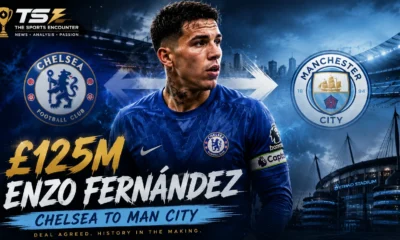

Man City Agree £125m Enzo Fernández Deal as Deadline Day Redraws Premier League’s Midfield Power
Manchester City have agreed a £125 million fee with Chelsea for Enzo Fernández in a deadline-day move that would equal...

Bukayo Saka Punishes Aston Villa as Arsenal Win 1-0 and Leave Emery Searching for Answers
Bukayo Saka’s 59th-minute goal gave Arsenal a 1-0 win at Aston Villa, keeping the defending champions perfect through two Premier...


Cherki Ends Crystal Palace Revival as Haaland Brace Sends Manchester City Top
Manchester City beat Crystal Palace 4-1 at Selhurst Park as Erling Haaland and Rayan Cherki struck twice each. Palace briefly...


Carabao Cup: Bradford Stun Burnley as Everton, Spurs and Brentford Light Up the Night
Bradford City knocked Burnley out on penalties, Thierno Barry hit a hat-trick for Everton, Tottenham scored five and Brentford struck...


Bruno Fernandes Wins PFA Player of the Year After Record-Breaking Manchester United Season
Bruno Fernandes has been named the 2026 PFA Men’s Players’ Player of the Year after producing a historic 21-assist Premier...


Draisaitl and Peterka Are Going Home as NHL Expands Germany Push
The NHL is expanding its push into Germany with four regular-season games in 2027-28. The Edmonton Oilers will play in...


Ron Duguay Walks Without a Walker as Stage 4 Cancer Fight Enters a New Treatment Phase
Ron Duguay has reached an encouraging rehabilitation milestone after his recent hospitalization, walking without a walker as his Stage 4...


Anze Kopitar Becomes Immortal in Los Angeles as Kings Retire No. 11 and Build His Statue
The Los Angeles Kings will retire Anze Kopitar’s No. 11 and unveil a bronze statue outside Crypto.com Arena, cementing the...


Ville Koivunen’s Eight-Year, $32M Penguins Deal Is a Bet on Pittsburgh’s Next Era
The Pittsburgh Penguins have committed to their future by signing 23-year-old forward Ville Koivunen to an eight-year, $32 million contract...


Tommy Novak’s $13.95M Penguins Extension Reveals Pittsburgh’s Plan Beyond the Crosby Era
The Pittsburgh Penguins have secured versatile forward Tommy Novak on a three-year, $13.95 million extension. After recording 42 points in...


Tim Seifert Sets the Stage Before Liam Dawson Seals The Hundred 2026 Final
Tim Seifert powered Manchester Super Giants toward the title before Mohammad Amir’s late burst created panic and Liam Dawson settled...


Crawley’s Costly Blunder Helps Super Giants Reach The Hundred Final
Paul Walter and Heinrich Klaasen powered Manchester Super Giants to 186 before Josh Tongue’s four wickets and Zak Crawley’s costly...


MI London Beat Birmingham Phoenix by Two Runs but Miss Hundred Eliminator on Net Run Rate
MI London survived a remarkable Birmingham Phoenix comeback to win by two runs at Edgbaston, but the victory was nowhere...


Tim Seifert Blows Sunrisers Leeds Away as Manchester Super Giants Surge Toward Hundred Eliminator
Tim Seifert hammered an unbeaten 80 from 40 balls as Manchester Super Giants chased 128 in just 67 legal deliveries,...

Stubbs Spoils Trent Rockets’ Lord’s Party as Southern Brave Win by Six Wickets
Tristan Stubbs hit an unbeaten 52 from 28 balls as Southern Brave chased 159 in 97 balls to beat Trent...


Wimbledon 2026 Withstands FIFA World Cup Clash, Breaks Attendance Record
Wimbledon attracted a record 550,151 spectators and generated 4.8 billion social media impressions in 2026. Dry weather, Arthur Fery’s semifinal...

Wimbledon Men’s Singles Champions: How Triumph on Grass Changed Their Careers
From Spencer Gore and William Renshaw to Roger Federer, Novak Djokovic, Carlos Alcaraz, and Jannik Sinner, discover how every Wimbledon...

Guo Hanyu and Kristina Mladenovic Turn Trust Into Wimbledon 2026 Glory
Guo Hanyu and Kristina Mladenovic turned a new partnership into Wimbledon glory, defeating Gabriela Dabrowski and Luisa Stefani in a...


Jannik Sinner’s Wimbledon Defense Against Novak Djokovic and Alexander Zverev
Jannik Sinner’s Wimbledon 2026 defense began with a five-set escape and ended with victories over Novak Djokovic and Alexander Zverev....

Muchova, Noskova Turn Wimbledon Women’s Singles Final Into an All-Czech Affair
Karolina Muchova saved match point to beat Coco Gauff in a Centre Court thriller, while Linda Noskova handled Marta Kostyuk...

Swiatek Sweeps Aside Rybakina to Claim Toronto Crown Ahead of US Open
Iga Swiatek swept aside Elena Rybakina 6-2, 6-3 to claim the 2026 National Bank Open title in Toronto, securing her...

Brandon Nakashima Beats Jodar to Reach First Masters 1000 Final
Brandon Nakashima held off Rafael Jodar 7-6(3), 6-4 to reach the first Masters 1000 final of his career at the...

National Bank Open: Iga Swiatek, Elina Svitolina Reach Semifinals as Montreal Enters QF Stage
Iga Swiatek and Elina Svitolina became the first confirmed National Bank Open 2026 semifinalists in Toronto, while Montreal’s men’s draw...

When Paris Welcomed Two New French Open Champions
Paris, France – June 9, 2026: There are days at Roland Garros when tennis feels like a sport. Then there...


French Open 2026: Mirra Andreeva Becomes a Grand Slam Reality
Mirra Andreeva relived the memories of Monica Seles on Super Sunday at Roland Garros to lift her maiden French Open...


Galle Gallants Are LPL 2026 Champions After 5-Wicket Revenge Win Over Jaffna Kings
Galle Gallants are the 2026 Lanka Premier League champions after defeating Jaffna Kings by five wickets, chasing 124 in 15.5...


LPL 2026 Final Preview: Galle Seek Revenge as Jaffna Chase a Fifth Crown
Galle Gallants and Jaffna Kings meet in the Lanka Premier League 2026 final after three dramatic clashes this season, with...
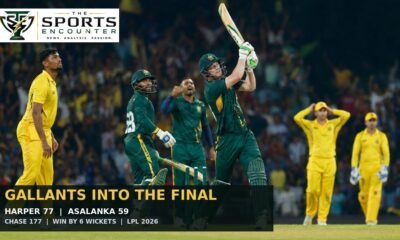

Harper and Asalanka Punish Colombo’s Chaos as Galle Reach LPL Final
Sam Harper’s commanding 77 and Charith Asalanka’s composed 59 carried Galle Gallants past Colombo Kaps and into the LPL 2026...
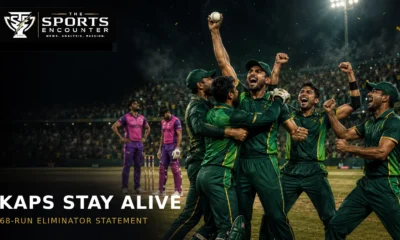

McDermott and Neesham Set the Trap Before Sahan Ends Kandy’s LPL Run
Colombo Kaps eliminated Kandy Royals by 68 runs after McDermott and Neesham powered them past 200 before Sahan and Dahani...
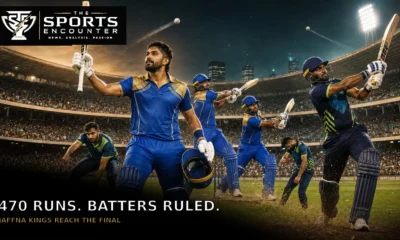

Mishara’s Unbeaten 108 Sends Jaffna Kings Into LPL Final After 470-Run Assault
Kamil Mishara’s unbeaten century carried Jaffna Kings into the LPL 2026 final after Galle Gallants fell 14 runs short in...


Guyana Amazon Warriors Defend 85 to Break San Francisco Hearts and Retain Global Super League Title
Guyana Amazon Warriors recovered from 29 for eight, defended a total of 85, and defeated San Francisco Unicorns by six...


Tim Robinson Explodes as Unicorns Thump Vipers to Enter the Global Super League Final
Tim Robinson struck an unbeaten 68 as San Francisco Unicorns defeated Desert Vipers by eight wickets in the Global Super...
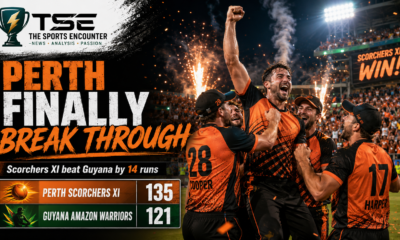

Perth Find Their Missing Finish as Spin Silences Guyana
Brody Couch rescued Perth Scorchers XI with 43 before five spin options dismantled Guyana Amazon Warriors for 121 in a...


Akeal Hosein Nearly Steals It, but Desert Vipers Escape in Final Over
Rilee Rossouw mastered a difficult Providence pitch before Desert Vipers survived Akeal Hosein’s four-wicket fightback to beat Perth Scorchers XI...

Shadab Khan and Zachary Carter Rescue Desert Vipers’ GSL Campaign
Shadab Khan dismantled San Francisco’s middle order before 19-year-old Zachary Carter launched a fearless chase, helping Desert Vipers secure their...


LeBron James Partners With PGA Tour for Akron Golf Event as Firestone Gets New Life
LeBron James is bringing professional golf back to Akron through a new PGA Tour-backed Invitational at Firestone Country Club, combining...


Lakers’ $12.5B Sale Confirms a New Reality: This Is Luka Dončić’s Team Now
The Lakers are entering another major transition, with a reported $12.5 billion ownership deal arriving as LeBron James departs and...

NBA 2026-27 Schedule Is Here: Opening Night, Christmas Games and Biggest Dates to Watch
The NBA has released its full 2026-27 schedule, with LeBron James opening his 76ers career against the defending champion Knicks,...

LeBron James to Challenge NBA Champions Knicks to Kick Off His 76ers Era
LeBron James will begin his Philadelphia 76ers era against the defending champion New York Knicks at Madison Square Garden before...


LeBron James Says No to LA 2028, but Team USA Is Reportedly Saving Him a Seat
LeBron James says he plans to watch the 2028 Los Angeles Olympics, but USA Basketball is reportedly prepared to give...

Aaron Donald Changes the Rams’ Super Bowl Math as Will Levis Hits Free Agency in NFL Roster Reset
Aaron Donald’s comeback has strengthened the Rams’ Super Bowl case, while Will Levis has cleared waivers and entered free agency...

Connor Hellebuyck Trade Request Puts Winnipeg Jets at a Franchise Crossroads
Connor Hellebuyck has confirmed that he asked the Winnipeg Jets for a trade months ago. The three-time Vezina winner’s request...


Seattle Seahawks Sale Approved for Record $9.612 Billion as Khosla Family Ends Paul Allen Era
NFL owners have unanimously approved the Seattle Seahawks sale to the Khosla family in a record $9.612 billion transaction, closing...



Carlos Alcaraz Returns with a Win as Travis Scott and Nike Turn His US Open Comeback Into a Cultural Event
Carlos Alcaraz returned to singles after four months out and beat Roman Safiullin in straight sets while debuting a Travis...


Sabalenka Restores Order at US Open as Alcaraz Begins Long-Awaited New York Comeback
Aryna Sabalenka began her bid for a third straight US Open title with a 6-4, 6-4 win over Camila Osorio,...

Novak Djokovic’s US Open Collapse Raises the Hardest Question Yet About His Future
Novak Djokovic’s first-round US Open defeat to Mariano Navone was historic, but the bigger concern is physical. At 39, recurring...
-

 Editor's Choice4 weeks ago
Premier League 2026–27 Curtain Raiser: Fixtures, Teams, Title Contenders, Transfers and Season Predictions
-

 Editor's Choice4 weeks ago
National Bank Open 2026: All You Need to Know
-
Editor's Choice3 weeks ago
When Will Lionel Messi Retire? Argentina President Says Only Messi Has the Answer