


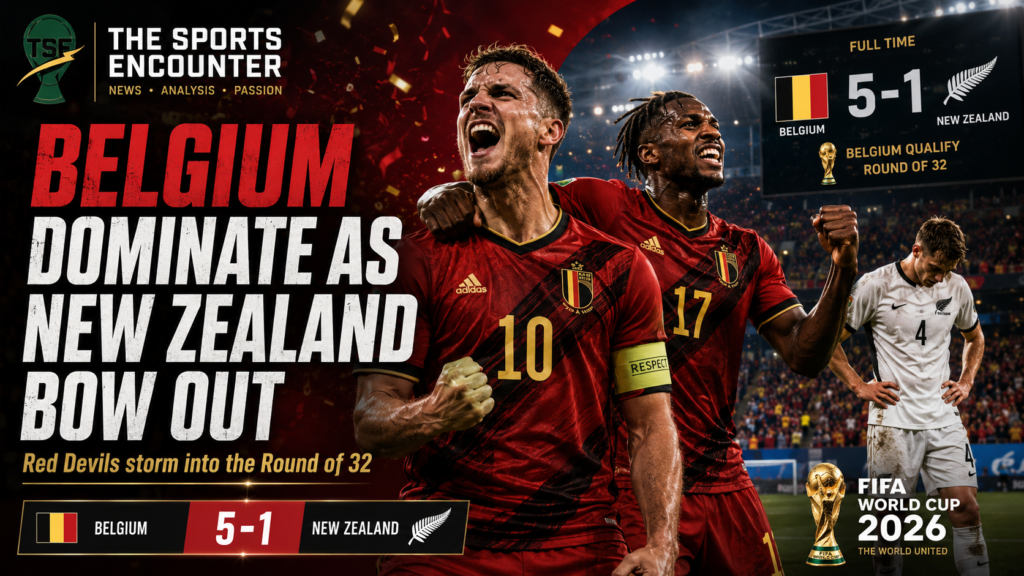
A 5-1 win over New Zealand did more than carry Belgium into the Round of 32. It changed the mood around a side that had looked controlled without being convincing in earlier matches. This time, Belgium played with tempo, width, patience, and a ruthless edge that New Zealand simply could not live with for long enough.
Leandro Trossard set the tone with a brace. Kevin De Bruyne added authority. Romelu Lukaku came off the bench and scored almost immediately. Alexis Saelemaekers finished the night in stoppage time, turning a win into a warning.
New Zealand had their moment through Elijah Just, who scored late after Thibaut Courtois failed to deal cleanly with a corner. Yet the goal only softened the scoreline. It did not change the story.
Belgium were better in every major phase of the match. New Zealand worked, chased, resisted in flashes, and briefly showed spirit after halftime. But by the end, the All Whites looked like a side that had reached the emotional and physical edge of its tournament.
For full tournament context, fixtures, and knockout movement, follow The Sports Encounter’s FIFA World Cup 2026 coverage.
Match Scorecard
| Match | New Zealand vs Belgium |
|---|---|
| Competition | FIFA World Cup 2026 |
| Stage | Group G |
| Venue | Vancouver |
| Final Score | New Zealand 1-5 Belgium |
| Belgium Goals | Leandro Trossard 28’, 50’, Kevin De Bruyne 67’, Romelu Lukaku 86’, Alexis Saelemaekers 90+4’ |
| New Zealand Goal | Elijah Just 84’ |
| Yellow Cards | Marko Stamenic 46’, Elijah Just 56’ |
| Red Cards | None reported |
| Belgium Outcome | Qualified for Round of 32 |
| New Zealand Outcome | Eliminated |
Trossard Turns Control Into Damage
Belgium’s biggest issue earlier in the tournament had been turning possession into punishment. Against New Zealand, Trossard solved that problem.
His opening goal in the 28th minute gave Belgium the lead their control deserved. It also forced New Zealand into a difficult space. The All Whites could no longer survive by delaying Belgium, compressing central areas, and waiting for moments to break forward. They had to open up eventually, and Belgium had too much quality in those spaces.
Trossard’s second goal, five minutes after halftime, effectively broke New Zealand’s structure. It was the kind of finish Belgium had been missing earlier in Group G: sharp, instinctive, and decisive before the opponent could reset.
That second goal mattered because it gave Belgium emotional control as much as scoreboard control. New Zealand could still run. They could still compete. They could still send bodies forward. But from that point, the match belonged to Belgium’s rhythm.
Belgium’s attacking improvement also felt significant because their earlier World Cup form had raised real questions. As The Sports Encounter noted after Belgium’s frustrating draw with Iran, Group G had become a survival test rather than a smooth passage. In Vancouver, Belgium finally played like a team ready to move beyond that anxiety.
De Bruyne Gives Belgium the Authority They Needed
Kevin De Bruyne’s 67th-minute goal was the moment Belgium stopped looking like a team trying to qualify and started looking like a team preparing for knockout football.
He found space near the edge of the area, shaped his body, and placed his finish with the calm of a player who knows when a match is ready to be settled. New Zealand had defenders back, but they were sliding, reacting, and chasing shadows. Belgium moved the ball with too much certainty.
That goal also pushed Belgium toward the top of Group G on goal difference as Egypt and Iran played out their own result. In a tournament format where Round of 32 pairings can change quickly, Belgium’s late surge carried practical value. They did not simply qualify. They improved their route.
This was also the version of De Bruyne Belgium needed to see. He did not have to dominate every touch or carry every attack. He had to give Belgium direction. Against New Zealand, he did exactly that.
For readers still tracking how the expanded format works, The Sports Encounter’s explainer on the FIFA World Cup 2026 qualification process breaks down the Round of 32, third-place routes, and tie-breaker picture.
Lukaku and Saelemaekers Add the Knockout Punch
Belgium’s substitutes made the scoreline look brutal.
Romelu Lukaku entered late, took the captain’s armband, and scored with his first touch in the 86th minute. Nicolas Raskin delivered the cross, and Lukaku met it with the kind of header that gives defenders no real second chance.
For Belgium, that was more than a fourth goal. It was proof that their bench can affect a match quickly. In knockout football, that matters.
Alexis Saelemaekers added the fifth in stoppage time after New Zealand’s shape had fully stretched. By then, the All Whites were chasing pride more than possibility. Belgium kept attacking anyway.
That ruthless finish may feel harsh on New Zealand, but it also underlined Belgium’s professional mindset. Top teams often use these final group-stage matches to manage energy. Belgium used this one to rediscover their edge.
The performance also completed a useful response to the concerns highlighted in The Sports Encounter’s Day 11 World Cup review, when Belgium’s attack still looked short of rhythm despite their talent. Against New Zealand, the Red Devils finally turned pressure into goals.
New Zealand’s Campaign Ends With Regret
New Zealand entered the match knowing only a win would give them a real path toward the knockout stage. That context made the performance more painful.
They were not passive throughout the match. Elijah Just gave them their best attacking spark, driving through midfield and later scoring from a corner. Max Crocombe made important saves. There were short spells when New Zealand moved the ball with courage and tried to test Belgium’s defensive line.
Still, the gap was clear.
New Zealand struggled to manage Belgium’s movement between the lines. Once they fell behind, they lacked the attacking control required to turn pressure into sustained threat. Their passing became rushed. Their defensive spacing grew wider. Belgium’s pace and technical quality punished every loose touch.
Their World Cup campaign ends with familiar frustration. The All Whites had moments of promise across Group G, including their breathless 2-2 draw with Iran and a bright start against Egypt. But they could not turn those moments into a complete performance.
Against Belgium, the tournament finally caught up with them.
For more on the earlier damage to New Zealand’s campaign, read The Sports Encounter’s report on Mohamed Salah leading Egypt to a historic World Cup win as New Zealand collapsed after a bright start.
Discipline: Two New Zealand Bookings, No Red Cards
The match did not turn ugly, but New Zealand’s frustration appeared early in the second half.
Marko Stamenic received the first yellow card in the 46th minute after bringing down Youri Tielemans. Elijah Just was then booked in the 56th minute for pulling back Trossard as Belgium threatened to break forward.
There were no red cards reported.
Those bookings reflected New Zealand’s wider problem. Belgium kept finding cleaner angles, and the All Whites often had to defend while facing their own goal. That kind of pressure usually creates fouls. In Vancouver, it also showed how hard New Zealand had to work just to stay near Belgium’s speed of play.
Who Could Belgium Face in the Round of 32?
Belgium’s win sent them into the Round of 32 as Group G winners. Their next opponent is expected to come from the pool of third-placed teams from Group A, Group I, or Group J, with South Korea, Senegal, or Algeria among the likely possibilities depending on final group-stage calculations.
That creates an interesting test for Belgium.
A third-placed opponent may look favorable on paper, but the expanded FIFA World Cup 2026 format has already shown how dangerous those routes can become. Several teams that finish third arrive in the knockouts with momentum, little pressure, and enough tactical identity to frustrate bigger names.
Belgium will still prefer this position. Winning the group after entering the final match under pressure gives them a cleaner emotional platform. It also gives the squad belief after a sluggish start.
South Korea’s own route has already carried tension, especially after Mexico edged Korea Republic in a tight World Cup fight. Senegal, meanwhile, have shown enough quality to make any knockout opponent uncomfortable.
Final Word: Belgium Needed a Performance, Not Just a Result
Belgium did what serious teams do when the group stage reaches its sharp end. They removed doubt.
The scoreline was heavy, but the most important part was the manner of the win. Trossard gave Belgium cutting edge. De Bruyne gave them control. Lukaku reminded everyone that he can still change a match quickly. Saelemaekers added the final stamp.
New Zealand leave with effort, heart, and a few good memories, but also with the hard truth of tournament football. Courage can keep a team alive for stretches. Quality, depth, and execution decide the nights that matter most.
Belgium now move forward. Their World Cup finally has shape.
New Zealand go home. Their campaign had hope, but Vancouver gave them the answer they did not want.
For a wider look at how this result fit into the day’s drama, read our full Day 16 World Cup 2026 highlights feature.