



Day 16 of the FIFA World Cup 2026 had everything a tournament day needs: a heavyweight flexing its authority, an African side producing one of the cleanest statements of the group stage, a European giant grinding through pressure, a tiny island nation stretching its dream into the knockouts, and a late offside decision that sent football fans into full courtroom mode.
This was the kind of day that reminded everyone why group-stage finales can feel more chaotic than knockout matches. Some teams needed control. Some needed goals. Some needed only a point. Some needed a miracle.
By the end of the night, France looked dangerous, Senegal looked alive, Spain looked mature, Cape Verde looked fearless, Belgium looked ruthless, Egypt survived, and Iran walked away with the kind of heartbreak that will be replayed for years.
For more tournament coverage, follow The Sports Encounter’s FIFA World Cup 2026 hub.
Day 16 Scorecard
| Match | Result | Main Story |
|---|---|---|
| Norway vs France | France won 4-1 | France punished Norway’s rotated lineup |
| Senegal vs Iraq | Senegal won 5-0 | Senegal delivered a statement performance |
| Uruguay vs Spain | Spain won 1-0 | Spain controlled a tense qualification test |
| Cape Verde vs Saudi Arabia | 0-0 draw | Cape Verde’s historic knockout dream survived |
| New Zealand vs Belgium | Belgium won 5-1 | Belgium found attacking rhythm at the right time |
| Egypt vs Iran | 1-1 draw | Iran’s late disallowed goal created huge debate |
1. France Turn Norway’s Gamble Into a Warning for Everyone Else
Norway’s decision to rest Erling Haaland and several key players against France was always going to attract attention. Once France took control, it started to look less like rotation and more like an invitation.
France Crush Norway After Haaland and Ødegaard Start on the Bench
France won 4-1 and did it with the calm authority of a side that understands tournament football. They did not need chaos. They did not need emotional surges. They simply moved the ball with purpose, attacked the spaces Norway left open, and punished defensive uncertainty whenever it appeared.
Norway still had a chance to make the game feel different, including a missed penalty that could have changed the emotional temperature of the match. Instead, that miss became part of a wider story: France were sharper in the decisive moments.
The result did more than confirm France’s quality. It reminded the rest of the field that France can win in several ways. They can play through pressure, counter with speed, attack from wide areas, and turn small mistakes into heavy punishment.
For Norway, the question will linger. Was protecting key players worth the damage to rhythm and confidence? Tournament managers often think beyond one match, but World Cup momentum has a strange way of punishing overcalculation.
France left the pitch looking like a team ready for the Round of 32. Norway left with a problem they created for themselves.
2. Senegal’s 5-0 Win Gives Africa One of Day 16’s Loudest Statements
Senegal’s 5-0 win over Iraq was the cleanest result of Day 16 and arguably the most important emotional statement.
Senegal Punish 10-Man Iraq as Round of 32 Hope Survives
This was not just about the scoreline. Senegal played like a side that knew exactly what the moment demanded. They pressed with hunger, attacked with numbers, and kept Iraq pinned into uncomfortable zones for long spells. Every goal seemed to strip away another layer of Iraqi resistance.
Iraq’s campaign had already been difficult, but this defeat gave it a painful ending. They struggled to match Senegal’s pace, physicality, and attacking variety. Once the game opened up, Iraq had no real way to slow the damage.
Senegal, on the other hand, used the match to send a message. They looked more direct, more confident, and more connected than they had earlier in the tournament. The forward movement had better timing. The midfield carried more aggression. The finishing had conviction.
This was the type of performance that can reset how a team feels about itself.
Fans often remember the teams that hit form late in the group stage because they enter the knockouts with belief rather than relief. Senegal gave themselves exactly that. They did not stumble forward. They charged into the conversation.
The Sports Encounter has been tracking how heat, rhythm, and match tempo are shaping this tournament, especially in our piece on World Cup 2026 hydration breaks. Senegal’s performance showed another side of tournament management: when the body is ready and the mind is clear, a team can turn pressure into power.
3. Spain Win Ugly, and That May Matter More Than Winning Pretty
Spain’s 1-0 win over Uruguay was not the loudest result of the day, but it may prove one of the most valuable.
Spain Edge Uruguay as Bielsa’s World Cup Ends in Frustration
World Cups rarely reward teams that only know how to dominate easy matches. The deeper rounds usually ask different questions. Can you protect a lead? Can you stay calm when the opponent turns physical? Can you survive a game that refuses to become beautiful?
Spain answered those questions against Uruguay.
Uruguay’s performance carried frustration. They fought, pressed, and tried to drag Spain into a match full of contact and emotion. But Spain kept finding ways to manage the ball, slow the pace, and keep the game within their preferred structure.
The 1-0 scoreline may look narrow, but it told a bigger story. Spain showed patience. They showed tactical discipline. They did enough in attack and stayed organized when Uruguay tried to force the match into desperation.
For Uruguay, this was a bitter exit from a campaign that never fully found its voice. They had enough talent to trouble teams, but not enough attacking fluency when the decisive moments arrived.
Spain will not frame this as a masterpiece. They should frame it as evidence. A World Cup contender needs at least one win like this before the knockouts begin.
4. Cape Verde Turn a 0-0 Draw Into a National Football Memory
A goalless draw can be forgettable. Cape Verde’s 0-0 result against Saudi Arabia was anything but.
Cabo Verde Reach Round of 32 After Holding Saudi Arabia in Tense World Cup Draw
For Cape Verde, this was about nerve, structure, and history. They did not need to light up the scoreboard. They needed to protect the work they had done across the group stage. They needed to manage the occasion without letting the size of the moment swallow them.
That is harder than it sounds.
Saudi Arabia needed a response after a disappointing tournament, but they could not find the breakthrough. Their campaign ended with more questions than answers. The attacking rhythm was too inconsistent, the final-third choices too predictable, and the urgency too late.
Cape Verde’s story is the opposite. They have become one of the tournament’s most human narratives, a team carrying far more than football tactics. Every clearance mattered. Every defensive recovery had weight. Every minute pushed them closer to a stage few expected them to reach.
There are World Cup moments built on spectacular goals. There are others built on resistance.
Cape Verde’s magic came from holding firm.
That 0-0 draw may never dominate highlight reels, but for Cape Verde fans, it will feel as bright as any five-goal thriller. Their team survived the pressure and walked into the knockout conversation with pride.
5. Group G Ends with Belgium’s Roar and Iran’s Cruelest Frame
Group G produced Day 16’s sharpest contrast in mood.
Belgium Finally Find Their Bite as New Zealand’s World Cup Ends in Vancouver
Belgium battered New Zealand 5-1 and finally looked like a team that had stopped hesitating. Their attacking play had width, speed, and purpose. New Zealand fought hard, but Belgium’s quality kept stretching the match until the scoreline became heavy.
For Belgium, this was the performance they needed before the knockouts. A team with attacking pedigree cannot spend a whole tournament searching for fluency. At some point, the rhythm has to arrive. Against New Zealand, it did.
Then came Egypt vs Iran, and the whole tone of the day changed.
The 1-1 draw carried huge stakes, but the stoppage-time controversy turned it into one of the tournament’s loudest talking points. Iran thought they had found a late winner. The celebrations started. Then the offside flag and review stopped everything.
The internet reacted immediately. Many fans blamed the referee. Others accused FIFA. But the core issue was Law 11, not emotion. Offside is judged against the second-last opponent, not simply the last visible defender. If the Iranian attacker was nearer to the goal line than both the ball and the second-last Egyptian opponent when the pass was played, the goal had to be disallowed.
That made the decision painful, but not automatically wrong.
Iran’s heartbreak was real. Egypt’s relief was real too. Their draw helped Egypt move toward a Round of 32 meeting with Australia, while Iran were left with the cruel feeling that one frame had changed everything.
For a deeper rule breakdown, read The Sports Encounter’s explainer on why Iran’s disallowed goal against Egypt was the right call.
Why Day 16 Felt Different
Day 16 had a proper tournament pulse because almost every match carried consequence.

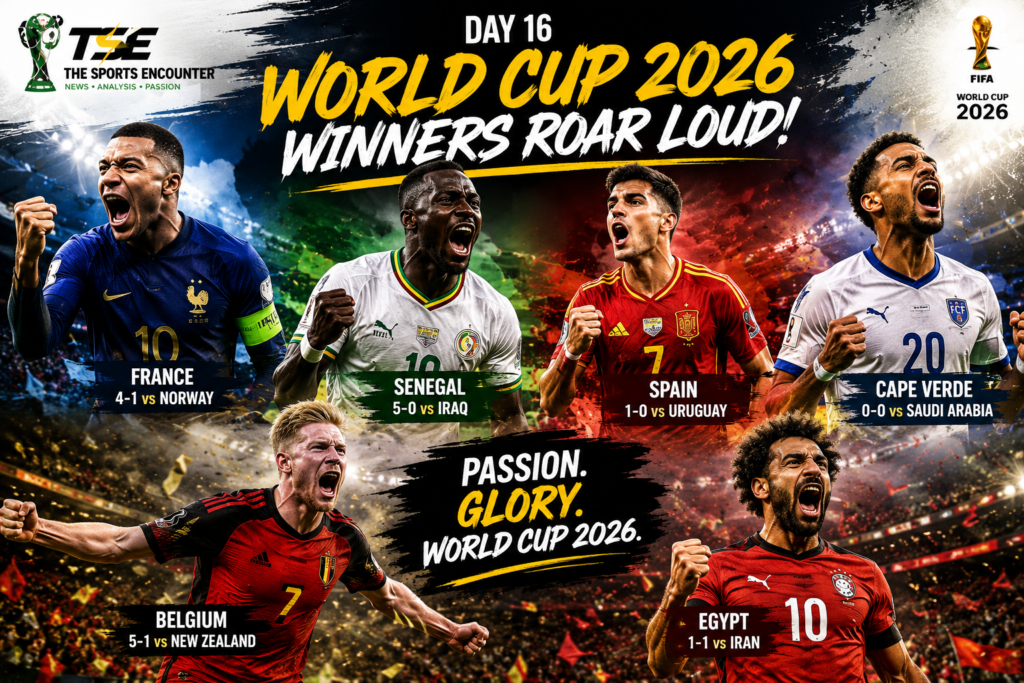
France looked like a contender. Senegal looked revived. Spain showed knockout composure. Cape Verde protected a historic dream. Belgium found its attacking voice. Egypt survived a storm. Iran became the latest team to learn that World Cup heartbreak often arrives through the smallest margins.
That is what made the day magical.
The football was not always clean. The emotions were not always fair. The arguments will not disappear quickly. But World Cups are remembered through days like this, when scores, laws, tactics, and human pain all collide at once.
Day 16 did not belong to one team.
It belonged to the pressure of the moment.
FAQ
What were the biggest results from Day 16 of the FIFA World Cup 2026?
The biggest results included France beating Norway 4-1, Senegal defeating Iraq 5-0, Spain edging Uruguay 1-0, Belgium beating New Zealand 5-1, and Egypt drawing 1-1 with Iran.
Why was Cape Verde’s draw with Saudi Arabia important?
Cape Verde’s 0-0 draw mattered because it helped extend their historic World Cup 2026 run and kept their knockout dream alive.
Why did Iran’s late goal against Egypt become controversial?
Iran’s late goal was disallowed for offside, sparking online outrage. The key rule is that an attacker must not be nearer to goal than both the ball and the second-last opponent when the ball is played.
Which team made the strongest statement on Day 16?
Senegal’s 5-0 win over Iraq was the loudest statement in terms of scoreline, while France’s 4-1 win over Norway carried major knockout-stage warning signs.
What made Day 16 magical?
Day 16 combined dominant wins, tense qualification pressure, a historic underdog story, a late VAR controversy, and major knockout implications across Groups G, H, and I.
The Sports Encounter Credibility Line
The Sports Encounter’s World Cup 2026 coverage focuses on fixtures, team news, match analysis, fan stories, tournament trends, and the biggest talking points from football’s global stage.