


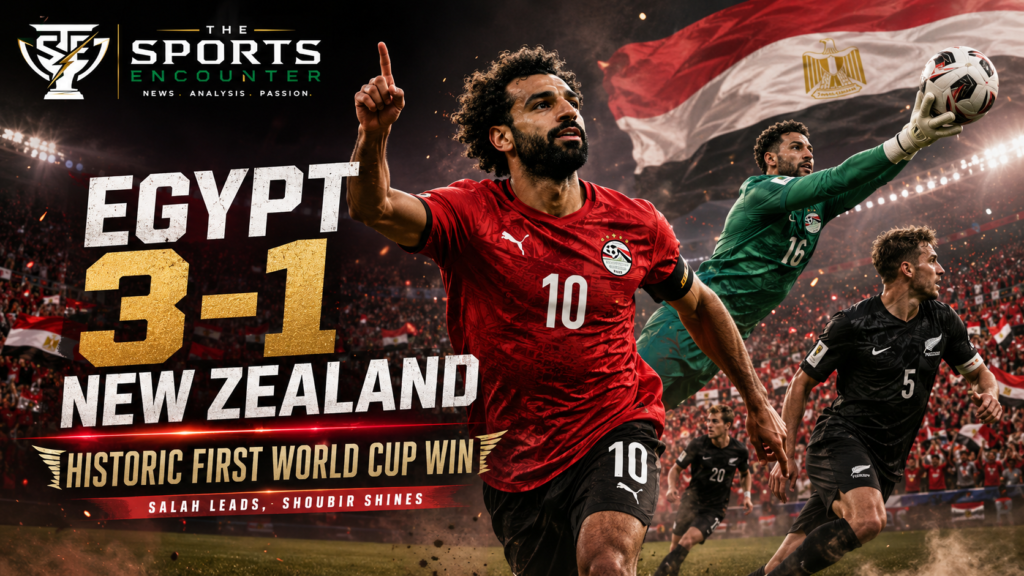
Egypt finally have their World Cup victory.
After decades of near-misses, short stays, and painful exits, the Pharaohs turned one difficult night in Vancouver into a landmark result. New Zealand struck first, made Egypt work, and looked ready to drag Group G into even deeper chaos.
Then Mohamed Salah took over.
Egypt beat New Zealand 3-1 at BC Place in a Group G match that started with pressure, turned into a test of nerve, and ended with Egyptian history. Finn Surman gave New Zealand a first-half lead, but Mostafa Zico, Salah, and Mahmoud Trezeguet scored after the break to deliver Egypt’s first-ever win at the FIFA World Cup finals.
For full tournament context, fixtures, and knockout movement, follow The Sports Encounter’s FIFA World Cup 2026 schedule.
New Zealand Start Fast and Punish Egypt From a Set Piece
New Zealand came into this match still carrying the frustration of their 2-2 draw with Iran. They had already shown in that opener that they could hurt teams, press with energy, and make opponents uncomfortable.
They did the same to Egypt early.
The All Whites found their breakthrough in the 15th minute when Tim Payne’s corner picked out Finn Surman. The defender escaped his marker and powered his header into the net. Egypt goalkeeper Mostafa Shoubir had little chance with the finish, and New Zealand suddenly had the game exactly where they wanted it.
That goal gave New Zealand belief. Chris Wood provided the target up front, Elijah Just pressed Egypt’s back line, and Callum McCowatt kept finding pockets between midfield and defense. Egypt had more attacking names, but New Zealand had the cleaner first-half structure.
This was the danger Egypt faced. A slow start against Belgium had already cost them full points in their opener. Against New Zealand, another early lapse threatened to turn a promising campaign into a desperate one.
The pressure around Group G had already been clear after Iran fought back twice to deny New Zealand in their World Cup opener. This match carried the same edge: no team in the group could afford to waste a lead, a chance, or a moment of control.
Mostafa Shoubir Keeps Egypt Alive Before the Attack Clicks
Egypt’s comeback will be remembered for Salah’s goal and the roar that followed Trezeguet’s header, but Mostafa Shoubir deserves serious credit.
The Egyptian goalkeeper had to manage a difficult first half in which New Zealand used direct balls, corners, and second phases to keep Egypt unsettled. He could not stop Surman’s header, but he stayed calm after the goal and prevented the match from slipping away before Egypt found their rhythm.
One of his most important interventions came when New Zealand threatened again through McCowatt. Shoubir reacted sharply to keep Egypt within one goal, and that mattered. At 2-0 down, Egypt would have needed a completely different emotional response. At 1-0, the match still had a door open.
Late in stoppage time, with New Zealand pushing bodies forward, Shoubir again reacted well to a deflected Tyler Bindon effort. It was the kind of save that rarely leads highlight packages, but it protects the scoreline and kills the last bit of panic.
His performance was not only about shot-stopping. He gave Egypt control in moments when New Zealand tried to turn the match into a physical aerial contest. He claimed space, slowed the game when needed, and helped Egypt survive long enough for their attack to arrive.
Salah Changes the Match by Moving Closer to the Action
Egypt’s first half had a familiar problem. Salah was involved, but not always close enough to hurt New Zealand in the most dangerous zones.
After the break, Egypt changed the feel of the match.
Salah began drifting inside more often. Emam Ashour grew into the game and started connecting midfield with the front line. Omar Marmoush gave Egypt width and movement from the left, while Mostafa Zico attacked the box with far more conviction.
That shift changed everything.
Egypt equalized in the 58th minute when Mohamed Hany delivered from the right and Zico headed home. The goal was simple, direct, and badly needed. More importantly, it told Egypt that New Zealand could be pushed back.
Nine minutes later, Salah gave Egypt the lead.
The captain combined with Zico, moved into the right channel, and finished with the calm of a player who has lived in high-pressure moments for most of his career. It was a goal built on timing, trust, and presence. Salah did not force the game. He waited until Egypt had runners around him, then picked the moment to strike.
That was the difference under Salah.
Egypt’s attack becomes more dangerous when Salah acts as both finisher and connector. He does not need to touch the ball every few seconds. He needs the right touches in the right zones. Against New Zealand, Egypt finally gave him that platform after halftime.
The signs were already there in Egypt’s opener, when Salah showed Egypt still had a World Cup pulse against Belgium. This time, he turned influence into outcome.
Zico and Trezeguet Give Egypt More Than a Salah Story
The easy headline is Salah. The better reading is that Egypt won because Salah finally had enough help.
Zico scored the equalizer and assisted Salah’s goal. That two-way contribution changed the entire structure of Egypt’s attack. He gave Salah a nearby partner, attacked spaces inside the box, and forced New Zealand’s defenders to make choices instead of simply shifting toward Egypt’s captain.
Trezeguet then arrived from the bench and made the final statement.
In the 82nd minute, Salah’s corner found Trezeguet near the front area, and the substitute headed home Egypt’s third. New Zealand’s defending was poor, but Egypt’s hunger was clear. Trezeguet attacked the ball like a player who understood the value of the moment.
That goal gave Egypt breathing room. It also gave the result a stronger historical weight. This was not a lucky 1-0. Egypt came from behind, scored three times in the second half, and finished the match with authority.
For readers following the wider tournament structure, The Sports Encounter has also explained how teams move from the group stage to the knockouts in this guide to the FIFA World Cup 2026 qualification process.
New Zealand Let Another Lead Slip Away
For New Zealand, this will sting.
They led Iran twice and drew 2-2. They led Egypt and lost 3-1. Across two matches, the All Whites have shown they belong at this level, but they have also shown the painful gap between competing and managing a World Cup game.
New Zealand’s first-half plan worked. They used Wood’s presence, attacked set pieces, and forced Egypt into uncomfortable defensive moments. Their problem came after halftime, when Egypt increased the tempo and New Zealand could not slow the game down.
Once Egypt equalized, New Zealand looked stretched. After Salah scored, they lost defensive clarity. By the time Trezeguet added the third, the All Whites had moved from control to damage limitation.
This is the harsh side of tournament football. New Zealand have played brave football. They have scored three goals in two matches. They have taken leads against both Iran and Egypt. Yet they now sit bottom of Group G with one point.
Their final match against Belgium becomes a survival game.
Group G Situation After Egypt’s Win
Egypt now sit top of Group G with four points from two matches.
That changes the mood of the group.
Belgium and Iran are both on two points after their 0-0 draw, while New Zealand remain on one point. Egypt’s final group match against Iran will decide whether the Pharaohs advance with authority or leave themselves waiting on other results.
The expanded FIFA World Cup 2026 format gives more teams a route into the Round of 32, but it also makes goal difference, discipline, and third-place rankings more important. Egypt’s 3-1 win gives them a useful +2 goal difference. That matters.
Current Group G picture:
| Team | Points | Goal Difference |
|---|---|---|
| Egypt | 4 | +2 |
| Iran | 2 | 0 |
| Belgium | 2 | 0 |
| New Zealand | 1 | -2 |
Egypt’s path is now clear. A win against Iran would seal top spot. A draw should be enough to advance. Even a defeat may not end their campaign, depending on Belgium vs New Zealand and the third-place table.
New Zealand need to beat Belgium and hope the group opens up elsewhere. Anything less will likely end their tournament.
For more build-up around this exact matchday, read The Sports Encounter’s FIFA World Cup 2026 Day 11 preview.
Cards and Discipline
There were no red cards in New Zealand vs Egypt.
The match did include three yellow cards:
| Minute | Player | Team | Card |
| 17’ | Mohamed Lashin | Egypt | Yellow card |
| 20’ | Sarpreet Singh | New Zealand | Yellow card |
| 34’ | Callum McCowatt | New Zealand | Yellow card |
Discipline could still matter in Group G because fair play can become a tiebreaker if teams finish level on points, goal difference, and goals scored. Egypt avoided major trouble here, while New Zealand’s two first-half bookings reflected the pressure they faced once Egypt began pushing forward.
Final Verdict
Egypt needed a result. They got history.
This was their first victory at the World Cup finals, but it felt bigger than a record-book entry. It showed that Egypt can survive pressure, adjust during a match, and let Salah influence the game without carrying every action alone.
Shoubir gave them stability. Zico gave them movement and end product. Trezeguet gave them the final blow. Salah gave them the moment.
New Zealand will look back at another lead lost and wonder how a promising World Cup campaign drifted so quickly toward danger. Egypt will look ahead to Iran with belief, momentum, and a real chance to control Group G.
For the Pharaohs, this was the night the wait finally ended.