


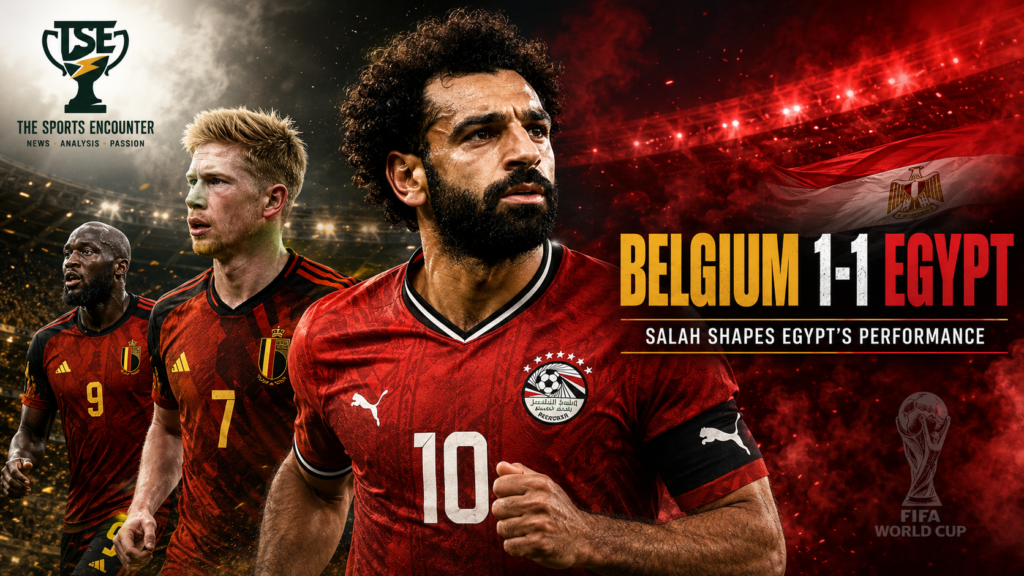
Egypt came close to a major World Cup statement but had to settle for a 1-1 draw against Belgium in their Group G opener. Emam Ashour fired Egypt ahead in the first half after Mohamed Salah’s assist, before Romelu Lukaku’s second-half arrival changed Belgium’s attacking shape and helped force Mohamed Hany’s own goal. Salah did not score, but his influence shaped Egypt’s best attacking spells and gave the Pharaohs belief against one of Europe’s most experienced sides.
Belgium Rescue a Point, But Egypt Leave With Belief
Belgium escaped with a point. Egypt left with something almost as valuable: proof that they can compete at this level.
The Pharaohs held Belgium to a 1-1 draw in their FIFA World Cup 2026 Group G opener, and for long stretches, they looked like the team with the clearer identity. Belgium had more of the ball, more familiar names, and the heavier tournament reputation. Egypt had shape, patience, courage, and Mohamed Salah.
That combination nearly produced one of the early statements of the tournament.
For more World Cup coverage, follow The Sports Encounter’s central FIFA World Cup 2026 hub, where every major storyline, match report, and tactical shift will be tracked throughout the tournament.
Emam Ashour Gives Egypt the Lead
Egypt’s breakthrough came in the 19th minute, and it carried the fingerprints of their captain.
Salah found space, read the moment, and picked the right pass for Emam Ashour, who finished with the confidence of a player ready for a bigger stage. The goal gave Egypt a deserved lead and changed the emotional temperature of the match.
Belgium had started with control, but Egypt’s opener forced the Red Devils into a more uncomfortable game. Kevin De Bruyne tried to drag Belgium forward. Jeremy Doku looked dangerous in flashes. Still, Egypt’s defensive block stayed compact enough to frustrate Belgium before halftime.
This was not a smash-and-grab plan from Egypt. It was structured, disciplined, and brave enough to counter when Belgium gave them space.
Lukaku Changes the Match Without Scoring
Belgium needed a different reference point in attack, and Romelu Lukaku gave them one as soon as he came on.
His introduction in the second half changed Belgium’s body language. Suddenly, crosses had a target. Egypt’s center-backs had a physical problem to solve. Belgium’s wide players had a clearer reason to deliver early balls into dangerous areas.
The equalizer came through that pressure. A Thomas Meunier cross caused panic inside the Egypt box, and Mohamed Hany turned the ball into his own net under pressure from Lukaku’s presence.
Lukaku did not need a clean finish to change the scoreline. His movement and strength shifted the match just enough for Belgium to survive.
That matters for Belgium. Their golden generation has changed shape, but their tournament hopes still depend on experienced players making ugly moments useful. Belgium did not look convincing, but they did avoid defeat.
Did Mohamed Salah Impact Egypt’s Performance?
Yes. Salah had a clear impact on Egypt’s performance, even without scoring.
Salah Gave Egypt Their Best Route Forward
Egypt’s first-half goal came because Salah saw the pass early and executed it cleanly. His assist for Ashour was more than a statistical contribution. It gave Egypt a lead, belief, and tactical leverage.
Once Egypt went ahead, Belgium had to chase. That allowed Egypt to stay compact, choose their breaks, and play with more confidence.
Salah Changed Belgium’s Defensive Behavior
Belgium could not defend Egypt as a basic low-block opponent because Salah remained a threat in transition. Even when he was not directly on the ball, his positioning pulled attention toward Egypt’s right side and created room for others to move.
That influence matters. Elite players do not only affect games through goals. They affect spacing, defensive decisions, and the fear level of opponents.
Salah Gave Egypt Leadership Under Pressure
Egypt’s biggest test came after Belgium’s equalizer. At that stage, the game could have slipped away. Instead, Egypt stayed alive, pushed forward in moments, and kept asking questions.
Salah’s presence helped Egypt maintain belief. He gave them a senior figure in a match where Belgium had De Bruyne, Lukaku, and other high-level European experience across the pitch.
Egypt’s Bigger Message: They Are More Than Salah
Salah remains Egypt’s headline name, but this performance also showed that Egypt cannot be reduced to one player.
Ashour delivered the goal. Omar Marmoush provided energy and threat between the lines. The midfield worked hard to protect the defense. Egypt’s shape forced Belgium to work for every clean look.
That should encourage Hossam Hassan. Egypt did not play like a side waiting for Salah to save them. They played like a team that understands Salah can raise their ceiling, while the rest of the structure carries the floor.
That balance could decide Egypt’s tournament.
Belgium’s Warning Sign: Control Without Sharpness
Belgium will see the draw as a rescue act, but the performance raised questions.
They had possession, experience, and quality, yet Egypt often looked more dangerous in the moments that mattered. Belgium’s buildup lacked speed at times, and their first-half attacking rhythm looked predictable.
Lukaku’s impact helped, but Belgium cannot rely on rescue substitutions every match. Their next Group G fixture against Iran now carries extra pressure, especially after dropping two points in a match many expected them to win.
For context on the full tournament rhythm, check The Sports Encounter’s FIFA World Cup 2026 schedule for group-stage dates, fixtures, and knockout-round structure.
What This Result Means for Group G
A draw keeps both teams alive, but it changes the pressure map.
Belgium remain favorites to qualify from the group, but this result removes their margin for comfort. Egypt, meanwhile, have given themselves a platform. A win in their next match could put them in a strong position to chase the knockout stage.
This is why opening matches matter. They do not decide everything, but they set the mood.
Egypt’s mood should be positive. Belgium’s should be cautious.
Across the tournament, early group-stage matches have already produced strong storylines, from Germany’s ruthless 7-1 win over Curacao to Sweden’s dominant 5-1 victory over Tunisia. Egypt did not win like those teams, but their draw with Belgium still sends a message.
Final Verdict
Belgium found a way back, but Egypt found something bigger than a point.
They found evidence.
Evidence that their structure can hold. Evidence that Salah still changes matches. Evidence that their supporting cast can step into the light. Evidence that Belgium, for all their quality, can be unsettled by discipline, pressure, and fast transitions.
Salah did not need a goal to shape the match. His assist, movement, leadership, and gravity gave Egypt their best attacking identity.
Belgium survived. Egypt grew.
That may become the real story of this Group G opener.