


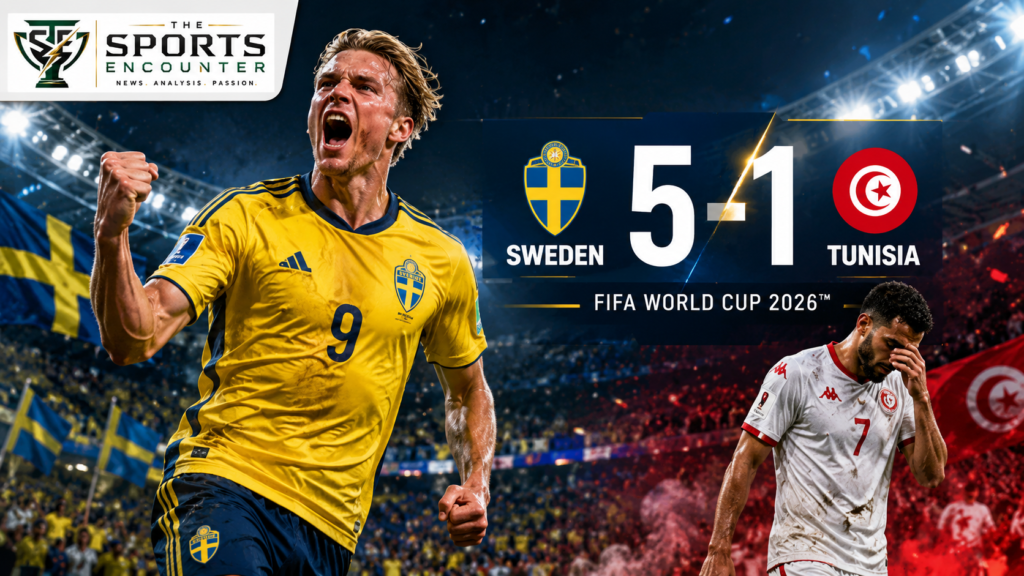
Sweden made one of the loudest early statements of the FIFA World Cup 2026 with a commanding 5-1 win over Tunisia in their Group F opener in Monterrey.
It was a ruthless, confident, and surprisingly one-sided performance from Graham Potter’s side, who punished Tunisia’s defensive mistakes, pressed with purpose, and used the attacking chemistry of Alexander Isak, Viktor Gyökeres, and Yasin Ayari to take control of the match before Tunisia could settle.
For more tournament coverage, follow our FIFA World Cup 2026 hub.
Sweden Start Fast and Never Let Tunisia Breathe
Sweden did not need much time to expose Tunisia’s defensive uncertainty.
The tone was set early when Tunisia goalkeeper Mouhib Chamakh failed to deal cleanly with a direct ball forward. Viktor Gyökeres reacted quickly, Sweden kept the move alive, and Yasin Ayari finished with power to give the European side the perfect start.
That early goal changed the emotional shape of the match.
Tunisia had arrived needing discipline, patience, and defensive calm. Instead, they were dragged into a game Sweden clearly preferred. Potter’s side looked stronger in transition, cleaner in the final third, and far more comfortable when the match opened up.
Sweden’s second goal came through Alexander Isak, whose low effort found a way past Chamakh. It was another painful moment for Tunisia, not only because of the scoreline, but because the goal reflected a broader problem. Their defensive structure lacked confidence, and their goalkeeper looked badly shaken.
Tunisia Find a Brief Way Back
Tunisia did show one flash of real quality before halftime.
Hannibal Mejbri, one of the few Tunisian players willing to demand the ball and carry responsibility, delivered from the right side. Omar Rekik met the cross and guided his header in to reduce the deficit.
That goal gave Tunisia a lifeline.
For a short spell, they looked more willing to step higher, play with bravery, and ask Sweden questions. The problem was that their comeback needed control, not emotion. Sweden remained dangerous every time Tunisia gave the ball away, and the North African side never truly looked settled enough to build sustained pressure.
Gyökeres and Isak Turn the Match Into a Rout
The second half belonged to Sweden’s front line.
Gyökeres was central to almost everything good Sweden produced. His movement stretched Tunisia’s defenders, his physical presence disrupted their rhythm, and his finishing gave Sweden the third goal that killed Tunisia’s comeback hopes.
Isak also played with the intelligence of a forward who understood when to combine, when to press, and when to attack space. His role in Sweden’s fourth goal showed that clearly, as Mattias Svanberg came off the bench and finished sharply after Sweden again found room inside Tunisia’s defensive shape.
By that point, the match had moved beyond Tunisia’s reach.
Ayari then added his second late in the game, sealing a personal performance that will be remembered as one of the standout individual displays of the early group stage.
Key Match Points
What Went Wrong for Tunisia?
Tunisia’s biggest issue was not effort. It was control.
Their defensive line looked uncomfortable against Sweden’s direct running. The midfield struggled to protect the back four when Sweden moved quickly through transition. Most damaging of all, individual mistakes gave Sweden the kind of chances a strong attacking team rarely wastes.
Sabri Lamouchi’s side also had a difficult emotional balance to manage. After going behind early, Tunisia tried to become more adventurous. That created moments of promise, especially through Mejbri, but it also left space for Sweden to attack.
Against a side with Isak and Gyökeres leading the line, that was a dangerous trade.
Tunisia now face serious pressure in their remaining Group F matches against Japan and the Netherlands. Their tournament is not over, but this result leaves them with very little room for error.
Read more of our tournament analysis in the FIFA World Cup 2026 coverage section.
What This Win Means for Sweden
For Sweden, this was more than three points.
It was a statement that their attack can hurt teams quickly and repeatedly. Potter’s side looked balanced, confident, and tactically clear. Sweden used a 3-4-1-2 structure that allowed width, central combinations, and direct access into their two main forwards.
Ayari’s performance added another layer to the story. His two goals gave Sweden a different type of threat from midfield, while Gyökeres and Isak gave Tunisia constant problems with their movement and power.
Sweden will face stronger tests, especially against the Netherlands and Japan, but this result gives them a major platform in Group F. Goal difference could matter later, and a four-goal winning margin is a valuable early advantage.
Player of the Match: Yasin Ayari
Yasin Ayari was the clear standout.
His first goal gave Sweden control. His second completed the rout. Beyond the goals, he played with energy, timing, and composure in key moments.
There was also a personal twist to his performance. Ayari was born in Sweden to a Tunisian father, which made his double against Tunisia one of the more emotional subplots of the match.
Football often writes these strange stories. On this night, Ayari wrote Sweden’s first major chapter of the tournament.
Final Verdict
Sweden were clinical. Tunisia were careless. That was the simple truth of the match.
Potter’s team looked like a side with structure, attacking confidence, and belief. Tunisia looked like a team still trying to discover its identity under pressure.
A 5-1 scoreline can sometimes flatter a team. This one did not feel unfair. Sweden earned the margin because they forced mistakes, attacked them quickly, and kept pushing until the final whistle.
Group F now has its first major statement.
Sweden have momentum.
Tunisia have questions.
And the rest of the group has been warned.