


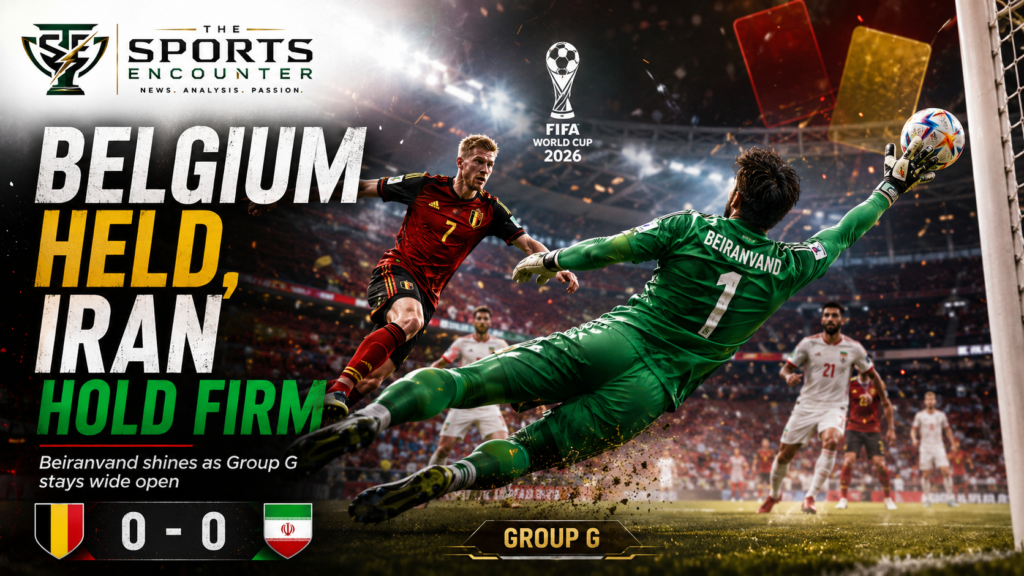
Belgium had the stronger names, the cleaner possession spells, and the bigger attacking reputation. Kevin De Bruyne tried to find rhythm between the lines. Romelu Lukaku gave Iran’s center backs a physical reference point. Leandro Trossard and Dodi Lukebakio offered movement from wider areas.
Still, Belgium never turned pressure into punishment.
Iran stayed compact, protected the middle, and forced Belgium into shots that required precision rather than power. When Belgium did finally break through the defensive line, Alireza Beiranvand produced the kind of goalkeeping display that changes the emotional value of a draw.
For more tournament context, fixtures, match reports, and group-stage analysis, follow The Sports Encounter’s FIFA World Cup 2026 hub.
Beiranvand Gives Iran the Point They Needed
Iran’s best player was easy to identify.
Alireza Beiranvand did not only make saves. He changed Belgium’s mood.
His biggest moment came in the second half when Belgium created their clearest passage of the match. De Bruyne helped open the space, Maxim De Cuyper arrived in a dangerous position, and Belgium looked ready to turn control into a lead. Beiranvand somehow got across and pushed the effort away.
That save mattered for more than the scoreline.
Belgium had already been growing frustrated. Iran had spent long stretches defending without much possession. A goal at that stage could have broken the match open. Instead, Beiranvand kept Iran level and forced Belgium to start again.
He also dealt with Lukebakio’s curling effort, commanded his area under late pressure, and refused to give Belgium the cheap rebound they needed. His performance was not built on one highlight. It was built on timing, body shape, patience, and concentration.
Goalkeepers often get praised when they make dramatic saves. Beiranvand deserved praise because he managed the entire final third around him. He held his line when Belgium wanted him to move early. He stayed upright long enough to react. He also gave Iran’s back line the confidence to keep defending deep without panic.
After Iran’s wild 2-2 draw with New Zealand, this was a different kind of point. That opener showed Iran’s fight. This match showed their structure. Readers can revisit that first Group G result here: Iran Fight Back Twice to Deny New Zealand in Wild 2-2 World Cup Opener.
Belgium’s Attack Still Looks Too Slow for Its Talent
Belgium’s problem was not effort.
It was sharpness.
They moved the ball well enough in phases, but too many attacks needed an extra touch. Too many final passes arrived half a second late. Too many crosses asked Lukaku to solve traffic rather than attack space.
That matters because Belgium are not playing like a team with margin.
They drew 1-1 with Egypt in their opener. Now they have drawn 0-0 with Iran. Two games, two points, one goal, and no clear attacking rhythm. Belgium are still unbeaten, but unbeaten does not mean comfortable in a 48-team World Cup group.
The warning signs were already visible before this match. Belgium came into Day 11 needing a sharper performance, as explained in The Sports Encounter’s FIFA World Cup 2026 Day 11 preview, but Iran turned that pressure into another uncomfortable night for Roberto Martinez’s side.
Their issue is not only finishing. It is tempo before the finish.
When De Bruyne had space, Belgium looked dangerous. When Iran collapsed around him, Belgium needed faster rotations and braver off-ball runs. Instead, the attack often became predictable. Iran could read the next pass, shift across, and trust Beiranvand when the block finally cracked.
That is a dangerous pattern for Belgium.
A side with De Bruyne, Lukaku, Trossard, Tielemans, and Lukebakio should not look short of ideas for this long. Tournament football does not wait for reputations to warm up.
Nathan Ngoy’s Red Card Changes the Match
Belgium’s frustration became heavier after Nathan Ngoy was sent off in the second half.
The red card came after a defensive mistake opened space for Mehdi Taremi. Ngoy pulled him back and left the referee with a major decision. Belgium were reduced to 10 men, and Iran suddenly had the crowd, the moment, and the belief that a famous win might be there.
Iran did not fully gamble after the red card, which may frustrate some supporters. But it was understandable.
A win would have pushed Iran close to the Round of 32. A defeat would have undone the value of two hard-earned draws. Iran chose control over chaos, especially with Egypt still waiting in the final group match.
Belgium, meanwhile, had to protect the point while still searching for a winner. That balance never looked comfortable. The late attacks came, but they carried more desperation than clarity.
Taremi’s Offside Warning Shows Iran Had a Real Threat
Iran were not only defending.
Mehdi Taremi gave Belgium enough problems to keep the match honest. His disallowed goal showed exactly why Belgium could not push recklessly. Taremi’s movement between defenders remained Iran’s best attacking weapon, and his ability to turn loose passes into danger forced Belgium’s back line to stay alert.
That is why the red card felt so important.
Belgium were not punished on the scoreboard, but Ngoy’s dismissal came from the kind of moment Iran had been waiting for. One mistake. One forward reading the pass early. One defender forced into a desperate decision.
Iran lacked the final attacking volume to win, but they did enough to prove this was not a passive point.
Group G Qualification Picture After Belgium vs Iran
Group G is still alive for all four teams.
Iran now sit on two points from two matches after draws against New Zealand and Belgium. Belgium also have two points after draws against Egypt and Iran. Egypt later changed the group’s mood by beating New Zealand, a result covered in Salah Leads Egypt to Historic First World Cup Win as New Zealand Collapse After Bright Start.
Under the FIFA World Cup 2026 format, the top two teams in each group qualify automatically for the Round of 32. The eight best third-placed teams also move forward, which means four points will likely be valuable and three points may still keep a team in the wider survival conversation depending on goal difference and results across other groups.
For a full explanation of the expanded format, read The Sports Encounter’s guide: Know All About FIFA World Cup 2026 Qualification Process.
What Iran Need Next
Iran face Egypt in their final Group G match.
A win would move Iran to five points, which should be enough to qualify and could even win the group depending on the other result. A draw would take them to three points, keeping them alive but likely pushing them into a nervous wait around second place or the best third-place table.
A defeat would leave Iran on two points and make qualification unlikely unless other results fall kindly.
Iran’s biggest lesson from the Belgium draw is clear. Their defensive structure can travel. Their goalkeeper can rescue them. But against Egypt, they may need more attacking courage earlier in the match.
What Belgium Need Next
Belgium face New Zealand in their final group match.
A win would take Belgium to five points and should send them through. A draw would leave them on three points, which may still be enough in some scenarios, but it would feel risky because goal difference, goals scored, discipline, and other group results could all enter the conversation.
A defeat would leave Belgium stuck on two points and in real danger of a second straight ugly World Cup group-stage exit.
Belgium’s final match is no longer routine. It is a test of whether they can turn talent into urgency before the tournament starts moving without them. For the full fixture path and tournament dates, readers can also check The Sports Encounter’s FIFA World Cup 2026 schedule.
Final Word: Iran Found Control, Belgium Lost Certainty
This was not a classic 0-0.
It had tension, a disallowed goal, a red card, late Belgian pressure, and one goalkeeper who gave Iran a platform to believe.
Belgium will see it as two points dropped. That is fair. They had enough quality to win and enough pressure to force the issue earlier. But quality on paper does not break a compact block by itself. Belgium needed speed, precision, and conviction. They only found those things in short bursts.
Iran will see it differently.
They were organized, emotionally steady, and protected by a goalkeeper who understood the moment. Beiranvand turned Belgium’s best chances into frustration and gave Team Melli a real route into the final group match.
Belgium still have the players to escape Group G.
Iran still have the fight to make this group uncomfortable for everyone.
After this draw, neither team can relax. But Iran may leave Los Angeles feeling slightly better about who they are.
Belgium leave knowing they still have to prove it.