


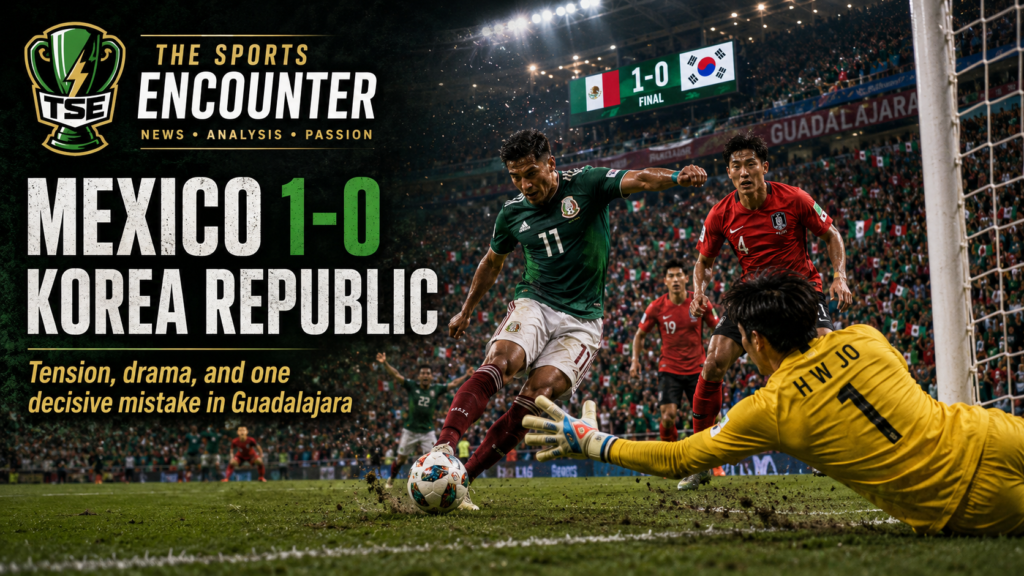
Mexico became the first team to reach the FIFA World Cup 2026 knockout stage after a tense 1-0 win over Korea Republic, but the match was far more dramatic than the scoreline suggested.
Mexico 1-0 Korea Republic: One Error, One Finish, One Massive Result
Mexico did not need a masterpiece to take control of Group A.
They needed patience, pressure, one Korea Republic mistake, and a goalkeeper brave enough to protect the lead when the match finally caught fire.
In a high-voltage FIFA World Cup 2026 Group A clash at Estadio Akron in Guadalajara, Mexico beat Korea Republic 1-0 through Luis Romo’s second-half strike. The win pushed the co-hosts into the knockout stage and gave their home crowd another night to remember.
For Korea Republic, this was painful. They had survived Mexico’s early energy, settled into the match, and looked capable of dragging the game into a tactical arm wrestle. Then one moment between goalkeeper Kim Seung-gyu and defender Lee Gi-hyuk changed the night.
The result also added another sharp chapter to a World Cup that has already produced drama across the groups, from DR Congo’s shock result against Portugal to England’s chaotic win over Croatia.
Romo Punishes the Moment Korea Republic Lost Control
The decisive moment came in the 50th minute.
Mexico sent the ball into a dangerous area, Korea Republic failed to clear with authority, and Kim Seung-gyu moved to collect. Instead of killing the danger, the Korean goalkeeper collided with Lee Gi-hyuk and spilled the ball into Romo’s path.
Romo reacted faster than everyone else.
That was the difference.
Mexico had not been cutting Korea Republic open at will. This was not a match filled with free-flowing attacking football. It was tight, physical, nervy, and full of tactical hesitation. That made Romo’s reaction even more important. In World Cup football, one loose touch can become a national memory.
Korea Republic’s frustration was clear because they had worked so hard to keep Mexico uncomfortable. Kim Min-jae marshaled the back line with his usual authority, while Lee Han-beom and Lee Gi-hyuk spent long spells absorbing Mexico’s pressure.
For almost 50 minutes, Korea Republic’s defensive plan looked disciplined enough to frustrate the co-hosts.
Then the whole structure cracked.
Korea Republic’s Defensive Work Deserved More Than Defeat
This match will be remembered for Kim Seung-gyu’s error, but that should not erase Korea Republic’s defensive effort.
Hong Myung-bo’s side started under pressure. Mexico pressed high, pushed runners into the channels, and tried to use the energy of the home crowd to force early mistakes. Korea Republic bent, but they did not collapse.
Kim Min-jae read several dangerous situations before they became clear chances. Hwang In-beom and Paik Seung-ho worked hard to screen the back three. The wingbacks also had to make hard recovery runs because Mexico kept trying to stretch the pitch.
That was the real tactical fight.
Mexico wanted width, tempo, and second balls. Korea Republic wanted compact spaces, controlled possession after recovery, and quick releases into Son Heung-min and Lee Kang-in.
The Korean plan was not pretty, but it was working.
Until the goalkeeper’s mistake handed Mexico the one opening they could not afford to give away.
Raúl Rangel Becomes Mexico’s Late Hero
If Romo scored the goal, Raúl Rangel protected the result.
Korea Republic pushed harder after falling behind. Son Heung-min started drifting into pockets of space, Lee Kang-in tried to force Mexico’s defenders into awkward one-on-one situations, and the Korean front line finally found more urgency.
Mexico’s defenders had to block, clear, and scramble.
Then came the late moment that could have flipped the entire story.
Rangel produced a brilliant double save when Korea Republic looked ready to equalize. First, he reacted to the initial effort. Then he recovered quickly enough to stop the follow-up. It was the kind of goalkeeping sequence that changes group-stage mathematics.
For Mexico, that save felt almost as valuable as Romo’s goal.
For Korea Republic, it was the moment when hope hit a wall.
A Match Wrapped in Tension, Controversy, and World Cup Noise
This was never just a clean football story.
Before the match, Korea Republic had already dealt with an unusual distraction after reports of a drone near their training camp. Hong Myung-bo later said the incident happened before the team practiced tactics, so it did not directly affect preparations. Still, in a World Cup setting, even a small disruption can feed the emotional pressure around a major fixture.
There was also wider controversy around the matchday atmosphere. FIFA’s anti-discrimination messaging remained visible, with captains exchanging special pennants as part of a campaign against hate speech. Mexico’s fan culture has faced repeated scrutiny in past tournaments, especially over discriminatory chants, so the issue carried extra weight on a night when the co-hosts were chasing qualification.
On the pitch, the tension came from the stakes.
Mexico knew victory would put them through. Korea Republic knew defeat would leave them needing a result in their final group match. That pressure shaped the football. Neither team played with full freedom. Every mistake felt heavier. Every clearance earned a roar. Every Korean attack after the 50th minute carried danger.
This was not a beautiful match.
It was a World Cup match.
There is a difference.
Mexico’s Attack Still Has Questions
Mexico deserve credit for their control, maturity, and ability to win a tight game. Six points from two matches is exactly what a host nation wants.
Still, this performance raised a fair question.
Can Mexico create enough against stronger knockout-stage opponents?
They pressed well early. They attacked with energy. They forced Korea Republic into uncomfortable defensive moments. But the winning goal came from an error, not a clean attacking pattern.
That matters.
The best sides in this tournament will not always gift second chances inside the box. Mexico’s next challenge will be to turn control into clearer openings. Their defensive structure and goalkeeper give them a strong base, but the attack still needs more sharpness in the final third.
The same issue has appeared in several early World Cup stories. Teams are winning tense matches, but many are still searching for rhythm. That pattern also showed up when Uzbekistan made history while Colombia took control, where moments of quality mattered more than long spells of dominance.
Korea Republic Still Have a Way Back
Korea Republic leave Guadalajara hurt, but not finished.
They beat Czechia in their opening match and still have three points. Their final Group A match against South Africa now becomes a test of nerve, recovery, and tactical clarity.
The positive signs are real.
Korea Republic defended with structure. They carried threat when Lee Kang-in found space. Son still attracted Mexican defenders even when service into him was limited. Kim Min-jae remained a commanding figure at the back.
The problem was execution in the decisive moments.
World Cups are cruel that way. A team can perform large parts of its plan correctly and still lose because of one lapse.
Hong Myung-bo now has to make sure that one lapse does not become the emotional center of Korea Republic’s tournament.
What This Result Means for Group A
Mexico now sit in control of Group A with two wins from two. They have beaten South Africa and Korea Republic, kept momentum at home, and reached the knockout stage earlier than anyone else in the tournament.
Korea Republic remain alive, but the margin has tightened.
Their final group match against South Africa will decide whether this defeat becomes a warning or a wound. A strong response could still send Korea Republic through. Another error, another flat attacking spell, or another missed chance could send them into a long summer of regret.
The World Cup has already reminded teams that no group-stage match is safe, as Ghana showed with their late drama against Panama in another gripping tournament story from The Sports Encounter’s FIFA World Cup 2026 coverage.
Final Word
Mexico won because they stayed alive to the loose ball and trusted their goalkeeper when Korea Republic came hard at the end.
Korea Republic lost because one defensive misunderstanding turned a controlled match into a rescue mission.
That is why this match will sting.
It was not a collapse. It was not a mismatch. It was one of those World Cup nights where tension builds slowly, then one mistake writes the headline.