Editor's Choice
Mexico vs South Africa Analysis: 5 Takeaways from the 2026 World Cup Opener
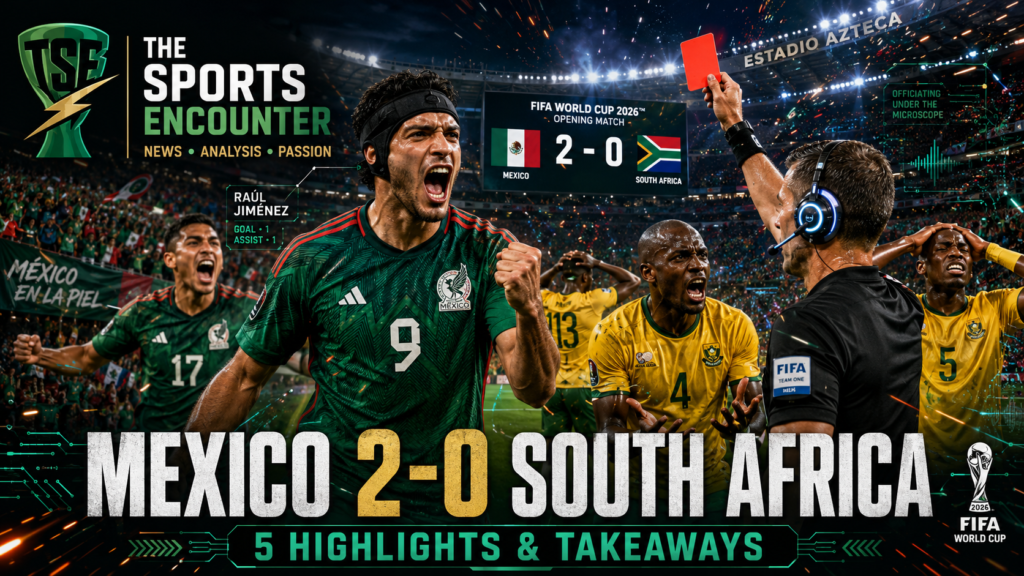
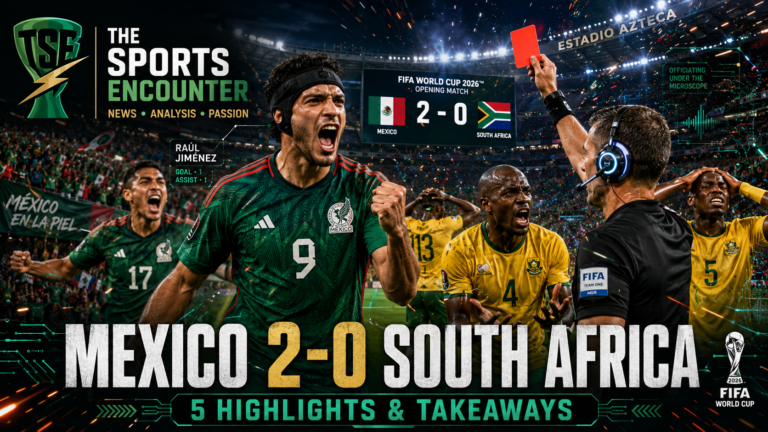
Mexico opened the FIFA World Cup 2026 with a 2-0 win over South Africa at Estadio Azteca, but the result was only half the story. The match will be remembered for three red cards, a tense debate over Wilton Sampaio’s officiating, Mexico’s smart tactical control, South Africa’s lack of attacking quality, and Raúl Jiménez’s emotional first World Cup goal.
For Mexico, this was a statement win built on structure, intensity, and early attacking chemistry. For South Africa, it was a damaging opener that exposed problems with discipline, ball security, and tournament composure.
FIFA World Cup 2026 Opener Offered Drama, Debate, and Instant Reaction
The FIFA World Cup 2026 needed a memorable opening act. Mexico and South Africa delivered one, although not always for the cleanest footballing reasons.
At the historic Estadio Azteca, Mexico beat South Africa 2-0 in front of a roaring home crowd. Julián Quiñones scored the first goal of the tournament in the ninth minute, setting off the kind of early eruption every co-host dreams about. Raúl Jiménez added the second with a powerful header in the second half, giving Mexico control of Group A and giving Mexican fans a night they will remember for years.
ALSO READ: Mexico Beat South Africa 2-0 in World Cup Opener Amid Red Cards Frenzy
Yet the match quickly moved beyond the scoreline.
Three red cards turned the opener into a global talking point. South Africa lost Sphephelo Sithole early in the second half, then substitute Themba Zwane late on. Mexico also finished with 10 men after César Montes was dismissed in stoppage time for a reckless challenge that could hurt El Tri in their next match.
That debate will continue. What is already clear is this: Mexico handled the chaos better than South Africa.
1. Mexico’s Fast Start Changed the Entire Match
Opening matches are often tense. Teams usually spend the first 20 minutes feeling the occasion, measuring risk, and trying not to make the first major mistake.
Mexico did the opposite.
Javier Aguirre’s side pressed with purpose from the opening whistle. The front line did not simply wait for South Africa to make errors. It forced them. Mexico’s pressure around the ball unsettled Bafana Bafana’s buildup, and the early goal came from exactly that kind of aggression.
Quiñones’ ninth-minute strike gave Mexico more than a lead. It gave them emotional command of the match.
From that point, South Africa had to chase the game in one of football’s most intimidating venues. The Azteca crowd grew louder. Mexico’s midfield became sharper in duels. South Africa’s passing became rushed and predictable.
That early goal also allowed Mexico to play the match on its own terms. Aguirre’s team did not need to dominate possession for long stretches in a decorative way. It needed to control territory, win second balls, protect central spaces, and strike when South Africa overcommitted.
That is exactly what Mexico did.
The biggest tactical takeaway from Mexico’s performance was not flair. It was game management. El Tri understood the emotional weight of the occasion and turned it into pressure on South Africa instead of pressure on themselves.
The official FIFA video shows the opening ceremony of the FIFA World Cup 2026 in Mexico.
2. South Africa Looked Overwhelmed by the Stage and the Altitude
South Africa’s return to the World Cup should have been a proud moment. Instead, their opening performance raised serious concerns.
Bafana Bafana looked uncomfortable from the early minutes. The passing was loose. The midfield struggled to receive under pressure. The front line was starved of quality service. South Africa wanted to absorb pressure and break quickly, but that plan depends on clean first passes and brave decision-making in transition.
They had neither for long enough.
The Estadio Azteca factor cannot be ignored. Mexico City’s altitude makes the venue one of the toughest places in world football, especially for teams not fully adapted to its rhythm. South Africa’s legs looked heavy as the match wore on, and their decision-making deteriorated badly in the second half.
But altitude alone cannot explain the performance.
South Africa were too careless in possession. Too often, they played themselves into danger with poor touches or rushed passes. Their attacking transitions lacked timing. Their defensive recovery shape became stretched after the first red card.
The 2-0 scoreline was actually generous to South Africa. Ronwen Williams made key saves that prevented the match from turning into a heavier defeat. In a 48-team World Cup where goal difference could decide third-place qualification routes, those saves may still matter.
South Africa can recover, but they now have two problems at once: a points problem and a performance problem.
3. The Red Cards Defined the Match, but the Referee Debate Is Not Simple
Three red cards in a World Cup opener will always dominate the headlines.
The key question is whether Wilton Sampaio was too harsh or whether the players left him with little choice.
Sithole’s dismissal changed the game’s tactical balance. As the last man, his foul denied Mexico a dangerous attacking situation and left South Africa exposed for the rest of the match. Under modern officiating standards, that kind of decision is difficult to escape if the referee judges it as denial of an obvious goalscoring opportunity.
Zwane’s red card added another layer of controversy. A high-arm challenge on Roberto Alvarado brought VAR into focus and left South Africa with nine men. Hugo Broos and South African supporters will feel that the decision damaged any remaining chance of a comeback.
Then came Montes’ stoppage-time red card for Mexico. That one may be the hardest for Aguirre to accept because it was avoidable. Mexico were 2-0 up. South Africa were already down to nine. There was no need for a rash challenge in that phase of the match.
So, was Sampaio harsh?
The better answer is that he was strict in a match that became increasingly reckless. The opener had emotional heat, physical contact, and rising frustration. A more lenient referee might have allowed the game to flow longer. A stricter one, as Sampaio proved, chose control over tolerance.
For fans, the red cards added chaos. For coaches, they will be used as a warning. In this World Cup, discipline may be as important as tactics.
4. Mexico’s Attack Gave Aguirre a Real Foundation
Mexico’s biggest positive from their FIFA World Cup 2026 opening match was not only the victory. It was the way the attacking players connected and complemented each other.
Quiñones gave Mexico directness, movement, and ruthlessness in front of goal. His early strike was not a random moment. It reflected his constant willingness to attack space, drop into pockets, and force South Africa’s defenders into rushed decisions.
Roberto Alvarado was another major bright spot. His wing play stretched South Africa and gave Mexico a reliable outlet when the game became congested. His assist for Jiménez’s second goal showed quality and composure, especially in a match that had already become physically messy.
Then there was Jiménez.
At 35, his goal carried emotional weight. After everything he has been through in his career, including the serious skull injury that forced him to wear protective headgear, scoring in a World Cup opener at the Azteca was a powerful football story.
It was also tactically important.
Jiménez gave Mexico a focal point. He occupied defenders, attacked crosses, and helped Mexico turn wide pressure into genuine penalty-box threat. Against stronger opponents later in the tournament, Mexico will need that kind of presence.
Aguirre now has a platform. Mexico do not need to become a possession-heavy side overnight. They need their front line to stay efficient, their midfield to protect transitions, and their defenders to avoid unnecessary suspensions.
The attack looked ready. The discipline still needs work.
5. South Africa’s FIFA World Cup 2026 Campaign Is Already Under Pressure
One defeat does not end a World Cup campaign, especially in the expanded 48-team format. But South Africa’s opening loss creates immediate pressure.
They leave the Azteca with zero points, a minus-two goal difference, and two suspended players. That is a brutal combination after only one match.
The bigger concern is tactical flexibility. Sithole’s red card affects midfield balance. Zwane’s suspension removes experience and creativity. Hugo Broos must now rebuild parts of his plan before South Africa face Czechia.
The Czech match now becomes close to must-not-lose territory.
South Africa need to fix three areas quickly.
First, they must improve their first phase of possession. Against Mexico, too many attacks died before they started.
Second, they need better emotional control. Tournament football punishes frustration. One reckless decision can change a match. Two can damage an entire group-stage campaign.
Third, they need more from the forwards. Lyle Foster and Iqraam Rayners were isolated for long stretches, but they also need to offer more movement when service is limited. In World Cup football, forwards sometimes have to create value from very little.
South Africa were lucky to lose by only two goals. That is not a cruel assessment. It is the reality of the match.
Williams kept the scoreline respectable. Mexico missed chances to make it worse. The red cards reduced South Africa’s structure. The next game will show whether this was opening-night shock or a deeper tournament problem.
Tactical Snapshot: Why Mexico Controlled the Key Areas in FIFA World Cup 2026 Opener
| Area | Mexico | South Africa |
|---|---|---|
| Pressing | Aggressive and well-timed | Struggled to play through pressure |
| Midfield control | Strong defensive tracking and second-ball wins | Too many turnovers in dangerous zones |
| Attack | Quiñones, Alvarado, and Jiménez combined well | Forwards lacked service and support |
| Discipline | Mostly controlled, but Montes’ red card was costly | Major collapse with two dismissals |
| Tournament outlook | Strong start, but defensive suspension is a concern | Immediate pressure before second group match |
Was Referee Sampaio Too Harsh?
The referee debate will probably follow this match for days.
Sampaio’s decisions shaped the game, but the match was already heading toward chaos before the second and third red cards. South Africa’s frustration was visible. Mexico’s physical edge also crossed the line late through Montes.
From a neutral tactical viewpoint, the red cards did not create Mexico’s superiority. Mexico were already sharper, more organized, and more dangerous. What the cards did was remove South Africa’s pathway back into the match.
That distinction matters.
Mexico deserved the win. South Africa can still question individual decisions. Both things can be true.
FIFA World Cup 2026: What Mexico Must Fix Before the Next Match
Mexico’s victory gives them breathing room, but Aguirre will not view this as a complete performance.
Montes’ suspension is the immediate issue. Losing a center-back after a needless red card creates avoidable disruption. In a short group stage, defensive continuity matters.
Mexico also need to be more ruthless when opponents are reduced to nine men. The match could have been killed earlier and more emphatically. Better teams will not offer that many second chances.
Still, this was a strong opening statement. Mexico showed emotional control for most of the night, handled the pressure of hosting, and found goals from two important forwards.
FIFA World Cup 2026: What South Africa Must Fix Before Facing Czechia
South Africa need a reset, not panic.
Broos must rebuild midfield structure and restore confidence quickly. The next match will require calmer possession, better spacing between midfield and attack, and more discipline in duels.
South Africa’s best hope is to treat the Mexico match as a damage-control lesson. The performance was poor, but the scoreline did not completely destroy their tournament math. In the expanded World Cup format, recovery remains possible.
But the margin for error is already thin.
Another slow start, another red card, or another loose passing display could turn this campaign into a short and painful return to the world stage.
Final Verdict
Mexico’s 2-0 win over South Africa was not a perfect performance, but it was exactly the kind of opener a host nation needs: early goal, emotional control, attacking confidence, and three points.
South Africa, meanwhile, leave with hard questions. Their discipline collapsed. Their transition plan failed. Their goalkeeper protected them from a heavier defeat. Their next match now carries serious pressure.
The FIFA World Cup 2026 opener will be remembered for the red cards, the Azteca atmosphere, and the referee debate. But beneath the chaos, the football lesson was simple.
Mexico looked like a team ready for the occasion.
South Africa looked like a team swallowed by it.
FAQs About FIFA World Cup 2026 Opening Match
Who scored for Mexico against South Africa in the FIFA World Cup 2026 opener?
Julián Quiñones scored Mexico’s first goal in the ninth minute, while Raúl Jiménez added the second with a second-half header.
How many red cards were shown in Mexico vs South Africa?
Three red cards were shown. South Africa had Sphephelo Sithole and Themba Zwane sent off, while Mexico’s César Montes was dismissed late in stoppage time.
Was Mexico’s win over South Africa deserved?
Yes. Mexico were sharper, more organized, and more dangerous throughout the match. South Africa’s red cards made the scoreline harder to reverse, but Mexico had already taken control before the dismissals.
Why did South Africa struggle against Mexico?
South Africa struggled with Mexico’s pressing, the Azteca atmosphere, altitude, poor ball retention, and a major second-half disciplinary collapse.
What is Mexico’s biggest concern after the opener?
Mexico’s biggest concern in the FIFA World Cup 2026 is César Montes’ suspension. His late red card creates a defensive selection problem for Javier Aguirre before the next group match.
Can South Africa still qualify from the group?
Yes, South Africa can still qualify, especially under the expanded World Cup format. However, they must respond quickly, improve discipline, and avoid another damaging result in their next match.
Source Attribution
This analysis is based on verified match reporting, live match updates, and post-match details from Reuters, major sports outlets, and tournament coverage of the Mexico vs South Africa 2026 FIFA World Cup opener.
The Sports Encounter’s World Cup 2026 coverage focuses on fixtures, team news, match analysis, fan stories, tournament trends, and the biggest talking points from football’s global stage.
Editor's Choice
Carolina Hurricanes Go 3-2 Up in Stanley Cup Final After Game 5 Win Over Vegas Golden Knights
The Carolina Hurricanes are now one win away from turning a long wait into a Stanley Cup final victory celebration.
Carolina Hurricanes beat the Vegas Golden Knights 4-2 in Game 5 of the Stanley Cup Final in Raleigh, taking a 3-2 lead in the best-of-seven series and moving within one victory of their first championship since 2006. Game 6 will be played Sunday in Las Vegas, where the Golden Knights must respond or watch Carolina lift the Cup on their ice.
This was not a perfect Hurricanes performance. Vegas scored first. The Golden Knights pushed late. Carolina had to survive a tense 6-on-4 situation in the closing minutes. Yet that may be exactly why this win matters so much.
Championship teams do not always win cleanly. They win the moments that wobble.
Carolina did that in Game 5.
Jordan Staal’s Final Keeps Getting Bigger for Carolina Hurricanes
Jordan Staal has turned this Stanley Cup Final into a captain’s series.
The 37-year-old scored for the fifth straight game, becoming the first player to score in each of the first five games of a Stanley Cup Final since Jean Beliveau did it for the Montreal Canadiens in 1956. That is not just a neat historical footnote. It explains why Carolina suddenly feels like a team carrying emotional weight and tactical balance at the same time.
ALSO READ: Stanley Cup Final at Even Stevens as Hurricanes Win Game 4
Staal’s goal came in the first period after Vegas had taken a 1-0 lead through Pavel Dorofeyev. Instead of letting the Golden Knights settle into the night, Staal redirected a shot-pass from Nikolaj Ehlers past Carter Hart to tie the game.
That response changed the mood inside Lenovo Center.
Vegas had the opening goal. Carolina had the answer.
In a Stanley Cup Final, that matters. Momentum does not just come from goals. It comes from who looks least disturbed by pressure.
Right now, that team is Carolina.
Svechnikov Turns Power Play Into Punishment
If Staal gave the Hurricanes emotional control, Andrei Svechnikov gave them separation.
Svechnikov scored twice on the power play, including the goal that put Carolina ahead 2-1 in the second period and another in the third to stretch the lead to 4-1. Sebastian Aho also scored late in the second period, giving Carolina four unanswered goals after falling behind early.
That four-goal run tells the real story of Game 5.
Vegas did not collapse immediately. The Golden Knights still had dangerous stretches. Jack Eichel assisted both Dorofeyev goals, and Dorofeyev kept Vegas alive by scoring again in the third period. But Carolina’s special teams and top-end forwards punished the Golden Knights at the exact points where the game could have tilted back.
Svechnikov’s first goal came after Brayden McNabb took a cross-checking penalty. His second arrived during a double-minor high-sticking penalty to Mark Stone. Vegas could not afford those mistakes in Raleigh. Carolina made sure they were expensive.
Brandon Bussi Rewards Brind’Amour’s Brave Call
One of the biggest storylines of the series has been Carolina coach Rod Brind’Amour’s decision to trust Brandon Bussi in goal.
That call looked bold after Bussi replaced Frederik Andersen in Game 4. After Game 5, it looks like one of the defining decisions of the Final.
Bussi made 23 saves in his second straight start and helped Carolina protect the lead late, including during Vegas’ final power-play push with Carter Hart pulled.
The numbers do not fully capture the pressure. Bussi was not simply protecting a regular-season lead in November. He was guarding a Game 5 advantage in the Stanley Cup Final, with the Hurricanes one mistake away from giving Vegas fresh life.
He did enough.
That is all Carolina needed.

For a team built on structure, pressure, and depth, stable goaltending at this stage can become the final piece. Bussi does not need to steal every game. He needs to give the Hurricanes confidence that their system will not be undone by nervous moments.
Game 5 suggested he can do that.
Vegas Golden Knights Still Has Life, But the Problems Are Growing
The Golden Knights are not finished. They still return to Las Vegas for Game 6, and this is a roster with enough skill, championship experience, and edge to force a Game 7.
But the warning signs are clear.
Vegas has now lost two straight games after taking a 2-1 series lead. Carter Hart made 20 saves in Game 5, but Carolina has found ways to beat him repeatedly during the Final. Vegas also lost forward William Karlsson to an apparent left arm injury in the second period, and coach John Tortorella said Karlsson is likely unavailable for the rest of the series.
That is a major blow.
Karlsson gives Vegas experience, defensive detail, and center-depth value. Losing a player like that in a Stanley Cup Final does not just affect line combinations. It affects matchups, special teams, faceoff plans, and late-game trust.
Vegas now has two problems at once: win Game 6 and solve Carolina’s growing rhythm.
That is not impossible. It is just getting harder.
Why Game 5 Felt Like a Championship Shift for Carolina Hurricanes
This was the type of game that often defines a Final.
Carolina Hurricanes did not dominate every second. The Hurricanes took a punch, answered it, built a lead, then held firm under late pressure. Staal scored again. Svechnikov took over on the power play. Aho delivered a big second-period goal. Ehlers produced three assists. Shayne Gostisbehere added two assists. Bussi stood strong enough in net.
That is championship layering.
One hero can win a night. Multiple contributors can win a series.
Carolina Hurricanes now has that feeling. The captain is scoring. The stars are contributing. The goalie switch has not backfired. The building believes. The bench looks settled. Vegas, meanwhile, is starting to look like the team reacting rather than dictating.
Still, the Stanley Cup does not hand itself over because a team leads 3-2. Carolina must now close on the road, inside a hostile Las Vegas building, against a Golden Knights team that knows how quickly a series narrative can flip.
Staal said after the win that the fourth victory is always the toughest. He is right. The first three wins create hope. The fourth one creates history.
Carolina is close.
Vegas is cornered.
Game 6 now becomes more than an elimination game. It becomes a test of whether the Hurricanes can turn momentum into memory.
Source Attribution: NHL.com
The Sports Encounter’s NHL coverage focuses on match reports, series analysis, player performances, tactical trends, fan impact, and the biggest talking points from hockey’s biggest stage.
Cricket
Jason Holder Propels West Indies to T20I win over Sri Lanka
West Indies opened the T20I series against Sri Lanka with a seven-wicket win at Sabina Park, Kingston, thanks to the heroics of former skipper Jason Holder. However, the scoreline only tells part of the story.
According to The Sports Encounter, this was a match shaped by control, surface reading, and the one familiar Caribbean all-rounder reminding everyone why he still matters in the shortest format.
Jason Holder: Player of the Match Performance
Sri Lanka posted 147 for 9 after choosing to bat, a total that looked competitive only because their bowlers fought hard later in the chase. West Indies reached 149 for 3 in 19.2 overs, with Shai Hope anchoring the pursuit through an unbeaten 65 from 54 balls and Rovman Powell finishing the match with a six. Jason Holder was named Player of the Match after taking 3 for 18 in four overs, the most decisive spell of the night.
Jason Holder’s role was central because he attacked Sri Lanka’s innings at exactly the point where it could have moved beyond West Indies’ control. Pathum Nissanka and Kusal Mendis gave Sri Lanka a fast start, adding 43 in 4.2 overs. Then Holder changed the rhythm with two wickets in two balls, removing Nissanka for 18 and Lasith Croospulle for a first-ball duck. Sri Lanka went from 43 without loss to 43 for 2 in the space of two deliveries.
ALSO READ: Clinical Bangladesh Seal Historic ODI Series Win Over Australia
That short burst did more than damage the scorecard. It disturbed Sri Lanka’s batting order and forced Mendis to rebuild while still carrying the responsibility of keeping the innings moving. In T20 cricket, that is often where matches quietly turn. The scoreboard may still look healthy, but the dressing room starts recalculating. Batters stop playing the next ball freely and start thinking about the next wicket.
How Kusal Mendis Missed His Zalmi Partner
Mendis tried to resist that shift. His 36 from 23 balls included two fours and three sixes, and for a brief period he looked like the one Sri Lankan batter capable of turning a difficult surface into a 165-plus total. Yet his dismissal at 65 for 4 left Sri Lanka with too much repair work. Kamindu Mendis later made 51 from 39 balls, while Dasun Shanaka added 22, but the innings never fully recovered its early bite.

This is where the Babar Azam comparison becomes interesting. Mendis did not simply miss runs. He missed a stabilizing presence at the other end, the kind of partner who allows an aggressive batter to attack without feeling exposed every over.
During PSL 2026, Mendis and Babar built one of the most productive partnerships of the tournament for Peshawar Zalmi. Against Karachi Kings, they put on 191 for the second wicket, the highest partnership for any wicket in PSL history. Mendis scored 109 from 52 balls, while Babar remained unbeaten on 87 from 51.
That partnership mattered because it showed what Mendis looks like when he has trust at the other end. Babar’s value in such stands is rarely only about boundaries. He absorbs pressure, reads match tempo, and gives his partner room to play instinctively. Against West Indies, Mendis had no such cushion after Holder’s double strike. He was captain, wicketkeeper, attacking batter, and stabilizer all at once. That burden narrowed Sri Lanka’s scoring options.
West Indies Back to Merry Old Ways of T20I Cricket
West Indies, by contrast, looked like a side rediscovering the old T20I language that once made them feared around the world. Power still exists in the lineup, but this win was not built on reckless hitting. It was constructed through bowling intelligence, role clarity, and controlled aggression.
Jason Holder explained after the match that he took a close look at the surface before bowling and felt a fuller length would work better than banging the ball in too short. He also said the pitch was two-paced, and his focus was to keep the stumps in play and make Sri Lanka hit him from a good length.
That is the sign of a more mature West Indies T20 setup. The old version often relied on overwhelming batting firepower. This version still has the six-hitting muscle, but it also seems to understand that modern T20I cricket is won through phases. Holder and Shamar Joseph took three wickets each. Roston Chase gave away only 19 runs in four overs and took a wicket. Sri Lanka scored only 25 runs in the last five overs of their innings, which kept the target below the danger zone.
Then came the chase. Brandon King’s 37 from 22 balls gave West Indies the perfect launch. The hosts scored 66 in the powerplay, putting Sri Lanka under pressure before spin could fully settle into the contest. Hope then played the senior batter’s role, even when Sri Lanka dragged the chase deeper than West Indies would have wanted.
Sri Lanka Tried Their Best to Spoil the Party
Sri Lanka deserve credit for making the chase uncomfortable. Wanindu Hasaranga removed King and Shimron Hetmyer, while Maheesh Theekshana conceded only 20 runs in four overs. Eshan Malinga dismissed Chase and kept the pressure alive. At 128 for 3 in the 16.4th over, Sri Lanka still had a small opening.
But West Indies had done enough early. That is the lesson from the match. Jason Holder’s wickets reduced Sri Lanka’s ceiling. King’s powerplay hitting reduced West Indies’ chase pressure. Hope’s unbeaten half-century prevented panic. Powell’s six completed the job.
For Sri Lanka, the concern is clear. Mendis cannot keep carrying multiple roles without deeper batting support. Kamindu showed composure, but Sri Lanka need a top-order partnership that gives their captain space to attack with freedom. The contrast with his PSL chemistry alongside Babar is hard to ignore because it explains the human side of batting partnerships. Some players do not just add runs. They change how safely others can express themselves.
For West Indies, this was more than a series-opening win. It was a signal. Their T20I identity may be returning, but in a sharper, more structured form. Holder gave them control. Hope gave them calm. King gave them speed. The bowlers gave them discipline.
The Caribbean side once ruled T20 cricket through intimidation. At Sabina Park, they showed something more dangerous for future opponents: intimidation backed by method.
The Sports Encounter’s World Cup 2026 coverage focuses on fixtures, team news, match analysis, fan stories, tournament trends, and the biggest talking points from football’s global stage.
Breaking News
Roberto Baggio: The Man Who Died Standing
Some footballers are remembered for lifting trophies. Some are remembered for goals, medals, celebrations, and parades. Roberto Baggio is remembered for silence.
A painful silence.
The kind of silence that falls over a stadium when one man realizes that the whole world will remember him for the one thing he failed to do, not for everything he had done before it, The Sports Encounter observed.
At the 1994 FIFA World Cup, Baggio did not simply play for Italy. He carried Italy. He dragged a nervous, unconvincing, struggling side through danger, doubt, and near elimination. He gave his country life when the tournament looked lost. He turned broken matches into miracles.
Then, in the final, football did something cruel.
It reduced his entire World Cup to one missed penalty.
Brazil celebrated. Italy froze. Baggio stood alone in the middle of the Rose Bowl in Pasadena, head down, hands on hips, the ball gone over the bar and a lifetime of pain suddenly written across his face.
That image became history.
But it was never the full truth.
Roberto Baggio was not the villain of the 1994 World Cup final.
He was the reason Italy reached it.
Italy Were Falling Before Roberto Baggio Lifted Them
Italy arrived at USA 1994 with pride, tradition, and expectation, but their tournament began badly. A 1-0 defeat to the Republic of Ireland immediately placed the Azzurri under pressure.
They were not playing like champions. They looked tense. They looked heavy. They looked like a team carrying history rather than writing it.
For large parts of that tournament, Italy did not flow.
They survived.
And survival needed someone special.
That someone was Roberto Baggio.
He was not loud. He was not physically imposing. He did not need to dominate with anger or arrogance. Baggio carried a different kind of strength. He had softness in his feet and steel in his mind. He played like a man who could hear football differently from everyone else.
ALSO READ: Mexico vs South Africa Analysis: 5 Takeaways from the 2026 World Cup Opener
When Italy reached the knockout stage, their World Cup nearly ended against Nigeria.
Italy trailed 1-0. Gianfranco Zola had been sent off. Time was running out. The Italians were almost gone.
Then Baggio appeared.
In the 88th minute, with Italy standing on the edge of elimination, he scored.
Not a wild strike. Not a desperate swing. A calm finish under impossible pressure.
That was Baggio.
When others panicked, he breathed.
When Italy were dying, he gave them air.
He then scored again from the penalty spot in extra time. Italy won 2-1 and stayed alive.
That match should have been remembered as one of the greatest rescue acts in Italian football history. Instead, it became one chapter that many people forgot because the ending of the tournament was louder than the journey.
Spain Felt His Genius
Against Spain in the quarterfinal, Italy again needed someone to break the tension.
The match was level at 1-1. The clock was moving toward extra time. Every touch mattered. Every mistake could become fatal.
Then Baggio made his move.
He slipped through, rounded the goalkeeper, and finished from a tight angle. It was not just a goal. It was a moment of cold courage.
Many players can score when a team is already flying.
Baggio scored when a nation was holding its breath.
That is what made him different.
He did not decorate Italy’s World Cup. He saved it.
Bulgaria Saw the Divine Ponytail at His Best
By the semifinal, Baggio had already rescued Italy twice.
Still, he was not finished.
Bulgaria had become one of the stories of the tournament. They had beaten Germany. Hristo Stoichkov was playing with fire in his boots. Bulgaria believed destiny had opened a door for them.
Baggio closed it.
Two first-half goals. Two moments of technical beauty. Two reminders that some players do not need many chances to change history.
Italy won 2-1.
Baggio had taken them to the final.
By that point, his 1994 World Cup had already become legendary. He had scored five goals in the knockout rounds. He had rescued Italy against Nigeria. He had punished Spain. He had stopped Bulgaria.
He had done what only the very greatest players do.
He had made an imperfect team believe it could touch glory.
Then Came Pasadena
The final against Brazil was tense, cautious, and exhausting.
Brazil had Romario, Bebeto, Dunga, and a team full of power, discipline, and belief. Italy had defensive pride, tactical structure, and one tired genius carrying too much emotional weight.
The match ended 0-0 after extra time.
Then came penalties.
Football can be beautiful for 120 minutes and brutal in five kicks.
Franco Baresi missed for Italy.
Daniele Massaro missed for Italy.
Brazil moved ahead.
Then Baggio walked toward the penalty spot.
This is the part that still hurts.
Because that walk was not just a football moment. It looked like a man walking into judgment.
He had carried Italy for weeks. He had answered every emergency. He had turned fear into hope. But now, with his body tired and the World Cup almost gone, Italy still needed him to save them one more time.
One more miracle.
One more rescue.
One more act of genius.
He struck the ball.
It flew over the bar.
Brazil were world champions.
Baggio stood still.
No fall. No scream. No dramatic collapse.
Just stillness.
His head lowered. His hands on his hips. His body upright, but something inside him clearly broken.
That is why he became the man who died standing.
Roberto Baggio: The Cruelty of One Image
Football can be unfair in the way it remembers.
It loves simple stories. Winners and losers. Heroes and villains. Glory and failure.
Baggio’s story was too complex for that.
So football made it simple.
It took one image from Pasadena and allowed it to swallow the whole tournament.
The miss became bigger than the miracle.
The final became bigger than the road to the final.
The pain became bigger than the greatness.
That is the tragedy.
ALSO READ: FIFA World Cup 2026 Curtain Raiser: The B(oldest) Event Ever?
People remember the ball going over the bar before they remember the goal against Nigeria.
They remember the silence before they remember the winner against Spain.
They remember the heartbreak before they remember the two goals against Bulgaria.
They remember the failure of one kick before they remember the courage of an entire World Cup.
But truth does not disappear just because memory becomes lazy.
Roberto Baggio did not lose Italy the World Cup.
Roberto Baggio gave Italy a World Cup final.
Roberto Baggio: A Hero Without Full Recognition
Baggio is loved. No one can deny that.
But love is not always the same as recognition.
He is admired as a beautiful footballer. He is respected as a genius. He is remembered as one of Italy’s greats.
Still, his 1994 World Cup is not honored with the full weight it deserves.
If another player had carried a nation through the knockout rounds and won the trophy, that campaign would be treated as immortal.
Baggio did almost everything except lift the cup.
That missing final step changed the way history judged him.
And that is painfully unfair.
Because greatness should not always depend on the last kick.
Sometimes greatness is found in the burden carried before that kick ever happens.
Baggio’s burden was enormous.
He played with the expectation of a football nation. He played through pressure, pain, and exhaustion. He became Italy’s answer to every problem. Then, when he finally missed, the same football world that had relied on him allowed him to stand alone with the blame.
There is something deeply human in that.
Many people know that feeling.
You can do ten things right, then one mistake becomes your identity.
You can carry people through difficult days, then they remember the one day you could not carry them anymore.
That is why Baggio’s story still hurts.
It is not only about football.
It is about how cruel memory can be to those who gave everything.
The Divine Ponytail Was Still Human
His nickname, Il Divin Codino, “The Divine Ponytail,” made him sound untouchable.
But he was not untouchable.
He was human.
That is what made the moment so painful.
The man who looked so calm with the ball at his feet suddenly looked completely alone. The player who had given Italy belief now stood as the face of national heartbreak.
There was no hiding place in Pasadena.
The camera found him. History froze him. The world judged him.
But maybe that stillness was also his final act of courage.
He did not run from the moment.
He did not turn away.
He stood there and took the pain.
That image is often treated as failure.
Maybe it should be seen differently.
Maybe it was dignity.
Maybe it was a man accepting the most painful moment of his career without asking anyone else to carry it for him.
The Final Verdict
Roberto Baggio’s 1994 World Cup story should not be remembered as the story of a missed penalty.
It should be remembered as the story of a man who carried Italy as far as his body and soul could take them.
He saved them against Nigeria.
He punished Spain.
He broke Bulgaria.
He gave Italy a final they probably had no right to reach.
Then, at the very end, he missed.
That is the painful truth. But it is not the whole truth.
The whole truth is that Roberto Baggio was Italy’s hero before football turned him into its scapegoat.
He was the miracle before he became the memory.
He was the light before the shadow.
He was the man who stood alone while others celebrated, carrying not just defeat, but the weight of being misunderstood forever.
History gave Brazil the trophy.
But it gave Baggio something different.
A wound that never fully healed.
A legacy that still makes football fans emotional.
A silence that still speaks.
Roberto Baggio did not die as a villain in Pasadena.
He died standing as a hero football never fully thanked.