


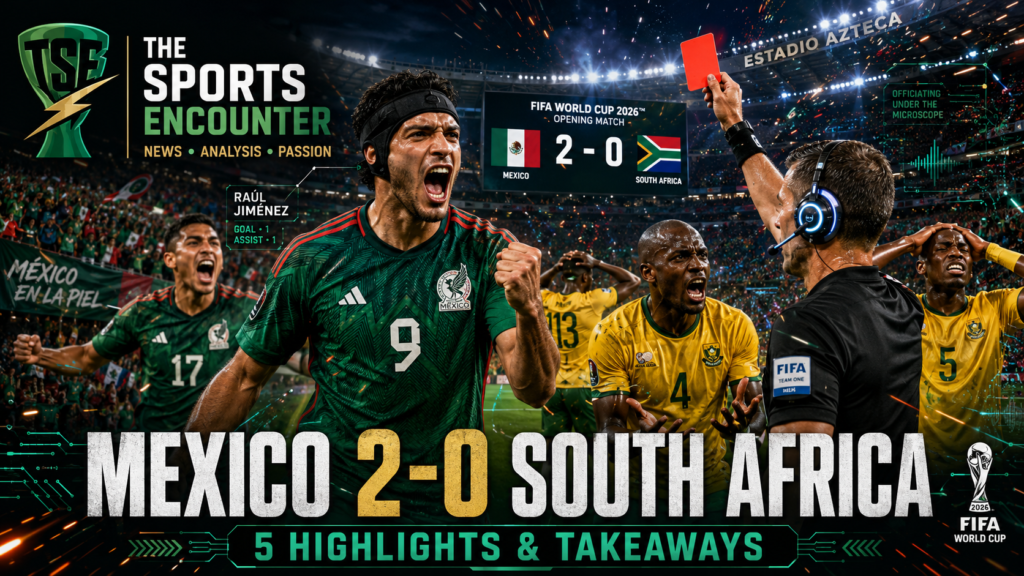
Mexico opened the FIFA World Cup 2026 with a 2-0 win over South Africa at Estadio Azteca, but the result was only half the story. The match will be remembered for three red cards, a tense debate over Wilton Sampaio’s officiating, Mexico’s smart tactical control, South Africa’s lack of attacking quality, and Raúl Jiménez’s emotional first World Cup goal.
For Mexico, this was a statement win built on structure, intensity, and early attacking chemistry. For South Africa, it was a damaging opener that exposed problems with discipline, ball security, and tournament composure.
FIFA World Cup 2026 Opener Offered Drama, Debate, and Instant Reaction
The FIFA World Cup 2026 needed a memorable opening act. Mexico and South Africa delivered one, although not always for the cleanest footballing reasons.
At the historic Estadio Azteca, Mexico beat South Africa 2-0 in front of a roaring home crowd. Julián Quiñones scored the first goal of the tournament in the ninth minute, setting off the kind of early eruption every co-host dreams about. Raúl Jiménez added the second with a powerful header in the second half, giving Mexico control of Group A and giving Mexican fans a night they will remember for years.
ALSO READ: Mexico Beat South Africa 2-0 in World Cup Opener Amid Red Cards Frenzy
Yet the match quickly moved beyond the scoreline.
Three red cards turned the opener into a global talking point. South Africa lost Sphephelo Sithole early in the second half, then substitute Themba Zwane late on. Mexico also finished with 10 men after César Montes was dismissed in stoppage time for a reckless challenge that could hurt El Tri in their next match.
That debate will continue. What is already clear is this: Mexico handled the chaos better than South Africa.
1. Mexico’s Fast Start Changed the Entire Match
Opening matches are often tense. Teams usually spend the first 20 minutes feeling the occasion, measuring risk, and trying not to make the first major mistake.
Mexico did the opposite.
Javier Aguirre’s side pressed with purpose from the opening whistle. The front line did not simply wait for South Africa to make errors. It forced them. Mexico’s pressure around the ball unsettled Bafana Bafana’s buildup, and the early goal came from exactly that kind of aggression.
Quiñones’ ninth-minute strike gave Mexico more than a lead. It gave them emotional command of the match.
From that point, South Africa had to chase the game in one of football’s most intimidating venues. The Azteca crowd grew louder. Mexico’s midfield became sharper in duels. South Africa’s passing became rushed and predictable.
That early goal also allowed Mexico to play the match on its own terms. Aguirre’s team did not need to dominate possession for long stretches in a decorative way. It needed to control territory, win second balls, protect central spaces, and strike when South Africa overcommitted.
That is exactly what Mexico did.
The biggest tactical takeaway from Mexico’s performance was not flair. It was game management. El Tri understood the emotional weight of the occasion and turned it into pressure on South Africa instead of pressure on themselves.
The official FIFA video shows the opening ceremony of the FIFA World Cup 2026 in Mexico.
2. South Africa Looked Overwhelmed by the Stage and the Altitude
South Africa’s return to the World Cup should have been a proud moment. Instead, their opening performance raised serious concerns.
Bafana Bafana looked uncomfortable from the early minutes. The passing was loose. The midfield struggled to receive under pressure. The front line was starved of quality service. South Africa wanted to absorb pressure and break quickly, but that plan depends on clean first passes and brave decision-making in transition.
They had neither for long enough.
The Estadio Azteca factor cannot be ignored. Mexico City’s altitude makes the venue one of the toughest places in world football, especially for teams not fully adapted to its rhythm. South Africa’s legs looked heavy as the match wore on, and their decision-making deteriorated badly in the second half.
But altitude alone cannot explain the performance.
South Africa were too careless in possession. Too often, they played themselves into danger with poor touches or rushed passes. Their attacking transitions lacked timing. Their defensive recovery shape became stretched after the first red card.
The 2-0 scoreline was actually generous to South Africa. Ronwen Williams made key saves that prevented the match from turning into a heavier defeat. In a 48-team World Cup where goal difference could decide third-place qualification routes, those saves may still matter.
South Africa can recover, but they now have two problems at once: a points problem and a performance problem.
3. The Red Cards Defined the Match, but the Referee Debate Is Not Simple
Three red cards in a World Cup opener will always dominate the headlines.
The key question is whether Wilton Sampaio was too harsh or whether the players left him with little choice.
Sithole’s dismissal changed the game’s tactical balance. As the last man, his foul denied Mexico a dangerous attacking situation and left South Africa exposed for the rest of the match. Under modern officiating standards, that kind of decision is difficult to escape if the referee judges it as denial of an obvious goalscoring opportunity.
Zwane’s red card added another layer of controversy. A high-arm challenge on Roberto Alvarado brought VAR into focus and left South Africa with nine men. Hugo Broos and South African supporters will feel that the decision damaged any remaining chance of a comeback.
Then came Montes’ stoppage-time red card for Mexico. That one may be the hardest for Aguirre to accept because it was avoidable. Mexico were 2-0 up. South Africa were already down to nine. There was no need for a rash challenge in that phase of the match.
So, was Sampaio harsh?
The better answer is that he was strict in a match that became increasingly reckless. The opener had emotional heat, physical contact, and rising frustration. A more lenient referee might have allowed the game to flow longer. A stricter one, as Sampaio proved, chose control over tolerance.
For fans, the red cards added chaos. For coaches, they will be used as a warning. In this World Cup, discipline may be as important as tactics.
4. Mexico’s Attack Gave Aguirre a Real Foundation
Mexico’s biggest positive from their FIFA World Cup 2026 opening match was not only the victory. It was the way the attacking players connected and complemented each other.
Quiñones gave Mexico directness, movement, and ruthlessness in front of goal. His early strike was not a random moment. It reflected his constant willingness to attack space, drop into pockets, and force South Africa’s defenders into rushed decisions.
Roberto Alvarado was another major bright spot. His wing play stretched South Africa and gave Mexico a reliable outlet when the game became congested. His assist for Jiménez’s second goal showed quality and composure, especially in a match that had already become physically messy.
Then there was Jiménez.
At 35, his goal carried emotional weight. After everything he has been through in his career, including the serious skull injury that forced him to wear protective headgear, scoring in a World Cup opener at the Azteca was a powerful football story.
It was also tactically important.
Jiménez gave Mexico a focal point. He occupied defenders, attacked crosses, and helped Mexico turn wide pressure into genuine penalty-box threat. Against stronger opponents later in the tournament, Mexico will need that kind of presence.
Aguirre now has a platform. Mexico do not need to become a possession-heavy side overnight. They need their front line to stay efficient, their midfield to protect transitions, and their defenders to avoid unnecessary suspensions.
The attack looked ready. The discipline still needs work.
5. South Africa’s FIFA World Cup 2026 Campaign Is Already Under Pressure
One defeat does not end a World Cup campaign, especially in the expanded 48-team format. But South Africa’s opening loss creates immediate pressure.
They leave the Azteca with zero points, a minus-two goal difference, and two suspended players. That is a brutal combination after only one match.
The bigger concern is tactical flexibility. Sithole’s red card affects midfield balance. Zwane’s suspension removes experience and creativity. Hugo Broos must now rebuild parts of his plan before South Africa face Czechia.
The Czech match now becomes close to must-not-lose territory.
South Africa need to fix three areas quickly.
First, they must improve their first phase of possession. Against Mexico, too many attacks died before they started.
Second, they need better emotional control. Tournament football punishes frustration. One reckless decision can change a match. Two can damage an entire group-stage campaign.
Third, they need more from the forwards. Lyle Foster and Iqraam Rayners were isolated for long stretches, but they also need to offer more movement when service is limited. In World Cup football, forwards sometimes have to create value from very little.
South Africa were lucky to lose by only two goals. That is not a cruel assessment. It is the reality of the match.
Williams kept the scoreline respectable. Mexico missed chances to make it worse. The red cards reduced South Africa’s structure. The next game will show whether this was opening-night shock or a deeper tournament problem.
Tactical Snapshot: Why Mexico Controlled the Key Areas in FIFA World Cup 2026 Opener
| Area | Mexico | South Africa |
|---|---|---|
| Pressing | Aggressive and well-timed | Struggled to play through pressure |
| Midfield control | Strong defensive tracking and second-ball wins | Too many turnovers in dangerous zones |
| Attack | Quiñones, Alvarado, and Jiménez combined well | Forwards lacked service and support |
| Discipline | Mostly controlled, but Montes’ red card was costly | Major collapse with two dismissals |
| Tournament outlook | Strong start, but defensive suspension is a concern | Immediate pressure before second group match |
Was Referee Sampaio Too Harsh?
The referee debate will probably follow this match for days.
Sampaio’s decisions shaped the game, but the match was already heading toward chaos before the second and third red cards. South Africa’s frustration was visible. Mexico’s physical edge also crossed the line late through Montes.
From a neutral tactical viewpoint, the red cards did not create Mexico’s superiority. Mexico were already sharper, more organized, and more dangerous. What the cards did was remove South Africa’s pathway back into the match.
That distinction matters.
Mexico deserved the win. South Africa can still question individual decisions. Both things can be true.
FIFA World Cup 2026: What Mexico Must Fix Before the Next Match
Mexico’s victory gives them breathing room, but Aguirre will not view this as a complete performance.
Montes’ suspension is the immediate issue. Losing a center-back after a needless red card creates avoidable disruption. In a short group stage, defensive continuity matters.
Mexico also need to be more ruthless when opponents are reduced to nine men. The match could have been killed earlier and more emphatically. Better teams will not offer that many second chances.
Still, this was a strong opening statement. Mexico showed emotional control for most of the night, handled the pressure of hosting, and found goals from two important forwards.
FIFA World Cup 2026: What South Africa Must Fix Before Facing Czechia
South Africa need a reset, not panic.
Broos must rebuild midfield structure and restore confidence quickly. The next match will require calmer possession, better spacing between midfield and attack, and more discipline in duels.
South Africa’s best hope is to treat the Mexico match as a damage-control lesson. The performance was poor, but the scoreline did not completely destroy their tournament math. In the expanded World Cup format, recovery remains possible.
But the margin for error is already thin.
Another slow start, another red card, or another loose passing display could turn this campaign into a short and painful return to the world stage.
Final Verdict
Mexico’s 2-0 win over South Africa was not a perfect performance, but it was exactly the kind of opener a host nation needs: early goal, emotional control, attacking confidence, and three points.
South Africa, meanwhile, leave with hard questions. Their discipline collapsed. Their transition plan failed. Their goalkeeper protected them from a heavier defeat. Their next match now carries serious pressure.
The FIFA World Cup 2026 opener will be remembered for the red cards, the Azteca atmosphere, and the referee debate. But beneath the chaos, the football lesson was simple.
Mexico looked like a team ready for the occasion.
South Africa looked like a team swallowed by it.
FAQs About FIFA World Cup 2026 Opening Match
Who scored for Mexico against South Africa in the FIFA World Cup 2026 opener?
Julián Quiñones scored Mexico’s first goal in the ninth minute, while Raúl Jiménez added the second with a second-half header.
How many red cards were shown in Mexico vs South Africa?
Three red cards were shown. South Africa had Sphephelo Sithole and Themba Zwane sent off, while Mexico’s César Montes was dismissed late in stoppage time.
Was Mexico’s win over South Africa deserved?
Yes. Mexico were sharper, more organized, and more dangerous throughout the match. South Africa’s red cards made the scoreline harder to reverse, but Mexico had already taken control before the dismissals.
Why did South Africa struggle against Mexico?
South Africa struggled with Mexico’s pressing, the Azteca atmosphere, altitude, poor ball retention, and a major second-half disciplinary collapse.
What is Mexico’s biggest concern after the opener?
Mexico’s biggest concern in the FIFA World Cup 2026 is César Montes’ suspension. His late red card creates a defensive selection problem for Javier Aguirre before the next group match.
Can South Africa still qualify from the group?
Yes, South Africa can still qualify, especially under the expanded World Cup format. However, they must respond quickly, improve discipline, and avoid another damaging result in their next match.
Source Attribution
This analysis is based on verified match reporting, live match updates, and post-match details from Reuters, major sports outlets, and tournament coverage of the Mexico vs South Africa 2026 FIFA World Cup opener.
The Sports Encounter’s World Cup 2026 coverage focuses on fixtures, team news, match analysis, fan stories, tournament trends, and the biggest talking points from football’s global stage.