


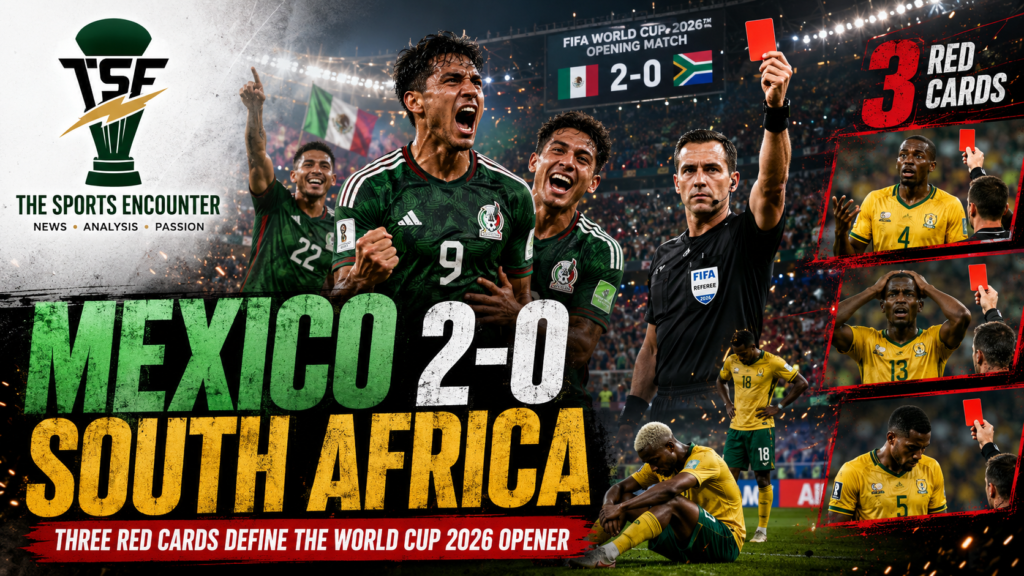
Mexico thrived in the World Cup opener in front of the packed home crowd, but not with the clean, flowing performance the tournament might have hoped for.
At the Mexico City Stadium, better known to football fans as the Azteca, the co-hosts beat South Africa 2-0 in the opening match of the FIFA World Cup 2026. Julián Quiñones scored the first goal of the World Cup in the ninth minute, and Raúl Jiménez made it 2-0 midway through the second half.
That should have been the main story.
Instead, the match will probably be remembered for something else: three red cards in one World Cup opener.
South Africa finished with nine men after Sphephelo Sithole and Themba Zwane were sent off in the second half. Mexico also ended the night with 10 players after César Montes received a late red card in stoppage time. For an opening match meant to launch the expanded 48-team World Cup with color, rhythm, and celebration, this became a game shaped by discipline, frustration, and a referee who refused to let much slide.
Mexico Strike Early and Control the Mood
Mexico did not need long to settle the nerves.
With the crowd behind them and South Africa struggling to deal with their pressing, Mexico forced early mistakes and attacked with purpose. The opening goal arrived in the ninth minute, when Quiñones took advantage of Mexico’s front-foot pressure and finished powerfully to give the hosts a dream start.
It was the kind of goal that immediately changed the temperature of the night. South Africa had arrived as underdogs, but the early concession made their task much heavier. Instead of growing into the occasion, they looked hesitant, loose in possession, and short of attacking conviction.
Mexico were not brilliant throughout the first half, but they did enough. They pressed high, moved the ball with greater confidence, and found spaces behind a South African side that never looked fully comfortable.
Quiñones could have doubled Mexico’s lead before halftime when he struck the post. Raúl Jiménez also had moments around the box, while South Africa’s best attacking phases came through long balls and isolated breaks rather than sustained pressure.
At halftime, Mexico led 1-0. South Africa were still technically in the game, but only on the scoreboard.
South Africa’s Lacklustre Display Left Them Chasing Shadows
South Africa’s biggest problem was not just the red cards. It was the performance before and between those moments.
They lacked control in midfield, struggled to build cleanly from the back, and failed to give their forwards enough quality service. There were brief spells when they pressed Mexico and pushed higher, but those moments never developed into real pressure.
This was not a brave defeat where an underdog kept punching until the final whistle. South Africa looked disjointed, reactive, and short of clarity. Their passing was loose. Their decision-making was rushed. Their attacking structure never stretched Mexico enough.
Even before going down to 10 men, Bafana Bafana were second best.
After Sithole’s dismissal early in the second half, the match became even more one-sided. Mexico pushed South Africa deeper and deeper, and the second goal felt inevitable. Jiménez finally delivered it in the 67th minute, meeting a cross with a composed header to make it 2-0.
From there, South Africa were trying to avoid damage rather than chase the match.
In truth, they were lucky to lose by only two goals. Mexico had enough chances and enough territory to win more comfortably. A sharper final pass, a cleaner finish, or a little more ruthlessness could have turned this into a painful opening-night rout.
Three Red Cards Turn the Match Into a Debate
The first major flashpoint came in the 50th minute.
Sithole was shown red after bringing down a Mexican runner in a dangerous position. South Africa felt the decision was harsh, but the referee appeared to judge that the foul stopped a clear attacking opportunity. Whether it was a straight red or a second-yellow situation, the effect was the same: South Africa were reduced to 10 men with almost the entire second half still to play.
That moment broke whatever balance remained in the game.
The second red card came in the 84th minute when Zwane was dismissed after an off-the-ball incident involving Roberto Alvarado. Replays showed Zwane raising his hand toward Alvarado’s face. That is always dangerous territory for a player. Once the referee reviewed it, the decision became difficult to avoid.
The third red card came deep into stoppage time, and this one will probably create the most debate. Montes brought down Khuliso Mudau near the edge of the area as South Africa tried to break. The referee judged it as denial of a goal-scoring opportunity and sent the Mexican defender off.
That decision felt the harshest of the three.
Mudau was advancing into a promising area, but there was enough doubt about angle, control, and covering defenders to argue that a yellow card would have been more appropriate. Even Montes looked shocked. On another night, with another referee, that might have stayed as a caution. Check out the official FIFA rules about red cards.
Was the Referee Too Harsh?
The short answer: on one decision, probably. On all three, not really.
Sithole’s red card can be debated because the contact did not look violent, but the referee appeared to focus on the attacking situation rather than the force of the foul. If he judged it as denying a clear chance, the decision fits the law, even if it felt severe in the moment.
Zwane’s dismissal was the clearest. Players know the risk when they raise a hand toward an opponent’s face. It does not matter whether the contact is born from frustration, irritation, or a moment of stupidity. At World Cup level, with cameras everywhere and VAR available, that kind of action rarely survives review.
Montes’ red card was different. It looked like a cynical foul, yes. It deserved punishment. But a straight red felt heavy. There was enough uncertainty to make a yellow card seem more reasonable.
So was the referee harsh?
He was strict, certainly. He also set a very low tolerance level for tactical fouls and off-the-ball behavior. But South Africa cannot hide behind the officiating. Their own poor discipline made the referee’s job easier, and their football did not give them enough protection from those decisions.
The official highlights from the FIFA World Cup opening match between Mexico and South Africa.
Mexico Get the Job Done, But Questions Remain
For Mexico, this was an important win but not a flawless performance.
They handled the occasion well. They scored early. They used the crowd. They created enough danger to keep South Africa under pressure. Quiñones gave them spark, Jiménez gave them a proper striker’s finish, and the midfield controlled long phases after South Africa went down to 10 men.
Still, Mexico should have killed the game earlier. Against stronger teams, missed chances and late defensive lapses could matter more. Montes’ red card also leaves them with a selection problem for the next match, depending on suspension rules and squad balance.
But opening matches are often more about survival than perfection. Mexico survived the pressure, took three points, and gave their fans the winning start they demanded.
South Africa Need a Reset Fast
South Africa now face a serious early tournament problem.
A 2-0 defeat is not fatal in a 48-team World Cup, especially with more group-stage pathways available. But the manner of the performance will worry Hugo Broos and his coaching staff.
They were passive for too long. They lacked composure under pressure. They lost discipline when the game began to slip away. Two red cards in the second half is not bad luck. It points to frustration, poor emotional control, and a team that failed to manage the moment.
If South Africa want to stay alive in the group, they need a sharper structure, cleaner ball progression, and far better decision-making in their next match.
They were beaten by two goals, but the gap on the field looked wider.
Final Verdict
Mexico’s 2-0 win over South Africa gave the FIFA World Cup 2026 the opening result many home fans expected, but the night will be filed under controversy more than quality.
Quiñones and Jiménez gave Mexico the goals. South Africa’s poor display gave Mexico control. The referee gave the world something to argue about.
Three red cards in one match will dominate the headlines, but the deeper truth is simpler: Mexico were better, South Africa were poor, and the scoreline probably flattered Bafana Bafana more than it punished them.
The World Cup has begun. Not beautifully, perhaps, but definitely loudly.