Connect with us

Published

on

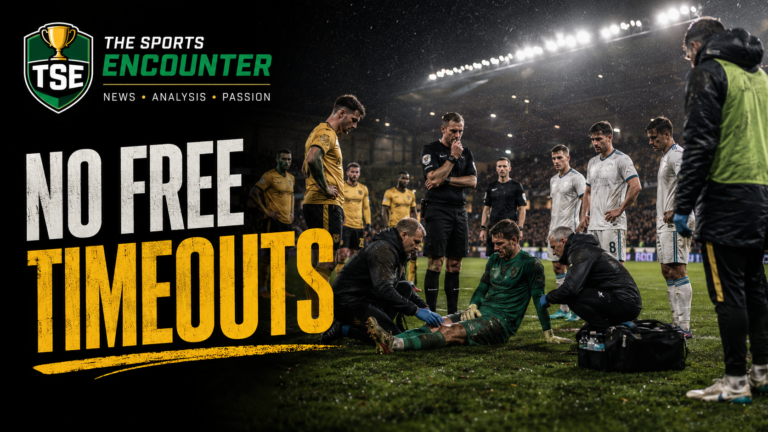
English football’s proposed trial to stop tactical goalkeeper injury breaks may look like a small rule tweak. In reality, it could reshape how managers control momentum, how referees manage stoppages, and how teams protect pressure in the Premier League, EFL, WSL, and beyond.

English soccer may be about to close one of the game’s most obvious tactical loopholes.

A new trial has been proposed to stop teams from using goalkeeper injury stoppages as unofficial timeouts. Under the proposed rule, if a goalkeeper receives on-pitch treatment, one outfield player from the same team must leave the field for one minute. The team would have 10 seconds to nominate that player. If no player is nominated in time, the captain would leave by default.

The trial still needs approval from the International Football Association Board, known as IFAB, but the plan could be tested across English football, including the Premier League, English Football League, National League, and Women’s Super League. Reuters reported that the first trial could come in the League Cup preliminary round between Tranmere Rovers and Rochdale on August 1.

This is not only about time-wasting. It is about power.

Modern football has become a game of tactical detail, data-led preparation, in-game coaching, pressing triggers, rest-defense structures, substitutions, set-piece routines, and sideline communication. Every stoppage now has value. A goalkeeper going down for treatment can give a manager 60 seconds to reorganize a press, calm a rattled team, break an opponent’s rhythm, or deliver a tactical correction without using a substitution window.

English football’s proposed trial aims to remove that reward. If it works, it could change how teams behave under pressure.

TL;DR: What is the proposed goalkeeper timeout rule?

Question Answer
What is being proposed? If a goalkeeper receives on-pitch treatment, one outfield teammate must leave the pitch for one minute.
Why? To stop teams from using goalkeeper injury stoppages as tactical timeouts.
Who chooses the player? The team has 10 seconds to nominate one outfield player.
What happens if no one is chosen? The captain must leave the field by default.
Where could it be tested? Across English football, including the Premier League, EFL, National League, and WSL, subject to IFAB approval.
What are the exceptions? Clear fouls, bleeding injuries, suspected concussions, collisions involving the goalkeeper, and genuine safety-related cases.

Why English soccer is targeting goalkeeper injury breaks

Football has always had gamesmanship. Players slow restarts. Goalkeepers take extra seconds. Defenders stand over free kicks. Substituted players walk slowly. Managers use every legal pause to pass information.

The goalkeeper injury break has become more sensitive because it creates a unique loophole.

Outfield players who receive treatment usually have to leave the pitch temporarily. Goalkeepers are treated differently because a team cannot realistically restart play without one. That practical exception has created room for manipulation. A goalkeeper can go down, receive treatment, and remain on the field while teammates walk toward the technical area for instructions.

That can look harmless in isolation. In a high-pressure match, it can change momentum.

A team defending a lead can use the pause to slow the game. A side under heavy pressing can reset its structure. A manager can adjust marking assignments. A team losing control after conceding chances can breathe, gather, and restart with a clearer plan.

That is why this trial matters. It tries to make the stoppage costly enough that teams stop treating goalkeeper treatment as a free tactical reset.

How the rule could change Premier League matches

The Premier League would feel this change quickly because the league already operates at a tactical speed where small pauses matter.

High-pressing teams build pressure through rhythm. They want repeat attacks, quick restarts, crowd energy, and emotional momentum. A goalkeeper injury break can puncture that rhythm at exactly the wrong time.

Under the proposed trial, a team would think twice before using that tactic because losing an outfield player for one minute can be dangerous. Even one minute with a temporary numerical disadvantage can create space for a shot, a cross, a second ball, or a set-piece mismatch.

That risk could force managers to find cleaner ways to communicate. Teams may rely more on pre-planned signals, captain-led adjustments, coded instructions, and faster sideline messaging during natural stoppages.

It could also increase the value of intelligent on-field leaders. Midfielders, center-backs, and captains who can read tactical problems without constant sideline correction may become even more important.

That leadership element connects with a wider football trend The Sports Encounter has covered in stories such as how leadership changes the meaning of greatness in modern sport. Different game, same principle: structure matters most when pressure rises.

Why this could hit defensive teams hardest

The biggest impact may come in matches where one team spends long periods defending.

A lower-block side under pressure often uses stoppages to survive. Goalkeeper delays, treatment pauses, substitutions, slow restarts, and tactical instructions all help drain emotion from the game. Supporters may hate it, but coaches understand its value.

The proposed rule would not remove defensive resilience. It would make artificial breaks harder to justify.

If a goalkeeper genuinely needs treatment, the rule allows safety-related exceptions. If the stoppage looks tactical, the team may have to sacrifice an outfield player for 60 seconds. That creates a direct sporting cost.

Imagine a team leading 1-0 away from home in the 78th minute. The home side has momentum, corners, and crowd noise. The away goalkeeper goes down. Under the proposed trial, the away team may lose an outfield player for the restart period. That one-minute window could become a major attacking opportunity.

In English soccer, where late pressure often decides matches, that is not a minor detail.

The rule may change how managers coach during games

Managers love control. Modern coaches want structure in every phase: build-up, press, counter-press, rest defense, transitions, set pieces, and game-state management.

Goalkeeper injury stoppages have quietly become a way to regain control without burning a substitution or waiting for halftime.

This trial challenges that habit.

If teams cannot gather freely during goalkeeper treatment, managers will need to build stronger communication systems before the match. Players will need to understand contingency plans. Captains will need authority. Goalkeepers may become tactical communicators rather than tactical timeout triggers.

That could make matches feel more continuous and less coach-controlled. The game may shift slightly back toward player decision-making during live pressure.

For fans, that would be a positive change. Football is most compelling when momentum feels alive. Stoppages can be necessary, but manufactured pauses break the emotional arc of a match.

Why referees will face the toughest job

The idea is simple. The application will be difficult.

Referees must protect player safety while discouraging tactical abuse. That balance will create pressure. If officials apply the rule too aggressively, they may be accused of punishing genuine injuries. If they apply it too softly, teams will keep exploiting the loophole.

The key will be consistency.

The proposed exceptions matter. Clear fouls, bleeding injuries, suspected concussions, goalkeeper collisions, and unavoidable safety-related incidents should not trigger punishment. Medical issues must remain medical issues.

The problem sits in the grey area. A goalkeeper feeling discomfort after a routine save. A cramp complaint during opposition pressure. A keeper going down after no contact. These moments will test referees, fourth officials, medical staff, and managers.

English football already debates officiating every week. Add a new one-minute removal rule, and the early weeks of the trial could bring controversy.

Still, controversy alone does not make a rule bad. The real question is whether the rule improves match flow and reduces obvious manipulation.

How this links to IFAB’s wider battle against time-wasting

This proposed trial fits a wider IFAB push to improve match flow and player behavior. IFAB confirmed earlier this year that it wanted trials to assess tactical injury delays by goalkeepers and explore deterrents. The law-making body has also moved against goalkeeper ball-holding delays.

From the 2025-26 Laws of the Game, goalkeepers face a stronger punishment if they hold the ball for more than eight seconds. After a visible referee countdown, the opposition can receive a corner kick. IFAB explained the change as part of its effort to tackle goalkeeper time-wasting and improve the flow of matches through its official updates on goalkeeper time-wasting.

That means football is attacking two different goalkeeper-related delays at once.

Issue What it targets Consequence
Goalkeeper holding the ball too long Delaying release after catching or controlling the ball Corner kick to the opposition after the eight-second limit
Goalkeeper injury tactical timeout Using treatment breaks to reset tactics One outfield teammate leaves the pitch for one minute

The pattern is clear. Football authorities want fewer dead moments, fewer soft delays, and fewer loopholes that reward manipulation.

Why the WSL and lower leagues matter in this trial

This trial could become especially valuable because it may cover more than the Premier League.

If the Premier League alone tested it, the story would become another elite football debate. If the rule also runs through the EFL, National League, and Women’s Super League, English football can gather a broader evidence base.

Lower leagues often expose practical problems faster. Referees work with fewer cameras. Medical resources differ. Crowd pressure varies. Pitch conditions and match tempo can make interpretation more complicated.

The WSL also matters because tactical goalkeeper stoppages have already drawn attention in women’s football. A successful trial there could help show that this is not only a men’s elite-level issue. It is a football issue.

That broader scope would make the findings more useful for IFAB and other competitions.

Could teams find new loopholes?

Of course they could.

Football teams adapt quickly. If goalkeeper injury timeouts become costly, managers may shift tactical messages to other stoppages. Substitutions, throw-ins, set pieces, hydration breaks, VAR checks, and injury treatment for outfield players may become more important communication windows.

That does not make the trial pointless. Good rules rarely eliminate all manipulation. They reduce the most obvious incentive.

If the goalkeeper treatment break stops functioning as a free timeout, the game improves. Teams can still coach. Players can still receive instructions. The difference is that a questionable goalkeeper injury no longer becomes the easiest route to a full team talk.

Football should reward smart preparation, not fake vulnerability.

The fan experience could improve

Supporters understand when a player is genuinely hurt. They also know when a stoppage feels convenient.

Few things frustrate fans more than a match losing rhythm because of avoidable delays. English soccer sells intensity. The Premier League’s global appeal comes from pace, pressure, noise, and the sense that a match can swing in seconds.

Manufactured pauses damage that product.

This rule could help keep matches moving. It could also reduce the irritation around late-game tactics, especially in matches where one side protects a narrow lead through repeated stoppages.

The Sports Encounter has often explored how modern sport now competes for attention, from World Cup 2026’s potential impact on American soccer viewership to the commercial rise of major women’s basketball events. The lesson is the same: fans reward sports that respect tension, pace, and emotional clarity.

If football wants younger audiences to stay engaged, match flow matters.

What this means for tactical culture in England

English football has always loved physical intensity, but the modern English game is now deeply tactical. Premier League clubs hire specialist coaches for set pieces, restarts, throw-ins, pressing, recruitment, opposition analysis, and in-game strategy.

That sophistication has raised the standard. It has also made every pause more valuable.

The proposed goalkeeper timeout rule sends a clear message: tactical intelligence is welcome, but injury stoppages should not become coaching loopholes.

This could force teams to become more disciplined before matches. Managers may rehearse emergency plans more carefully. Players may learn to adjust shape without huddling near the bench. Captains may carry more in-game responsibility.

In that sense, the rule could improve football rather than simply punish time-wasting.

It may make teams more self-sufficient.

The possible downside: genuine injuries must never feel suspicious by default

The biggest risk is cultural, not technical.

Goalkeepers absorb collisions, awkward landings, shoulder impacts, hand injuries, muscle problems, and head-contact risks. A rule designed to deter tactical misuse must not create pressure on injured goalkeepers to avoid treatment.

Medical staff must remain protected. Referees must make safety the first priority. Managers must avoid turning the rule into a complaint machine every time an opposing goalkeeper receives care.

The game needs a strong deterrent against manipulation. It also needs trust around genuine injury care.

That balance will decide whether the trial earns support.

Why this could become a global rule

If English football runs the trial successfully, other leagues will watch closely.

England offers IFAB a valuable testing ground because its football pyramid has visibility, scale, pressure, and variety. The Premier League brings global scrutiny. The EFL brings match volume. The National League brings practical testing outside elite conditions. The WSL adds a major women’s football context.

If the data shows fewer tactical goalkeeper stoppages, better match flow, and no meaningful increase in medical risk, IFAB could eventually consider a wider law change.

That would make this trial more than an English football experiment. It could become a global football reform.

Final verdict: a small rule that could change match control

English soccer’s proposed goalkeeper timeout trial looks narrow, but its impact could be wide.

It targets one of modern football’s most visible loopholes. It protects match rhythm. It forces managers to coach with more discipline. It gives referees a clearer deterrent. It asks teams to stop treating goalkeeper treatment as a free tactical pause.

The rule will need careful handling. Genuine injuries must remain protected, and referees will need consistent guidance. Early controversy is likely because English football argues over every new law, especially when it affects momentum in close matches.

Still, the principle is strong.

Football should not punish real treatment. It should punish the tactical exploitation of treatment. If this trial can separate those two things fairly, English soccer may help shape the next major step in football’s battle against time-wasting.

For a sport that lives on rhythm, pressure, and emotional momentum, that could matter more than many fans realize.

For more football analysis, tournament coverage, and tactical stories, follow The Sports Encounter’s football coverage, including our work on the FIFA World Cup 2026 fan-voted dream team, why England lost the World Cup 2026 semifinal to Argentina, the Argentina vs Spain World Cup 2026 final preview, and the France vs England third-place preview.


Elma Victors is a London-based accounting professional and sports writer with a strong interest in tennis, soccer, cricket, and major international competitions. Her analytical background shapes a detail-oriented approach to sports coverage, helping her examine performances, statistics, trends, and the human stories behind important sporting events.

Breaking News

Glasgow 2026 Day 4 Wrap-Up: Australia Pulls Away as Nigeria, Jamaica and Scotland Light Up the Games

Australia pulled away at the top of the Glasgow 2026 medal table on Day 4, but Nigeria, Jamaica, Canada, Scotland, and England all delivered major moments across swimming, athletics, gymnastics, weightlifting, and Para sport as the Commonwealth Games moved into full competition mode.

Published

on

VFX cinematic featured image showing Australia standing on top of the Commonwealth Games podium, with England second and Canada third, under stadium lights with The Sports Encounter logo and the headline “Australia Leads the Chase.”

Four days into Glasgow 2026, the medal table has started to look less like a contest at the top and more like an Australian statement.

Australia ended Monday, July 27, with 26 gold, 13 silver and 20 bronze medals, giving it 59 overall. That is a commanding lead after Day 4 and reflects the depth of a team that has turned the pool into its strongest weapon while still finding gold across other venues.

England remained second with 8 gold, 13 silver and 11 bronze for 32 total medals. Canada sat third with 7 gold, 8 silver and 6 bronze. Nigeria climbed into fourth with 6 gold and 4 silver, while Scotland’s 5 golds kept the host nation firmly inside the top five.

For a compact Games built around 10 sports, six Para sports and four venues, Day 4 showed exactly why Glasgow 2026 can still deliver a full multi-sport punch. The official Glasgow 2026 Commonwealth Games website described the day as one packed with standout moments across swimming, athletics, gymnastics and weightlifting.

For more major-event coverage, visit The Sports Encounter’s FIFA World Cup 2026 hub.

Glasgow 2026 Medal Table After Day 4

RankNationGoldSilverBronzeTotal
1Australia26132059
2England8131132
3Canada78621
4Nigeria64010
5Scotland54211
6South Africa33511
7Malaysia3025
8India25310
9Jamaica2002
10New Zealand1438

The Pool Remains Australia’s Power Base

Australia’s Day 4 dominance again began in the water.

Jenna Forrester delivered one of the standout Australian performances by winning the women’s 400m individual medley. Sam Williamson added another gold in the men’s 50m breaststroke, while Meg Harris took the women’s 100m freestyle. Alex Perkins continued Australia’s strong butterfly campaign with gold in the women’s 100m butterfly.

The women’s 4x200m freestyle relay then added another layer to Australia’s pool control, with England taking silver and New Zealand claiming bronze.

This was not only about medal volume. It was about pressure management. Australia looked like a team that expects to win and has enough depth to keep winning even when the schedule becomes heavy. That is what separates a strong swimming nation from a Games-defining one.

For readers who enjoy performance rankings and all-time debates, The Sports Encounter’s ranking of the 10 best NHL players ever uses a similar data-and-context approach.

Rose Davies Gives Australia a Historic Track Moment

Australia’s Day 4 was not limited to swimming.

Rose Davies won gold in the women’s 10,000m, giving Australia one of its most meaningful athletics moments of the Games so far. Her victory mattered because it moved Australia’s success beyond the pool and into the opening night of athletics.

The time, the setting and the timing all helped. Athletics often changes the emotional rhythm of the Commonwealth Games. Swimming can build the early medal table, but track and field gives the Games a different stage, with national pride playing out in front of a louder, more direct crowd.

TL;DR

Day 4 of the Glasgow 2026 Commonwealth Games belonged to Australia on the medal table, but the day’s emotional range stretched far beyond one nation. Australia surged to 26 gold medals and 59 total medals after another dominant swimming night and key wins in athletics and gymnastics. England stayed second overall, Canada moved strongly with hammer throw and gymnastics success, Nigeria turned weightlifting into a gold rush, Jamaica announced itself on the track and in the high jump, while hosts Scotland found one of their loudest moments through Ben Sandilands’ Para athletics gold.

Davies’ win gave Australia a statement at Scotstoun Stadium and reminded rivals that the medal-table leader is not relying on one sport alone.

Nigeria Turns Weightlifting Into a Statement

Nigeria had one of the most important national days of Glasgow 2026.

Rafiatu Lawal won gold in the women’s 58kg weightlifting event, continuing Nigeria’s strong start in the sport. Edidiong Umoafia also delivered gold in the men’s 71kg class, helping Nigeria climb to six gold medals by the end of Day 4.

That number matters.

Nigeria’s medal table position is built on gold efficiency. With 10 total medals and six golds, the team has converted podium chances into top-step finishes at an impressive rate. That is why Nigeria sat fourth overall despite having fewer total medals than Scotland, South Africa and India.

For African sport, this was a day with real visibility. Nigeria’s weightlifters did more than win medals. They gave the country a sharp identity at these Games: powerful, disciplined and dangerous whenever the bar is loaded.

For more global sports stories with national pride at the center, read our feature on Sidny Lopes Cabral’s World Cup wonder goal for Cape Verde.

Jamaica Arrives in Athletics With Two Golds

Jamaica waited for athletics, and then made its entrance properly.

Demario Prince won the men’s 110m hurdles in 13.17 seconds, giving Jamaica a sharp sprint-hurdles statement. Soon after, Romaine Beckford added gold in the men’s high jump with a clearance of 2.25m.

Two golds in quick succession changed Jamaica’s position on the medal table and gave its Games campaign a new feel.

Jamaica does not need a long explanation when athletics begins. The country carries a deep track-and-field identity, and even when the event is not the 100m or 200m, Jamaican victories still bring a certain electricity to a Games.

Prince’s hurdles gold was direct and fast. Beckford’s high jump win added variety. Together, they made Day 4 feel like Jamaica had finally opened its main chapter at Glasgow 2026.

Canada Finds Gold Through Power and Precision

Canada’s Day 4 was built on two very different qualities: raw power and technical control.

Ethan Katzberg won the men’s hammer throw with a massive 80.97m effort. It was the kind of performance that made the event feel settled early. Katzberg entered with world-class authority and performed like an athlete fully comfortable with being the target.

Canada also collected gymnastics gold through Jordan Carroll in the men’s pommel horse and Lia-Monica Fontaine in the women’s vault, while Felix Dolci won the men’s rings final.

That mix helped Canada move to seven gold medals and 21 total medals. More importantly, it showed range. Canada was not relying on one discipline. It found medals through field events, apparatus finals and steady podium depth.

For readers tracking North American sports trends, The Sports Encounter’s NBA coverage hub offers more stories around elite performance, pressure and legacy.

Scotland Gets Its Home-Crowd Moment

Every host nation needs moments that belong to the crowd as much as the athlete.

Ben Sandilands gave Scotland one of those moments by winning gold in the men’s 1500m T20 in 3:57.25. It was one of the loudest emotional wins of Day 4 because it joined performance with place. A Scottish athlete winning at home, in Para athletics, in front of a crowd hungry for a shared release, gave Glasgow a proper Games memory.

Scotland ended Day 4 with 5 gold, 4 silver and 2 bronze medals, good enough for fifth on the medal table. That is a strong position for the host nation, especially in a Games where Australia has already opened a major gap at the top.

Hosts do not need to dominate a Games to define parts of it. They need moments that feel local, loud and lasting. Sandilands gave Scotland exactly that.

England Stays Second Through Depth

England’s Day 4 was not as explosive as Australia’s, but it kept the team second overall.

Luke Whitehouse won gold in the men’s floor exercise, while Thomas Young took the men’s T20 100m title in 11.11 seconds. Sophie Hahn added gold in the women’s T38 100m, and Brock Whiston won the women’s SB8 100m breaststroke.

Adam Ramsay-Peaty’s bronze in the men’s 50m breaststroke also carried attention because of his name, profile and comeback story.

England’s medal table strength is based on spread. The team has 32 medals after Day 4, with 13 silvers and 11 bronzes showing depth across events. The challenge is conversion. Australia has raced ahead because it has turned more finals into gold. England has stayed visible because it keeps reaching podiums.

That difference may define the rest of the Games.

India Adds Weightlifting and High Jump Value

India’s Day 4 was quieter than Australia’s or Nigeria’s, but still important.

India’s medal table showed 2 gold, 5 silver and 3 bronze medals after Day 4. The standout athletics result came through Sarvesh Kushare, who took silver in the men’s high jump behind Jamaica’s Romaine Beckford after clearing the same height of 2.25m.

India also continued to find relevance in weightlifting and boxing, two areas where the country entered Glasgow with real medal expectations.

The broader story for India is still developing. A 10-medal total keeps the team in the top 10, but the next phase will decide whether this becomes a solid Games or a missed opportunity. Boxing quarter-finals, weightlifting finals and athletics events could still reshape that conversation.

For more cricket and India-focused sports coverage, visit The Sports Encounter’s Cricket hub.

Day 4 Changed the Shape of Glasgow 2026

Day 4 mattered because it widened the Games.

The first few days of any Commonwealth Games can feel dominated by the pool and early medal-table movement. Monday changed that. Athletics arrived with genuine force. Weightlifting gave Nigeria a golden identity. Gymnastics spread medals across Australia, England and Canada. Para sport created some of the day’s most emotional wins.

That is the beauty of the Commonwealth Games when they work well. The medal table tells one story, but the day itself tells many.

Australia is clearly the team to chase. England has depth but needs more gold conversion. Canada looks balanced. Nigeria looks dangerous whenever strength sports come into play. Scotland has enough home energy to keep producing headline moments. Jamaica has entered the athletics conversation with perfect timing.

For broader tournament analysis, read our feature on how World Cup 2026 viewership reflected soccer’s rise in the United States.

Final Verdict

Day 4 of Glasgow 2026 gave the Commonwealth Games its clearest shape so far.

Australia is no longer simply leading. It is pulling away. The swimming team remains the main engine, but Rose Davies’ 10,000m gold showed that Australia can also hurt rivals in athletics.

Behind that dominance, the Games became richer. Nigeria’s weightlifters gave their country a golden day. Jamaica announced itself through hurdles and high jump. Canada found medals through hammer throw and gymnastics. Scotland got a home-crowd moment through Ben Sandilands. England stayed second by stacking podiums across sport and Para sport.

The medal table may say Australia owns the Games right now.

Day 4 said something wider: Glasgow 2026 has moved from opening rhythm into full competition mode.

The chase is on, even if Australia has already made everyone else chase from a long way back.

The Sports Encounter’s Commonwealth Games coverage focuses on results, medal-table movement, athlete stories, tactical context, national trends and the biggest talking points from Glasgow 2026.

Continue Reading

Breaking News

Sidny Lopes Cabral’s World Cup Wonder Goal Gave Cape Verde a Moment No One Can Take Away

Sidny Lopes Cabral’s stunning 25-yard strike against Argentina gave Cape Verde its defining World Cup 2026 moment. The 23-year-old left-back won the Hyundai Goal of the Tournament after fans voted for a goal that carried technique, pressure, national pride, and one unforgettable underdog story.

Marcos Wetherfield | The Sports Encounter

Published

on

VFX cinematic featured image showing Cape Verde’s Sidny Lopes Cabral-inspired footballer celebrating a dramatic long-range goal against Argentina, with The Sports Encounter logo and the headline “Goal of a Nation.”

Some goals win matches. Some goals win tournaments. A few goals survive beyond both.

Sidny Lopes Cabral’s strike against Argentina belongs in that final category.

The Cape Verde left-back has won the Hyundai Goal of the Tournament at the 2026 FIFA World Cup after fans voted his extra-time equalizer against Argentina as the best goal of the competition. FIFA confirmed the award after a public vote, with Lopes Cabral’s goal chosen from a shortlist of 12 outstanding strikes from the tournament.

The moment came on July 3 in the Round of 32, with Cape Verde trailing Argentina 2-1 in extra time. The match already felt like a football fairytale stretched to its limit. Argentina had the pedigree, the history, the champions’ aura, and the weight of expectation. Cape Verde had belief, structure, bravery, and nothing to lose.

Then Lopes Cabral stepped onto a loose ball from 25 yards.

He struck it with his right foot. The ball bent wickedly, rose cleanly, and flew into the far top corner. Argentina’s goalkeeper had no real answer. The Cape Verde bench exploded. The crowd froze for a fraction of a second, then understood what it had just seen.

Cape Verde had equalized against Argentina in extra time at the World Cup.

Argentina eventually advanced 3-2, but the goal stayed with the tournament. It stayed with fans, neutrals, Cape Verdeans, and anyone who watches football for the moments that feel bigger than the scoreline.

For more World Cup coverage, visit The Sports Encounter’s FIFA World Cup 2026 hub.

Why Lopes Cabral’s Goal Won the Fan Vote

The award was not handed to him because the story was romantic. It was won because the goal had everything a great World Cup strike needs.

There was distance, technique, pressure, and timing. And there was opponent quality and the emotional chaos around it.

According to the Associated Press, Lopes Cabral’s goal was voted the best of 308 goals scored at the tournament. It finished ahead of Eldor Shomurodov’s lob for Uzbekistan against Congo and Wilson Isidor’s rising strike for Haiti against Morocco.

That matters because this was not a quiet award given in isolation. Fans chose it from a tournament full of elite finishing, long-range shots, clever team moves, and individual brilliance. Lopes Cabral’s goal still rose above the rest.

Part of its appeal came from the visual drama. A left-back hitting a right-footed curler from distance already feels slightly unexpected. Doing it against Argentina in extra time gives it a different temperature. The ball seemed to carry more than technique. It carried a country’s refusal to leave the tournament quietly.

The official FIFA World Cup report on Sidny Lopes Cabral’s Goal of the Tournament award confirmed the fan-voted honor and placed the Cape Verde defender among the most memorable names of the 2026 World Cup.

A Cape Verde Goal Against the Scale of World Football

Cape Verde entered the 2026 World Cup as one of the tournament’s most compelling stories.

This is a nation of roughly 600,000 people, spread across islands in the Atlantic, competing on football’s biggest stage against countries with deeper systems, larger populations, richer leagues, and generations of World Cup history.

That scale is why Lopes Cabral’s goal mattered so much.

TL;DR

Cape Verde’s Sidny Lopes Cabral has won the Hyundai Goal of the Tournament at the 2026 FIFA World Cup for his stunning 25-yard strike against Argentina in the Round of 32. The 23-year-old left-back equalized in extra time with a curling right-footed shot into the top corner, taking the score to 2-2 before Argentina eventually won 3-2. For Cape Verde, a nation of roughly 600,000 people, the goal became more than a highlight. It became a symbol of belief, identity, and football’s ability to make smaller nations feel enormous for one unforgettable night.

It was not only Cape Verde scoring against Argentina, but it was also a smaller football country forcing one of the game’s giants to feel real fear in extra time. To say the least, it was a left-back from a developing football nation producing the tournament’s most replayed technical moment against one of the sport’s most powerful teams.

Cape Verde did not win the match. Yet football memory has never belonged only to winners.

Cameroon still has Italia 90. Senegal still has 2002. Costa Rica still has 2014. Morocco still has 2022. Cape Verde now has 2026, and Lopes Cabral’s goal may become the single image that carries that memory for years.

For fans who followed the tournament’s wider emotional stories, our coverage of the FIFA World Cup 2026 fan-voted dream team showed how strongly supporters responded to surprise performers and unlikely heroes.

The Journey Behind the Strike

The goal becomes even stronger when placed next to Lopes Cabral’s career path.

Born in Rotterdam to Cape Verdean parents, he grew up inside Europe’s football structure but carried Cape Verde through family, identity, and national belonging. His route to the World Cup was not polished from the start.

He once earned around €850 a month while playing in Germany’s fifth tier. That is not the glamorous road people often imagine when they watch a World Cup highlight. It is the road of lower-league football, uncertain contracts, modest wages, long travel, and stubborn belief.

From there, Lopes Cabral climbed to Trabzonspor and then into Cape Verde’s World Cup story. His career arc now reads like a message to young players who feel the professional game is already closed to them.

Football likes to sell dreams, but it rarely explains the difficult middle part. Lopes Cabral’s story contains that middle part. The low salary. The lower divisions. The slow climb. The need to keep going when nobody is building a campaign around your name.

That is why his message to young Cape Verdeans lands with real weight. He hopes this moment shows them their dreams are reachable. After this World Cup, that line sounds less like motivation and more like evidence.

The Celebration Made It Human

Great goals often become more powerful because of what happens after the ball hits the net.

Lopes Cabral’s celebration added another layer to the story. AP reported that he broke away from teammates and climbed toward the stands to reach his girlfriend and look for his mother. He later said he had told them before the match that if he scored, he would run to them.

That detail changed the scene.

The goal was no longer only about technique. It became family, sacrifice, migration, national pride, and the private life behind a public moment. His mother’s emotional reaction, his girlfriend in the stands, and his desperate attempt to reach them gave the strike a human ending.

Football fans remember those moments because they cut through the noise.

A 25-yard curler against Argentina is spectacular. A young Cape Verdean player climbing toward his family after scoring it feels unforgettable.

Why This Goal Belongs in World Cup Memory

Every World Cup has a goal that captures the tournament’s spirit.

Sometimes it comes from a superstar. Sometimes it comes from a tactical masterpiece. Some other times, it comes from a player who briefly turns into a symbol for something much larger than himself.

Lopes Cabral’s goal fits the third category.

Cape Verde fans erupt in celebration after Sidny Lopes Cabral’s iconic World Cup 2026 goal against Argentina, waving flags under stadium lights with The Sports Encounter logo and the headline “Cape Verde Erupts.”

It did not win Cape Verde the match. Neither did it send them into the next round. It did something different; it gave their World Cup debut a permanent image, it gave supporters a moment they can replay without needing to explain the final result first.

That is a rare kind of sporting power.

Argentina advanced, as great teams often do. Cape Verde left, as brave teams sometimes must. But the goal belonged to Cape Verde. The tournament’s fans confirmed that by voting it the best goal of the World Cup.

For more stories about tournament-defining football moments, read The Sports Encounter’s analysis of how the World Cup 2026 final viewership reflected soccer’s rise in the United States.

The Bigger Meaning for African Football

Lopes Cabral’s award also speaks to African football’s growing presence at the World Cup.

For decades, African teams have brought talent, athleticism, culture, and atmosphere to the tournament. What has changed in recent years is the expectation. More African sides now arrive with tactical maturity, global experience, and players developed across Europe, Africa, and beyond.

Cape Verde’s run added a new layer to that story.

This was not one of Africa’s traditional World Cup powers. It was a smaller nation making its first major global statement. That gives the achievement a different texture. It tells other smaller federations that progress does not always need to begin with a huge population or a giant domestic league.

It can begin with scouting, diaspora connections, coaching structure, defensive organization, player belief, and one generation willing to carry the flag into uncomfortable places.

Lopes Cabral became the face of that belief because his goal translated all of it into one clean strike.

What Comes Next for Sidny Lopes Cabral?

The challenge now is turning the moment into momentum.

World Cups can change careers quickly. A goal like this brings attention, but attention does not guarantee stability. Lopes Cabral will now return to club football with a different profile. Opponents will know him. Scouts will track him. Cape Verdeans will expect more from him.

That is the next test.

The best version of this story is not only that Lopes Cabral scored the goal of the tournament. It is that the goal becomes a platform for a stronger club career, greater national responsibility, and a new generation of Cape Verdean players who see his path as possible.

For Cape Verde, the award keeps the country’s World Cup story alive beyond elimination. But, for Lopes Cabral, it turns one shot into a career marker. For world football, it offers a reminder that the most meaningful moments often come from places the global audience was too slow to watch.

Final Verdict

Sidny Lopes Cabral’s Hyundai Goal of the Tournament award feels right because the goal carried everything football asks from a World Cup moment.

It had beauty, pressure, surprise, a giant opponent, a smaller nation refusing to disappear, and it had a family story behind it and a national story around it.

Cape Verde lost 3-2 to Argentina, but Lopes Cabral gave his country something that defeat could not erase.

Years from now, people may not remember every detail of that Round of 32 match. They may forget the sequence before the shot. They may need reminding who scored Argentina’s winner.

But they will remember the Cape Verde left-back who bent a right-footed strike into the top corner from 25 yards and made a nation of 600,000 feel like the center of the football world.

That is why fans voted for it.

That is why it mattered.

And that is why Sidny Lopes Cabral’s goal now belongs to World Cup history.

Continue Reading

Breaking News

Greaves Five-For Gives West Indies Narrow Edge Over Pakistan

Shan Masood made history at Tarouba, Justin Greaves hit back with five wickets, and West Indies ended Day 3 narrowly ahead in a tense low-scoring Test.

Published

on

Greaves Five-For Gives West Indies Narrow Edge Over Pakistan

TL;DR

  • West Indies closed Day 3 at 126/7, leading Pakistan by 155 runs in a low-scoring first Test.
  • Shan Masood scored a brilliant century, the first Test hundred at Brian Lara Cricket Academy.
  • Justin Greaves gave West Indies a major advantage with a five-wicket haul.
  • Mohammad Abbas led Pakistan’s fightback with another disciplined spell.
  • Shamar Joseph’s late sixes against Aamer Jamal gave West Indies vital extra runs.
  • Day 4 starts with West Indies trying to stretch the lead and Pakistan chasing quick wickets.

Match Information

DetailInformation
MatchWest Indies vs Pakistan, 1st Test
SeriesPakistan tour of West Indies 2026
VenueBrian Lara Cricket Academy, Tarouba, Trinidad
Current PositionWest Indies 311 and 126/7, leading Pakistan by 155
Pakistan 1st Innings282 all out
West Indies 1st Innings311 all out
Top BatterShan Masood, 109
Top BowlerJustin Greaves, five-wicket haul
Key Pakistan BowlerMohammad Abbas
Turning PointJustin Greaves removing Shan Masood after Pakistan had threatened to erase the deficit
Series PositionFirst Test of the series
What It MeansWest Indies hold a narrow but valuable advantage on a tough surface

Day 3 Leaves Both Teams Close Enough to Believe

The first Test at Brian Lara Cricket Academy has already given Tarouba a proper red-ball memory: a hard pitch, unstable batting, stubborn seam bowling, and two unpredictable teams refusing to let the match settle.

West Indies ended Day 3 at 126 for 7, leading Pakistan by 155 runs, with Shamar Joseph and Kemar Roach still capable of turning a useful advantage into a seriously difficult fourth-innings chase. On a pitch where every run has asked questions of technique and temperament, that lead already feels heavier than the number suggests.

Pakistan walked off with mixed emotions. Shan Masood gave them a historic hundred. Their bowlers dragged them back into the match. Yet the batting collapse after lunch left West Indies with the kind of advantage that matters in low-scoring Tests.

For Pakistan, this match also carries a larger story because Babar Azam is captaining the Test side again after three years. The Sports Encounter already explored that wider leadership reset in Babar Azam Returns as Test Captain: Is Pakistan’s Red-Ball Crisis Over?, and this Test is now giving that question a serious early examination.

Tarouba’s First Test Has Found Its Own Personality

Brian Lara Cricket Academy is hosting its first-ever international Test match, and the venue has not offered easy cricket. The pitch has given seamers enough help to stay interested, batters enough value for discipline, and captains enough doubt to keep changing fields.

West Indies dominated the opening day through useful batting and home-condition control. Pakistan came back strongly on Day 2, first through the bowling of Mohammad Ali and Mohammad Abbas, then through the 155-run second-wicket stand between Imam-ul-Haq and Shan Masood.

That partnership changed the mood of the match. It gave Pakistan structure after West Indies had threatened to dictate the Test. It also gave Shan Masood the platform for an innings that now belongs to the venue’s history.

For wider cricket coverage, readers can follow The Sports Encounter’s Cricket section, where Pakistan, West Indies, Test cricket, and major international stories are tracked with deeper context.

Shan Masood Gives Pakistan a Landmark Hundred

Shan Masood’s century was the innings Pakistan needed and the milestone Tarouba will remember. His hundred became the first Test century at Brian Lara Cricket Academy, and it came under pressure, not comfort.

Masood batted with clarity. He left well, waited for scoring chances, and kept Pakistan from slipping into the kind of collapse that often follows early pressure overseas. Imam-ul-Haq’s 63 gave the stand balance, but Masood carried the deeper responsibility.

There was also an emotional layer to the innings. Masood recently lost Pakistan’s Test captaincy, with Babar Azam returning to the role. In that context, his hundred felt like a professional answer rather than a personal statement. He did not need noise. The bat spoke loudly enough.

Pakistan’s 282 still left them 29 runs behind, but without Masood’s innings, the match may have moved quickly toward West Indies.

Justin Greaves Turns the Morning Back Toward West Indies

Pakistan entered the third day with a chance to move ahead. Masood was set, the deficit was shrinking, and West Indies needed someone to break the rhythm before the match drifted away.

Justin Greaves did exactly that.

The medium pacer produced the most important spell of the day, taking five wickets and pulling Pakistan back from a promising position. His dismissal of Masood changed the innings. Once the centurion fell, Pakistan’s lower order could not keep the pressure on West Indies.

Greaves’ five-wicket haul did more than protect a small lead. It gave West Indies belief that the pitch would keep rewarding accuracy. In a high-scoring Test, a 29-run first-innings lead may feel small. In Tarouba, it felt like real currency.

That is where the match turned. Pakistan had worked hard enough to think about control. Greaves made sure they only got close.

Mohammad Abbas Keeps Pakistan Alive

Pakistan’s bowlers then had to respond quickly. A loose second innings from West Indies could have pushed the game away from them. Mohammad Abbas made sure that did not happen.

Abbas bowled with the control that has defined his best Test cricket. He attacked the stumps, forced batters to play, and gave Pakistan the kind of old-school pressure that works on surfaces with uneven rhythm. There was no need for theatrics. His value came from repetition, patience, and discipline.

Mohammad Ali also maintained pressure, while the rest of the seam group kept West Indies from settling into a long partnership. Pakistan reduced the hosts to 126 for 7 by stumps, turning what could have been a draining day into a genuine contest.

For readers interested in why spells like Abbas’ still matter in modern cricket, The Sports Encounter’s analysis on whether modern fast bowlers are losing the Test cricket art gives useful context around control, workload, pace, and long-format skill.

Shamar Joseph’s Late Hitting Changes the Feel of Day 4

Just when Pakistan looked ready to close the day with full momentum, Shamar Joseph changed the mood.

His three important sixes against Aamer Jamal gave West Indies late breathing space. Tail-end runs often feel irritating in the moment and decisive the next morning. That may be the case here.

A lead of 130 would have looked manageable. A lead of 155 already feels tricky. If Joseph and Kemar Roach add another 20 or 30 on Day 4, Pakistan’s chase could move from difficult to dangerous.

West Indies have built recent belief across formats, and The Sports Encounter has covered that wider Caribbean fight through stories such as Jason Holder Propels West Indies to T20I Win Over Sri Lanka and West Indies Win Final T20I After Sri Lanka Drop the Match and the Series. This Test is now testing whether that competitive edge can translate into red-ball control.

Babar Azam’s Captaincy Return Gets an Immediate Stress Test

Babar Azam’s return as Pakistan Test captain was always going to be judged by moments like these. Pakistan have won important sessions in this Test, but they have not yet controlled the match for long enough.

That is the challenge Babar faces. Pakistan’s bowling has kept them alive. Masood’s hundred gave the batting card respectability. Imam’s contribution mattered. Yet the collapse after Masood’s dismissal and the late runs conceded to Shamar Joseph have left Pakistan chasing the game.

The Sports Encounter’s series preview, West Indies vs Pakistan Test Series: Babar Azam Begins Red-Ball Reset, framed this tour as a chance for Pakistan to find direction again. Tarouba has already made that mission complicated.

What Comes Next on Day 4?

West Indies will begin Day 4 with a clear target: stretch the lead as far as possible. Shamar Joseph and Kemar Roach do not need a long stand to hurt Pakistan. Even 25 extra runs could change the chase.

Pakistan need quick wickets. Abbas, Mohammad Ali, Khurram Shahzad, and Aamer Jamal must close the innings before West Indies move beyond reach. Then the batters must handle pressure on a surface where starts have not easily become safety.

The first hour of Day 4 may decide the match. If Pakistan finish West Indies quickly, they will believe they can chase. If West Indies push the target near or beyond 180, their bowlers will walk out with serious confidence.

Final Takeaway

Day 3 did not settle the match. It sharpened it.

Shan Masood gave Pakistan history. Justin Greaves gave West Indies control. Mohammad Abbas gave Pakistan hope. Shamar Joseph gave the hosts late momentum.

At a new Test venue, two unpredictable cricket teams have created exactly the kind of contest fans remember: low totals, hard runs, fragile momentum, and a fourth day where every wicket and every run may feel decisive.

Continue Reading

FIFA World Cup 2026 Hub

VFX cinematic featured image showing Cape Verde’s Sidny Lopes Cabral-inspired footballer celebrating a dramatic long-range goal against Argentina, with The Sports Encounter logo and the headline “Goal of a Nation.” VFX cinematic featured image showing Cape Verde’s Sidny Lopes Cabral-inspired footballer celebrating a dramatic long-range goal against Argentina, with The Sports Encounter logo and the headline “Goal of a Nation.”
Breaking News6 hours ago

Sidny Lopes Cabral’s World Cup Wonder Goal Gave Cape Verde a Moment No One Can Take Away

Sidny Lopes Cabral’s stunning 25-yard strike against Argentina gave Cape Verde its defining World Cup 2026 moment. The 23-year-old left-back...

Gianni Infantino angrily addresses reporters at a tense press conference as cameras flash, alongside The Sports Encounter logo and the headline “FIFA Fires Back.” Gianni Infantino angrily addresses reporters at a tense press conference as cameras flash, alongside The Sports Encounter logo and the headline “FIFA Fires Back.”
Editor's Choice13 hours ago

Gianni Infantino Defends FIFA World Cup 2026 Decisions in an Open Letter

Gianni Infantino says critics allowed hate to obscure the joy of FIFA World Cup 2026. Fans, players, officials, and national...

FIFA World Cup 2026 Final Viewership Confirms Soccer’s Rise in the US FIFA World Cup 2026 Final Viewership Confirms Soccer’s Rise in the US
Editor's Choice5 days ago

FIFA World Cup 2026 Final Viewership Confirms Soccer’s Rise in the US

The FIFA World Cup 2026 final drew nearly 63 million U.S. viewers across Fox, Telemundo, and Peacock. The record audience,...

Back view of the 11 players selected in the fan-voted FIFA World Cup 2026 Dream Team walking toward the trophy under stadium lights. Back view of the 11 players selected in the fan-voted FIFA World Cup 2026 Dream Team walking toward the trophy under stadium lights.
Editor's Choice5 days ago

Who Made It to the Fan-Voted Dream Team of the FIFA World Cup 2026?

The fan-voted FIFA World Cup 2026 Dream Team features standout performers from Spain, France, Argentina, England, Norway, and Cape Verde,...

Lamine Yamal kisses the FIFA World Cup trophy as his Spain teammates celebrate behind him under gold confetti and bright stadium lights. Lamine Yamal kisses the FIFA World Cup trophy as his Spain teammates celebrate behind him under gold confetti and bright stadium lights.
Editor's Choice1 week ago

How Youngster Lamine Yamal Came of Age in the FIFA World Cup 2026

Lamine Yamal arrived at the FIFA World Cup 2026 as football’s most celebrated teenager. He left as a world champion...

Kylian Mbappé celebrates a FIFA World Cup 2026 goal in his signature crossed-arms pose as France teammates and fans react inside a packed stadium. Kylian Mbappé celebrates a FIFA World Cup 2026 goal in his signature crossed-arms pose as France teammates and fans react inside a packed stadium.
Editor's Choice1 week ago

Meet the Top 10 Goal Scorers of the FIFA World Cup 2026

Kylian Mbappé’s speed, movement, and ruthless finishing produced 10 goals and another Golden Boot, but the FIFA World Cup 2026...

Rodri lifts the FIFA World Cup 2026 trophy as Spain’s players celebrate on the winners’ podium beneath gold confetti and stadium lights. Rodri lifts the FIFA World Cup 2026 trophy as Spain’s players celebrate on the winners’ podium beneath gold confetti and stadium lights.
Editor's Choice1 week ago

Why FIFA Picked Rodri as the Best Player of the FIFA World Cup 2026

Rodri did not lead the FIFA World Cup 2026 scoring charts, but Spain’s captain controlled the spaces, passing lanes, defensive...

Breaking News1 week ago

From Johannesburg to New Jersey: Spain’s Two World Cup Heroes

Separated by sixteen years and two different generations, Andrés Iniesta and Ferran Torres delivered the goals that defined Spain's two...

Ferran Torres Ends Argentina’s Resistance as Spain Rule the World Again Ferran Torres Ends Argentina’s Resistance as Spain Rule the World Again
Breaking News1 week ago

Ferran Torres Ends Argentina’s Resistance as Spain Rule the World Again

Ferran Torres struck in extra time as Spain’s relentless control overwhelmed Argentina, ended Lionel Messi’s title defense, and delivered La...

Saka Hat-Trick Outshines Mbappé Record in World Cup Bronze Match Saka Hat-Trick Outshines Mbappé Record in World Cup Bronze Match
Breaking News1 week ago

Saka Hat-Trick Outshines Mbappé Record in World Cup Bronze Match

Bukayo Saka scored a hat-trick as England survived a fierce French comeback to win a record-breaking 6-4 World Cup third-place...

Wall mural of an iconic Argentina No. 10 footballer raising his arms as fans wave national flags beneath the slogan “Greatest Athlete of All Time,” with The Sports Encounter logo in the lower-left corner. Wall mural of an iconic Argentina No. 10 footballer raising his arms as fans wave national flags beneath the slogan “Greatest Athlete of All Time,” with The Sports Encounter logo in the lower-left corner.
Editor's Choice1 week ago

Is Lionel Messi the Greatest Athlete Ever? The Case, By the Numbers

Lionel Messi’s case reaches far beyond football. From a World Cup title and eight Ballon d’Or awards to 900 career...

Lionel Messi and Lamine Yamal during a 2007 UNICEF charity photoshoot. Photo Credit: Joan Monfort Lionel Messi and Lamine Yamal during a 2007 UNICEF charity photoshoot. Photo Credit: Joan Monfort
Editor's Choice1 week ago

From Messi to Yamal, 19 years ago

From Lionel Messi’s rise as Barcelona’s young prodigy to Lamine Yamal’s emergence as football’s next sensation, this story explores the...

Kylian Mbappé faces Harry Kane and Jude Bellingham in a dramatic France vs. England World Cup 2026 third-place playoff poster with national flags and the tagline “Pride on the Line.” Kylian Mbappé faces Harry Kane and Jude Bellingham in a dramatic France vs. England World Cup 2026 third-place playoff poster with national flags and the tagline “Pride on the Line.”
Editor's Choice2 weeks ago

France vs England: The 2026 World Cup Game Nobody Wanted, But Won’t Want to Miss

France and England meet in the 2026 World Cup third-place playoff in Miami after painful semifinal defeats. The bronze final...

Lionel Messi and Lamine Yamal headline the Argentina vs. Spain 2026 World Cup final preview, with MetLife Stadium, the trophy, ticket prices, travel demand, injury updates, and The Sports Encounter logo. Lionel Messi and Lamine Yamal headline the Argentina vs. Spain 2026 World Cup final preview, with MetLife Stadium, the trophy, ticket prices, travel demand, injury updates, and The Sports Encounter logo.
Editor's Choice2 weeks ago

Argentina vs. Spain World Cup 2026 Final: Messi, Yamal, Team News and Full Build-Up

Argentina and Spain meet in the 2026 FIFA World Cup final at MetLife Stadium, with Lionel Messi chasing a historic...

Thomas Tuchel and dejected England players react after a 2-1 World Cup 2026 semi-final defeat as Lionel Messi and Argentina celebrate in the background. Thomas Tuchel and dejected England players react after a 2-1 World Cup 2026 semi-final defeat as Lionel Messi and Argentina celebrate in the background.
Editor's Choice2 weeks ago

What Went Wrong for England in the World Cup 2026 Semi-Final Defeat to Argentina

England led Argentina through Anthony Gordon’s second-half goal but surrendered control as Enzo Fernández and Lautaro Martínez completed a dramatic...

Pelé’s blue No. 10 shirt from Brazil’s 1958 World Cup final is displayed at auction after selling for $4.9 million, with a young Pelé, the trophy celebration, and The Sports Encounter logo. Pelé’s blue No. 10 shirt from Brazil’s 1958 World Cup final is displayed at auction after selling for $4.9 million, with a young Pelé, the trophy celebration, and The Sports Encounter logo.
Breaking News2 weeks ago

Pelé’s 1958 World Cup Final Shirt Sells for $4.9 Million in Historic Sotheby’s Auction

Pelé’s blue No. 10 shirt from Brazil’s historic 1958 World Cup final victory over Sweden has sold for $4.9 million...

Messi Engineers Argentina’s Late Escape as England Falter in Atlanta Messi Engineers Argentina’s Late Escape as England Falter in Atlanta
Breaking News2 weeks ago

Messi Engineers Argentina’s Late Escape as England Falter in Atlanta

Lionel Messi created two late goals as Argentina punished England’s retreat, completed a dramatic 2-1 comeback in Atlanta, and reached...

VFX-style featured image showing ten FIFA World Cup 2026 footballers from behind with shirt names including Mbappe, Messi, Haaland, and Bellingham, standing in a dramatic stadium under The Sports Encounter logo. VFX-style featured image showing ten FIFA World Cup 2026 footballers from behind with shirt names including Mbappe, Messi, Haaland, and Bellingham, standing in a dramatic stadium under The Sports Encounter logo.
Editor's Choice2 weeks ago

Top 10 Players of the FIFA World Cup 2026

Mbappé leads the tournament in goal contributions, Messi keeps rewriting World Cup history, and Haaland transformed Norway. We rank the...

How VAR Became a WAR at the FIFA World Cup 2026 How VAR Became a WAR at the FIFA World Cup 2026
Editor's Choice2 weeks ago

How VAR Became a WAR at the FIFA World Cup 2026?

VAR was introduced to correct obvious mistakes. At World Cup 2026, sensors, expanded reviews, disputed red cards, and accusations of...

Famous football friendship pairings appear in a cinematic stadium collage exploring why fans care about player bromances and reunions. Famous football friendship pairings appear in a cinematic stadium collage exploring why fans care about player bromances and reunions.
Editor's Choice2 weeks ago

Why Do Player Friendships, Bromances, and Reunions Fascinate Fans?

Haaland and Bellingham, Mbappé and Hakimi, Messi and Suárez. Football friendships give fans warmth, humor, loyalty, and emotional stories that...

ASEAN Championship 2026

English Premier League 2026

NHL 2026

The Hundred 2026

Wimbledon 2026

French Open 2026

Lanka Premier League 2026

Global Super League 2026

The World of LeBron James

NFL 2026-27

Boxing Gloves On

US Open 2026

Breaking News