MANCHESTER, England, July 10, 2019: India were 5/3. hit Sharma was gone for one.
Virat Kohli was gone for one.
KL Rahul was gone for one.
A chase of 240, which had looked modest by India’s batting standards, had become a World Cup semifinal emergency within 19 deliveries.
Story at a glance
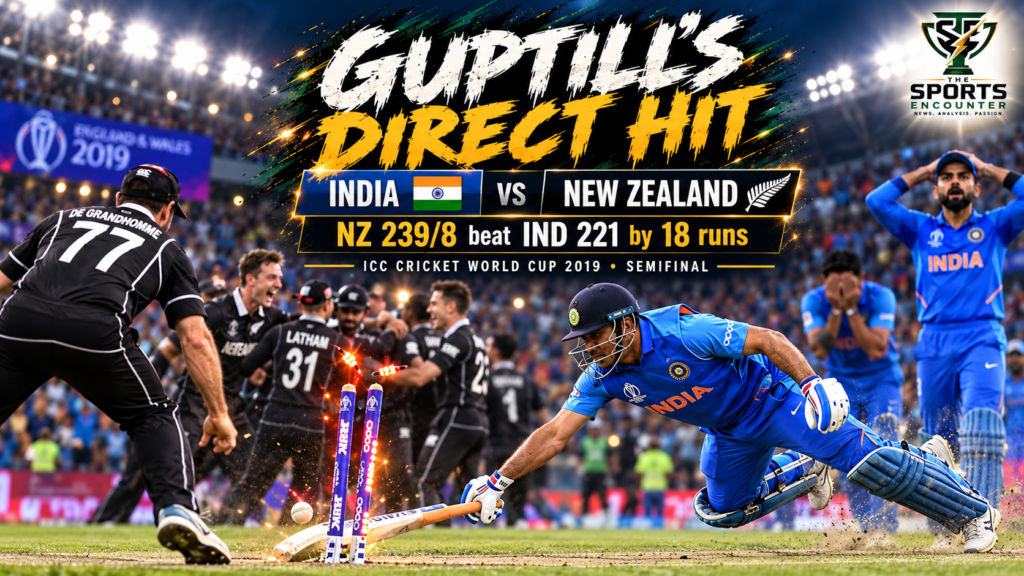
Why Match 38 Belongs in A Celebration of 5000 ODIs
The original A Celebration of 5000 ODIs roadmap gives the immediate reason.
Rain Turns One Semifinal Into a Two-Day Test of Nerve
The match began on July 9.
Jasprit Bumrah Strikes Before New Zealand Can Settle
Martin Guptill lasted 14 balls.
Kane Williamson Gives New Zealand an Innings
Williamson made 67 from 95 balls.
Ross Taylor Produces the Innings New Zealand Needed Most
Taylor top-scored with 74 from 90 balls.
Then it became 24/4.
Later, 92/6.
For most teams, that would have been the end of the story.
Ravindra Jadeja refused to let it end.
MS Dhoni joined him.
Together they turned a match that looked dead into something New Zealand suddenly had to survive.
Jadeja attacked. Dhoni calculated. Their seventh-wicket partnership reached 116. India moved from 92/6 to 208/6.
With three overs remaining, they needed 37.
Jadeja fell for 77.
Dhoni remained.
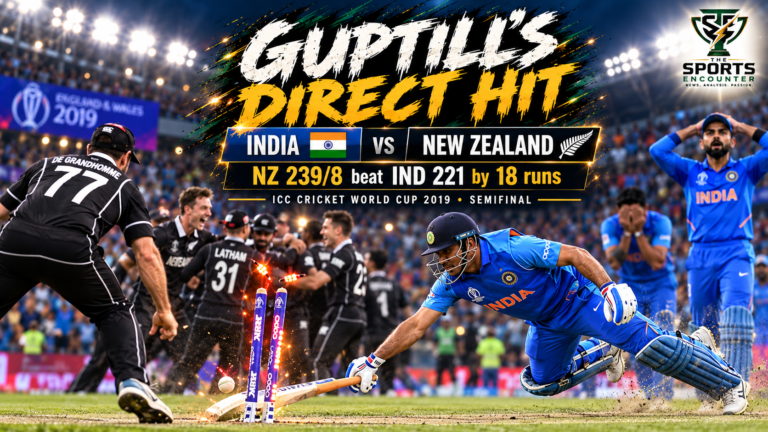
Then, with India needing 25 from 10 balls, Dhoni pushed for a second run.
Martin Guptill picked up from deep square leg.
One stump to hit.
One direct throw.
Dhoni was short.
India’s last great hope was walking back.
New Zealand completed an 18-run victory and reached their second consecutive World Cup final.
That is why this semifinal is Match 38 in A Celebration of 5000 ODIs.
It contains almost everything that makes knockout ODI cricket irresistible: rain, a two-day contest, new-ball destruction, a collapse, a seemingly impossible comeback, brilliant fielding and a run-out that changed the destination of the World Cup.
TL;DR
- New Zealand won the toss and chose to bat.
- Rain suspended play at 211/5 after 46.1 overs on July 9.
- The match resumed on the reserve day, July 10.
- New Zealand finished on 239/8.
- Ross Taylor top-scored with 74 from 90 balls.
- Kane Williamson made 67 from 95.
- Bhuvneshwar Kumar took 3/43.
- India collapsed to 5/3.
- Rohit Sharma, Virat Kohli and KL Rahul all made one run each.
- India were 24/4 after 10 overs.
- Rishabh Pant and Hardik Pandya each made 32.
- India fell to 92/6.
- Ravindra Jadeja smashed 77 from 59 balls.
- MS Dhoni made 50 from 72.
- Jadeja and Dhoni added 116 for the seventh wicket.
- Matt Henry took 3/37 and was named Player of the Match.
- Trent Boult and Mitchell Santner took two wickets each.
- Jadeja fell with India at 208/7.
- Martin Guptill’s direct hit ran Dhoni out for 50.
- India were dismissed for 221 in 49.3 overs.
- New Zealand won by 18 runs.
- New Zealand advanced to their second consecutive ODI World Cup final.
New Zealand vs India 2019 World Cup Semifinal: Match at a Glance
| Detail | Information |
|---|---|
| Competition | ICC Cricket World Cup 2019 |
| Match | First Semifinal |
| Dates | July 9-10, 2019 |
| Venue | Old Trafford, Manchester |
| Toss | New Zealand won and batted |
| New Zealand | 239/8 in 50 overs |
| India | 221 all out in 49.3 overs |
| Result | New Zealand won by 18 runs |
| Player of the Match | Matt Henry |
| New Zealand top scorer | Ross Taylor, 74 |
| India top scorer | Ravindra Jadeja, 77 |
| Best New Zealand bowling | Matt Henry, 3/37 |
| Best India bowling | Bhuvneshwar Kumar, 3/43 |
| India’s collapse | 5/3, then 24/4, then 92/6 |
| Key partnership | Jadeja and Dhoni, 116 |
| Decisive fielding moment | Guptill’s direct hit to run out Dhoni |
| Tournament consequence | New Zealand reached the World Cup final |
Why Match 38 Belongs in A Celebration of 5000 ODIs
The original A Celebration of 5000 ODIs roadmap gives the immediate reason.
India collapsed to 5/3.
Jadeja and Dhoni later revived a chase that appeared finished.
New Zealand survived by 18 runs.
That is enough to justify inclusion.
The deeper reason is how many times this semifinal changed emotional ownership.
New Zealand’s 239 looked short.
Then India were 5/3.
The chase looked over.
Then Pant and Hardik rebuilt.
They both fell.
At 92/6, it looked over again.
Then Jadeja produced one of the finest pressure innings of his career.
At 208/6, with Dhoni still there, India had made the impossible believable.
Jadeja fell.
Dhoni remained.
Then Guptill needed one perfect throw.
He found it.
This match belongs here because logic declared India finished several times.
India kept rejecting the verdict.
New Zealand still found the final answer.
Rain Turns One Semifinal Into a Two-Day Test of Nerve
The match began on July 9.
It finished on July 10.
New Zealand reached 211/5 after 46.1 overs before persistent rain forced play to stop.
That created an unusual psychological challenge.
The semifinal did not simply pause.
Both teams had an entire night to think about it.
New Zealand returned the following morning with 23 balls remaining.
India returned knowing the target would probably be manageable.
The reserve day preserved a full 50-over contest.
It also extended the pressure for almost 24 hours.
Jasprit Bumrah Strikes Before New Zealand Can Settle
Martin Guptill lasted 14 balls.
He scored one.
Bumrah found the outside edge and Virat Kohli took the catch.
New Zealand were 1/1.
The dismissal appeared insignificant later because Guptill would still produce one of the match’s most famous moments in the field.
With the bat, however, he gave India exactly the start they wanted.
New Zealand had to rebuild from the fourth over.
Kane Williamson Gives New Zealand an Innings
Williamson made 67 from 95 balls.
Six fours.
Strike rate 70.52.
Like many of his best World Cup innings, this one was built around understanding conditions rather than forcing them.
Old Trafford was slow.
The ball did not always arrive cleanly.
India’s attack gave little away.
Williamson therefore accepted a controlled tempo.
He added 68 with Henry Nicholls.
After Jadeja bowled Nicholls for 28, Williamson joined Ross Taylor.
That partnership would form the spine of New Zealand’s total.
Williamson had already shown his ability to manage difficult chases and difficult surfaces in Match 35, when his unbeaten 106 carried New Zealand past South Africa.
Here, he performed the same role batting first.
Ross Taylor Produces the Innings New Zealand Needed Most
Taylor top-scored with 74 from 90 balls.
Three fours.
One six.
The numbers do not suggest domination.
That was never the requirement.
Taylor needed to preserve New Zealand’s innings while finding enough scoring opportunities to keep 230-plus realistic.
When Williamson fell at 134/3, Taylor became the senior batter responsible for the finish.
Jimmy Neesham made 12.
Colin de Grandhomme added 16 from 10.
Taylor remained.
Rain interrupted his innings.
He returned the next morning.
Then Jadeja finally removed him with a direct hit at 225/6.
Taylor had given New Zealand the total their bowlers would later turn into something much larger.
Ravindra Jadeja Starts Influencing the Match Long Before He Bats
Jadeja’s 77 would become the innings everyone remembers.
His entire match was extraordinary.
With the ball:
10 overs, 34 runs, 1 wicket.
He bowled Henry Nicholls.
Then came the fielding.
Taylor attempted a second run.
Jadeja attacked the ball and hit the stumps directly.
Later, he took a boundary catch to dismiss Tom Latham.
His fingerprints were already all over the semifinal before he walked out with India 92/6.
What followed transformed an excellent all-round performance into something much bigger.
Bhuvneshwar Kumar Prevents New Zealand From Reaching 250
Bhuvneshwar finished with 3/43.
His wickets came late enough to matter.
He removed de Grandhomme.
Then Latham.
Then Matt Henry.
New Zealand had been positioned to push beyond 250.
India kept them to 239.
At halftime, that looked like a major advantage.
A team featuring Rohit, Rahul, Kohli, Pant, Dhoni, Hardik and Jadeja needed 240.
Few expected New Zealand’s bowlers to make it feel impossible within four overs.
Matt Henry’s Opening Spell Breaks India Before the Chase Begins
India’s tournament had been built around its top order.
Rohit Sharma entered the semifinal after five World Cup centuries.
KL Rahul had just scored a century against Sri Lanka.
Virat Kohli was Virat Kohli.
Matt Henry removed two of them.
Rohit edged Henry behind for one.
Three overs later, Rahul did the same.
Between those wickets, Trent Boult trapped Kohli lbw for one.
India were 5/3.
Rohit: 1.
Kohli: 1.
Rahul: 1.
A combined three runs from the top three.
New Zealand had done in 19 deliveries what almost nobody had managed throughout the tournament.
Player of the Match Matt Henry Wins the Semifinal With the New Ball
Henry finished with:
10 overs
1 maiden
37 runs
3 wickets
Economy: 3.70
His wickets were Rohit Sharma, KL Rahul and Dinesh Karthik.
That makes the figures even more valuable.
Henry did not clean up the tail after New Zealand were safe.
He broke India’s batting structure before the chase could develop.
Rohit and Rahul were both dismissed behind the wicket.
Karthik was removed later through Jimmy Neesham’s remarkable catch.
By the time Henry had finished his first major burst, India were trying to survive rather than chase.
That is why he was named Player of the Match despite Jadeja’s 77 and Taylor’s 74.
Trent Boult Removes Kohli and Changes the Entire Chase
Kohli faced six balls.
He made one.
Boult attacked the stumps.
Kohli was trapped lbw.
India reviewed.
The decision remained.
India were 5/2.
Within three deliveries, Rahul was gone too.
The importance cannot be overstated.
India’s three most trusted top-order batters had all disappeared before the score reached six.
A chase of 240 suddenly felt closer to 340.
Jimmy Neesham’s Catch Makes It 24/4
Dinesh Karthik tried to stabilize.
He lasted 25 balls for six.
Then Matt Henry found an edge.
Neesham flew to his left and completed a spectacular one-handed catch.
India were 24/4.
At the end of the first 10 overs they had only 24 runs.
This was no longer a conventional chase.
India were rebuilding from catastrophe.
Rishabh Pant and Hardik Pandya Keep India Breathing
Pant and Hardik both made 32.
Neither innings became large enough.
Both were necessary.
Pant helped India move from 24/4 to 71/4.
Then he attacked Mitchell Santner and was caught by Colin de Grandhomme.
India 71/5.
Hardik continued with Dhoni.
He too eventually attacked Santner and found Kane Williamson.
India 92/6.
Two recoveries.
Two dismissals at moments when a longer partnership was required.
New Zealand had forced India back toward defeat again.
Mitchell Santner Wins the Middle Overs Without Needing a Spectacular Spell
Santner’s figures were outstanding:
10 overs
2 maidens
34 runs
2 wickets
The wickets were Pant and Hardik.
His economy rate was 3.40.
That combination was decisive.
India were already under scoreboard pressure after the early collapse.
Santner made acceleration even harder.
He did not allow the middle order an easy route back.
Every over consumed created additional pressure for whoever remained.
That pressure eventually became Jadeja’s problem.
Ravindra Jadeja Walks In at 92/6 and Decides to Attack
The conventional response at 92/6 would have been survival.
Jadeja chose something more aggressive.
His 77 came from only 59 balls.
Four fours.
Four sixes.
Strike rate 130.51.
Against a New Zealand attack that had strangled nearly everyone else, Jadeja found boundaries.
That changed the required rate.
More importantly, it changed belief.
Dhoni could continue playing the long game because Jadeja was doing the scoring.
Their contrasting roles became the foundation of the comeback.
MS Dhoni Turns Calculation Into a Weapon
Dhoni scored 50 from 72 balls.
One four.
One six.
Strike rate 69.44.
By modern standards, the tempo looks slow.
The match situation explains it.
India were 92/6.
One more wicket could expose the tail.
Dhoni’s job was not to match Jadeja’s strike rate.
It was to remain.
He rotated strike.
He absorbed pressure.
He allowed Jadeja to attack.
As the target fell, Dhoni’s innings began to make more sense.
The finish was approaching the kind of equation he had solved throughout his career.
Jadeja and Dhoni Add 116 and Resurrect the Chase
This was the partnership that made the semifinal unforgettable.
India were 92/6.
They reached 208/6.
Jadeja scored the majority of the runs.
Dhoni supplied stability.
The partnership reached 116.
New Zealand’s body language changed.
The crowd found its voice again.
A chase that had once looked finished was now very much alive.
The comeback had echoes of other great recoveries in this series, including India’s defense of 183 in the 1983 World Cup final and India’s narrow one-run defeat to Australia in Chennai in 1987.
The scoreboard said India had six wickets down.
Jadeja and Dhoni made it feel like New Zealand were the team under pressure.
Trent Boult Removes Jadeja at 208/7
India needed 32 from 13 balls.
Jadeja attacked again.
This time, the shot did not clear the field.
Williamson took the catch.
Jadeja walked back for 77.
It was an extraordinary innings.
It was also incomplete.
Dhoni remained.
India still needed 32.
The match had one more turn left.
Dhoni’s Six Keeps India Alive
Lockie Ferguson bowled the 49th over.
Dhoni attacked.
Six.
Suddenly the equation changed again.
India needed 25 from 11.
Then Dhoni pushed the next ball and looked for two.
That decision created the match’s defining image.
Martin Guptill Needs One Throw
Guptill had scored one run with the bat.
His biggest contribution arrived from the deep.
Dhoni turned for the second.
Guptill collected.
He had one stump to aim at.
The throw hit.
Dhoni’s bat was inches short.
Out for 50.
India 216/8.
The run-out transformed New Zealand’s position from vulnerable to almost safe.
Few fielding moments in World Cup history have carried more weight.
Guptill had missed with the bat.
He did not miss when the semifinal depended on his arm.
New Zealand Finish What Guptill Started
Bhuvneshwar Kumar was bowled by Ferguson for zero.
Yuzvendra Chahal struck one boundary before edging Jimmy Neesham behind.
India 221 all out.
Three balls remained.
New Zealand won by 18 runs.
They were going back to the World Cup final.
Four years after Grant Elliott’s six against South Africa carried New Zealand into their first final, the Black Caps had done it again.
That 2015 breakthrough is revisited in Match 29: Elliott’s Six Breaks New Zealand’s Semifinal Barrier and South African Hearts.
Manchester proved the first final had not been a one-off.
Complete Match Scorecard
New Zealand Batting: 239/8 in 50 Overs
| Batter | Dismissal | R | B | 4s | 6s | SR |
|---|---|---|---|---|---|---|
| Martin Guptill | c Virat Kohli b Jasprit Bumrah | 1 | 14 | 0 | 0 | 7.14 |
| Henry Nicholls | b Ravindra Jadeja | 28 | 51 | 2 | 0 | 54.90 |
| Kane Williamson (c) | c Ravindra Jadeja b Yuzvendra Chahal | 67 | 95 | 6 | 0 | 70.53 |
| Ross Taylor | run out (Ravindra Jadeja) | 74 | 90 | 3 | 1 | 82.22 |
| Jimmy Neesham | c Dinesh Karthik b Hardik Pandya | 12 | 18 | 1 | 0 | 66.67 |
| Colin de Grandhomme | c MS Dhoni b Bhuvneshwar Kumar | 16 | 10 | 2 | 0 | 160.00 |
| Tom Latham (wk) | c Ravindra Jadeja b Bhuvneshwar Kumar | 10 | 11 | 0 | 0 | 90.91 |
| Mitchell Santner | not out | 9 | 6 | 1 | 0 | 150.00 |
| Matt Henry | c Virat Kohli b Bhuvneshwar Kumar | 1 | 2 | 0 | 0 | 50.00 |
| Trent Boult | not out | 3 | 3 | 0 | 0 | 100.00 |
Did not bat: Lockie Ferguson
Extras: 18 (5 leg byes, 13 wides)
Total: 239/8 in 50 overs
Run rate: 4.78
Fall of wickets: 1/1 Martin Guptill (3.3), 69/2 Henry Nicholls (18.2), 134/3 Kane Williamson (35.2), 162/4 Jimmy Neesham (41.0), 200/5 Colin de Grandhomme (44.4), 225/6 Ross Taylor (47.6), 225/7 Tom Latham (48.1), 232/8 Matt Henry (48.6).
India Bowling
| Bowler | O | M | R | W | Econ |
|---|---|---|---|---|---|
| Bhuvneshwar Kumar | 10 | 1 | 43 | 3 | 4.30 |
| Jasprit Bumrah | 10 | 1 | 39 | 1 | 3.90 |
| Hardik Pandya | 10 | 0 | 55 | 1 | 5.50 |
| Ravindra Jadeja | 10 | 0 | 34 | 1 | 3.40 |
| Yuzvendra Chahal | 10 | 0 | 63 | 1 | 6.30 |
India Batting: 221 All Out in 49.3 Overs
| Batter | Dismissal | R | B | 4s | 6s | SR |
|---|---|---|---|---|---|---|
| KL Rahul | c Tom Latham b Matt Henry | 1 | 7 | 0 | 0 | 14.29 |
| Rohit Sharma | c Tom Latham b Matt Henry | 1 | 4 | 0 | 0 | 25.00 |
| Virat Kohli (c) | lbw b Trent Boult | 1 | 6 | 0 | 0 | 16.67 |
| Rishabh Pant | c Colin de Grandhomme b Mitchell Santner | 32 | 56 | 4 | 0 | 57.14 |
| Dinesh Karthik | c Jimmy Neesham b Matt Henry | 6 | 25 | 1 | 0 | 24.00 |
| Hardik Pandya | c Kane Williamson b Mitchell Santner | 32 | 62 | 2 | 0 | 51.61 |
| MS Dhoni (wk) | run out (Martin Guptill) | 50 | 72 | 1 | 1 | 69.44 |
| Ravindra Jadeja | c Kane Williamson b Trent Boult | 77 | 59 | 4 | 4 | 130.51 |
| Bhuvneshwar Kumar | b Lockie Ferguson | 0 | 1 | 0 | 0 | 0.00 |
| Yuzvendra Chahal | c Tom Latham b Jimmy Neesham | 5 | 5 | 1 | 0 | 100.00 |
| Jasprit Bumrah | not out | 0 | 0 | 0 | 0 | 0.00 |
Extras: 16 (3 leg byes, 13 wides)
Total: 221 all out in 49.3 overs
Run rate: 4.46
Fall of wickets: 4/1 Rohit Sharma (1.3), 5/2 Virat Kohli (2.4), 5/3 KL Rahul (3.1), 24/4 Dinesh Karthik (10.0), 71/5 Rishabh Pant (22.5), 92/6 Hardik Pandya (30.3), 208/7 Ravindra Jadeja (47.5), 216/8 MS Dhoni (48.3), 217/9 Bhuvneshwar Kumar (49.0), 221/10 Yuzvendra Chahal (49.3).
New Zealand Bowling
| Bowler | O | M | R | W | Econ |
|---|---|---|---|---|---|
| Trent Boult | 10 | 2 | 42 | 2 | 4.20 |
| Matt Henry | 10 | 1 | 37 | 3 | 3.70 |
| Lockie Ferguson | 10 | 0 | 43 | 1 | 4.30 |
| Colin de Grandhomme | 2 | 0 | 13 | 0 | 6.50 |
| Jimmy Neesham | 7.3 | 0 | 49 | 1 | 6.53 |
| Mitchell Santner | 10 | 2 | 34 | 2 | 3.40 |
Eight Turning Points That Decided the Semifinal
1. Bumrah Removes Guptill for One
India gained immediate control.
New Zealand had to build rather than attack.
2. Williamson and Taylor Turn 69/2 Into a Platform
New Zealand’s two most experienced batters absorbed India’s attack and created the foundation for 239.
3. India Restrict New Zealand Below 240
Bhuvneshwar’s late wickets and Jadeja’s fielding kept the target within reach.
At halftime, India appeared to hold the advantage.
4. India Collapse to 5/3
Rohit, Kohli and Rahul each scored one.
The semifinal changed in 19 balls.
5. Neesham’s Catch Removes Karthik at 24/4
India lost another experienced batter before the powerplay had ended.
6. Santner Removes Pant and Hardik
Both had begun rebuilding.
Both fell for 32.
India slipped to 92/6.
7. Jadeja and Dhoni Add 116
This partnership resurrected the chase and forced New Zealand back under genuine pressure.
8. Guptill Runs Out Dhoni
India still had a chance.
One direct hit removed it.
Why India Lost Despite Jadeja’s Extraordinary 77
India did not lose because Jadeja and Dhoni failed.
They lost because the recovery demanded almost perfection after 5/3.
The top three contributed three runs combined.
Karthik added six.
Pant and Hardik rebuilt but neither converted 32 into the innings India required.
That placed an impossible amount of responsibility on the final recognized pair.
Jadeja and Dhoni produced 127 runs between them.
The other nine Indian batters produced 78.
The imbalance explains the defeat.
Why New Zealand Won With Only 239
New Zealand’s total was not imposing.
Their bowling plan made it sufficient.
Henry and Boult attacked the stumps and outside edge immediately.
Santner then controlled the middle overs.
Ferguson provided pace.
Neesham and de Grandhomme gave Williamson tactical flexibility.
Most importantly, New Zealand kept taking wickets before a partnership became permanent.
The only exception was Jadeja and Dhoni.
Even then, they eventually found two decisive moments.
Boult dismissed Jadeja.
Guptill removed Dhoni.
Ravindra Jadeja Produced One of the Great Losing Performances
There are performances that deserve victory.
Cricket does not guarantee it.
Jadeja:
- bowled 10 overs for 34
- took Nicholls’ wicket
- ran out Taylor
- caught Latham
- scored 77 from 59
- hit four fours
- hit four sixes
- helped add 116 for the seventh wicket
That is an extraordinary contribution in a World Cup semifinal.
It did not change the final result.
That makes it even more memorable.
The series has already featured another great performance that ended in defeat when Carlos Brathwaite’s century brought West Indies within one six of beating New Zealand.
Jadeja belongs in that category.
Dhoni’s Last ODI Ends With a Run-Out
The semifinal became MS Dhoni’s 350th and final ODI.
That gives Guptill’s throw an even heavier historical weight.
Dhoni had built a career around controlling endings.
He had finished chases.
He had calculated required rates.
He had won India a World Cup final with a six eight years earlier.
His ODI career ended while attempting to manufacture the final chase of another World Cup knockout.
There is a cruel symmetry in that.
Dhoni did not retire from ODI cricket immediately after the match.
But he never played another ODI.
His final act became that desperate second run.
New Zealand’s Knockout Identity Becomes Impossible to Ignore
New Zealand had now eliminated South Africa in 2011.
They defeated South Africa again in the 2015 semifinal.
Then they eliminated tournament-leading India in 2019.
That progression matters.
The Black Caps were no longer charming outsiders who occasionally disrupted larger teams.
They had become one of ODI cricket’s most dependable tournament sides.
Their 2011 quarterfinal comeback against South Africa is revisited in Match 27.
Their 2015 semifinal breakthrough appears in Match 29.
Manchester completed the pattern.
India’s World Cup Campaign Ends After Leading the Group Stage
That is one of the harshest realities of knockout cricket.
India had finished first in the group stage.
Rohit had scored five centuries.
The bowling attack had repeatedly delivered.
The team looked built for the final.
Then three wickets disappeared for five runs.
Everything before that still mattered.
None of it could rescue the semifinal.
This is why ODI World Cups produce stories that league tables cannot predict.
One new-ball spell can erase weeks of control.
New Zealand’s 2019 World Cup Story Was Already Full of Escapes
The semifinal did not appear from nowhere.
New Zealand had already won several games through calmness under pressure.
Williamson’s century carried them past South Africa in Match 35.
Brathwaite then came within one six of defeating them in Match 32.
By the semifinal, New Zealand had developed an unusual relationship with pressure.
They did not always dominate.
They survived.
India Had Also Learned to Escape Trouble
India’s own tournament contained narrow victories.
Against Afghanistan, a total of 224 looked vulnerable until Bumrah and Mohammed Shami rescued the defense.
Shami finished that match with a final-over hat-trick, revisited in Match 34.
Manchester reversed the experience.
This time India needed the escape.
New Zealand denied it.
Why the 18-Run Margin Is Misleading
Eighteen runs does not sound particularly close.
The final overs were.
India were 208/6.
They needed 32 from 13.
Dhoni was still there.
Jadeja was still there.
Then Jadeja fell.
Dhoni hit Ferguson for six.
The requirement became 25 from 11.
One throw changed everything.
That is why the final margin fails to describe the finish.
The semifinal was decided by moments, not 18 runs.
The Match Before the Match Everyone Remembers
The 2019 World Cup final is remembered as one of the strangest and most dramatic matches cricket has ever produced.
It will be Match 39 in this series.
But New Zealand had to survive Manchester before they could reach Lord’s.
This semifinal deserves its own place because it contained a completely different kind of drama.
The final was absurdity.
The semifinal was resurrection.
India were dead.
Then they were alive.
Then one direct hit ended it.
Continue A Celebration of 5000 ODIs
 A Celebration of 5000 ODIsA Celebration of 5000 ODIs Match 40: Maharaj Saves South Africa After Pakistan Turn 271 Into a One-Wicket World Cup Trap
 A Celebration of 5000 ODIsA Celebration of 5000 ODIs Match 39: England Win the World Cup on Boundary Count After New Zealand Tie Them Twice
 A Celebration of 5000 ODIsA Celebration of 5000 ODIs Match 36: Malinga Turns 232 Into a Trap as England’s World Cup Certainty Suddenly Cracks
Frequently Asked Questions
Who Won India vs New Zealand in the 2019 World Cup Semifinal?
New Zealand won by 18 runs after scoring 239/8 and dismissing India for 221 in 49.3 overs.
Who Was Player of the Match?
Matt Henry was named Player of the Match after taking 3/37 from 10 overs.
Why Did the Match Take Two Days?
Rain stopped New Zealand’s innings at 211/5 after 46.1 overs on July 9. The semifinal resumed on the reserve day, July 10.
What Was India’s Score When Their Top Three Were Out?
India were 5/3 after Rohit Sharma, Virat Kohli and KL Rahul were each dismissed for one.
How Many Runs Did Ravindra Jadeja Score?
Jadeja scored 77 from 59 balls with four fours and four sixes.
How Many Runs Did MS Dhoni Score?
Dhoni made 50 from 72 balls.
How Many Runs Did Jadeja and Dhoni Add?
They added 116 for the seventh wicket after India had fallen to 92/6.
How Was Dhoni Dismissed?
Martin Guptill ran Dhoni out with a direct hit from the deep in the 49th over.
Who Was New Zealand’s Top Scorer?
Ross Taylor made 74 from 90 balls. Kane Williamson scored 67 from 95.
Why Is This Match Included in A Celebration of 5000 ODIs?
India collapsed to 5/3 and later 92/6 before Jadeja and Dhoni produced a 116-run recovery. The chase remained alive deep into the final two overs before Guptill’s direct hit ran out Dhoni and New Zealand survived by 18 runs.
World Cup
- A Celebration of 5000 ODIs Match 40: Maharaj Saves South Africa After Pakistan Turn 271 Into a One-Wicket World Cup Trap
- A Celebration of 5000 ODIs Match 39: England Win the World Cup on Boundary Count After New Zealand Tie Them Twice
- Tim Ream Comes Home for USMNT Farewell as St. Louis Honors 86-Cap World Cup Captain
- A Celebration of 5000 ODIs Match 38: India Rise From 5/3, but Guptill’s Direct Hit Sends New Zealand Back to the World Cup Final
- A Celebration of 5000 ODIs Match 36: Malinga Turns 232 Into a Trap as England’s World Cup Certainty Suddenly Cracks