Wellington, New Zealand, November 17, 2026: Mitchell Santner has been ruled out of New Zealand’s two-Test series against India after scans confirmed a fracture in his right hand, leaving the Black Caps without their most experienced specialist spinner just two days before the opening match at Basin Reserve. Dean Foxcroft has been called into the 14-player squad, but his inclusion creates a selection dilemma as New Zealand attempts to protect its position at the top of the World Test Championship standings.
The Mitchell Santner injury occurred while the 34-year-old all-rounder was batting during Sunday’s fifth ODI against India at Mount Maunganui. New Zealand Cricket has not established a return date, and his availability for the four-Test series in Australia beginning December 9 remains uncertain. For captain Tom Latham and coach Rob Walter, the immediate challenge is replacing Santner’s bowling control and batting depth without weakening a team preparing for two important home Tests.
Key Takeaways
- The Mitchell Santner injury occurred while the 34-year-old all-rounder was batting during Sunday’s fifth ODI against India at Mount Maunganui.
- The injury occurred during the final ODI at Bay Oval, where India completed a 3-1 series victory.
- Foxcroft, a Central Districts spin-bowling all-rounder, replaces Santner in the 14-player group.
- The strongest evidence of Santner’s value against India came during New Zealand’s historic 2024 Test series victory on the subcontinent.
Mitchell Santner Injury: What New Zealand Cricket Confirmed
New Zealand Cricket announced that Santner would miss both Tests after medical examinations confirmed the fracture.
Story at a glance

Mitchell Santner Injury: What New Zealand Cricket Confirmed
New Zealand Cricket announced that Santner would miss both Tests after medical examinations confirmed the fracture.
Why Dean Foxcroft Has Been Called Into New Zealand’s Test Squad
Foxcroft, a Central Districts spin-bowling all-rounder, replaces Santner in the 14-player group.
Santner’s 13 Wickets Against India Explain the Scale of His Absence
The strongest evidence of Santner’s value against India came during New Zealand’s historic 2024 Test series victory on the subcontinent.
Rachin Ravindra and Glenn Phillips Become More Important
Santner’s withdrawal increases the potential bowling responsibilities of Rachin Ravindra and Glenn Phillips.
New Zealand Could Rely More Heavily on Its Pace Attack
New Zealand retains several established seam-bowling options, including Matt Henry, Kyle Jamieson, Nathan Smith, Jacob Duffy and Blair Tickner.
The injury occurred during the final ODI at Bay Oval, where India completed a 3-1 series victory.
Santner was struck on his right hand while batting. Subsequent scans established the extent of the injury, ruling him out of the red-ball series beginning Thursday.
The federation has not announced a recovery timetable or confirmed whether surgery will be necessary. His rehabilitation and return to competitive cricket remain subject to medical assessment.
| Key Information | Confirmed Details |
|---|---|
| Player | Mitchell Santner |
| Age | 34 |
| Injury | Fractured right hand |
| Injury occurred | Fifth ODI against India, Mount Maunganui |
| Matches ruled out | Both India Tests |
| Replacement | Dean Foxcroft |
| Return date | Not confirmed |
| Australia Test series | Participation subject to further assessment |
The official New Zealand Cricket injury announcement confirms the diagnosis and Foxcroft’s inclusion.
The timing is particularly unfortunate because Santner had already become an important figure during India’s tour, captaining New Zealand’s white-ball side through a disrupted series.
Earlier injury setbacks involving Rachin Ravindra and Mark Chapman had forced alterations to New Zealand’s ODI selections. The Sports Encounter examined those problems in its analysis of New Zealand’s squad injuries and the challenge of managing player availability.
Santner’s absence is a separate development. Unlike the earlier white-ball concerns, this injury has now definitively removed a senior all-rounder from the Test squad.
Why Dean Foxcroft Has Been Called Into New Zealand’s Test Squad
Foxcroft, a Central Districts spin-bowling all-rounder, replaces Santner in the 14-player group.
He made his Test debut against Ireland in May and has previously been involved in New Zealand’s limited-overs arrangements.
His selection gives Walter another right-arm spin option while retaining some batting flexibility.
However, Foxcroft is not a direct tactical equivalent to Santner.
Santner bowls left-arm orthodox spin and has extensive experience operating against international batters. Foxcroft’s off-spin provides a different angle, creating distinct matchups against India’s left-handed and right-handed players.
The change matters because a specialist spinner’s responsibilities extend beyond taking wickets. Controlling scoring rates, maintaining pressure between spells from fast bowlers and creating opportunities through changes of pace can all influence the course of a Test.
Foxcroft has an opportunity to demonstrate that he can contribute in those areas, but his inclusion in the squad does not guarantee selection for Wellington.
Can Foxcroft Replace Santner’s Bowling and Batting Value?
New Zealand must consider the roles Santner would otherwise have performed.
| Selection Factor | Mitchell Santner | Dean Foxcroft |
|---|---|---|
| Primary bowling style | Left-arm orthodox spin | Right-arm off-spin |
| International experience | Established across formats | Limited Test experience |
| Batting contribution | Lower-order all-rounder | Batting all-rounder |
| Primary tactical advantage | Spin control, variation and proven wicket-taking ability | Alternative spin angle and additional batting flexibility |
| Selection consideration | Unavailable because of injury | Competes for a place in the playing XI |
The central question is whether New Zealand wants a like-for-like spin-bowling replacement or believes another combination will better suit the conditions.
If the Basin Reserve surface offers considerable assistance to seam bowling, Walter could prioritize the fast-bowling resources already available.
If the hosts anticipate needing a dedicated spin option over a prolonged innings, Foxcroft becomes a more relevant selection consideration.
Neither approach has been confirmed, and the final decision will depend on pitch assessments and the availability of other players.
Santner’s 13 Wickets Against India Explain the Scale of His Absence
The strongest evidence of Santner’s value against India came during New Zealand’s historic 2024 Test series victory on the subcontinent.
In the second Test at Pune, Santner took 13 wickets for 157 runs across the match, producing one of the defining performances in New Zealand’s cricket history.
His first-innings figures of 7/53 helped dismiss India for 156. He then claimed 6/104 in the second innings as New Zealand secured a 113-run victory.
The result gave the Black Caps their first Test series triumph in India.
| Santner’s Pune Performance | Figures | Significance |
|---|---|---|
| First innings | 7/53 | Helped dismiss India for 156 |
| Second innings | 6/104 | Prevented India from reaching its 359-run target |
| Match | 13/157 | Career-best match figures |
| Result | New Zealand won by 113 runs | Secured historic series victory |
The ICC’s analysis of Santner’s record-breaking Pune performance highlighted his use of different bowling speeds to unsettle India’s batters.
Those skills could have been particularly useful during the upcoming series.
However, the circumstances are different. Pune offered conditions suited to spin, while Wellington and Christchurch can present different challenges depending on surface preparation, weather and match progression.
Santner’s exceptional record in India establishes his ability to influence a Test, but it does not automatically establish that he would have produced the same figures in New Zealand.
The loss is therefore best understood as a reduction in proven tactical options rather than a guaranteed number of wickets removed from the team.
Rachin Ravindra and Glenn Phillips Become More Important
Santner’s withdrawal increases the potential bowling responsibilities of Rachin Ravindra and Glenn Phillips.
Ravindra offers left-arm spin and top-order batting, while Phillips provides right-arm off-spin alongside his middle-order contribution.
Both players can help New Zealand maintain an additional spin option without necessarily selecting another specialist bowler.
Nevertheless, their primary batting responsibilities may influence how heavily Walter is prepared to rely on them with the ball.
Ravindra’s availability also needs to be considered carefully because he was previously managing a shoulder injury.
New Zealand’s initial Test squad announcement identified Ravindra, Tom Blundell and Devon Conway as players working through fitness concerns.
The Sports Encounter’s earlier report on Conway’s concussion and its impact on the ODI lineup documented how medical concerns had already affected New Zealand’s batting selections.
Those earlier setbacks must not be confused with confirmed withdrawals from the Test series.
Ravindra, Conway and Blundell were named in the Test squad, and their final match availability depends on subsequent assessments.
With Santner now definitely unavailable, avoiding another late selection disruption becomes increasingly important.
New Zealand Could Rely More Heavily on Its Pace Attack
New Zealand retains several established seam-bowling options, including Matt Henry, Kyle Jamieson, Nathan Smith, Jacob Duffy and Blair Tickner.
That depth provides Walter with alternatives if he decides the opening Test requires a pace-dominated attack.
Henry recently demonstrated his ability to exploit helpful conditions during the fourth ODI against India.
He took 6/27 as New Zealand bowled India out for 89, securing a 244-run victory at Bay Oval.
The performance was examined in TSE’s detailed report on Matt Henry’s six-wicket haul and New Zealand’s remarkable ODI victory.
That result does not guarantee similar success with a red ball, but it reinforces Henry’s value as an experienced wicket-taking option.
Jamieson’s height and ability to extract bounce provide another potential advantage, while Smith offers seam bowling and lower-order batting.
The challenge is deciding how to distribute responsibilities without losing the variety Santner would have provided.
Playing an additional seamer could strengthen New Zealand’s ability to attack with the new ball and maintain pressure through multiple pace spells.
However, a pace-heavy attack could become less flexible if the surface slows or the fast bowlers require prolonged periods of recovery.
Those considerations must be balanced against the team’s batting depth.
India’s Squad Changes Add Another Dimension to the Selection Battle
India arrives with substantial fast-bowling resources and its own selection decisions.
Shubman Gill captains a squad featuring Jasprit Bumrah, Mohammed Siraj, Prasidh Krishna, Akash Deep and Anshul Kamboj.
The BCCI also announced that Gurnoor Brar had been added to the Test squad, while Kuldeep Yadav was released to participate in domestic cricket.
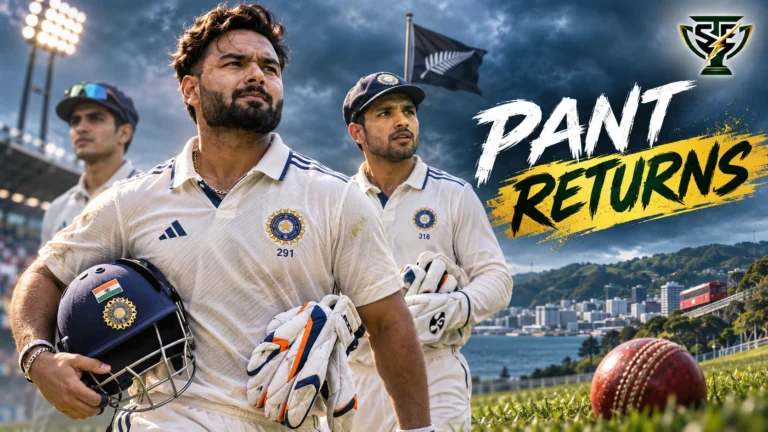
Rishabh Pant has joined the squad after overcoming the fitness concerns that initially placed his selection under assessment.
The BCCI’s official squad update confirms those changes.
Pant’s return strengthens India’s batting and wicketkeeping options, although it creates a decision about the place of Dhruv Jurel.
The Sports Encounter previously examined that issue in its analysis of Pant’s fitness clearance and India’s wicketkeeping dilemma.
The balance of India’s attack also matters for New Zealand.
If the visitors select a strong seam attack, the hosts may prioritize additional batting protection. Conversely, New Zealand may seek to exploit the conditions by retaining as many specialist seamers as possible.
That tactical question has been part of the series buildup since India’s original squad announcement, examined in TSE’s coverage of Bumrah’s return and India’s pace-heavy Test squad.
India vs New Zealand Test Schedule and World Test Championship Stakes
The series begins in Wellington on November 19 before moving to Christchurch for the second Test on November 27.
| Match | Scheduled Dates | Venue | Importance |
|---|---|---|---|
| First Test | November 19–23 | Cello Basin Reserve, Wellington | New Zealand’s first Test without Santner |
| Second Test | November 27–December 2 | Hagley Oval, Christchurch | Final match of India’s Test tour |
| Australia tour begins | December 9 | Australia | Start of four-Test series; Santner’s availability unresolved |
The two India Tests form part of the 2025–27 ICC World Test Championship cycle.
New Zealand enters the series leading the championship standings, while India is attempting to strengthen its own position in the qualification race.
A Test victory is worth 12 championship points, with four points awarded for a draw and six for a tie, subject to any over-rate penalties.
Continue the Cricket Story


Consequently, two victories would offer New Zealand a potential 24 points before penalties.
That is the maximum available from this series, not a prediction of the outcome.
The standings are determined by points percentage rather than total points alone, making every result relevant to qualification.
New Zealand’s preparation is particularly demanding because its schedule extends beyond India into a four-Test tour of Australia.
The team’s medical management must therefore consider the immediate series without compromising longer-term player availability.
Will Mitchell Santner Be Fit for the Australia Tests?
Santner’s participation in the Australia series remains uncertain.
New Zealand Cricket has confirmed that its medical staff are assessing his recovery and will provide a further update.
The governing body has not announced a rehabilitation timetable or set a definitive date for his return.
Hand fractures can vary considerably in severity and recovery requirements, so it would be inappropriate to infer a specific return date from the diagnosis alone.
For New Zealand, the immediate priority is ensuring that Santner recovers sufficiently before returning to international competition.
The Australia tour begins December 9, leaving a relatively short interval between the end of the India series and the next major assignment.
Whether that interval is sufficient cannot currently be established.
New Zealand’s Updated 14-Player Test Squad
The Black Caps have retained the structure of their original squad, replacing Santner with Foxcroft.
| Player | Role |
|---|---|
| Tom Latham (captain) | Opening batter |
| Tom Blundell | Wicketkeeper-batter |
| Devon Conway | Top-order batter |
| Jacob Duffy | Fast bowler |
| Dean Foxcroft | Batting and off-spin all-rounder |
| Matt Henry | Fast bowler |
| Kyle Jamieson | Fast bowler |
| Daryl Mitchell | Middle-order batter |
| Henry Nicholls | Batter |
| Glenn Phillips | Batting and off-spin all-rounder |
| Rachin Ravindra | Batting and left-arm spin all-rounder |
| Nathan Smith | Seam-bowling all-rounder |
| Blair Tickner | Fast bowler |
| Will Young | Top-order batter |
New Zealand retains five specialist seam-bowling options alongside Smith, with Ravindra, Phillips and Foxcroft offering different degrees of spin-bowling support.
The presence of those players allows Walter to consider multiple combinations without calling in another replacement immediately.
However, the final playing XI will depend on fitness assessments, conditions and the team’s preferred balance.
What Santner’s Absence Means for the First Test
The Mitchell Santner injury has removed a proven match-winner from a New Zealand team preparing for a demanding international schedule.
His performance in Pune established what he can accomplish against India’s batters, while his versatility offers a level of balance that cannot be replicated simply by selecting another spinner.
Foxcroft’s inclusion provides cover and creates an opportunity for a less-experienced all-rounder, but it does not settle New Zealand’s bowling combination.
Walter must decide whether to give Foxcroft that opportunity, rely more heavily on Ravindra and Phillips, or strengthen the seam attack.
The decision will determine how New Zealand distributes its bowling responsibilities and protects its batting depth in Wellington.
For India, Santner’s absence removes a bowler responsible for one of the most destructive spells the team has faced in recent Test history.
That does not eliminate the challenges awaiting Gill’s side. New Zealand remains equipped with experienced fast bowlers and several all-round options capable of influencing the series.
The opening Test will provide the first meaningful evidence of whether the hosts can absorb Santner’s absence without sacrificing the balance that helped them rise to the top of the World Test Championship standings.
Mitchell Santner
- Mitchell Santner Injury Leaves New Zealand Facing India Test Selection Dilemma
- Stubbs Spoils Trent Rockets’ Lord’s Party as Southern Brave Win by Six Wickets
- Mitchell Santner Blasts Trent Rockets Into The Hundred Top Three With Six-Wicket Win Over MI London
- Dropped Catch Costs West Indies as New Zealand Win by One Wicket
- Jayden Lennox Spuns Magic as New Zealand Go 2-1 Up in West Indies ODI Series