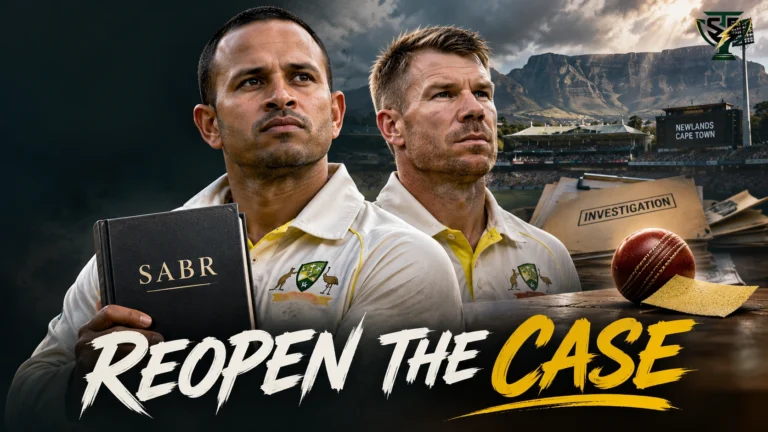
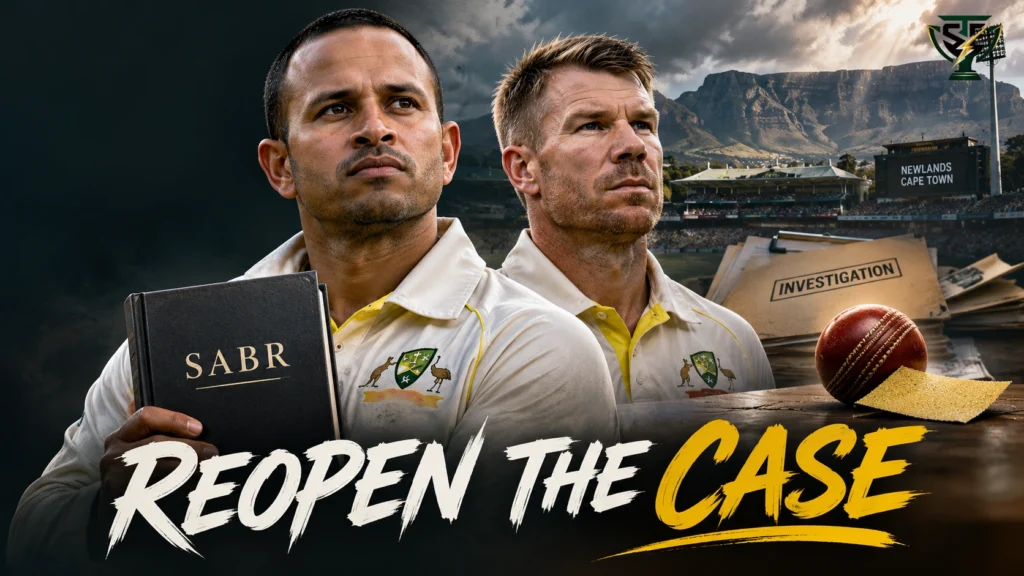
SYDNEY, Australia, November 12, 2026: Eight years after Australian cricket’s most damaging ball-tampering scandal, Usman Khawaja has challenged the official account of Sandpapergate in his autobiography Sabr, David Warner has publicly supported him, and Cricket Australia has refused to reopen an investigation that punished three players while clearing everyone else. The new disclosures have revived questions about how extensively the misconduct was known, whether the original investigation was sufficiently thorough and why Australian cricket’s governing body believes those questions no longer deserve independent examination.
Cricket Australia’s refusal is increasingly difficult to defend. Khawaja’s account contains allegations about discussions and alleged tampering before the infamous Cape Town Test, while Warner, one of the three players sanctioned in 2018, has challenged the original investigative process. Mitchell Starc maintains that the bowlers did not know sandpaper had been taken onto the field, Mitchell Marsh has declined to revisit his recollections, and captain Pat Cummins is preparing to address the controversy. The conflicting accounts do not establish that additional players committed misconduct, but they provide substantial grounds for an independent inquiry capable of determining whether the original findings remain credible.
Key Takeaways
- The original Sandpapergate controversy erupted during Australia’s third Test against South Africa at Newlands, Cape Town, in March 2018.
- Cricket Australia subsequently imposed 12-month suspensions on captain Steve Smith and vice-captain David Warner, while Bancroft received a nine-month ban.
- Cricket Australia chief executive Todd Greenberg has rejected calls for another investigation.
- Pat Cummins is expected to address the renewed allegations at a media conference in Sydney on November 13.
What Khawaja’s Sabr Reveals About the Sandpaper Scandal
The original Sandpapergate controversy erupted during Australia’s third Test against South Africa at Newlands, Cape Town, in March 2018.
Story at a glance
What Khawaja’s Sabr Reveals About the Sandpaper Scandal
The original Sandpapergate controversy erupted during Australia’s third Test against South Africa at Newlands, Cape Town, in March 2018.
Warner’s Support Changes the Significance of Khawaja’s Allegations
David Warner’s intervention has given the renewed controversy additional weight.
Why Cricket Australia’s Refusal to Reopen the Case Is Premature
Cricket Australia chief executive Todd Greenberg has rejected calls for another investigation.
Starc’s Denial Must Be Examined, Not Disregarded
Mitchell Starc has publicly rejected suggestions that he knew sandpaper had been taken onto the field to alter the ball.
Mitchell Marsh’s Silence Leaves Questions Unanswered
Australia’s white-ball captain Mitchell Marsh faced repeated questions about Sandpapergate before the ODI series against England.
Television cameras captured Cameron Bancroft attempting to alter the condition of the cricket ball using sandpaper. The images exposed an illegal attempt to gain reverse swing and triggered a crisis that led to the departure of senior Australian players from the tour.
Cricket Australia subsequently imposed 12-month suspensions on captain Steve Smith and vice-captain David Warner, while Bancroft received a nine-month ban.
The investigation concluded that those three players were responsible for the plot. Other players and members of the coaching staff were not found culpable.
That version of events has now been challenged by Khawaja, who was part of Australia’s touring squad.
In Sabr: Finding My Way in Cricket and Life, Khawaja describes discussions about manipulating the ball, an alleged earlier use of sandpaper during the second Test at Port Elizabeth, and a dressing-room environment in which he says knowledge of the practice extended beyond the three sanctioned individuals.
His account also describes an alleged experiment on a cricket ball before the Cape Town incident and conversations about how to make the ball reverse swing more effectively.
These details are consequential because they potentially move the controversy beyond one failed attempt during a single Test.
If independently substantiated, they could establish that the misconduct developed through earlier discussions or incidents that were not adequately addressed in Cricket Australia’s published findings.
However, Khawaja has not named every person he believes knew about the practice, and his statements require careful interpretation.
His argument about collective responsibility does not necessarily establish that every player directly participated in tampering, approved the use of sandpaper or possessed identical knowledge of the plan.
The distinction is essential. Knowing that a team wants to generate reverse swing, witnessing an unlawfully altered ball and participating in a deliberate plan to use an abrasive substance are different matters with potentially different disciplinary consequences.
The Australian Broadcasting Corporation’s detailed examination of Sabr documents the book’s allegations and highlights the ambiguity surrounding Khawaja’s descriptions of collective involvement.
That ambiguity provides a reason to investigate, rather than a justification for dismissing his testimony or treating every teammate as guilty.
Warner’s Support Changes the Significance of Khawaja’s Allegations
David Warner’s intervention has given the renewed controversy additional weight.
Warner was not an outside observer of Sandpapergate. He was vice-captain during the South Africa tour and received one of the two longest suspensions imposed by Cricket Australia.
In a video published on social media, Warner strongly endorsed Khawaja’s account.
He described it as “100 per cent accurate” and criticized the original investigation as rushed and poorly conducted.
Warner also questioned why Khawaja had not been interviewed as part of the original process, particularly given his proximity to Bancroft and his account of dressing-room discussions.
That criticism deserves particular attention.
If an individual with potentially relevant firsthand knowledge was not interviewed, an independent reviewer should establish why that decision was made, what information investigators had available and whether the omission materially affected their conclusions.
The answer cannot be assumed in advance. Investigators may have had reasons for focusing on particular witnesses, and the full investigative record has not been publicly examined in this renewed controversy.
But Warner’s challenge is specific enough to be tested against interview records and contemporaneous evidence.
His support also creates a complicated personal context. As a previously sanctioned player, Warner has a direct interest in how responsibility for the incident is understood.
That interest does not invalidate his testimony, but neither should his endorsement be treated as independent proof of every allegation in Khawaja’s book.
Warner should be interviewed, his account should be tested against other evidence, and any contradictions should be documented.
The episode is already affecting the beginning of Australia’s home international season. The Sports Encounter’s Australia-England ODI preview examined how Khawaja’s disclosures and Warner’s response have overshadowed preparations for the white-ball series in Perth.
Why Cricket Australia’s Refusal to Reopen the Case Is Premature
Cricket Australia chief executive Todd Greenberg has rejected calls for another investigation.
Greenberg has acknowledged that Khawaja’s book contains details contradicting other accounts, but he maintains that the governing body remains satisfied with its original findings.
Chairman David Boon has also supported the decision not to reopen the case, arguing that conflicting recollections from eight years ago would make another investigation unproductive.
There are legitimate concerns about revisiting an incident after such a long period.
Memories can become less reliable, witnesses may interpret events differently, documents may no longer be available, and participants have already endured substantial reputational and professional consequences.
But those difficulties do not establish that further scrutiny would be pointless.
The question should be whether credible new information exists that could materially change the understanding of what happened.
There is a meaningful difference between reopening a case because public controversy has returned and commissioning an independent assessment because a firsthand participant has published detailed claims that conflict with the findings previously accepted by the governing body.
Cricket Australia should not be required to presume Khawaja is correct.
Equally, it should not presume that its 2018 investigation was exhaustive merely because it concluded the case eight years ago.
Those are precisely the questions an independent reviewer could examine.
Greenberg and Boon also face an institutional conflict that goes beyond the conduct of individual cricketers.
Cricket Australia has a legitimate interest in maintaining confidence in its disciplinary system. A finding that the original inquiry overlooked important evidence could damage the organization’s reputation.
That makes independent oversight preferable to another internal assessment of whether the governing body should reconsider its own previous conclusions.
The broader importance of accountability in cricket is illustrated by TSE’s investigation into the Clicky Ponting cheating case, which examined how deliberate deception can undermine trust in decisions made during a match.
The offenses and jurisdictions are different, but both illustrate why cricket’s credibility depends on establishing facts and applying appropriate rules rather than relying on reputation or public sentiment.
Starc’s Denial Must Be Examined, Not Disregarded
Mitchell Starc has publicly rejected suggestions that he knew sandpaper had been taken onto the field to alter the ball.
His response is consistent with a joint statement issued in 2021 by Starc, Pat Cummins, Josh Hazlewood and Nathan Lyon.
The four bowlers said they were unaware that a foreign substance had been used and learned of the incident when the images appeared on the Newlands television screen.
Starc has reiterated that his recollection has not changed.
He has also denied knowing about the alleged earlier use of sandpaper during the Port Elizabeth Test.
These denials are material evidence that any renewed investigation must consider seriously.
A fair inquiry cannot begin by assuming that all four bowlers were dishonest because Khawaja’s account raises questions about the wider team’s knowledge.
Equally, a collective denial does not eliminate the need to test conflicting evidence.
Investigators would need to distinguish between general discussions about reverse swing, knowledge of inappropriate ball treatment and specific advance awareness that Bancroft would carry sandpaper onto the field.
They would also need to determine which incidents are being discussed, because the allegations concerning Port Elizabeth and Cape Town are not identical.
Starc’s position, including his response to Khawaja, has been documented by the ABC’s reporting on his renewed denial.
The objective should be to establish whether the competing accounts can be reconciled through contemporaneous evidence, not to force witnesses toward one preferred version.
Mitchell Marsh’s Silence Leaves Questions Unanswered
Australia’s white-ball captain Mitchell Marsh faced repeated questions about Sandpapergate before the ODI series against England.
Marsh, who played during the 2018 South Africa tour, declined to offer his own detailed recollection.
He explained that he respected Khawaja’s decision to tell his story but wanted to focus on the upcoming international matches.
Marsh also indicated that he had personally moved on from the scandal.
That position deserves to be understood within its context.
Marsh was addressing reporters ahead of a series for which he carries direct leadership responsibility. He was not appearing before an independent investigative panel.
He is entitled to decide what he wishes to discuss publicly, and declining an answer at a media conference does not establish involvement in wrongdoing.
However, his refusal reinforces the distinction between public-relations management and an accountable investigative process.
Players should not be expected to resolve disputed allegations through disconnected interviews, social media posts and press conferences.
An independent investigation could allow relevant witnesses to provide full accounts under consistent procedures rather than responding to isolated questions under public pressure.
Australia’s leadership challenges extend beyond this controversy. TSE’s analysis of Australia’s aging Test squad examined the transition facing senior figures including Smith, Cummins, Starc, Hazlewood and Lyon.
Questions about the 2018 team’s culture have particular relevance during that transition because several senior players remain influential in the national setup.
That does not make them culpable. It makes a credible resolution important for a generation preparing to hand greater responsibility to younger players.
Cummins’ Press Conference Is an Opportunity, Not a Substitute for an Inquiry
Pat Cummins is expected to address the renewed allegations at a media conference in Sydney on November 13.
The Australian Test captain has indicated that he wants to understand the full extent of Khawaja’s account before responding.
His decision to engage publicly is preferable to allowing unanswered questions to dominate discussion without any response from one of the central figures in the current leadership group.
However, even a detailed statement from Cummins cannot replace a properly constituted investigation.
A press conference allows a player to explain his recollection. It does not ordinarily involve independent access to witness testimony, private correspondence, investigative records and all relevant contemporaneous evidence.
Nor should Cummins be expected to answer for every other participant in the 2018 tour.
He can explain his own actions and understanding, including the distinction between knowing that the team wanted reverse swing and knowing about a specific illegal method of altering the ball.
But the broader responsibility for determining what happened belongs to the appropriate investigative authority.
Cricket Australia’s confidence in Cummins’ leadership should also remain separate from the question of whether additional evidence warrants review.
Boon has publicly supported the current captain. That expression of confidence is not a disciplinary finding about the allegations in Khawaja’s book.
Cummins’ subsequent statements should be assessed on their content and consistency with available evidence, rather than being treated as either automatic vindication or proof of misconduct.
The Original Investigation Has Five Questions It Still Needs to Answer
A renewed investigation would be most valuable if its scope were defined clearly before witnesses were interviewed.
The purpose should be to test the credibility and completeness of the 2018 findings, rather than to produce a predetermined list of additional offenders.
| Unresolved Question | Evidence Required | Why It Matters |
|---|---|---|
| Was sandpaper used before Cape Town? | Contemporaneous testimony, match records and available communications | Could establish whether the misconduct extended beyond the originally exposed incident |
| Who knew about a specific illegal method? | Separate witness interviews and evidence of discussions or instructions | Distinguishes general knowledge of reverse swing from awareness of tampering |
| Was Khawaja’s evidence overlooked? | Original interview records, investigative notes and witness-selection decisions | Tests the completeness of the initial inquiry |
| Did any staff member encourage improper conduct? | Witness testimony and relevant coaching or management communications | Determines whether responsibility extended beyond players |
| Were material facts deliberately concealed? | Comparison of earlier statements with independently corroborated evidence | Establishes whether any additional accountability is warranted |
The distinction between unanswered questions and proven misconduct must remain central throughout the process.
Some allegations may be corroborated. Others may be contradicted by stronger evidence. Still others may remain impossible to determine conclusively.
A credible inquiry must be prepared to report each of those outcomes.
Accountability Must Include Due Process and Proportionate Punishment
The strongest argument for reopening Sandpapergate is not that everyone in the 2018 team should receive a suspension.
It is that everyone whose conduct is credibly implicated should face the same standard of independent scrutiny.
Any additional disciplinary action must depend on established facts, applicable regulations, the seriousness of the conduct and procedural fairness.
Evidence of directly tampering with a ball, planning the offense, knowingly encouraging it or deliberately concealing material information could carry different consequences.
Simply being present in a dressing room or benefiting from a bowler’s performance would not be sufficient to establish individual wrongdoing.
The original sanctions must also be considered. Smith, Warner and Bancroft already served substantial penalties.
A new inquiry should not automatically reopen those punishments or impose additional penalties for conduct that has already been finally adjudicated.
Instead, investigators should determine whether separate misconduct or deliberate deception is established and whether the governing regulations permit further disciplinary proceedings.
Any finding should be accompanied by clear reasons and an opportunity for affected individuals to respond and appeal.
Potential time limits, contractual provisions and the jurisdiction of the original disciplinary body would also require legal review before new sanctions could be considered.
These safeguards would make the investigation stronger, not weaker.
Continue the Cricket Story

Accountability without fairness risks becoming another form of institutional injustice.
Why Australian Cricket Cannot Simply Declare the Matter Closed
Cricket Australia’s reluctance to revisit the scandal is understandable from an organizational perspective.
The controversy damaged the national team’s reputation, disrupted leadership and subjected players to intense public criticism.
The board introduced disciplinary measures and Australian cricket subsequently rebuilt much of its competitive standing.
Yet sporting success and institutional accountability are separate questions.
Australia’s subsequent achievements cannot establish whether the original investigation gathered all the relevant evidence.
Nor does the passage of eight years automatically resolve contradictions between firsthand accounts.
The problem is particularly sensitive because Sandpapergate became a defining moment in the rivalry between Australia and South Africa.
When Australia returned to South Africa for Test cricket, the controversy remained an unavoidable part of the series narrative. TSE’s preview of Australia’s return to South Africa examined the scandal’s lasting influence on public expectations and the Australian team’s reputation.
The rivalry also demonstrated that modern cricket does not need to reproduce the hostility associated with 2018 to remain competitive.
That question was explored in The Sports Encounter’s analysis of sportsmanship and aggression in the Australia-South Africa rivalry.
The lesson is relevant today.
Australian cricket’s reputation will be protected more effectively by demonstrating confidence in independent scrutiny than by presenting a previous institutional conclusion as beyond challenge.
An Independent Review Offers a Practical Way Forward
Cricket Australia does not need to begin with an open-ended disciplinary investigation against the entire 2018 touring party.
A more proportionate first step would be to appoint an independent reviewer with access to the original case material.
That reviewer should examine the methodology used in 2018, determine whether potentially significant witnesses were omitted and assess whether Khawaja’s disclosures provide sufficiently material new evidence.
Where appropriate, the reviewer could seek interviews with Khawaja, Warner, Smith, Bancroft, relevant bowlers and members of the coaching and management staff.
The investigation would then have two possible routes.
If the reviewer finds no credible basis for further action, Cricket Australia could publish a reasoned explanation, subject to privacy and legal obligations, and close the matter with stronger public justification than it currently possesses.
If the reviewer identifies substantial contradictions supported by credible evidence, the board should authorize a full independent investigation, with disciplinary referrals where warranted.
That approach would protect players against unsupported accusations while preventing serious new information from being dismissed without examination.
It would also reduce the risk that future investigations are judged according to the reputations or seniority of the people involved.
Cricket Australia’s Legacy Depends on Establishing the Truth
The central issue is no longer whether Sandpapergate damaged Australian cricket. That is beyond serious dispute.
The question is whether Cricket Australia established the full extent of the wrongdoing and whether new evidence now requires an independent assessment of its conclusions.
Khawaja has introduced a detailed firsthand account that challenges the accepted narrative. Warner, himself sanctioned in 2018, has supported that account and questioned the investigative process.
Starc has maintained his denial. Other former players and coaches have disputed broader allegations. Marsh has declined to offer a detailed public explanation, and Cummins is preparing to address the matter.
Those competing accounts cannot all be resolved by selecting whichever version is most convenient for the governing body.
Nor should they be resolved through public accusations against individuals whose misconduct has not been established.
The responsibility belongs to an independent process that tests evidence fairly and reaches conclusions that can withstand scrutiny.
If additional people are proved to have participated in or deliberately concealed wrongdoing, appropriate accountability should follow, subject to the applicable rules and legal protections.
If the original findings are upheld, those whose conduct has been questioned should receive the benefit of a transparent and credible explanation.
That is why Cricket Australia should reopen its examination of Sandpapergate.
The governing body has an opportunity to demonstrate that integrity means more than protecting cricket’s public image. It means being willing to challenge a previous institutional decision when credible new evidence raises material questions.
Eight years have passed since the cameras at Newlands exposed the sandpaper. The passage of time has not removed the responsibility to establish what happened.
Australian cricket deserves a definitive account supported by evidence. So do the players who were punished, those who were cleared, and the supporters who have spent eight years being asked to accept an official explanation that is once again under serious dispute.