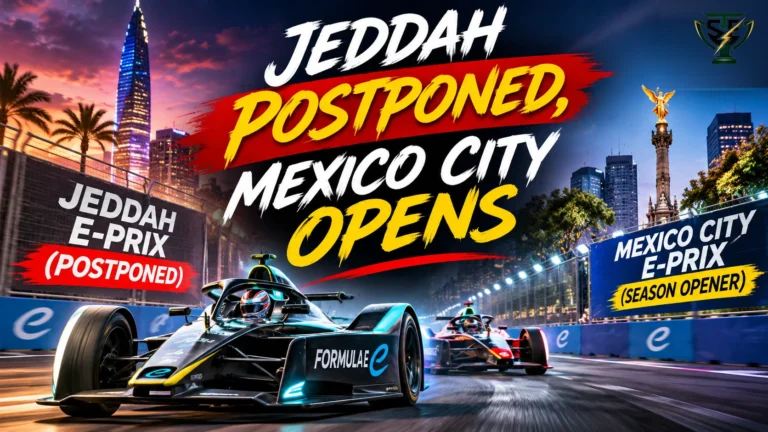
LONDON, England, November 12, 2026: Formula E has postponed its Saudi Arabian season-opening double-header in Jeddah from December 18–19 to April 16–17, 2027, citing the escalating conflict in the Middle East and related logistical concerns. The decision means Mexico City will launch the championship’s highly anticipated GEN4 era on January 16, while China’s Sanya E-Prix moves forward to April 3. Organizers have preserved the planned 21-race calendar, although the two Saudi races remain dependent on conditions allowing the event to proceed safely.
The revised schedule, approved by the FIA World Motor Sport Council, marks a significant change to Formula E’s most ambitious season yet. Jeddah had been selected to introduce the championship’s revolutionary GEN4 cars, but the ongoing security situation forced organizers to activate a contingency plan developed months earlier. The reshuffle also compresses the championship into approximately seven months, increasing the importance of logistics, reliability and preparation as teams adapt to the new generation of electric racing machinery.
Key Takeaways
- The revised schedule, approved by the FIA World Motor Sport Council, marks a significant change to Formula E’s most ambitious season yet.
- The revised Season 13 schedule retains 21 races across 13 cities, beginning in North America before moving through Asia, the Middle East and Europe.
- The most important sporting consequence is that Mexico City, rather than Jeddah, will host the first competitive race involving Formula E’s GEN4 machinery.
- Saudi Arabia has been an important partner in Formula E’s international development since joining the calendar in 2018.
Why Formula E Postponed Its Saudi Arabian Season Opener
Formula E announced the changes following discussions involving Saudi Arabian host partner SELA, the Saudi Automobile and Motorcycle Federation, the FIA and other local stakeholders.
Story at a glance
Why Formula E Postponed Its Saudi Arabian Season Opener
Formula E announced the changes following discussions involving Saudi Arabian host partner SELA, the Saudi Automobile and Motorcycle Federation, the FIA and other local stakeholders.
New Formula E Calendar: Jeddah, Mexico City and Sanya Changes
The rescheduling affects three particularly important elements of the championship: the opening event, the Saudi Arabian double-header and the Chinese race at Sanya.
Full Revised Formula E Race Calendar
The revised Season 13 schedule retains 21 races across 13 cities, beginning in North America before moving through Asia, the Middle East and Europe.
Mexico City Will Launch Formula E’s GEN4 Era
The most important sporting consequence is that Mexico City, rather than Jeddah, will host the first competitive race involving Formula E’s GEN4 machinery.
What the Delay Means for Formula E Teams and Drivers
The postponement creates an unexpected seven-week extension between the originally planned opening races and the championship’s new starting date.
The championship explained that the decision reflected recent developments in the region and the practical difficulties of delivering an international motorsport event under uncertain security conditions.
Saudi Arabia has experienced renewed attacks involving Houthi forces based in Yemen, creating concerns about air travel, infrastructure and the movement of international personnel.
Although Jeddah’s circuit infrastructure remains in place, staging a world championship requires considerably more than an available racing venue.
Formula E must transport cars, batteries, spare parts, specialist equipment and broadcast facilities across international borders. Teams also need secure travel arrangements for drivers, engineers, mechanics and operational staff.
Any interruption to those movements could affect the entire championship, particularly at the start of a season introducing substantially new technology.
According to Reuters’ report on the calendar decision, Formula E chief executive Jeff Dodds emphasized preserving the Saudi Arabian races rather than removing them immediately.
The championship’s agreement with its Saudi partners therefore establishes April as a replacement window while allowing more time to reassess the operating environment.
New Formula E Calendar: Jeddah, Mexico City and Sanya Changes
The rescheduling affects three particularly important elements of the championship: the opening event, the Saudi Arabian double-header and the Chinese race at Sanya.
| Event | Previous Date | Revised Date | Consequence |
|---|---|---|---|
| Jeddah E-Prix, Race 1 | December 18, 2026 | April 16, 2027 | Moves from season opener to Round 6 |
| Jeddah E-Prix, Race 2 | December 19, 2026 | April 17, 2027 | Becomes Round 7 |
| Mexico City E-Prix | January 16, 2027 | January 16, 2027 | Becomes new opening round |
| Sanya E-Prix | April 17, 2027 | April 3, 2027 | Moves forward by two weeks |
Mexico City’s date remains unchanged. Its significance changes because the championship will now begin there rather than in Saudi Arabia.
The revised Sanya date also removes its previously scheduled overlap with Formula One’s Chinese Grand Prix in Shanghai, which is scheduled for April 18.
Formula E’s official calendar-change announcement confirms that Jeddah retains its double-header format and that existing ticket holders will receive instructions from authorized ticketing partners.
The change is a postponement rather than a cancellation. However, April’s races are not guaranteed if security conditions deteriorate or remain unsuitable.
Full Revised Formula E Race Calendar
The revised Season 13 schedule retains 21 races across 13 cities, beginning in North America before moving through Asia, the Middle East and Europe.
| Rounds | Dates | Venue |
|---|---|---|
| 1 | January 16 | Mexico City, Mexico |
| 2 | February 6 | Austin, United States |
| 3 | February 20 | Miami, United States |
| 4 | March 13 | São Paulo, Brazil |
| 5 | April 3 | Sanya, China |
| 6–7 | April 16–17 | Jeddah, Saudi Arabia |
| 8–9 | May 1–2 | Monaco |
| 10–11 | May 8–9 | Berlin, Germany |
| 12–13 | May 29–30 | Brands Hatch, United Kingdom |
| 14–15 | June 18–19 | Zandvoort, Netherlands |
| 16–17 | June 26–27 | Madrid, Spain |
| 18–19 | July 10–11 | Shanghai, China |
| 20–21 | July 24–25 | Tokyo, Japan |
Calendar note: All dates in this table fall in 2027 and reflect the revised schedule announced on November 12, 2026. Further changes remain possible, especially for Jeddah.
The 21-race structure remains intact because the two Jeddah races have been moved rather than removed.
The original season would have started in December and concluded in July. The revised schedule runs from January 16 to July 25, reducing the competitive calendar to approximately 190 days between the first and final race dates.
That creates an average of roughly one race every nine days across the championship, although the actual distribution is uneven because several venues stage double-headers.
This calculation helps illustrate the operational demands of the new schedule. It does not mean teams race at nine-day intervals throughout the season.
Mexico City Will Launch Formula E’s GEN4 Era
The most important sporting consequence is that Mexico City, rather than Jeddah, will host the first competitive race involving Formula E’s GEN4 machinery.
The championship had originally planned to introduce the cars under the floodlights at Jeddah Corniche Circuit.
Now, the Autódromo Hermanos Rodríguez will provide the first competitive test of the new technical regulations.
GEN4 represents the largest performance advancement in Formula E’s history.
The new cars feature permanent all-wheel drive, significantly increased power and revised aerodynamic configurations designed to produce faster racing and more demanding strategic decisions.
Under the new technical package, cars can operate at 450 kilowatts in race mode and reach 600 kilowatts in Attack Mode.
Formula E has also introduced a second race format, E-PrixUnleashed, which uses a shorter, performance-focused structure alongside the championship’s established energy-management racing format.
The FIA’s official explanation of the GEN4 regulations details the revised power levels, aerodynamic options and sporting changes.
Those developments make the identity of the opening venue more significant than an ordinary calendar adjustment.
Teams will be discovering how their cars perform under real racing conditions, including tire management, energy deployment and the tactical challenges created by the new machinery.
What the Delay Means for Formula E Teams and Drivers
The postponement creates an unexpected seven-week extension between the originally planned opening races and the championship’s new starting date.
That additional time could be valuable for manufacturers still refining their GEN4 powertrains and associated systems.
Preseason testing remains scheduled for November 16–20 at Circuito del Jarama near Madrid.
Teams will use the tests to examine reliability, aerodynamic behavior, energy efficiency and the operation of new technical components.
The extra period before Mexico City may allow engineers to analyze the test data more thoroughly and address problems discovered during the first collective running.
However, the benefits will not necessarily be distributed equally.
Manufacturers with reliable development programs may use the extension to refine performance, while teams encountering substantial technical difficulties could remain under pressure despite the additional preparation time.
Once competition begins, the revised calendar creates a different challenge.
The championship’s extensive double-header schedule means teams must be prepared for successive racing weekends and relatively short intervals between events in different countries.
Travel from Sanya to Jeddah, followed by consecutive European events, places a premium on logistics and dependable equipment.
Defending champion Pascal Wehrlein will enter the new season seeking another title after claiming his second Formula E world championship.
The Porsche driver is among those facing the task of adapting to the new machinery while maintaining the consistency required for a championship challenge.
Could the Jeddah E-Prix Still Be Cancelled?
Although April dates have been approved, Formula E has not ruled out further changes if the situation in Saudi Arabia does not improve.
According to Reuters, organizers expect to make a decision by mid-to-late February if concerns remain about hosting the rescheduled races.
Dodds indicated that reducing the number of championship races would be more likely than arranging another replacement venue at short notice.
That distinction is significant.
Formula E has preserved the complete 21-race calendar in its current announcement, but that depends on Jeddah eventually taking place.
If both Saudi races were removed without replacement, the schedule would fall to 19 rounds.
Such a reduction would alter the number of available championship points and potentially affect teams whose performances are better suited to certain circuits or race formats.
It could also affect commercial obligations, broadcasting arrangements and fan travel plans.
For now, Formula E and its Saudi partners remain committed to staging the double-header in April.
Ticket holders have been advised that official partners will provide information about validity, transfers and refunds. Fans should rely on those direct communications rather than assuming existing bookings automatically cover every associated travel expense.
Saudi Arabia’s Security Crisis Has Already Affected Other Sports
Formula E’s decision follows several disruptions to international sporting events in Saudi Arabia and neighboring countries.
The continuing regional conflict has created uncertainty for organizers operating across the Middle East, particularly where large international delegations depend on predictable travel arrangements.
FIFA previously postponed its esports finals in Jeddah following attacks in Saudi Arabia, leaving participating teams and organizers facing a revised tournament timetable.
The Sports Encounter examined that decision in its report on the postponed FIFAe Finals in Jeddah.
Saudi Arabia’s domestic football calendar has also faced disruption, including the postponement of Saudi Pro League fixtures following wider changes to the international schedule.
Those consequences were covered in TSE’s analysis of the Saudi Pro League postponement and Asian Cup calendar changes.
Regional sporting instability is therefore affecting both international competitions and domestic scheduling.
The implications differ by sport, but the common problem is the difficulty of maintaining complex competition calendars while security conditions remain uncertain.
Why Formula E’s Decision Differs From Formula One
Formula E’s postponement also highlights how leading motorsport championships can respond differently to the same regional circumstances.
Formula One has continued planning to conclude its season with races in Qatar and Abu Dhabi, maintaining those events on its calendar while monitoring the regional security environment.
The Sports Encounter examined that position in its report on Formula One’s commitment to its Gulf season finales and the remaining safety concerns.
Formula E, meanwhile, had been preparing to begin a new season in Saudi Arabia rather than complete an existing championship.
That distinction affects the available options.
Continue the Motorsport Story
 MotorsportRacing Bulls Retain Liam Lawson and Arvid Lindblad as Nikola Tsolov Misses Out
 MotorsportF1 Keeps Qatar and Abu Dhabi Finales as Imola Stands Down, but Safety Could Still Rewrite the Ending
 MotorsportMarc Márquez One Step From MotoGP History as Qatar Grand Prix Faces War and Safety Questions
Moving an opening race allows Formula E to delay its competitive debut while retaining a substantial part of the calendar. Formula One must consider how any changes to its final events would influence a championship already approaching its conclusion.
The commercial arrangements, logistics, host-country conditions and individual risk assessments also differ.
MotoGP has faced similar questions surrounding events in Qatar, including the security implications of staging major racing competitions during regional hostilities.
Those concerns form part of TSE’s coverage of the Qatar MotoGP event and its safety challenges.
There is no universal response that every motorsport organizer must adopt. Each championship must assess the conditions surrounding its own events and operational requirements.
Why Keeping Jeddah Matters to Formula E
Saudi Arabia has been an important partner in Formula E’s international development since joining the calendar in 2018.
The championship initially raced in Diriyah before transferring its Saudi Arabian event to Jeddah in 2025.
The move introduced Formula E to the Jeddah Corniche Circuit, a venue already established as a major destination for international motorsport.
The 2025 Jeddah weekend also introduced the PIT BOOST feature, adding mandatory mid-race charging stops to Formula E’s evolving sporting format.
Saudi Arabia’s role therefore extends beyond hosting a pair of races.
The partnership has provided Formula E with a venue for technical innovation, international exposure and the development of new racing formats.
Retaining the April double-header protects those longer-term objectives while avoiding an immediate cancellation.
It also reduces the disruption associated with removing two rounds from a championship designed around 21 races.
Nevertheless, preserving the partnership does not eliminate the need for a fresh security assessment before the event proceeds.
The Revised Schedule Gives GEN4 a Different Opening Challenge
Formula E’s decision ensures that its new technical era will begin without waiting for a final resolution of the Saudi Arabian security situation.
Mexico City now receives the opening race, while Austin, Miami and São Paulo complete the early American phase before the championship returns to Asia.
Sanya’s move to April 3 creates a new transition into the rescheduled Jeddah weekend.
The competition then moves to Monaco, Berlin and the remaining European events before concluding in Tokyo.
For teams, the central challenge will be adapting to the GEN4 machinery while managing the demands of an increasingly concentrated international calendar.
For organizers, the immediate achievement is preserving the planned race count without abandoning Saudi Arabia’s place in the championship.
But the revised dates should not be mistaken for a complete resolution.
Jeddah’s races remain subject to the evolving situation, and a further decision may be necessary before teams commit to the April event.
The next decisive milestone is the November preseason test in Madrid, followed by the competitive GEN4 debut in Mexico City on January 16.
Formula E has found a way to begin its new era without its original opening venue. Whether it can complete the season with all 21 races will depend partly on conditions beyond the control of the championship, its teams and its drivers.