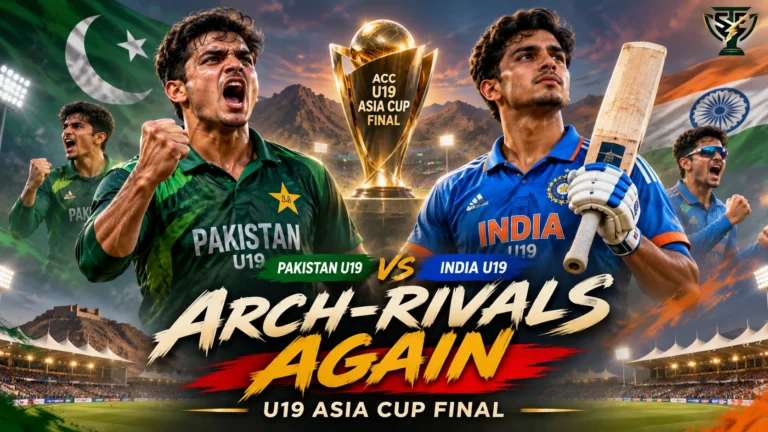
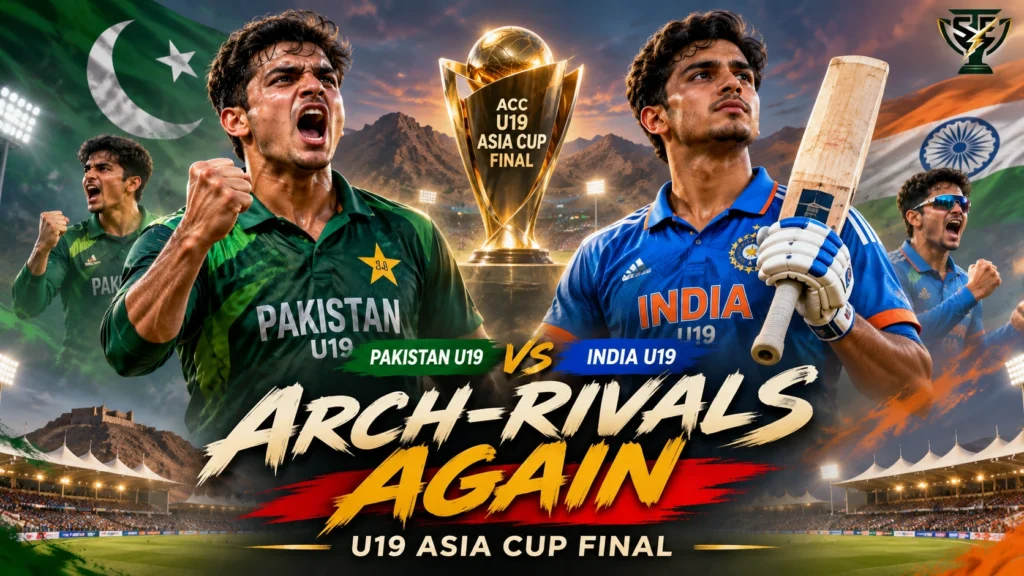
AL AMERAT, Oman, November 12, 2026: Pakistan and India will contest another high-stakes Under-19 Asia Cup final after both arch-rivals swept aside their semifinal opponents in Oman, setting up a championship rematch that carries the weight of two recent Pakistan victories over their neighbors. Defending champions Pakistan demolished Bangladesh by nine wickets after Rizwanullah’s outstanding 5/30, while India crushed Afghanistan by eight wickets through a commanding chase led by captain Lakshya Raichandani’s 93.
The victories ensure that two of Asian cricket’s fiercest rivals will meet for the title on November 14 at Al Amerat’s Ministry Turf 2. Pakistan enter the final unbeaten, having defeated India by three wickets in the group stage and by 191 runs in the previous edition’s final. India, however, have responded to that group-stage disappointment with increasingly authoritative batting performances. The championship contest will test whether Pakistan’s ability to win difficult matches can overcome an Indian lineup that has repeatedly dominated run chases.
Key Takeaways
- The victories ensure that two of Asian cricket’s fiercest rivals will meet for the title on November 14 at Al Amerat’s Ministry Turf 2.
- Pakistan’s title-defense schedule was confirmed by the Pakistan Cricket Board before the tournament.
- Captain Farid Hasan joined Abdullah Al Muhi in a recovery effort, but their partnership ended when Rizwanullah dismissed Hasan for 17 with the score at 68/3.
- The upcoming championship has historical significance because Pakistan defeated India by 191 runs in the previous U19 Asia Cup final.
Pakistan vs India U19 Asia Cup Final: Match Details
| Detail | Confirmed Information |
|---|---|
| Fixture | Pakistan U19 vs India U19 |
| Competition | ACC Men’s U19 Asia Cup |
| Stage | Final |
| Date | Saturday, November 14, 2026 |
| Venue | Al Amerat Cricket Ground, Ministry Turf 2, Oman |
| Start time in Oman | 9:00 a.m. |
| Start time in Pakistan | 10:00 a.m. |
| Start time in India | 10:30 a.m. |
| Defending champions | Pakistan U19 |
| Previous group meeting | Pakistan won by three wickets |
Pakistan’s title-defense schedule was confirmed by the Pakistan Cricket Board before the tournament. Both semifinals took place on November 12, giving the finalists one day without competitive action before the championship match.
Story at a glance
Pakistan vs India U19 Asia Cup Final: Match Details
Pakistan’s title-defense schedule was confirmed by the Pakistan Cricket Board before the tournament. Both semifinals took place on November 12, giving the finalists one day without competitive action before the championship match.
Rizwanullah’s Five-Wicket Haul Sends Pakistan Into the Final
Pakistan’s nine-wicket semifinal victory over Bangladesh began with a bowling performance that prevented the opposition from exploiting a promising start.
Hayam Khan and Usman Khan Complete Pakistan’s Dominant Chase
Pakistan’s response was almost as impressive as their bowling.
India Overpower Afghanistan Through Lakshya Raichandani’s 93
India’s route into the final was equally convincing, although Afghanistan made their opponents work harder with the bat.
Raichandani, Sehwag and Vineeth Give India a Powerful Batting Platform
India’s openers, Lakshya Raichandani and Aaryavir Sehwag, immediately placed Afghanistan’s bowling attack under pressure.
Rizwanullah’s Five-Wicket Haul Sends Pakistan Into the Final
Pakistan’s nine-wicket semifinal victory over Bangladesh began with a bowling performance that prevented the opposition from exploiting a promising start.
Bangladesh elected to bat but struggled almost immediately against Pakistan’s seamers. Mohammad Sayyam removed SK Jarif Siyam for one and Kawser Ahmed for nine, reducing Bangladesh to 25/2 inside six overs.
Captain Farid Hasan joined Abdullah Al Muhi in a recovery effort, but their partnership ended when Rizwanullah dismissed Hasan for 17 with the score at 68/3.
Al Muhi was Bangladesh’s most convincing batter. He attacked whenever the bowlers offered width or length, reaching his half-century from 44 balls and eventually making 50 from 45 deliveries, including four fours and two sixes.
His innings briefly gave Bangladesh a platform from which to rebuild. At 98/5 after 18.3 overs, however, the side was already running out of specialist batting resources.
Rizwanullah had removed Al Muhi, caught by wicketkeeper Hamza Zahoor, and then dismantled Bangladesh’s lower middle order.
All Rafi, who contributed 20 from 22 balls, became his next victim through a caught-and-bowled dismissal. Three balls later, Robiul Hasan Anik fell LBW for a duck.
Those wickets took Bangladesh from 111/5 to 111/7, effectively eliminating the prospect of a competitive total.
Rizwanullah returned to dismiss Rakibul Hossan for 26, completing a five-wicket haul in eight overs at a cost of just 30 runs.
Ahmed Hussain removed Sheikh Atiqur Rahman to end Bangladesh’s innings at 138 in 31.4 overs.
Pakistan’s attack shared the pressure effectively. Sayyam finished with 2/29 from seven overs, Ali Raza took 1/36, Hasnain Abbas Dar returned 1/22, and Ahmed Hussain claimed 1/4 from 1.4 overs.
Rizwanullah nevertheless supplied the decisive wickets, dismissing both Bangladesh’s leading scorer and four other batters before the innings could develop into a significant total.
Pakistan vs Bangladesh Semifinal Scorecard
| Category | Performance |
|---|---|
| Bangladesh U19 | 138 all out, 31.4 overs |
| Pakistan U19 | 141/1, 21.5 overs |
| Result | Pakistan won by nine wickets |
| Balls remaining | 169 |
| Rizwanullah | 5/30 from eight overs |
| Mohammad Sayyam | 2/29 from seven overs |
| Hayam Khan | 69 from 72 balls |
| Usman Khan | 64 not out from 54 balls |
| Bangladesh’s leading batter | Abdullah Al Muhi, 50 from 45 balls |
| Player of the Match | Rizwanullah |
Hayam Khan and Usman Khan Complete Pakistan’s Dominant Chase
Pakistan’s response was almost as impressive as their bowling.
Openers Hayam Khan and Usman Khan added 123 runs in 20.4 overs, leaving Bangladesh without a realistic opening to return to the contest.
Hayam scored 69 from 72 deliveries, striking eight boundaries and a six. He reached his half-century from 53 balls and provided the stability Pakistan needed to avoid unnecessary pressure in a knockout match.
Usman was more aggressive, scoring an unbeaten 64 from 54 balls, including seven fours and two sixes. His fifty came from 47 deliveries.
Bangladesh finally broke the partnership when Robiul Hasan Anik removed Hayam at 123/1, but the dismissal came too late to alter the outcome.
Abdul Qadir struck eight from five deliveries, including a six, as Pakistan completed the chase in just 21.5 overs.
The nine-wicket margin and 169 unused deliveries reflected Pakistan’s comprehensive control of both innings.
More importantly for the final, Pakistan demonstrated that they can win through different combinations of players. Usman has already made an unbeaten 139 against the UAE, Hamza Zahoor scored a match-winning century against India, and Ahmed Hussain produced a major all-round performance against Nepal.
Those contributions were documented in The Sports Encounter’s report on Pakistan and India’s opening victories and its analysis of the decisive final Group A matches.
The semifinal adds Rizwanullah and Hayam to Pakistan’s growing list of players who have made important contributions at different stages of the tournament.
India Overpower Afghanistan Through Lakshya Raichandani’s 93
India’s route into the final was equally convincing, although Afghanistan made their opponents work harder with the bat.
Afghanistan elected to bat and reached 227/8 in their allotted 50 overs, recovering from an uncertain start through half-centuries by Noman Salarzai and Shah Faisal Rahimi.
At 86/3 after 19.4 overs, Afghanistan needed a substantial partnership to prevent India from controlling the contest.
Salarzai scored 51 from 78 deliveries, while Rahimi contributed 51 from 72. Their fourth-wicket partnership added 57 runs before Arjun Rajput dismissed Salarzai at 143/4.
That breakthrough was followed by two rapid dismissals. Aryan Savsani removed Amir Hamza for a duck and Tahir Sarwary for one, reducing Afghanistan to 146/6 at the end of the 37th over.
Captain Sohail Khan helped repair the damage with an unbeaten 36 from 44 balls, adding valuable late runs alongside Rahimi and the lower order.
Ishan Sood was India’s leading bowler, claiming 3/43 from nine overs. Savsani finished with 2/29, while Rajput, Kavya Paresh Patel and Yashbardhan Chauhan took one wicket each.
Afghanistan’s total was respectable after the middle-order setbacks, but India approached the chase with a level of authority that quickly removed any doubts about their batting depth.
Raichandani, Sehwag and Vineeth Give India a Powerful Batting Platform
India’s openers, Lakshya Raichandani and Aaryavir Sehwag, immediately placed Afghanistan’s bowling attack under pressure.
The pair added 117 runs for the first wicket in 17 overs, giving India a commanding position before the first dismissal.
Raichandani was particularly effective during the opening phase. He reached his half-century from just 39 balls, with nine boundaries, before converting his innings into a match-defining 93 from 90 deliveries.
His final score included 13 fours and one six.
Sehwag contributed 51 from 57 balls, striking four fours and four sixes. His dismissal came when Noor Ali Niazai removed him at 117/1.
India did not allow that wicket to interrupt their momentum.
VK Vineeth joined Raichandani, and the pair carried the score to 194 before Afghanistan captain Sohail Khan dismissed the Indian skipper.
Vineeth remained unbeaten on 57 from 62 deliveries, while Yashbardhan Chauhan struck 16 not out from 14 balls to complete the chase.
India reached 230/2 in 36.5 overs, winning with 79 balls remaining.
Raichandani was named Player of the Match, but India’s performance was built around three substantial batting contributions rather than the efforts of one individual.
India vs Afghanistan Semifinal Scorecard
| Category | Performance |
|---|---|
| Afghanistan U19 | 227/8, 50 overs |
| India U19 | 230/2, 36.5 overs |
| Result | India won by eight wickets |
| Balls remaining | 79 |
| Lakshya Raichandani | 93 from 90 balls |
| Aaryavir Sehwag | 51 from 57 balls |
| VK Vineeth | 57 not out from 62 balls |
| Ishan Sood | 3/43 from nine overs |
| Afghanistan’s leading batters | Noman Salarzai 51, Shah Faisal Rahimi 51 |
| Player of the Match | Lakshya Raichandani |
Pakistan Have Already Beaten India, but the Final Presents a Different Challenge
The most intriguing element of Saturday’s final is that these teams have already met in the tournament.
Pakistan defeated India by three wickets on November 8 after India were dismissed for 208 in 46.3 overs.
Pakistan’s chase was far from straightforward.
India’s bowlers repeatedly challenged the Pakistani batting order, and the defending champions required an extraordinary unbeaten century from wicketkeeper Hamza Zahoor to reach 209/7 in 48.1 overs.
Hamza scored 100 not out from 108 deliveries, striking ten fours and three sixes. His innings compensated for failures elsewhere in the top order, including captain Farhan Yousaf’s dismissal for two.
The ICC’s official match scorecard confirms that Pakistan crossed the target with just 11 balls remaining.
That result established Pakistan’s ability to survive serious pressure against India. It also highlighted a weakness that could become important in the final.
Pakistan cannot assume that another individual rescue innings will be available if India’s bowlers remove several leading batters cheaply.
India, meanwhile, must avoid allowing Pakistan’s lower middle order to rebuild after early wickets. Their inability to close out the previous encounter remains the clearest warning from the head-to-head result.
The difference between the two teams’ semifinal victories also deserves attention.
Pakistan chased a modest target of 139 and were able to control the innings without taking significant risks.
India successfully chased 228 at a run rate above six per over, demonstrating that their batting lineup can maintain positive scoring while protecting wickets.
The two performances cannot be compared simply by wickets remaining or victory margin because the targets differed considerably.
However, India’s ability to combine an aggressive opening partnership with another substantial middle-order stand makes them a more dangerous opponent than the earlier group-stage defeat might suggest.
Pakistan vs India: The Tactical Battles That Could Decide the Title
Rizwanullah Against India’s Top Order
Rizwanullah’s semifinal figures have elevated him into one of Pakistan’s most important bowling options heading into the final.
His dismissal of Abdullah Al Muhi for 50 demonstrated the value of removing a set batter before the opposition can accelerate.
Against India, that responsibility will be particularly significant because Raichandani and Sehwag have shown how quickly they can establish a strong opening partnership.
Pakistan need early wickets to prevent India’s leading batters from dictating the middle overs.
Rizwanullah will also have support from Ali Raza and Mohammad Sayyam, whose ability to contain scoring and create pressure could determine whether India can reproduce their performance against Afghanistan.
India’s Bowlers Against Pakistan’s Multiple Match-Winners
India face a different problem.
Pakistan have already produced major batting performances through Usman Khan, Hamza Zahoor, Farhan Yousaf, Ahmed Hussain and Hayam Khan.
That distribution makes it difficult to identify one batter whose dismissal would guarantee control of the innings.
Ishan Sood’s three-wicket semifinal performance gives India a proven wicket-taking option, while the contributions of Savsani, Patel and the Chauhans provide additional alternatives.
India’s central challenge will be sustaining pressure after the first breakthrough rather than allowing Pakistan to recover through another substantial partnership.
Powerplay Discipline and Middle-Over Partnerships
The tournament has demonstrated the importance of early wickets and controlled partnerships.
Pakistan defeated Bangladesh after reducing them to 25/2. India, by contrast, gave Afghanistan no early opening during their own chase.
For both finalists, the first ten overs could establish the tactical direction of the match.
The more difficult challenge may come afterward. Pakistan’s earlier victory over India was decided by their capacity to recover from setbacks, while India’s semifinal success relied on maintaining strong partnerships after the opening stand.
Whichever team protects its batting resources through the middle overs is likely to gain greater freedom to accelerate near the end.
What the Semifinals Reveal About the Two Finalists
| Measure | Pakistan U19 | India U19 |
|---|---|---|
| Semifinal opponent | Bangladesh | Afghanistan |
| Semifinal result | Won by nine wickets | Won by eight wickets |
| Opposition total | 138 all out | 227/8 |
| Successful chase | 141/1 in 21.5 overs | 230/2 in 36.5 overs |
| Balls remaining | 169 | 79 |
| Leading semifinal batter | Hayam Khan, 69 | Lakshya Raichandani, 93 |
| Leading semifinal bowler | Rizwanullah, 5/30 | Ishan Sood, 3/43 |
| Tournament record | Four wins, no defeats | Three wins, one defeat |
| Previous meeting | Won by three wickets | Lost by three wickets |
The semifinal scorecards reveal two different strengths.
Pakistan delivered the more destructive bowling performance, dismissing Bangladesh for fewer than 140 before completing a comfortable chase.
India defeated stronger scoreboard resistance, successfully chasing a total of 228 without losing control of the required run rate.
Continue the U19 Asia Cup Story
 CricketU19 Asia Cup Semifinals: Pakistan’s Perfect Run Meets Bangladesh Bowlers as India Face Unbeaten Afghanistan
 CricketStylish Sehwag and Perfect Ahmed Hussain Send India and Pakistan Into U19 Asia Cup Semifinals
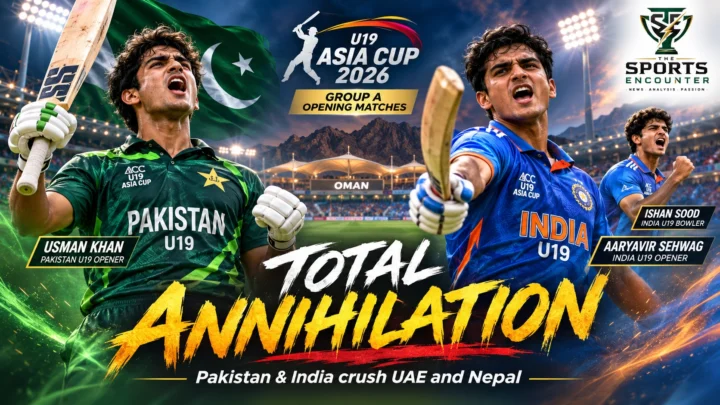
 U19 Asia CupU19 Asia Cup 2026: Pakistan, India Totally Annihilate the UAE and Nepal in Opening Encounters
Neither performance provides a reliable prediction of the final because both teams will face a substantially different opposition attack.
Pakistan’s unbeaten record remains significant, particularly after their narrow victory over India. India’s growing batting confidence, however, means the defending champions cannot rely on earlier results to deliver another title.
Another Final Adds to Pakistan and India’s Youth Cricket Rivalry
The upcoming championship has historical significance because Pakistan defeated India by 191 runs in the previous U19 Asia Cup final.
Pakistan’s captain Farhan Yousaf also led that title-winning side, providing leadership continuity between the two campaigns.
Before the current tournament, the PCB described Pakistan as determined to defend the title rather than simply repeat the previous result.
The PCB’s official squad announcement also highlighted the team’s preparation, including a four-match Youth ODI series in England.
Pakistan’s young cricketers had demonstrated their batting potential during that tour. In September, Usman Khan struck 151 and Farhan scored 115 in a 177-run victory over England, a performance examined in The Sports Encounter’s detailed match analysis.
Those experiences help explain why Pakistan have multiple batters capable of producing substantial innings under pressure.
India’s challenge is equally compelling. The team recovered from its defeat against Pakistan to beat UAE and then Afghanistan, reaching the final with momentum rather than merely relying on its standing as one of the tournament favorites.
The rivalry has added emotional significance because this is a title rematch, but the decisive factors will remain batting discipline, bowling execution and the ability to adapt to the conditions in Al Amerat.
Why the Semifinal Favorites Failed to Stop the Final Rematch
The knockout results also offer an important lesson about tournament form.
Afghanistan entered the semifinals unbeaten, having defeated Bangladesh, Malaysia and Sri Lanka. Its group-stage net run rate of +3.176 was the strongest among the four semifinalists.
Bangladesh, meanwhile, had recovered from an opening defeat to Afghanistan to qualify through victories over Sri Lanka and Malaysia.
As The Sports Encounter’s semifinal preview explained, Bangladesh possessed a significant wicket-taking threat through Tafiul Alam Tamim, while Afghanistan’s Noor Ali Niazi entered the knockouts with 13 wickets.
Neither side could convert those strengths into a semifinal victory.
Bangladesh’s batting failed before its bowlers could apply meaningful scoreboard pressure. Afghanistan made a more competitive total, but India’s top order controlled the chase.
The contrast demonstrates why an unbeaten group record or impressive individual statistics do not automatically translate into knockout success.
Pakistan and India now face the same challenge. Their semifinal performances earned places in the final, but those victories provide no guarantee once the championship match begins.
Afghanistan’s earlier group-stage dominance was documented in TSE’s opening-day analysis of Group B, making its elimination a particularly important reminder of how quickly tournament momentum can change.
Pakistan Seek Another Title as India Chase Redemption
Pakistan will enter the final with the confidence of an unbeaten campaign, a victory over India earlier in the tournament and the experience of winning the previous edition.
India arrive with a different incentive. Having lost both the previous final and the latest group-stage meeting, they now have an opportunity to reverse that sequence with the title at stake.
Rizwanullah’s emergence as Pakistan’s semifinal match-winner adds another dimension to an attack already supported by Ali Raza and Mohammad Sayyam.
India’s strongest argument lies in its batting. Raichandani, Sehwag and Vineeth showed against Afghanistan that the side can combine aggressive scoring with long partnerships.
Pakistan have the stronger recent head-to-head record. India have demonstrated the capacity to score quickly against a competitive bowling attack.
The final will determine which of those advantages matters more under championship pressure.
For Pakistan, victory would complete an unbeaten title defense and extend their recent dominance of this youth rivalry. For India, it would represent a significant turnaround after two defeats to the same opponent across consecutive editions.
Another Pakistan-India final is assured. The result remains wide open.