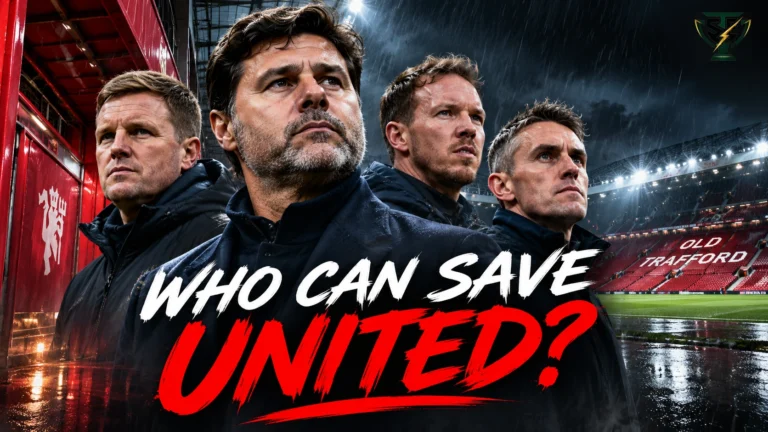
MANCHESTER, England, November 10, 2026: Manchester United are considering another managerial change after a collapse that has dragged Michael Carrick’s side into the Premier League relegation zone, with United States national team coach Mauricio Pochettino emerging as the reported favorite to replace him. The 4-4 draw against Aston Villa at Old Trafford left United 18th with eight points from ten matches, one victory all season and eight consecutive league games without a win. Eddie Howe, Julian Nagelsmann and Kieran McKenna are also reportedly under consideration as the club’s leadership weighs another change before a difficult visit to Liverpool.
The predicament is extraordinary because Carrick was supposed to represent the end of United’s managerial uncertainty. He guided the club from seventh to third last season, secured Champions League qualification and earned a permanent appointment after an impressive spell as interim manager. Ten league matches later, United have conceded 19 goals, repeatedly surrendered control of games and fallen into another crisis. Pochettino offers Premier League experience and an established record of developing players, but his contract with U.S. Soccer runs through 2030. The bigger question is whether United can identify a coach capable of repairing their defensive structure, restoring confidence and surviving an institution that has repeatedly undermined its own rebuilds.
Manchester United’s Crisis Has Become a Relegation Problem
The numbers make uncomfortable reading for a club that entered the season expecting another challenge for Champions League qualification.
United have won once, drawn five times and lost four of their opening ten Premier League matches. Their eight points leave them 18th, one point behind both Coventry City and Nottingham Forest.
Story at a glance
Manchester United’s Crisis Has Become a Relegation Problem
The numbers make uncomfortable reading for a club that entered the season expecting another challenge for Champions League qualification.
How Did Michael Carrick Go From Savior to Possible Casualty?
When Carrick returned as interim manager in January, United needed stability after Ruben Amorim’s departure.
Why the Aston Villa Draw May Have Sealed Carrick’s Fate
United’s 4-4 draw with Aston Villa presented both the strongest argument for retaining Carrick and the clearest evidence of why his position is under threat.
Mauricio Pochettino: The Favorite Who Already Has a Job
Pochettino, 54, is the leading candidate according to reports about United’s internal discussions.
Eddie Howe: The Premier League Specialist With a Proven Recovery Record
Howe offers a different argument.
The most troubling statistic is the defensive record. United have conceded 19 goals, almost two per match, while scoring 14.
The attacking output is not the primary explanation for their league position. Fourteen goals in ten games should have provided more opportunities to collect points. Conceding at the current rate has made it exceptionally difficult to convert competitive performances into victories.
The Premier League’s official analysis of United’s Aston Villa draw confirms that the club has equaled its longest winless Premier League sequence and occupies its lowest position after ten top-flight matches since the 1986-87 season.
Manchester United’s League Position After Ten Matches
| Measure | Record | What It Reveals |
|---|---|---|
| League position | 18th | United are in the relegation zone |
| Matches played | 10 | More than a quarter of the league campaign completed |
| Wins | 1 | Only one successful league result |
| Draws | 5 | Repeated inability to turn competitive games into victories |
| Defeats | 4 | Forty percent of league fixtures lost |
| Goals scored | 14 | 1.40 per match |
| Goals conceded | 19 | 1.90 per match |
| Goal difference | -5 | Defensive shortcomings outweigh attacking production |
| Points | 8 | 0.80 per match |
| Current winless league run | 8 matches | Five draws and three defeats |
TSE statistical analysis: United’s eight points from ten games represent a projected 30.4 points over a 38-match season if their current rate continues. That is a simple extrapolation, not a prediction of their final total. It illustrates the urgency of improving results.
Continuing at that rate would leave United vulnerable to relegation. However, the remaining 28 matches provide substantial opportunity for recovery.
United’s problems did not emerge overnight. The Sports Encounter’s investigation into the failures holding Manchester United back previously examined the club’s inconsistent recruitment, recurring tactical problems and inability to sustain improvement.
The latest results have reinforced those concerns.
How Did Michael Carrick Go From Savior to Possible Casualty?
When Carrick returned as interim manager in January, United needed stability after Ruben Amorim’s departure.
The former England midfielder provided it.
His initial spell brought 11 victories in 16 Premier League matches and helped United climb from seventh to third, securing a return to the Champions League.
The improvement was significant enough for the club to appoint him permanently.
TSE’s assessment of Carrick’s Manchester United rebuild explored the foundations of that recovery and the expectation that a full preseason would help consolidate his methods.
Instead, United have lost the organization that made the turnaround possible.
Their pressing has frequently lacked coordination. Midfielders have struggled to protect the spaces in front of the defense, and attacking players have not consistently restricted opponents’ passing options.
Those weaknesses become especially damaging when United lose possession with several players committed forward.
Defenders are left facing opponents running into space, and individual mistakes become more likely when the team repeatedly loses its collective shape.
These are problems a manager must address, but their persistence also raises questions about recruitment, squad balance and whether United’s hierarchy has provided a coherent footballing structure.
From Carrick’s Recovery to United’s Collapse
| Period | League Performance | Competitive Position | Central Lesson |
|---|---|---|---|
| January-May 2026 | 11 wins in Carrick’s first 16 league matches | Recovered from seventh to third | Clearer roles and improved organization produced results |
| End of 2025-26 | 71 points | Third place and Champions League qualification | The revival created expectations of sustained improvement |
| First five league matches of 2026-27 | 5 points | Lower half of the table | Early warning signs appeared |
| After nine league matches | 7 points | Relegation danger | Defensive mistakes and inconsistent performances persisted |
| After ten league matches | 8 points | 18th place | Pressure escalated into a potential managerial change |
The deterioration is particularly striking because Carrick’s original recovery was not built on an entirely new squad.
He improved the performances of several established players by giving them clearer responsibilities.
Yet the following campaign exposed how fragile that improvement remained.
TSE’s earlier analysis of 14 reasons United’s revival had stalled identified weaknesses involving pressing, midfield balance, game management and attacking cohesion.
The search for a new manager must begin with those problems, rather than simply choosing the most recognizable candidate.
Why the Aston Villa Draw May Have Sealed Carrick’s Fate
United’s 4-4 draw with Aston Villa presented both the strongest argument for retaining Carrick and the clearest evidence of why his position is under threat.
The players demonstrated remarkable determination to recover from two separate two-goal deficits.
They also conceded four goals through a series of lapses that would concern any prospective manager.
Villa scored twice inside the opening four minutes through Alysson and Nicolas Jackson.
Bruno Fernandes converted a penalty before Youri Tielemans equalized against his former club.
United had restored parity before halftime, only to concede another two goals shortly after the interval.
John McGinn scored from the penalty spot, and Leon Goretzka punished confusion inside the United penalty area.
Trailing 4-2 entering stoppage time, United recovered through Joshua Zirkzee and Patrick Dorgu.
Dorgu’s equalizer, in the sixth minute of added time, completed another extraordinary comeback.
The official Manchester United match report confirms the eight goals, their timing and the decisive late contributions.
The Four Phases That Exposed United’s Problem
| Match Phase | What Happened | Why It Matters |
|---|---|---|
| Opening four minutes | Alysson and Nicolas Jackson put Villa 2-0 ahead | United’s defensive organization failed immediately |
| First-half recovery | Fernandes and Tielemans made it 2-2 | The team demonstrated attacking resilience |
| Start of second half | McGinn and Goretzka restored Villa’s two-goal lead | United repeated their defensive errors after halftime |
| Stoppage time | Zirkzee and Dorgu scored to secure a 4-4 draw | Substitutions and determination rescued one point |
The overlooked contribution came from Dorgu, who returned from injury as a substitute and supplied the cross for Zirkzee’s goal before scoring the equalizer himself.
That intervention deserves recognition.
Yet the match also demonstrated an uncomfortable contradiction: United are capable of dramatic recoveries but cannot consistently establish the defensive platform that would make such recoveries unnecessary.
The 3-2 Champions League victory over Roma earlier in the week followed a similar pattern, with United recovering from a two-goal deficit.
Two extraordinary comebacks within five days show that the players are still responding to Carrick.
They do not establish that his tactical approach is producing sustainable results.
Mauricio Pochettino: The Favorite Who Already Has a Job
Pochettino, 54, is the leading candidate according to reports about United’s internal discussions.
His managerial background makes that interest understandable.
He has worked in the Premier League with Southampton, Tottenham Hotspur and Chelsea, reached the Champions League final with Tottenham, and won domestic honors at Paris Saint-Germain.
His reputation rests partly on developing young players within demanding tactical systems.
At Tottenham, he helped build an energetic side capable of competing near the top of the Premier League despite operating with different resources from several leading rivals.
His teams have often relied on aggressive pressing, coordinated defensive movement and quick attacks after regaining possession.
Those qualities address several of United’s recurring weaknesses.
However, his current employment creates a complication that cannot be ignored.
Pochettino signed a contract extension with the United States Soccer Federation in August, committing him to the national team through 2030.
The official U.S. Soccer announcement describes a project extending beyond the senior national team, including player development, youth pathways and preparations for the next World Cup cycle.
His departure would therefore involve more than resigning from an ordinary short-term coaching appointment.
What Makes Pochettino an Attractive Candidate?
The Argentine understands the Premier League’s competitive demands and has experience managing high-profile players.
His work at Tottenham offers evidence of his ability to establish a recognizable playing identity over several seasons.
United need exactly that kind of consistency.
They also require a manager capable of improving the performances of younger players without making every setback an excuse for another major transfer campaign.
Pochettino’s development work with the United States provides additional context. He led the team into the World Cup knockout rounds and subsequently committed to a longer-term development program.
There are questions about whether his methods would suit every United player, particularly those who struggle with sustained pressing and defensive discipline.
He would also face the same executive pressures and recruitment decisions that complicated the work of his predecessors.
Could Manchester United Buy Pochettino Out of His U.S. Contract?
Reports suggest that a financial agreement could make an appointment possible, with a release payment around £7 million or approximately $10 million discussed in media coverage.
Those figures should be treated as reported estimates rather than a publicly verified contractual obligation.
U.S. Soccer has not publicly confirmed the relevant termination terms.
United would need to establish whether Pochettino wanted the job, whether he could leave under the terms of his agreement and how any departure would affect the United States’ international commitments.
The U.S. national team is preparing for Concacaf Nations League quarterfinal matches against Haiti.
Its existing commitments make the timing of any possible negotiations important.
The distinction is essential: Pochettino is reportedly the favorite, but he has not been appointed, and there is no verified agreement between the parties.
Eddie Howe: The Premier League Specialist With a Proven Recovery Record
Howe offers a different argument.
The former Newcastle United manager has extensive experience building competitive Premier League teams and improving players within a consistent tactical structure.
His time at Bournemouth demonstrated an ability to develop a club over several seasons, while his subsequent work at Newcastle included Champions League qualification and a domestic cup triumph.
Howe’s teams have generally emphasized intensity, organized pressing and attacking movement.
Those characteristics could help United address the gaps between their midfield and defensive lines.
His familiarity with English football also reduces some of the uncertainty associated with appointing someone without recent Premier League experience.
However, the scale of scrutiny at Manchester United would be different.
Howe would inherit an established squad containing prominent international players, an impatient supporter base and a leadership structure under pressure.
The more immediate question is whether United would give him sufficient authority over footballing decisions to establish a coherent system.
The club’s recruitment and structural difficulties have already been examined in TSE’s report on Erik ten Hag’s allegations about Manchester United’s broken promises.
Howe’s candidacy should be judged against that background.
He offers experience in building teams, but his work would depend on whether the club provides the conditions necessary for sustained improvement.
Julian Nagelsmann: The Tactical Thinker With the Highest Adaptation Risk
Nagelsmann represents perhaps the most adventurous option among the reported leading candidates.
The former Bayern Munich and Germany coach established his reputation through tactical innovation and his willingness to alter formations, pressing structures and attacking patterns according to opponents.
His work at Hoffenheim and RB Leipzig demonstrated an ability to challenge stronger teams through organization and flexible positioning.
He later managed Bayern Munich before taking charge of Germany.
His international tenure ended following Germany’s elimination in the World Cup round of 32.
For United, Nagelsmann could offer a more comprehensive tactical overhaul than some alternative candidates.
He might introduce a flexible defensive structure, clearer pressing triggers and improved positional relationships between the midfield and attack.
However, tactical sophistication does not guarantee an immediate response from a struggling squad.
Players need time to understand new responsibilities, particularly when a coach regularly changes formations or makes detailed adjustments between matches.
United’s current league position leaves little room for a prolonged experimental period.
Nagelsmann would need to balance his broader tactical ambitions with immediate improvements in defensive reliability and points accumulation.
Kieran McKenna: A Return to Old Trafford With Different Expectations
McKenna is another intriguing name because of his previous experience at Manchester United.
He worked on the club’s coaching staff before leaving to pursue senior management opportunities.
His subsequent work at Ipswich Town established his reputation as a coach capable of implementing structured possession football and developing players.
McKenna understands the club’s environment, but returning as head coach would represent a significantly greater responsibility.
He would have to manage established international players, confront immediate results pressure and make decisions under an intensity of scrutiny that few coaching positions can match.
His familiarity with United could make his initial adaptation easier.
However, familiarity alone would not resolve the team’s defensive and organizational problems.
The question is whether his coaching methods would provide a sufficiently rapid improvement while also supporting a longer-term rebuilding process.
That challenge is illustrated by the contrast between United’s preseason ambitions and their present position.
In TSE’s Premier League title-contender assessment, United were considered capable of competing near the top following Carrick’s earlier recovery.
The distance between those expectations and the current relegation battle demonstrates how quickly a promising project can unravel.
Which Manchester United Manager Candidate Fits the Crisis Best?
The four reported candidates possess different strengths, and their suitability depends on what United’s hierarchy regards as the priority.
If the objective is immediate improvement in pressing, defensive organization and player confidence, Premier League experience may carry additional weight.
If United want a comprehensive tactical redesign, Nagelsmann offers a different approach.
If the board believes the club needs continuity with its existing footballing culture, McKenna would present another possibility.
These are editorial assessments of coaching suitability, not confirmed evaluations made by United’s executives.
Managerial Candidate Comparison
| Candidate | Relevant Experience | Potential Advantage | Principal Concern |
|---|---|---|---|
| Mauricio Pochettino | Tottenham, Chelsea, PSG, United States | Premier League experience, player development and organized pressing | Under contract with U.S. Soccer through 2030 |
| Eddie Howe | Bournemouth, Newcastle United | Premier League team-building and established coaching methods | Must adapt his approach to United’s squad and organizational pressures |
| Julian Nagelsmann | Hoffenheim, RB Leipzig, Bayern Munich, Germany | Tactical flexibility and experience at elite clubs | Complex methods may require adaptation time |
| Kieran McKenna | Manchester United coaching staff, Ipswich Town | Club familiarity and structured positional coaching | Limited experience leading a club under United’s present scrutiny |
| Michael Carrick | Manchester United | Existing player relationships and evidence of a previous successful recovery | Current league results and defensive failures |
TSE assessment: Pochettino offers the strongest combination of high-level experience, familiarity with English football and a recognizable coaching identity.
Howe is a credible alternative, particularly if United prioritize an experienced domestic manager who can rebuild collective organization.
Nagelsmann could offer the greatest tactical variation but would need time to introduce his ideas.
McKenna may appeal to those seeking a longer-term project, although the club’s immediate position makes that appointment more demanding.
None of the candidates can be regarded as a guaranteed solution.
The Problem Every Candidate Must Solve: United Cannot Control Games
Manchester United’s difficulties extend beyond the identity of the manager.
The club has repeatedly invested in players and coaching changes without establishing a consistently effective style of football.
Last season’s third-place finish briefly suggested that Carrick had resolved several problems.
The present campaign has exposed how little margin United possess when their defensive organization deteriorates.
In October, Como defeated United 4-1 in the Champions League.
Nico Paz scored twice and supplied another goal as the Italian side repeatedly exploited weaknesses in United’s positioning and midfield protection.
TSE’s report on Como’s victory over United reconstructed the decisive sequences and the problems exposed by the result.
United subsequently lost 3-0 at home to Bournemouth in the Premier League.
The visitors repeatedly attacked the spaces available during defensive transitions, leaving Carrick’s team struggling to regain control.
TSE’s analysis of Bournemouth’s victory examined how the defeat accelerated United’s domestic crisis.
These matches were followed by the defeat at Chelsea and the eight-goal draw with Aston Villa.
The circumstances differed, but the central defensive problem remained.
United repeatedly allowed opponents to create dangerous situations before establishing control of the contest.
What Must the Next Manchester United Manager Fix First?
| Priority | Observed Problem | Required Improvement | How Success Can Be Evaluated |
|---|---|---|---|
| Defensive positioning | Opponents find space between United’s lines | Improve spacing, communication and coverage | Fewer clear chances conceded and fewer avoidable goals |
| Pressing coordination | Forwards and midfielders do not always press together | Establish clear triggers and supporting movements | More effective possession recoveries without exposing defenders |
| Midfield protection | Opponents attack central spaces after turnovers | Improve defensive balance behind attacking players | Reduced exposure during transitions |
| Game management | United struggle to protect favorable match situations | Improve decision-making when leading or drawing | More victories from competitive positions |
| Player roles | Selection changes disrupt tactical consistency | Define clearer individual responsibilities | More stable collective performances |
| Recruitment alignment | Squad construction and tactical requirements have not consistently matched | Coordinate coaching and executive decisions | Greater squad balance and fewer recurring positional weaknesses |
These priorities demonstrate why another appointment cannot be judged solely by how many trophies a manager has won or how well he speaks during interviews.
United need an appointment that addresses specific weaknesses visible in recent matches.
The club’s wider predicament has become increasingly difficult to dismiss. TSE’s comparison of Manchester United and Manchester City’s contrasting crises examined why United’s problems were significantly more serious than an ordinary short-term slump.
Can United Afford Another Managerial Gamble?
The financial implications of another managerial change deserve consideration, but United have not publicly established the total cost of dismissing Carrick and appointing a successor.
Any assessment must distinguish confirmed contractual information from reported estimates.
Pochettino’s agreement with U.S. Soccer is officially confirmed through 2030. The terms of any potential release or compensation package have not been publicly verified by the federation.
Other candidates would present different contractual and staffing considerations.
Those costs would matter because United’s leadership must also address recruitment and squad-building needs.
The Premier League’s record transfer spending has intensified the scrutiny facing managers whose clubs have invested heavily without achieving corresponding results.
TSE’s analysis of record Premier League transfer spending examined how substantial investment has increased expectations surrounding recruitment and coaching performance.
For United, the bigger risk would be making an expensive appointment without resolving the organizational problems that have contributed to repeated setbacks.
A new manager may improve results in the short term. Sustaining that improvement requires cooperation between coaches, recruitment executives and club leadership.
Should Manchester United Sack Michael Carrick Before Liverpool?
The international break gives United’s leadership an opportunity to review Carrick’s position without immediately preparing for another Premier League fixture.
However, the next opponent makes the decision particularly sensitive.
United travel to Liverpool on November 22, followed by a Champions League match against Sporting CP and a home league game against Brentford.
A new manager appointed immediately would have a limited preparation period, potentially complicated by international absences.
Keeping Carrick would preserve continuity but could also deepen the pressure if United fail to improve.
The club must therefore decide whether an immediate appointment offers a better chance of improved performances than allowing Carrick to continue with revised tactical priorities.
Manchester United’s Next Competitive Tests
| Fixture | Competition | Date | Why It Matters |
|---|---|---|---|
| Liverpool vs Manchester United | Premier League | November 22 | Major rivalry and immediate opportunity to address league form |
| Sporting CP vs Manchester United | Champions League | November 25 | European test amid domestic uncertainty |
| Manchester United vs Brentford | Premier League | November 28 | Important opportunity to improve the points total |
| Newcastle United vs Manchester United | Premier League | December 2 | Another demanding away fixture |
The fixture sequence creates a genuine dilemma.
Acting before Liverpool could give a new manager an opportunity to begin correcting United’s problems immediately.
However, an appointment made without sufficient consideration could produce another short-lived improvement followed by familiar difficulties.
Retaining Carrick would provide the players with continuity and an opportunity to respond to the recent results.
Yet the longer the team remains in the relegation zone, the harder it becomes to defend the current approach.
Continue the Premier League Story
 Premier LeagueManchester United Face a Relegation Fight, Manchester City Lose Invincibility: One City, Two Different Crises
 Premier LeagueTen Hag Accuses Ronaldo of Letting Manchester United Down, Then Turns on Club’s Broken Promises
 Premier LeagueWhat’s Wrong With Manchester United? Inside the Failures Holding the Red Devils Hostage
Frequently Asked Questions About Manchester United’s Next Manager
Who is the favorite to become Manchester United manager?
Mauricio Pochettino is the reported leading candidate to replace Michael Carrick. Manchester United have not confirmed an appointment.
Has Manchester United sacked Michael Carrick?
As of November 10, 2026, Manchester United have not officially announced Carrick’s dismissal. His position is under review according to reporting.
Why is Michael Carrick under pressure?
United are 18th in the Premier League with eight points from ten matches, having won just once and conceded 19 goals.
Is Mauricio Pochettino available?
Pochettino remains under contract with U.S. Soccer through 2030. A move to Manchester United would require the relevant parties to resolve his contractual position.
Who are the other reported candidates?
Eddie Howe, Julian Nagelsmann and Kieran McKenna are among the names linked with the position. None has been officially appointed.
Where did Manchester United finish last season?
United finished third in the Premier League with 71 points under Michael Carrick, qualifying for the Champions League.
When is Manchester United’s next match?
United are scheduled to play Liverpool at Anfield on November 22, followed by Sporting CP in the Champions League on November 25.
Can Manchester United avoid relegation?
Yes. With 28 league matches remaining after ten rounds, United have substantial time to improve their position. However, their current points return and defensive record make an improvement urgent.
Who Can Stop Manchester United’s Shambolic Slide?
Mauricio Pochettino appears the strongest reported candidate because of his Premier League experience, player-development record and history of building organized teams.
Eddie Howe offers an alternative grounded in sustained domestic coaching experience, while Julian Nagelsmann could introduce more ambitious tactical changes.
Kieran McKenna brings familiarity with the club and a reputation for structured coaching, though United’s immediate competitive position would make his appointment demanding.
Carrick himself cannot be dismissed as a manager without ability. His record last season demonstrates that he can improve this team.
But the collapse in results has placed his earlier achievements under severe pressure.
The 4-4 draw with Aston Villa captured the contradiction at the heart of United’s season. There is enough spirit and attacking quality to recover from desperate situations, but not enough collective control to prevent those situations from developing.
The next appointment must address that imbalance.
United’s hierarchy also needs to confront its own role in a cycle of managerial changes, recruitment uncertainty and declining performances.
Marcus Rashford’s return under Carrick was among the developments that suggested the club could rebuild confidence through clearer relationships and defined responsibilities. The current crisis demonstrates how quickly that progress can be lost when results deteriorate.
Whether the next manager is Pochettino, Howe, Nagelsmann, McKenna or Carrick, the requirement is the same: establish defensive stability, restore control of matches and build a team capable of delivering results without depending on extraordinary late comebacks.
Manchester United can appoint another manager. The harder challenge is ensuring that the next one has a realistic opportunity to succeed.
Manchester United
- The Hunt for the Next Manchester United Manager: Who Can Halt the Shambolic Slide?
- Champions League: PSG Rewrite the Record Books, Bayern Silence Atlético, and Cunha’s Wild Double Rescues Manchester United
- Frank Ilett’s AI Haircut Prank Fools Manchester United Fans as Chelsea Defeat Extends 755-Day Wait
- Manchester United Face a Relegation Fight, Manchester City Lose Invincibility: One City, Two Different Crises
- The Straight Re(a)d: Roll Up, Roll Up! United’s Circus, Haaland’s Feast and Kane’s One-Man Show