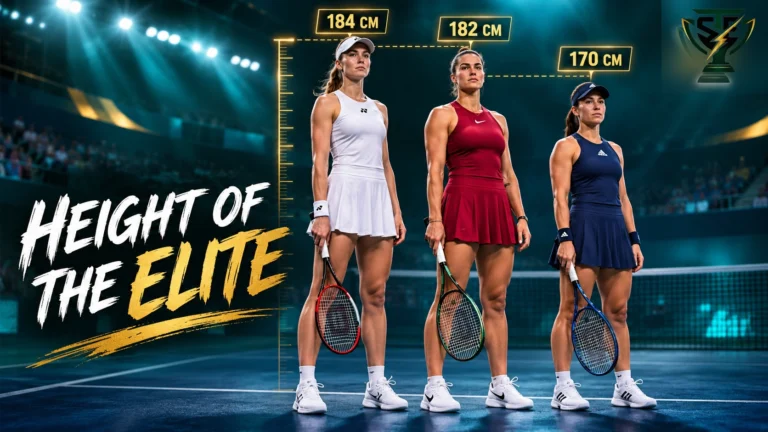
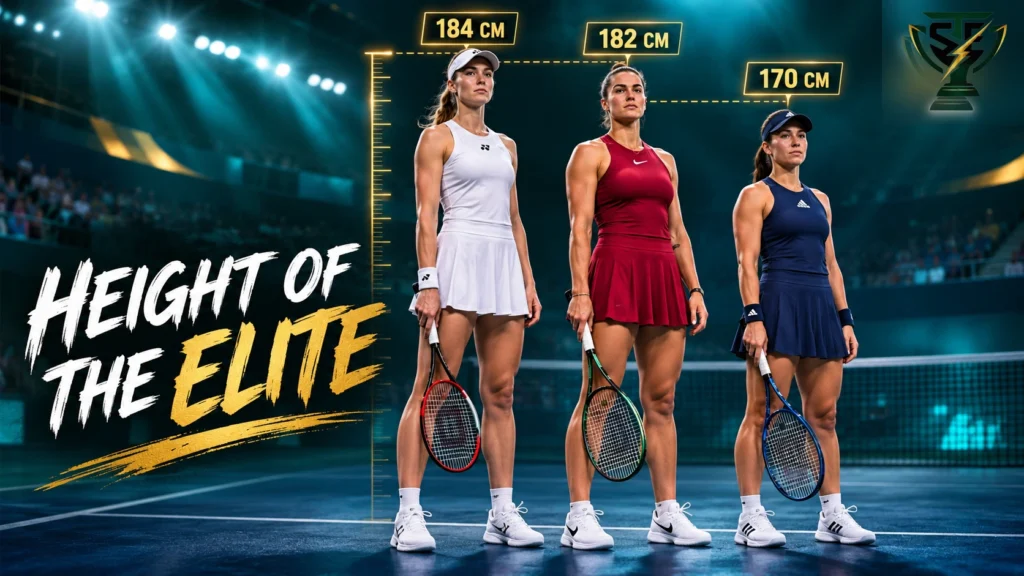
New York, United States, November 18, 2026: Elena Rybakina has a physical advantage that is immediately apparent when she stands alongside many of the world’s leading tennis players. At 184 centimeters, or just over six feet, the Kazakhstan star was the tallest player in the Women’s Tennis Association’s Top 10 on September 14, 2026. Aryna Sabalenka followed at 182 cm, with Karolína Muchová third at 180 cm. Yet the most remarkable detail is that Rybakina also became world No. 1 on that same date, raising an intriguing question: how much does height really contribute to success in elite women’s tennis?
The tallest WTA Top 10 player is not necessarily the strongest server, fastest mover or most complete competitor. Jessica Pegula, the shortest player in the September comparison at 170 cm, was ranked third, while Coco Gauff, Mirra Andreeva and Iga Świątek all demonstrated that successful players can have different physical builds and tactical strengths. Across the ten players, the average listed height was exactly 177 cm. The 14-centimeter difference between Rybakina and Pegula tells only part of the story. Serve mechanics, movement, anticipation and decision-making explain why all ten reached the highest level of the women’s game.
TL;DR: Who Is the Tallest WTA Top 10 Player?
- Elena Rybakina is the tallest in the September 14, 2026 Top 10 at 184 cm (6 feet 0.4 inches).
- Aryna Sabalenka ranks second by height at 182 cm.
- Karolína Muchová is third at 180 cm, followed by Linda Nosková at 179 cm.
- Jessica Pegula is the shortest member of the group at 170 cm.
- The average height of all ten players is 177 cm, or approximately 5 feet 9.7 inches.
- The difference between the tallest and shortest players is 14 cm, approximately 5.5 inches.
- Height can influence serving angles and court coverage, but it does not independently determine ranking or match results.
WTA Top 10 Height Comparison: All Ten Players Ranked
The following table uses the ten players featured in the September 14, 2026 ranking snapshot and their listed heights. It sorts them by height rather than ranking position.
| Height Rank | Player | Country | Height | WTA Rank, Sept. 14 |
|---|---|---|---|---|
| 1 | Elena Rybakina | Kazakhstan | 184 cm / 6 ft 0.4 in | 1 |
| 2 | Aryna Sabalenka | Belarus | 182 cm / 5 ft 11.7 in | 2 |
| 3 | Karolína Muchová | Czechia | 180 cm / 5 ft 10.9 in | 8 |
| 4 | Linda Nosková | Czechia | 179 cm / 5 ft 10.5 in | 6 |
| 5 | Iga Świątek | Poland | 176 cm / 5 ft 9.3 in | 9 |
| 6= | Coco Gauff | United States | 175 cm / 5 ft 8.9 in | 4 |
| 6= | Mirra Andreeva | Russia | 175 cm / 5 ft 8.9 in | 5 |
| 6= | Marta Kostyuk | Ukraine | 175 cm / 5 ft 8.9 in | 10 |
| 9 | Elina Svitolina | Ukraine | 174 cm / 5 ft 8.5 in | 7 |
| 10 | Jessica Pegula | United States | 170 cm / 5 ft 6.9 in | 3 |
Editorial note: Ranking positions are the September 14, 2026 historical snapshot, not the November 18 rankings. Heights are listed in centimeters, with imperial figures converted mathematically and rounded. The supplied graphic uses simplified feet-and-inches labels, some of which are less precise than the centimeter values.
Story at a glance
WTA Top 10 Height Comparison: All Ten Players Ranked
The following table uses the ten players featured in the September 14, 2026 ranking snapshot and their listed heights. It sorts them by height rather than ranking position.
Why Elena Rybakina Is the Tallest Player in the WTA Top 10
Rybakina’s height of 184 cm places her four centimeters above the 180 cm mark and two centimeters above Sabalenka, her closest competitor in the comparison.
Aryna Sabalenka: Almost as Tall, but With a Different Power Game
Sabalenka stands 182 cm, making her the second-tallest player in the comparison.
Karolína Muchová and Linda Nosková: The Tall Czech Contenders
The next two players in the height comparison represent Czechia.
Jessica Pegula: The Shortest Player, but Third in the Rankings
Pegula provides the most important counterexample to the assumption that greater height produces a higher ranking.
The WTA’s September 14 rankings report documents Rybakina’s rise to the top and Kostyuk’s arrival among the leading ten.
Why Elena Rybakina Is the Tallest Player in the WTA Top 10
Rybakina’s height of 184 cm places her four centimeters above the 180 cm mark and two centimeters above Sabalenka, her closest competitor in the comparison.
Her powerful serve is one of the most recognizable aspects of her game.
A taller player can potentially contact the ball higher during the serve, creating a different trajectory over the net and into the service box.
That geometry can help produce a steeper downward angle, but only when the player combines height with effective technique, timing and ball placement.
Rybakina’s serving strength cannot be credited to height alone.
Her fluid delivery, coordinated movement and ability to produce pace without appearing excessively forceful are important components of her effectiveness.
She also uses relatively flat groundstrokes to take time away from opponents.
When the first serve creates a weak return, she can move forward in the rally and attack with her next shot.
That combination makes her difficult to face on fast surfaces.
In September 2026, she also achieved something no other player from Kazakhstan had previously accomplished: becoming the WTA singles world No. 1.
Her rise followed a US Open title victory over Sabalenka, completing a significant season at Grand Slam level.
The Sports Encounter documented that achievement in its report on Rybakina officially becoming world No. 1.
How Rybakina’s Height Compares With Her Main Rivals
| Opponent | Height | Rybakina’s Difference |
|---|---|---|
| Aryna Sabalenka | 182 cm | 2 cm taller |
| Karolína Muchová | 180 cm | 4 cm taller |
| Linda Nosková | 179 cm | 5 cm taller |
| Iga Świątek | 176 cm | 8 cm taller |
| Coco Gauff | 175 cm | 9 cm taller |
| Mirra Andreeva | 175 cm | 9 cm taller |
| Elina Svitolina | 174 cm | 10 cm taller |
| Jessica Pegula | 170 cm | 14 cm taller |
The numbers show the physical range of her main competitors, but they do not predict head-to-head results.
For example, a nine-centimeter difference against Gauff does not remove the challenge of returning Gauff’s serve or handling her defensive speed.
Likewise, Rybakina’s slight height advantage over Sabalenka does not automatically translate into greater power.
Aryna Sabalenka: Almost as Tall, but With a Different Power Game
Sabalenka stands 182 cm, making her the second-tallest player in the comparison.
The Belarusian is associated with aggressive baseline tennis, powerful groundstrokes and a forceful service motion.
Although she is slightly shorter than Rybakina, her game illustrates why height alone is an incomplete measure of serving and hitting power.
Sabalenka uses substantial racket-head speed and muscular coordination to generate pace.
Her ability to strike through the ball from both wings allows her to dictate rallies when her timing is effective.
Rybakina’s strokes often appear more economical, while Sabalenka’s attacking approach is typically more visibly explosive.
Both methods have proved successful at the highest level.
They also demonstrate that players of similar heights can develop different technical identities.
Rybakina defeated Sabalenka in the 2026 Australian Open and US Open finals, while Sabalenka claimed important titles of her own during the season.
The Sports Encounter examined their contrasting performances in its analysis of Rybakina’s US Open victory and the rivalry that reshaped the rankings.
Karolína Muchová and Linda Nosková: The Tall Czech Contenders
The next two players in the height comparison represent Czechia.
Muchová stands 180 cm, while Nosková is 179 cm.
Despite being only one centimeter apart, they have notably different playing identities.
Karolína Muchová: Height Combined With Variety
Muchová uses her physical reach alongside touch, changes of pace and an unusually varied selection of shots.
Her game can include slices, volleys, drop shots and transitions toward the net.
Those options make her less predictable than a player who relies almost exclusively on baseline power.
Her height can help her cover the net and deal with certain higher-bouncing balls, but her tactical choices are essential to making those advantages useful.
Linda Nosková: A Powerful New-Generation Player
Nosková combines a strong serve with aggressive groundstrokes and a willingness to take control of points early.
At 179 cm, she has enough height to create favorable serving contact and reach, but her greatest strengths also depend on timing and coordination.
Her development during 2026 was especially significant.
She won Wimbledon and established herself among the most important young players on the WTA Tour.
The Sports Encounter examined her season, personal journey and championship breakthrough in its detailed profile of Nosková’s remarkable 2026 campaign.
Jessica Pegula: The Shortest Player, but Third in the Rankings
Pegula provides the most important counterexample to the assumption that greater height produces a higher ranking.
She is the shortest player in the September 14 Top 10 at 170 cm.
Yet she occupied third place in the world rankings.
That distinction is worth emphasizing.
Pegula was 14 centimeters shorter than Rybakina but ranked above seven players who were taller than her.
Her success relies heavily on clean ball striking, early preparation, consistent depth and intelligent positioning.
She can take the ball relatively early, reducing the time opponents have to recover their court position.
Her ability to redirect pace is especially effective against aggressive opponents.
Rather than trying to match every tall opponent’s serving angle, Pegula can compensate through return positioning and efficient groundstrokes.
Her performances during the 2026 WTA Finals further demonstrated those qualities.
The Sports Encounter analyzed her run in its report on Pegula’s qualification for the WTA Finals semifinals.
Coco Gauff, Mirra Andreeva and Marta Kostyuk Share the Same Listed Height
Three players in the September comparison stand exactly 175 cm tall.
They are Gauff, Andreeva and Kostyuk.
But their shared height has not produced identical playing styles.
Gauff is known for exceptional defensive movement, athletic coverage and the ability to extend rallies.
Andreeva combines anticipation with tactical intelligence and an expanding range of attacking options.
Kostyuk uses explosive movement, aggressive groundstrokes and a willingness to challenge opponents from the baseline.
All three demonstrate that tennis development depends on more than the measurement of a player’s body.
Their respective approaches have also evolved through experience, coaching and competition.
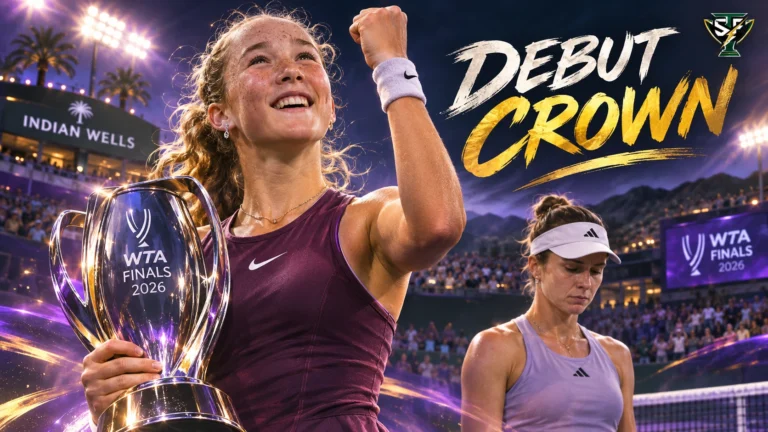
Andreeva’s progress became particularly striking in November when she captured the 2026 WTA Finals title.
The Sports Encounter covered the achievement in its report on Andreeva’s unbeaten championship campaign.
At 175 cm, the Russian’s success offers another reminder that exceptional results do not require being among the tallest athletes in the field.
What Are the Average, Median and Height Range of the WTA Top 10?
The ten heights in the September snapshot allow several useful calculations.
| Measure | Result | Explanation |
|---|---|---|
| Tallest player | 184 cm | Elena Rybakina |
| Shortest player | 170 cm | Jessica Pegula |
| Average height | 177.0 cm | Sum of ten heights divided by ten |
| Median height | 175 cm | Middle two values after sorting |
| Height range | 14 cm | 184 minus 170 |
| Players at least 180 cm | 3 of 10 | 30% of the group |
| Players at least 175 cm | 8 of 10 | 80% of the group |
| Players below 175 cm | 2 of 10 | Svitolina and Pegula |
Original statistical finding: The mean height of 177 cm is two centimeters above the median of 175 cm.
This happens partly because the taller players, especially Rybakina and Sabalenka, pull the average upward.
The median provides a useful description of the center of this particular group without giving the tallest players disproportionate influence.
However, ten players are not enough to establish a reliable relationship between height and professional success across the WTA Tour.
The group was also selected on the basis of ranking performance, not randomly from all professional players.
The statistics therefore describe this specific Top 10 snapshot rather than all women’s tennis.
Does Being Taller Give Tennis Players an Advantage?
Height can provide advantages in certain aspects of tennis, but those advantages depend on how players use their physical characteristics.
The most obvious example is serving.
Players who contact the ball from a greater height may have a larger range of trajectories available when aiming into the service box.
Longer reach can also assist with volleys and some defensive situations.
But tennis is a dynamic sport.
Players must accelerate, decelerate, recover their balance, change direction and adjust their hitting position many times during a match.
Height alone does not establish superiority in any of those tasks.
Height Advantages and Limitations in Tennis
| Aspect | Potential Advantage | Important Qualification |
|---|---|---|
| Serving | Higher contact point can improve available angles | Technique, placement and speed remain essential |
| Net coverage | Longer reach can help cover volleys | Reaction time and positioning still matter |
| High balls | Some tall players can strike high contact points comfortably | Footwork and timing determine effectiveness |
| Baseline defense | Reach may reduce the distance needed for certain shots | Acceleration and court anticipation are equally important |
| Low balls | No automatic height advantage | Flexibility and knee bend can become more demanding |
| Long rallies | Reach can help in selected defensive situations | Endurance, movement efficiency and strategy dominate |
A tall player with poor serve mechanics may be less effective than a shorter player with excellent technique.
Similarly, a shorter competitor with outstanding anticipation may reach difficult balls more consistently than a taller player who reacts late.
The important consideration is the relationship between physical characteristics and acquired skills.
Does Height Determine WTA Rankings? The September Top 10 Says No
The comparison provides several examples challenging a simple height-ranking relationship.
Rybakina was both the tallest player and world No. 1.
Sabalenka was second-tallest and world No. 2.
Those two cases might initially suggest a strong relationship.
But Pegula immediately complicates that conclusion.
At 170 cm, she was the shortest player and world No. 3.
Muchová, the third-tallest, occupied eighth place.
Nosková, fourth-tallest, was sixth.
Gauff and Andreeva shared the same height while occupying fourth and fifth positions.
These differences demonstrate that physical stature does not determine ranking order.
A player’s ranking is based on results and ranking points earned through competition, not height, physical reach or serving speed.
Winning consistently against strong opponents requires a combination of technical skill, movement, decision-making, fitness and psychological resilience.
How the WTA Top 10 Changed After September 14
The original height comparison represents an important moment in the 2026 season, when Rybakina first took the world No. 1 ranking.
But rankings change as players accumulate or lose points and defend results from previous tournaments.
By November 16, the completion of the season-ending WTA Finals had produced another major development.
Mirra Andreeva finished the year at world No. 2 after her unbeaten title run, moving ahead of Sabalenka.
Rybakina remained world No. 1.
The distinction matters because the September chart’s height measurements remain relevant for comparing those ten players, but the numerical rankings should not be presented as current.
Readers seeking the latest positions can consult the official WTA singles rankings.
The Sports Encounter has also maintained ongoing coverage through its dedicated 2026 WTA Finals tournament hub, including player profiles, match results and the implications of the season-ending championship.
How Should Young Tennis Players Interpret the Height Comparison?
The comparison should not be interpreted as an ideal height chart for becoming a professional tennis player.
It describes a selection of successful competitors rather than a physical eligibility standard.
Players develop at different rates, and adult height is only one aspect of athletic development.
For young competitors, it is generally more useful to develop consistent technique, efficient movement, coordination, fitness and decision-making than to compare themselves constantly with taller professionals.
Coaching methods can also be adapted to suit an athlete’s natural physical characteristics.
Players with greater reach may benefit from particular serving and net-play techniques, while those with different movement patterns may build their games around timing, returns and court positioning.
Neither route guarantees success.
Elite tennis requires players to combine natural attributes with years of practice, competitive experience and effective coaching.
Continue the Tennis Story


Frequently Asked Questions About WTA Top 10 Player Heights
Who is the tallest WTA Top 10 player in the September 2026 comparison?
Elena Rybakina is the tallest at 184 cm, approximately 6 feet 0.4 inches.
How tall is Elena Rybakina?
Rybakina is listed at 184 cm, or 1.84 meters.
How tall is Aryna Sabalenka?
Sabalenka is 182 cm tall, two centimeters shorter than Rybakina.
Who is the shortest player in the comparison?
Jessica Pegula is the shortest at 170 cm, despite being ranked world No. 3 on September 14.
What is the average height of the ten players?
The average is exactly 177 cm, approximately 5 feet 9.7 inches.
How tall are Coco Gauff and Mirra Andreeva?
Both are listed at 175 cm. Marta Kostyuk shares that height.
How tall are Linda Nosková and Karolína Muchová?
Nosková stands 179 cm, while Muchová is 180 cm.
Is Rybakina taller than Iga Świątek?
Yes. Rybakina stands 184 cm, compared with Świątek’s 176 cm, a difference of eight centimeters.
Are taller tennis players always better servers?
No. Greater height can provide certain geometric advantages, but serve effectiveness also depends on technique, racket speed, placement and consistency.
Does height determine WTA ranking?
No. The ranking system rewards competitive results. The September comparison includes Pegula at 170 cm and world No. 3, showing that high rankings are achievable across different heights.
What the WTA Top 10 Height Comparison Really Reveals
Elena Rybakina is the tallest player in the September 14 WTA Top 10, and her combination of reach, serving technique and attacking groundstrokes has helped make her one of the most formidable competitors in women’s tennis.
But the rest of the ranking tells a more interesting story.
Sabalenka generates extraordinary power despite being slightly shorter.
Muchová combines height with exceptional touch and variety.
Nosková uses an aggressive game built around timing and early attacks.
Gauff relies heavily on movement and defensive skill.
Andreeva has developed into a major champion through anticipation, composure and tactical intelligence.
Pegula, the shortest member of the group, demonstrates how efficiency, timing and consistency can overcome a significant difference in stature.
All ten reached the uppermost level of women’s tennis by developing individual approaches suited to their abilities.
The 14-centimeter gap between Rybakina and Pegula is real, but it does not explain their achievements on its own.
Rybakina leads the height comparison at 184 cm. The wider lesson is that tennis excellence comes in different physical forms, and the best players succeed by making their own attributes work for them.