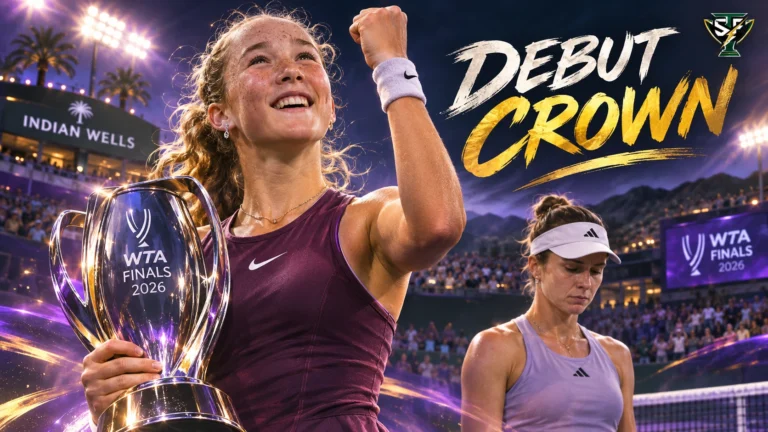
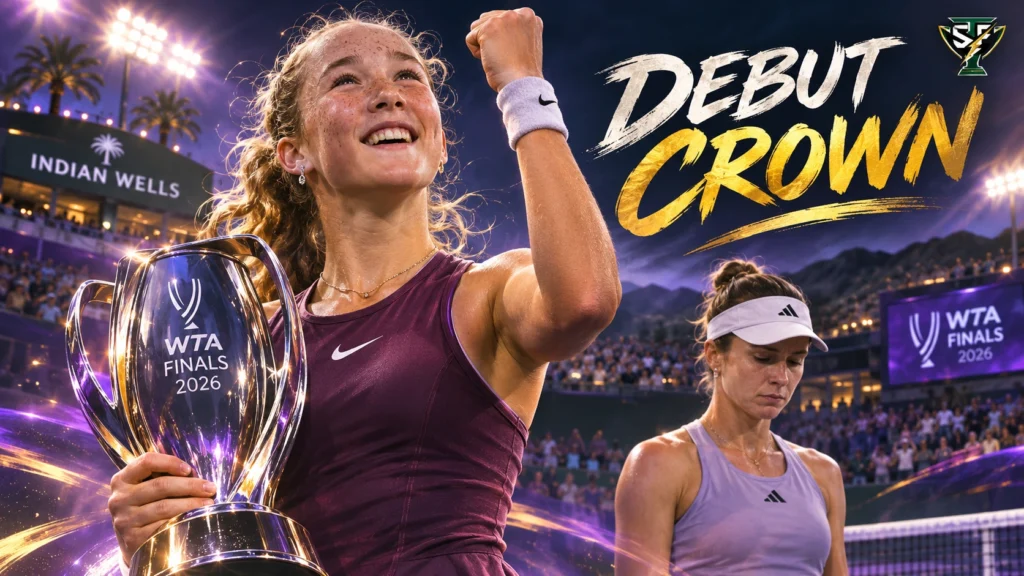
INDIAN WELLS, United States, November 16, 2026: Mirra Andreeva completed an extraordinary debut at the WTA Finals 2026 by defeating Elina Svitolina 7-5, 6-3 in Sunday’s championship match, becoming the youngest winner of the season-ending singles tournament since Maria Sharapova in 2004. The 19-year-old Russian finished with five victories from five matches, without conceding a set, and claimed the Billie Jean King Trophy, $3.37 million in prize money and a career-high world No. 2 ranking.
Andreeva’s achievement becomes even more remarkable when measured against her opposition and the manner of her victories. She beat Svitolina twice, recovered from 4-1 down to dismantle Aryna Sabalenka, swept past alternate Diana Shnaider and defeated Jessica Pegula in the semifinals. Across 10 sets, she won 61 games and conceded only 26, becoming just the third player alongside Chris Evert and Serena Williams to win the WTA Finals on debut without losing a set. The championship also completed a season in which she won Roland-Garros and established herself among the leading contenders for the world’s top ranking.
Key Takeaways
- Mirra Andreeva completed an extraordinary debut at the WTA Finals 2026 by defeating Elina Svitolina 7-5, 6-3 in Sunday’s championship match, becoming the youngest winner of the season-ending singles tournament since Maria Sharapova in 2004.
- Andreeva’s success also reflects the work she has undertaken with former Wimbledon champion Conchita Martínez.
- The most immediate consequence is her rise to world No. 2.
- Mirra Andreeva did not merely win the WTA Finals 2026.
WTA Finals 2026: Key Takeaways From Andreeva’s Championship
- Mirra Andreeva defeated Elina Svitolina 7-5, 6-3 in the November 15 singles final at Indian Wells.
- Andreeva won all five matches and all 10 sets in her first WTA Finals singles appearance.
- Her victories came against Svitolina twice, Sabalenka, Shnaider and Pegula.
- The 19-year-old won 61 games and lost only 26 across the tournament.
- She became the youngest champion since Maria Sharapova in 2004 and joined an exclusive group of undefeated debut champions who did not drop a set.
- Her prize package included $3.37 million, 1,500 ranking points and a specially designed Mercedes-AMG SL 55.
- Andreeva finished 2026 with a tour-leading 55 victories, four singles titles and the world No. 2 ranking.
- Svitolina reached the final after losing her opening group match, completing an impressive comeback season despite the disappointment of defeat.
Every Mirra Andreeva Match on Her Road to the WTA Finals 2026 Title
Andreeva’s championship campaign involved three group-stage victories, a semifinal against Pegula and a rematch with Svitolina for the trophy.
Story at a glance
Every Mirra Andreeva Match on Her Road to the WTA Finals 2026 Title
Andreeva’s championship campaign involved three group-stage victories, a semifinal against Pegula and a rematch with Svitolina for the trophy.
How Andreeva’s Perfect Campaign Compares With Tennis History
The WTA Finals has crowned numerous champions who dominated the season-ending event.
Conchita Martínez’s Influence on Andreeva’s Development
Andreeva’s success also reflects the work she has undertaken with former Wimbledon champion Conchita Martínez.
Five Victories Deliver $3.37 Million and World No. 2 Ranking
Andreeva’s perfect campaign earned the maximum available singles prize money of $3.37 million.
The Final’s Political Context: Respect Without a Handshake
Andreeva’s victory also took place against the background of Russia’s continuing war against Ukraine.
| Round | Opponent | Result | Games Won | Games Lost | Decisive Detail |
|---|---|---|---|---|---|
| Group 2, Match 1 | Elina Svitolina | 6-4, 6-0 | 12 | 4 | Won the final seven games |
| Group 2, Match 2 | Aryna Sabalenka | 6-4, 6-0 | 12 | 4 | Won 11 consecutive games from 1-4 down |
| Group 2, Match 3 | Diana Shnaider | 6-2, 6-1 | 12 | 3 | Completed unbeaten group campaign |
| Semifinal | Jessica Pegula | 6-3, 6-4 | 12 | 7 | Reached championship match on debut |
| Final | Elina Svitolina | 7-5, 6-3 | 13 | 8 | Claimed Billie Jean King Trophy |
| Tournament total | Five matches | 5-0 matches, 10-0 sets | 61 | 26 | Undefeated singles champion |
The table reveals a pattern that extended throughout the competition.
Andreeva conceded fewer than five games in each of her three group matches, then encountered progressively stronger resistance during the knockout rounds.
Despite that escalation, no opponent took a set from her.
The official WTA Finals draw and results confirms her complete five-match route.
Match One: Andreeva Announces Her Arrival Against Svitolina
WTA Finals 2026 Group Stage: Andreeva Defeats Svitolina 6-4, 6-0
Andreeva’s first match was against an opponent who understood the demands of the season-ending tournament better than most.
Svitolina had won the championship in 2018 and reached the final again in 2019.
She also possessed a recent psychological advantage, having defeated Andreeva 6-2, 6-4 in the fourth round of the 2026 Australian Open.
But the Russian teenager transformed their latest meeting into a demonstration of composure and defensive consistency.
The first set remained competitive until Andreeva secured the decisive break.
She finished the opening set 6-4 and then prevented Svitolina from winning another game.
The Russian won the final seven games to complete a 70-minute victory.
Perhaps the most significant statistic was her ability to defend her serve.
Svitolina created six break-point opportunities, but Andreeva saved every one.
That resilience meant the Ukrainian could not convert occasional stretches of pressure into a sustained challenge.
Andreeva’s movement also helped her extend rallies, force additional shots and exploit errors from an opponent who was trying to dictate play.
The victory was covered in The Sports Encounter’s opening Group 2 report, which examined her seven-game finishing run and the early qualification implications.
In retrospect, the match established two patterns that remained important throughout the tournament: Andreeva’s ability to absorb pressure and her capacity to accelerate decisively once she gained control.
Match Two: An Eleven-Game Surge Ends Sabalenka’s Challenge
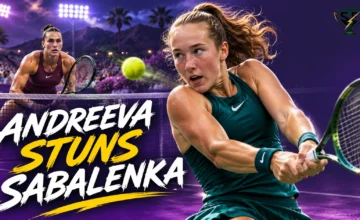
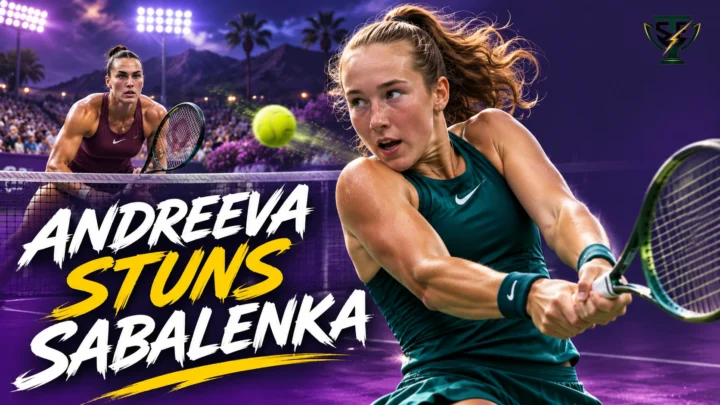
Andreeva Overturns 4-1 Deficit to Beat Aryna Sabalenka 6-4, 6-0
If the victory over Svitolina demonstrated composure, Andreeva’s second match revealed how quickly she could change the direction of a contest.
Aryna Sabalenka arrived as one of the tournament’s most dangerous contenders, armed with a powerful serve, aggressive groundstrokes and extensive experience at the highest level.
Sabalenka initially appeared in control.
She built a 4-1 lead in the opening set, repeatedly placing Andreeva under pressure from the baseline.
But the match then underwent an extraordinary reversal.
Andreeva won five consecutive games to take the opening set 6-4.
She then won all six games of the second set.
From trailing 1-4, the teenager won 11 consecutive games, completing the contest in just 62 minutes.
During that sequence, she won 45 of the final 55 points.
That meant Andreeva collected approximately 81.8% of the points played during the closing stretch.
It was not merely a comeback. It was a sustained period of control against an opponent who had initially dominated.
Andreeva also became the first player to win a 6-0 set in each of her first two WTA Finals singles matches.
The result settled the most important question in Group 2 earlier than expected.
Andreeva qualified for the semifinals as group winner with a match still to play.
TSE’s detailed account of Andreeva’s recovery against Sabalenka analyzed the dramatic momentum shift and the consequences for the qualification race.
The significance of this victory extended beyond the tournament standings.
Andreeva had demonstrated that a five-game deficit in a set, as measured from 1-4, did not necessarily reflect an opponent’s lasting control of the match.
Her ability to change pace, protect the court and turn defense into attacking opportunities became a central feature of her championship.
Match Three: Shnaider Cannot Disrupt Andreeva’s Perfect Group Record
Andreeva Beats Diana Shnaider 6-2, 6-1 to Finish 3-0
Andreeva entered her final round-robin match already guaranteed first place in Group 2.
Her scheduled opponent had originally been Karolína Muchová, but the Czech withdrew and alternate Diana Shnaider entered the competition.
That substitution created a different type of challenge.
Andreeva faced an opponent entering the tournament late, with limited opportunity to establish match rhythm at the venue.
However, the teenager refused to allow the altered circumstances to reduce her intensity.
She defeated Shnaider 6-2, 6-1 in only 55 minutes.
Shnaider struggled to maintain consistency, recording seven winners and 32 unforced errors.
She also won only three of 15 points played behind her second serve.
Andreeva repeatedly placed the alternate under pressure through controlled depth and accurate returning.
The result completed a flawless group campaign.
Across three matches, Andreeva won 36 games and lost only 11.
She had not conceded a set.
Even more strikingly, two of her three victories had featured a 6-0 set.
Group 2 Final Standings and Qualification Consequences
| Player | Matches | Sets | Outcome |
|---|---|---|---|
| Mirra Andreeva | 3-0 | 6-0 | Qualified as group winner |
| Elina Svitolina | 2-1 | 5-3 | Qualified as runner-up |
| Aryna Sabalenka | 1-2 | 3-4 | Eliminated |
| Karolína Muchová | 0-2 | 1-4 | Withdrew |
| Diana Shnaider | 0-1 | 0-2 | Eliminated as alternate |
Andreeva’s dominance meant the second semifinal qualification place became a contest between Svitolina and Sabalenka.
Svitolina eventually defeated Sabalenka 6-3, 3-6, 6-1 to advance.
That development created the possibility of another meeting between Andreeva and Svitolina if both survived their semifinals.
The qualification mathematics, match scores and withdrawals are documented in TSE’s WTA Finals tournament hub.
Match Four: Pegula Tests Andreeva’s Championship Credentials
Andreeva Defeats Jessica Pegula 6-3, 6-4 in the Semifinals
Jessica Pegula presented a different challenge from Andreeva’s three group opponents.
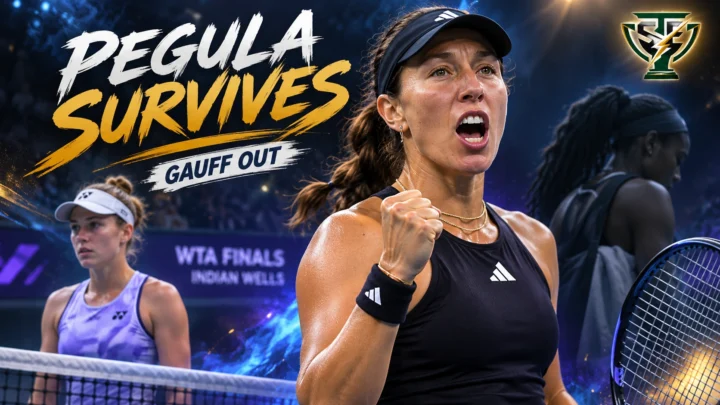
The American had survived one of the tournament’s most dramatic qualification battles, saving match point against Linda Nosková and winning the deciding set to claim her semifinal place.
That victory had eliminated Coco Gauff despite the two Americans finishing with identical group records.
Pegula therefore arrived with substantial momentum and the confidence gained from surviving a match in which her campaign had been one point from ending.
Andreeva was making her first appearance in the WTA Finals knockout rounds.
But the Russian again demonstrated the consistency that had defined her group campaign.
She defeated Pegula 6-3, 6-4, securing another straight-sets victory.
The first set confirmed that Andreeva could manage the pressure of a knockout match without abandoning the tactical discipline that had brought her to the semifinals.
In the second, Pegula continued searching for opportunities through controlled ball placement and changes of direction.
Andreeva nevertheless preserved the advantage required to close out the match.
She completed her fourth consecutive straight-sets victory and became the first singles finalist.
The contest also emphasized that her tournament success was not dependent on an unusually favorable group draw.
She had now defeated multiple elite opponents with different strengths, including Sabalenka’s power and Pegula’s consistency.
Pegula’s dramatic route into the semifinals had previously been examined in TSE’s account of Pegula’s decisive win against Nosková and Gauff’s elimination.
Andreeva’s semifinal victory provided the final chapter of that qualification story.
Match Five: Andreeva Defeats Svitolina Again to Win the WTA Finals 2026
Championship Final: Mirra Andreeva 7-5, 6-3 Elina Svitolina
The final presented Andreeva with a familiar opponent but a more demanding stage.
Svitolina had recovered impressively from the straight-sets defeat she suffered against Andreeva in the opening group match.
She defeated Muchová, overcame Sabalenka in three sets and then dominated Linda Nosková 6-2, 6-1 in the semifinals.
The Ukrainian was therefore approaching the final with greater confidence than the opening meeting suggested.
She also had experience of winning the WTA Finals in 2018.
Andreeva, meanwhile, had not lost a set throughout her debut campaign.
The championship match became the sternest test of that perfect record.
Andreeva broke serve in the opening game and moved ahead 2-0.
Svitolina responded by breaking back and leveling at 2-2.
The Russian regained the advantage and served for the opening set at 5-4.
But she started that game with consecutive double faults, creating immediate pressure.
Svitolina capitalized to break and level the score at 5-5.
The setback could have changed the direction of the match.
Instead, Andreeva broke Svitolina in the next game and served out the opening set 7-5.
The 55-minute set demonstrated her ability to recover emotionally after surrendering an important advantage.
That resilience became even more significant during the second set.
The Final’s Turning Point: Andreeva Survives the Seventh-Game Battle
The second set produced an extended seventh game that became the most demanding service contest of the tournament.
It lasted approximately 10 minutes and featured six deuces.
Svitolina eventually held serve to reduce Andreeva’s advantage to 4-3.
The hold kept the Ukrainian within touching distance, despite the sustained pressure on her service game.
But Andreeva did not allow the failed break opportunities to disrupt her concentration.
She held serve for 5-3.
Returning in the following game, the Russian created three match points.
The final point ended when Svitolina missed an overhead smash, completing a 7-5, 6-3 victory after one hour and 48 minutes.
Andreeva had won five of the final six games.
She celebrated by embracing her team and coach Conchita Martínez, who had guided her through a season of major breakthroughs.
| Decisive Moment | Score or Situation | Consequences |
|---|---|---|
| Opening break | Andreeva moves ahead 2-0 | Teenager establishes early advantage |
| Svitolina responds | First set reaches 2-2 | Ukrainian shows greater resistance than in group match |
| Andreeva fails to serve out set | First set becomes 5-5 | Svitolina extends opening-set contest |
| Andreeva breaks again | 6-5 | Opportunity to serve for first set restored |
| Andreeva closes opener | 7-5 | One set from championship |
| Svitolina wins long service game | Second set, 4-3 | Final remains competitive |
| Andreeva holds and breaks | 6-3 | Completes undefeated title run |
The most revealing difference between the opening group encounter and the final was Svitolina’s competitiveness.
In the first match, she managed only four games.
In the final, she won eight.
Andreeva conceded twice as many games but still secured the championship without dropping a set.
That distinction makes the result more impressive than a simple repetition of the earlier victory.
How Andreeva’s Perfect Campaign Compares With Tennis History
The WTA Finals has crowned numerous champions who dominated the season-ending event.
But winning the championship on debut without dropping a set remains exceptionally rare.
Andreeva joined Chris Evert and Serena Williams in an exclusive historical group.
At 19, she also became the youngest champion since Sharapova in 2004.
| Achievement | Andreeva’s Record | Historical Context |
|---|---|---|
| Debut title | Champion at first appearance | Joins distinguished group of debut winners |
| Perfect match record | 5-0 | No defeats in group or knockout stages |
| Perfect sets record | 10-0 | Joins Evert and Serena Williams among unbeaten-set debut champions |
| Age | 19 | Youngest champion since Sharapova in 2004 |
| Games won | 61 | Across five matches |
| Games lost | 26 | Only Swiatek’s 2023 title run conceded fewer since 2003 |
| Ranking points earned | 1,500 | Maximum available for an undefeated champion |
| Prize money | $3.37 million | Maximum singles payout for undefeated champion |
Andreeva won approximately 70.1% of all games played across her five matches.
That figure comes from dividing 61 games won by the 87 games played.
It is especially revealing because every victory was achieved in straight sets.
Her first three opponents collected only 11 games combined.
Pegula and Svitolina managed 15 in the knockout rounds.
The figures demonstrate how the standard of opposition increased without producing a significant decline in Andreeva’s match-winning effectiveness.
Conchita Martínez’s Influence on Andreeva’s Development
Andreeva’s success also reflects the work she has undertaken with former Wimbledon champion Conchita Martínez.
The Spaniard has helped the teenager develop a more balanced competitive approach.
Andreeva’s natural defensive instincts, court coverage and ability to anticipate an opponent’s next shot were already considerable strengths.
But the WTA Finals demonstrated an improved ability to decide when to attack and when to extend a rally.
Against Sabalenka, she initially struggled with pace and power before adjusting.
Against Svitolina, she repeatedly changed the direction of rallies and forced her opponent to attempt increasingly difficult shots.
Against Pegula, she maintained enough baseline consistency to prevent the American from controlling the exchanges.
Those matches required different tactical responses.
The willingness to adjust is one reason her title should be viewed as a development milestone rather than merely a remarkable sequence of results.
Martina Navratilova has also highlighted Andreeva’s potential for further improvement, particularly through serving and net play.
There remains considerable scope for the teenager to strengthen those aspects of her game.
That prospect is significant given what she has already achieved before turning 20.
Five Victories Deliver $3.37 Million and World No. 2 Ranking
Andreeva’s perfect campaign earned the maximum available singles prize money of $3.37 million.
The tournament’s total prize fund was $10 million.
The unbeaten champion also collected 1,500 ranking points.
Each round-robin victory was worth 200 points, the semifinal victory contributed 400 and winning the final added 500.
Those figures confirm the importance of the group matches beyond determining semifinal qualification.
Had Andreeva suffered a group-stage defeat, she could still have won the trophy, but her total ranking-point and prize-money awards would have been lower.
| Stage | Ranking Points Earned | Running Total |
|---|---|---|
| Victory over Svitolina | 200 | 200 |
| Victory over Sabalenka | 200 | 400 |
| Victory over Shnaider | 200 | 600 |
| Semifinal victory over Pegula | 400 | 1,000 |
| Final victory over Svitolina | 500 | 1,500 |
The reward lifted Andreeva to a career-high world No. 2 ranking, bringing her within 300 points of Elena Rybakina.
She also received a specially designed ultraviolet-purple Mercedes-AMG SL 55 4MATIC+.
The car provided an unusual celebratory detail because Andreeva does not yet have a driver’s license.
Her achievement illustrates the financial and competitive importance of the season-ending tournament, where each victory contributes to both immediate rewards and the final rankings.
The WTA’s official championship guide provides the prize-money and ranking-point structure.
The Final’s Political Context: Respect Without a Handshake
Andreeva’s victory also took place against the background of Russia’s continuing war against Ukraine.
Svitolina has maintained a policy of not shaking hands with Russian or Belarusian opponents since Russia launched its full-scale invasion of Ukraine in February 2022.
The players therefore did not exchange the traditional postmatch handshake.
They also did not pose together for the customary finalist photographs.
During the presentation ceremony, Svitolina did not directly congratulate Andreeva in her speech.
She instead thanked those who had supported her, including spectators and people in Ukraine.
That decision was consistent with Svitolina’s established public position rather than evidence of a new personal dispute between the finalists.
Andreeva responded differently during her own remarks.
She congratulated Svitolina on her season and specifically acknowledged the demands of returning to professional competition after motherhood.
The Ukrainian nodded in acknowledgment.
Those contrasting gestures illustrated how the political circumstances surrounding their nationalities remained present even during a major sporting celebration.
They should not overshadow the legitimacy of Andreeva’s sporting victory or the significance of Svitolina’s return to the championship match.
The situation also shows why tennis tournaments must accommodate the positions of athletes affected by international conflicts without turning every sporting interaction into a simplistic judgment about personal respect.
Elina Svitolina’s Defeat Does Not Diminish Her Comeback
Although the championship belonged to Andreeva, Svitolina’s tournament deserves recognition.
The 32-year-old returned to the WTA Finals for the first time since 2019.
She had won the tournament in 2018 and finished runner-up the following year.
Her 2026 campaign included a title in Auckland, a WTA 1000 victory in Rome and a runner-up finish in Dubai.
She also balanced her professional commitments with motherhood and the emotional burden of the continuing war in Ukraine.
After losing to Andreeva in her opening group match, she recovered to defeat Muchová and Sabalenka.
She then beat Nosková 6-2, 6-1 in the semifinals.
That recovery demonstrated both tactical quality and psychological resilience.
Svitolina ultimately lost the final, but her tournament record of three victories and two defeats represents a substantial achievement.
Her performance provides another example of the unique demands of the WTA Finals round-robin format.
A player can lose an opening match and still advance to the championship contest.
The fate of Coco Gauff offered a striking contrast.
Gauff finished Group 1 with two wins and one defeat but was eliminated on a set-percentage tiebreaker.
Her earlier comeback against Marta Kostyuk, explored in TSE’s report on Gauff’s six-game recovery, was ultimately insufficient to secure qualification.
For Svitolina, the format offered a second opportunity after defeat.
For Andreeva, it provided five consecutive opportunities to demonstrate why she deserved the trophy.
What Does Andreeva’s WTA Finals Victory Mean for Women’s Tennis?
The most immediate consequence is her rise to world No. 2.
Andreeva will enter the next season within striking distance of Rybakina’s top ranking.
Her undefeated WTA Finals campaign also reinforces the progress she made by winning the French Open earlier in 2026.
The two titles demonstrate her ability to succeed across different surfaces and competitive formats.
Roland-Garros required her to navigate a traditional Grand Slam draw on clay.
Indian Wells required her to defeat elite opposition repeatedly on hard courts, including three group matches in which there was little opportunity to adjust to an unfamiliar opponent’s game.
The demands were different, but the outcome was the same.
Andreeva finished as champion.
Her success also raises the competitive pressure on established contenders.
Sabalenka suffered a particularly damaging defeat in Group 2.
Pegula, who had fought back from match point down to reach the semifinals, could not halt the teenager’s advance.
Svitolina performed better in the championship match than in their earlier meeting but still could not force a deciding set.
The next phase of Andreeva’s career will be determined by whether she can sustain this standard across a longer season while opponents continue adapting to her game.
There will also be heightened expectations, greater media attention and more pressure to defend ranking points and titles.
But her performances in California provided substantial evidence that she possesses the competitive tools required to manage those challenges.
WTA Finals Doubles: Siniaková and Townsend Complete the Championship Picture
The season-ending tournament also crowned a doubles champion.
Kateřina Siniaková and Taylor Townsend defeated Sara Errani and Jasmine Paolini 6-4, 6-3 in Sunday’s championship match.
The Czech-American partnership recovered from an opening group-stage defeat against the Italians before winning their remaining matches.
That campaign included a semifinal victory over Gabriela Dabrowski and Luisa Stefani.
The doubles title completed a successful week for the finalists and added another major trophy to Siniaková and Townsend’s partnership.
While Andreeva’s singles achievement was the tournament’s defining individual story, the doubles final showed how teams could recover from an early setback and still finish as champions.
Continue the WTA Finals Story
 WTA FinalsAndreeva Crushes Sabalenka as Svitolina Fights Back at WTA Finals
 WTA FinalsRybakina Outdid Sabalenka When It Mattered the Most: Can Either Survive the WTA Finals Pressure Cooker?
 WTA FinalsMirra Andreeva’s Historic 2026: Roland-Garros Glory, 50 Wins, and the Battle to Become Tennis’ Next Queen
Frequently Asked Questions About the WTA Finals 2026
Who won the WTA Finals 2026 women’s singles title?
Mirra Andreeva won the title by defeating Elina Svitolina 7-5, 6-3 in the November 15 final at Indian Wells.
How many matches did Mirra Andreeva win?
Andreeva won all five of her matches, including three group-stage contests, the semifinal and the championship final.
Did Mirra Andreeva lose a set at the WTA Finals?
No. She won all 10 sets played during her undefeated title run.
Who did Andreeva defeat during the tournament?
She defeated Elina Svitolina twice, Aryna Sabalenka, Diana Shnaider and Jessica Pegula.
What happened in Andreeva’s match against Aryna Sabalenka?
Andreeva recovered from 4-1 down in the opening set and won 11 consecutive games to secure a 6-4, 6-0 victory.
How much prize money did Andreeva earn?
She earned $3.37 million for completing the tournament unbeaten.
What is Mirra Andreeva’s ranking after winning the WTA Finals?
Her title lifted her to a career-high world No. 2 ranking.
Why did Svitolina not shake hands with Andreeva?
Svitolina has maintained a policy of not shaking hands with Russian and Belarusian players following Russia’s full-scale invasion of Ukraine in 2022.
Who was the youngest WTA Finals champion before Andreeva?
Maria Sharapova won the 2004 championship at 17. Andreeva became the youngest champion since then by winning at 19.
Who won the WTA Finals 2026 doubles title?
Kateřina Siniaková and Taylor Townsend defeated Sara Errani and Jasmine Paolini 6-4, 6-3.
What It Means: Andreeva’s Triumph Signals a New Championship Standard
Mirra Andreeva did not merely win the WTA Finals 2026. She controlled the tournament from her opening match to the final point.
Her victory over Svitolina established the standard.
Her remarkable comeback against Sabalenka demonstrated how quickly she could reverse momentum.
Her dominant performance against Shnaider completed a flawless group campaign.
Her semifinal victory over Pegula confirmed that the same quality would translate into knockout tennis.
And her second victory over Svitolina proved she could withstand the pressure of playing for one of the sport’s most important trophies.
The final statistics provide a compelling measure of her consistency: five wins, no defeats, 10 sets won, none lost, 61 games won and just 26 conceded.
Those achievements are especially significant because they came at her first appearance in the season-ending singles championship.
Her ranking, prize money and individual records are the immediate rewards.
The larger consequence is that women’s tennis enters its next season with a 19-year-old Grand Slam champion and undefeated WTA Finals winner challenging for the world No. 1 position.
Andreeva’s most impressive achievement may not be any one victory in California.
It is that five different matches, featuring different opponents and forms of pressure, produced the same result.
Her opponents could make the contests more competitive. None could take a set.