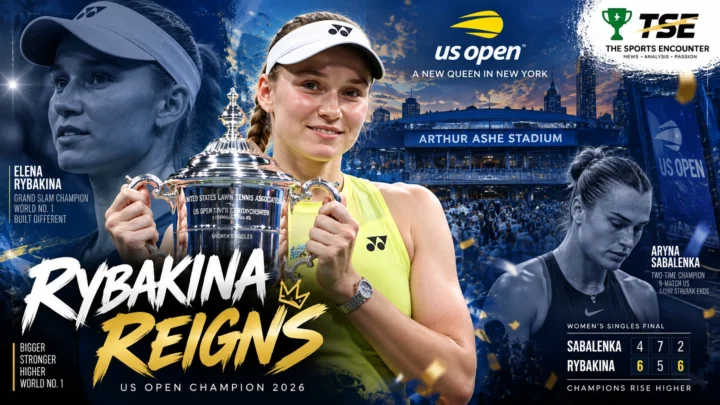


NEW YORK, UNITED STATES, September 12, 2026: Aryna Sabalenka and Elena Rybakina have given the 2026 US Open something the women’s tournament has not seen in more than a decade: the two highest-ranked players in the draw meeting for the title.
Using the WTA computer rankings in place when each US Open began, the 2026 championship match is the 11th US Open women’s final since the rankings began in 1975 to feature world No. 1 against world No. 2.
The previous one came in 2013, when Serena Williams beat Victoria Azarenka in three sets.
That makes the Sabalenka-Rybakina final rare in a way that goes beyond their rivalry. Grand Slam draws routinely scatter elite players before the last weekend through injuries, upsets and difficult matchups. Getting No. 1 and No. 2 through six rounds at the same major is harder than the seed numbers make it look.
For ongoing coverage, visit The Sports Encounter’s tennis section and our US Open 2026 archive.
How Many Times Have WTA No. 1 and No. 2 Met in the US Open Final?
The answer is 11 times since the WTA introduced computer rankings in November 1975, counting the rankings in place at the start of the tournament.
| Year | World No. 1 | World No. 2 | US Open Champion | Final Result |
|---|---|---|---|---|
| 1976 | Chris Evert | Evonne Goolagong Cawley | Chris Evert | 6-3, 6-0 |
| 1983 | Martina Navratilova | Chris Evert | Martina Navratilova | 6-1, 6-3 |
| 1984 | Martina Navratilova | Chris Evert | Martina Navratilova | 4-6, 6-4, 6-4 |
| 1987 | Steffi Graf | Martina Navratilova | Martina Navratilova | 7-6, 6-1 |
| 1989 | Steffi Graf | Martina Navratilova | Steffi Graf | 3-6, 7-5, 6-1 |
| 1994 | Steffi Graf | Arantxa Sánchez Vicario | Arantxa Sánchez Vicario | 1-6, 7-6, 6-4 |
| 1998 | Martina Hingis | Lindsay Davenport | Lindsay Davenport | 6-3, 7-5 |
| 2002 | Serena Williams | Venus Williams | Serena Williams | 6-4, 6-3 |
| 2003 | Kim Clijsters | Justine Henin-Hardenne | Justine Henin-Hardenne | 7-5, 6-1 |
| 2013 | Serena Williams | Victoria Azarenka | Serena Williams | 7-5, 6-7(6), 6-1 |
| 2026 | Aryna Sabalenka | Elena Rybakina | TBD | Final scheduled September 12 |
The US Open’s official 2026 final preview confirms that this is the first championship match between the top two seeds since 2013.
There is an important technical distinction. Rankings and seedings are usually aligned at the top, but they are not identical concepts. The table above uses WTA rankings at the start of each tournament because the question is specifically about the world’s top two players.
Why 1996 Is a Special Case
Steffi Graf and Monica Seles played the 1996 US Open final as the top two seeds, but they do not appear in the No. 1-versus-No. 2 count above.
The reason is unusual: Graf and Seles were officially co-No. 1 in the WTA rankings during that period following Seles’ return to competition.
Graf won the final 7-5, 6-4.
So if the question is about the top two seeds, 1996 belongs in the conversation. If the question is specifically about world No. 1 against world No. 2, it does not.
That distinction is one reason historical ranking comparisons need more care than simply reading seed numbers from a draw.
The First No. 1 vs No. 2 Final Came in 1976
The first US Open women’s final after the introduction of the WTA computer rankings produced exactly the matchup the rankings predicted.
Chris Evert, the world No. 1 and defending champion, faced No. 2 Evonne Goolagong Cawley on the green clay at Forest Hills.
Evert won 6-3, 6-0 for her second consecutive US Open title.
The US Open’s official year-by-year history records Evert defeating Goolagong in back-to-back finals in 1975 and 1976. The ranking system had only just begun when the second of those meetings took place.
Navratilova and Evert Made the Matchup Feel Normal
The 1980s contain the densest part of the list.
Martina Navratilova and Chris Evert occupied the top two positions for long stretches of the decade, so their appearances in the 1983 and 1984 finals reflected the structure of the women’s game at the time.
Navratilova won both.
In 1983 she dominated 6-1, 6-3. A year later, Evert pushed her much harder before Navratilova recovered from losing the opening set to win 4-6, 6-4, 6-4.
Those finals help explain why the modern gap is striking. During an era dominated by two players, No. 1 against No. 2 could feel almost expected. In the current WTA, depth and surface-specific matchups make that outcome much less common.
Graf and Navratilova Extended the Pattern
By 1987, Steffi Graf had become world No. 1, with Navratilova at No. 2.
Navratilova still beat her 7-6, 6-1 in the final to claim her fourth US Open singles title.
Two years later, Graf reversed the result. The 1989 final again featured world No. 1 against No. 2, and Graf recovered from losing the first set to win 3-6, 7-5, 6-1.
The sequence shows another reason these finals matter historically. A No. 1-versus-No. 2 championship match is often where a rivalry’s balance becomes visible in real time.
1994 Put the No. 2 Player on Top
Steffi Graf entered the 1994 US Open as world No. 1. Arantxa Sánchez Vicario was No. 2.
Graf raced through the opening set 6-1, but Sánchez Vicario fought back to win 1-6, 7-6, 6-4 and claim her only US Open singles title.
The official US Open Bracket of Champions history specifically identifies the match as a No. 1-versus-No. 2 showdown.
1998 Marked a Changing of the Guard
Martina Hingis entered the 1998 final as world No. 1 and defending champion. Lindsay Davenport was No. 2.
Davenport won 6-3, 7-5 to capture her first Grand Slam singles title.
One month later she would take the No. 1 ranking herself.
That match is a useful reminder that the ranking entering a major and the ranking leaving it can tell different stories. The final itself can become the transition point.
The Williams Sisters Brought No. 1 vs No. 2 Back in 2002
Serena Williams and Venus Williams reached the 2002 US Open final as the world’s top two players.
Serena won 6-4, 6-3, completing the third leg of what became the “Serena Slam” when she won the 2003 Australian Open.
The WTA’s retrospective on Serena’s New York career notes that the No. 1 ranking was part of the stakes around that period. Serena’s 2002 US Open victory also completed a remarkable sequence of major finals against her sister.
Clijsters and Henin Made It Back-to-Back No. 1 vs No. 2 Finals
The next year produced another top-two championship match.
Kim Clijsters entered the 2003 US Open as world No. 1. Justine Henin-Hardenne was No. 2.
Henin won 7-5, 6-1 for her first US Open title.
That made 2002 and 2003 the only consecutive US Opens in the ranking era to finish with No. 1 against No. 2 in the women’s final.
Then Came a Ten-Year Wait
From 2004 through 2012, the world’s top two women did not meet for the US Open title.
There were great champions during that span, including Maria Sharapova, Justine Henin, Serena Williams and Kim Clijsters, but the draw never produced the exact No. 1-versus-No. 2 final.
The drought ended in 2013.
Serena Williams, ranked No. 1, faced No. 2 Victoria Azarenka in a rematch of the previous year’s final. Serena won 7-5, 6-7(6), 6-1.
The significance of 2013 is why the 2026 WTA No. 1 race became such an important storyline as this year’s tournament reached its second week.
Why the Gap From 2013 to 2026 Matters
Thirteen years without a No. 1-versus-No. 2 US Open women’s final is not evidence that the rankings were weak.
It is evidence of how difficult a two-week major is to control.
During that period, the US Open produced breakthrough champions, teenage champions, comeback champions and finals between players ranked well outside the top two.
One upset can remove a favorite. One difficult matchup can reshape an entire half of the draw. Injuries can open a path overnight.
The 2026 tournament itself nearly followed that pattern. Rybakina had entered New York managing an ankle problem, while Sabalenka had endured an uneven middle part of the season.
Instead, both survived.
Rybakina’s Rise Makes the 2026 Final Even More Unusual
Rybakina entered the tournament ranked No. 2, but by reaching the semifinals she did enough to secure the world No. 1 ranking for the first time when the next official list is released.
We tracked that climb in our full analysis of Rybakina’s road to world No. 1.
Her quarterfinal victory over Zheng Qinwen kept the ranking push alive, a match covered in our Rybakina-Zheng report.
Then she came from a set down to beat Coco Gauff in the semifinals. Our semifinal analysis examined how Rybakina turned that match around.
Sabalenka reached the final from the other half by beating Jessica Pegula. We covered the tactical key in our Sabalenka-Pegula semifinal report.
The 2026 Final Is More Than a Ranking Curiosity
The ranking history gives the match context, but the tennis itself makes the final compelling.
Sabalenka and Rybakina have built one of the defining rivalries of the current women’s tour. The 2026 US Open final will be their 18th meeting, with Sabalenka holding a narrow career lead entering the match.
Rybakina beat Sabalenka in this year’s Australian Open final. Sabalenka arrives in New York seeking a third consecutive US Open title.
That combination gives the final several layers at once: a rematch of Melbourne, a fight between the tournament’s top two seeds, a rivalry between the top two players of the year and a symbolic handover of the No. 1 ranking regardless of who lifts the trophy.
TSE Analysis: No. 1 vs No. 2 Finals Are Rare Because Majors Reward Survival
The ranking table tells us who has been best over a long period. A Grand Slam draw asks a different question.
Can the best players survive six separate opponents, changing conditions, pressure, fatigue and the tactical problems created by a knockout bracket?
Most years, at least one of the top two does not.
That is why 11 No. 1-versus-No. 2 finals across more than five decades of WTA computer rankings is a meaningful number.
The 2026 final therefore represents more than a predictable outcome produced by the seeding system. It represents something the US Open has not managed since Serena Williams and Victoria Azarenka in 2013: the two highest-ranked women arriving at the final weekend exactly where the rankings said they belonged.
Frequently Asked Questions
How many times have world No. 1 and No. 2 met in the US Open women’s final?
Using WTA rankings at the start of each tournament, the 2026 final is the 11th such meeting since the computer rankings began in 1975.
When was the previous No. 1 vs No. 2 US Open women’s final?
The previous one came in 2013, when world No. 1 Serena Williams defeated No. 2 Victoria Azarenka.
Why is the 1996 Graf-Seles final not included?
Graf and Seles were the top two seeds, but they were officially co-No. 1 in the WTA rankings at the time rather than No. 1 and No. 2.
Who are the 2026 US Open women’s finalists?
Aryna Sabalenka and Elena Rybakina. Sabalenka entered the tournament ranked No. 1 and Rybakina No. 2, although Rybakina secured the next No. 1 ranking by reaching the semifinals.