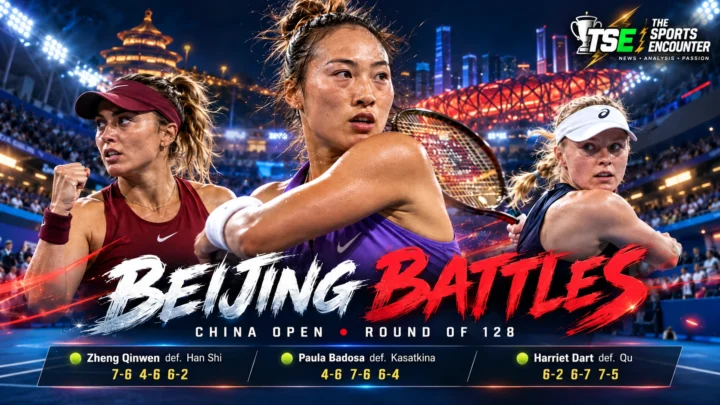
BEIJING, China, October 5, 2026: The China Open women’s draw has lost the two players who spent most of 2026 defining its highest level, and they disappeared within barely a day of each other.
World No. 2 Aryna Sabalenka followed new World No. 1 Elena Rybakina out of Beijing when 20-year-old Czech Nikola Bartunkova defeated her 6-4, 6-3 in the third round on Sunday.
Rybakina had suffered an even more improbable defeat on Saturday. World No. 118 Alina Charaeva recovered from losing the opening set to beat the top seed 3-6, 6-4, 6-3 in Rybakina’s first match since becoming World No. 1 and winning the US Open.
The result is a China Open without either of its top two seeds before the fourth round.
Story at a glance

How Did Nikola Bartunkova Knock Aryna Sabalenka Out of the China Open?
Bartunkova did not spend the opening stages waiting for Sabalenka to play badly.
Why Is Bartunkova’s Victory Such a Significant Breakthrough?
Bartunkova is not an unknown junior suddenly appearing from nowhere.
What Has Gone Wrong for Sabalenka Since Miami?
Sabalenka’s Beijing defeat becomes more important when placed inside the trajectory of her season.
Why Is Elena Rybakina’s Defeat More Complicated?
Rybakina’s Beijing result initially looked like one of the great ranking upsets of the season.
How Does the Injury Change the Meaning of Rybakina’s Beijing Loss?
Three weeks ago, Rybakina appeared to have reached the strongest point of her career.
That alone transforms the title race. The more important story, however, is that the two exits carry very different consequences.
Sabalenka has now gone nine consecutive tournaments without winning a title after starting the season strongly. Rybakina’s defeat has already developed into a physical concern: she has withdrawn from next week’s Wuhan Open to rest a recurring lower-leg and foot problem.
For two players who contested the US Open final less than a month ago, Beijing has produced an abrupt reversal.
The official China Open tournament page confirms that the WTA 1000 event runs through October 11, meaning most of the championship is still ahead even though its two highest seeds are already gone.
How Did Nikola Bartunkova Knock Aryna Sabalenka Out of the China Open?
Bartunkova did not spend the opening stages waiting for Sabalenka to play badly.
She broke the four-time major champion immediately.
That early break changed the emotional structure of the match because Sabalenka was forced to chase almost from the beginning rather than establish the aggressive front-running position that usually makes her so difficult to stop.
The most revealing sequence came later in the opening set.
Sabalenka generated five break-point opportunities in one game and converted none of them.
For a player whose returning power can turn a service game in a few swings, that missed opportunity became extremely expensive.
Bartunkova protected the advantage, won the opening set 6-4 and then refused to allow the match to become a familiar Sabalenka comeback.
The Czech finished the job 6-3 in the second set after 95 minutes.
The WTA’s official match report confirmed the straight-sets upset.
Why Is Bartunkova’s Victory Such a Significant Breakthrough?
Bartunkova is not an unknown junior suddenly appearing from nowhere.
She entered Beijing ranked No. 34, her career high, after a season in which she had already reached three Grand Slam third rounds and established herself inside the Top 50.
She is still only 20.
Before Beijing, her best WTA 1000 result was the Round of 16.
Beating Sabalenka therefore represents something different from incremental ranking progress. It is the first victory of her young career that immediately places her inside one of the season’s biggest championship conversations.
Bartunkova next faces Austria’s Sinja Kraus.
That matchup looks very different now than it did when the draw was made. Sabalenka was supposed to be the heavyweight controlling this section. Bartunkova has removed her herself.
What Has Gone Wrong for Sabalenka Since Miami?
Sabalenka’s Beijing defeat becomes more important when placed inside the trajectory of her season.
She remains No. 2 in the world and has won 46 matches this year according to the latest WTA statistics.
Consistency is not the problem.
Closing tournaments has become the problem.
Since her success during the early hard-court stretch, Sabalenka has gone through Madrid, Rome, Roland Garros, Berlin, Wimbledon, Toronto, Cincinnati, the US Open and now Beijing without another championship.
Some of those results were deep runs.
She reached the US Open final and came within one victory of completing a historic New York three-peat.
TSE followed that chase closely after Sabalenka overwhelmed Jessica Pegula’s second serve in the semifinal.
The final was different.
Rybakina beat Sabalenka 6-4, 5-7, 6-2, ending the three-peat attempt and replacing her at the top of women’s tennis. TSE later examined how close Sabalenka had come to joining rare US Open history.
Beijing adds a different concern.
She was not eliminated by another established Top 10 rival in a semifinal or final.
She went out in the third round to a 20-year-old playing the biggest match of her career.
Why Is Elena Rybakina’s Defeat More Complicated?
Rybakina’s Beijing result initially looked like one of the great ranking upsets of the season.
It now looks like part of a larger physical story.
Charaeva entered their second-round match ranked No. 118.
Rybakina won the first set 6-3 and appeared positioned to make a routine start to her first tournament as World No. 1.
Instead, Charaeva won the next two sets 6-4, 6-3.
The historical context is remarkable.
Since the WTA rankings began in 1975, Charaeva became only the ninth player ranked outside the Top 100 to defeat the World No. 1. She was also the lowest-ranked player ever to come from a set down to beat the No. 1-ranked player.
That achievement deserves to stand on its own.
But Rybakina revealed afterward that recovery since the US Open had been difficult and that she felt discomfort in her foot late in the match.
The concern became concrete when she withdrew from Wuhan.
The WTA subsequently confirmed in its official Wuhan withdrawal update that Rybakina has been managing a lingering lower-leg and foot issue.
How Does the Injury Change the Meaning of Rybakina’s Beijing Loss?
Three weeks ago, Rybakina appeared to have reached the strongest point of her career.
She defeated Sabalenka in New York, won her third major and completed the ranking climb TSE had tracked throughout the summer.
Her US Open quarterfinal victory over Zheng Qinwen mathematically secured the No. 1 ranking.
Her comeback against Coco Gauff then took her into the final, a match TSE analyzed through the first-serve and return numbers that turned the semifinal in Rybakina’s favor.
She finished the job against Sabalenka.
When the ranking became official, TSE documented Rybakina’s arrival as the first player representing Kazakhstan to reach singles No. 1.
Beijing was supposed to be the first test of how she would carry that status.
Instead, it became another reminder of the physical problems that had already interrupted her season.
Rybakina retired from her Cincinnati quarterfinal against Iga Swiatek in August with a lower-leg or ankle problem. She recovered in time to win the US Open, but the current foot issue now removes her from Wuhan as well.
That makes recovery, rather than rankings, the immediate priority.
Does Sabalenka Still Have a Real Chance to Reclaim World No. 1?
The ranking race has changed considerably since New York.
The latest WTA rankings list Rybakina at 9,901 points and Sabalenka at 7,810.
That is a gap of 2,091 points.
Sabalenka therefore cannot treat Rybakina’s early Beijing loss as an automatic route back to No. 1.
But Rybakina missing Wuhan introduces a new variable.
A healthy player can defend ranking points by winning matches.
An injured player cannot.
The significance will depend on how quickly Rybakina recovers and how many points both women have to defend during the final weeks of the season.
TSE’s earlier US Open No. 1 ranking analysis showed how quickly those equations can change when tournament results and physical availability intersect.
How Much Has the China Open Women’s Draw Opened Up?
A great deal.
The No. 1 and No. 2 seeds are gone.
No. 3 Coco Gauff remains in the tournament as of publication, while Mirra Andreeva and Linda Noskova have already negotiated the weekend’s upset wave and advanced deeper into the draw.
Iga Swiatek and Naomi Osaka are also still alive.
Noskova’s position deserves particular attention. Last year’s finalist dismissed Viktorija Golubic 6-2, 6-1 in only 55 minutes.
Andreeva defeated Polina Kudermetova 6-4, 6-1 despite trailing 4-2 in the opening set.
Those results looked routine when viewed individually.
Once Rybakina and Sabalenka disappear, they become much more valuable.
The championship is no longer built around the expected possibility of another meeting between the two women who contested the US Open final.
The door is open for somebody else to own Beijing.
Why Does This Matter for Gauff, Andreeva, Noskova and Swiatek?
Major draws do not become easy when leading seeds lose.
They become different.
Every surviving contender now knows that one of the most difficult potential opponents has disappeared from each end of the bracket.
That changes pressure as much as probability.
Gauff has won this tournament before. Noskova was runner-up last season. Andreeva is already a Grand Slam champion. Swiatek has the experience to exploit an unstable draw.
The players who manage the psychological shift best may gain as much as those who gain tactically.
TSE’s history of No. 1 versus No. 2 US Open finals showed how unusual it was for Rybakina and Sabalenka to meet with so much of women’s tennis concentrated around them in New York.
Beijing has produced the opposite situation.
Neither has survived long enough to shape the second week.
What Happens Next for Nikola Bartunkova and Alina Charaeva?
Bartunkova advances to face Kraus with an opportunity to turn one career-defining victory into a genuine WTA 1000 run.
That distinction matters.
Young players frequently produce a spectacular upset and then struggle to recover emotionally or physically for the next match.
Continue the China Open Story
 China OpenBartunkova Stuns Sabalenka, Osaka Survives, and Andreeva Takes Control as Beijing Draw Opens Up
 China OpenDjokovic Refuses to Lose as De Minaur, Medvedev, and Hurkacz Complete China Open Final Four
 China OpenZverev Holds Firm, Shang Delivers at Home, While Safiullin Shocks Cobolli in China Open
Her next challenge is to make beating Sabalenka part of a tournament rather than the tournament itself.
Charaeva’s situation is similar.
She moves on to face Sonay Kartal after producing one of the most statistically improbable victories of the season.
A player ranked No. 118 has already beaten the world No. 1.
The next question is whether she can handle a match in which the spotlight and expectation have suddenly shifted toward her.
What Comes Next for Rybakina and Sabalenka?
For Sabalenka, Wuhan becomes particularly important.
She is a multiple-time champion there and now arrives with something to prove after the Beijing disappointment.
TSE’s Wuhan Open field preview originally framed the tournament as a gathering of the entire WTA Top 10.
Rybakina’s withdrawal has already changed that picture.
For the World No. 1, the objective is now recovery. She is next expected to return in Ningbo, where she is the defending champion.
For Sabalenka, there is no comparable physical explanation attached to Beijing.
Her challenge is competitive.
She needs to turn deep runs and strong stretches back into championships.
What Do the Beijing Upsets Tell Us About the WTA Right Now?
Women’s tennis spent much of the US Open looking increasingly concentrated around Rybakina and Sabalenka.
Rybakina’s rise to No. 1 was built through a season of sustained results, something TSE explored in our detailed reconstruction of her road to the top ranking.
Sabalenka remained the player she had to displace.
Three weeks later, the WTA 1000 in Beijing has reminded everyone how fragile that apparent hierarchy can be.
A No. 118 player defeated the World No. 1.
A 20-year-old ranked No. 34 eliminated the World No. 2 in straight sets.
Neither result means Rybakina or Sabalenka has suddenly stopped belonging at the top of the sport.
They do mean the China Open is no longer their tournament to define.
Someone else now gets that opportunity.
China Open 2026 Sabalenka and Rybakina FAQs
Who Beat Aryna Sabalenka at the 2026 China Open?
Nikola Bartunkova of the Czech Republic defeated Sabalenka 6-4, 6-3 in the third round.
How Old Is Nikola Bartunkova?
Bartunkova is 20 years old and entered Beijing ranked No. 34 in the world.
Who Beat Elena Rybakina in Beijing?
World No. 118 Alina Charaeva defeated Rybakina 3-6, 6-4, 6-3 in the second round.
Why Was Charaeva’s Win Historic?
She became only the ninth player outside the Top 100 to defeat the WTA World No. 1 and the lowest-ranked player to do so after losing the opening set.
Did Rybakina Get Injured at the China Open?
Rybakina said she felt her foot during the defeat. She subsequently withdrew from the Wuhan Open because of a lingering lower-leg and foot issue.
Is Rybakina Still World No. 1?
Yes. The latest WTA rankings list Rybakina at No. 1 ahead of Sabalenka at No. 2.
How Many Tournaments Has Sabalenka Gone Without a Title?
Beijing became her ninth consecutive tournament without winning a championship after her earlier-season title success.
Who Does Bartunkova Play Next?
Bartunkova is scheduled to face Sinja Kraus.
Who Does Charaeva Play Next?
Charaeva’s next opponent is Sonay Kartal.
When Is the China Open Women’s Final?
The singles final is scheduled for Sunday, October 11, 2026.
China
- China Open: Sabalenka Follows Rybakina Out as Top Two Seeds Fall Within 24 Hours
- Djokovic Refuses to Lose as De Minaur, Medvedev, and Hurkacz Complete China Open Final Four
- Bartunkova Stuns Sabalenka, Osaka Survives, and Andreeva Takes Control as Beijing Draw Opens Up
- Asian Games 2026 End With China on Top, India’s Late Gold Rush and a New Generation of Asian Stars
- Matt Orr and Everton Camargo Crown Unbeaten Hong Kong as First FIFA ASEAN Challenge Cup Champions