
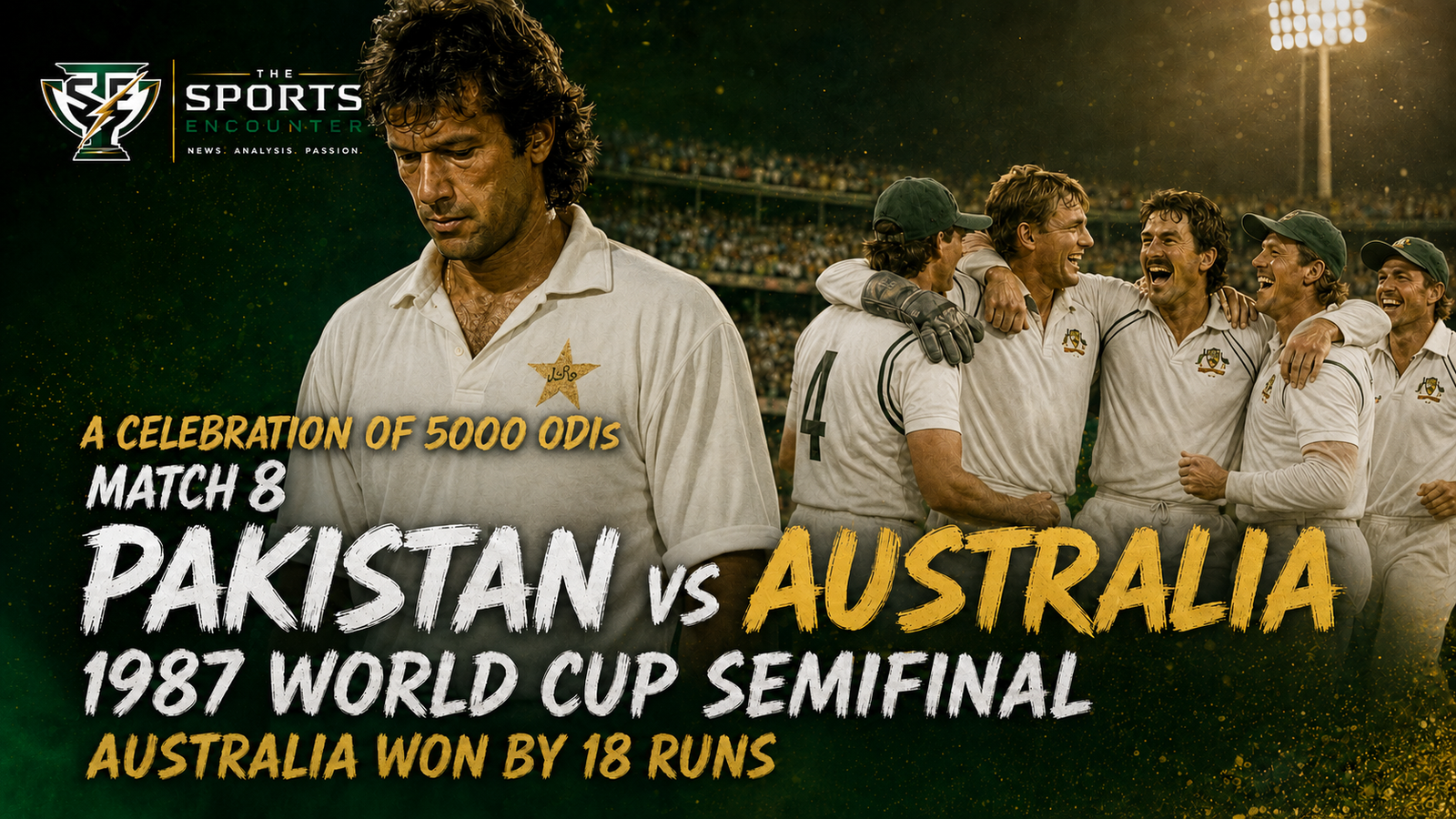
A Celebration of 5000 ODIs Match 8: Australia Break Pakistan’s World Cup Dream in Lahore
Steve Waugh transformed the final over before Craig McDermott dismantled Pakistan’s chase, sending Australia into the 1987 World Cup final by the narrowest of margins.

Eighteen runs separated Pakistan from a home World Cup final. Australia had collected exactly 18 from the last over of its innings.
That symmetry still defines the 1987 semifinal in Lahore. Pakistan recovered from 38 for three through Javed Miandad and Imran Khan, giving a packed Gaddafi Stadium reason to believe. Yet the runs Steve Waugh extracted at the end of Australia’s innings became a burden Pakistan could never shed.
Craig McDermott then took five wickets, including four during the closing stages, as Australia dismissed Pakistan for 249 to win by 18 runs.
That combination of late-innings calculation, a courageous recovery and ruthless fast bowling earns the semifinal its place as Match 8 in A Celebration of 5000 ODIs, The Sports Encounter’s journey through the matches that shaped one-day international cricket.
TL;DR
- Australia defeated Pakistan by 18 runs in the 1987 World Cup semifinal.
- Steve Waugh’s unbeaten 32 helped Australia score 18 from the final over and reach 267 for eight.
- Pakistan fell to 38 for three before Javed Miandad and Imran Khan added 112.
- Craig McDermott claimed five for 44 and won the Player of the Match award.
- Pakistan conceded 34 extras, a costly loss of control in a tight knockout match.
- Australia advanced to the final and secured its first World Cup title by beating England.
Match Information
| Detail | Information |
|---|---|
| Match | Australia vs Pakistan, 1987 World Cup semifinal |
| Date | November 4, 1987 |
| Venue | Gaddafi Stadium, Lahore |
| Toss | Australia won the toss and batted |
| Australia | 267/8 in 50 overs |
| Pakistan | 249 all out in 49 overs |
| Result | Australia won by 18 runs |
| Player of the Match | Craig McDermott, 5/44 |
| Turning Point | Australia scored 18 runs from the final over |
| Tournament Impact | Australia advanced to the World Cup final |
Complete Match Scorecard
Australia Batting
| Batter | Dismissal | Runs | Balls | 4s | 6s |
|---|---|---|---|---|---|
| Geoff Marsh | Run out | 31 | 57 | 2 | 0 |
| David Boon | St Javed Miandad b Saleem Malik | 65 | 91 | 4 | 0 |
| Dean Jones | b Tauseef Ahmed | 38 | 45 | 3 | 0 |
| Allan Border | Run out | 18 | 22 | 2 | 0 |
| Mike Veletta | b Imran Khan | 48 | 50 | 2 | 0 |
| Steve Waugh | Not out | 32 | 28 | 4 | 1 |
| Simon O’Donnell | Run out | 0 | 2 | 0 | 0 |
| Greg Dyer | b Imran Khan | 0 | 1 | 0 | 0 |
| Craig McDermott | b Imran Khan | 1 | 3 | 0 | 0 |
| Tim May | Not out | 0 | 2 | 0 | 0 |
| Bruce Reid | Did not bat | ||||
| Extras | 34 (b 1, lb 19, nb 1, w 13) | ||||
| Total | 267/8 in 50 overs |
Fall of wickets: 73, 155, 155, 215, 236, 236, 241, 249.
Pakistan Bowling
| Bowler | Overs | Maidens | Runs | Wickets |
|---|---|---|---|---|
| Imran Khan | 10 | 1 | 36 | 3 |
| Saleem Jaffar | 6 | 0 | 57 | 0 |
| Wasim Akram | 10 | 0 | 54 | 0 |
| Abdul Qadir | 10 | 0 | 39 | 0 |
| Tauseef Ahmed | 10 | 1 | 39 | 1 |
| Saleem Malik | 4 | 0 | 22 | 1 |
Pakistan Batting
| Batter | Dismissal | Runs | Balls | 4s | 6s |
|---|---|---|---|---|---|
| Ramiz Raja | Run out | 1 | 1 | 0 | 0 |
| Mansoor Akhtar | b McDermott | 9 | 19 | 0 | 0 |
| Saleem Malik | c McDermott b Waugh | 25 | 31 | 3 | 0 |
| Javed Miandad | b Reid | 70 | 103 | 4 | 0 |
| Imran Khan | c Dyer b Border | 58 | 84 | 4 | 0 |
| Wasim Akram | b McDermott | 20 | 13 | 0 | 2 |
| Ijaz Ahmed | c Jones b Reid | 8 | 7 | 1 | 0 |
| Saleem Yousuf | c Dyer b McDermott | 21 | 15 | 2 | 0 |
| Abdul Qadir | Not out | 20 | 16 | 2 | 0 |
| Saleem Jaffar | c Dyer b McDermott | 0 | 2 | 0 | 0 |
| Tauseef Ahmed | c Dyer b McDermott | 1 | 3 | 0 | 0 |
| Extras | 16 (lb 6, w 10) | ||||
| Total | 249 all out in 49 overs |
Fall of wickets: 2, 37, 38, 150, 177, 192, 212, 236, 247, 249.
Australia Bowling
| Bowler | Overs | Maidens | Runs | Wickets |
|---|---|---|---|---|
| Craig McDermott | 10 | 0 | 44 | 5 |
| Bruce Reid | 10 | 2 | 41 | 2 |
| Steve Waugh | 9 | 1 | 51 | 1 |
| Simon O’Donnell | 10 | 1 | 45 | 0 |
| Tim May | 6 | 0 | 36 | 0 |
| Allan Border | 4 | 0 | 26 | 1 |
David Boon Gives Australia Its Platform
David Boon’s 65 provided the control Australia needed after choosing to bat. His partnership with Geoff Marsh settled the innings, while Dean Jones maintained the tempo with 38.
Pakistan fought back when Jones and Boon departed at 155. Mike Veletta responded with 48 from 50 balls, keeping Australia above a run-a-ball trajectory without taking reckless risks.
Imran Khan led Pakistan’s attack superbly, conceding only 36 runs and taking three wickets. However, the support bowling lacked the same discipline. Pakistan conceded 34 extras, including 13 wides and 19 leg byes. In a match decided by 18 runs, those concessions were damaging.
Steve Waugh Turns One Over Into the Winning Margin
Australia slipped from 215 for three to 249 for eight as Imran attacked the lower order. Pakistan appeared to have limited the damage, but Waugh changed the shape of the contest in the final six deliveries.
His unbeaten 32 from 28 balls drove Australia to 267. The last over, delivered by Saleem Jaffar, cost 18 runs. Waugh’s calm, clean striking gave Australia a total that demanded an exceptional chase under semifinal pressure.
It echoed the composure Australia had shown in its one-run victory over India in Chennai. Once again, a handful of late runs proved decisive.
Javed Miandad and Imran Khan Rescue Pakistan
Pakistan’s chase began disastrously. Ramiz Raja was run out before McDermott removed Mansoor Akhtar. Waugh then dismissed Saleem Malik, leaving the hosts 38 for three.
Miandad and Imran refused to let the occasion collapse around them. Their 112-run partnership restored order through controlled rotation, selective aggression and a clear understanding of the required rate.
Imran made 58 before Allan Border dismissed him at 150. Miandad continued to 70, but Bruce Reid bowled him with Pakistan still needing 56 runs. Wasim Akram, Saleem Yousuf and Abdul Qadir attacked bravely, though Australia retained just enough control.
Craig McDermott Owns the Semifinal
McDermott delivered the performance that separated the teams. After removing Mansoor early, he returned to stop Pakistan’s lower-order charge.
Wasim Akram had struck two sixes in a rapid 20 when McDermott bowled him. Saleem Yousuf followed after making 21 from 15 balls. McDermott then dismissed Saleem Jaffar and Tauseef Ahmed to complete figures of five for 44.
The spell earned him the Player of the Match award and carried Australia into the final. Pace mattered, but so did his ability to attack the stumps when Pakistan’s batters had no time to settle.
Why This Semifinal Belongs in the 5,000 ODIs Collection
The match captured the unforgiving mathematics of knockout cricket. Australia’s final-over acceleration, Pakistan’s 34 extras and McDermott’s closing spell all contributed directly to an 18-run result.
Pakistan had enjoyed a powerful home campaign, winning five of its six group matches. The semifinal offered Imran’s team the chance to reach a World Cup final on home soil. Instead, Australia absorbed the atmosphere and survived Pakistan’s strongest partnership.
The victory also prepared the way for Australia’s seven-run win over England in the 1987 final, which secured the country’s first men’s World Cup title.
Readers can explore more landmark matches through The Sports Encounter’s Celebration of 5000 ODIs collection, including India’s 1983 final triumph and Kapil Dev’s rescue against Zimbabwe.
Pakistan found courage after losing three early wickets, but Australia owned the smaller moments. Waugh won the final over, McDermott won the closing passage, and those two interventions ended a nation’s dream within sight of the final.






A Celebration of 5000 ODIs
A Celebration of 5000 ODIs Match 9: Inzamam Silences Eden Park and Sends Pakistan Into the 1992 World Cup Final
New Zealand appeared headed for a home World Cup final until 22-year-old Inzamam-ul-Haq produced 37 balls of fearless hitting that transformed Pakistan’s destiny.
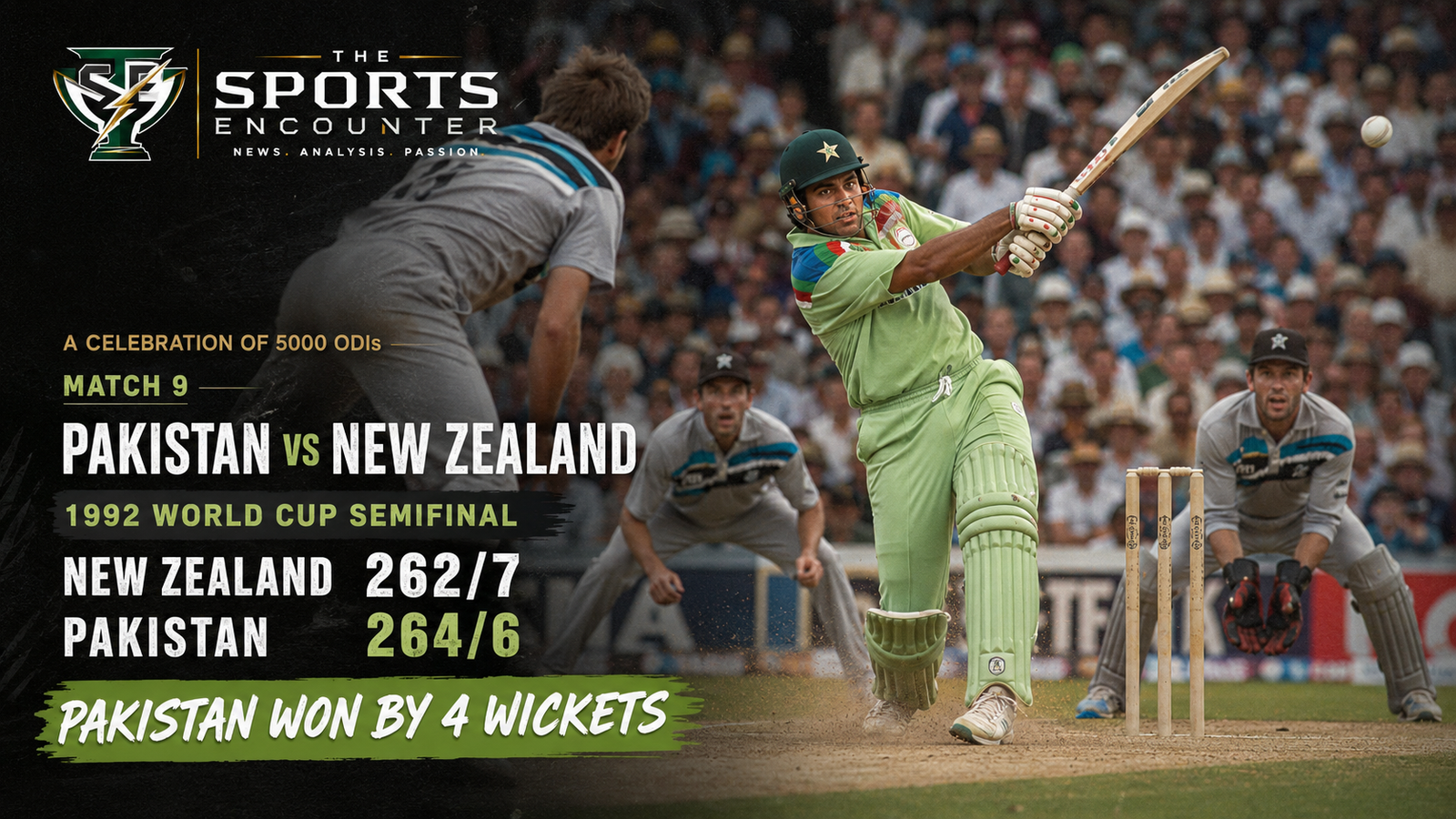
New Zealand had controlled the tournament, filled Eden Park with expectation and placed 263 runs between Pakistan and a first World Cup final. With Pakistan needing 123 from fewer than 16 overs and four wickets already gone, the co-hosts appeared ready to complete their journey.
Then Inzamam-ul-Haq walked into the pressure.
The 22-year-old had contributed little during Pakistan’s erratic campaign. Few outside the dressing room knew what he could become. Thirty-seven balls later, New Zealand knew his name and Pakistan had found the innings that would change its World Cup history.
Inzamam hammered 60, Javed Miandad finished unbeaten on 57 and Moin Khan completed the chase with six balls remaining. Pakistan won by four wickets and advanced to the final, where Imran Khan’s team would defeat England.
That sudden transformation earns this semifinal its position as Match 9 in A Celebration of 5000 ODIs, The Sports Encounter’s collection of the matches that defined one-day international cricket.
TL;DR
- Pakistan chased 263 to defeat New Zealand by four wickets at Eden Park.
- Inzamam-ul-Haq changed the chase with 60 from only 37 balls.
- Javed Miandad anchored Pakistan with an unbeaten 57 from 69 deliveries.
- Martin Crowe led New Zealand’s 262 for seven with a brilliant 91.
- Crowe’s hamstring injury prevented him from fielding and deprived New Zealand of its captain during Pakistan’s chase.
- The victory sent Pakistan into its first men’s Cricket World Cup final.
Pakistan vs New Zealand 1992 Semifinal: Match Information
| Detail | Information |
|---|---|
| Match | New Zealand vs Pakistan, first semifinal |
| Competition | 1992 Cricket World Cup |
| Date | March 21, 1992 |
| Venue | Eden Park, Auckland |
| Toss | New Zealand won the toss and batted |
| New Zealand | 262/7 in 50 overs |
| Pakistan | 264/6 in 49 overs |
| Result | Pakistan won by four wickets with six balls remaining |
| Player of the Match | Inzamam-ul-Haq, 60 from 37 balls |
| Turning Point | Inzamam attacked after Pakistan slipped to 140/4 |
| Tournament Impact | Pakistan reached its first World Cup final |
Complete Match Scorecard
New Zealand Batting
| Batter | Dismissal | Runs | Balls | 4s | 6s |
|---|---|---|---|---|---|
| Mark Greatbatch | b Aaqib Javed | 17 | 22 | 0 | 2 |
| John Wright | c Ramiz Raja b Mushtaq Ahmed | 13 | 44 | 1 | 0 |
| Andrew Jones | lbw b Mushtaq Ahmed | 21 | 53 | 2 | 0 |
| Martin Crowe | Run out | 91 | 83 | 7 | 3 |
| Ken Rutherford | c Moin Khan b Wasim Akram | 50 | 68 | 5 | 1 |
| Chris Harris | st Moin Khan b Iqbal Sikander | 13 | 12 | 1 | 0 |
| Ian Smith | Not out | 18 | 10 | 3 | 0 |
| Dipak Patel | lbw b Wasim Akram | 8 | 6 | 1 | 0 |
| Gavin Larsen | Not out | 8 | 6 | 1 | 0 |
| Danny Morrison | Did not bat | ||||
| Willie Watson | Did not bat | ||||
| Extras | 23 (b 4, lb 7, nb 4, w 8) | ||||
| Total | 262/7 in 50 overs |
Fall of wickets: 35/1, 39/2, 87/3, 194/4, 214/5, 221/6, 244/7.
Pakistan Bowling
| Bowler | Overs | Maidens | Runs | Wickets |
|---|---|---|---|---|
| Wasim Akram | 10 | 0 | 40 | 2 |
| Aaqib Javed | 10 | 2 | 45 | 1 |
| Mushtaq Ahmed | 10 | 0 | 40 | 2 |
| Imran Khan | 10 | 0 | 59 | 0 |
| Iqbal Sikander | 9 | 0 | 56 | 1 |
| Aamer Sohail | 1 | 0 | 11 | 0 |
Pakistan Batting
| Batter | Dismissal | Runs | Balls | 4s | 6s |
|---|---|---|---|---|---|
| Aamer Sohail | c Jones b Patel | 14 | 20 | 1 | 0 |
| Ramiz Raja | c Morrison b Watson | 44 | 55 | 6 | 0 |
| Imran Khan | c Larsen b Harris | 44 | 93 | 1 | 2 |
| Javed Miandad | Not out | 57 | 69 | 4 | 0 |
| Saleem Malik | c substitute b Larsen | 1 | 2 | 0 | 0 |
| Inzamam-ul-Haq | Run out | 60 | 37 | 7 | 1 |
| Wasim Akram | b Watson | 9 | 8 | 1 | 0 |
| Moin Khan | Not out | 20 | 11 | 2 | 1 |
| Mushtaq Ahmed | Did not bat | ||||
| Iqbal Sikander | Did not bat | ||||
| Aaqib Javed | Did not bat | ||||
| Extras | 15 (b 4, lb 10, w 1) | ||||
| Total | 264/6 in 49 overs |
Fall of wickets: 30/1, 84/2, 134/3, 140/4, 227/5, 238/6.
New Zealand Bowling
| Bowler | Overs | Maidens | Runs | Wickets |
|---|---|---|---|---|
| Dipak Patel | 10 | 1 | 50 | 1 |
| Danny Morrison | 9 | 0 | 55 | 0 |
| Willie Watson | 10 | 2 | 39 | 2 |
| Gavin Larsen | 10 | 1 | 34 | 1 |
| Chris Harris | 10 | 0 | 72 | 1 |
Martin Crowe Builds a Total Worth Defending
New Zealand’s aggressive tournament strategy had made them the strongest side of the round-robin stage. Seven victories from eight matches earned the co-hosts first place, with Pakistan providing their only defeat.
Pakistan struck early in the semifinal, reducing New Zealand to 39 for two and later 87 for three. Crowe responded with the innings his team needed.
The captain made 91 from 83 deliveries, combining careful placement with controlled aggression. His 107-run partnership with Ken Rutherford, who scored 50, carried New Zealand to 194 for three. Ian Smith, Dipak Patel and Gavin Larsen then added useful late runs as the hosts reached 262 for seven.
Crowe’s innings came at a physical cost. A hamstring injury kept him off the field during Pakistan’s chase, leaving John Wright to manage the defense. New Zealand lost its sharpest tactical mind at the moment it needed him most.
Mushtaq Ahmed and Wasim Akram Limit the Damage
Pakistan’s bowling performance contained enough discipline to keep 263 within reach.
Mushtaq Ahmed claimed two for 40, removing Wright and Andrew Jones before Crowe could fully control the innings. Wasim Akram also finished with two for 40, dismissing Rutherford and Patel during New Zealand’s push through the closing overs.
The hosts still scored 68 from their final eight overs, but Pakistan avoided the kind of complete late collapse that would have pushed the target closer to 290.
Javed Miandad Holds the Chase Together
Pakistan’s reply moved unevenly. Ramiz Raja supplied early momentum with 44, while Imran Khan occupied 93 balls for his 44. The captain’s cautious approach preserved wickets but allowed the required rate to climb.
Imran departed at 134, and Saleem Malik followed six runs later. Pakistan stood at 140 for four in the 35th over, needing 123 from 95 deliveries.
Miandad kept the innings connected. His unbeaten 57 from 69 balls gave Inzamam the freedom to attack without carrying the entire chase. The veteran’s judgment became especially important after New Zealand briefly reopened the contest with late wickets.
Inzamam-ul-Haq Announces Himself to the World
Inzamam began with the clarity of a batter who saw opportunity where others saw danger. He struck seven fours and one six, reaching scoring areas New Zealand had protected effectively throughout the tournament.
His 60 came at a strike rate of 162.16, extraordinary for that era and even more striking under semifinal pressure. The partnership with Miandad added 87 and reduced a demanding equation to 36 runs from five overs.
A direct hit from Chris Harris eventually ran Inzamam out, but his work had changed the emotional and mathematical balance of the chase. The Player of the Match award was inevitable.
The ICC’s history of the 1992 World Cup identifies Inzamam’s innings as the performance that carried Pakistan into its first final.
Moin Khan Finishes What Inzamam Started
Wasim Akram’s dismissal left Pakistan at 238 for six, giving New Zealand a final opening. Moin Khan closed it quickly.
The wicketkeeper struck an unbeaten 20 from 11 balls, including two fours and a six. With four required from the final over, Moin pulled Chris Harris to the boundary and completed the chase with six deliveries unused.
His finishing burst deserves recognition alongside Inzamam and Miandad. Inzamam transformed the equation, Miandad protected the chase, and Moin completed it before pressure could return.
Why Match 9 Belongs in the 5,000 ODIs Collection
This semifinal changed several careers and two nations’ World Cup histories. New Zealand lost despite producing the tournament’s most consistent cricket. Crowe finished as the competition’s leading run-scorer with 456, but injury and Inzamam’s assault denied him a home final.
Pakistan carried the victory into Melbourne and won the World Cup four days later. That triumph became the defining achievement of Imran Khan’s playing career and the foundation of Inzamam’s long international journey.
The match also continues a recurring theme across The Sports Encounter’s 5000 ODIs collection: great one-day contests often turn on a short, violent change in tempo. Steve Waugh’s final-over assault in Lahore carried similar weight, while Australia’s one-run escape against India showed how narrow margins can redirect a tournament.
Other defining World Cup performances include Kapil Dev’s 175 against Zimbabwe, India’s defense of 183 in the 1983 final and Australia’s seven-run victory in the 1987 final.
Eden Park expected to celebrate New Zealand’s first appearance in a World Cup final. Instead, it witnessed the arrival of a young Pakistan batter whose 37-ball intervention changed the direction of the tournament.
A Celebration of 5000 ODIs
A Celebration of 5000 ODIs Match 7: Australia Punish Gatting’s Reverse Sweep to Win the 1987 World Cup Final
England appeared positioned to win its first World Cup until Mike Gatting’s reverse sweep opened the door for Allan Border and Australia at Eden Gardens.
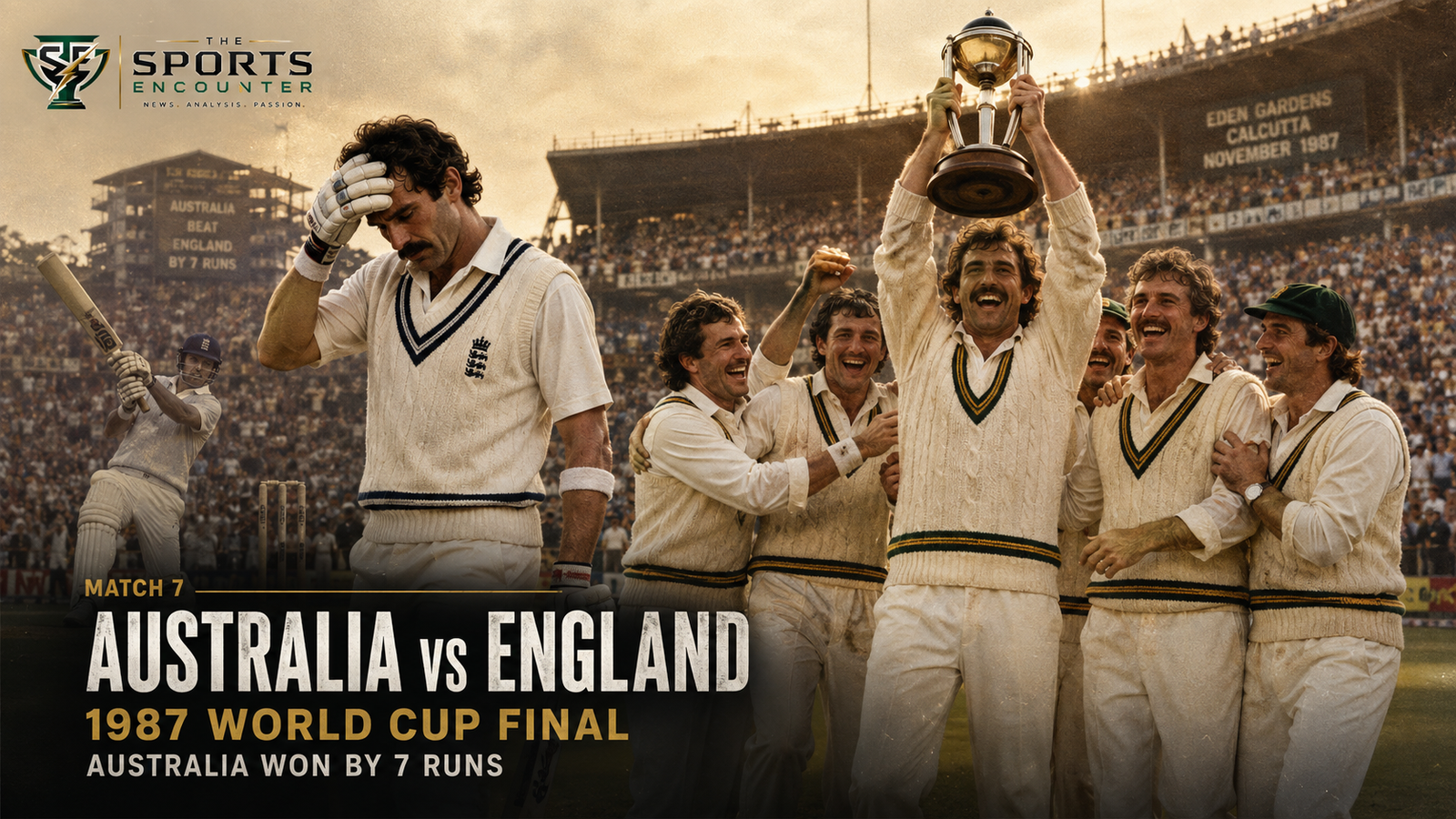
England were 135/2 and moving steadily toward a first World Cup title when Mike Gatting attempted the shot that would follow him for the rest of his career.
Allan Border was bowling his occasional left-arm spin. Gatting moved across his crease and tried to reverse-sweep the Australian captain. The ball struck the top edge, looped behind the wicket and dropped into Greg Dyer’s gloves.
A partnership worth 69 runs had ended. Australia finally had an opening.
England remained in the chase until the last over, but the control established by Gatting and Bill Athey never fully returned. Australia defended 253/5, won by seven runs and lifted the World Cup for the first time at Eden Gardens on November 8, 1987.
The final earns its place as Match 7 in A Celebration of 5000 ODIs because one adventurous shot changed the emotional direction of a global final. David Boon supplied the innings, Mike Veletta transformed the total, and Border intervened precisely when England appeared ready to take command.
TL;DR
- Australia scored 253/5 after winning the toss at Eden Gardens.
- David Boon made 75 from 125 balls and received the Player of the Match award.
- Mike Veletta’s unbeaten 45 from 31 deliveries powered Australia’s late acceleration.
- Bill Athey scored 58, while Mike Gatting and Allan Lamb made 41 and 45.
- Gatting’s failed reverse sweep against Allan Border changed the direction of the chase.
- England finished on 246/8, leaving Australia with a seven-run victory and its first World Cup title.
Australia vs England 1987 World Cup Final: Key Information
| Detail | Information |
|---|---|
| Match | Australia vs England, 1987 World Cup final |
| Date | November 8, 1987 |
| Venue | Eden Gardens, Calcutta, now Kolkata |
| Toss | Australia won the toss and batted |
| Australia | 253/5 in 50 overs |
| England | 246/8 in 50 overs |
| Result | Australia won by seven runs |
| Player of the Match | David Boon, 75 from 125 balls |
| Leading England batter | Bill Athey, 58 from 103 balls |
| Leading bowlers | Eddie Hemmings 2/48; Steve Waugh 2/37; Allan Border 2/38 |
| Turning point | Mike Gatting’s reverse sweep against Border at 135/2 |
| Tournament impact | Australia won its first men’s Cricket World Cup |
The match and tournament history are documented by the International Cricket Council.
Complete Match Scorecard
Australia Innings: 253/5 in 50 Overs
| Batter | Dismissal | Runs | Balls | 4s | 6s |
|---|---|---|---|---|---|
| David Boon | c Downton b Hemmings | 75 | 125 | 7 | 0 |
| Geoff Marsh | b Foster | 24 | 49 | 3 | 0 |
| Dean Jones | c Athey b Hemmings | 33 | 57 | 1 | 1 |
| Craig McDermott | b Gooch | 14 | 8 | 2 | 0 |
| Allan Border | Run out | 31 | 31 | 3 | 0 |
| Mike Veletta | Not out | 45 | 31 | 6 | 0 |
| Steve Waugh | Not out | 5 | 4 | 0 | 0 |
| Simon O’Donnell | Did not bat | ||||
| Greg Dyer | Did not bat | ||||
| Tim May | Did not bat | ||||
| Bruce Reid | Did not bat | ||||
| Extras | 1 bye, 13 leg byes, 5 wides, 7 no-balls | 26 | |||
| Total | Five wickets, 50 overs | 253 |
England Bowling
| Bowler | Overs | Maidens | Runs | Wickets |
|---|---|---|---|---|
| Phil DeFreitas | 6 | 1 | 34 | 0 |
| Gladstone Small | 6 | 0 | 33 | 0 |
| Neil Foster | 10 | 0 | 38 | 1 |
| Eddie Hemmings | 10 | 1 | 48 | 2 |
| John Emburey | 10 | 0 | 44 | 0 |
| Graham Gooch | 8 | 1 | 42 | 1 |
England Innings: 246/8 in 50 Overs
| Batter | Dismissal | Runs | Balls | 4s | 6s |
|---|---|---|---|---|---|
| Graham Gooch | lbw b O’Donnell | 35 | 57 | 4 | 0 |
| Tim Robinson | lbw b McDermott | 0 | 1 | 0 | 0 |
| Bill Athey | Run out | 58 | 103 | 2 | 0 |
| Mike Gatting | c Dyer b Border | 41 | 45 | 3 | 1 |
| Allan Lamb | b Waugh | 45 | 55 | 4 | 0 |
| Paul Downton | c O’Donnell b Border | 9 | 8 | 1 | 0 |
| John Emburey | Run out | 10 | 16 | 0 | 0 |
| Phil DeFreitas | c Reid b Waugh | 17 | 10 | 2 | 1 |
| Neil Foster | Not out | 7 | 6 | 0 | 0 |
| Gladstone Small | Not out | 3 | 3 | 0 | 0 |
| Eddie Hemmings | Did not bat | ||||
| Extras | 1 bye, 14 leg byes, 2 wides, 4 no-balls | 21 | |||
| Total | Eight wickets, 50 overs | 246 |
Australia Bowling
| Bowler | Overs | Maidens | Runs | Wickets |
|---|---|---|---|---|
| Craig McDermott | 10 | 1 | 51 | 1 |
| Bruce Reid | 10 | 0 | 43 | 0 |
| Steve Waugh | 9 | 0 | 37 | 2 |
| Simon O’Donnell | 10 | 1 | 35 | 1 |
| Tim May | 4 | 0 | 27 | 0 |
| Allan Border | 7 | 0 | 38 | 2 |
David Boon Anchors Australia’s Innings
Boon’s 75 lacked the rapid scoring associated with modern finals, but the conditions demanded patience. He batted for 125 deliveries, absorbed England’s most disciplined periods and provided stability after Geoff Marsh departed with the score at 75.
Dean Jones added 33, while the unusual promotion of Craig McDermott produced 14 from eight balls. Australia then lost Jones, McDermott and Boon within 17 runs, slipping from 151/1 to 168/4.
Boon had given Australia a foundation. The innings still required someone to convert that foundation into a competitive final total.
His control and endurance earned him Player of the Match, completing a tournament in which he scored 447 runs.
Mike Veletta Changes the Value of Australia’s Total
Veletta arrived with Australia needing urgency and struck an unbeaten 45 from 31 balls. His six boundaries allowed Australia to collect 65 runs from the final six overs.
Border supported him with 31 from 31 deliveries before being run out at 241/5. Waugh added five from four balls, taking the total to 253.
Veletta’s innings became increasingly valuable as England’s pursuit tightened. Without his late acceleration, Gatting’s dismissal may have caused only a temporary interruption rather than a decisive shift.
Australia’s earlier ability to survive pressure had already appeared in the one-run group victory over India, which prepared Border’s side for another close finish.
Mike Gatting’s Reverse Sweep Opens the Final
Tim Robinson fell to McDermott from the first ball he faced, but England recovered through Gooch and Athey.
Gatting then changed the pace of the pursuit. His 41 came from 45 balls, and the partnership with Athey placed England at 135/2. The required rate remained manageable, both batters were settled, and Australia needed to create a mistake.
Border brought himself into the attack and Gatting supplied the opportunity.
The reverse sweep carried an obvious cost because of what followed. Athey was run out for 58 at 170/4, while Paul Downton managed nine. England had moved from a controlled chase into a sequence of new batters facing a rising required rate.
Allan Lamb Keeps England Alive
Lamb made 45 from 55 deliveries and carried England to 220/6. His innings prevented Australia from closing the final immediately after Athey’s departure.
Waugh then bowled Lamb, leaving England seven wickets down and still needing 34 runs. DeFreitas attacked with 17 from ten balls, including a six, but Waugh removed him at 235/8.
England required 17 from the final over and scored ten. Neil Foster and Gladstone Small remained unbeaten, yet the chase ended at 246/8.
Border finished with 2/38, while Waugh’s 2/37 gave Australia control during the closing overs.
Why Match 7 Belongs in A Celebration of 5000 ODIs
The seven-run margin tells only part of the story.
Australia entered the tournament as an unfancied side after a difficult period in its cricket history. Border’s team then survived the one-run match against India, defeated host Pakistan in the semifinal and held its nerve against England.
The final also marked a major change in World Cup geography and structure. India and Pakistan became the first countries outside England to host the tournament, while the competition adopted the 50-over innings that defines ODI cricket today.
This series previously revisited India’s 1983 final victory over West Indies, Kapil Dev’s rescue against Zimbabwe, the chaotic 1975 final and Gary Gilmour’s remarkable semifinal.
Readers can explore more historical match reports through The Sports Encounter Cricket Hub.
England had enough time, enough wickets and two established batters when Gatting shaped for the reverse sweep. Australia recognized the opening, controlled the next passage and completed the victory that began its rise as ODI cricket’s most successful World Cup nation.
A Celebration of 5000 ODIs
A Celebration of 5000 ODIs Match 6: Australia Beat India by One Run After Chennai Chase Turns Into Final-Over Agony
SEO Meta Title: India vs Australia 1987 World Cup Thriller
Meta Description: Australia edged India by one run in Chennai after Geoff Marsh’s century, Craig McDermott’s four wickets and a dramatic final-over collapse.
Suggested Slug: australia-india-1987-world-cup-one-run-thriller
Focus Keyphrase: Australia vs India 1987 World Cup
Excerpt: Geoff Marsh’s century gave Australia control, but India carried the chase to the final delivery before Steve Waugh secured a one-run World Cup escape in Chennai.
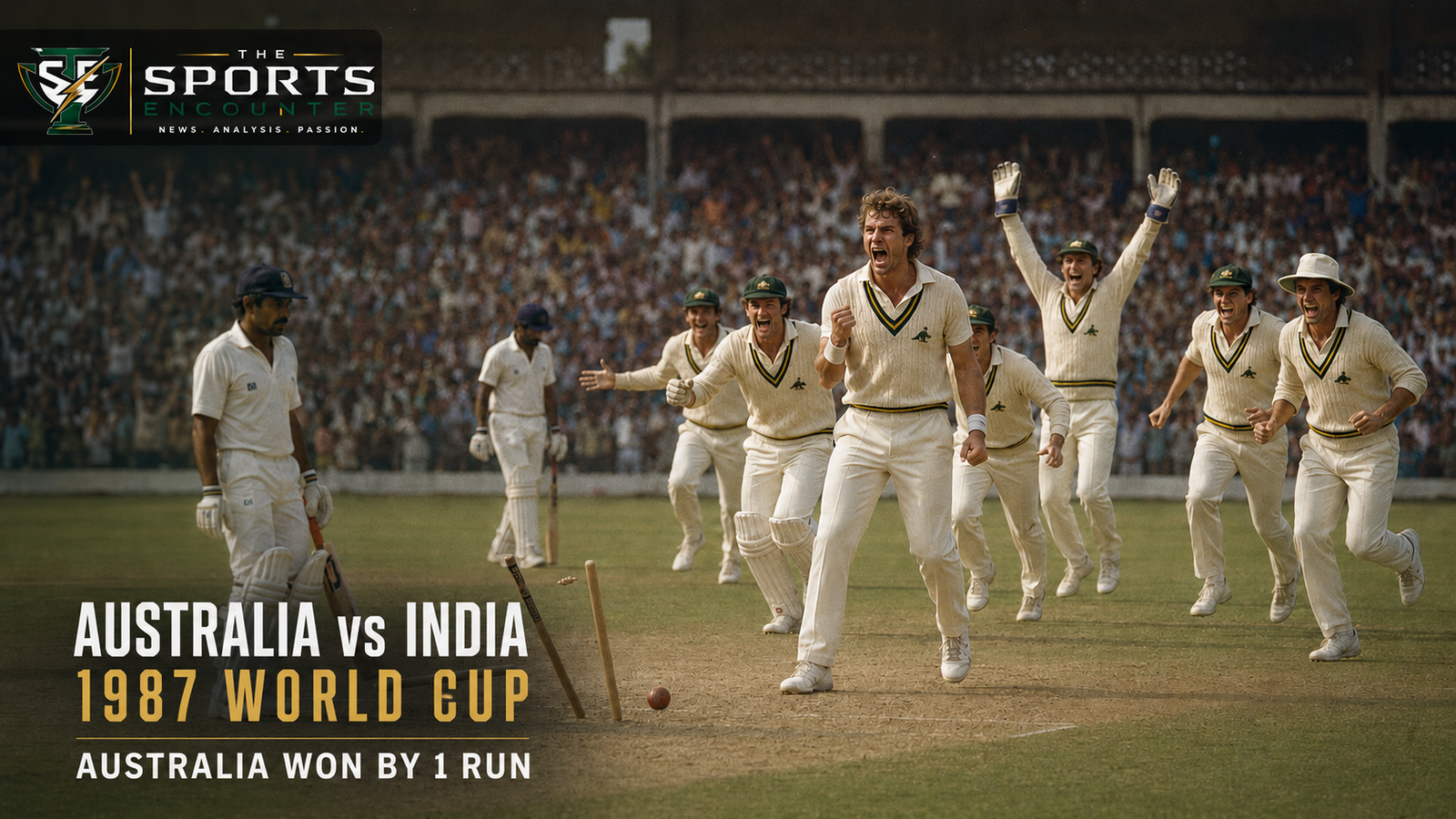
India needed two runs to tie when Maninder Singh faced Steve Waugh with one delivery left. Kiran More stood unbeaten at the other end, the Chennai crowd could barely process the tension, and a chase that had once appeared under control had reached its narrowest possible margin.
Waugh bowled straight. Maninder swung, missed and lost his stumps. Australia had won by one run.
The ending alone earns this match a place in A Celebration of 5000 ODIs, but the complete story carries even greater intrigue. Australia’s total had increased from 268 to 270 after a Dean Jones boundary was corrected from four to six during the innings break. India later finished on 269.
Geoff Marsh’s painstaking century, Navjot Sidhu’s five sixes, Craig McDermott’s middle-order intervention and Waugh’s final delivery produced a World Cup match in which every run acquired historical weight.
TL;DR
- Australia scored 270/6 after India chose to field in Chennai.
- Geoff Marsh made 110 from 141 balls and received the Player of the Match award.
- Kris Srikkanth scored 70 and Navjot Sidhu struck 73 during India’s chase.
- Craig McDermott took 4/56, including three wickets during a decisive middle-order spell.
- Steve Waugh bowled Maninder Singh from the penultimate delivery to complete a one-run victory.
- A Dean Jones boundary, initially recorded as four, was corrected to six during the innings break.
Australia vs India 1987 World Cup: Match Information
| Detail | Information |
|---|---|
| Match | India vs Australia, third match, 1987 World Cup |
| Date | October 9, 1987 |
| Venue | MA Chidambaram Stadium, Chennai |
| Toss | India won the toss and fielded |
| Australia | 270/6 in 50 overs |
| India | 269 all out in 49.5 overs |
| Result | Australia won by one run |
| Player of the Match | Geoff Marsh, 110 from 141 balls |
| Top Indian performers | Navjot Sidhu 73, Kris Srikkanth 70 |
| Leading bowler | Craig McDermott, 4/56 |
| Final turning point | Steve Waugh bowled Maninder Singh with one ball remaining |
| Tournament stage | Group A |
| ODI number | ODI No. 453 |
Match details can also be checked through the official ICC cricket platform.
Complete Match Scorecard
Australia Innings: 270/6 in 50 Overs
| Batter | Dismissal | Runs | Balls | 4s | 6s |
|---|---|---|---|---|---|
| David Boon | lbw b Shastri | 49 | 68 | 5 | 0 |
| Geoff Marsh | c Azharuddin b Prabhakar | 110 | 141 | 7 | 1 |
| Dean Jones | c Sidhu b Maninder Singh | 39 | 35 | 2 | 2 |
| Allan Border | b Binny | 16 | 22 | 0 | 0 |
| Tom Moody | c Kapil Dev b Prabhakar | 8 | 13 | 1 | 0 |
| Steve Waugh | Not out | 19 | 17 | 0 | 0 |
| Simon O’Donnell | Run out | 7 | 10 | 0 | 0 |
| Greg Dyer | Did not bat | ||||
| Peter Taylor | Did not bat | ||||
| Craig McDermott | Did not bat | ||||
| Bruce Reid | Did not bat | ||||
| Extras | 18 leg byes, 2 wides, 2 no-balls | 22 | |||
| Total | Six wickets, 50 overs | 270 |
India Bowling
| Bowler | Overs | Maidens | Runs | Wickets |
|---|---|---|---|---|
| Kapil Dev | 10 | 0 | 41 | 0 |
| Manoj Prabhakar | 10 | 0 | 47 | 2 |
| Roger Binny | 7 | 0 | 46 | 1 |
| Maninder Singh | 10 | 0 | 48 | 1 |
| Ravi Shastri | 10 | 0 | 50 | 1 |
| Mohammad Azharuddin | 3 | 0 | 20 | 0 |
India Innings: 269 All Out in 49.5 Overs
| Batter | Dismissal | Runs | Balls | 4s | 6s |
|---|---|---|---|---|---|
| Sunil Gavaskar | c Reid b Taylor | 37 | 32 | 6 | 1 |
| Kris Srikkanth | lbw b Waugh | 70 | 83 | 7 | 0 |
| Navjot Sidhu | b McDermott | 73 | 79 | 4 | 5 |
| Dilip Vengsarkar | c Jones b McDermott | 29 | 45 | 2 | 0 |
| Mohammad Azharuddin | b McDermott | 10 | 14 | 1 | 0 |
| Kapil Dev | c Boon b O’Donnell | 6 | 10 | 0 | 0 |
| Ravi Shastri | c and b McDermott | 12 | 11 | 1 | 0 |
| Kiran More | Not out | 12 | 14 | 2 | 0 |
| Roger Binny | Run out | 0 | 3 | 0 | 0 |
| Manoj Prabhakar | Run out | 5 | 7 | 0 | 0 |
| Maninder Singh | b Waugh | 4 | 5 | 0 | 0 |
| Extras | 2 byes, 7 leg byes, 2 wides | 11 | |||
| Total | All out, 49.5 overs | 269 |
Australia Bowling
| Bowler | Overs | Maidens | Runs | Wickets |
|---|---|---|---|---|
| Craig McDermott | 10 | 0 | 56 | 4 |
| Bruce Reid | 10 | 2 | 35 | 0 |
| Simon O’Donnell | 9 | 1 | 32 | 1 |
| Peter Taylor | 5 | 0 | 46 | 1 |
| Steve Waugh | 9.5 | 0 | 52 | 2 |
| Allan Border | 6 | 0 | 39 | 0 |
Geoff Marsh Gives Australia Its Foundation
Marsh batted through most of Australia’s innings and refused to let Chennai’s heat, spin or slow surface separate him from his method.
His 110 from 141 balls included seven fours and one six. The pace appears restrained beside modern ODI scoring, but Australia needed an anchor while adjusting to unfamiliar conditions. Marsh added 110 for the opening wicket with David Boon, who contributed 49.
Dean Jones then accelerated with 39 from 35 deliveries. Steve Waugh’s unbeaten 19 helped Australia reach 270, a strong total in the first World Cup played under the now-familiar 50-over format.
Marsh deserved the Player of the Match award because his innings gave every later Australian contribution its value.
The Boundary Correction That Became Part of the Result
Jones struck Maninder Singh toward the long boundary during his 39. The umpires initially awarded four, but Australia argued that the ball had cleared the rope.
During the innings break, the decision was corrected to six, with Indian captain Kapil Dev accepting the amendment. Australia’s score moved from 268 to 270.
The revision did not single-handedly defeat India. The chase still contained 299 legal deliveries, ten wickets and several moments India could have controlled. Yet the final margin ensured those two corrected runs would remain attached to the match forever.
Kapil’s career and sporting influence extend far beyond that painful incident, as explored in The Sports Encounter’s profile of the all-rounder who transformed Indian cricket.
Kris Srikkanth and Navjot Sidhu Put India Ahead
India began with aggression. Gavaskar made 37 from 32 balls before Srikkanth settled into a more substantial innings of 70.
Sidhu then attacked Australia’s spinners, hitting five sixes in his 73 from 79 balls. India reached 207/2 and appeared capable of controlling the remaining 64 runs.
That position made the collapse more damaging. India had wickets, established batters and a required rate within reach. Australia needed a bowler to disrupt the chase before India could coast through the final overs.
Craig McDermott Changes the Match
McDermott supplied Australia’s decisive spell.
He bowled Sidhu for 73, removed Azharuddin and then dismissed Vengsarkar, reducing India from 207/2 to 232/5. His fourth wicket came when he caught Shastri from his own bowling.
McDermott finished with 4/56. Bruce Reid went wicketless but conceded only 35 from ten overs, giving Australia the control required to survive Peter Taylor’s expensive spell.
Steve Waugh Owns the Final Delivery
India entered the final stages with More trying to guide the lower order home. Run-outs removed Binny and Prabhakar, but Maninder struck four and kept the chase alive.
Two runs were required from two balls. Waugh needed one wicket.
His straight delivery defeated Maninder and hit the stumps. Australia escaped with the smallest winning margin available in ODI cricket.
Waugh’s figures of 2/52 carried more importance than their economy rate suggests. He dismissed Srikkanth and then ended the match himself.
Why Match 6 Belongs in A Celebration of 5000 ODIs
The one-run margin supplies an obvious answer, but this match offers much more.
It featured a century, an aggressive Indian chase, a middle-order collapse, two late run-outs, a final-delivery wicket and a corrected boundary that exactly matched the eventual difference between the teams.
The result also introduced the resilience that would define Australia’s tournament. Allan Border’s side eventually lifted its first World Cup, beginning the country’s rise toward ODI dominance.
Readers can revisit India’s previous World Cup triumph through Match 5, the 1983 final against West Indies, Kapil Dev’s rescue against Zimbabwe and the chaotic 1975 World Cup final.
For more historical reports and current analysis, visit The Sports Encounter Cricket Hub.
India had controlled significant portions of the chase. Australia controlled its final delivery. In Chennai, that was enough to separate 270 from 269 and victory from one of India’s most painful World Cup defeats.


Can FIFA Oust Gianni Infantino? Regional Powerhouses Now Weigh Historic No-Confidence Vote
Gianni Infantino is facing the most serious political challenge of his FIFA presidency as UEFA, the AFC and CONCACAF discuss...


AFC-Qatar Rift Deepens as Infantino Crisis Divides Asian Football
AFC President Sheikh Salman bin Ebrahim Al-Khalifa has hit back at Qatar after its football federation challenged the confederation’s stance...


Why FIFA COO Kevin Lamour Was Shown the Exit Way
FIFA COO Kevin Lamour has left the organization weeks after accusing staff of being deceived over the abandoned FIFA Forward...


Ireland Turns on Infantino as FIFA Election Revolt Spreads Beyond Europe’s Heavyweights
Ireland has withdrawn its support for Gianni Infantino’s re-election as FIFA president, adding another national association to a widening governance...


Donald Trump Comes to Gianni Infantino’s Rescue as FIFA Crisis Turns Political
Donald Trump has thrown his support behind Gianni Infantino as UEFA, AFC and CONCACAF deepen their challenge to the FIFA...


UEFA, AFC and CONCACAF Turn on Infantino as FIFA Crisis Becomes a Fight for His Presidency
UEFA, the AFC and CONCACAF have jointly accused FIFA President Gianni Infantino of breaking trust over the abandoned World Cup...


FIFA Says Infantino Is Being Undermined as Leadership Crisis Turns Into a Battle Over Legitimacy
FIFA has escalated its defense of Gianni Infantino, warning of a concerted effort to undermine its president as the fallout...


When Will Lionel Messi Retire? Argentina President Says Only Messi Has the Answer
Lionel Messi’s retirement remains an open question after his eight-goal 2026 World Cup. Argentina president Claudio Tapia says only Messi...


English FA Turns Its Back on Gianni Infantino, Withdraws Support for Re-Election
The English FA has formally withdrawn its support for Gianni Infantino’s bid for another term as FIFA president, adding major...


FIFA President Apologizes to Member Nations After FIFA World Cup Selloff Plan Fails to Inspire
FIFA has apologized to its member associations after abandoning a controversial plan to sell a 20% stake in a new...


Infantino in Survival Mode After World Cup Stake Sale Idea Results in Global Revolt
Gianni Infantino’s abandoned World Cup commercial rights proposal has triggered an internal FIFA revolt, lost European support, and drawn a...


Crisis Plagues FIFA as Wenger, Grafstrom and Federations Break Ranks
Gianni Infantino’s grip on FIFA is under growing pressure after senior officials, European federations and former allies distanced themselves from...


Infantino Looks to Smaller Nations After UEFA, CONCACAF Snub
Gianni Infantino’s FIFA future may depend on smaller and emerging nations after UEFA and CONCACAF lost confidence in his leadership....


FIFA’s World Cup Stake Plan Failed in Three Days. The Damage to Gianni Infantino May Last Much Longer
FIFA’s attempt to sell a 20% stake in a new World Cup commercial entity collapsed within days after a global...


Cristiano Ronaldo’s World Cup Career: Goals, Records and Final Farewell
Cristiano Ronaldo became the first man to score in six FIFA World Cups, but football’s greatest tournament never gave him...


The Golden Generation Saying Goodbye After the FIFA World Cup 2026
The 2026 World Cup did more than crown a champion. It marked the emotional farewell of a generation that shaped...


Neymar’s World Cup Career: Skill, Pain, and the Rainbow Flick Legacy
Neymar carried Brazil’s World Cup hopes across four tournaments, producing unforgettable goals while enduring injuries, criticism and elimination heartbreak. His...


Is the FIFA World Cup 2030 Not for Sale Anymore?
FIFA’s proposal to sell a minority stake in a $20 billion World Cup commercial company appears to have collapsed after...


FIFA Explores 64-Nation World Cup for 2030: Is Another Expansion Worth It?
FIFA is examining whether the 2030 World Cup should expand from 48 to 64 teams. The proposal could increase global...


FIFA Revolt Moves Inside Infantino’s Office as Cordeiro Quits and Kevin Lamour Condemns World Cup Selloff
FIFA’s World Cup stake crisis has moved inside the organization. Carlos Cordeiro has resigned in protest, while chief operating officer...


Vietnam Break Malaysia’s Resistance as Xuân Son Double Sets Up Thailand Final Rematch
Nguyễn Xuân Son came off the bench to score twice as defending champion Vietnam completed a 4-0 aggregate semifinal victory...


Singapore Win the Night, Thailand Win the Tie as Bangkok Tension Ends in Another ASEAN Final
Singapore ended a 14-year wait for victory over Thailand, but the War Elephants protected their first-leg advantage to reach another...


Vietnam Leave Malaysia With a Two-Goal Problem and a Semifinal Still to Finish
Vietnam survived Malaysia’s best pressure before Xuân Son’s spectacular header and Faris Danish’s late own goal created a commanding ASEAN...


Arsenal Defend the Crown as Guardiola, Salah, and the Old Premier League Order Disappear
Arsenal begin their first Premier League title defense in more than two decades as a reshaped league opens around them....


Rashford Is Back in the Picture as Manchester United Prepare One Final Transfer Push
Marcus Rashford is back in Manchester United’s first-team plans after 18 months away, with Michael Carrick praising his fitness, attitude...


Premier League 2026: Villa Sign Suzuki and Ruggeri as Arsenal Land Konsa, and Man Utd Close on Baleba
Aston Villa have completed deals for Zion Suzuki and Matteo Ruggeri, Arsenal are moving for Ezri Konsa, and Manchester United...


Rodri Joins Barcelona After 14-Trophy Manchester City Era
Rodri has left Manchester City after 298 appearances and 14 major trophies to join Barcelona on a deal through 2030....


Premier League Opens VAR Decisions to Public Scrutiny in Major Transparency Push
The Premier League is opening refereeing decisions to greater public scrutiny in 2026-27, with weekly KMI Panel reviews, direct VAR...


Draisaitl and Peterka Are Going Home as NHL Expands Germany Push
The NHL is expanding its push into Germany with four regular-season games in 2027-28. The Edmonton Oilers will play in...


Ron Duguay Walks Without a Walker as Stage 4 Cancer Fight Enters a New Treatment Phase
Ron Duguay has reached an encouraging rehabilitation milestone after his recent hospitalization, walking without a walker as his Stage 4...


Anze Kopitar Becomes Immortal in Los Angeles as Kings Retire No. 11 and Build His Statue
The Los Angeles Kings will retire Anze Kopitar’s No. 11 and unveil a bronze statue outside Crypto.com Arena, cementing the...


Ville Koivunen’s Eight-Year, $32M Penguins Deal Is a Bet on Pittsburgh’s Next Era
The Pittsburgh Penguins have committed to their future by signing 23-year-old forward Ville Koivunen to an eight-year, $32 million contract...


Tommy Novak’s $13.95M Penguins Extension Reveals Pittsburgh’s Plan Beyond the Crosby Era
The Pittsburgh Penguins have secured versatile forward Tommy Novak on a three-year, $13.95 million extension. After recording 42 points in...


Tim Seifert Sets the Stage Before Liam Dawson Seals The Hundred 2026 Final
Tim Seifert powered Manchester Super Giants toward the title before Mohammad Amir’s late burst created panic and Liam Dawson settled...


Crawley’s Costly Blunder Helps Super Giants Reach The Hundred Final
Paul Walter and Heinrich Klaasen powered Manchester Super Giants to 186 before Josh Tongue’s four wickets and Zak Crawley’s costly...


MI London Beat Birmingham Phoenix by Two Runs but Miss Hundred Eliminator on Net Run Rate
MI London survived a remarkable Birmingham Phoenix comeback to win by two runs at Edgbaston, but the victory was nowhere...


Tim Seifert Blows Sunrisers Leeds Away as Manchester Super Giants Surge Toward Hundred Eliminator
Tim Seifert hammered an unbeaten 80 from 40 balls as Manchester Super Giants chased 128 in just 67 legal deliveries,...


Stubbs Spoils Trent Rockets’ Lord’s Party as Southern Brave Win by Six Wickets
Tristan Stubbs hit an unbeaten 52 from 28 balls as Southern Brave chased 159 in 97 balls to beat Trent...


Wimbledon 2026 Withstands FIFA World Cup Clash, Breaks Attendance Record
Wimbledon attracted a record 550,151 spectators and generated 4.8 billion social media impressions in 2026. Dry weather, Arthur Fery’s semifinal...


Wimbledon Men’s Singles Champions: How Triumph on Grass Changed Their Careers
From Spencer Gore and William Renshaw to Roger Federer, Novak Djokovic, Carlos Alcaraz, and Jannik Sinner, discover how every Wimbledon...


Guo Hanyu and Kristina Mladenovic Turn Trust Into Wimbledon 2026 Glory
Guo Hanyu and Kristina Mladenovic turned a new partnership into Wimbledon glory, defeating Gabriela Dabrowski and Luisa Stefani in a...


Jannik Sinner’s Wimbledon Defense Against Novak Djokovic and Alexander Zverev
Jannik Sinner’s Wimbledon 2026 defense began with a five-set escape and ended with victories over Novak Djokovic and Alexander Zverev....


Muchova, Noskova Turn Wimbledon Women’s Singles Final Into an All-Czech Affair
Karolina Muchova saved match point to beat Coco Gauff in a Centre Court thriller, while Linda Noskova handled Marta Kostyuk...


Swiatek Sweeps Aside Rybakina to Claim Toronto Crown Ahead of US Open
Iga Swiatek swept aside Elena Rybakina 6-2, 6-3 to claim the 2026 National Bank Open title in Toronto, securing her...


Brandon Nakashima Beats Jodar to Reach First Masters 1000 Final
Brandon Nakashima held off Rafael Jodar 7-6(3), 6-4 to reach the first Masters 1000 final of his career at the...


National Bank Open: Iga Swiatek, Elina Svitolina Reach Semifinals as Montreal Enters QF Stage
Iga Swiatek and Elina Svitolina became the first confirmed National Bank Open 2026 semifinalists in Toronto, while Montreal’s men’s draw...


When Paris Welcomed Two New French Open Champions
Paris, France – June 9, 2026: There are days at Roland Garros when tennis feels like a sport. Then there...


French Open 2026: Mirra Andreeva Becomes a Grand Slam Reality
Mirra Andreeva relived the memories of Monica Seles on Super Sunday at Roland Garros to lift her maiden French Open...


Galle Gallants Are LPL 2026 Champions After 5-Wicket Revenge Win Over Jaffna Kings
Galle Gallants are the 2026 Lanka Premier League champions after defeating Jaffna Kings by five wickets, chasing 124 in 15.5...


LPL 2026 Final Preview: Galle Seek Revenge as Jaffna Chase a Fifth Crown
Galle Gallants and Jaffna Kings meet in the Lanka Premier League 2026 final after three dramatic clashes this season, with...


Harper and Asalanka Punish Colombo’s Chaos as Galle Reach LPL Final
Sam Harper’s commanding 77 and Charith Asalanka’s composed 59 carried Galle Gallants past Colombo Kaps and into the LPL 2026...

McDermott and Neesham Set the Trap Before Sahan Ends Kandy’s LPL Run
Colombo Kaps eliminated Kandy Royals by 68 runs after McDermott and Neesham powered them past 200 before Sahan and Dahani...


Mishara’s Unbeaten 108 Sends Jaffna Kings Into LPL Final After 470-Run Assault
Kamil Mishara’s unbeaten century carried Jaffna Kings into the LPL 2026 final after Galle Gallants fell 14 runs short in...


Guyana Amazon Warriors Defend 85 to Break San Francisco Hearts and Retain Global Super League Title
Guyana Amazon Warriors recovered from 29 for eight, defended a total of 85, and defeated San Francisco Unicorns by six...


Tim Robinson Explodes as Unicorns Thump Vipers to Enter the Global Super League Final
Tim Robinson struck an unbeaten 68 as San Francisco Unicorns defeated Desert Vipers by eight wickets in the Global Super...


Perth Find Their Missing Finish as Spin Silences Guyana
Brody Couch rescued Perth Scorchers XI with 43 before five spin options dismantled Guyana Amazon Warriors for 121 in a...


Akeal Hosein Nearly Steals It, but Desert Vipers Escape in Final Over
Rilee Rossouw mastered a difficult Providence pitch before Desert Vipers survived Akeal Hosein’s four-wicket fightback to beat Perth Scorchers XI...


Shadab Khan and Zachary Carter Rescue Desert Vipers’ GSL Campaign
Shadab Khan dismantled San Francisco’s middle order before 19-year-old Zachary Carter launched a fearless chase, helping Desert Vipers secure their...


Lakers’ $12.5B Sale Confirms a New Reality: This Is Luka Dončić’s Team Now
The Lakers are entering another major transition, with a reported $12.5 billion ownership deal arriving as LeBron James departs and...


NBA 2026-27 Schedule Is Here: Opening Night, Christmas Games and Biggest Dates to Watch
The NBA has released its full 2026-27 schedule, with LeBron James opening his 76ers career against the defending champion Knicks,...


LeBron James to Challenge NBA Champions Knicks to Kick Off His 76ers Era
LeBron James will begin his Philadelphia 76ers era against the defending champion New York Knicks at Madison Square Garden before...


LeBron James Says No to LA 2028, but Team USA Is Reportedly Saving Him a Seat
LeBron James says he plans to watch the 2028 Los Angeles Olympics, but USA Basketball is reportedly prepared to give...


A Documentary on LeBron James in the Making?
ESPN is reportedly close to securing unprecedented access to LeBron James’ final NBA chapter, combining his Philadelphia title chase with...


NFL Bulletin: Woody Johnson Expands Sports Empire, Colts Get Warren Relief, Broncos Add Rapp
Woody Johnson expands his sports portfolio with an Aston Martin F1 stake, while the Colts receive encouraging Tyler Warren injury...


NFL Stars vs Flag Football Specialists: Who Should Make Team USA’s 10-Man LA28 Roster?
NFL superstars have been cleared to pursue Olympic flag football, but Team USA has only 10 roster spots for LA28....


NFL Injury Update: Jayden Higgins Lost for 2026 as Chargers and Eagles Face Major Week 1 Questions
The Texans have lost Jayden Higgins for the entire 2026 season, while the Chargers wait for clarity on Tyler Biadasz’s...




US Open Smashes Prize Money Record as Grand Slams Finally Give Players a Seat at the Table
The US Open has raised its 2026 player compensation to a record $108 million, including $5.5 million for each singles...


Carlos Alcaraz Returns at US Open After Four Months Away, but Can He Defend His Crown?
Carlos Alcaraz has confirmed his return to competitive tennis at the 2026 US Open after more than four months out...


Elina Svitolina’s Ankle Injury Raises US Open 2026 Fitness Concerns After Cincinnati Withdrawal
Elina Svitolina has withdrawn from the Cincinnati Open because of a right ankle injury carried over from Toronto. The world...
-

 Cricket3 weeks ago
Is The Hundred Losing Its Oomph Among English Cricket Fans?
-

 Editor's Choice2 weeks ago
Premier League 2026–27 Curtain Raiser: Fixtures, Teams, Title Contenders, Transfers and Season Predictions
-

 Editor's Choice3 weeks ago
US Open 2026 Curtain-Raiser: Players, Schedule, Title Contenders, New York Storylines and Everything Fans Need to Know