Breaking News
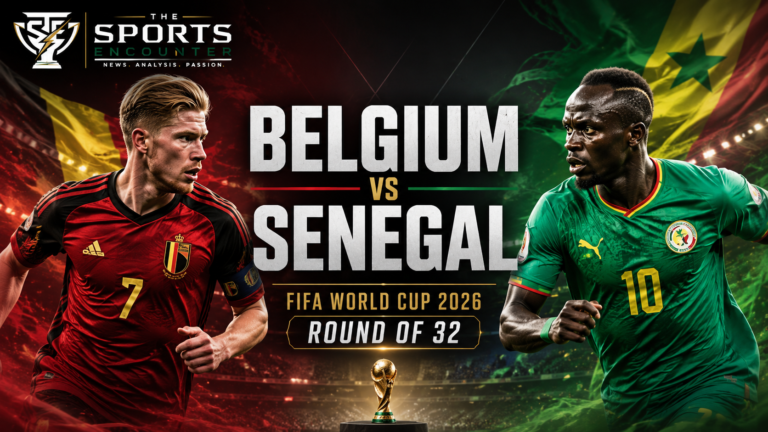
Belgium vs Senegal Preview: Can the Lions of Teranga Shake Another Favorite in the World Cup 2026 Round of 32?
Belgium face Senegal in a World Cup 2026 Round of 32 clash that looks simple on paper but dangerous on the pitch, with the Lions of Teranga chasing a knockout upset after surviving the Lucky 8 route.
Belgium arrive in Seattle with the stronger group finish, the bigger European reputation, and the cleaner route into the FIFA World Cup 2026 Round of 32.
Senegal arrive with something more dangerous than comfort: survival energy.
That alone makes this knockout tie feel tighter than the bracket suggests. Belgium have the names, the experience, and the late group-stage surge. Senegal have pace, power, emotional urgency, and a point to prove after squeezing into the knockouts through the expanded World Cup’s third-place route.
For full tournament movement, follow The Sports Encounter’s FIFA World Cup 2026 coverage and our wider soccer analysis.
Match Facts Box
| Detail | Information |
|---|---|
| Match | Belgium vs Senegal |
| Competition | FIFA World Cup 2026 |
| Stage | Round of 32 |
| Venue | Seattle |
| Belgium route | Group G winners |
| Senegal route | Third in Group I, qualified among the Lucky 8 |
| Belgium group record | Draws vs Egypt and Iran, 5-1 win vs New Zealand |
| Senegal group record | Lost to France and Norway, beat Iraq 5-0 |
| Key Belgium players | Kevin De Bruyne, Romelu Lukaku, Leandro Trossard, Jérémy Doku, Thibaut Courtois |
| Key Senegal players | Sadio Mané, Ismaïla Sarr, Iliman Ndiaye, Pape Gueye, Mory Diaw |
| Main question | Can Senegal turn a difficult group-stage escape into a knockout upset? |
Belgium Found Their Bite at the Right Time
Belgium’s World Cup did not begin with swagger. Their opening draws against Egypt and Iran left questions around tempo, sharpness, and whether this group could still handle knockout-level pressure.
Then came New Zealand.
Belgium’s 5-1 win changed the mood around Rudi Garcia’s team. Leandro Trossard scored twice, Kevin De Bruyne added control and authority, Romelu Lukaku came off the bench and scored, and Belgium finally looked like a side willing to stretch opponents rather than simply manage possession.
The Sports Encounter’s report on Belgium’s 5-1 win over New Zealand captured the key shift well: Belgium played with width, patience, and a sharper edge. That matters because knockout football usually punishes teams still searching for rhythm.
Belgium now look closer to a settled side. De Bruyne gives them passing direction. Trossard offers movement between the lines. Doku, if used from the start or off the bench, can attack Senegal’s full-backs in one-v-one situations. Lukaku gives Belgium the power option if the match becomes physical or direct.
Just as important, Belgium enter this match with a fully available squad. That gives Garcia tactical flexibility, especially if Senegal force the game into transitions.
Senegal’s Group Stage Was Messy, But Not Meaningless
Senegal’s path to Seattle was not smooth. They lost 3-1 to France, then 3-2 to Norway, and those two defeats left them under real pressure before their final group match.
Their response against Iraq said plenty.
Senegal won 5-0, punished a 10-man opponent, and revived a campaign that had started to look fragile. The result was not just about the margin. It showed that Senegal still had attacking punch, emotional control, and enough belief to survive a difficult group. The Sports Encounter covered that response in detail in Senegal Punish 10-Man Iraq as Round of 32 Hope Survives.
Their qualification also fits the wider World Cup 2026 story. The expanded format has kept more teams alive through the “Lucky 8” third-place route, and Senegal became one of the teams to benefit from that new layer of knockout drama. For a broader look at that picture, read The Sports Encounter’s breakdown of the World Cup 2026 knockout picture and Lucky 8 race.
Still, Senegal cannot ignore the warning signs. They conceded six goals across the France and Norway defeats. Against elite attackers, their defensive errors became expensive. That has to change against Belgium because De Bruyne does not need many invitations, and Lukaku rarely needs a perfect game to punish one loose moment.
Can the African Finalists Reach the Round of 16?
Senegal’s wider context makes this match even more layered. This is a team still carrying the weight of a dramatic AFCON cycle, where they reached the continental final and later saw the title picture altered by disciplinary controversy. Whatever label fans attach to them, Senegal remain one of Africa’s most hardened tournament teams.
That matters in knockout football.
They have players who understand pressure. Sadio Mané still gives them leadership and emotional gravity. Ismaïla Sarr can trouble Belgium with direct running. Iliman Ndiaye brings movement and invention. Pape Gueye’s midfield work gives Senegal a route into the game if they can stop Belgium from controlling the central tempo.
The concern sits behind them. Édouard Mendy’s injury means Mory Diaw is expected to continue in goal. In a match where Belgium can shoot from distance, cross early, and attack second balls, Senegal’s goalkeeper and center-backs will need calm decision-making from the first whistle.
Senegal can reach the Round of 16, but their margin for error is thin. They cannot give Belgium the kind of defensive gifts that France and Norway punished. They also cannot spend long stretches pinned deep, hoping for one break. Their best chance comes through controlled aggression: press Belgium’s buildup at selective moments, protect the central lane to De Bruyne, and release Sarr or Mané quickly into the space behind Belgium’s advanced full-backs.
Where This Match Could Be Won
Belgium will want control. Senegal will want disruption.
That is the tactical heart of the tie.
If Belgium settle into possession early, they can move Senegal side to side, draw the wide midfielders inward, and create isolation opportunities for Doku or Trossard. De Bruyne’s passing range can also turn Senegal’s defensive shape around quickly, especially if Lukaku or De Ketelaere pins the center-backs.
Senegal need to make the game less comfortable. They should not turn it into a reckless end-to-end match, but they do need to make Belgium defend while facing their own goal. Sarr’s speed, Mané’s timing, and Ndiaye’s movement can stretch Belgium if Senegal win the ball cleanly in midfield.
Set pieces could also matter. Belgium have height and delivery. Senegal have strength and aerial presence. In a knockout tie, one dead-ball moment can shift the entire emotional temperature.
Belgium Are Favorites, But Senegal Are Dangerous
Belgium deserve favorite status. They topped their group, found attacking rhythm at the right time, and have enough experience to manage difficult passages. Their 5-1 win over New Zealand gave them confidence and scoreboard proof.
But Senegal are not a soft third-place qualifier. Their group included France and Norway, two teams with genuine attacking weapons. Their heavy win over Iraq showed they can still explode when the game opens. Their challenge now is to produce that same attacking clarity without losing defensive discipline.
The first 20 minutes will tell us a lot. If Belgium score early, Senegal may have to chase, and that could open the game for De Bruyne, Trossard, Doku, and Lukaku. If Senegal survive the early pressure and land a counterpunch, the tie can become uncomfortable quickly for a Belgium side still carrying memories of slow starts earlier in the tournament.
Belgium have the cleaner case on paper.
Senegal have the kind of athletic, emotional, and transitional threat that can make paper feel useless after one mistake.
Breaking News
Ten-Man USA Beat Bosnia 2-0 to Set Up Belgium Clash
The USA moved into the FIFA World Cup 2026 Round of 16 with a controlled 2-0 win over Bosnia and Herzegovina. Folarin Balogun scored before his second-half red card, while Malik Tillman sealed the night with a late free kick as the USMNT protected a knockout lead with 10 men.
The USA needed a grown-up knockout performance. They got one with a goal in each half, a red card in the middle, and a clean sheet that may matter more than the scoreline.
A 2-0 win over Bosnia and Herzegovina sent the co-hosts into the FIFA World Cup 2026 Round of 16, where Belgium now wait in Seattle. Folarin Balogun scored near the end of the first half, Malik Tillman curled in a brilliant second-half free kick, and Mauricio Pochettino’s team survived the final stretch with 10 men after Balogun’s red card.
For a home nation carrying expectation, this was the kind of result that turns pressure into proof.
The performance had flaws. The USA lost their main striker to suspension. Bosnia had long spells where they forced the hosts to defend with discipline rather than comfort. Yet the Americans managed the night with enough control, enough maturity, and enough emotional edge to make Santa Clara feel like a proper World Cup knockout stage.
For wider tournament context, follow The Sports Encounter’s FIFA World Cup 2026 coverage.
Match Facts
Match: USA vs Bosnia and Herzegovina
Competition: FIFA World Cup 2026
Stage: Round of 32
Venue: San Francisco Bay Area Stadium, Santa Clara
Final Score: USA 2-0 Bosnia and Herzegovina
USA Goals: Folarin Balogun 45’, Malik Tillman 82’
Red Card: Folarin Balogun, USA, 64’
Yellow Cards: Stjepan Radeljić, Bosnia and Herzegovina; Sergej Barbarez, Bosnia and Herzegovina manager
Next Match: USA vs Belgium, Round of 16
USA Found the First Goal at the Right Time
The opening half gave the USA exactly what they needed and exactly when they needed it.
Bosnia arrived with a clear idea. Sergej Barbarez’s team wanted to stay compact, slow the home crowd, and use Edin Džeko’s presence to connect attacks. That plan kept the match awkward for long spells. Bosnia defended with numbers, challenged second balls, and asked the USA to prove they could solve a knockout game without rushing.
For most of the first half, the Americans had more of the ball, but Bosnia made them work for clean looks. Christian Pulisic carried danger between the lines. Malik Tillman looked sharp when he found room to face forward. Weston McKennie and Tyler Adams gave the midfield a harder edge, especially when Bosnia tried to turn possession into transitions.
Then Balogun changed the tone.
The USA striker had already looked like the most direct threat in the match, and his goal near halftime gave the hosts control before the break. Knockout games often turn on timing. Scoring late in the first half gave the USA the scoreboard advantage and forced Bosnia to come out with more ambition after halftime.
It also rewarded the USA for starting with patience instead of panic.
That mattered because this match carried a different emotional weight from the group stage. The Sports Encounter previewed that pressure in USA vs Bosnia: A Home Knockout Night That Could Define the USMNT’s World Cup, and the first half showed why. A home crowd can lift a team, but it can also make every misplaced pass feel heavier.
The USA handled that weight well enough to lead at halftime.
Bosnia Had Courage, But Not Enough Sharpness
Bosnia did not leave this World Cup quietly.
They played like a team that understood the size of the occasion, and they carried themselves with pride even when the USA controlled the cleaner moments. Džeko gave them leadership. Ermedin Demirović worked across the front line. Their back line absorbed pressure for much of the first half before Balogun finally broke through.
After halftime, Bosnia had a clear route back into the match when Balogun saw red in the 64th minute.
The challenge on Tarik Muharemović changed the game’s shape. The VAR review brought a straight red card, and the USA suddenly had to protect a 1-0 lead with one fewer player. Bosnia had time, territory, and a numerical advantage. Those three things usually create a storm.
They created pressure, but not enough clarity.
Bosnia moved the ball into advanced areas, pushed more bodies forward, and tried to test Matt Freese and the American center backs. Still, they lacked the final pass and first-time ruthlessness required to punish 10 men. Their attacks often became hopeful rather than precise. Crosses came in without enough runners attacking the right spaces. Long-range efforts did not shift the emotional balance.
That will hurt.
This was Bosnia’s chance to turn a respected tournament run into a historic breakthrough. Their earlier group-stage story already had substance, including the kind of resilience The Sports Encounter noted while covering Canada’s group campaign and Bosnia’s role in it in Switzerland Silence Vancouver as Canada Survive World Cup Scare. Against the USA, they again showed organization and pride. What they missed was knockout precision.
Balogun’s Red Card Changes the Belgium Conversation
Balogun’s night will be remembered in two parts.
First, he scored the goal that put the USA on course for the Round of 16. Then he received the red card that will keep him out of the Belgium match.
That is a brutal swing for the player and a major tactical problem for Pochettino. Balogun gives the USA depth runs, penalty-box instinct, and a striker’s confidence. Without him, the Americans will need a reshaped front line against a Belgium team that just survived its own wild knockout test against Senegal.
Still, the response to the red card showed something important.
The USA did not collapse into survival mode too early. They narrowed the pitch, kept their defensive distances tighter, and trusted Tillman, Pulisic, and the midfield to find moments when Bosnia overcommitted. Tim Ream and Chris Richards gave the back line the kind of calm that rarely trends online but often decides knockout matches.
That defensive maturity may become the real story of the night.
A young host nation, playing with 10 men in front of a charged crowd, protected a knockout lead without losing its shape. That is progress.
Tillman’s Free Kick Closed the Door
Malik Tillman gave the match its defining image in the 82nd minute.
With Bosnia pushing for an equalizer, Tillman stepped over a free kick just outside the box and delivered the strike that broke the contest open. The shot beat Nikola Vasilj and gave the USA a 2-0 lead that felt decisive the moment it hit the net.
It was a brilliant goal, but it also carried tactical importance.
Bosnia had begun to believe the equalizer could come. The crowd had felt the tension. The USA needed one clean action to reset the night. Tillman provided it with the kind of technical quality that changes how people talk about a player in a tournament.
He had already influenced the match with his movement and link play. The free kick made him the headline partner to Balogun, and maybe the player who now carries more attacking responsibility into the Belgium game.
Cards and Discipline
The major disciplinary moment came in the 64th minute, when Folarin Balogun received a straight red card after a VAR review for his challenge on Tarik Muharemović. That leaves the USA without their scorer for the Round of 16.
Bosnia defender Stjepan Radeljić was also booked during the match. Bosnia manager Sergej Barbarez received a yellow card from the technical area late on after an emotional sideline exchange.
No Bosnia player was sent off.
What This Win Means for the USA
This win gives the USA more than a place in the Round of 16. It gives them a knockout-stage reference point.
The group stage had already offered momentum, but the 3-2 loss to Türkiye raised fair questions about defensive control and squad balance. The Sports Encounter covered those warning signs in Turkey Leave World Cup 2026 With Pride After Shocking USA. Against Bosnia, the Americans answered with a more serious performance.
They scored before halftime. They managed adversity. They kept a clean sheet. They closed the game with a special goal rather than a desperate clearance.
Belgium will ask harder questions. Their comeback against Senegal showed their depth, experience, and late-match threat. The USA will face that challenge without Balogun, which changes the attacking equation immediately.
Even so, the co-hosts move forward with belief that now feels earned.
Bosnia leave with respect, but also with regret. They had the man advantage, the time, and the emotional opening to make this match difficult in the final half hour. They could not turn those pieces into a goal.
The USA did.
In knockout football, that is usually the line between a story that continues and one that ends.
Breaking News
Belgium Rise From 2-0 Down to Stun Senegal in Extra-Time World Cup Drama
Senegal led Belgium 2-0 until the 86th minute and looked ready to produce a major World Cup knockout statement. Then Romelu Lukaku and Youri Tielemans dragged Belgium back in four wild minutes before Tielemans scored a 120+5’ penalty to complete a stunning 3-2 comeback and send the Red Devils into the Round of 16.
Belgium looked beaten, exposed, and seconds away from one of the biggest knockout defeats of FIFA World Cup 2026.
Then the match changed with the kind of speed only tournament football can produce.
Senegal led 2-0 until the final stretch of normal time in Seattle. They had scored through Habib Diarra and Ismaïla Sarr, controlled large parts of the emotional rhythm, and pushed Belgium into the uncomfortable space between panic and regret. By the 85th minute, the Lions of Teranga were close enough to the Round of 16 to feel it.
Belgium still found a way back.
Romelu Lukaku scored in the 86th minute. Youri Tielemans equalized in the 89th. Extra time followed. Then, in the 120+5th minute, Tielemans converted a controversial penalty to complete a 3-2 win that sent Belgium into the Round of 16 and left Senegal staring at one of the cruelest exits of the tournament.
For Belgium, this was survival with fire. For Senegal, it was heartbreak after a performance that deserved more than a footnote.
For wider tournament movement and knockout context, follow The Sports Encounter’s FIFA World Cup 2026 coverage.
Match Facts
Match: Belgium vs Senegal
Competition: FIFA World Cup 2026
Stage: Round of 32
Venue: Seattle Stadium
Final Score: Belgium 3-2 Senegal after extra time
Senegal Goals: Habib Diarra 25’, Ismaïla Sarr 51’
Belgium Goals: Romelu Lukaku 86’, Youri Tielemans 89’, Youri Tielemans 120+5’ penalty
Yellow Cards: Brandon Mechele, Belgium; Lamine Camara, Senegal
Red Cards: None reported
Next Match: Belgium vs United States, Round of 16
Senegal Played Like a Team Ready to Shake the Bracket
Senegal did not stumble into this match hoping Belgium would have an off day. They played with purpose.
Their first goal came in the 25th minute after Sadio Mané’s delivery created trouble inside Belgium’s box. Ismaïla Sarr attacked the cross, the ball came back into danger, and Habib Diarra reacted first. That finish gave Senegal the lead, but the larger message came through the build-up. Senegal had pace wide, courage in central areas, and a clear plan to make Belgium defend in motion.
That mattered because Belgium had arrived in Seattle with renewed confidence after their 5-1 win over New Zealand. The Red Devils had finally found attacking rhythm in that group-stage finale, a shift covered in detail by The Sports Encounter’s report on how Belgium finally found their bite against New Zealand. Senegal refused to let that confidence settle early.
After halftime, the African side grew even sharper.
Sarr’s 51st-minute goal was the kind of finish that turns a good performance into a serious upset threat. Lamine Camara’s diagonal pass opened Belgium’s back line, and Sarr handled the moment with calm and violence in the same movement. He brought the ball under control, drove through the space, and beat Thibaut Courtois with a finish that gave Senegal a 2-0 lead.
At that point, Senegal looked faster, cleaner, and more emotionally connected to the match. Their midfield pressed with intelligence. Their forwards ran with belief. Their defense accepted pressure without collapsing.
The painful part is that they did so much right for so long.
Belgium’s First 85 Minutes Raised Real Questions
Belgium’s comeback should not erase how poor they looked for most of normal time.
Rudi Garcia’s side had possession, names, and experience, but they lacked clarity for too long. Kevin De Bruyne could not fully dictate the game. Leandro Trossard drifted in and out. Charles De Ketelaere struggled to give Belgium the central threat they needed before Lukaku’s introduction changed the shape.
Senegal forced Belgium into rushed decisions. The Red Devils often looked like a team trying to solve three problems at once: break Senegal’s defensive block, stop the counterattack, and manage their own rising frustration.
That is why this comeback carries two meanings.
It shows Belgium still have character, depth, and late-game quality. It also shows they cannot afford another slow, loose, emotionally flat knockout start. Against stronger opponents, a two-goal hole may become final.
The earlier warning signs from Belgium’s campaign had not disappeared. Their group-stage draws against Egypt and Iran had already raised questions before the New Zealand win changed the mood. The Senegal match brought those questions back, even as the final score gave Belgium a dramatic answer.
Lukaku Changed the Weight of the Match
Belgium needed presence. Lukaku gave them that.
His 86th-minute goal did more than reduce the deficit. It changed the emotional balance inside the stadium. Senegal had defended a two-goal lead with growing confidence, but one goal gave Belgium belief and forced Senegal to think about survival instead of control.
That difference can break a team quickly.
Three minutes later, Tielemans scored the equalizer. Belgium had gone from beaten to level in four minutes. The comeback did not come from long dominance. It came from pressure, experience, and the sudden fear that grips a team when a secure lead starts slipping away.
Senegal had spent most of the match making Belgium uncomfortable. In that late spell, Belgium returned the favor with interest.
For readers tracking the knockout pattern of late drama, The Sports Encounter also covered how Harry Kane rescued England against DR Congo, another Round of 32 match where a favorite needed a late intervention to survive.
Tielemans Turned Relief Into History
Extra time carried tension rather than control.
Senegal still had chances to regain the lead, and Sarr remained dangerous whenever he found space. Belgium, meanwhile, looked caught between pushing for the winner and protecting themselves from a final Senegal break. Penalties began to feel likely.
Then came the decisive moment.
A late Belgium attack brought a challenge involving Lamine Camara and Tielemans. The decision went to VAR, and Belgium received the penalty deep into added time at the end of extra time. Senegal protested. Their frustration was understandable. Knockout exits hurt enough. A 120+5’ penalty after surrendering a two-goal lead cuts deeper.
Tielemans still had to score it.
He did.
That penalty completed one of the great Belgium comebacks in World Cup history and sent them into a Round of 16 meeting with the United States. For Belgium, the winner may become a psychological turning point. Teams often need one wild escape to start believing something bigger is possible.
For Senegal, it will feel like punishment for one bad spell after 85 minutes of strong tournament football.
Cards and Discipline
The match feed reported two yellow cards.
Brandon Mechele received Belgium’s booking, while Lamine Camara was shown Senegal’s yellow card. No red cards were reported.
Discipline did not decide the match in the usual sense, but Camara’s late involvement in the penalty incident will dominate Senegal’s post-match pain. His yellow card and the decisive VAR-reviewed foul will place him at the center of a brutal football conversation, even though Senegal’s collapse involved far more than one player or one decision.
What This Means for Belgium and Senegal
Belgium move forward with momentum, but also with warnings they cannot ignore.
They have Lukaku’s penalty-box force, Tielemans’ nerve, De Bruyne’s passing range, Courtois’ experience, and enough attacking depth to hurt teams late. Their bench changed this match. Their senior players stayed alive long enough to strike. That counts in knockout football.
Still, Belgium spent too long waiting for urgency. Against the United States, they will face a host nation carrying crowd energy, pace, and the lift of a 2-0 win over Bosnia. For more on that American storyline, read The Sports Encounter’s preview of USA vs Bosnia and the USMNT’s home knockout pressure.
Senegal leave with a different kind of truth.
They were close. Painfully close. Their 5-0 win over Iraq had restored their tournament belief, a result featured in The Sports Encounter’s Day 16 World Cup 2026 highlights. Against Belgium, they showed that the revival was real. Diarra gave them control. Sarr gave them brilliance. Mané gave them leadership. Their midfield gave Belgium problems for most of the night.
Then four minutes changed everything.
That is the cruelty of the World Cup. A team can play with intelligence, courage, and personality, then lose its place in the tournament because one late wave becomes too strong.
Belgium survive. Senegal suffer.
Seattle will remember both.
Breaking News
Kane’s Late Brilliance Saves England as DR Congo Push World Cup Favorite to the Edge
Harry Kane rescued England with two late goals, including a stunning winner, as DR Congo came within 15 minutes of one of the biggest shocks of World Cup 2026.
Match Facts
| Detail | Information |
|---|---|
| Match | England vs DR Congo |
| Competition | FIFA World Cup 2026, Round of 32 |
| Venue | Atlanta Stadium, Atlanta |
| Result | England 2-1 DR Congo |
| Goals | Brian Cipenga 7’, Harry Kane 75’, Harry Kane 86’ |
| Yellow Cards | Jude Bellingham 19’, Noah Sadiki 28’ |
| Red Cards | None reported |
| Next Match | England vs Mexico, Round of 16 |
England survived. That is the cleanest way to say it.
For 75 minutes in Atlanta, DR Congo played with the nerve, discipline, and belief of a team ready to tear up the bracket. Brian Cipenga’s early goal gave the Leopards a lead they protected with courage and intelligence. Lionel Mpasi made key saves. Aaron Wan-Bissaka and Axel Tuanzebe threw themselves into blocks. Noah Sadiki and Samuel Moutoussamy worked across midfield with a calmness that made England look rushed for long spells.
Then Harry Kane changed the night.
The England captain scored twice in the final 15 minutes to drag England into the FIFA World Cup 2026 Round of 16, where they will now face hosts Mexico. The first goal brought relief. The second brought disbelief. Kane’s 86th-minute winner, a sharp turn and rising finish from the edge of the area, already has a fair case as the goal of the tournament so far.
For England, this was a warning wrapped inside a win. For DR Congo, it was heartbreak with honor.
DR Congo Scored First and Made England Panic
DR Congo did not wait for England to settle. Cipenga struck in the 7th minute after a sharp move exposed England’s right side and gave the Leopards the perfect start.
That goal changed the rhythm of the match. England wanted control, but DR Congo forced them into doubt. Every misplaced pass drew louder noise from the Congolese support. Every clearance felt like a small victory. The underdog had the scoreboard, and for long stretches, they had the clearer emotional grip on the game.
This performance also fit the wider story of DR Congo’s tournament. Their comeback win over Uzbekistan had already sent them into this historic knockout clash with England, and their earlier draw against Portugal showed they could trouble elite opposition. Readers can revisit that journey here: DR Congo Fight Back in Atlanta to Reach Historic World Cup Knockout Clash With England and DR Congo Stun Portugal as Ronaldo’s World Cup Question Grows Louder.
Against England, they came within 15 minutes of turning a brave campaign into a landmark upset.
Bellingham Carried England Before Kane Arrived
Before Kane found the net, Jude Bellingham looked like England’s only player willing to bend the match by force of personality.
He pressed. He demanded the ball. He attacked space. He tried to lift the crowd and pull England out of their slow, nervous rhythm. His yellow card in the 19th minute showed the danger of playing on that edge, but it also reflected how much emotional weight he carried in the first half.
Bellingham’s header before halftime forced one of Mpasi’s biggest saves. He kept finding pockets between DR Congo’s midfield and defense, but England lacked the final touch until the late surge. For a long time, this looked like another knockout night where Bellingham would have to do too much alone.
That changed when England finally started to stretch DR Congo after the second-half hydration break.
Hydration Breaks Changed England’s Shape and Mood
The hydration breaks became more than pauses. They acted like tactical reset buttons.
In the first half, England looked different after the break. They moved the ball with more urgency, pushed Djed Spence higher, and started to find more deliveries into the box. It still looked messy, but the tempo improved.
The second-half hydration break mattered even more. Thomas Tuchel used that window to sharpen England’s structure, calm the panic, and reinforce the need for wider service. England’s earlier crossing had often looked hopeful rather than planned. After the reset, the attacks carried more purpose.
Anthony Gordon’s delivery for Kane’s 75th-minute equalizer showed why those changes mattered. England finally attacked the spaces between DR Congo’s center backs and full backs with timing rather than frustration. Kane’s header changed the match, but the setup came from a tactical adjustment England had been chasing all night.
Tuchel will not call this a complete performance. He should not. Still, the second-half changes worked when England needed them most.
Kane’s Winner Was Captaincy in One Moment
Kane’s equalizer was a striker’s goal. His winner was something else.
With extra time closing in, Kane received the ball near the edge of the area, turned away from pressure, shifted across the D, and whipped a rising finish into the top corner. It was clean, cold, and technically brutal. DR Congo had defended with discipline for most of the night. That finish gave them almost nothing to defend.
Great tournament forwards often live for these moments. Kane had spent much of the match fighting through traffic, blocked shots, and tight marking. He stayed patient enough to remain dangerous and ruthless enough to punish one brief opening.
England did not play like champions for most of the night. Kane finished like one.
For more on the question England carried into this game, read: Can Harry Kane Guide England Past DR Congo and Into the Round of 16?
Cards and Discipline
The match had two reported yellow cards.
Bellingham was booked in the 19th minute after a sliding challenge during England’s poor opening spell. Sadiki received DR Congo’s yellow in the 28th minute after fouling Spence shortly after the first hydration break.
No red card was reported in the match feeds checked for this report.
That discipline helped the match keep its tactical shape. DR Congo stayed aggressive without losing control, while England had to manage Bellingham’s emotional edge for more than 70 minutes.
What This Means for England and DR Congo
England move on, but Mexico will have watched this with interest. The hosts beat Ecuador to reach the Round of 16, and they now face an England side still searching for a complete knockout performance. Read more here: Mexico Break the Wall as Hosts Shut Out Ecuador and March Into World Cup 2026 Round of 16.
England have Kane, Bellingham, depth, and enough late-game quality to survive bad spells. They also have defensive gaps, slow starts, and a worrying habit of needing crisis before clarity.
DR Congo leave with pain, but also with proof. They scored first against England, led deep into the second half, and made one of the tournament favorites search for answers until Kane produced two moments of elite finishing.
The Leopards lost the match. They did not lose respect.
The Sports Encounter’s World Cup 2026 coverage focuses on fixtures, team news, match analysis, fan stories, tournament trends, and the biggest talking points from football’s global stage.