
Cricket
How Lord’s Pitch Fiasco Exposes Modern-Day Batting Technique
Lord’s marked its 150th Test match with history, but not the kind the Home of Cricket would have wanted. England beat New Zealand by 115 runs in the first Test of the series, yet the match became less about England’s win and more about a pitch that failed the occasion.
This was not just another low-scoring Test. It was Lord’s 150th Test match, the most by any cricket ground in the world. Such a milestone deserved a contest shaped by skill, patience, and pressure. Instead, it produced one of the shortest completed Tests ever staged at the venue.
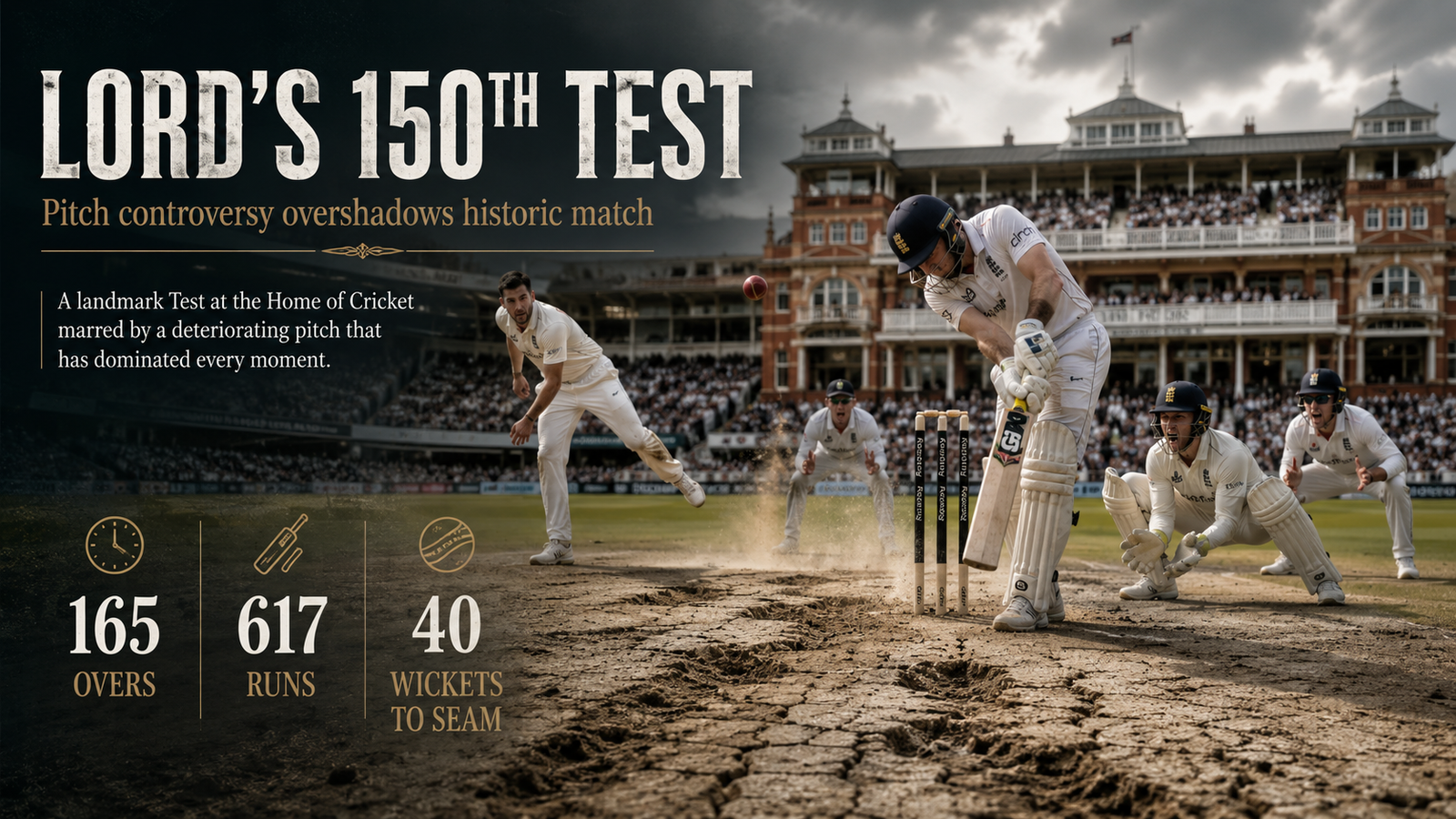
The match lasted only 165 overs. That made it the second-shortest completed Test in Lord’s history, according to Sky Sports. Across four innings, the scores were 140, 113, 226, and 138. Only 617 runs were scored in the entire match. All 40 wickets fell to seam bowling, and not a single over to spin. Thirty-three wickets fell inside the first two days alone, including 17 on day two. For a five-day Test at Lord’s, those numbers are hard to defend.
England’s Harry Brook made 56 in the first innings, while debutant Emilio Gay scored 57 in the second. They were the only two half-centurions in the match. New Zealand’s best batting efforts came from Glenn Phillips, who made 34 and 44, and Devon Conway, who scored 41 in the chase. These were not match-defining innings. They were survival efforts on a pitch where batters never looked settled.
ALSO READ: Pakistan Beat Australia 2-1, and the Pitch Criticism Completely Misses the Point
The MCC later apologized and admitted the pitch showed more variable bounce than expected. England captain Ben Stokes also said the surface was not ideal for Test cricket and warned that such conditions do not help the long-term health of the format.
Nasser Hussain was even more direct on Sky Sports. He called the Lord’s surface “substandard” and “not good enough” for Test cricket after 33 wickets fell in two days. Michael Vaughan also said the MCC would know the pitch had not met the required standard. Stuart Broad took a milder line, saying the pitch was not ideal but still produced entertainment.
Still, the pitch should not hide the batting failures. England and New Zealand batters both showed poor judgment outside off stump, hard hands, loose footwork, and a lack of trust in defense. Too many dismissals came from half-committed strokes. Batters poked instead of leaving, pushed instead of softening their hands, and attacked without control.
Modern Test batting often carries a white-ball hangover. On a moving pitch, that approach gets exposed quickly. Lord’s offered an unfair surface, but it also exposed fragile methods.
Cricket has seen worse pitch-related disasters. The 1998 Jamaica Test between West Indies and England was abandoned after only 10.1 overs because of dangerous bounce. In 2009, the Antigua Test between West Indies and England was abandoned after just 10 balls due to unsafe outfield conditions. Those matches remain rare examples of conditions forcing abandonment.
Lord’s did not reach that extreme, but its 150th Test became a warning. A great venue cannot rely on history alone. The pitch must match the occasion.
Cricket
Jason Holder Propels West Indies to T20I win over Sri Lanka
West Indies opened the T20I series against Sri Lanka with a seven-wicket win at Sabina Park, Kingston, thanks to the heroics of former skipper Jason Holder. However, the scoreline only tells part of the story.
According to The Sports Encounter, this was a match shaped by control, surface reading, and the one familiar Caribbean all-rounder reminding everyone why he still matters in the shortest format.
Jason Holder: Player of the Match Performance
Sri Lanka posted 147 for 9 after choosing to bat, a total that looked competitive only because their bowlers fought hard later in the chase. West Indies reached 149 for 3 in 19.2 overs, with Shai Hope anchoring the pursuit through an unbeaten 65 from 54 balls and Rovman Powell finishing the match with a six. Jason Holder was named Player of the Match after taking 3 for 18 in four overs, the most decisive spell of the night.
Jason Holder’s role was central because he attacked Sri Lanka’s innings at exactly the point where it could have moved beyond West Indies’ control. Pathum Nissanka and Kusal Mendis gave Sri Lanka a fast start, adding 43 in 4.2 overs. Then Holder changed the rhythm with two wickets in two balls, removing Nissanka for 18 and Lasith Croospulle for a first-ball duck. Sri Lanka went from 43 without loss to 43 for 2 in the space of two deliveries.
ALSO READ: Clinical Bangladesh Seal Historic ODI Series Win Over Australia
That short burst did more than damage the scorecard. It disturbed Sri Lanka’s batting order and forced Mendis to rebuild while still carrying the responsibility of keeping the innings moving. In T20 cricket, that is often where matches quietly turn. The scoreboard may still look healthy, but the dressing room starts recalculating. Batters stop playing the next ball freely and start thinking about the next wicket.
How Kusal Mendis Missed His Zalmi Partner
Mendis tried to resist that shift. His 36 from 23 balls included two fours and three sixes, and for a brief period he looked like the one Sri Lankan batter capable of turning a difficult surface into a 165-plus total. Yet his dismissal at 65 for 4 left Sri Lanka with too much repair work. Kamindu Mendis later made 51 from 39 balls, while Dasun Shanaka added 22, but the innings never fully recovered its early bite.

This is where the Babar Azam comparison becomes interesting. Mendis did not simply miss runs. He missed a stabilizing presence at the other end, the kind of partner who allows an aggressive batter to attack without feeling exposed every over.
During PSL 2026, Mendis and Babar built one of the most productive partnerships of the tournament for Peshawar Zalmi. Against Karachi Kings, they put on 191 for the second wicket, the highest partnership for any wicket in PSL history. Mendis scored 109 from 52 balls, while Babar remained unbeaten on 87 from 51.
That partnership mattered because it showed what Mendis looks like when he has trust at the other end. Babar’s value in such stands is rarely only about boundaries. He absorbs pressure, reads match tempo, and gives his partner room to play instinctively. Against West Indies, Mendis had no such cushion after Holder’s double strike. He was captain, wicketkeeper, attacking batter, and stabilizer all at once. That burden narrowed Sri Lanka’s scoring options.
West Indies Back to Merry Old Ways of T20I Cricket
West Indies, by contrast, looked like a side rediscovering the old T20I language that once made them feared around the world. Power still exists in the lineup, but this win was not built on reckless hitting. It was constructed through bowling intelligence, role clarity, and controlled aggression.
Jason Holder explained after the match that he took a close look at the surface before bowling and felt a fuller length would work better than banging the ball in too short. He also said the pitch was two-paced, and his focus was to keep the stumps in play and make Sri Lanka hit him from a good length.
That is the sign of a more mature West Indies T20 setup. The old version often relied on overwhelming batting firepower. This version still has the six-hitting muscle, but it also seems to understand that modern T20I cricket is won through phases. Holder and Shamar Joseph took three wickets each. Roston Chase gave away only 19 runs in four overs and took a wicket. Sri Lanka scored only 25 runs in the last five overs of their innings, which kept the target below the danger zone.
Then came the chase. Brandon King’s 37 from 22 balls gave West Indies the perfect launch. The hosts scored 66 in the powerplay, putting Sri Lanka under pressure before spin could fully settle into the contest. Hope then played the senior batter’s role, even when Sri Lanka dragged the chase deeper than West Indies would have wanted.
Sri Lanka Tried Their Best to Spoil the Party
Sri Lanka deserve credit for making the chase uncomfortable. Wanindu Hasaranga removed King and Shimron Hetmyer, while Maheesh Theekshana conceded only 20 runs in four overs. Eshan Malinga dismissed Chase and kept the pressure alive. At 128 for 3 in the 16.4th over, Sri Lanka still had a small opening.
But West Indies had done enough early. That is the lesson from the match. Jason Holder’s wickets reduced Sri Lanka’s ceiling. King’s powerplay hitting reduced West Indies’ chase pressure. Hope’s unbeaten half-century prevented panic. Powell’s six completed the job.
For Sri Lanka, the concern is clear. Mendis cannot keep carrying multiple roles without deeper batting support. Kamindu showed composure, but Sri Lanka need a top-order partnership that gives their captain space to attack with freedom. The contrast with his PSL chemistry alongside Babar is hard to ignore because it explains the human side of batting partnerships. Some players do not just add runs. They change how safely others can express themselves.
For West Indies, this was more than a series-opening win. It was a signal. Their T20I identity may be returning, but in a sharper, more structured form. Holder gave them control. Hope gave them calm. King gave them speed. The bowlers gave them discipline.
The Caribbean side once ruled T20 cricket through intimidation. At Sabina Park, they showed something more dangerous for future opponents: intimidation backed by method.
The Sports Encounter’s World Cup 2026 coverage focuses on fixtures, team news, match analysis, fan stories, tournament trends, and the biggest talking points from football’s global stage.
Cricket
Clinical Bangladesh Seal Historic ODI Series Win Over Australia
Bangladesh cricket has had famous days before, but this one will sit close to the top of the list, The Sports Encounter reported on Thursday. The home side beat Australia by five wickets in the second One-day International to secure their first-ever ODI series victory over the Aussies, completing a result built on discipline, pressure, calm batting, and a disastrous Australian start that shaped the contest long before the chase reached its final stretch.
Australia lost three wickets before scoring a single run. In a rain-affected match where every phase carried extra weight, that opening collapse became the difference between a competitive total and a target Bangladesh could manage with clarity.
The visitors recovered through a century stand between Marnus Labuschagne and Xavier Bartlett, but that partnership only repaired part of the damage. Once Australia began at 0 for 3, they had already surrendered control of the match. Bangladesh sensed it. The crowd sensed it. Australia, even during their recovery, never fully escaped it.
Bangladesh entered the second ODI with a 1-0 lead after winning the first match by 86 runs via the DLS method, a victory that ended a 20-year wait for an ODI win over Australia. That opening result had already created the possibility of history in Mirpur. The second ODI turned that possibility into reality.
Australia’s 0 for 3 Start Set the Tone
In ODI cricket, early wickets matter. Three wickets before the scoreboard moves can break a batting innings before it has shape.
That is exactly what happened to Australia.
Bangladesh came out sharp, direct, and emotionally switched on. Their new-ball spell carried energy without losing control. The lines were aggressive. The fielders stayed alive. The pressure created mistakes, and Australia quickly found themselves in survival mode.
From that point, the innings changed from construction to repair.
Labuschagne and Bartlett deserve credit for fighting back. Their century partnership gave Australia something to bowl at and prevented a complete collapse. But recovery runs do not always carry the same value as pressure-free runs. Australia had already been forced into caution. The innings lost rhythm. The middle overs became about damage limitation rather than dominance.
That is why the final target, adjusted after rain, felt reachable for Bangladesh. A chase of 192 was never automatic under lights and movement, but it was well within range for a side that had already dominated the series in all three departments.
Bangladesh Faced Early Swing, Then Took Control
Australia began their defense with the kind of new-ball spell that briefly reopened the match.
Xavier Bartlett struck in the first over, removing Tanzid Hasan for a duck. The ball was moving both ways, and Bangladesh captain Najmul Hossain Shanto survived an early LBW scare in the second over after successfully reviewing the umpire’s decision.
For a few overs, Australia had the exact start they needed.
But Bangladesh did not panic.
Shanto and Soumya Sarkar absorbed the movement, picked their moments, and slowly took the sting out of the Australian attack. Their partnership of 86 shifted the match back toward Bangladesh. They did it with judgment, but also with intent. A few boundaries and sixes arrived at the right time, making sure Australia could not settle into a long squeeze.
Soumya’s 42 ended when he attempted a reverse sweep against Matthew Renshaw and was caught at slip. Shanto followed soon after for 41, caught behind while trying to cut Riley Meredith.
For a short period, Australia had a way back.
Hridoy and Miraz Finish the Job
The middle-order wobble gave Australia hope, but Bangladesh had enough composure left.
Mosaddek Hossain and Towhid Hridoy steadied the innings, just as they had done in the first ODI. Adam Zampa removed Mosaddek for 15 when he holed out at long off, but Hridoy refused to let the chase slip into chaos.
His unbeaten 40 was not just a useful score. It was the innings that gave Bangladesh the finish they needed. Alongside skipper Mehidy Hasan Miraz, he kept the chase calm, practical, and professional.
That word matters: professional.
Bangladesh did not treat the moment like a surprise. They did not stumble under the weight of history. They played like a team that expected to win because their cricket across the series had earned that belief.
Clinical Bangladesh, More Questions for Australia
Bangladesh’s biggest statement in this series has been their maturity.

They were exuberant, but not reckless. They were aggressive, but not emotional. They made Australia work for every phase of the game and then punished them whenever the visitors slipped.
Australia improved their fielding from the first ODI, but their bowling faded after the early burst. Once Soumya and Shanto settled, the movement became less threatening and the pressure started to shift. Zampa’s wicket of Mosaddek created another opening, but Australia did not sustain enough pressure to force a full collapse.
Their bigger problem remains the top order.
Three wickets for no runs in an ODI is more than a bad start. It exposes preparation, shot selection, and early-innings clarity. Australia recovered enough to compete, but they never recovered enough to command.
Bangladesh, meanwhile, now have a result that will echo far beyond this series. Beating Australia in a bilateral ODI series for the first time is not a routine home achievement. It is a marker of growth, belief, and execution.
A huge crowd turned up despite it being a working day, and they were rewarded with a piece of history. Bangladesh did not just win the match. They owned the important moments.
Australia began with disaster. Bangladesh ended with history.
Cricket
Ben Stokes’ Captaincy Future Uncertain After Fresh Off-Field Controversy
Ben Stokes has built one of modern cricket’s most powerful leadership stories. He dragged England Test cricket out of caution, gave it courage, and turned a struggling red-ball side into one of the most watchable teams in world cricket.
Now, one night out in London has placed that legacy under uncomfortable pressure.
Stokes and England fast bowler Gus Atkinson were dropped from England’s squad for the second Test against New Zealand after a nightclub incident following England’s win at Lord’s, sources informed TheSportsEncounter. The ECB confirmed an investigation into a breach of team protocols, with reports saying the players broke England’s midnight curfew before an altercation took place at the Rex Rooms nightclub in Chelsea.
Joe Root has been named interim captain, which immediately raises the bigger question: is this a short disciplinary pause, or the beginning of the end for Stokes as England Test captain?
The answer depends on what the ECB investigation finds. But even before any final ruling, the damage is clear.
This is not just about Stokes being present at a nightclub. It is about leadership, timing, repeated history, and England’s public image. A captain does not only lead when the ball is moving under lights or when a chase gets tight on the fifth day. A captain also sets the tone away from the field.
That is where Stokes now faces the toughest scrutiny.
The most serious part of the issue is that England already had discipline concerns around team culture. A midnight curfew had reportedly been introduced after previous off-field problems. If the captain himself is found to have broken that rule, the ECB has a leadership problem, not just a player discipline problem.
Stokes also carries past baggage. His 2017 Bristol nightclub incident remains one of the most famous off-field controversies involving an England cricketer. He was later found not guilty of affray in court, but the ECB still handed him an eight-match ban and a £30,000 fine. He had already missed major cricket during that period, including the 2017-18 Ashes. That history makes this latest episode harder to dismiss as one isolated mistake.
ALSO READ: How Lord’s Pitch Fiasco Exposes Modern-Day Batting Technique
Sky Sports voices have taken a measured view. Nasser Hussain and Michael Atherton both argued that the latest incident should not automatically cost Stokes the captaincy. Hussain’s key point was that Stokes should avoid making an emotional decision. That matters because there is a difference between accountability and panic. England must punish wrongdoing if the investigation confirms it, but they should also avoid destroying one of their most influential modern cricketers over a curfew breach alone.
Still, Stokes has a decision to make.
If he wants to continue as captain, he must show the ECB, his teammates, and England fans that he still has control of the dressing room and himself. The standard for a captain is always higher than the standard for a regular player. Atkinson may receive punishment and move on quickly. Stokes will not get that luxury because he wears the armband.
History shows cricket boards can act strongly when captains bring unwanted attention to the team. Andrew Flintoff was stripped of England’s vice-captaincy during the 2007 World Cup after the infamous “Fredalo” drinking incident. Steve Smith lost Australia’s captaincy and received a ban after the 2018 ball-tampering scandal in Cape Town. Hansie Cronje’s career ended completely after South Africa’s match-fixing scandal in 2000.
Those cases were different in severity, especially Cronje and Smith, because they involved the integrity of cricket itself. But they show one common truth: captaincy can disappear quickly when trust breaks.
Stokes’ case sits in a different category. This is not match-fixing. This is not ball-tampering. There is no confirmed finding yet that he initiated violence. That is why calling for his immediate removal would be premature.
But England cannot ignore the pattern either.
The ECB now has three options. It can fine or reprimand Stokes and restore him after the inquiry. It can suspend him for a limited period and allow Root to continue temporarily. Or it can decide that the leadership has become too unstable and move toward a permanent change.
The smartest route may be the middle one. Stokes should not be sacked before all facts are clear. But he also cannot return as if nothing happened. England need a visible reset: a clear apology if wrongdoing is confirmed, a serious internal review of player discipline, and a firm message that captaincy comes with a higher standard.
For Stokes, this may be the most important innings of his captaincy without a bat in hand.
He has survived pressure before. He has rebuilt his image before. He has produced career-defining moments from chaos before. But this time, the challenge is different. He does not need to hit sixes, bowl through pain, or inspire a dressing room with tactical courage.
He needs to prove judgment.
If he does that, this incident may become another painful chapter in a complicated career. If he fails to do that, England may decide that the Bazball era needs a new captain before the damage spreads further.
For now, Stokes has not lost the captaincy permanently. But for the first time since he took charge, the question feels real.
Stay tuned to The Sports Encounter for more in-depth sports news and analysis.