


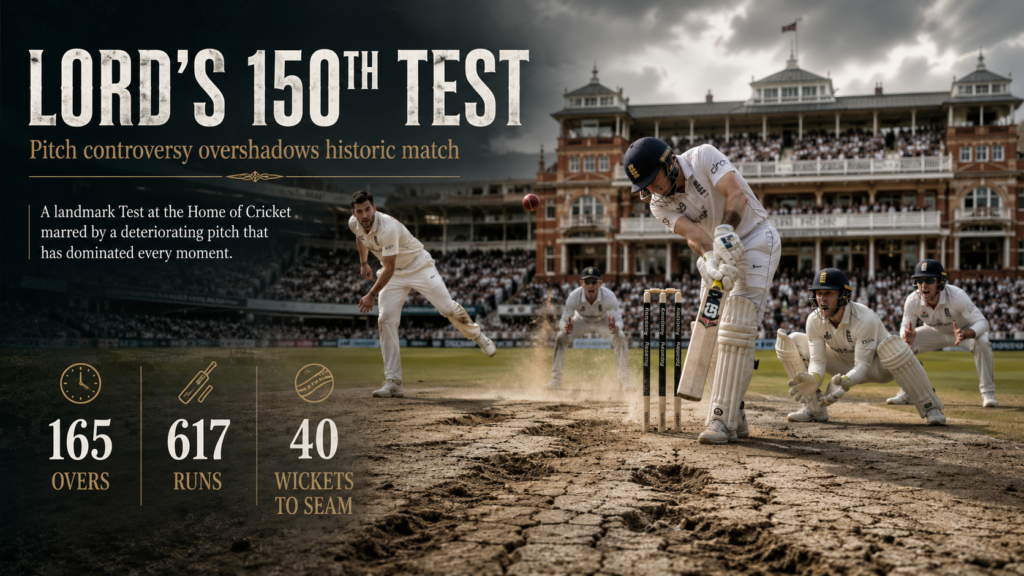
Lord’s marked its 150th Test match with history, but not the kind the Home of Cricket would have wanted. England beat New Zealand by 115 runs in the first Test of the series, yet the match became less about England’s win and more about a pitch that failed the occasion.
This was not just another low-scoring Test. It was Lord’s 150th Test match, the most by any cricket ground in the world. Such a milestone deserved a contest shaped by skill, patience, and pressure. Instead, it produced one of the shortest completed Tests ever staged at the venue.
The match lasted only 165 overs. That made it the second-shortest completed Test in Lord’s history, according to Sky Sports. Across four innings, the scores were 140, 113, 226, and 138. Only 617 runs were scored in the entire match. All 40 wickets fell to seam bowling, and not a single over to spin. Thirty-three wickets fell inside the first two days alone, including 17 on day two. For a five-day Test at Lord’s, those numbers are hard to defend.
England’s Harry Brook made 56 in the first innings, while debutant Emilio Gay scored 57 in the second. They were the only two half-centurions in the match. New Zealand’s best batting efforts came from Glenn Phillips, who made 34 and 44, and Devon Conway, who scored 41 in the chase. These were not match-defining innings. They were survival efforts on a pitch where batters never looked settled.
ALSO READ: Pakistan Beat Australia 2-1, and the Pitch Criticism Completely Misses the Point
The MCC later apologized and admitted the pitch showed more variable bounce than expected. England captain Ben Stokes also said the surface was not ideal for Test cricket and warned that such conditions do not help the long-term health of the format.
Nasser Hussain was even more direct on Sky Sports. He called the Lord’s surface “substandard” and “not good enough” for Test cricket after 33 wickets fell in two days. Michael Vaughan also said the MCC would know the pitch had not met the required standard. Stuart Broad took a milder line, saying the pitch was not ideal but still produced entertainment.
Still, the pitch should not hide the batting failures. England and New Zealand batters both showed poor judgment outside off stump, hard hands, loose footwork, and a lack of trust in defense. Too many dismissals came from half-committed strokes. Batters poked instead of leaving, pushed instead of softening their hands, and attacked without control.
Modern Test batting often carries a white-ball hangover. On a moving pitch, that approach gets exposed quickly. Lord’s offered an unfair surface, but it also exposed fragile methods.
Cricket has seen worse pitch-related disasters. The 1998 Jamaica Test between West Indies and England was abandoned after only 10.1 overs because of dangerous bounce. In 2009, the Antigua Test between West Indies and England was abandoned after just 10 balls due to unsafe outfield conditions. Those matches remain rare examples of conditions forcing abandonment.
Lord’s did not reach that extreme, but its 150th Test became a warning. A great venue cannot rely on history alone. The pitch must match the occasion.