Workload Management: Were Old Fast Bowlers Better at Test Cricket, or Do We Remember Them Differently?
Walsh and Ambrose have reopened cricket’s workload debate, raising a bigger question about skill, endurance, T20 money, and the changing value of Test fast bowling.
Fast bowlers once measured readiness through overs bowled. Modern cricket measures almost every delivery they send down, then decides when they have entered a physical “red zone.”
That change has turned “workload management” into one of cricket’s most disputed terms. It began as a sports-science tool to reduce injuries. Today, many supporters see it as an explanation used whenever a leading quick misses Test cricket but remains available for a lucrative franchise league.
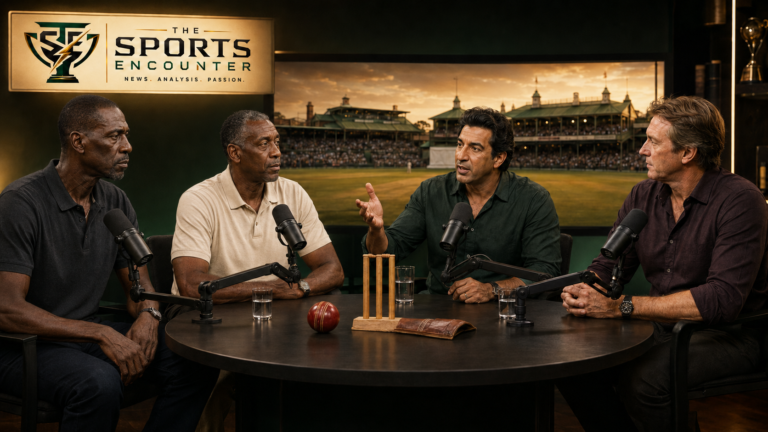
Courtney Walsh and Curtly Ambrose recently challenged the modern approach during their appearance on the Stick to Cricket podcast with Michael Vaughan, Sir Alastair Cook, Phil Tufnell, and David Lloyd. Their comments also raised a deeper question: Were previous generations more skillful and durable in Test cricket, or has nostalgia made their achievements look untouchable?
TL;DR
- Courtney Walsh believes regular bowling maintains match fitness and rhythm.
- Curtly Ambrose said watching from the sidelines when fit would have “destroyed” him.
- Earlier greats developed through sustained red-ball bowling and learned how to build dismissals across long spells.
- T20 leagues offer shorter spells, larger financial rewards, schedule flexibility, and faster global fame.
- Modern bowlers face heavier travel, crowded calendars, aggressive batting, video analysis, and multiple-format demands.
- James Anderson, Stuart Broad, Mitchell Starc, Tim Southee, Kemar Roach, Kagiso Rabada, and Matt Henry challenge the idea that modern bowlers lack Test skill.
- The real generational difference may involve preparation and priorities rather than talent.
Old and Modern Fast Bowlers: Test Career Comparison
Earlier Generation
| Fast Bowler | Country | Tests | Test Wickets | ODIs | Defining Test Qualities |
|---|---|---|---|---|---|
| Courtney Walsh | West Indies | 132 | 519 | 205 | Durability, bounce, control, and long-spell discipline |
| Curtly Ambrose | West Indies | 98 | 405 | 176 | Steep bounce, accuracy, intimidation, and tactical patience |
| Wasim Akram | Pakistan | 104 | 414 | 356 | Conventional swing, reverse swing, seam movement, and variation |
| Waqar Younis | Pakistan | 87 | 373 | 262 | Late reverse swing, pace, yorkers, and relentless stump attacks |
| Glenn McGrath | Australia | 124 | 563 | 250 | Accuracy, seam movement, patience, and batter-specific planning |
Modern Generation
| Fast bowler | Country | Tests | Test wickets | Test status | Defining Test qualities |
|---|---|---|---|---|---|
| James Anderson | England | 188 | 704 | Retired | Swing, seam control, adaptation, and technical efficiency |
| Stuart Broad | England | 167 | 604 | Retired | Seam movement, bounce, competitive instinct, and match-changing spells |
| Tim Southee | New Zealand | 107 | 391 | Retired | Outswing, control, tactical intelligence, and new-ball skill |
| Mitchell Starc | Australia | 105 | 433 | Active | Pace, late swing, yorkers, and old-ball threat |
| Kemar Roach | West Indies | 89 | 300 | Active | Seam movement, accuracy, adaptability, and intelligent use of the crease |
| Trent Boult | New Zealand | 78 | 317 | Limited Test involvement | Left-arm swing, control, angle, and early breakthroughs |
| Kagiso Rabada | South Africa | 73 | 340 | Active | Pace, bounce, aggression, and elite strike rate |
| Matt Henry | New Zealand | 35 | 152 | Active | Seam movement, accuracy, persistent lengths, and new-ball control |
Statistics are updated through July 15, 2026.
Walsh and Ambrose Reject Stop-Start Fast Bowling
Walsh played 132 Tests and 205 ODIs, taking 519 wickets in the longer format. According to the discussion around the podcast, he missed only one Test through injury.
“If you’re going to rest me and bring me back, I’m going to start all over again,” Walsh said. “Once you’re match fit, it’s maintenance.”
His argument centers on rhythm. Fast bowlers condition their bodies by bowling, recover between matches, and learn how to operate when physically tired. Repeatedly removing a healthy bowler can interrupt the very resilience a management team wants to build.
Ambrose offered the player’s emotional perspective.
“I want to win,” he said. “To sit and watch cricket and not be a part of it, that destroys me.”
Walsh also recalled Glenn McGrath saying that interruptions to his playing rhythm were “killing him” toward the end of his career. For that generation, availability formed part of a fast bowler’s reputation.
Were Previous Generations More Skillful?
The old masters developed techniques perfectly suited to Test cricket.
Wasim could swing the ball in either direction and became one of reverse swing’s greatest exponents. Waqar attacked toes and stumps at pace. McGrath dismissed elite batters through control and careful planning. Ambrose generated steep bounce without sacrificing accuracy, while Walsh adjusted his pace and methods as his body changed.
Those bowlers understood how to create a dismissal over several overs. They watched a batter’s footwork, altered their position on the crease, changed the angle, and waited for pressure to produce an error.
Their education came through red-ball cricket. Domestic competitions, county seasons, Tests, and extended spells gave them thousands of deliveries in which to understand fatigue, rhythm, pitch deterioration, and the ageing ball.
The Sports Encounter’s features on Kapil Dev’s influence on Indian fast bowling and Sir Ian Botham’s demanding all-round career offer further examples of players whose skills were shaped by the longer game.
Nostalgia Cannot Explain Everything
Memory favors greatness. Supporters remember Ambrose taking 7 for 1, Wasim producing unplayable swing, Waqar crushing stumps, and McGrath controlling entire sessions. Less effective spells gradually disappear from the conversation.
Modern bowlers face challenges earlier generations never experienced at the same scale. Video analysts study every release point and bowling pattern. Batters attack from the opening session, while improved bats and shorter boundaries punish small errors. Constant travel between international series and franchise competitions also reduces proper preparation time.
T20 bowling involves genuine technical skill. Wide yorkers, slower-ball variations, hard lengths, and rapid tactical adjustments have become essential weapons. However, four high-intensity overs cannot fully prepare someone for a third spell late on the fourth afternoon of a Test.
That gap may explain why older bowlers often looked more complete in the longer format. Their cricketing education gave Test bowling the most time.
Modern Cricket Still Produces Great Test Bowlers
James Anderson and Stuart Broad provide the clearest response to claims that modern bowlers lack durability or red-ball intelligence.
Anderson played 188 Tests and took 704 wickets. Broad collected 604 wickets across 167 matches. Together, they repeatedly adapted their lengths, pace, and tactics while carrying England’s attack through different captains, coaches, and playing styles.
Tim Southee finished with 391 Test wickets, while Kemar Roach recently became only the fifth West Indian to reach 300. The Sports Encounter covered Roach’s milestone during West Indies’ victory over Sri Lanka.
Matt Henry’s Test career developed slowly, yet his recent 11-wicket performance against England showed the value of persistent seam bowling. His rise is examined in our report on New Zealand’s commanding Oval victory.
Rabada’s strike power and Starc’s longevity offer further evidence that today’s game still produces complete Test quicks.
Starc Uses Workload Management to Protect Test Cricket
Mitchell Starc offers the most important counterargument to the idea that workload management always pushes players toward T20 leagues.
When he retired from T20 internationals in 2025, Starc said Test cricket had “always been my highest priority.” He stepped away from the shortest international format to stay fresh for Test assignments and the 2027 ODI World Cup, according to the International Cricket Council.
Starc managed his workload by removing T20Is from his schedule. Test cricket benefited from that decision.
His approach proves that the purpose behind workload management matters as much as the number of overs saved.
T20 Money Has Changed the Career Equation
Franchise cricket offers fast bowlers an attractive bargain: four overs per match, compact tournaments, substantial contracts, and immediate global exposure.
Test cricket can demand 20 overs in a day, another spell the following morning, and five days of physical and mental strain. Flat pitches may offer little assistance, yet the bowler must return and keep working.
The financial gap makes shorter cricket difficult to resist. Tournaments covered through The Sports Encounter’s Lanka Premier League hub provide players with clear roles and defined schedules. Test series offer far less physical certainty.
Trent Boult’s decision to leave New Zealand’s central contract gave him greater control over his availability and access to franchise opportunities. His choice reflected cricket’s changing economy, where players can achieve money and fame without chasing 100 Tests.
Workload Management Needs Credibility
Medical research has found links between sudden increases in bowling volume and injury risk. Cricket would be irresponsible to ignore that evidence.
Supporters lose trust when the policy appears selective. If a bowler is physically unavailable for Test cricket, the same medical caution should follow him into his next franchise tournament.
Earlier fast bowlers may not have possessed more natural ability. They received a deeper education in Test bowling because the longer format stood at the center of their careers.
Modern quicks remain capable of equal greatness. Anderson, Broad, Starc, Southee, Roach, Rabada, and Henry have proved that. The larger question concerns what cricket asks young bowlers to master first: the patient craft of taking 20 wickets or the profitable art of surviving four overs.
Workload management should help fast bowlers build sustainable Test careers. When it mainly clears a path toward the next T20 contract, the term begins to sound like an excuse.
For more international reports, records, and analysis, visit The Sports Encounter’s Cricket hub.
Breaking News
England Punish India’s Batting Collapse as Root Finishes on 99
Joe Root’s unbeaten 99 carried England through a difficult chase after India wasted a strong position and collapsed to 233 all out in Cardiff.
Joe Root had spent almost the entire chase holding England together. When he reached 99 with victory only a stroke away, a familiar hundred appeared inevitable.
Gus Atkinson had other ideas.
A wide followed by Atkinson’s boundary completed England’s four-wicket victory, leaving Root stranded one run short of his century. The personal milestone disappeared, but Root had already secured the result that mattered most. England chased India’s 233 at Sophia Gardens and leveled the three-match ODI series at 1-1.
India’s bowlers made the pursuit uncomfortable after reducing England to 125 for five. Their batters had already surrendered the stronger position, collapsing from 178 for three to 233 all out in 44 overs.
Follow The Sports Encounter’s Cricket Hub for more international match reports, analysis, and breaking cricket news.
TL;DR
- England beat India by four wickets to level the ODI series at 1-1.
- Joe Root anchored the chase with an unbeaten 99.
- Virat Kohli and Shreyas Iyer scored 65 and 66, respectively.
- India collapsed from 178 for three to 233 all out in 44 overs.
- Jofra Archer, Gus Atkinson, and Saqib Mahmood shared eight wickets.
- India’s repeated batting failures remain a serious concern before the Lord’s decider.
England vs India Second ODI Scorecard
| Detail | Information |
|---|---|
| Match | England vs India, 2nd ODI |
| Result | England won by four wickets |
| Venue | Sophia Gardens, Cardiff |
| Date | July 16, 2026 |
| India | 233 all out in 44 overs |
| England | 234 for six |
| Top India Batters | Shreyas Iyer 66, Virat Kohli 65 |
| Top England Batter | Joe Root 99* |
| Top England Bowlers | Jofra Archer 3-47, Gus Atkinson 3-50, Saqib Mahmood 2-52 |
| Turning Point | India lost seven wickets for 55 runs |
| Series Position | Level at 1-1 |
Kohli and Shreyas Put India in Control
India’s innings contained enough stability to support a total near 280.
Shubman Gill made 31 from 30 balls before Atkinson removed him. Rohit Sharma took longer to settle, scoring 26 from 47 deliveries before Will Jacks ended his stay.
Ishan Kishan’s latest failure interrupted India’s recovery. The wicketkeeper-batter managed one from eight balls and offered Sam Curran a return catch, leaving India at 111 for three.
Virat Kohli and Shreyas Iyer then produced India’s strongest phase. Kohli scored 65 from 66 balls, while Shreyas made 66 from 71 deliveries. Their 67-run partnership carried the visitors to 178 for three and created a platform for a strong finish.
Archer’s return changed everything.
He removed Kohli before dismissing Axar Patel and Shivam Dube. Washington Sundar scored two, Axar made one, and Dube fell first ball. India suddenly found themselves 193 for seven.
The same all-rounders who had rescued India during their six-wicket victory in the first ODI at Edgbaston contributed only three runs between them in Cardiff.
England’s Fast Bowlers Take Control
Archer, Atkinson, and Saqib Mahmood refused to let India rebuild.
Archer finished with 3 for 47, while Atkinson collected 3 for 50. Mahmood added 2 for 52 as England’s three frontline fast bowlers shared eight wickets.
Jasprit Bumrah’s unbeaten 20 from 13 balls pushed India beyond 230, but Atkinson dismissed Shreyas and Prasidh Krishna to end the innings after 44 overs.
Those six unused overs mattered. Even a controlled finish could have pushed India toward 260 and placed far greater pressure on England’s unstable top order.
Bumrah Gives India Early Hope
Bumrah removed Ben Duckett with the first delivery of England’s chase. Prasidh Krishna then dismissed Jacob Bethell for four, reducing the hosts to eight for two.
Harry Brook attempted to counterattack but fell to Gurnoor Brar for 16. England reached only 53 for three before Root and Curran began repairing the innings.
Curran made 26, while Jos Buttler contributed 17 before Axar Patel bowled him. At 125 for five, India had created a genuine opening despite their modest total.
Root never allowed the required rate to become a problem. He absorbed Bumrah’s pressure, worked the ball into gaps, and built practical partnerships instead of chasing boundaries.
Will Jacks supported him with 30 from 44 deliveries before Brar removed him at 197 for six. Atkinson then joined Root and quickly closed the remaining distance.
Root reached 99, but Atkinson struck the winning boundary before his senior teammate could complete the century. The moment carried some humor, although Root’s innings had already defined the match.
India’s Bowlers Deserved More Runs
India’s attack competed well throughout the chase.
Bumrah supplied the ideal start and conceded only 38 runs from nine overs. Brar removed Brook and Jacks, while Prasidh, Dube, and Axar claimed one wicket each.
A target around 270 could have turned those breakthroughs into a series-clinching performance. Defending 233 left India with almost no room for a poor over or missed opportunity.
Root understood that equation. He could respect good bowling, accept dot balls, and wait for scoring opportunities because England never faced serious pressure from the required rate.
Ishan Kishan’s Form Demands Attention
Kishan’s one from eight balls continued a difficult tour.
He showed his quality with 56 during England’s series-clinching fifth T20I victory, but his wider body of work remains inconsistent. He also managed only four when India suffered another damaging defeat in Bristol.
His Cardiff dismissal arrived when India needed stability after losing both openers. With KL Rahul available, India must decide whether Kishan remains their best option for the series decider.
India’s Batting Problem Crosses Formats
Cardiff extended a troubling pattern across India’s recent T20I and ODI performances.
They were bowled out for 76 during their record 125-run defeat at Trent Bridge. They then reached only 158 for seven in Bristol before England completed the chase inside 14 overs.
Individual innings have repeatedly prevented worse outcomes. Shreyas carried the batting in Bristol. Kohli and Shreyas provided the substance in Cardiff. Support from the rest of the lineup remains unreliable when wickets begin falling together.
India has a proud tradition of match-changing all-rounders, explored in The Sports Encounter’s feature on Kapil Dev’s influence on Indian cricket. Yet modern balance cannot depend on Axar and Washington repairing every damaged innings.
Lord’s Decider Will Test India’s Response
The series moves to Lord’s on July 19 with both teams carrying clear concerns.
England’s top order remains vulnerable, but Root gave them the control and maturity needed to survive another difficult chase. India’s bowlers showed enough quality to challenge the hosts. Their batters must now provide a defendable total.
The official ICC series schedule confirms that the third ODI will decide the contest.
Root left Cardiff without his century. England left with the series alive. India left facing the same batting questions that have followed them for most of this tour.
Breaking News
Messi Engineers Argentina’s Late Escape as England Falter in Atlanta
Lionel Messi created two late goals as Argentina punished England’s retreat, completed a dramatic 2-1 comeback in Atlanta, and reached the World Cup final against Spain.
England stood five minutes from their first World Cup final since 1966. Nine minutes later, Lionel Messi and Argentina had taken it away.
Enzo Fernández’s spectacular equalizer and Lautaro Martínez’s stoppage-time header overturned Anthony Gordon’s 55th-minute opener as Argentina beat England 2-1 in a fiercely contested FIFA World Cup 2026 semifinal at Atlanta Stadium.
Messi created both Argentine goals. His short-corner combination opened the space for Fernández in the 85th minute before his curling cross found Lautaro in the 92nd.
England had defended bravely, with Jordan Pickford producing several important saves. Yet their decision to protect a one-goal lead for more than half an hour invited a level of pressure they could not sustain.
TL;DR
- Argentina beat England 2-1 in the second FIFA World Cup 2026 semifinal.
- Anthony Gordon gave England the lead in the 55th minute.
- Enzo Fernández equalized with a superb long-range strike in the 85th minute.
- Lionel Messi assisted both Argentine goals, including Lautaro Martínez’s 90+2-minute winner.
- England collected one yellow card, while Argentina received three. No player was sent off.
- Argentina will face Spain in the World Cup final on July 19.
Argentina vs England Semifinal Scorecard
| Detail | Information |
|---|---|
| Match | England vs Argentina |
| Competition | FIFA World Cup 2026 semifinal |
| Final score | England 1-2 Argentina |
| Goalscorers | Anthony Gordon 55’; Enzo Fernández 85’; Lautaro Martínez 90+2’ |
| Venue | Atlanta Stadium, Atlanta, Georgia |
| Date | July 15, 2026 |
| Top performer | Lionel Messi, two assists |
| Turning point | England withdrew after Gordon’s opener and allowed Argentina to control the final half-hour |
| Yellow cards | England: Elliot Anderson; Argentina: Lisandro Martínez, Cristian Romero, Rodrigo De Paul |
| Red cards | None |
| What it means | Argentina advance to face Spain in the July 19 final |
Physical Confrontations Overshadow the First Half
The opening ten minutes contained more confrontation than soccer.
Hard challenges, body contact, arguments, and players surrounding referee Ismail Elfath repeatedly interrupted the flow. Enzo Fernández’s early collision with Elliot Anderson triggered the first major scuffle, setting the tone for a half shaped by fouls and simmering hostility.
Argentina committed 12 of the 19 first-half fouls. Anderson entered the referee’s book after catching Messi, while Lisandro Martínez received Argentina’s first caution. Cristian Romero was also booked later in the match.
Neither side produced a shot on target before halftime. England tried to attack through Gordon and Morgan Rogers, but Argentina crowded the midfield and prevented Jude Bellingham from finding space between the lines.
Messi remained unusually quiet during that period. England’s compact positioning limited his access to the penalty area, while Anderson and Declan Rice worked hard to close the central passing routes.
The teams entered halftime level at 0-0, with the contest balanced but rarely controlled.
Gordon Gives England the Breakthrough
England returned with greater purpose and created the first decisive attacking move of the semifinal.
Rice helped advance the ball before Rogers delivered the final pass into Gordon’s path. The Newcastle forward finished calmly in the 55th minute, giving England a 1-0 lead and placing the country within touching distance of its first men’s World Cup final in 60 years.
The goal should have encouraged England to keep attacking. Instead, it changed their mindset.
Thomas Tuchel’s side began dropping deeper, surrendering territory and asking Pickford and the defense to survive wave after wave of Argentine pressure. Gordon left the field for Ezri Konsa in the 72nd minute as England shifted toward a five-man defensive line.
The change removed one of England’s most effective counterattacking outlets. Argentina could now send more players forward without worrying as much about space behind their defense.
England had already required late interventions from Bellingham to survive Norway in the quarterfinal. Against the defending champions, protecting a narrow advantage carried far greater risk.
Pickford and the Woodwork Delay Argentina
Pickford did everything possible to protect England’s lead.
He denied Julián Álvarez shortly after halftime and produced his best save in the 69th minute, reacting sharply to keep out Nicolás González’s downward header. His positioning and reflexes kept England ahead while Argentina increased the pressure.
The woodwork also came to England’s rescue. Alexis Mac Allister met Rodrigo De Paul’s cross with a stooping header in the 76th minute, only to see the ball strike the post.
Another Mac Allister effort hit the woodwork shortly before Argentina’s winning goal.
Those escapes gave England warnings, but they did not produce a meaningful tactical response. The team remained close to its own penalty area and struggled to retain possession whenever it cleared the ball.
The pattern carried an uncomfortable echo of England’s 2018 semifinal defeat by Croatia. England led that match before losing control, conceding an equalizer, and falling in extra time. In Atlanta, the collapse arrived even faster.
Messi Finds the Openings That England Left Behind
Messi had spent much of the match operating outside its central drama. When England’s concentration began to fade, he took control.
Argentina worked a short corner in the 85th minute. Messi received the return ball and found Fernández in space approximately 25 yards from goal. The midfielder struck a dipping shot beyond Pickford and into the far corner.
The equalizer reflected Argentina’s sustained control, but the defending champions were not interested in waiting for extra time.
Five minutes of normal time had passed when Messi moved beyond Nico O’Reilly on the right. His curling cross reached Lautaro between John Stones and Reece James, and the substitute powered his header home from close range in the 92nd minute.
Argentina had turned the semifinal around in seven minutes.
Rodrigo De Paul received a yellow card during the delayed restart following the winning goal. That caution completed the official disciplinary list at four yellow cards and no dismissals, according to the live match feed. The official FIFA World Cup match center provides the governing body’s tournament results and disciplinary records.
England’s Retreat Brings Another Semifinal Defeat
England’s approach after taking the lead will face intense scrutiny.
The defensive substitutions made tactical sense in isolation, but the collective retreat handed Argentina possession, territory, and repeated opportunities. England stopped playing through midfield and relied on clearances that returned the ball almost immediately.
Harry Kane became isolated. Bellingham could no longer influence attacks, while Gordon’s departure reduced England’s ability to threaten on the break.
Pickford’s saves postponed the problem. They could not solve it.
England had shown resilience throughout the knockout rounds, including their dramatic victories over Mexico in the round of 16 and Norway in the quarterfinal. This time, complacency after taking the lead allowed Argentina to dictate the match’s decisive phase.
Argentina and Spain Set Up the World Cup Final
Argentina now head to New York New Jersey Stadium on July 19 for a final against Spain.
Spain earned their place by beating France 2-0 in the first semifinal, combining defensive discipline with greater control in possession.
Argentina arrive with a different strength. They have repeatedly survived difficult situations, including their extra-time quarterfinal victory over Switzerland.
At 39, Messi remains the player who recognizes the decisive opening before anyone else. England contained him for long periods, but he only needed two moments to reshape the semifinal.
Readers can follow the buildup, confirmed lineups, final result, and tournament analysis through The Sports Encounter’s FIFA World Cup 2026 coverage and wider soccer news and analysis. The tournament’s leading individual performers are also assessed in our ranking of the top 10 players at the FIFA World Cup 2026.
England had the lead and a route to the final. Argentina had Messi, patience, and the courage to keep attacking. In Atlanta, those qualities made the difference.
The Sports Encounter’s World Cup 2026 coverage focuses on fixtures, team news, match analysis, fan stories, tournament trends, and the biggest talking points from football’s global stage.
Breaking News
From Penalty Debate to Total Control: Spain Knock France Out
Spain controlled France from the opening half and won 2-0 through Mikel Oyarzabal and Pedro Porro to reach their first World Cup final since 2010.
France arrived in Dallas chasing a third consecutive World Cup final with Kylian Mbappé and Ousmane Dembélé leading the tournament’s most feared attack. Ninety minutes later, both had been contained, Spain had completed a commanding 2-0 victory, and Didier Deschamps’ side were heading home without finding a convincing response.
Mikel Oyarzabal converted a disputed first-half penalty before Pedro Porro completed a slick passing move in the 58th minute. Spain then defended their advantage with discipline, awareness, and an exceptional performance from goalkeeper Unai Simón.
The result sends La Roja into their second World Cup final and their first since winning the trophy in 2010. They will face the winner of Argentina’s semifinal against England on July 19.
Spain’s victory also confirmed the defensive strength highlighted in our France vs Spain semifinal preview. France possessed the bigger individual names in attack. Spain controlled where, when, and how those players received the ball.
Follow the tournament through The Sports Encounter’s FIFA World Cup 2026 coverage and our broader soccer news and analysis.
TL;DR
- Spain beat France 2-0 in the first FIFA World Cup 2026 semifinal.
- Mikel Oyarzabal converted a 22nd-minute penalty after Lucas Digne caught Lamine Yamal inside the box.
- Pedro Porro doubled Spain’s lead in the 58th minute after combining with Dani Olmo.
- Yamal had a potential third goal disallowed for offside three minutes later.
- Unai Simón repeatedly left his penalty area to deny Mbappé and controlled Spain’s defense superbly.
- Adrien Rabiot, Mbappe and Marc Cucurella received yellow cards. No red cards were issued.
France vs Spain Semifinal Scorecard
| Detail | Information |
|---|---|
| Match | France vs Spain, FIFA World Cup 2026 semifinal |
| Result | Spain won 2-0 |
| Venue | Dallas Stadium, Arlington, Texas |
| Date | July 14, 2026 |
| Goalscorers | Mikel Oyarzabal 22’ penalty, Pedro Porro 58’ |
| Disallowed Goal | Lamine Yamal, 61’, offside |
| Yellow Cards | France: Adrien Rabiot 9’; Kylian Mbappé 86’; Spain: Marc Cucurella 31’, |
| Red Cards | None |
| Top Performer | Unai Simón, commanding goalkeeping and proactive defensive coverage |
| Turning Point | Oyarzabal’s first-half penalty gave Spain control of the semifinal |
| What It Means | Spain reached their first World Cup final since 2010 |
| Next Match | Spain vs Argentina or England, World Cup final, July 19 |
Spain Take Control Before the First Hydration Break
The opening minutes revealed how Spain intended to manage the semifinal. Rodri remained available beneath the first line of French pressure, while Dani Olmo, Fabián Ruiz, and Álex Baena kept offering passing angles between the lines.
France spent long stretches chasing possession. Whenever Deschamps’ midfield moved forward, Spain found the spare player and moved the ball into another area. Their passes carried purpose, and their positioning made the field feel wider than it was.
The breakthrough came in the 22nd minute. Digne misjudged a defensive header and attempted to hook the ball clear without seeing Yamal moving behind him. His raised boot caught the Spanish winger, and referee Iván Barton immediately pointed to the penalty spot.
France protested, with Mbappé appearing to argue that the ball had touched Yamal’s arm before the contact. Barton did not visit the pitchside monitor. However, the VAR team checked the incident and allowed the original decision to stand.
That distinction matters. The referee did not refuse a VAR check altogether. He chose not to conduct an on-field review because the video officials found no clear and obvious error that required intervention.
Debate will continue over whether Yamal deliberately moved into the path of Digne’s attempted clearance. The defender still caught him high inside the penalty area, giving the officials sufficient grounds to uphold the call.
Oyarzabal showed no concern about the controversy. He drove the penalty beyond Mike Maignan to preserve his perfect record across his last six spot kicks and score his fifth goal of the tournament.
France Spend the First Half Chasing Shadows
France needed a quick tactical response after falling behind. Instead, their attacking structure became increasingly disconnected.
Mbappé struggled to receive the ball facing Spain’s goal. Dembélé found little room between the defensive and midfield lines, while Bradley Barcola fired over after choosing a difficult shot instead of using Digne’s overlapping run.
William Saliba’s injury added to France’s problems. The central defender left the field around the half-hour mark, forcing Maxence Lacroix into a semifinal that was already moving at Spain’s pace.
Rabiot’s early yellow card also weakened France’s midfield aggression. Deschamps removed him at halftime after another late challenge placed him at risk of a second booking.
Spain’s possession and pass completion reflected their control, but their movement mattered even more. Olmo repeatedly appeared in pockets France failed to close. Yamal stretched Digne on the right, while Oyarzabal’s positioning occupied both central defenders.
France reached halftime without creating a sustained period of pressure. Mbappé and Dembélé remained peripheral, and Spain looked far more likely to score the next goal.
Pedro Porro Finishes Spain’s Best Move
Spain carried the same authority into the second half. France needed urgency, yet La Roja continued moving the ball with greater clarity.
The second goal arrived in the 58th minute after an attack that briefly appeared to have broken down. Spain recycled possession rather than forcing a hopeful delivery. Porro played a sharp give-and-go with Olmo, broke into the penalty area, and guided his finish past Maignan into the bottom corner.
That sequence captured the difference between the teams. Spain trusted their positioning and combinations. France waited for an individual player to create something outside the normal flow of the game.
Three minutes later, Yamal appeared to make it 3-0 with a curling finish. The offside flag correctly ruled out the goal, offering France a narrow escape from an even heavier semifinal defeat.
Spain’s knockout journey had already shown their patience. A late winner eliminated Portugal before another composed performance carried them past Belgium, detailed in our report on Spain’s quarterfinal victory over Belgium. Against France, that patience developed into complete tactical control.
Unai Simón Plays the Semifinal as Spain’s Extra Defender
Spain’s defense deserved as much credit as the goalscorers. Cucurella, Aymeric Laporte, Pau Cubarsí, and Porro tracked France’s runners closely, denied central spaces, and rarely allowed Mbappé or Dembélé to receive the ball in comfortable positions.
Simón completed the structure behind them.
The Spanish goalkeeper repeatedly recognized danger before France could turn it into a shot. His best first-half intervention came when Rabiot released Mbappé through the middle. Simón raced beyond his penalty area and cleared the ball with perfect timing.
Similar decisions followed after halftime. He attacked through balls, claimed crosses, and narrowed angles whenever France threatened to move behind Spain’s back line.
Mbappé forced him into action from a tight angle during France’s brief spell of second-half pressure. Simón stayed composed and protected the clean sheet.
His performance combined goalkeeping, anticipation, and defensive leadership. Spain’s high line could operate confidently because their goalkeeper read the space behind it so well. That complete awareness made him the strongest candidate for Player of the Match.
France’s Biggest Weapons Find No Space
Mbappé entered the semifinal level with Lionel Messi on eight goals in the Golden Boot race. Dembélé had scored in France’s 2-0 quarterfinal win over Morocco. Neither player could influence this match consistently.
Spain surrounded Mbappé whenever he moved inside and trusted Porro to follow him when he drifted wide. Dembélé faced similar pressure, with Rodri and Ruiz denying the central combinations France usually use to accelerate attacks.
Deschamps introduced Désiré Doué and Manu Koné, but the substitutions did not change the underlying problem. France lacked coordinated movement around the ball. Their most dangerous players kept receiving possession in crowded or unfavorable areas.
For the first time since their 2-0 group-stage defeat against Mexico in 2010, France lost a World Cup match by a two-goal margin. Their previous knockout exits had been decided by one goal, extra time, or penalties.
Spain Return to the World Cup Final
Spain’s route to the final has grown stronger with every knockout round. They eliminated Portugal through late discipline, survived Belgium’s attacking threat, and then produced their most complete performance against the world’s top-ranked team.
The same control that ended Cristiano Ronaldo and Portugal’s World Cup run now carried Spain past Mbappé and France.
Luis de la Fuente’s side will enter the final with six clean sheets from seven matches, a midfield capable of controlling tempo, and enough variety to score through forwards, midfielders, or advancing defenders.
France leave Dallas with a far less comfortable assessment. Their run to the semifinal confirmed their depth and quality, but Spain exposed how dependent their attack remains on isolated moments from elite individuals.
La Roja played with the stronger structure, sharper awareness, and greater collective confidence. A place in the World Cup final became the natural reward.