GUWAHATI, India, September 30, 2026: West Indies made 405 for seven.
Three of their batters scored centuries.
They produced the highest ODI total in their history.
And they still lost with 39 balls remaining.
Story at a glance

India vs West Indies 2nd ODI at a Glance
Three days earlier, India had already chased 296 with eight wickets and 50 balls remaining as Gill and Virat Kohli dominated the first ODI. The Sports Encounter’s first ODI report showed how Kuldeep Yadav first changed West Indies’ innings before India’s top order made the chase look comfortable. The Sports Encounter
West Indies Did Almost Everything a Batting Side Could Ask
There is danger in viewing 405 for seven only through the lens of the defeat.
Shai Hope’s Reprieves Became Expensive
India had opportunities to stop the innings much earlier.
Amir Jangoo Turned a Strong Total Into West Indies History
Jangoo produced the sharpest acceleration of the West Indies innings.
Kuldeep Yadav Reached 200 ODI Wickets on a Day Built Against Bowlers
Almost every bowler suffered.
That sentence captures how extraordinary, and how uncomfortable for bowlers, the second India-West Indies ODI became at Barsapara Cricket Stadium.
Shubman Gill produced one of the most destructive chases in ODI history, finishing unbeaten on 223 from 133 balls as India reached 406 for two in only 43.3 overs to win by eight wickets and take an unassailable 2-0 lead in the three-match series.
Rohit Sharma contributed 101 from 75 balls and crossed 12,000 ODI runs along the way.
Earlier, John Campbell made 101, Shai Hope 104 and Amir Jangoo 114 as West Indies became one of the rare teams in ODI history to produce three centurions in the same innings.
Five centuries.
811 runs.
Nine wickets in 93.3 overs.
One successful chase above 400.
The batting was exceptional.
The pitch deserves a separate conversation.
India vs West Indies 2nd ODI at a Glance
| Detail | Information |
|---|---|
| Match | India vs West Indies, 2nd ODI |
| Date | September 30, 2026 |
| Venue | Barsapara Cricket Stadium, Guwahati |
| Toss | India won and fielded |
| West Indies | 405/7 in 50 overs |
| India | 406/2 in 43.3 overs |
| Result | India won by eight wickets |
| Balls Remaining | 39 |
| Series | India lead 2-0, series won |
| Top West Indies Batter | Amir Jangoo, 114 |
| Top India Batter | Shubman Gill, 223* |
| Major Partnership | Gill and Rohit, 255 for the first wicket |
| Central Story | India chased 406 as Gill made an ODI double century |
Three days earlier, India had already chased 296 with eight wickets and 50 balls remaining as Gill and Virat Kohli dominated the first ODI. The Sports Encounter’s first ODI report showed how Kuldeep Yadav first changed West Indies’ innings before India’s top order made the chase look comfortable. The Sports Encounter
Guwahati removed even the illusion of balance.
West Indies Did Almost Everything a Batting Side Could Ask
There is danger in viewing 405 for seven only through the lens of the defeat.
West Indies batted superbly.
Keacy Carty fell early, but Campbell ensured India could not build pressure.
The left-hander reached fifty quickly and then completed a century that gave West Indies control of the first half of the innings.
By the time he fell, the visitors were already scoring at a rate that suggested 350 would be the minimum acceptable total.
Shai Hope’s Reprieves Became Expensive
India had opportunities to stop the innings much earlier.
Hope survived two chances and then used the second life well.
The West Indies captain moved from consolidation into acceleration and eventually reached 104.
His partnership with Jangoo became the innings’ defining phase.
The pair added 182 for the third wicket.
At 301 for two in the 38th over, West Indies were no longer thinking about 350.
Four hundred had become realistic.
Amir Jangoo Turned a Strong Total Into West Indies History
Jangoo produced the sharpest acceleration of the West Indies innings.
He transformed a promising platform into a historic total, finishing with 114 from 77 balls.
That innings helped push West Indies beyond 400 for the first time in ODI cricket.
For most teams, three centuries and a total above 400 would produce a victory.
Guwahati made it look inadequate.
Kuldeep Yadav Reached 200 ODI Wickets on a Day Built Against Bowlers
Almost every bowler suffered.
Kuldeep still found a milestone.
He dismissed Shai Hope and Keemo Paul to finish with two wickets and reach 200 ODI wickets.
That achievement continued an excellent run for Kuldeep in this series after he had already played the central bowling role in India’s first ODI victory over West Indies.
The wider bowling figures were brutal.
Anything fractionally short sat up.
Full balls travelled.
The outfield rewarded timing immediately.
Was 405 Actually Enough on This Pitch?
That sounds absurd.
It was not.
The question started changing almost immediately when India began their chase.
Rohit Sharma and Gill attacked the target rather than merely keeping pace with it.
By the 21st over they had passed 200.
By the 25th over India were around 250 without loss.
West Indies had gone from defending the highest ODI score in their history to searching for any way to slow down one of the most violent chases the format has seen.
This was not a late assault.
India dismantled the target from the beginning.
Rohit Sharma Makes 406 Look Ordinary
Rohit’s hundred risks becoming a footnote because of what Gill did beside him.
It should not.
His 101 from 75 balls gave India the kind of start that makes even a 400-plus chase psychologically manageable.
He also crossed 12,000 ODI runs, adding another milestone to a career already filled with them.
His partnership with Gill reached 255 before he was dismissed.
India were 255 for one after just over 26 overs.
The match was effectively already broken.
The contrast with India’s recent ODI series in England is striking.
At Lord’s, Rohit made 138, Gill 77 and Kohli 74, yet India still fell short of 388. The Sports Encounter’s report, Rohit and Kohli Fight, but England’s 387 Proves Too Much at Lord’s, showed how one large target can become suffocating when wickets interrupt momentum. The Sports Encounter
Against West Indies, India barely allowed interruption to exist.
Shubman Gill Goes From Century to History
Gill reached fifty without ever appearing rushed.
Then he accelerated.
His hundred came in 62 balls.
After Rohit’s dismissal, the tempo hardly changed.
Gill kept driving through cover, punishing width and using the short boundaries intelligently.
By the time Kohli departed for 29, the chase had become a matter of timing rather than survival.
Gill moved through 150, then toward 200, while West Indies simply ran out of ways to slow him.
He eventually finished on 223 not out from 133 balls.
The innings contained 26 fours and eight sixes.
It was his second ODI double hundred and one of the most dominant chases by an Indian captain.
Gill’s ODI Progression Has Become Impossible to Ignore
Only a few months ago, India were still searching for consistency in difficult ODI chases.
Gill made 80 before retiring hurt in India’s first ODI victory over England, covered by TSE in England’s Reckless Batting Opens the Door for Axar Patel and India. The Sports Encounter
He then made 31 when India collapsed in Cardiff.
At Lord’s, his 77 kept India alive but could not finish the chase.
Against West Indies, the progression was obvious.
A century in the first ODI.
A double century in the second.
India are no longer asking Gill merely to stabilize chases.
Their captain is now destroying them.
Five Centuries Made the Match Look Like a Batting Exhibition
The most unusual feature of the contest was not only the total.
It was the century distribution.
West Indies:
- John Campbell, 101
- Shai Hope, 104
- Amir Jangoo, 114
India:
- Rohit Sharma, 101
- Shubman Gill, 223*
That meant five different batters reached three figures in one ODI.
West Indies had three centurions in the same innings and still lost.
That fact alone places the match among the strangest high-scoring ODIs of the modern era.
TSE’s A Celebration of 5000 ODIs series has repeatedly shown how the format’s greatest matches are often defined by the relationship between pressure and possibility. The Guwahati game belonged to the opposite extreme: almost every batting possibility was available. The Sports Encounter
The Pitch Debate Cannot Be Avoided
There are two ways to look at Guwahati.
The first celebrates elite batting.
Campbell attacked brilliantly.
Hope controlled the middle overs.
Jangoo accelerated with skill.
Rohit constructed a high-speed century.
Gill produced an innings few batters in the world could replicate.
None of those achievements should be dismissed because the surface was flat.
The second view asks whether the contest between bat and ball had become too unequal.
That question is equally legitimate.
The final numbers tell the story:
| Match Measure | Total |
|---|---|
| Runs | 811 |
| Wickets | 9 |
| Individual Centuries | 5 |
| Team Totals Above 400 | 2 |
| India’s Wickets Lost | 2 |
| Balls Remaining | 39 |
Calling the surface a “road” is cricket shorthand.
The underlying criticism is harder to dismiss.
When 405 becomes defendable only in theory, bowlers risk becoming delivery machines rather than equal participants in the contest.
Why the Pitch Question Matters Beyond One Spectacle
High-scoring cricket has obvious appeal.
Boundaries create noise.
Centuries create highlights.
Record chases attract global attention.
But 50-over cricket works best when batters must solve different phases.
New-ball movement.
Middle-over spin.
Reverse swing.
Changing pace.
Pressure created by dot balls.
There was very little of that in Guwahati.
The surface did not create the records by itself.
It made record-breaking considerably easier.
That distinction matters.
West Indies Cannot Simply Blame the Pitch
The visitors deserve sympathy.
They should not receive an excuse.
Both teams used the same surface.
West Indies had a historic batting day but then bowled too many deliveries into India’s strongest scoring zones.
Jayden Seales removed Rohit.
Shamar Joseph dismissed Kohli.
Nobody found Gill.
That is the larger concern.
A flat pitch can explain why a total gets chased.
It cannot fully explain why 406 was chased with 39 balls remaining.
Complete Scorecard
West Indies Batting: 405/7 in 50 Overs
| Batter | Dismissal | R | B | 4s | 6s | SR |
|---|---|---|---|---|---|---|
| John Campbell | c Naman Dhir b Gurnoor Brar | 101 | 68 | 9 | 5 | 148.52 |
| Keacy Carty | c Naman Dhir b Prasidh Krishna | 9 | 10 | 2 | 0 | 90.00 |
| Shai Hope (c/wk) | c Auqib Nabi b Kuldeep Yadav | 104 | 94 | 8 | 3 | 110.63 |
| Amir Jangoo | c Ruturaj Gaikwad b Ravindra Jadeja | 114 | 77 | 13 | 3 | 148.05 |
| Sherfane Rutherford | c sub b Gurnoor Brar | 0 | 1 | 0 | 0 | 0.00 |
| Roston Chase | not out | 29 | 25 | 4 | 0 | 116.00 |
| Keemo Paul | c Virat Kohli b Kuldeep Yadav | 3 | 8 | 0 | 0 | 37.50 |
| Alzarri Joseph | c Rohit Sharma b Ravindra Jadeja | 8 | 10 | 1 | 0 | 80.00 |
| Shamar Joseph | not out | 14 | 8 | 1 | 1 | 175.00 |
Extras: 23
Total: 405/7 in 50 overs
India Bowling
| Bowler | O | M | R | W | Econ |
|---|---|---|---|---|---|
| Prasidh Krishna | 5 | 0 | 45 | 1 | 9.00 |
| Auqib Nabi | 8.5 | 0 | 84 | 0 | 9.50 |
| Gurnoor Brar | 10 | 0 | 96 | 2 | 9.60 |
| Naman Dhir | 6.1 | 0 | 38 | 0 | 6.16 |
| Ravindra Jadeja | 10 | 0 | 75 | 2 | 7.50 |
| Kuldeep Yadav | 10 | 0 | 65 | 2 | 6.50 |
India Batting: 406/2 in 43.3 Overs
| Batter | Dismissal | R | B | 4s | 6s | SR |
|---|---|---|---|---|---|---|
| Rohit Sharma | lbw b Jayden Seales | 101 | 75 | 10 | 6 | 134.67 |
| Shubman Gill (c) | not out | 223 | 133 | 26 | 8 | 167.67 |
| Virat Kohli | c Sherfane Rutherford b Shamar Joseph | 29 | 19 | 3 | 1 | 152.63 |
| Ruturaj Gaikwad | not out | 31 | 37 | 83.78 |
Extras: 22
Total: 406/2 in 43.3 overs
West Indies Bowling
| Bowler | O | M | R | W | Econ |
|---|---|---|---|---|---|
| Jayden Seales | 8 | 0 | 78 | 1 | 9.75 |
| Alzarri Joseph | 8 | 0 | 89 | 0 | 11.12 |
| Shamar Joseph | 6 | 0 | 52 | 1 | 8.67 |
| Keemo Paul | 3 | 0 | 49 | 0 | 16.33 |
| Roston Chase | 8.3 | 0 | 63 | 0 | 7.41 |
| Vitel Lawes | 10 | 0 | 73 | 0 | 7.30 |
What Does the Win Mean for the Series?
India now lead the three-match series 2-0 and have secured it with one game remaining.
The third ODI will be played on October 3.
West Indies have lost the series, but their batting performance gives them far more to work with than the result alone suggests.
Campbell is attacking confidently.
Hope remains the middle-order reference point.
Jangoo has now produced a major innings.
The bowling attack remains the larger concern.
India’s 2027 World Cup Picture Is Becoming Clearer at the Top
India still have selection questions elsewhere.
The top order is becoming less complicated.
Gill is captain and has consecutive hundreds in this series.
Rohit has just made another ODI century.
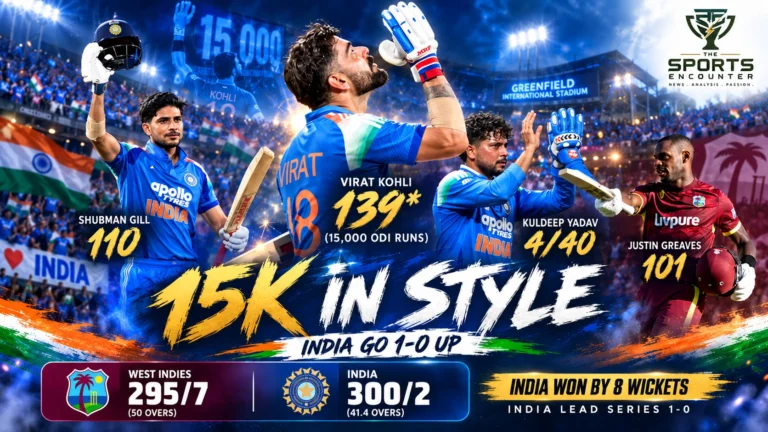
Kohli scored an unbeaten 139 in the first game and crossed 15,000 ODI runs.
For a side building toward the 2027 World Cup, that blend of experience and Gill’s prime years is becoming an obvious strength.
The Sports Encounter has already tracked that evolution across India’s recent ODI campaign.
At Edgbaston, Gill’s injury interrupted his innings before Axar Patel finished the chase. The Sports Encounter
At Lord’s, the top order kept India alive but could not quite overcome 387. The Sports Encounter
Against West Indies, the same batting core has made two consecutive chases look increasingly routine.
Final Verdict: Gill Made History, but the Pitch Made Bowlers Almost Irrelevant
There is no reason to diminish Shubman Gill’s 223.
It was spectacular.
He read the chase perfectly, accelerated without losing shape and produced an innings worthy of every headline it receives.
Rohit’s 101 was another elite performance.
Campbell, Hope and Jangoo made centuries worthy of winning almost any other ODI.
That is exactly why the final result raises a legitimate question.
If five centuries and 811 runs can fit into one 93.3-over match while only nine wickets fall, has the competitive balance moved too far?
A great pitch should reward good batting.
It should also give great bowling a chance.
Guwahati gave us history.
It gave us spectacle.
It gave us records almost by the over.
Whether it gave us enough of a contest between bat and ball is much harder to defend.
Continue the Cricket Story
 CricketVirat Kohli Becomes Fastest to 15,000 Runs as Kuldeep Yadav Pegs Back West Indies in the First ODI
 CricketAsian Games Cricket Semifinals: Pakistan-Bangladesh, India-Sri Lanka, Weather, Squads, and Washout Rules
 A Celebration of 5000 ODIsA Celebration of 5000 ODIs Match 38: India Rise From 5/3, but Guptill’s Direct Hit Sends New Zealand Back to the World Cup Final
FAQs
How Many Runs Did Shubman Gill Score in the Second ODI Against West Indies?
Gill scored an unbeaten 223 from 133 balls, with 26 fours and eight sixes.
How Many Centuries Were Scored in the Match?
Five. John Campbell, Shai Hope and Amir Jangoo scored centuries for West Indies, while Rohit Sharma and Shubman Gill reached three figures for India.
What Was West Indies’ Score?
West Indies made 405 for seven in 50 overs.
What Was India’s Target?
India needed 406 and reached 406 for two in 43.3 overs.
How Big Was Rohit Sharma and Shubman Gill’s Opening Partnership?
They added 255 runs for the first wicket.
What Record Did Rohit Sharma Reach?
Rohit crossed 12,000 ODI runs and scored another century.
How Many ODI Wickets Does Kuldeep Yadav Have?
Kuldeep reached 200 ODI wickets during the match.
Has India Won the ODI Series?
Yes. India lead the three-match series 2-0 with one game remaining.
Why Was the Guwahati Pitch Criticized?
The surface offered very little help to bowlers. The match produced 811 runs, five centuries and only nine wickets, while India chased 406 with 39 balls unused.
Shubman Gill
- Shubman Gill’s 223 Turns 406 Into a Cruise as Five Centuries Expose Guwahati’s Batting ‘Road’
- Virat Kohli Becomes Fastest to 15,000 Runs as Kuldeep Yadav Pegs Back West Indies in the First ODI
- Sri Lanka Avoid Innings Defeat as Sooriyabandara Leads Colombo Fightback
- England’s Reckless Batting Opens the Door for Axar Patel and India