
KINGSTON, Jamaica, May 20, 2006: India needed two runs from three balls. Yuvraj Singh had just struck consecutive boundaries, dragging his side back from the brink of defeat against West Indies at Sabina Park. Dwayne Bravo, entrusted with the final over after conceding 20 runs in his previous three, had one last opportunity to rescue a match that appeared to have slipped away.
Bravo delivered a disguised slower ball. Yuvraj, advancing and attempting to work it toward the leg side, was beaten completely. The ball struck his stumps. India were dismissed for 197 chasing 199, and West Indies had won by one run with two deliveries remaining. The dismissal ended India’s remarkable streak of 17 consecutive successful ODI run chases and brought the five-match series level at 1-1.
Key Takeaways
- India needed 11 runs from the final over, with Yuvraj and No. 11 Munaf Patel at the crease.
- India’s reply began with Virender Sehwag and Rahul Dravid.
- The 2006 Kingston encounter deserves its place among the great One-Day Internationals because the contest changed direction repeatedly.
- For most of the day, Sarwan’s unbeaten 98 and West Indies’ disciplined bowling had kept the contest alive.
This extraordinary encounter earns Match 78 status in The Sports Encounter’s A Celebration of 5000 ODIs, our series examining 100 unforgettable men’s One-Day Internationals.
Story at a glance

Ramnaresh Sarwan’s 98* Rescues West Indies From 1/2
The circumstances behind West Indies’ eventual victory make the result even more remarkable.
Marlon Samuels and Carlton Baugh Provide Critical Support
Sarwan’s innings would have been far less effective without important contributions from the lower middle order.
Irfan Pathan’s 3/45 Gives India an Early Advantage
Irfan Pathan was India’s leading wicket-taker.
Ajit Agarkar and India’s Supporting Bowlers Maintain the Pressure
Ajit Agarkar produced India’s most economical substantial spell.
Ian Bradshaw’s 3/33 Puts India Under Immediate Pressure
India’s reply began with Virender Sehwag and Rahul Dravid.
Its place in the collection rests on more than the final margin. West Indies had recovered from 1/2 to reach 198/9, India had collapsed to 60/4, and Yuvraj’s defiant 93 had almost turned a losing chase into another remarkable victory. The decisive delivery reversed the contest again, producing one of the most memorable finishes of the decade.
West Indies vs India 2006: Match Summary
| Match detail | Information |
|---|---|
| Match | West Indies vs India, 2nd ODI |
| Date | May 20, 2006 |
| Venue | Sabina Park, Kingston, Jamaica |
| Series | India tour of West Indies, 2006 |
| Toss | India won and elected to field |
| West Indies | 198/9 in 50 overs |
| India | 197 all out in 49.4 overs |
| Result | West Indies won by one run |
| Player of the Match | Ramnaresh Sarwan |
| West Indies’ leading batter | Ramnaresh Sarwan, 98* |
| India’s leading batter | Yuvraj Singh, 93 |
| Best West Indies bowling | Ian Bradshaw, 3/33 |
| Best India bowling | Irfan Pathan, 3/45 |
| Decisive wicket | Yuvraj Singh b Dwayne Bravo |
| Series position afterward | Level 1-1 |
How Dwayne Bravo Turned India’s Final Over Into a One-Run Defeat
India needed 11 runs from the final over, with Yuvraj and No. 11 Munaf Patel at the crease.
Munaf took a single from the opening delivery. Yuvraj then hit two consecutive fours, one from a top edge that cleared the wicketkeeper and another through the covers.
The equation became two runs from three balls.
West Indies were suddenly defending a margin so small that a single mistimed delivery could have decided the game against them.
Bravo changed his pace for the fourth ball. Yuvraj failed to adjust and was bowled for 93.
That final delivery ended the innings at 49.4 overs. It was not the sixth ball of the over, as some retrospective summaries have incorrectly suggested.
Ramnaresh Sarwan’s 98* Rescues West Indies From 1/2
The circumstances behind West Indies’ eventual victory make the result even more remarkable.
India captain Rahul Dravid chose to bowl first, and his seamers immediately justified the decision.
Chris Gayle fell for a duck, caught by MS Dhoni off Ajit Agarkar.
Runako Morton was trapped lbw by Irfan Pathan for one.
West Indies were 1/2 after 2.2 overs.
Captain Brian Lara then joined Ramnaresh Sarwan, but India continued to dominate.
Pathan dismissed Lara for 14, leaving West Indies 24/3.
Harbhajan Singh removed Shivnarine Chanderpaul for ten.
At 43/4 after 19 overs, the hosts faced the possibility of being dismissed for a total considerably below 150.
Sarwan refused to let the innings collapse completely.
He combined cautious defense with selective attacking strokes, working through the middle overs while his teammates struggled to establish themselves.
The right-hander eventually finished unbeaten on 98 from 138 deliveries, including seven fours and one six.
His strike rate of 71.01 reflected the difficult conditions and the responsibility he carried.
Sarwan remained at the crease for almost the entire innings, contributing 49.5% of West Indies’ final total of 198.
That proportion is the most revealing statistic of the innings.
Nearly half of the team’s runs came from one batter operating under sustained pressure.
His unbeaten 98 later earned him the official Player of the Match award.
Marlon Samuels and Carlton Baugh Provide Critical Support
Sarwan’s innings would have been far less effective without important contributions from the lower middle order.
Marlon Samuels scored 19 from 53 deliveries.
The innings was slow, but it helped West Indies avoid another immediate collapse after Chanderpaul’s dismissal.
Sarwan and Samuels rebuilt the innings from 43/4 to 103/5.
Their partnership added 60 runs.
Samuels eventually fell to Yuvraj Singh, caught behind by Dhoni.
Dwayne Bravo then departed for a duck, caught by Suresh Raina off Ramesh Powar.
West Indies were 105/6 after 35.5 overs.
Once again, India appeared to have the contest under control.
Carlton Baugh changed the tempo.
The wicketkeeper scored 21 from 17 deliveries, striking four boundaries.
His contribution helped West Indies reach 143/7 by the end of the 42nd over.
Ian Bradshaw added 12, while Jerome Taylor contributed nine.
Neither innings was substantial, but their runs mattered enormously in a match ultimately decided by one.
West Indies reached 198/9 from their 50 overs.
At the time, the total appeared vulnerable against an Indian batting lineup renowned for chasing targets.
Irfan Pathan’s 3/45 Gives India an Early Advantage
Irfan Pathan was India’s leading wicket-taker.
He finished with 3/45 from nine overs, including two maidens.
His opening spell removed Morton and Lara, helping reduce West Indies to 24/3.
He later returned to dismiss Bradshaw.
Those three wickets disrupted West Indies at different stages of the innings.
Pathan’s left-arm seam bowling was particularly effective early, when the conditions offered assistance and the hosts were struggling to establish momentum.
His performance gave India an opportunity to restrict the target to considerably less than 200.
However, Sarwan’s resistance prevented India from completing the job.
Pathan still deserved considerable credit for helping create a manageable chase.
Ajit Agarkar and India’s Supporting Bowlers Maintain the Pressure
Ajit Agarkar produced India’s most economical substantial spell.
He took 2/25 from ten overs, including two maidens.
His economy rate of 2.50 was outstanding in a format where batters were increasingly expected to score at close to five runs per over or more.
Agarkar removed Gayle and Jerome Taylor.
Harbhajan Singh contributed 1/32 from ten overs, dismissing Chanderpaul.
Powar took 2/38, removing Bravo and Baugh.
Yuvraj also contributed with the ball, claiming 1/17 from four overs.
India’s bowling performance was collectively strong.
No West Indies batter apart from Sarwan reached 25.
The hosts finished with a total that appeared unlikely to withstand India’s batting depth.
Yet the conditions, the early breakthroughs and West Indies’ discipline turned a relatively modest chase into an absorbing contest.
Ian Bradshaw’s 3/33 Puts India Under Immediate Pressure
India’s reply began with Virender Sehwag and Rahul Dravid.
West Indies needed early wickets to make 198 competitive.
Ian Bradshaw delivered them.
He dismissed Sehwag for 12, caught by substitute Dwayne Smith.
Dravid followed for 11, caught behind by Carlton Baugh.
India were 37/2 after 9.1 overs.
Bradshaw’s ability to move the ball and maintain a disciplined line prevented the openers from establishing a comfortable platform.
Irfan Pathan, promoted to No. 3, contributed 14 before Fidel Edwards dismissed him.
India were 51/3.
Mohammad Kaif then fell for four to Jerome Taylor.
At 60/4 after 17 overs, the chase had become considerably more difficult than the target suggested.
Bradshaw eventually finished with 3/33 from ten overs.
He later dismissed Agarkar, ending another attempted recovery.
His three wickets represented the foundation of West Indies’ defense.
Although the final delivery became the defining image of the match, Bradshaw’s earlier work made that moment possible.
Yuvraj Singh’s 93 Almost Extends India’s Winning Streak
Yuvraj Singh produced one of the most determined innings of his ODI career.
He scored 93 from 121 balls, striking eight fours and one six.
His innings began under severe pressure.
India had lost three wickets for 51 runs, and the scoring rate was struggling to match even the relatively modest target.
Yuvraj initially concentrated on rebuilding.
He worked with Suresh Raina, who contributed 27 from 55 deliveries.
Their fifth-wicket partnership added 64 runs, advancing India from 60/4 to 124/5.
It was India’s largest partnership of the innings.
The stand also restored some confidence to the chase.
However, Samuels dismissed Raina with India still requiring 75 runs.
The wicket reopened the contest.
MS Dhoni then fell for two.
Agarkar also managed only two.
India slipped to 134/7 after 38.5 overs.
Yuvraj was now responsible for almost the entire chase.
He continued accumulating runs while attempting to manage the tail.
Powar’s 12 helped India advance to 177/8.
Harbhajan Singh contributed one before Chris Gayle dismissed him at 187/9.
Munaf Patel joined Yuvraj with India needing another 12 runs.
The match appeared to favor West Indies.
Then Yuvraj launched his final assault.
His successive fours against Bravo reduced the requirement to two from three balls.
For a brief moment, India appeared certain to extend its extraordinary chasing record.
Yuvraj Singh’s Innings in Perspective
| Measure | Performance |
|---|---|
| Runs | 93 |
| Balls | 121 |
| Fours | 8 |
| Sixes | 1 |
| Strike rate | 76.86 |
| India at his arrival | 37/2 |
| India at his dismissal | 197 all out |
| Partnership with Raina | 64 |
| Final dismissal | Bowled by Bravo |
| Runs still required | 2 |
Yuvraj contributed approximately 47.2% of India’s final total.
His innings closely resembled Sarwan’s contribution for West Indies.
Both batters carried their teams after early collapses.
Both faced more than 120 deliveries.
Both finished in the nineties.
The difference was that Sarwan remained unbeaten, while Yuvraj fell with victory almost secured.
That distinction decided the match.
Dwayne Bravo’s Slower Ball Ends India’s 17-Match Chasing Streak
The pressure on Dwayne Bravo entering the final over was considerable.
He had conceded 20 runs from his first three overs and had not taken a wicket.
Other West Indies bowlers had performed far more effectively.
Bradshaw had taken three wickets.
Edwards had conceded only 19 runs from seven overs.
Samuels had taken two wickets for 30.
Chris Gayle had delivered ten overs for 33 runs and a wicket.
Yet Lara entrusted the final over to Bravo.
India needed 11.
Munaf’s single brought Yuvraj onto strike.
The first boundary involved considerable fortune, with the ball flying from the edge of Yuvraj’s bat.
The next was a clean attacking stroke through the covers.
India now required only two.
Bravo faced a choice between maintaining pace and changing the delivery.
He chose deception.
How Dwayne Bravo Used a Slower Ball to Beat Yuvraj
The decisive delivery was designed to disrupt Yuvraj’s timing.
The left-hander had adjusted successfully to Bravo’s preceding deliveries and appeared ready to finish the match.
But the slower ball arrived at a different pace from what Yuvraj expected.
The change prevented him from making effective contact.
His attempted shot failed, and the ball struck the stumps.
West Indies won immediately.
The delivery was a valuable example of death-bowling intelligence.
Instead of repeating a pace and length that Yuvraj had just attacked, Bravo altered the challenge.
The execution was decisive.
The result also reflected an important tactical contribution from Chris Gayle, whom contemporary reporting credited with advising Bravo to use the slower delivery.
The dismissal remains one of the most memorable examples of a bowler overturning a match through a single variation.
Marlon Samuels and Chris Gayle Quietly Shape the Defense
The match is frequently remembered through Bravo’s wicket and Bradshaw’s spell, but West Indies’ part-time spin also played a crucial role.
Samuels claimed 2/30 from ten overs.
His wickets were Raina and Powar.
Raina’s dismissal ended India’s largest partnership.
Powar’s wicket interrupted the late recovery.
Gayle contributed 1/33 from ten overs.
He removed Harbhajan Singh at 187/9, exposing Munaf to the final overs.
Together, Samuels and Gayle bowled 20 overs, conceded only 63 runs and took three wickets.
Their combined economy rate was 3.15.
That original statistical comparison helps explain how West Indies defended 198 despite receiving only one wicket from Bravo.
The spinners controlled the middle and late overs, forcing India to take risks while Yuvraj attempted to preserve wickets.
Their contribution was essential to keeping the chase alive until the final over.
Five Turning Points That Decided the Kingston Thriller
1. West Indies Collapse to 1/2
Gayle and Morton departed within the opening three overs.
India immediately seized control.
2. Sarwan Carries West Indies to 198
Sarwan’s unbeaten 98 prevented an early collapse from becoming a disastrous total.
He contributed nearly half the runs.
3. Bradshaw Reduces India to 37/2
The left-arm seamer removed Sehwag and Dravid, forcing India to rebuild rather than attack freely.
4. India Lose Three Wickets for Ten Runs
After reaching 124/4, India lost Raina, Dhoni and Agarkar, slipping to 134/7.
The collapse left Yuvraj carrying the chase with the lower order.
Continue A Celebration of 5000 ODIs
 A Celebration of 5000 ODIsA Celebration of 5000 ODIs Match 77: Zimbabwe vs New Zealand 2011, Malcolm Waller’s Unbeaten 99 Completes a Record Chase
 A Celebration of 5000 ODIsA Celebration of 5000 ODIs – Match 76: When Abdul Razzaq’s Century Stunned South Africans
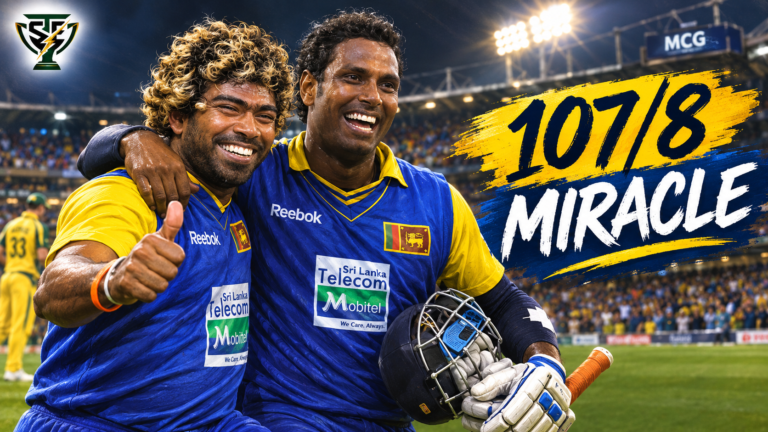 A Celebration of 5000 ODIsA Celebration of 5000 ODIs Match 75: Australia vs Sri Lanka 2010, Mathews and Malinga Rescue an Impossible Chase
5. Bravo Bowls Yuvraj With Two Runs Needed
Yuvraj struck two successive fours to take India within touching distance.
Bravo’s slower delivery then ended the innings and secured a one-run victory.
Why Ramnaresh Sarwan Was Player of the Match
The official Player of the Match award went to Ramnaresh Sarwan.
It was an appropriate decision.
Sarwan scored 98 not out when the remaining ten West Indies batters collectively contributed only 87 runs.
The extras added another 13.
His ability to survive the early collapse and bat through the innings gave the bowlers a total to defend.
Bravo produced the decisive wicket, but his bowling figures were 1/29 from 3.4 overs.
Bradshaw took three wickets for 33.
Both contributions were important.
Sarwan’s innings, however, accounted for nearly half of West Indies’ runs and transformed a disastrous beginning into a competitive match.
His performance supplied the foundation for the eventual victory.
India Lose Their Chasing Record as West Indies Reclaim the Series
India entered the match having won 17 consecutive ODIs while batting second.
The streak reflected an extraordinary period of confidence in run chases.
The team possessed several established batters, strong finishing options and a captain who had successfully managed difficult targets.
However, West Indies disrupted the formula.
Early wickets denied India the comfortable opening partnership it usually needed.
The middle overs were controlled by spin.
Repeated dismissals prevented Yuvraj from receiving sustained support.
Even after recovering to a position where only two runs were required, India could not finish the chase.
The victory leveled the five-match series at 1-1.
West Indies subsequently won the remaining three ODIs, securing the series 4-1.
The Kingston result therefore marked the beginning of a significant turnaround.
It also exposed an important limitation in India’s apparently unstoppable chasing record.
A strong batting lineup could still be defeated by sustained pressure, disciplined bowling and an accurately executed change of pace.
Why Match 78 Belongs in A Celebration of 5000 ODIs
The 2006 Kingston encounter deserves its place among the great One-Day Internationals because the contest changed direction repeatedly.
India appeared dominant when West Indies fell to 1/2.
Sarwan’s unbeaten innings then established a defendable total.
West Indies regained control at 60/4.
Yuvraj fought back, but India slipped to 134/7.
The chase revived once more through his late boundaries.
Finally, one delivery decided everything.
This installment offers an instructive contrast with Match 51, when Yuvraj and Mohammad Kaif rescued India in the 2002 NatWest Series final.
In that match, Yuvraj helped India recover from a middle-order collapse before Kaif finished the chase.
In Kingston, Yuvraj produced another outstanding rescue effort but could not survive the decisive delivery.
The match also connects naturally with West Indies’ remarkable 2004 Champions Trophy final victory over England.
Both encounters demonstrated how the Caribbean side could recover from difficult positions through patience, bowling discipline and contributions from overlooked players.
The narrow margin is only part of the story.
The real significance lies in how West Indies overturned India’s established strength and ended a remarkable winning sequence.
Complete Match Scorecard: West Indies vs India, May 20, 2006
West Indies Innings: 198/9 in 50 Overs
| Batter | Dismissal | R | B | 4s | 6s | SR |
|---|---|---|---|---|---|---|
| Chris Gayle | c Dhoni b Agarkar | 0 | 8 | 0 | 0 | 0.00 |
| Runako Morton | lbw b Pathan | 1 | 4 | 0 | 0 | 25.00 |
| Ramnaresh Sarwan | Not out | 98 | 138 | 7 | 1 | 71.01 |
| Brian Lara (c) | c Dravid b Pathan | 14 | 33 | 2 | 0 | 42.42 |
| Shivnarine Chanderpaul | c Kaif b Harbhajan | 10 | 21 | 2 | 0 | 47.62 |
| Marlon Samuels | c Dhoni b Yuvraj | 19 | 53 | 1 | 0 | 35.85 |
| Dwayne Bravo | c Raina b Powar | 0 | 3 | 0 | 0 | 0.00 |
| Carlton Baugh (wk) | c Pathan b Powar | 21 | 17 | 4 | 0 | 123.53 |
| Ian Bradshaw | c Harbhajan b Pathan | 12 | 16 | 1 | 0 | 75.00 |
| Jerome Taylor | c Dhoni b Agarkar | 9 | 9 | 1 | 0 | 100.00 |
| Fidel Edwards | Not out | 1 | 1 | 0 | 0 | 100.00 |
| Extras | 2 leg-byes, 8 wides, 3 no-balls | 13 | ||||
| Total | 9 wickets, 50 overs | 198 |
Fall of wickets: 1/1 (Gayle, 1.4), 1/2 (Morton, 2.2), 24/3 (Lara, 10.5), 43/4 (Chanderpaul, 18.6), 103/5 (Samuels, 34.6), 105/6 (Bravo, 35.5), 143/7 (Baugh, 41.6), 163/8 (Bradshaw, 46.3), 197/9 (Taylor, 49.5).
India Bowling
| Bowler | O | M | R | W | Economy |
|---|---|---|---|---|---|
| Irfan Pathan | 9 | 2 | 45 | 3 | 5.00 |
| Ajit Agarkar | 10 | 2 | 25 | 2 | 2.50 |
| Harbhajan Singh | 10 | 0 | 32 | 1 | 3.20 |
| Munaf Patel | 7 | 1 | 39 | 0 | 5.57 |
| Ramesh Powar | 10 | 0 | 38 | 2 | 3.80 |
| Yuvraj Singh | 4 | 0 | 17 | 1 | 4.25 |
India Innings: 197 All Out in 49.4 Overs
| Batter | Dismissal | R | B | 4s | 6s | SR |
|---|---|---|---|---|---|---|
| Rahul Dravid (c) | c Baugh b Bradshaw | 11 | 22 | 1 | 0 | 50.00 |
| Virender Sehwag | c sub (Dwayne Smith) b Bradshaw | 12 | 19 | 1 | 0 | 63.16 |
| Irfan Pathan | c Samuels b Edwards | 14 | 32 | 2 | 0 | 43.75 |
| Yuvraj Singh | b Bravo | 93 | 121 | 8 | 1 | 76.86 |
| Mohammad Kaif | c sub (Dwayne Smith) b Taylor | 4 | 12 | 0 | 0 | 33.33 |
| Suresh Raina | c Chanderpaul b Samuels | 27 | 55 | 1 | 0 | 49.09 |
| MS Dhoni (wk) | b Taylor | 2 | 7 | 0 | 0 | 28.57 |
| Ajit Agarkar | c & b Bradshaw | 2 | 4 | 0 | 0 | 50.00 |
| Ramesh Powar | c Taylor b Samuels | 12 | 22 | 1 | 0 | 54.55 |
| Harbhajan Singh | c & b Gayle | 1 | 4 | 0 | 0 | 25.00 |
| Munaf Patel | Not out | 2 | 5 | 0 | 0 | 40.00 |
| Extras | 4 leg-byes, 8 wides, 5 no-balls | 17 | ||||
| Total | All out, 49.4 overs | 197 |
Fall of wickets: 25/1 (Sehwag, 5.4), 37/2 (Dravid, 9.1), 51/3 (Pathan, 13.6), 60/4 (Kaif, 16.6), 124/5 (Raina, 35.2), 130/6 (Dhoni, 37.3), 134/7 (Agarkar, 38.5), 177/8 (Powar, 46.3), 187/9 (Harbhajan, 48.1), 197 all out (Yuvraj, 49.4).
West Indies Bowling
| Bowler | O | M | R | W | Economy |
|---|---|---|---|---|---|
| Fidel Edwards | 7 | 2 | 19 | 1 | 2.71 |
| Ian Bradshaw | 10 | 0 | 33 | 3 | 3.30 |
| Jerome Taylor | 9 | 0 | 49 | 2 | 5.44 |
| Dwayne Bravo | 3.4 | 0 | 29 | 1 | 7.91 |
| Chris Gayle | 10 | 0 | 33 | 1 | 3.30 |
| Marlon Samuels | 10 | 0 | 30 | 2 | 3.00 |
Result: West Indies won by one run.
Player of the Match: Ramnaresh Sarwan, 98 not out from 138 balls.
Series position: Level 1-1 after two matches.
One Ball That Changed the Entire Series
For most of the day, Sarwan’s unbeaten 98 and West Indies’ disciplined bowling had kept the contest alive.
But with two runs required from three deliveries, India’s 17-match winning sequence in successful ODI chases appeared destined to continue.
Dwayne Bravo had already conceded two consecutive boundaries. The situation demanded a delivery that could disrupt Yuvraj’s timing.
He produced it.
Yuvraj’s dismissal ended the match, handed West Indies a one-run victory and changed the direction of the five-match series.
The Kingston thriller remains a worthy entry in A Celebration of 5000 ODIs because it demonstrates how an entire day’s cricket can ultimately depend on the execution of one delivery.
India had nearly completed another remarkable chase.
West Indies had one final answer.
A Celebration of 5000 ODIs
- A Celebration of 5000 ODIs Match 78: Dwayne Bravo’s Slower Ball Breaks India’s 17-Match Chasing Streak
- A Celebration of 5000 ODIs Match 77: Zimbabwe vs New Zealand 2011, Malcolm Waller’s Unbeaten 99 Completes a Record Chase
- A Celebration of 5000 ODIs – Match 76: When Abdul Razzaq’s Century Stunned South Africans
- A Celebration of 5000 ODIs Match 75: Australia vs Sri Lanka 2010, Mathews and Malinga Rescue an Impossible Chase
- A Celebration of 5000 ODIs Match 74: India vs Australia 2009, Tendulkar’s 175 Ends in a Three-Run Heartbreak