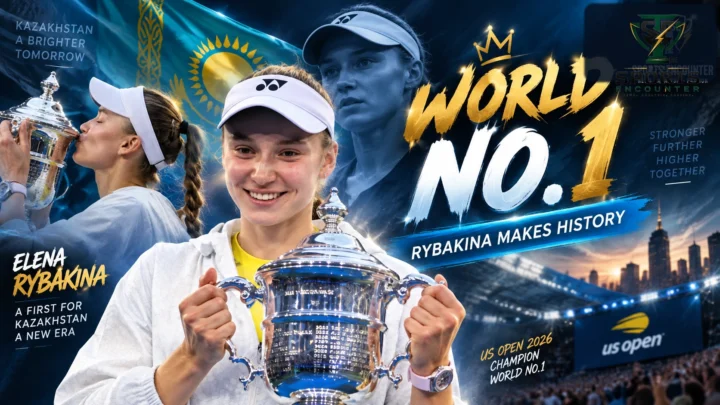
INDIAN WELLS, United States, November 18, 2026: Elena Rybakina has received official recognition as the first player representing Kazakhstan to finish a tennis season as world No. 1, adding a historic WTA honor to a campaign featuring two Grand Slam championships. The 27-year-old was presented with the Chris Evert WTA World No. 1 Trophy during the season-ending WTA Finals at Indian Wells, becoming the 17th woman to secure the year-end singles ranking.
The Rybakina year-end No. 1 achievement was decided before the final tournament began. Her victory over fellow Kazakhstani Yulia Putintseva at the Pan Pacific Open in Tokyo on October 29 made the ranking mathematically secure. The subsequent trophy ceremony celebrated a milestone that remained intact despite Rybakina’s withdrawal from the WTA Finals because of a viral illness.
Key Takeaways
- Elena Rybakina has received official recognition as the first player representing Kazakhstan to finish a tennis season as world No. 1, adding a historic WTA honor to a campaign featuring two Grand Slam championships.
- The Rybakina year-end No. 1 achievement was decided before the final tournament began.
- Reaching world No. 1 and finishing a season there are two separate accomplishments.
- Rybakina achieved the first milestone in September, when her US Open campaign made her the first player representing Kazakhstan to reach the singles summit.
The distinction gives Kazakhstan a unique place in tennis history. Rybakina is the first player representing the country, across men’s or women’s tennis and singles or doubles, to finish a season at the top of the world rankings. The WTA confirmed that achievement in its official announcement of her year-end recognition.
Story at a glance

Rybakina Year-End No. 1: Why the Trophy Matters
Reaching world No. 1 and finishing a season there are two separate accomplishments.
Two Grand Slam Titles Built the Foundation
Rybakina’s ranking lead was established through results at the most valuable tournaments on the women’s calendar.
The Numbers Behind Rybakina’s Historic Season
Rybakina’s achievement is best understood through several distinct milestones rather than the year-end ranking alone.
Why the WTA Finals Withdrawal Did Not Change the Rankings
Rybakina’s season ended under circumstances that contrasted sharply with the achievement being celebrated.
Why Kazakhstan’s Achievement Extends Beyond One Player
Rybakina’s rise carries particular significance because Kazakhstan has not historically been one of tennis’s dominant nations.
Rybakina Year-End No. 1: Why the Trophy Matters
Reaching world No. 1 and finishing a season there are two separate accomplishments.
A player can rise to the top of the weekly WTA rankings through results accumulated over the previous 52 weeks, but maintaining a sufficient advantage to guarantee the year-end position requires sustained success across the season.
Rybakina achieved the first milestone in September, when her US Open campaign made her the first player representing Kazakhstan to reach the singles summit. Her ranking officially became No. 1 on September 14.
The Sports Encounter documented that breakthrough in its report on Rybakina becoming the WTA’s 30th world No. 1.
Six weeks later, victory in Tokyo settled the remaining mathematical question. No rival could overtake her in the season-ending rankings.
That makes the trophy presented at Indian Wells a recognition of an entire campaign, rather than the reward for winning a particular match or tournament.
How Rybakina Year-End No. 1 Became Certain in Tokyo
Rybakina entered the closing weeks of the regular season with a commanding ranking position, strengthened by her two major championships and consistent results at other events.
She added the Ningbo Open title in October, her fourth singles championship of the season, before traveling to Tokyo.
After receiving a first-round bye at the Pan Pacific Open, she defeated Putintseva 6-2, 6-3 in the second round. The result secured the year-end ranking.
The win was particularly meaningful because Putintseva had caused Rybakina problems in earlier meetings. The matchup nevertheless ended in a controlled straight-sets victory at the moment when the ranking milestone was within reach.
By then, the season’s leading contenders no longer had enough available ranking opportunities to overturn her advantage.
The achievement was covered alongside Alexander Zverev’s successful pursuit of the men’s top ranking in TSE’s October report on the two year-end No. 1 breakthroughs.
Two Grand Slam Titles Built the Foundation
Rybakina’s ranking lead was established through results at the most valuable tournaments on the women’s calendar.
She began the Grand Slam season by winning the Australian Open, defeating Aryna Sabalenka in the final and claiming the second major singles title of her career.
That victory established an important early advantage in the rankings and demonstrated her ability to withstand the pressure of a major final against one of her principal rivals.
Her Stuttgart title added another championship on clay, broadening the evidence of her competitiveness beyond hard courts.
Rybakina then returned to Grand Slam success at the US Open, again defeating Sabalenka, this time 6-4, 5-7, 6-2.
The New York championship was her third career major and her second of the season.
It also marked the culmination of her rise to No. 1, a development examined in The Sports Encounter’s detailed account of her US Open final victory.
Winning both hard-court majors gave Rybakina a particularly valuable foundation. Each Grand Slam singles title carries 2,000 ranking points, meaning those two victories alone contributed 4,000 points before the rest of her season was considered.
That total should not be confused with her entire ranking score, which also reflected other eligible results under the WTA rankings system.
The Numbers Behind Rybakina’s Historic Season
Rybakina’s achievement is best understood through several distinct milestones rather than the year-end ranking alone.
| Milestone | Achievement | Why It Matters |
|---|---|---|
| WTA year-end singles ranking | No. 1 | First year-end No. 1 finish of her career |
| Historical WTA position | 17th woman | Joins the select group of year-end singles ranking leaders |
| Kazakhstan milestone | First across singles and doubles, men or women | Unprecedented year-end ranking achievement for the country |
| Grand Slam championships | Australian Open and US Open | Two of the season’s four majors |
| WTA singles titles | Four | Australian Open, Stuttgart, US Open and Ningbo |
| First week at world No. 1 | September 14 | Official entry into the No. 1 ranking position |
| Year-end No. 1 clinched | October 29 | Tokyo victory removed the remaining ranking uncertainty |
| Year-end ranking points | 8,099 | Top position in the November 16 ranking release |
The final rankings confirmed that Rybakina remained ahead of Mirra Andreeva, who finished second after winning the WTA Finals at Indian Wells.
Rybakina’s season is therefore notable for both its peak performances and the sustained results that allowed her to preserve her ranking advantage through the final tournament.
Why the WTA Finals Withdrawal Did Not Change the Rankings
Rybakina’s season ended under circumstances that contrasted sharply with the achievement being celebrated.
Having qualified for the WTA Finals as the world’s leading player, she withdrew before the competition began after citing a viral illness.
The WTA confirmed the withdrawal and the medical reason in its official tournament announcement.
Her absence deprived the event of its top-ranked singles player and defending champion.
However, it did not reverse the ranking calculation already settled in Tokyo.
Winning the WTA Finals and finishing the season as world No. 1 are separate achievements. The Finals awards ranking points, but Rybakina had already secured an advantage that could not be overcome through the remaining tournament.
The distinction became especially visible when Mirra Andreeva won the championship.
The 19-year-old defeated Elina Svitolina 7-5, 6-3 in the final, completing an unbeaten five-match campaign without losing a set.
Andreeva’s performance elevated her to the year-end No. 2 position and established another major contender for the next season. TSE’s report on Andreeva’s undefeated WTA Finals championship explains the Russian’s achievement and its ranking consequences.
Rybakina nevertheless remained the year-end No. 1, demonstrating the difference between the best performance at the season-ending event and the accumulated results that determine the annual rankings.
Why Kazakhstan’s Achievement Extends Beyond One Player
Rybakina’s rise carries particular significance because Kazakhstan has not historically been one of tennis’s dominant nations.
Born in Moscow, she began representing Kazakhstan in 2018 and subsequently developed into one of the country’s most successful international athletes.
Her first Grand Slam championship came at Wimbledon in 2022, followed by years of competing against the game’s leading players and managing the physical demands of the professional tour.
The transition from Grand Slam champion to world No. 1 was not immediate.
Rybakina experienced injuries, illness and difficult stretches in which strong individual results did not translate into the sustained ranking position she was pursuing.
Those setbacks make the latest milestone more substantial than a simple extension of her previous major titles.
The Sports Encounter explored those developments in its long-form account of Rybakina’s career decisions and road to No. 1.
Her achievement now provides Kazakhstan with a recognizable benchmark for its tennis development programs.
Continue the Tennis Story

It also adds another layer to the country’s international sporting reputation, demonstrating that an athlete representing Kazakhstan can finish above every competitor in one of the world’s most established individual sports.
That is a historical fact about Rybakina’s ranking, rather than proof that the country’s wider player-development system has already reached the same level.
How Rybakina Compares With the Other Leading Women
Rybakina’s year-end position reflects a season in which several leading competitors delivered major achievements of their own.
Sabalenka remained a formidable rival, reaching both hard-court Grand Slam finals against Rybakina while also collecting significant titles.
Andreeva won Roland-Garros and then the WTA Finals, completing a season that established her among the leading players of the next generation.
Coco Gauff, Jessica Pegula, Elina Svitolina and other established contenders also contributed to a competitive season across different surfaces.
But Rybakina’s Australian Open and US Open victories gave her an advantage at two of the tournaments carrying the greatest ranking rewards.
Her Stuttgart and Ningbo titles provided further reinforcement, while victories throughout the campaign protected the accumulated points lead.
That combination explains why a season-ending championship for another player did not change the identity of the year-end ranking leader.
The official WTA singles rankings provide the authoritative reference for players’ current positions and ranking points.
What Comes Next for the World’s Top-Ranked Woman?
Rybakina will enter the next season as the player every rival is trying to overtake.
The challenge changes when an athlete moves from pursuing the top ranking to defending it.
Her major victories give her substantial ranking points to defend when those tournaments return, particularly at the Australian Open and US Open.
Strong results at the same events will be important, although the ranking race will also depend on the performances of Andreeva, Sabalenka, Gauff, Pegula and other challengers.
The medical withdrawal from Indian Wells introduces a separate consideration. Rybakina’s preparation for the next season will need to account for recovery, without assuming the illness will have lasting consequences.
Her serving ability, first-strike tennis and performances on hard courts remain proven competitive strengths.
However, maintaining No. 1 will require the consistency that secured the ranking rather than relying solely on past Grand Slam achievements.
The Rybakina year-end No. 1 honor closes a season in which Kazakhstan’s leading tennis player won two majors, collected four titles and secured a place in WTA history. The trophy presentation recognizes what she accomplished over the full calendar, even though illness prevented her from defending the WTA Finals championship. Her next task is to turn that historic first finish into a sustained reign at the top of women’s tennis.
Elena Rybakina
- Elena Rybakina Crowned Year-End No. 1 as Kazakhstan Makes Tennis History
- Who Is the Tallest Player in the WTA Top 10 Rankings in 2026?
- Rybakina Outdid Sabalenka When It Mattered the Most: Can Either Survive the WTA Finals Pressure Cooker?
- Elena Rybakina’s Extraordinary 2026: Two Grand Slams, World No. 1, and the Crown She Refuses to Surrender
- Aryna Sabalenka’s Bitter-Sweet 2026: Sunshine Double Glory, Two Grand Slam Heartbreaks, and One Last Shot at Redemption