Connect with us

Published

on

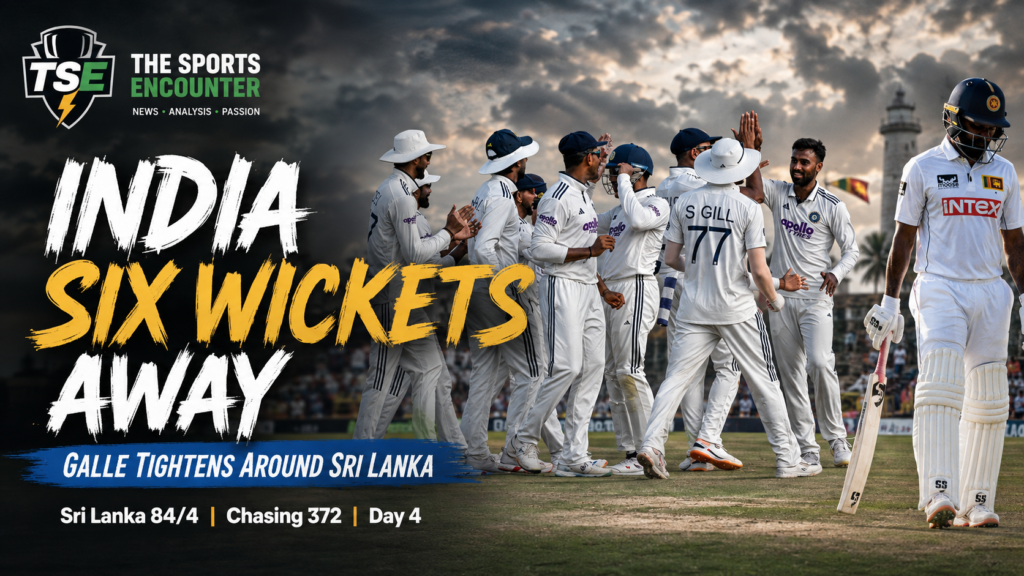
India spent the fourth day in Galle tightening a grip Sri Lanka have struggled to escape since the opening morning.

By stumps, the hosts were 84 for 4 chasing 372, still 288 runs short with only six wickets left. Dhananjaya de Silva remained unbeaten on 31 alongside first-innings centurion Sonal Dinusha on 25, but the broader picture is difficult to soften: India are one strong final-day session away from a victory that would feel thoroughly deserved.

The visitors did not dominate every passage of Day 4. They were bowled out for 193 in their second innings and lost wickets regularly while trying to accelerate. Yet they understood the match situation better. With rain already taking time out of the Test, India attacked the scoreboard, pushed the target beyond Sri Lanka’s realistic comfort zone, then used a disciplined combination of pace and spin to remove four top-order batters before bad light ended play.

Sri Lanka still have a route out of trouble.

It requires Dhananjaya and Dinusha to bat for a long time, Niroshan Dickwella to reproduce some of the resistance he showed in the first innings, and probably some help from the weather.

India, meanwhile, require six wickets.

That is the contest now.

Galle Test After Day 4: The Match Position

Team1st Innings2nd InningsMatch Position
India462193Set Sri Lanka 372 to win
Sri Lanka28484/4Need 288 more runs

India need: 6 wickets

Sri Lanka need: 288 runs

Day 5: August 19, 2026

Venue: Galle International Stadium

The state of the game reflects what The Sports Encounter identified before the series began in our Sri Lanka vs India Test series preview: Galle tends to punish teams that lose control of one or two sessions, and Sri Lanka have now spent too much of this match repairing damage rather than applying pressure.

India Did Not Need a Perfect Second Innings

India resumed Day 4 holding a first-innings lead of 178.

The objective was no longer to build another monumental score.

It was to create enough separation while leaving sufficient time to dismiss Sri Lanka again.

That distinction shaped the batting.

Yashasvi Jaiswal fell for a three-ball duck when Asitha Fernando found the edge. KL Rahul made 35, Devdutt Padikkal added 44 and captain Shubman Gill was dismissed for eight as Sri Lanka continued chipping away.

India were losing wickets, but the lead kept growing.

The innings did not need elegance.

It needed urgency.

That is why Rishabh Pant’s 66 became the decisive contribution.

Rishabh Pant Changed the Tempo of the Day

Pant scored 66 from 69 balls, striking eight fours and two sixes in an innings that pushed India away from any temptation to become conservative.

His method was familiar.

He attacked spin, pulled pace and kept searching for scoring opportunities even as wickets fell around him.

One sequence summed up the mood.

Lahiru Kumara struck Pant on the helmet with a bouncer.

Pant responded by pulling the next delivery for four.

He later fell attempting another aggressive pull, but by then the innings had done its job.

India reached 193, extending Sri Lanka’s target to 372.

It was enough to make survival the hosts’ more realistic objective.

Pant Becomes First Indian to 100 Test Sixes

The innings also carried personal history.

Pant became the first Indian batter to hit 100 sixes in Test cricket and only the fourth player overall to reach the landmark. He joined Ben Stokes, Brendon McCullum and Adam Gilchrist in that exclusive group. Reports from Galle also credited Pant with reaching the milestone faster than any previous batter in terms of Tests played.

The record fits Pant particularly well.

His Test career has rarely followed conventional batting logic. He attacks situations other batters try to survive, and he often turns the pressure of a deteriorating pitch into an argument for aggression rather than caution.

On Day 4, that instinct helped India create the time and scoreboard pressure their bowlers needed.

Sri Lanka Needed a Calm Start and Got the Opposite

A target of 372 at Galle was already severe.

The hosts’ only realistic plan was to reach stumps with most of their batting intact.

That possibility began disappearing quickly.

Mohammed Siraj removed Nishan Madushka for six, using a short ball effectively on a surface where the bounce remained inconsistent enough to make even defensive batting uncomfortable.

Then Manav Suthar struck.

Pasindu Sooriyabandara, playing as a concussion substitute for the injured Dinesh Chandimal, was given not out first ball after being hit on the pads.

Suthar persuaded Shubman Gill to review.

The decision was overturned.

Sri Lanka were 14 for 2.

Manav Suthar Has Become India’s Quiet Match-Winner

Suthar’s contribution deserves more attention than it may receive in a scorecard dominated by Padikkal’s 167 and Pant’s milestone.

The left-arm spinner took four wickets in Sri Lanka’s first innings and added two more on the fourth evening, finishing the day with figures of 2 for 30 in the second innings.

His value has come from pressure rather than spectacle.

He has repeatedly asked Sri Lanka’s batters to play from the crease, defend accurately and make decisions against deliveries that have begun turning more sharply as the Test has progressed.

That kind of bowling becomes especially dangerous in the fourth innings.

Batters know one mistake can end the match.

The result is hesitation.

Suthar has exploited it.

Kamindu Mendis’ Dismissal Exposed Sri Lanka’s Anxiety

Kamindu Mendis lasted only 12 balls.

Prasidh Krishna found the edge and KL Rahul completed the catch at first slip.

The dismissal mattered beyond the two runs Mendis contributed.

Sri Lanka needed one of their established middle-order batters to settle the chase.

Instead, another wicket disappeared before the innings had established any rhythm.

At 21 for 3, the chase had already become an exercise in damage control.

Lahiru Udara’s Wicket Left Sri Lanka With Almost No Margin

Lahiru Udara resisted longer than the early wickets suggested he might.

He made 16 from 58 balls, trying to absorb pressure rather than chase the target.

Suthar eventually removed him, with Dhruv Jurel taking the catch.

That left Sri Lanka 47 for 4.

From that point, Dhananjaya de Silva and Sonal Dinusha did what the top order had failed to do.

They stayed.

Dhananjaya de Silva Is Once Again Sri Lanka’s Crisis Man

There are few things more familiar in modern Sri Lankan Test cricket than Dhananjaya walking in with a repair job waiting for him.

He reached stumps on 31 from 73 balls.

The innings was not dramatic.

That was the point.

He defended carefully, trusted the occasional scoring opportunity and gave Sri Lanka a chance to carry meaningful resistance into the fifth morning.

There was also an enormous escape.

Dhananjaya edged Ravindra Jadeja to slip while on seven.

India began celebrating.

Then the no-ball signal arrived.

Jadeja had overstepped.

Had the delivery been legal, Sri Lanka would have been 32 for 4 much earlier, with even less batting left to protect the game.

Instead, their captain survived.

That moment remains one of the few pieces of fortune Sri Lanka can carry into Day 5.

Sonal Dinusha Has Already Saved Sri Lanka Once

Dinusha’s presence matters because he has already shown that he can bat through adversity in this match.

He scored 100 in Sri Lanka’s first innings, helping the hosts recover from 90 for 5 and avoid the follow-on alongside Niroshan Dickwella.

The Sports Encounter detailed that recovery in our Day 3 report from Galle.

Now he is being asked to do it again.

Dinusha ended Day 4 on 25 from 36 balls.

He looked more comfortable than several of the batters who preceded him, but the final day will ask a different question.

Can he survive long enough to turn India’s six-wicket requirement into a race against the clock?

Why Sri Lanka’s Top Order Has Failed Twice

The common thread across both Sri Lankan innings has been the inability of the top order to absorb India’s first wave.

In the first innings, Sri Lanka were reduced to 90 for 5 before Dinusha and Dickwella rebuilt.

In the second, they slipped to 47 for 4.

The bowlers have changed.

The pressure has not.

Siraj has attacked with pace and bounce.

Prasidh has created awkward angles.

Suthar has challenged both edges with turn.

Jadeja has offered almost nothing easy.

India have forced Sri Lanka to solve different problems without allowing enough time for the batters to settle into one method.

That is the hidden reason the visitors are six wickets away.

India Have Strangulated Sri Lanka Rather Than Blown Them Away

The strongest part of India’s Day 4 performance was not one magical spell.

It was the absence of release.

Sri Lanka finished the day scoring at 2.47 runs per over.

They were not attempting to chase aggressively, but even survival requires occasional pressure relief.

India rarely provided it.

Prasidh conceded 13 runs from eight overs.

Siraj gave away only 11 from five.

Suthar took two wickets while conceding 30 from 11.

Jadeja remained wicketless but still kept scoring difficult.

That is how a fourth-innings batting side begins to feel trapped.

Every maiden increases the importance of the next scoring opportunity.

Every boundary feels temporary.

Every defensive mistake becomes potentially fatal.

Chandimal Injury Leaves Sri Lanka With Another Problem

Sri Lanka’s task became harder when Dinesh Chandimal suffered neck and shoulder discomfort after an awkward fielding incident during India’s second innings.

He was taken to hospital for precautionary scans, and Pasindu Sooriyabandara entered the match as his concussion substitute.

Sooriyabandara’s first Test innings lasted one delivery.

He was trapped lbw by Suthar after India’s successful review.

The injury does not explain Sri Lanka’s overall position, but it removed experience from a batting order that badly needed it.

Can Sri Lanka Still Win?

Mathematically, yes.

Realistically, victory would require one of the greatest fourth-innings efforts ever produced at Galle.

Sri Lanka need 288 more runs with six wickets remaining.

The surface is deteriorating.

India have three frontline spinners available.

The hosts’ recognized batting beyond Dhananjaya, Dinusha and Dickwella is becoming thin.

A chase from here would require at least one enormous innings and probably two major partnerships.

Nothing about the first four days suggests that is the likely outcome.

Can Sri Lanka Save the Test?

This is the more realistic question.

A draw remains possible.

Weather has already interrupted the match, and bad light ended Day 4 at 84 for 4. Forecast concerns remain around the final day, meaning India may not necessarily receive a full allotment of overs.

That changes Sri Lanka’s objective.

They do not need 288 runs to frustrate India.

They need time.

If Dhananjaya and Dinusha can survive the first hour, every subsequent interruption becomes more valuable.

Dickwella then becomes critical.

He made 80 in the first innings and showed he can counterattack once settled.

Sri Lanka’s best escape route is therefore straightforward:

Survive early.

Force India into longer spells.

Make the old ball less responsive.

Let the weather become part of the game.

India’s Biggest Enemy on Day 5 May Be Time

India do not need to chase wickets recklessly.

They have a 287-run cushion.

The challenge is balancing patience with the possibility of shortened play.

If the weather stays clear, six wickets across a full day should feel manageable from this position.

If rain removes two sessions, the psychology changes.

Gill may need attacking fields for longer.

Jadeja and Suthar may have to bowl extended spells.

Siraj and Prasidh could become more valuable with the older ball if reverse movement appears.

The visitors have several ways to take wickets.

What they cannot manufacture is lost time.

Galle’s Fifth-Day Surface Should Favor India

Galle is one of the game’s classic spin venues.

By Day 5, the pitch usually becomes less predictable rather than more comfortable.

Turn matters.

So does variation.

The ball that goes straight can become as dangerous as the one that grips.

That is why Jadeja may still have a major role despite ending Day 4 without a wicket.

Sri Lankan batters have to account for turn.

Once they begin doing that, a ball that holds its line can find an edge or pad.

Suthar already demonstrated exactly that kind of threat.

India also have Kuldeep Yadav available, giving Gill another wrist-spin option if partnerships begin settling.

India’s First-Innings 462 Still Defines This Test

Day 4 created the immediate winning opportunity.

India’s first innings created the match.

Devdutt Padikkal’s 167, KL Rahul’s 82 and Dhruv Jurel’s 51 took India to 462.

Sri Lanka then made 284.

That 178-run advantage allowed India to bat aggressively the second time without fearing the consequences of losing wickets.

When Pant attacked on Tuesday, he was spending runs India had already earned.

This is why the visitors’ control feels deeper than one successful bowling session.

They have been ahead in the match for most of its duration.

Padikkal’s 167 Looks Bigger With Every Session

Padikkal’s first-innings century may not dominate the Day 4 headlines, but it remains the innings around which India’s advantage was constructed.

His 167 came from 230 balls and allowed India to build a total that Sri Lanka never truly matched.

The significance becomes clearer now.

If India had scored 350 rather than 462, Sri Lanka’s current situation might look survivable.

Because India reached 462, even Sri Lanka’s strong Dinusha-Dickwella partnership in the first innings only reduced the scale of the deficit.

It never erased it.

TSE Analysis: India Have Won the Match in Layers

The scoreboard says India need six wickets.

The deeper story is how many separate pieces have been required to reach this point.

Padikkal gave them first-innings scale.

Rahul provided stability.

Jurel added depth.

Suthar and Jadeja ensured Sri Lanka could not fully recover.

Pant accelerated the second innings.

Siraj and Prasidh attacked the new ball.

Suthar returned to expose a fragile top order again.

No single player has had to carry India across four days.

That may be the most encouraging aspect of their position.

The visitors have found different contributors for different phases.

Sri Lanka’s Problem Is Bigger Than 288 Runs

Focusing on the target alone misses the real challenge.

Sri Lanka are not simply 288 runs away.

They are trying to survive against an attack that has already dismissed them once for 284 and has removed four wickets in 34 second-innings overs.

The surface will be older.

The pressure will be greater.

The batting resources will be fewer.

Every new batter who arrives will know there is almost no margin for an error.

That psychological burden can become as important as the pitch.

What India Need to Do on Day 5

India’s blueprint should remain simple.

Remove one of the two overnight batters early.

If Dhananjaya falls, Sri Lanka lose their captain and most experienced remaining specialist batter.

If Dinusha falls, the player who has resisted India best across the match disappears.

Either wicket exposes Dickwella to immediate pressure.

From there, the tail is close.

The temptation will be to hunt wickets with every delivery.

India do not need to.

The same discipline that produced 84 for 4 can finish the game.

What Sri Lanka Need to Do on Day 5

The hosts should forget the target during the first session.

Trying to score 288 runs from this position creates unnecessary risk.

The first objective is reaching lunch.

Dhananjaya must continue batting as he did late on Day 4.

Dinusha needs to trust the method that produced his first-innings century.

Dickwella, if required, will have to balance counterattack with survival.

If Sri Lanka can enter the afternoon with only four or five wickets down, the weather and clock begin exerting pressure on India.

That is how the match can become uncomfortable again.

The World Test Championship Stakes Add Weight

This Test is also part of the ICC World Test Championship 2025-27 cycle.

Both teams entered the series needing points, which gives India’s position added significance.

The Sports Encounter’s series preview described the two matches as a major test for sides trying to stay relevant in the WTC race.

A road victory in Galle would therefore deliver more than a 1-0 series lead.

It would give India valuable away points in conditions where Sri Lanka traditionally expect to dictate terms.

Day 5 Could Still Produce One Last Twist

Test cricket has a habit of making certainty uncomfortable.

India are clearly ahead.

That does not mean the final day is ceremonial.

Dhananjaya has rescued Sri Lanka before.

Dinusha has already scored a century in this match.

Dickwella made 80.

Rain remains possible.

Bad light has already interfered.

Those are enough variables to prevent India from relaxing.

Still, Sri Lanka need almost everything to go their way.

India need six wickets.

That is why the visitors will wake up on Wednesday expecting to win rather than merely hoping to.

Frequently Asked Questions

What is the score after Day 4 of the Sri Lanka vs India first Test?

Sri Lanka are 84 for 4 in their second innings, chasing a target of 372. They need another 288 runs on Day 5, while India need six wickets.

What did India score in the second innings?

India were bowled out for 193. Rishabh Pant top-scored with 66, while Devdutt Padikkal made 44 and KL Rahul scored 35.

How many sixes has Rishabh Pant hit in Test cricket?

Pant reached 100 Test sixes during his 66 in Galle, becoming the first Indian and fourth batter overall to reach the landmark.

Who took Sri Lanka’s wickets on Day 4?

Manav Suthar took two wickets, while Mohammed Siraj and Prasidh Krishna claimed one each.

Who is unbeaten for Sri Lanka?

Captain Dhananjaya de Silva is unbeaten on 31 and Sonal Dinusha is 25 not out.

Why is Pasindu Sooriyabandara playing?

Sooriyabandara entered as a concussion substitute after Dinesh Chandimal suffered neck and shoulder discomfort and was sent for precautionary scans.

Can Sri Lanka still win the Test?

Yes mathematically, but they require another 288 runs with six wickets remaining on a deteriorating Galle surface. A draw appears more realistic than victory if the overnight partnership survives and weather removes significant playing time.

Can rain save Sri Lanka?

It could become a factor. Weather concerns remain for the final day, and bad light already ended Day 4 early. India therefore need to use their available time efficiently.

When does Day 5 begin?

The fifth and final day is scheduled for Wednesday, August 19, 2026, at Galle International Stadium.

India Can See the Finish Line

Four days into the Galle Test, India have reduced the equation to its simplest form.

Six wickets.

Sri Lanka have a much more complicated problem.

They need 288 runs, a long partnership, resistance from the lower order and probably cooperation from the weather.

Dhananjaya de Silva and Sonal Dinusha have kept a small opening alive.

India have spent four days closing almost every other one.

The visitors built the biggest first-innings total, controlled Sri Lanka’s recovery, attacked quickly enough in their second innings and then exposed the hosts’ top order for the second time.

They have not blown Sri Lanka away in one dramatic burst.

They have strangulated the match session by session.

One final squeeze should be enough.

Follow The Sports Encounter’s cricket coverage for the Day 5 result, analysis from the India-Sri Lanka series and the biggest stories from Test cricket around the world.
Serina Ramgopallan is a Sri Lanka-based sports writer and physical education graduate from the University of Colombo, covering cricket, athlete development, tournament competition, and major sporting events across South Asia and the wider international stage. Her academic background gives her a strong understanding of athletic performance, preparation, movement, and the physical demands placed on elite competitors. At The Sports Encounter, Serina contributes match reports, breaking news, tournament analysis, player-focused features, and in-depth cricket coverage, with particular attention to Sri Lanka, India, Bangladesh, and major franchise competitions. Her work combines regional insight with match context, performance analysis, and clear reporting, helping readers understand both the immediate result and the broader sporting implications behind it.

A Celebration of 5000 ODIs

A Celebration of 5000 ODIs Match 8: Australia Break Pakistan’s World Cup Dream in Lahore

Steve Waugh transformed the final over before Craig McDermott dismantled Pakistan’s chase, sending Australia into the 1987 World Cup final by the narrowest of margins.

Hamad Hussain | The Sports Encounter

Published

on

A Celebration of 5000 ODIs Match 8: Australia Break Pakistan’s World Cup Dream in Lahore

Eighteen runs separated Pakistan from a home World Cup final. Australia had collected exactly 18 from the last over of its innings.

That symmetry still defines the 1987 semifinal in Lahore. Pakistan recovered from 38 for three through Javed Miandad and Imran Khan, giving a packed Gaddafi Stadium reason to believe. Yet the runs Steve Waugh extracted at the end of Australia’s innings became a burden Pakistan could never shed.

Craig McDermott then took five wickets, including four during the closing stages, as Australia dismissed Pakistan for 249 to win by 18 runs.

That combination of late-innings calculation, a courageous recovery and ruthless fast bowling earns the semifinal its place as Match 8 in A Celebration of 5000 ODIs, The Sports Encounter’s journey through the matches that shaped one-day international cricket.

TL;DR

  • Australia defeated Pakistan by 18 runs in the 1987 World Cup semifinal.
  • Steve Waugh’s unbeaten 32 helped Australia score 18 from the final over and reach 267 for eight.
  • Pakistan fell to 38 for three before Javed Miandad and Imran Khan added 112.
  • Craig McDermott claimed five for 44 and won the Player of the Match award.
  • Pakistan conceded 34 extras, a costly loss of control in a tight knockout match.
  • Australia advanced to the final and secured its first World Cup title by beating England.

Match Information

DetailInformation
MatchAustralia vs Pakistan, 1987 World Cup semifinal
DateNovember 4, 1987
VenueGaddafi Stadium, Lahore
TossAustralia won the toss and batted
Australia267/8 in 50 overs
Pakistan249 all out in 49 overs
ResultAustralia won by 18 runs
Player of the MatchCraig McDermott, 5/44
Turning PointAustralia scored 18 runs from the final over
Tournament ImpactAustralia advanced to the World Cup final

Complete Match Scorecard

Australia Batting

BatterDismissalRunsBalls4s6s
Geoff MarshRun out315720
David BoonSt Javed Miandad b Saleem Malik659140
Dean Jonesb Tauseef Ahmed384530
Allan BorderRun out182220
Mike Velettab Imran Khan485020
Steve WaughNot out322841
Simon O’DonnellRun out0200
Greg Dyerb Imran Khan0100
Craig McDermottb Imran Khan1300
Tim MayNot out0200
Bruce ReidDid not bat
Extras34 (b 1, lb 19, nb 1, w 13)
Total267/8 in 50 overs

Fall of wickets: 73, 155, 155, 215, 236, 236, 241, 249.

Pakistan Bowling

BowlerOversMaidensRunsWickets
Imran Khan101363
Saleem Jaffar60570
Wasim Akram100540
Abdul Qadir100390
Tauseef Ahmed101391
Saleem Malik40221

Pakistan Batting

BatterDismissalRunsBalls4s6s
Ramiz RajaRun out1100
Mansoor Akhtarb McDermott91900
Saleem Malikc McDermott b Waugh253130
Javed Miandadb Reid7010340
Imran Khanc Dyer b Border588440
Wasim Akramb McDermott201302
Ijaz Ahmedc Jones b Reid8710
Saleem Yousufc Dyer b McDermott211520
Abdul QadirNot out201620
Saleem Jaffarc Dyer b McDermott0200
Tauseef Ahmedc Dyer b McDermott1300
Extras16 (lb 6, w 10)
Total249 all out in 49 overs

Fall of wickets: 2, 37, 38, 150, 177, 192, 212, 236, 247, 249.

Australia Bowling

BowlerOversMaidensRunsWickets
Craig McDermott100445
Bruce Reid102412
Steve Waugh91511
Simon O’Donnell101450
Tim May60360
Allan Border40261

David Boon Gives Australia Its Platform

David Boon’s 65 provided the control Australia needed after choosing to bat. His partnership with Geoff Marsh settled the innings, while Dean Jones maintained the tempo with 38.

Pakistan fought back when Jones and Boon departed at 155. Mike Veletta responded with 48 from 50 balls, keeping Australia above a run-a-ball trajectory without taking reckless risks.

Imran Khan led Pakistan’s attack superbly, conceding only 36 runs and taking three wickets. However, the support bowling lacked the same discipline. Pakistan conceded 34 extras, including 13 wides and 19 leg byes. In a match decided by 18 runs, those concessions were damaging.

Steve Waugh Turns One Over Into the Winning Margin

Australia slipped from 215 for three to 249 for eight as Imran attacked the lower order. Pakistan appeared to have limited the damage, but Waugh changed the shape of the contest in the final six deliveries.

His unbeaten 32 from 28 balls drove Australia to 267. The last over, delivered by Saleem Jaffar, cost 18 runs. Waugh’s calm, clean striking gave Australia a total that demanded an exceptional chase under semifinal pressure.

It echoed the composure Australia had shown in its one-run victory over India in Chennai. Once again, a handful of late runs proved decisive.

Javed Miandad and Imran Khan Rescue Pakistan

Pakistan’s chase began disastrously. Ramiz Raja was run out before McDermott removed Mansoor Akhtar. Waugh then dismissed Saleem Malik, leaving the hosts 38 for three.

Miandad and Imran refused to let the occasion collapse around them. Their 112-run partnership restored order through controlled rotation, selective aggression and a clear understanding of the required rate.

Imran made 58 before Allan Border dismissed him at 150. Miandad continued to 70, but Bruce Reid bowled him with Pakistan still needing 56 runs. Wasim Akram, Saleem Yousuf and Abdul Qadir attacked bravely, though Australia retained just enough control.

Craig McDermott Owns the Semifinal

McDermott delivered the performance that separated the teams. After removing Mansoor early, he returned to stop Pakistan’s lower-order charge.

Wasim Akram had struck two sixes in a rapid 20 when McDermott bowled him. Saleem Yousuf followed after making 21 from 15 balls. McDermott then dismissed Saleem Jaffar and Tauseef Ahmed to complete figures of five for 44.

The spell earned him the Player of the Match award and carried Australia into the final. Pace mattered, but so did his ability to attack the stumps when Pakistan’s batters had no time to settle.

Why This Semifinal Belongs in the 5,000 ODIs Collection

The match captured the unforgiving mathematics of knockout cricket. Australia’s final-over acceleration, Pakistan’s 34 extras and McDermott’s closing spell all contributed directly to an 18-run result.

Pakistan had enjoyed a powerful home campaign, winning five of its six group matches. The semifinal offered Imran’s team the chance to reach a World Cup final on home soil. Instead, Australia absorbed the atmosphere and survived Pakistan’s strongest partnership.

The victory also prepared the way for Australia’s seven-run win over England in the 1987 final, which secured the country’s first men’s World Cup title.

Readers can explore more landmark matches through The Sports Encounter’s Celebration of 5000 ODIs collection, including India’s 1983 final triumph and Kapil Dev’s rescue against Zimbabwe.

Pakistan found courage after losing three early wickets, but Australia owned the smaller moments. Waugh won the final over, McDermott won the closing passage, and those two interventions ended a nation’s dream within sight of the final.

Continue Reading

CPL 2026

Keemo Paul Stars With Bat and Ball as Jamaica Kingsmen Crush Patriots by 51 Runs

Keemo Paul delivered a superb all-round performance at Sabina Park, scoring 65 from 36 balls and taking three wickets as Jamaica Kingsmen recovered from 54 for four to defeat St Kitts and Nevis Patriots by 51 runs in CPL 2026 Match 10.

Published

on

Keemo Paul celebrates after leading Jamaica Kingsmen to a 51-run win over St Kitts and Nevis Patriots with 65 runs and three wickets in CPL 2026 Match 10.

KINGSTON, Jamaica, August 18, 2026: Keemo Paul produced one of the most complete performances of the Caribbean Premier League 2026 so far, smashing 65 from 36 balls before taking 3 for 30 as Jamaica Kingsmen overwhelmed St Kitts and Nevis Patriots by 51 runs at a roaring Sabina Park.

Jamaica’s victory looked highly unlikely during the first eight overs.

Kirk McKenzie and Keacy Carty were both dismissed without scoring inside the opening five deliveries. Usman Khan followed for 13, Reeza Hendricks made 19, and the Kingsmen were reduced to 54 for four after 7.2 overs.

Then captain Rovman Powell and Paul changed the entire shape of the match.

The pair added 99 runs for the fifth wicket, with Powell contributing a controlled 49 from 39 balls and Paul transforming the innings through a fearless 65 from only 36 deliveries. Jamaica recovered to 181 for six from their 20 overs.

The Patriots never came close.

They slipped to 31 for three, 64 for five and eventually 130 all out in exactly 18 overs as Paul’s three wickets were backed by Andre Russell’s superb 2 for 19, Hunain Shah’s accurate pace and Hassan Khan’s control through the middle overs.

The victory gave Jamaica consecutive wins after beginning the tournament with three straight defeats and sent the Sabina Park crowd home with something very different from the frustration that defined the opening week.

Readers can follow every result, turning point and tournament storyline through The Sports Encounter’s dedicated CPL 2026 coverage and our broader cricket news and analysis hub.

Jamaica Kingsmen vs St Kitts and Nevis Patriots: Match 10 Summary

Competition Caribbean Premier League 2026
Match Match 10
Date August 18, 2026
Venue Sabina Park, Kingston, Jamaica
Toss St Kitts and Nevis Patriots elected to field
Jamaica Kingsmen 181/6 in 20 overs
St Kitts and Nevis Patriots 130 all out in 18 overs
Result Jamaica Kingsmen won by 51 runs
Player of the Match Keemo Paul, 65 from 36 balls and 3/30
Points Jamaica Kingsmen 2, St Kitts and Nevis Patriots 0

Jamaica Lose Two Wickets Before They Score a Run

The Patriots could hardly have asked for a better start after Jason Holder won the toss and chose to bowl.

Saurabh Netravalkar struck almost immediately.

McKenzie was bowled from the second ball of the innings after Jamaica unsuccessfully reviewed the dismissal. Three deliveries later, Carty edged behind without scoring.

Jamaica were 0 for two after five balls.

That opening was particularly significant because batting collapses had already damaged the Kingsmen repeatedly during the tournament.

They were bowled out for just 117 when Mohammad Nabi and Guyana Amazon Warriors handed Jamaica their third consecutive defeat earlier in the home leg.

Another collapse appeared possible here.

Hasaranga Keeps the Pressure on Jamaica

Reeza Hendricks tried to restore momentum and struck a four and a six during his 19 from 14 deliveries.

Usman Khan struggled to settle at the other end.

Wanindu Hasaranga trapped Usman lbw for 13 at 36 for three. Jamaica reviewed the decision, but the original call survived.

Hasaranga then removed Hendricks, caught behind by Andre Fletcher, to leave the Kingsmen 54 for four after 7.2 overs.

The home side had lost four recognized batters and still had more than 12 overs to negotiate.

What followed became the decisive phase of the evening.

Powell and Paul Rebuild Without Allowing the Game to Drift

Powell arrived needing to balance two competing demands.

Jamaica could not afford another wicket.

They also could not spend six overs simply rebuilding and leave themselves defending 140.

The captain managed that tension well.

Paul gave him the ideal partner.

At the strategic timeout Jamaica were 75 for four after 10 overs. Powell had 20 and Paul 12.

They were still behind the game.

The difference was that neither looked trapped by it.

Keemo Paul Gets to 15 and Changes Gear

Paul explained afterward that he did not find the conditions particularly easy when he first arrived.

His approach was therefore unusually measured for a player capable of immediate power.

He absorbed a few deliveries, reached 15 and then felt he had properly understood the surface.

From there, the innings changed quickly.

Paul began using the sweep and reverse sweep, attacking areas the Patriots had assumed were protected by their spin options.

His confidence came directly from the role Jamaica’s coaching staff had given him.

The instruction was clear: if the top order fell into trouble, Paul could be promoted and trusted to attack rather than merely survive.

He reached his fifty from 30 balls with three fours and four sixes.

The hundred partnership did not quite arrive, but it barely mattered.

Paul and Powell added 99 for the fifth wicket.

Paul’s 65 Gives Jamaica the Innings They Needed

Paul eventually fell for 65 from 36 balls, caught by Kevin Wickham off Holder with Jamaica on 153 for five after 17.3 overs.

His innings included five fours and five sixes at a strike rate of 180.55.

The numbers matter because of where he started.

This was not a powerplay assault with fielding restrictions and a new ball.

Paul entered at 54 for four, against a bowling attack containing Holder, Hasaranga, Obed McCoy, Netravalkar and Kyle Mayers.

He converted a rescue job into a match-winning innings.

It continued an encouraging tournament for Paul, who had already taken three wickets in Jamaica’s dramatic opening-night defeat against Antigua and Barbuda Falcons.

This time, his contribution came with a victory attached.

Powell Misses Fifty but Plays the Captain’s Innings

Powell finished one run short of his half-century, making 49 from 39 balls with four fours and three sixes.

Obed McCoy dismissed him in the 19th over, taking a return catch with Jamaica on 167 for six.

The captain’s innings lacked the explosive strike rate of Paul’s assault, but it was arguably just as important structurally.

Powell gave Paul the freedom to attack because someone remained committed to batting deep.

That balance has become an important personal project for the Jamaica captain.

After the match, Powell spoke about trying to control his natural aggression enough to turn useful forties into longer innings while still maintaining the ability to finish matches.

The 49 did not complete that objective.

It did help win this game.

Russell Makes Sure Jamaica Reach 181

Andre Russell then provided the late acceleration Jamaica needed.

He struck two sixes in an unbeaten seven-ball 14, while Hassan Khan added seven from four.

The Kingsmen finished on 181 for six.

Considering they had been 0 for two and 54 for four, 181 represented a significant recovery.

The total also showed how quickly Jamaica’s middle order had evolved since Russell’s spectacular 68 nearly rescued a 207-run chase against Barbados Tridents.

Earlier in the tournament, Jamaica’s power hitters had often been asked to repair hopeless positions individually.

Against the Patriots, Powell and Paul repaired the innings together.

McCoy and Holder Do Their Jobs, but Jamaica Escape Anyway

McCoy was the Patriots’ most economical specialist bowler, finishing with 1 for 27 from four overs.

Holder conceded only 30 from his four and took the crucial wicket of Paul.

Netravalkar claimed 2 for 43 after causing the opening-over chaos, while Hasaranga took 2 for 36.

The problem was not a complete failure of the Patriots’ bowling.

It was their inability to finish Jamaica after reducing them to 54 for four.

That became even more costly once the chase began.

The Patriots Need 182 but Lose Fletcher in the First Over

Andre Fletcher had been the Patriots’ batting anchor earlier in the tournament, including an unbeaten 48 when St Kitts and Nevis defeated St Lucia Kings for their first victory of CPL 2026.

He lasted four balls at Sabina Park.

Fletcher struck Hassan Khan for six but was caught by Russell from the final ball of the opening over.

Johnson Charles and Kyle Mayers followed soon afterward.

Hunain Shah removed Charles for 11 before Paul bowled Mayers for eight.

The Patriots were 31 for three after 4.2 overs.

Unlike Jamaica, they never found a partnership capable of reversing the damage.

Kevin Wickham Tries to Hold the Chase Together

Wickham became the Patriots’ most substantial batter.

He made 37 from 34 balls with one four and two sixes.

The difficulty was the required rate.

Jamaica had posted 181, and survival alone could not solve the chase.

Nikhil Chaudhary provided a brief burst with 18 from 13 balls before Vitel Lawes trapped him lbw.

The Patriots reviewed.

The decision remained out.

Dasun Shanaka was then run out for two.

At 64 for five after 8.4 overs, Jamaica had complete control.

Andre Russell Bowls Like a Specialist

Russell’s batting contribution lasted only seven balls.

His bowling mattered considerably more.

The experienced all-rounder delivered four overs for only 19 runs and took two wickets.

That economy rate of 4.75 was comfortably Jamaica’s best among the bowlers who completed more than two overs.

He removed Holder for one and later dismissed Wickham for 37, effectively ending the only innings that still offered the Patriots a remote path back into the contest.

Russell also delivered 11 dot balls.

On a surface where changes of pace were gripping, his ability to take pace off the ball made him far more difficult to attack than a conventional death bowler.

Hassan Khan and Hunain Shah Squeeze the Chase

Paul later explained that Jamaica had identified how much the surface was gripping.

The bowling plan followed from that observation.

Slower deliveries became useful through the middle overs.

At the death, Jamaica increasingly attacked wide of off stump and made the Patriots manufacture power across larger areas of the field.

Hassan Khan conceded only 22 from three overs and dismissed Fletcher.

Hunain Shah returned 1 for 16 from three overs and repeatedly found his yorker.

The combined effect meant the Patriots never established the uninterrupted boundary sequence required to chase 182.

Navin Bidaisee Retired Out as Patriots Search for Momentum

The degree of St Kitts and Nevis’ difficulty became clear when Navin Bidaisee was retired out after scoring 19 from 16 balls.

The tactical decision came at the end of the 14th over with the Patriots on 108.

They needed a drastic change in scoring rate.

It never arrived.

Holder fell for one in the next over.

Wickham followed at 121.

The chase had moved beyond recovery.

Keemo Paul Returns to Finish What He Started

Paul’s night could already have justified Player of the Match recognition through his batting.

He added three wickets anyway.

Mayers was his first victim.

Obed McCoy became the second when Hassan Khan completed the catch at 129 for nine.

Wanindu Hasaranga was the last.

From the final ball of the 18th over, Paul found a hint of inward seam movement as Hasaranga backed away looking for a boundary. Odean Smith held the catch.

Patriots 130 all out.

Jamaica by 51 runs.

Keemo Paul’s Match-Winning Numbers

Runs 65
Balls 36
Fours 5
Sixes 5
Strike rate 180.55
Bowling 4 overs, 3/30
Player of the Match Yes

Five Overs That Changed the Match

The most revealing numbers came between overs 11 and 16 of Jamaica’s innings.

At the halfway stage, the Kingsmen were only 75 for four.

They reached 100 in the 14th over.

Paul’s fifty arrived from 30 balls.

By 16.5 overs, Jamaica had reached 150.

The Kingsmen scored 75 runs between the 11th over and the end of the 17th, transforming a vulnerable innings into one capable of supporting their bowling attack.

That acceleration proved decisive because the pitch became progressively less comfortable for clean hitting once Jamaica began varying pace.

Powell’s Captaincy Gets Easier When Powell the Batter Contributes

Powell made an interesting point after the match.

Leadership becomes simpler when the captain is contributing personally.

The theory showed itself at Sabina Park.

His 49 gave Jamaica stability.

That allowed him to captain the defense from a position of confidence rather than asking his bowlers to rescue another inadequate total.

Powell also resisted the temptation to overcomplicate his bowling changes.

Russell completed four overs.

Paul completed four.

Hassan and Hunain were used to exploit the surface.

Only Odean Smith struggled, conceding 24 from his two overs.

Jamaica’s Bowling Attack Suddenly Looks Formidable

Paul described the strategy as attacking the stumps hard before using slower balls as the pitch began gripping.

That approach suited Jamaica’s personnel unusually well.

Russell can change pace without sacrificing intimidation.

Paul can bowl into the surface and attack the stumps.

Hunain brings yorkers.

Hassan provides spin and control.

Smith offers raw pace even though this was a difficult night for him.

It is a considerably more balanced bowling attack than Jamaica’s early results suggested.

The challenge is reproducing it away from Sabina Park.

Back-to-Back Wins Change Jamaica’s Tournament

Jamaica’s season began painfully.

They lost the opener from the final delivery against Antigua and Barbuda Falcons.

Barbados Tridents then survived Russell’s extraordinary hitting to win by five runs.

Guyana Amazon Warriors followed by bowling Jamaica out for 117.

Three matches.

Three defeats.

The campaign was already beginning to look unstable.

Powell’s side have now won twice in succession.

That matters psychologically as much as mathematically.

Earlier losses had shown that Jamaica possessed individual match-winners without consistently building complete team performances.

Match 10 was different.

Powell rebuilt.

Paul accelerated.

Russell finished the innings.

The bowlers shared wickets and pressure.

Jamaica finally looked like a side whose pieces were working together.

Patriots’ Batting Problems Return

For St Kitts and Nevis, the defeat revived concerns that were visible during their opening loss to Trinbago Knight Riders.

In that match, Sunil Narine and TKR reduced the Patriots to 109 for nine.

They responded strongly against St Lucia, but the Jamaica chase brought back the same fundamental problem.

Too many early wickets left too much responsibility on the middle order.

Fletcher, Charles and Mayers combined for only 26 runs.

Shanaka made two.

Holder one.

Wickham’s 37 became respectable rather than threatening because nobody stayed with him long enough to build the chase.

Holder Defends His Bowling Decisions

Holder acknowledged afterward that the Patriots still had spin overs available during Jamaica’s innings.

He chose instead to trust pace later in the innings because Russell and Romario Shepherd-type power hitters are often comfortable attacking spin once set.

Kyle Mayers was therefore given the final over and delivered a reasonable nine-run over.

The captain’s wider concern is consistency.

St Kitts and Nevis now head toward their home leg with combinations still being assessed and several areas requiring improvement.

The official Caribbean Premier League match center provides the updated CPL schedule and results, while squad and franchise information can be found through the official Jamaica Kingsmen team page and the CPL’s official team directory, including St Kitts and Nevis Patriots.

Sabina Park Finally Gets the Celebration Jamaica Wanted

There was another important element to the victory.

Jamaican CPL cricket had returned to the island after a long absence, and the home leg began with disappointment.

The supporters kept coming.

Paul described the noise after boundaries and wickets as electrifying.

Powell was equally appreciative, thanking the crowd for staying behind the team during a difficult beginning.

The Kingsmen therefore leave their home fixtures with something much more valuable than a respectable farewell.

They leave with momentum.

TSE Turning Points: Where Jamaica Won Match 10

1. Powell and Paul refuse to panic at 54 for four

The Kingsmen had already lost most of their top order. Another quick wicket could have reduced the innings to survival. Instead, the fifth-wicket pair added 99.

2. Paul attacks after reaching 15

His early patience allowed him to understand the surface before accelerating into a 36-ball 65.

3. Jamaica turn 75 for four into 181 for six

The second half of the innings produced 106 runs. That acceleration transformed the match.

4. Fletcher falls in the first over

The Patriots lost one of their most important top-order players before the chase could develop any rhythm.

5. Mayers becomes Paul’s first wicket

At 31 for three, St Kitts and Nevis were already chasing both runs and stability.

6. Shanaka’s run-out leaves the Patriots 64 for five

The middle order had no opportunity to establish a recovery partnership.

7. Russell removes Holder and Wickham

His 2 for 19 eliminated two batters capable of taking the game deeper.

8. Paul’s final wicket completes the all-round performance

Hasaranga’s dismissal gave Paul the third wicket of his spell and Jamaica a 51-run victory.

What Jamaica’s Win Means for CPL 2026

Two consecutive victories do not erase the first three defeats.

They change what comes next.

The Kingsmen now know they can recover from poor starts, defend competitive totals and win matches without requiring Russell to produce an extraordinary rescue act.

That is important in a tournament where Barbados Tridents have also begun strongly, including their second successive victory behind Sherfane Rutherford and Gudakesh Motie.

Jamaica’s next challenge is portability.

Powell acknowledged that every Caribbean venue asks different questions.

The slower balls and change-ups that worked at Sabina Park will not automatically produce the same results elsewhere.

The Kingsmen have finally discovered a winning combination.

Now they have to prove it travels.

TSE Verdict: Keemo Paul Turns Jamaica’s Crisis Into Momentum

There were two Jamaica innings inside the same 20 overs.

The first produced 54 for four and carried all the familiar signs of a team still searching for answers.

The second belonged to Powell and Paul.

They turned damage limitation into aggression without losing control of the match.

Paul was the difference.

His 65 changed the scoreboard. His bowling removed Mayers, McCoy and Hasaranga. His final wicket closed the game.

Russell’s spell deserves nearly as much credit, while Powell’s 49 provided the structural innings Jamaica badly needed.

For the Patriots, the defeat was less complicated.

They bowled Jamaica into trouble and allowed them to escape.

Then their own top order failed to provide the same recovery.

Jamaica began their home leg wondering where their first win would come from.

They leave Kingston with two in a row and a player in Keemo Paul who suddenly looks capable of changing games with either discipline.

Frequently Asked Questions

Who won Jamaica Kingsmen vs St Kitts and Nevis Patriots in CPL 2026 Match 10?

Jamaica Kingsmen won by 51 runs at Sabina Park in Kingston.

What was the final score?

Jamaica Kingsmen scored 181 for six from 20 overs before bowling St Kitts and Nevis Patriots out for 130 in 18 overs.

Who was Player of the Match?

Keemo Paul was named Player of the Match after scoring 65 from 36 balls and taking three wickets for 30 runs.

How many sixes did Keemo Paul hit?

Paul hit five sixes and five fours during his 36-ball 65.

What did Rovman Powell score?

Powell made 49 from 39 balls with four fours and three sixes.

How big was the Powell-Paul partnership?

Rovman Powell and Keemo Paul added 99 runs for the fifth wicket after Jamaica had slipped to 54 for four.

Who was Jamaica’s best bowler?

Keemo Paul took the most wickets with 3 for 30, while Andre Russell delivered the most economical major spell with 2 for 19 from four overs.

Who top-scored for St Kitts and Nevis Patriots?

Kevin Wickham top-scored with 37 from 34 balls.

How did Jamaica start their innings?

Jamaica lost Kirk McKenzie and Keacy Carty without scoring and were 0 for two after five deliveries.

How many matches in a row have Jamaica Kingsmen won?

The victory over the Patriots gave Jamaica back-to-back wins after they had started CPL 2026 with three consecutive defeats.

Where was Match 10 played?

The match was played at Sabina Park in Kingston, Jamaica.

Who captains Jamaica Kingsmen?

Rovman Powell captains Jamaica Kingsmen.

Who captains St Kitts and Nevis Patriots?

Jason Holder captains St Kitts and Nevis Patriots.

Continue Reading

Breaking News

India Crush Sri Lanka by 165 Runs as Padikkal and Suthar Conquer Galle

India beat Sri Lanka by 165 runs in the first Test at Galle as Devdutt Padikkal’s 167 set up a commanding first-innings lead and Manav Suthar completed a 10-wicket match haul. Sonal Dinusha’s century and 84, plus Dhananjaya de Silva’s final-day resistance, kept Sri Lanka fighting before India closed out the win.

Published

on

Devdutt Padikkal and Manav Suthar celebrate India’s 165-run win over Sri Lanka in the first Test at Galle, where Padikkal scored 167 and Suthar took 10 wickets.

GALLE, August 19, 2026: India completed a commanding 165-run victory over Sri Lanka in the first Test at Galle after Manav Suthar ripped through the hosts on the final day, completing a remarkable 10-wicket match haul in only his second Test appearance.

Sri Lanka were bowled out for 206 while chasing 372, despite another determined rescue effort from Sonal Dinusha and captain Dhananjaya de Silva. Their 95-run fifth-wicket partnership delayed India’s victory and briefly brought the weather into the equation, but Suthar broke the resistance and then tore through the lower order before rain could have the final say.

The result gave India a 1-0 lead in the two-Test series, 12 ICC World Test Championship points and, according to the match record supplied from Galle, their 600th Test victory.

Yet the scoreline tells only part of a Test filled with personal breakthroughs, recoveries, collapses, missed opportunities and moments when the match threatened to change direction.

Devdutt Padikkal’s magnificent 167 gave India the platform. KL Rahul supplied the patience. Rishabh Pant injected urgency and reached a major six-hitting milestone. Suthar converted scoreboard pressure into 10 wickets. For Sri Lanka, Dinusha produced 184 runs across two innings, including his maiden Test century, while Niroshan Dickwella made his return count with an 80 that prevented the first innings from turning into a complete collapse.

The Sports Encounter had identified before the series that first-innings batting and spin control could decide the opening Test at Galle. Five days later, those two areas explain almost everything about India’s victory.

Sri Lanka vs India 1st Test: Match Summary

Match Sri Lanka vs India, 1st Test
Venue Galle International Stadium
Dates August 15-19, 2026
India 462 & 193
Sri Lanka 284 & 206
Target 372
Result India won by 165 runs
Player of the Match Devdutt Padikkal, 167 & 44
Best bowling Manav Suthar, 4/76 & 6/55
Series India lead 1-0
WTC points India 12, Sri Lanka 0

India Won the Test When 462 Became More Than a Score

India won the toss and chose to bat first, a decision that grew more valuable with every passing day as the Galle surface began showing greater wear.

Yashasvi Jaiswal gave the innings early energy with 32 from 37 balls before being run out, but his dismissal did not create the opening Sri Lanka needed.

KL Rahul and Devdutt Padikkal took control.

Rahul’s 82 came from 175 balls and fulfilled the traditional first-innings requirement at Galle: stay long enough to make the surface work for you rather than against you.

There was a complication when Rahul temporarily retired not out, but he later returned and resumed an innings built on judgment rather than urgency.

Padikkal played the larger innings.

Devdutt Padikkal Turns His Third Test Into a Career-Defining One

Padikkal arrived in Galle having played only two previous Tests.

He left the first innings with 167 from 230 balls, 15 fours, one six and the clearest statement of his young red-ball career.

This was not a nervous maiden hundred followed by survival.

Once established, Padikkal expanded.

His strike rate of 72.60 was unusually healthy for a Test innings of that length, particularly on a surface where Sri Lanka relied heavily on left-arm spin.

The left-hander explained after the match that the pitch was relatively slow and did not provide the left-arm spinners with excessive bite early enough to prevent left-handed batters from trusting their methods.

That technical detail mattered.

Prabath Jayasuriya sent down 39 overs in India’s first innings. Keshara Nuwantha also bowled 39.

Padikkal refused to let either dictate the rhythm.

His dismissal at 357 for five ended a career-best innings, but by then India already possessed the foundation from which the Test would be controlled.

Padikkal added another 44 in the second innings, meaning his match aggregate reached 211 runs.

Player of the Match was an obvious decision.

Rahul’s 82 Was Less Spectacular but Equally Important

Padikkal provided scale. Rahul provided security.

The opener occupied the crease for 250 minutes and faced 175 balls, absorbing the periods when Sri Lanka’s attack threatened to slow India’s progress.

His method also became relevant again on the final day when Rahul discussed the pitch after India’s victory.

His assessment was simple: batters who arrived with a clear method could succeed.

Sonal Dinusha’s sweeping strategy was one example. Padikkal’s approach to the left-armers was another.

Players who waited for the pitch to tell them what to do often found themselves trapped between options.

India’s Lower Middle Order Ensures Padikkal’s Work Is Not Wasted

Shubman Gill made only 16 and Rishabh Pant 39 in the first innings, but Dhruv Jurel’s 51 from 68 balls ensured Sri Lanka could not turn Padikkal’s dismissal into a quick end to the innings.

Jurel’s contribution took India beyond 400.

Manav Suthar then added 24, Mohammed Siraj 11 and Kuldeep Yadav an unbeaten 13 as the total reached 462.

That depth mattered because Sri Lanka would eventually make 284.

Without India’s lower-order additions, the first-innings lead might have been merely useful.

Instead, it became 178 runs.

Sri Lanka’s First Collapse Creates the Match’s Central Problem

Sri Lanka’s response could barely have started worse.

Nishan Madushka was dismissed for a duck from the second ball of the innings, caught by Padikkal off Mohammed Siraj.

Then spin arrived.

Suthar dismissed Dinesh Chandimal for four and Lahiru Udara for 27. Kuldeep Yadav removed Kamindu Mendis for 14. Ravindra Jadeja accounted for captain Dhananjaya de Silva for 21.

Sri Lanka were 90 for five.

The Sports Encounter’s Day 3 report tracked how quickly that top-order failure pushed Sri Lanka toward follow-on danger.

It was a familiar problem for a side whose batting had also disintegrated badly during the recent West Indies series. TSE’s report on Sri Lanka’s innings defeat at North Sound documented many of the same issues around partnership failure and middle-order repair work.

Sonal Dinusha and Niroshan Dickwella Refuse to Let Sri Lanka Disappear

At 90 for five, the first innings was close to becoming an embarrassment.

Instead, it produced Sri Lanka’s best partnership of the Test.

Sonal Dinusha and Niroshan Dickwella added 146 for the sixth wicket.

Dickwella, recalled to the Test side after a long absence, played the more assertive innings.

His 80 came from 115 balls with seven fours. He used his feet, rotated strike and prevented India’s spinners from bowling uninterrupted sequences at one defensive method.

Dinusha was calmer.

He occupied the crease for 269 minutes and faced 168 balls.

His maiden Test century contained only four fours and two sixes, which tells its own story about how patiently he accumulated.

Dinusha reached 100 before Jadeja trapped him lbw.

By then, he and Dickwella had taken Sri Lanka from 90 for five to a position where the follow-on had been avoided.

That partnership did not save the Test.

It did save Sri Lanka from losing it much earlier.

Dinusha’s Maiden Hundred Becomes More Impressive with What Followed

Dinusha’s first-innings century would have been significant on its own.

His second-innings 84 made it considerably more important.

Across the match, he scored 184 runs.

He repeatedly entered when Sri Lanka were in trouble and repeatedly looked more organized than players with greater international experience.

His batting also reinforced Rahul’s post-match observation about having a plan.

Dinusha committed to the sweep and used it as a method of pressure release against India’s spinners.

He did not wait to discover the perfect way to bat on the surface.

He chose one and trusted it.

Manav Suthar’s First-Innings Four-for Was Only the Beginning

India’s most productive first-innings bowler was Suthar.

He finished with 4 for 76 from 21.4 overs, removing Chandimal, Udara, Jayasuriya and Kumara.

Jadeja took 3 for 57, while Siraj, Prasidh Krishna and Kuldeep claimed one wicket each.

At that stage, Suthar’s performance already looked promising for a player in only his second Test.

The final innings turned promising into memorable.

India’s reliance on Jadeja has long shaped the balance of the Test side. TSE’s recent ICC Test rankings analysis highlighted Jadeja’s continued status as the leading Test all-rounder.

Suthar’s Galle performance does not replace that experience.

It does suggest India may have discovered another left-arm spinner capable of influencing Tests overseas.

India’s Second Innings Gives Sri Lanka Hope, Then Takes It Away

A 178-run first-innings lead put India firmly ahead.

The second innings was much less comfortable.

Jaiswal fell for a duck to Asitha Fernando with only three balls bowled.

Rahul made 35, Gill eight and Padikkal 44.

India slipped to 111 for four and then 120 for five.

For Sri Lanka, this was the opening they needed.

Asitha bowled with far greater impact than in the first innings and eventually finished with 4 for 31.

Jayasuriya took three wickets, while Lahiru Kumara claimed two.

Had India been bowled out around 140, the target might have moved into a psychologically different range.

Rishabh Pant prevented that.

Rishabh Pant’s 66 Changes the Tempo and Reaches a Historic Milestone

Pant made 66 from 69 balls with eight fours and two sixes.

His strike rate of 95.65 completely changed the tempo of an innings otherwise threatening to stall.

He carried India from vulnerability toward a lead large enough to make a fourth-innings chase at Galle extremely difficult.

One of his sixes also carried historical significance.

Pant reached 100 sixes in Test cricket, becoming the first Indian batter to reach the landmark and joining an elite group of Test cricket’s most prolific six-hitters.

The Sports Encounter documented the milestone in our Day 4 analysis from Galle.

His dismissal at 174 for six finally removed India’s primary source of acceleration.

The remaining wickets fell quickly enough for India to be dismissed for 193.

The target was 372.

Why India’s 193 Was Better Than It Looked

Gill admitted after the match that India wanted closer to 400 as their total advantage.

The batting approach therefore became more aggressive because of uncertainty around weather and how many overs India would eventually have available to dismiss Sri Lanka.

That context explains some of the wickets.

India were not merely trying to survive.

They were trying to buy bowling time.

A target of 372 on a Galle pitch entering its fourth and fifth days still represented enormous scoreboard pressure.

Sri Lanka’s Chase Starts with Another Top-Order Collapse

The hosts needed one thing above everything else when the fourth innings began.

A stable start.

They got another collapse.

Siraj removed Nishan Madushka for six.

Suthar then trapped concussion substitute Pasindu Sooriyabandara lbw for a golden duck after India successfully reviewed the original not-out decision.

Prasidh Krishna dismissed Kamindu Mendis for two.

Suthar removed Udara for 16.

At 47 for four, Sri Lanka were already staring at defeat.

Chandimal’s Concussion Adds Another Complication

Dinesh Chandimal had already endured a poor first innings when an injury removed him from the Test altogether.

Pasindu Sooriyabandara entered as his concussion replacement and therefore made his Test debut under unusual circumstances.

His first Test innings lasted one ball.

Suthar trapped him lbw after Gill challenged the original decision.

It became one of those cruel sporting sequences where a milestone and disappointment arrived almost simultaneously.

Dhananjaya Gets the Let-Off India Could Have Regretted

With Sri Lanka’s innings collapsing, Dhananjaya de Silva became central to any possibility of resistance.

He received an enormous escape on seven.

Dhananjaya edged Jadeja to slip.

India celebrated.

Then the no-ball signal arrived.

Jadeja had overstepped.

The Sri Lankan captain survived.

It was potentially the match’s biggest let-off because Dhananjaya and Dinusha then built the partnership India had been trying to prevent.

Dhananjaya and Dinusha Turn Day 5 Into a Race Against the Weather

Sri Lanka resumed the final day on 84 for four.

They did not need 288 runs immediately.

They needed time.

Dhananjaya and Dinusha understood that.

The fifth-wicket partnership reached 50 from 112 balls.

Dhananjaya completed his half-century from 125 deliveries.

Dinusha reached fifty from 77.

At drinks, Sri Lanka were 138 for four.

For the first time since the start of the chase, India had reason to feel the clock.

Rain remained in the area.

A significant interruption could change the calculation.

The partnership eventually reached 95.

That was when Jadeja struck.

Jadeja Breaks the Partnership India Had to Break

Dhananjaya fell for 59 from 151 balls, caught by Suthar off Jadeja.

The wicket changed the final day immediately.

India had spent much of the morning waiting for one mistake.

Once the captain departed at 142 for five, the innings again felt fragile.

Dickwella followed for 10, caught behind off Prasidh.

Sri Lanka reached lunch at 175 for six.

Dinusha remained.

So did the weather threat.

Suthar Ends Dinusha’s Resistance and Then Blows Through the Tail

Dinusha reached 84 from 128 balls.

Combined with his first-innings hundred, it was the most consistent Sri Lankan batting performance of the match.

Suthar finally removed him at 199 for seven, with Jurel completing the catch.

What followed was ruthless.

Prabath Jayasuriya was bowled first ball.

Lahiru Kumara survived only four deliveries before becoming Suthar’s next victim.

Sri Lanka went from 199 for six to 199 for nine.

The collapse turned a potentially awkward finish into a countdown.

The Final Wicket Shows Suthar Is More Than a Conventional Turner

Keshara Nuwantha and Asitha Fernando briefly kept India waiting.

Nuwantha even survived an Indian review at 76.4 overs.

Then Suthar produced the final ball of the match.

Rather than searching for exaggerated turn, he pushed the delivery through straighter around off stump.

Nuwantha was forced onto the back foot.

The inside edge missed the pad and crashed into the stumps.

India won.

Suthar had six wickets in the innings.

His match figures were 10 wickets for 131 runs.

For a player appearing in only his second Test, it was a striking announcement.

Manav Suthar: 10 Wickets and a Glimpse of India’s Next Spin Generation

First innings 4/76 from 21.4 overs
Second innings 6/55 from 23.4 overs
Match wickets 10
Match runs conceded 131
Test appearance Second Test

Gill’s praise after the match was significant.

The Indian captain described Suthar as a highly promising bowler who could play for the country for a long time.

The temptation to compare every emerging Indian spinner with Ravichandran Ashwin or Jadeja should be resisted.

The shoes are too large and Suthar’s sample remains tiny.

What Galle showed is enough for now.

He can flight the ball.

He can find turn.

He can change pace.

Most importantly, the final wicket showed that he can use the straighter delivery as a genuine attacking weapon.

Sri Lanka’s Top Order Lost the Test Twice

The strongest criticism of Sri Lanka must focus on their first four wickets in both innings.

They were 59 for four in the first innings and 47 for four in the second.

The middle and lower-middle order repeatedly repaired damage created before they arrived.

Dinusha scored 100 and 84.

Dickwella made 80.

Dhananjaya made 59 in the fourth innings.

Those are substantial contributions against an Indian attack containing several different threats.

The problem was support.

Kamindu Mendis made only 16 runs across the Test.

Madushka made six.

Chandimal scored four before leaving the match injured.

Udara produced starts without converting either one.

Dhananjaya acknowledged after the match that Sri Lanka’s batting decline after India posted 462 became the central problem.

Keshara Nuwantha’s Debut Was Difficult but Not Empty

Nuwantha’s first Test ended with him being bowled for the final wicket, but his debut contained meaningful contributions.

He took three wickets in India’s first innings, dismissing Rahul, Pant and Jadeja.

He added Padikkal in the second innings.

His match figures therefore included four Indian wickets.

Nuwantha also made 20 from 69 balls in the final innings, surviving long enough to delay India’s celebrations.

It was not a dream debut.

It was not an insignificant one either.

Asitha Fernando Wins Sri Lanka’s Second-Innings Battle

Asitha Fernando was relatively quiet in India’s first innings, taking 2 for 63.

He responded with 4 for 31 in the second.

Jaiswal, Jurel, Suthar and Prasidh all fell to him.

His spell gave Sri Lanka the small opening that Pant eventually closed.

Jayasuriya added three wickets, and Kumara took two.

Sri Lanka therefore bowled India out for 193 in fewer than 49 overs.

The failure was not creating a manageable first-innings position from which that bowling performance could become decisive.

Pant’s Milestone Adds Another Layer to His Test Identity

Pant reaching 100 Test sixes deserves more than a passing mention.

His batting has long challenged the traditional idea that wicketkeepers should merely stabilize the middle order.

At Galle, India needed acceleration rather than survival.

He recognized it immediately.

The milestone arrived naturally within the requirements of the match rather than through reckless pursuit.

That distinction explains much of Pant’s value.

India’s 600th Test Win Arrives Through Two Emerging Players

The victory was recorded as India’s 600th Test win, giving the result a broader team milestone.

The symmetry is notable.

A player in his third Test made 167.

A player in his second Test took 10 wickets.

India’s established core still mattered.

Rahul made 117 runs across the match.

Pant changed the second innings.

Jadeja took four wickets.

Siraj and Prasidh supplied important breakthroughs.

Yet the defining performances came from Padikkal and Suthar.

For a Test side moving further away from the generation represented by players such as Ajinkya Rahane, whose career TSE recently revisited in our tribute to India’s former crisis manager, that matters considerably.

Rain Came Three Overs Too Late for Sri Lanka

Weather remained part of the story until almost the final delivery.

India knew a major shower was possible.

Rahul admitted afterward that the team wanted to finish the match rather than allow the weather to create unnecessary uncertainty.

Within moments of the final wicket, the rain arrived heavily enough for the presentation ceremony to be moved indoors.

The timing created one of the Test’s final pieces of theatre.

Had that shower arrived only a few overs earlier, India’s urgency throughout the final morning would have looked even more important.

The groundstaff also deserve recognition for minimizing interruptions across five days despite repeated weather concerns.

Galle Produced a Proper Five-Day Test Pitch

The pitch allowed multiple methods to succeed.

Padikkal made 167.

Rahul made 82.

Dinusha scored a century.

Dickwella attacked for 80.

Pant counterattacked for 66.

Dhananjaya survived for 151 balls in the fourth innings.

Spinners increasingly came into the match from Day 3 onward.

Fast bowlers still took important wickets.

There was no need for exaggerated deterioration on the opening morning or a surface designed to end the game prematurely.

The contest rewarded adaptation.

That made it a strong advert for Test cricket during an August calendar in which 19 consecutive days of Test cricket are occupying the international schedule.

TSE Turning Points: Where India Won the Galle Test

1. Padikkal converts 100 into 167

A century was valuable.

The extra 67 runs were what helped turn a competitive total into 462.

2. Sri Lanka collapse to 90 for five

Dinusha and Dickwella repaired the innings, but too much damage had already been done.

3. India secure a 178-run lead

That margin meant even a poor second innings could still leave Sri Lanka with a severe target.

4. Pant counterattacks at 120 for five

Without his 66, the target might have fallen much closer to 300.

5. Sri Lanka fall to 47 for four

For the second time in the Test, the top order left the middle order solving an emergency.

6. Dhananjaya survives Jadeja’s no-ball

This was Sri Lanka’s biggest let-off and created the partnership that forced India to work on Day 5.

7. Jadeja finally removes Dhananjaya

The 95-run partnership ended and India’s path reopened.

8. Suthar dismisses Dinusha

Once Sri Lanka’s most resilient batter fell at 199, the tail disappeared almost immediately.

9. Suthar’s straighter ball finishes the Test

The final wicket completed a 10-wicket match haul and confirmed India had found the bowler best suited to the deteriorating surface.

Player of the Match: Why Padikkal Beat Suthar to the Award

Suthar’s 10 wickets made an overwhelming case.

Padikkal still deserved the award.

His 167 created the match situation from which Suthar could attack.

Without India’s 462 and the subsequent 178-run lead, Sri Lanka’s batters would have faced a very different psychological and tactical challenge.

Padikkal then added 44 in the second innings when runs had become harder to score.

His match contribution was therefore spread across both innings and directly shaped the scoreboard pressure India repeatedly exploited.

What the Victory Means for India’s World Test Championship Campaign

The Test forms part of the ICC World Test Championship 2025-27 cycle.

India collect 12 points and take a 1-0 lead into the final match of the series.

The stakes were already clear in our pre-series WTC assessment, with both countries entering the tour outside the qualification positions.

Gill made India’s longer-term ambition explicit after the win.

The World Test Championship final remains the target.

India know how difficult that route can become. Their previous WTC campaigns form part of a recent Test era that included New Zealand’s 2021 title under Kane Williamson, whose career and leadership TSE revisited in our retrospective on New Zealand’s modern great.

Sri Lanka Have More Positives Than the Margin Suggests

A 165-run defeat is decisive.

It does not mean Sri Lanka leave Galle empty-handed.

Dinusha’s 100 and 84 were exceptional.

Dickwella’s 80 justified his return.

Asitha’s second-innings four-wicket haul was encouraging.

Nuwantha took four wickets on debut.

Dhananjaya showed the patience required to survive against India’s attack.

The larger issue is whether those performances can stop being rescue acts.

Sri Lanka cannot continually ask Nos. 5, 6 and 7 to repair innings that have already lost shape.

India Also Have Questions Before the Second Test

The margin should not hide every Indian concern.

The second innings produced only 193.

Gill scored 24 runs across two innings.

Jaiswal made 32 and zero.

Kuldeep Yadav took only one wicket in the match and went wicketless in the fourth innings while conceding 38 from 11 overs.

Those are not crisis numbers after a 165-run win.

They are areas Sri Lanka can target in Colombo.

India’s broader red-ball transition should also be considered alongside developments elsewhere. TSE recently examined how Bangladesh dismantled Australia in Darwin, another reminder that Test sides are increasingly being punished when batting structures fail under sustained pressure.

Second Test Now Carries Two Very Different Pressures

India travel to Colombo knowing one more victory completes a 2-0 sweep.

Sri Lanka know anything less than a win means the series is gone.

The official International Cricket Council lists both matches as part of the World Test Championship cycle, adding consequences beyond the bilateral result.

Series and national-team updates are also available through the official Sri Lanka Cricket and Board of Control for Cricket in India platforms.

For continuing match reports, tactical analysis, milestones and international cricket coverage, readers can follow The Sports Encounter’s Cricket section.

TSE Verdict: India Won Because Their Breakthrough Players Owned the Biggest Moments

This Test will be remembered for Padikkal and Suthar.

One built the scoreboard.

The other dismantled Sri Lanka twice.

Around them, established players supplied the structure.

Rahul absorbed pressure.

Pant accelerated when India needed distance.

Jadeja broke the fifth-day partnership.

Siraj and Prasidh ensured the seamers remained relevant on a surface increasingly associated with spin.

Sri Lanka fought.

Dinusha was magnificent. Dickwella’s return was encouraging. Dhananjaya made India wait. Asitha gave the hosts a second-innings opening.

The difference was that Sri Lanka’s best cricket repeatedly came after serious damage had already been done.

India spent five days making sure their strongest moments arrived first.

Padikkal’s 167 created the advantage.

Suthar’s 10 wickets converted it into victory.

The rain arrived almost immediately afterward.

For Sri Lanka, it was three overs too late.

Frequently Asked Questions

Who won the first Test between Sri Lanka and India in Galle?

India defeated Sri Lanka by 165 runs after bowling the hosts out for 206 while defending a target of 372.

What were the final scores?

India scored 462 and 193. Sri Lanka replied with 284 and 206.

Who was Player of the Match?

Devdutt Padikkal was named Player of the Match after scoring 167 in India’s first innings and 44 in the second.

How many wickets did Manav Suthar take?

Suthar took 10 wickets in the match. He claimed 4 for 76 in Sri Lanka’s first innings and 6 for 55 in the second.

How many Tests has Manav Suthar played?

The Galle match was Suthar’s second Test appearance.

Who scored a century for Sri Lanka?

Sonal Dinusha scored 100 from 168 balls in Sri Lanka’s first innings and followed it with 84 in the second.

What did Niroshan Dickwella score?

Dickwella made 80 from 115 balls in Sri Lanka’s first innings during a 146-run sixth-wicket partnership with Dinusha.

What milestone did Rishabh Pant reach?

Pant reached 100 sixes in Test cricket during his second-innings 66.

How many runs did Devdutt Padikkal score in the match?

Padikkal scored 211 runs across the Test, making 167 in the first innings and 44 in the second.

What was India’s first-innings lead?

India led by 178 runs after scoring 462 and dismissing Sri Lanka for 284.

What was Sri Lanka’s target?

Sri Lanka were set 372 to win the Test.

What was Sri Lanka’s biggest partnership?

Sonal Dinusha and Niroshan Dickwella added 146 for the sixth wicket in the first innings.

What was the key partnership on Day 5?

Dhananjaya de Silva and Sonal Dinusha added 95 for the fifth wicket before Jadeja dismissed the Sri Lankan captain for 59.

Did rain affect the finish?

Rain had threatened to become a factor, but India completed the victory before a heavy shower arrived shortly after the final wicket.

Who took the final wicket?

Manav Suthar bowled Keshara Nuwantha for the final wicket, completing his 10-wicket match haul.

Who leads the series?

India lead the two-Test series 1-0.

When is the second Test?

The second and final Test begins on August 23, 2026, in Colombo.

Continue Reading

FIFA World Cup 2026 Hub

AFC President Sheikh Salman and Qatar football officials depicted in a dramatic split-screen graphic as the Gianni Infantino crisis deepens divisions inside Asian football. AFC President Sheikh Salman and Qatar football officials depicted in a dramatic split-screen graphic as the Gianni Infantino crisis deepens divisions inside Asian football.
Editor's Choice1 day ago

AFC-Qatar Rift Deepens as Infantino Crisis Divides Asian Football

AFC President Sheikh Salman bin Ebrahim Al-Khalifa has hit back at Qatar after its football federation challenged the confederation’s stance...

Kevin Lamour and Gianni Infantino feature in a FIFA governance graphic highlighting Lamour’s departure after criticism of the abandoned World Cup investment plan. Kevin Lamour and Gianni Infantino feature in a FIFA governance graphic highlighting Lamour’s departure after criticism of the abandoned World Cup investment plan.
Breaking News2 days ago

Why FIFA COO Kevin Lamour Was Shown the Exit Way

FIFA COO Kevin Lamour has left the organization weeks after accusing staff of being deceived over the abandoned FIFA Forward...

Gianni Infantino pictured against an Ireland football backdrop as the FAI withdraws support for his FIFA re-election campaign. Gianni Infantino pictured against an Ireland football backdrop as the FAI withdraws support for his FIFA re-election campaign.
Breaking News6 days ago

Ireland Turns on Infantino as FIFA Election Revolt Spreads Beyond Europe’s Heavyweights

Ireland has withdrawn its support for Gianni Infantino’s re-election as FIFA president, adding another national association to a widening governance...

Donald Trump backs Gianni Infantino as UEFA, AFC and CONCACAF intensify pressure on the FIFA president ahead of the 2027 election. Donald Trump backs Gianni Infantino as UEFA, AFC and CONCACAF intensify pressure on the FIFA president ahead of the 2027 election.
Breaking News1 week ago

Donald Trump Comes to Gianni Infantino’s Rescue as FIFA Crisis Turns Political

Donald Trump has thrown his support behind Gianni Infantino as UEFA, AFC and CONCACAF deepen their challenge to the FIFA...

Gianni Infantino appears under intense scrutiny as UEFA, AFC and CONCACAF challenge his FIFA leadership over the abandoned World Cup commercial rights stake-sale plan. Gianni Infantino appears under intense scrutiny as UEFA, AFC and CONCACAF challenge his FIFA leadership over the abandoned World Cup commercial rights stake-sale plan.
Editor's Choice1 week ago

UEFA, AFC and CONCACAF Turn on Infantino as FIFA Crisis Becomes a Fight for His Presidency

UEFA, the AFC and CONCACAF have jointly accused FIFA President Gianni Infantino of breaking trust over the abandoned World Cup...

Gianni Infantino stands under intense scrutiny in a cinematic FIFA leadership crisis scene, surrounded by press cameras, officials, global football imagery, and the headline “Infantino Under Pressure.” Gianni Infantino stands under intense scrutiny in a cinematic FIFA leadership crisis scene, surrounded by press cameras, officials, global football imagery, and the headline “Infantino Under Pressure.”
Editor's Choice2 weeks ago

FIFA Says Infantino Is Being Undermined as Leadership Crisis Turns Into a Battle Over Legitimacy

FIFA has escalated its defense of Gianni Infantino, warning of a concerted effort to undermine its president as the fallout...

Lionel Messi raises both index fingers toward the sky in Argentina’s No. 10 jersey during a match, illustrating the uncertainty around when the 39-year-old legend will retire from international football. Lionel Messi raises both index fingers toward the sky in Argentina’s No. 10 jersey during a match, illustrating the uncertainty around when the 39-year-old legend will retire from international football.
Editor's Choice2 weeks ago

When Will Lionel Messi Retire? Argentina President Says Only Messi Has the Answer

Lionel Messi’s retirement remains an open question after his eight-goal 2026 World Cup. Argentina president Claudio Tapia says only Messi...

Cinematic FIFA governance graphic showing a somber football executive at a FIFA Congress podium, a glowing FA letter stamped “Support Withdrawn,” the headline “FA Turns Against Infantino,” international flags, a connected globe, and The Sports Encounter logo. Cinematic FIFA governance graphic showing a somber football executive at a FIFA Congress podium, a glowing FA letter stamped “Support Withdrawn,” the headline “FA Turns Against Infantino,” international flags, a connected globe, and The Sports Encounter logo.
Breaking News2 weeks ago

English FA Turns Its Back on Gianni Infantino, Withdraws Support for Re-Election

The English FA has formally withdrawn its support for Gianni Infantino’s bid for another term as FIFA president, adding major...

A suited FIFA official bows at a crisis meeting beneath a fractured world football graphic, surrounded by delegates, torn $4.2 billion deal papers and the headline “World Cup Not for Sale.” A suited FIFA official bows at a crisis meeting beneath a fractured world football graphic, surrounded by delegates, torn $4.2 billion deal papers and the headline “World Cup Not for Sale.”
Editor's Choice2 weeks ago

FIFA President Apologizes to Member Nations After FIFA World Cup Selloff Plan Fails to Inspire

FIFA has apologized to its member associations after abandoning a controversial plan to sell a 20% stake in a new...

Gianni Infantino stands under pressure as FIFA officials hold crisis talks in Morocco following the rejected World Cup commercial stake sale proposal. Gianni Infantino stands under pressure as FIFA officials hold crisis talks in Morocco following the rejected World Cup commercial stake sale proposal.
Breaking News2 weeks ago

Infantino in Survival Mode After World Cup Stake Sale Idea Results in Global Revolt

Gianni Infantino’s abandoned World Cup commercial rights proposal has triggered an internal FIFA revolt, lost European support, and drawn a...

Gianni Infantino stands isolated at a FIFA podium as Arsène Wenger, Mattias Grafstrom, Prince Ali and divided football officials surround him, with fractured blue-and-red VFX imagery, The Sports Encounter logo, and the headline “Allies Break Ranks.” Gianni Infantino stands isolated at a FIFA podium as Arsène Wenger, Mattias Grafstrom, Prince Ali and divided football officials surround him, with fractured blue-and-red VFX imagery, The Sports Encounter logo, and the headline “Allies Break Ranks.”
Editor's Choice2 weeks ago

Crisis Plagues FIFA as Wenger, Grafstrom and Federations Break Ranks

Gianni Infantino’s grip on FIFA is under growing pressure after senior officials, European federations and former allies distanced themselves from...

Gianni Infantino stands between representatives of smaller football nations and the rejected UEFA and CONCACAF blocs, with a glowing world map, voting imagery, and the headline “Small Nations, Big Power” beneath The Sports Encounter logo. Gianni Infantino stands between representatives of smaller football nations and the rejected UEFA and CONCACAF blocs, with a glowing world map, voting imagery, and the headline “Small Nations, Big Power” beneath The Sports Encounter logo.
Editor's Choice2 weeks ago

Infantino Looks to Smaller Nations After UEFA, CONCACAF Snub

Gianni Infantino’s FIFA future may depend on smaller and emerging nations after UEFA and CONCACAF lost confidence in his leadership....

Gianni Infantino appears under a fractured World Cup trophy as UEFA, AFC, and other football stakeholders reject FIFA’s failed private investment stake plan. Gianni Infantino appears under a fractured World Cup trophy as UEFA, AFC, and other football stakeholders reject FIFA’s failed private investment stake plan.
Editor's Choice2 weeks ago

FIFA’s World Cup Stake Plan Failed in Three Days. The Damage to Gianni Infantino May Last Much Longer

FIFA’s attempt to sell a 20% stake in a new World Cup commercial entity collapsed within days after a global...

Cinematic tribute to Cristiano Ronaldo’s World Cup career, showing his rise, record-breaking goals and six-tournament journey on one side, and his emotional final farewell with Portugal on the other, under the headline “Goals. Records. Farewell.” with The Sports Encounter logo. Cinematic tribute to Cristiano Ronaldo’s World Cup career, showing his rise, record-breaking goals and six-tournament journey on one side, and his emotional final farewell with Portugal on the other, under the headline “Goals. Records. Farewell.” with The Sports Encounter logo.
Editor's Choice2 weeks ago

Cristiano Ronaldo’s World Cup Career: Goals, Records and Final Farewell

Cristiano Ronaldo became the first man to score in six FIFA World Cups, but football’s greatest tournament never gave him...

Cinematic VFX featured image showing fictionalized World Cup legend silhouettes walking toward a glowing stadium tunnel, with farewell confetti, The Sports Encounter logo, and the headline “The Last Dance: World Cup Legends Say Goodbye.” Cinematic VFX featured image showing fictionalized World Cup legend silhouettes walking toward a glowing stadium tunnel, with farewell confetti, The Sports Encounter logo, and the headline “The Last Dance: World Cup Legends Say Goodbye.”
Editor's Choice3 weeks ago

The Golden Generation Saying Goodbye After the FIFA World Cup 2026

The 2026 World Cup did more than crown a champion. It marked the emotional farewell of a generation that shaped...

Cinematic tribute to Neymar Jr.’s World Cup journey, showing his Brazilian flair and rainbow-flick skill on one side and his pain, injuries and emotional heartbreak on the other, with the headline “Skill. Pain. Legacy.” and The Sports Encounter logo. Cinematic tribute to Neymar Jr.’s World Cup journey, showing his Brazilian flair and rainbow-flick skill on one side and his pain, injuries and emotional heartbreak on the other, with the headline “Skill. Pain. Legacy.” and The Sports Encounter logo.
Editor's Choice3 weeks ago

Neymar’s World Cup Career: Skill, Pain, and the Rainbow Flick Legacy

Neymar carried Brazil’s World Cup hopes across four tournaments, producing unforgettable goals while enduring injuries, criticism and elimination heartbreak. His...

Cinematic FIFA World Cup 2030 graphic showing the golden trophy at the center of a global football revolt, with protesting delegates, distressed executives, collapsing financial charts, torn investment documents, and the headline “World Cup 2030: Not for Sale?” alongside The Sports Encounter logo. Cinematic FIFA World Cup 2030 graphic showing the golden trophy at the center of a global football revolt, with protesting delegates, distressed executives, collapsing financial charts, torn investment documents, and the headline “World Cup 2030: Not for Sale?” alongside The Sports Encounter logo.
Editor's Choice3 weeks ago

Is the FIFA World Cup 2030 Not for Sale Anymore?

FIFA’s proposal to sell a minority stake in a $20 billion World Cup commercial company appears to have collapsed after...

A cinematic World Cup 2030 graphic compares a 48-team format with a proposed 64-team expansion, surrounded by national teams, global flags, the trophy, and contrasting calls to grow or protect the tournament. A cinematic World Cup 2030 graphic compares a 48-team format with a proposed 64-team expansion, surrounded by national teams, global flags, the trophy, and contrasting calls to grow or protect the tournament.
Editor's Choice3 weeks ago

FIFA Explores 64-Nation World Cup for 2030: Is Another Expansion Worth It?

FIFA is examining whether the 2030 World Cup should expand from 48 to 64 teams. The proposal could increase global...

Gianni Infantino faces mounting internal opposition at FIFA as Carlos Cordeiro resigns and Kevin Lamour publicly challenges the proposed World Cup stake sale. Gianni Infantino faces mounting internal opposition at FIFA as Carlos Cordeiro resigns and Kevin Lamour publicly challenges the proposed World Cup stake sale.
Editor's Choice3 weeks ago

FIFA Revolt Moves Inside Infantino’s Office as Cordeiro Quits and Kevin Lamour Condemns World Cup Selloff

FIFA’s World Cup stake crisis has moved inside the organization. Carlos Cordeiro has resigned in protest, while chief operating officer...

Gianni Infantino faces mounting opposition to FIFA’s proposed World Cup stake sale as UEFA officials threaten a boycott and private investors circle the tournament’s commercial future. Gianni Infantino faces mounting opposition to FIFA’s proposed World Cup stake sale as UEFA officials threaten a boycott and private investors circle the tournament’s commercial future.
Editor's Choice3 weeks ago

Infantino’s World Cup Selloff Crisis Deepens as Adviser Quits and UEFA Backs FIFA Boycott

Gianni Infantino’s plan to bring private investors into a $20 billion FIFA commercial company has triggered a global soccer revolt....

ASEAN Championship 2026

English Premier League 2026

NHL 2026

The Hundred 2026

Wimbledon 2026

French Open 2026

Lanka Premier League 2026

Global Super League 2026

The World of LeBron James

NFL 2026-27

Boxing Gloves On

US Open 2026

Breaking News