


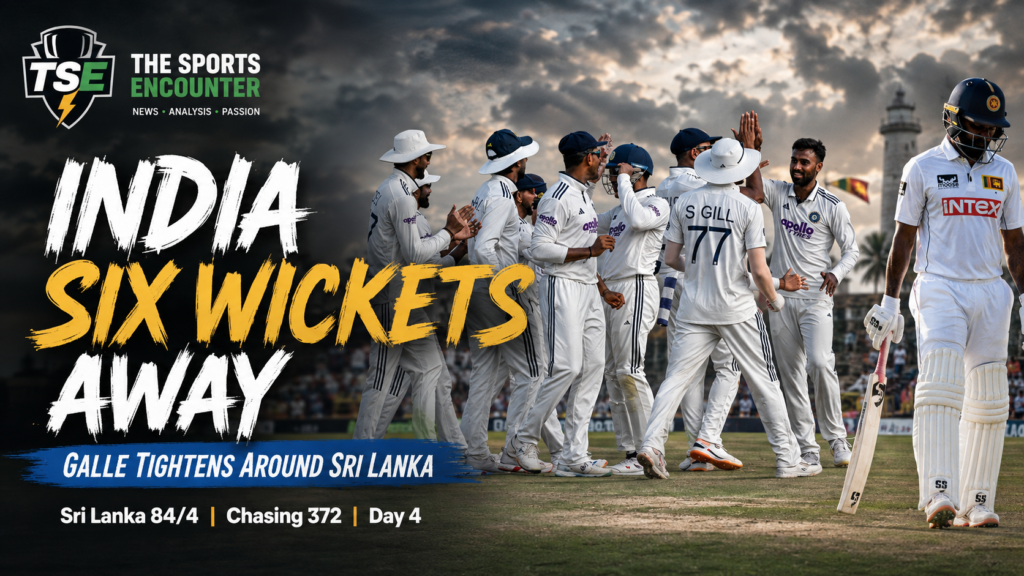
India spent the fourth day in Galle tightening a grip Sri Lanka have struggled to escape since the opening morning.
By stumps, the hosts were 84 for 4 chasing 372, still 288 runs short with only six wickets left. Dhananjaya de Silva remained unbeaten on 31 alongside first-innings centurion Sonal Dinusha on 25, but the broader picture is difficult to soften: India are one strong final-day session away from a victory that would feel thoroughly deserved.
The visitors did not dominate every passage of Day 4. They were bowled out for 193 in their second innings and lost wickets regularly while trying to accelerate. Yet they understood the match situation better. With rain already taking time out of the Test, India attacked the scoreboard, pushed the target beyond Sri Lanka’s realistic comfort zone, then used a disciplined combination of pace and spin to remove four top-order batters before bad light ended play.
Sri Lanka still have a route out of trouble.
It requires Dhananjaya and Dinusha to bat for a long time, Niroshan Dickwella to reproduce some of the resistance he showed in the first innings, and probably some help from the weather.
India, meanwhile, require six wickets.
That is the contest now.
Galle Test After Day 4: The Match Position
| Team | 1st Innings | 2nd Innings | Match Position |
|---|---|---|---|
| India | 462 | 193 | Set Sri Lanka 372 to win |
| Sri Lanka | 284 | 84/4 | Need 288 more runs |
India need: 6 wickets
Sri Lanka need: 288 runs
Day 5: August 19, 2026
Venue: Galle International Stadium
The state of the game reflects what The Sports Encounter identified before the series began in our Sri Lanka vs India Test series preview: Galle tends to punish teams that lose control of one or two sessions, and Sri Lanka have now spent too much of this match repairing damage rather than applying pressure.
India Did Not Need a Perfect Second Innings
India resumed Day 4 holding a first-innings lead of 178.
The objective was no longer to build another monumental score.
It was to create enough separation while leaving sufficient time to dismiss Sri Lanka again.
That distinction shaped the batting.
Yashasvi Jaiswal fell for a three-ball duck when Asitha Fernando found the edge. KL Rahul made 35, Devdutt Padikkal added 44 and captain Shubman Gill was dismissed for eight as Sri Lanka continued chipping away.
India were losing wickets, but the lead kept growing.
The innings did not need elegance.
It needed urgency.
That is why Rishabh Pant’s 66 became the decisive contribution.
Rishabh Pant Changed the Tempo of the Day
Pant scored 66 from 69 balls, striking eight fours and two sixes in an innings that pushed India away from any temptation to become conservative.
His method was familiar.
He attacked spin, pulled pace and kept searching for scoring opportunities even as wickets fell around him.
One sequence summed up the mood.
Lahiru Kumara struck Pant on the helmet with a bouncer.
Pant responded by pulling the next delivery for four.
He later fell attempting another aggressive pull, but by then the innings had done its job.
India reached 193, extending Sri Lanka’s target to 372.
It was enough to make survival the hosts’ more realistic objective.
Pant Becomes First Indian to 100 Test Sixes
The innings also carried personal history.
Pant became the first Indian batter to hit 100 sixes in Test cricket and only the fourth player overall to reach the landmark. He joined Ben Stokes, Brendon McCullum and Adam Gilchrist in that exclusive group. Reports from Galle also credited Pant with reaching the milestone faster than any previous batter in terms of Tests played.
The record fits Pant particularly well.
His Test career has rarely followed conventional batting logic. He attacks situations other batters try to survive, and he often turns the pressure of a deteriorating pitch into an argument for aggression rather than caution.
On Day 4, that instinct helped India create the time and scoreboard pressure their bowlers needed.
Sri Lanka Needed a Calm Start and Got the Opposite
A target of 372 at Galle was already severe.
The hosts’ only realistic plan was to reach stumps with most of their batting intact.
That possibility began disappearing quickly.
Mohammed Siraj removed Nishan Madushka for six, using a short ball effectively on a surface where the bounce remained inconsistent enough to make even defensive batting uncomfortable.
Then Manav Suthar struck.
Pasindu Sooriyabandara, playing as a concussion substitute for the injured Dinesh Chandimal, was given not out first ball after being hit on the pads.
Suthar persuaded Shubman Gill to review.
The decision was overturned.
Sri Lanka were 14 for 2.
Manav Suthar Has Become India’s Quiet Match-Winner
Suthar’s contribution deserves more attention than it may receive in a scorecard dominated by Padikkal’s 167 and Pant’s milestone.
The left-arm spinner took four wickets in Sri Lanka’s first innings and added two more on the fourth evening, finishing the day with figures of 2 for 30 in the second innings.
His value has come from pressure rather than spectacle.
He has repeatedly asked Sri Lanka’s batters to play from the crease, defend accurately and make decisions against deliveries that have begun turning more sharply as the Test has progressed.
That kind of bowling becomes especially dangerous in the fourth innings.
Batters know one mistake can end the match.
The result is hesitation.
Suthar has exploited it.
Kamindu Mendis’ Dismissal Exposed Sri Lanka’s Anxiety
Kamindu Mendis lasted only 12 balls.
Prasidh Krishna found the edge and KL Rahul completed the catch at first slip.
The dismissal mattered beyond the two runs Mendis contributed.
Sri Lanka needed one of their established middle-order batters to settle the chase.
Instead, another wicket disappeared before the innings had established any rhythm.
At 21 for 3, the chase had already become an exercise in damage control.
Lahiru Udara’s Wicket Left Sri Lanka With Almost No Margin
Lahiru Udara resisted longer than the early wickets suggested he might.
He made 16 from 58 balls, trying to absorb pressure rather than chase the target.
Suthar eventually removed him, with Dhruv Jurel taking the catch.
That left Sri Lanka 47 for 4.
From that point, Dhananjaya de Silva and Sonal Dinusha did what the top order had failed to do.
They stayed.
Dhananjaya de Silva Is Once Again Sri Lanka’s Crisis Man
There are few things more familiar in modern Sri Lankan Test cricket than Dhananjaya walking in with a repair job waiting for him.
He reached stumps on 31 from 73 balls.
The innings was not dramatic.
That was the point.
He defended carefully, trusted the occasional scoring opportunity and gave Sri Lanka a chance to carry meaningful resistance into the fifth morning.
There was also an enormous escape.
Dhananjaya edged Ravindra Jadeja to slip while on seven.
India began celebrating.
Then the no-ball signal arrived.
Jadeja had overstepped.
Had the delivery been legal, Sri Lanka would have been 32 for 4 much earlier, with even less batting left to protect the game.
Instead, their captain survived.
That moment remains one of the few pieces of fortune Sri Lanka can carry into Day 5.
Sonal Dinusha Has Already Saved Sri Lanka Once
Dinusha’s presence matters because he has already shown that he can bat through adversity in this match.
He scored 100 in Sri Lanka’s first innings, helping the hosts recover from 90 for 5 and avoid the follow-on alongside Niroshan Dickwella.
The Sports Encounter detailed that recovery in our Day 3 report from Galle.
Now he is being asked to do it again.
Dinusha ended Day 4 on 25 from 36 balls.
He looked more comfortable than several of the batters who preceded him, but the final day will ask a different question.
Can he survive long enough to turn India’s six-wicket requirement into a race against the clock?
Why Sri Lanka’s Top Order Has Failed Twice
The common thread across both Sri Lankan innings has been the inability of the top order to absorb India’s first wave.
In the first innings, Sri Lanka were reduced to 90 for 5 before Dinusha and Dickwella rebuilt.
In the second, they slipped to 47 for 4.
The bowlers have changed.
The pressure has not.
Siraj has attacked with pace and bounce.
Prasidh has created awkward angles.
Suthar has challenged both edges with turn.
Jadeja has offered almost nothing easy.
India have forced Sri Lanka to solve different problems without allowing enough time for the batters to settle into one method.
That is the hidden reason the visitors are six wickets away.
India Have Strangulated Sri Lanka Rather Than Blown Them Away
The strongest part of India’s Day 4 performance was not one magical spell.
It was the absence of release.
Sri Lanka finished the day scoring at 2.47 runs per over.
They were not attempting to chase aggressively, but even survival requires occasional pressure relief.
India rarely provided it.
Prasidh conceded 13 runs from eight overs.
Siraj gave away only 11 from five.
Suthar took two wickets while conceding 30 from 11.
Jadeja remained wicketless but still kept scoring difficult.
That is how a fourth-innings batting side begins to feel trapped.
Every maiden increases the importance of the next scoring opportunity.
Every boundary feels temporary.
Every defensive mistake becomes potentially fatal.
Chandimal Injury Leaves Sri Lanka With Another Problem
Sri Lanka’s task became harder when Dinesh Chandimal suffered neck and shoulder discomfort after an awkward fielding incident during India’s second innings.
He was taken to hospital for precautionary scans, and Pasindu Sooriyabandara entered the match as his concussion substitute.
Sooriyabandara’s first Test innings lasted one delivery.
He was trapped lbw by Suthar after India’s successful review.
The injury does not explain Sri Lanka’s overall position, but it removed experience from a batting order that badly needed it.
Can Sri Lanka Still Win?
Mathematically, yes.
Realistically, victory would require one of the greatest fourth-innings efforts ever produced at Galle.
Sri Lanka need 288 more runs with six wickets remaining.
The surface is deteriorating.
India have three frontline spinners available.
The hosts’ recognized batting beyond Dhananjaya, Dinusha and Dickwella is becoming thin.
A chase from here would require at least one enormous innings and probably two major partnerships.
Nothing about the first four days suggests that is the likely outcome.
Can Sri Lanka Save the Test?
This is the more realistic question.
A draw remains possible.
Weather has already interrupted the match, and bad light ended Day 4 at 84 for 4. Forecast concerns remain around the final day, meaning India may not necessarily receive a full allotment of overs.
That changes Sri Lanka’s objective.
They do not need 288 runs to frustrate India.
They need time.
If Dhananjaya and Dinusha can survive the first hour, every subsequent interruption becomes more valuable.
Dickwella then becomes critical.
He made 80 in the first innings and showed he can counterattack once settled.
Sri Lanka’s best escape route is therefore straightforward:
Survive early.
Force India into longer spells.
Make the old ball less responsive.
Let the weather become part of the game.
India’s Biggest Enemy on Day 5 May Be Time
India do not need to chase wickets recklessly.
They have a 287-run cushion.
The challenge is balancing patience with the possibility of shortened play.
If the weather stays clear, six wickets across a full day should feel manageable from this position.
If rain removes two sessions, the psychology changes.
Gill may need attacking fields for longer.
Jadeja and Suthar may have to bowl extended spells.
Siraj and Prasidh could become more valuable with the older ball if reverse movement appears.
The visitors have several ways to take wickets.
What they cannot manufacture is lost time.
Galle’s Fifth-Day Surface Should Favor India
Galle is one of the game’s classic spin venues.
By Day 5, the pitch usually becomes less predictable rather than more comfortable.
Turn matters.
So does variation.
The ball that goes straight can become as dangerous as the one that grips.
That is why Jadeja may still have a major role despite ending Day 4 without a wicket.
Sri Lankan batters have to account for turn.
Once they begin doing that, a ball that holds its line can find an edge or pad.
Suthar already demonstrated exactly that kind of threat.
India also have Kuldeep Yadav available, giving Gill another wrist-spin option if partnerships begin settling.
India’s First-Innings 462 Still Defines This Test
Day 4 created the immediate winning opportunity.
India’s first innings created the match.
Devdutt Padikkal’s 167, KL Rahul’s 82 and Dhruv Jurel’s 51 took India to 462.
Sri Lanka then made 284.
That 178-run advantage allowed India to bat aggressively the second time without fearing the consequences of losing wickets.
When Pant attacked on Tuesday, he was spending runs India had already earned.
This is why the visitors’ control feels deeper than one successful bowling session.
They have been ahead in the match for most of its duration.
Padikkal’s 167 Looks Bigger With Every Session
Padikkal’s first-innings century may not dominate the Day 4 headlines, but it remains the innings around which India’s advantage was constructed.
His 167 came from 230 balls and allowed India to build a total that Sri Lanka never truly matched.
The significance becomes clearer now.
If India had scored 350 rather than 462, Sri Lanka’s current situation might look survivable.
Because India reached 462, even Sri Lanka’s strong Dinusha-Dickwella partnership in the first innings only reduced the scale of the deficit.
It never erased it.
TSE Analysis: India Have Won the Match in Layers
The scoreboard says India need six wickets.
The deeper story is how many separate pieces have been required to reach this point.
Padikkal gave them first-innings scale.
Rahul provided stability.
Jurel added depth.
Suthar and Jadeja ensured Sri Lanka could not fully recover.
Pant accelerated the second innings.
Siraj and Prasidh attacked the new ball.
Suthar returned to expose a fragile top order again.
No single player has had to carry India across four days.
That may be the most encouraging aspect of their position.
The visitors have found different contributors for different phases.
Sri Lanka’s Problem Is Bigger Than 288 Runs
Focusing on the target alone misses the real challenge.
Sri Lanka are not simply 288 runs away.
They are trying to survive against an attack that has already dismissed them once for 284 and has removed four wickets in 34 second-innings overs.
The surface will be older.
The pressure will be greater.
The batting resources will be fewer.
Every new batter who arrives will know there is almost no margin for an error.
That psychological burden can become as important as the pitch.
What India Need to Do on Day 5
India’s blueprint should remain simple.
Remove one of the two overnight batters early.
If Dhananjaya falls, Sri Lanka lose their captain and most experienced remaining specialist batter.
If Dinusha falls, the player who has resisted India best across the match disappears.
Either wicket exposes Dickwella to immediate pressure.
From there, the tail is close.
The temptation will be to hunt wickets with every delivery.
India do not need to.
The same discipline that produced 84 for 4 can finish the game.
What Sri Lanka Need to Do on Day 5
The hosts should forget the target during the first session.
Trying to score 288 runs from this position creates unnecessary risk.
The first objective is reaching lunch.
Dhananjaya must continue batting as he did late on Day 4.
Dinusha needs to trust the method that produced his first-innings century.
Dickwella, if required, will have to balance counterattack with survival.
If Sri Lanka can enter the afternoon with only four or five wickets down, the weather and clock begin exerting pressure on India.
That is how the match can become uncomfortable again.
The World Test Championship Stakes Add Weight
This Test is also part of the ICC World Test Championship 2025-27 cycle.
Both teams entered the series needing points, which gives India’s position added significance.
The Sports Encounter’s series preview described the two matches as a major test for sides trying to stay relevant in the WTC race.
A road victory in Galle would therefore deliver more than a 1-0 series lead.
It would give India valuable away points in conditions where Sri Lanka traditionally expect to dictate terms.
Day 5 Could Still Produce One Last Twist
Test cricket has a habit of making certainty uncomfortable.
India are clearly ahead.
That does not mean the final day is ceremonial.
Dhananjaya has rescued Sri Lanka before.
Dinusha has already scored a century in this match.
Dickwella made 80.
Rain remains possible.
Bad light has already interfered.
Those are enough variables to prevent India from relaxing.
Still, Sri Lanka need almost everything to go their way.
India need six wickets.
That is why the visitors will wake up on Wednesday expecting to win rather than merely hoping to.
Frequently Asked Questions
What is the score after Day 4 of the Sri Lanka vs India first Test?
Sri Lanka are 84 for 4 in their second innings, chasing a target of 372. They need another 288 runs on Day 5, while India need six wickets.
What did India score in the second innings?
India were bowled out for 193. Rishabh Pant top-scored with 66, while Devdutt Padikkal made 44 and KL Rahul scored 35.
How many sixes has Rishabh Pant hit in Test cricket?
Pant reached 100 Test sixes during his 66 in Galle, becoming the first Indian and fourth batter overall to reach the landmark.
Who took Sri Lanka’s wickets on Day 4?
Manav Suthar took two wickets, while Mohammed Siraj and Prasidh Krishna claimed one each.
Who is unbeaten for Sri Lanka?
Captain Dhananjaya de Silva is unbeaten on 31 and Sonal Dinusha is 25 not out.
Why is Pasindu Sooriyabandara playing?
Sooriyabandara entered as a concussion substitute after Dinesh Chandimal suffered neck and shoulder discomfort and was sent for precautionary scans.
Can Sri Lanka still win the Test?
Yes mathematically, but they require another 288 runs with six wickets remaining on a deteriorating Galle surface. A draw appears more realistic than victory if the overnight partnership survives and weather removes significant playing time.
Can rain save Sri Lanka?
It could become a factor. Weather concerns remain for the final day, and bad light already ended Day 4 early. India therefore need to use their available time efficiently.
When does Day 5 begin?
The fifth and final day is scheduled for Wednesday, August 19, 2026, at Galle International Stadium.
India Can See the Finish Line
Four days into the Galle Test, India have reduced the equation to its simplest form.
Six wickets.
Sri Lanka have a much more complicated problem.
They need 288 runs, a long partnership, resistance from the lower order and probably cooperation from the weather.
Dhananjaya de Silva and Sonal Dinusha have kept a small opening alive.
India have spent four days closing almost every other one.
The visitors built the biggest first-innings total, controlled Sri Lanka’s recovery, attacked quickly enough in their second innings and then exposed the hosts’ top order for the second time.
They have not blown Sri Lanka away in one dramatic burst.
They have strangulated the match session by session.
One final squeeze should be enough.
Follow The Sports Encounter’s cricket coverage for the Day 5 result, analysis from the India-Sri Lanka series and the biggest stories from Test cricket around the world.