


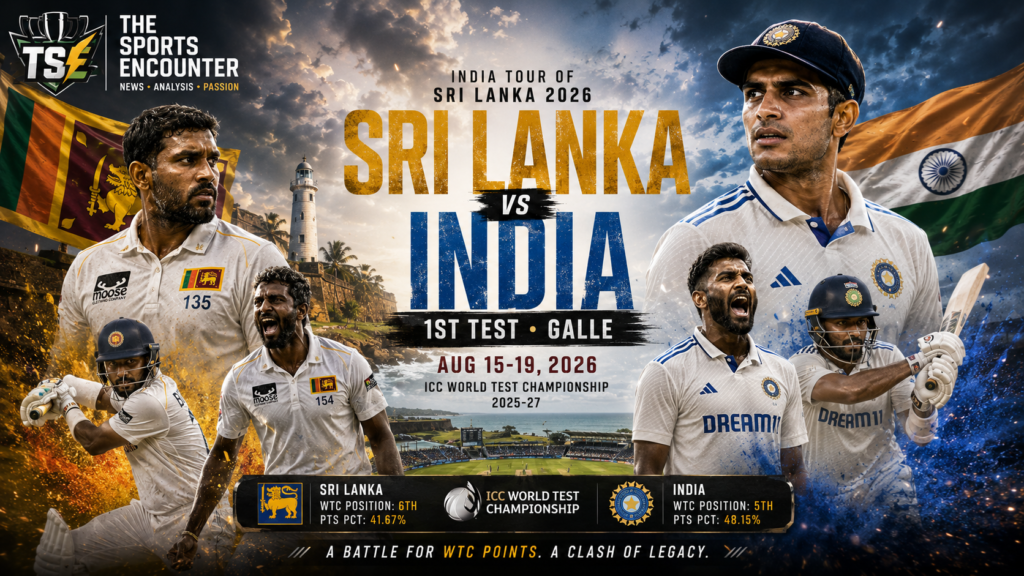
Published: August 12, 2026
Galle has a habit of making Test cricket uncomfortable.
Batters arrive knowing the surface may deteriorate beneath them. Spinners know patience can suddenly turn into wickets. Captains understand that one poor session can grow into a result before a team has time to recover.
That makes it an appropriate place for India and Sri Lanka to meet on August 15.
Neither side enters this two-Test series completely settled.
India are fifth in the ICC World Test Championship standings after four victories and four defeats from nine Tests. Sri Lanka sit one place lower, having won only one of their first four matches in the current cycle.
Both teams have injury problems.
India are without Jasprit Bumrah and Sai Sudharsan. Washington Sundar was unavailable for selection for the opening Test. Sri Lanka have lost Pathum Nissanka following wrist surgery and Kusal Mendis to a hamstring injury.
Both teams are also trying to understand what comes next.
Shubman Gill is leading an Indian Test side increasingly separated from the generation that carried the country through much of the previous decade. Ajinkya Rahane has retired. Bumrah is unavailable. Younger batters are being asked to establish themselves quickly, while Ravindra Jadeja remains the experienced all-round pillar around whom much of the side’s balance still revolves.
Sri Lanka have different questions.
Dhananjaya de Silva remains captain. Kamindu Mendis has emerged as one of the most productive young Test batters in the world. Dinesh Chandimal continues to supply experience. Prabath Jayasuriya remains devastating in favorable conditions.
Yet their recent red-ball results have been inconsistent, their batting has been disrupted by injuries and their last Test series ended with serious questions about whether their home advantage remains as intimidating as it once was.
So this is not simply India touring Sri Lanka again.
It is a World Test Championship pressure series between two teams whose margins for error are already shrinking.
Readers can follow every major red-ball development through The Sports Encounter Cricket Hub and our wider cricket news and analysis coverage.
Sri Lanka vs India Test Series 2026: Key Information
| Detail | Information |
|---|---|
| Series | India tour of Sri Lanka 2026 |
| Format | Two Tests |
| Competition | ICC World Test Championship 2025-27 |
| First Test | August 15-19, 2026 |
| First Test Venue | Galle International Stadium |
| Second Test | August 23-27, 2026 |
| Second Test Venue | Sinhalese Sports Club, Colombo |
| Sri Lanka Captain | Dhananjaya de Silva |
| India Captain | Shubman Gill |
| First Test Start | 10:00 a.m. local time |
Sri Lanka Cricket officially confirmed the two-Test tour, while the ICC has highlighted the series as an important World Test Championship opportunity for both teams.
World Test Championship Pressure Changes the Meaning of This Series
The table provides the clearest explanation for why these two Tests matter.
| Team | Tests | Wins | Points Percentage | WTC Position |
|---|---|---|---|---|
| India | 9 | 4 | 48.15% | 5th |
| Sri Lanka | 4 | 1 | 41.67% | 6th |
The official ICC World Test Championship standings show both countries outside the current top two.
India have already played half of their championship schedule.
That creates urgency.
They have Australia, Sri Lanka and New Zealand remaining in the cycle. Losing substantial points in Galle and Colombo would place enormous pressure on the later series.
Sri Lanka have played fewer Tests, but their position is hardly comfortable.
They began the cycle positively against Bangladesh before losing momentum against West Indies. Their remaining schedule includes India, South Africa, Pakistan and New Zealand.
A home series is therefore something Sri Lanka cannot afford to waste.
This is where the WTC has changed bilateral cricket.
Twenty years ago, a two-Test series between India and Sri Lanka might have existed largely within its own context.
Now every defeat travels.
It remains on the standings months later.
India know that better than most. They have reached two World Test Championship finals and lost both, including the inaugural final against New Zealand. The scale of that achievement and disappointment remains part of the legacy explored in The Sports Encounter’s retrospective on Kane Williamson and New Zealand’s 2021 WTC triumph.
India Enter Galle Without Jasprit Bumrah
India’s biggest absence is obvious.
Jasprit Bumrah is not part of the touring squad.
The BCCI had initially made his inclusion dependent on fitness clearance, but he was subsequently replaced by Auqib Nabi. The BCCI officially confirmed Nabi as Bumrah’s replacement.
India can survive without Bumrah more easily in Sri Lanka than they could in Australia or England because Galle is likely to favor spin increasingly as the match develops.
That should not disguise the loss.
Bumrah changes a Test before conditions become helpful.
He gives India wickets with a new ball, reverse swing with an older one and control when a partnership begins building.
Without him, Mohammed Siraj becomes the senior fast bowler.
Prasidh Krishna, Gurnoor Brar and Auqib Nabi provide additional seam options, but none carries Bumrah’s certainty.
That changes how much pressure falls on Jadeja and Kuldeep Yadav.
Sai Sudharsan’s Injury Opens the Door for Sarfaraz Khan
India suffered another injury before departure when Sai Sudharsan developed a stress reaction in his right toe.
He has been ruled out of the full series.
Sarfaraz Khan has replaced him after making significant runs in domestic cricket. The BCCI confirmed Sarfaraz’s recall on August 9.
Sarfaraz has played six Tests, scoring 371 runs with one century and three half-centuries.
His first-class average remains exceptional.
Yet the interesting question is not simply whether he plays.
It is where.
India already have KL Rahul, Yashasvi Jaiswal, Gill, Rishabh Pant, Devdutt Padikkal and possibly Sarfaraz competing for batting positions.
The injury removes one contender but does not eliminate the selection debate.
Shubman Gill Is Fit and Ready
Gill’s absence from India’s first innings in the tour match briefly created another concern.
That issue appears resolved.
The team described the decision as precautionary rather than a significant injury problem.
Gill returned in the second innings and scored 44 from 54 balls.
His fitness matters because India need more from Gill than captaincy.
He is their leading run-scorer in the current WTC cycle.
The ICC lists him among India’s central performers during a campaign in which the side has struggled to create consistent momentum.
Gill now faces a different leadership challenge from captaining in England or India.
Galle demands patience from captains.
Fields often need to remain attacking even when wickets do not arrive immediately.
Spinners may have to bowl through quiet passages before the surface suddenly begins responding.
Burning reviews, changing plans every two overs or reacting emotionally to one counterattacking partnership can be expensive.
This series may tell us as much about Gill the captain as Gill the batter.
India’s Test Identity Is Changing Around Him
The timing adds another layer.
Ajinkya Rahane officially retired from international cricket in July, removing another figure associated with India’s previous red-ball generation.
Rahane’s importance was rarely captured by averages alone. His record in difficult overseas conditions and his unbeaten Test captaincy run made him one of India’s great crisis managers, a legacy explored in our detailed tribute to Ajinkya Rahane.
Gill’s India must now create its own version of that resilience.
KL Rahul provides experience.
Jadeja provides continuity.
Pant provides counterattack.
Siraj provides aggression.
The rest of the batting order increasingly belongs to a new generation.
Ravindra Jadeja May Be India’s Most Important Player in the Series
In Galle, the most valuable player may not be the captain.
Jadeja gives India control in three disciplines.
His left-arm spin can exploit deteriorating surfaces.
His batting allows India to extend an innings after the top order has been broken.
His fielding adds pressure around the bat, where half-chances become wickets.
He also remains the world’s leading Test all-rounder in the latest rankings covered by The Sports Encounter. Our analysis of the Test rankings showed Jadeja maintaining a commanding position at No. 1 among all-rounders.
India’s dependence on him also connects to a broader structural issue. The country’s shortage of dependable multi-format all-rounders beyond Jadeja and a few specialists has been examined in our investigation into India’s developing all-rounder problem.
Washington Sundar’s absence for the opening Test makes Jadeja even more valuable.
Kuldeep Yadav Could Become India’s Match-Winner
Kuldeep offers something different from Jadeja.
Jadeja compresses scoring.
Kuldeep creates uncertainty.
His wrist-spin, changes of pace and ability to attack both edges make him a natural wicket-taking option when batters attempt to settle against conventional spin.
The tactical question is how India balance the attack.
At Galle, playing both Jadeja and Kuldeep appears logical.
Manav Suthar and Saransh Jain provide additional spin options.
India could therefore field three specialist or near-specialist spinners depending on the surface.
The temptation should be resisted if conditions show significant early assistance for seam.
Galle has a reputation for spin, but the new ball can still matter.
Sri Lanka Have Their Own Injury Crisis
The hosts enter with two substantial batting absences.
Pathum Nissanka remains unavailable while recovering from wrist surgery.
Kusal Mendis is out with a hamstring injury.
Those absences weaken both the top order and the wicketkeeping options.
Nissanka had been Sri Lanka’s leading run-scorer in the current WTC cycle.
Kusal Mendis provides experience, strokeplay and the ability to change momentum quickly.
Losing both places additional responsibility on Dinesh Chandimal, Kamindu Mendis and Dhananjaya de Silva.
Niroshan Dickwella Returns After Three Years
Kusal’s injury has created one of the series’ most intriguing comeback stories.
Niroshan Dickwella is back in Sri Lanka’s Test squad three years after his last international appearance.
The wicketkeeper-batter is now 33.
His return is not a sentimental selection.
Sri Lanka need experience behind the stumps and flexibility in the lower middle order.
Dickwella has always been unconventional.
He sweeps early, attacks spin and can disturb a bowler’s length.
Those qualities can be valuable in Galle, particularly if Jadeja and Kuldeep begin controlling the middle overs.
They can also create risk.
India will know Dickwella rarely allows a quiet contest to remain quiet.
Sri Lanka Have Selected Two Uncapped Players
Keshara Nuwantha and Pasindu Sooriyabandara provide the new faces.
Nuwantha is particularly interesting.
The 25-year-old off-spinner has only limited first-class experience but recently impressed against India A in Galle and also bowled against India in the tour match.
His inclusion gives Sri Lanka another spin option alongside Prabath Jayasuriya and Ramesh Mendis.
Sooriyabandara gives the selectors additional top-order cover with Nissanka unavailable.
The hosts therefore face a familiar Test-selection tension.
Do they trust established names or use home conditions to introduce younger players?
Prabath Jayasuriya Is the Bowler India Must Solve
Every serious India game plan should begin here.
Prabath Jayasuriya has built an extraordinary Test record in Sri Lanka.
His numbers at Galle are particularly dangerous.
He does not require spectacular turn every delivery.
His effectiveness comes from repetition.
He attacks the stumps.
He forces batters to play.
He changes pace subtly enough that the same defensive stroke does not always produce the same result.
The ICC’s official player profile reflects how quickly Jayasuriya has become one of Sri Lanka’s defining Test bowlers since his debut.
India’s right-handed batters face a particular problem.
Gill and Rahul cannot simply defend him for entire sessions.
They need rotation.
They need controlled use of the feet.
They need to stop close catchers from becoming increasingly aggressive.
Galle Is Where Jayasuriya Became a Test Force
His relationship with the venue matters.
Jayasuriya announced himself in spectacular fashion against Australia in 2022, taking 12 wickets on debut as Sri Lanka produced an innings victory.
He subsequently became the fastest spinner in more than seven decades to reach 50 Test wickets.
This is why India cannot treat him as simply another left-arm spinner.
Galle has already amplified his strengths repeatedly.
Dinesh Chandimal Is Still Sri Lanka’s Stability Point
Chandimal enters with strong recent numbers.
Across his most recent ten Tests, he has scored 874 runs at an average of 48.56.
That consistency is important because Sri Lanka’s top order has been disrupted.
Chandimal may bat at No. 3.
If he does, India should attack him immediately rather than simply wait for spin to become dominant.
Siraj can challenge him with the new ball.
Kuldeep may become the more interesting matchup later because Chandimal uses his feet well against conventional spin.
Kamindu Mendis Has Become Sri Lanka’s Modern Test Pillar
Kamindu’s rise has changed Sri Lanka’s batting outlook.
He has produced 758 runs across his recent ten Tests at an average of 47.38.
Those numbers confirm that his extraordinary early Test form was not merely a brief burst.
Kamindu bats with calmness that becomes especially useful on turning pitches.
He does not need the surface to be easy.
He needs enough time to understand it.
India’s task is therefore to remove him before he becomes comfortable rotating Jadeja and Kuldeep.
His importance was visible during Sri Lanka’s difficult West Indies tour. The Sports Encounter’s analysis of Sri Lanka’s heavy North Sound defeat showed how quickly the batting lineup can unravel when its central players are removed before partnerships develop.
Dhananjaya de Silva Has to Lead With the Bat Too
Sri Lanka’s captain faces the same dual responsibility as Gill.
Dhananjaya cannot contribute only tactically.
His batting at No. 5 may become the hinge between a competitive total and a collapse.
He is particularly important against Jadeja because right-handed middle-order batters who remain trapped on the crease can disappear quickly against India’s left-arm spinner.
Dhananjaya needs to decide when to defend and when to disrupt.
That balance will influence Sri Lanka’s entire innings.
Sri Lanka Have Selected More Fast Bowlers Than Expected
The squad includes Asitha Fernando, Lahiru Kumara, Vishwa Fernando and Dilshan Madushanka, with Milan Rathnayaka providing another seam-bowling option.
That is unusual depth for a Sri Lankan home Test squad.
It suggests the selectors do not want Galle’s reputation to dictate the attack before they see the pitch.
Asitha is almost certain to play.
He has taken 25 wickets across his most recent nine Tests.
The second seam position is less obvious.
Lahiru offers pace.
Vishwa provides a left-arm angle.
Madushanka brings another left-arm option but has played only one Test and is still searching for his first wicket in the format.
Dilshan Madushanka Is the Wildcard Selection
Madushanka has spent much of the recent period playing T20 cricket.
He did not feature prominently in Sri Lanka’s recent four-day structure and has not played a Test since his debut against Pakistan in 2023.
Selecting him would therefore represent an aggressive choice.
His left-arm angle against India’s right-handers could be useful early.
The tradeoff is red-ball rhythm.
Galle often rewards bowlers who understand how to build pressure across long spells rather than chase wickets immediately.
Sri Lanka’s Likely XI
The final lineup has not been confirmed, but the current squad balance points toward something close to:
- Lahiru Udara
- Nishan Madushka
- Dinesh Chandimal
- Kamindu Mendis
- Dhananjaya de Silva (c)
- Niroshan Dickwella (wk)
- Ramesh Mendis or Sonal Dinusha
- Prabath Jayasuriya
- Asitha Fernando
- Lahiru Kumara or Vishwa Fernando
- Keshara Nuwantha or another bowling option
The ICC confirmed Sri Lanka’s 16-player first-Test squad on August 12.
India’s Likely XI
India have more flexibility but may lean heavily toward spin.
- Yashasvi Jaiswal
- KL Rahul
- Shubman Gill (c)
- Devdutt Padikkal or Sarfaraz Khan
- Rishabh Pant (wk)
- Ravindra Jadeja
- Dhruv Jurel or another batting/bowling option
- Kuldeep Yadav
- Mohammed Siraj
- Prasidh Krishna
- Manav Suthar or additional spinner
The official BCCI squad announcement gives India several possible combinations.
Choosing between batting depth and a third spinner may become the defining selection call.
Gill and Rahul Give India Their Strongest Batting Foundation
The recent numbers are impressive.
| Batter | Recent Matches | Runs | Average |
|---|---|---|---|
| Shubman Gill | 9 | 1,076 | 82.77 |
| KL Rahul | 10 | 896 | 52.71 |
| Dinesh Chandimal | 10 | 874 | 48.56 |
| Kamindu Mendis | 10 | 758 | 47.38 |
Gill’s recent scoring is exceptional.
Rahul’s contribution may be even more important structurally.
Opening in Galle requires judgment.
There may be early seam.
Spin can arrive quickly.
Reverse swing may appear later.
A batter who survives 80 balls can change the match even before reaching fifty because he exposes how the pitch is behaving for everyone behind him.
Rishabh Pant Can Break Galle’s Usual Rhythm
Pant is the batter Sri Lanka may fear most if he reaches the middle with India stable.
Conventional defensive batting allows close catchers to grow into the contest.
Pant attacks that environment.
He can sweep Jayasuriya.
He can use his feet.
He can hit over the infield.
The challenge is choosing the right moment.
A reckless 35 can look entertaining but leave India exposed.
A controlled 75 scored quickly can change a Test.
India vs Sri Lanka Test History: India Hold the Advantage
India have generally controlled the rivalry.
The most recent five Tests strongly favor them.
| Date | Result |
|---|---|
| March 12, 2022 | India won by 238 runs |
| March 4, 2022 | India won by an innings and 222 runs |
| December 2, 2017 | Draw |
| November 24, 2017 | India won by an innings and 239 runs |
| November 16, 2017 | Draw |
The location matters.
All five of those matches were played in India.
Galle changes the equation.
Sri Lanka’s best route to beating India has historically involved creating surfaces where their spinners can influence every stage of the match rather than allowing India to rely on greater batting depth.
India’s Previous Sri Lankan Success Should Still Give Them Confidence
India have won important Test series in Sri Lanka before.
The rivalry has also produced several turning points in Indian red-ball history.
Virat Kohli’s early captaincy era was shaped partly by overseas victories in Sri Lanka.
Rahane, Jadeja, Ashwin and other members of India’s previous generation learned to win in conditions that demanded aggressive spin bowling and disciplined batting.
That history gives India experience at an institutional level even though the lineup itself has changed.
Galle International Stadium: The Surface Is Part of the Contest
Few major Test venues have identities as strong as Galle.
The sea sits beside the ground.
Wind can influence movement.
Humidity adds physical strain.
The pitch often begins better for batting than its reputation suggests.
Then the surface changes.
Footmarks grow.
Turn becomes less predictable.
Defensive strokes become dangerous.
Batters who delayed scoring on day one sometimes regret it on day three.
The Toss Matters, but Not for the Simplistic Reason
Bat first and avoid batting last.
That is the conventional Galle logic.
Reality is more nuanced.
If early moisture or overhead conditions offer significant movement, batting first can become dangerous.
A captain has to judge the specific pitch, not the venue’s mythology.
Still, neither side will enjoy chasing a substantial target on days four or five.
That increases the value of first-innings runs.
Key Battle No. 1: Shubman Gill vs Prabath Jayasuriya
This may define the series.
Gill likes to score through timing rather than constant physical aggression.
Jayasuriya wants batters trapped between defense and rotation.
If Gill allows too many consecutive dot balls, close catchers will surround him.
If he attacks too early, Jayasuriya can use changes of pace and trajectory against him.
The answer lies somewhere between.
Key Battle No. 2: Kamindu Mendis vs Ravindra Jadeja
Kamindu has the technique and temperament to become Sri Lanka’s best batter in the series.
Jadeja does not give batters time to think.
His speed through the air means footwork decisions have to be made early.
Kamindu must score square and behind the wicket without allowing Jadeja to attack one line indefinitely.
Key Battle No. 3: Rishabh Pant vs Prabath Jayasuriya
This matchup could become spectacular.
Pant will not allow Jayasuriya to bowl quietly.
Jayasuriya will not be intimidated simply because Pant hits one six.
The winner may be determined by discipline rather than aggression.
If Pant forces a defensive field without sacrificing his wicket, India gain an enormous advantage.
Key Battle No. 4: Dinesh Chandimal vs Kuldeep Yadav
Chandimal’s experience against finger spin makes Kuldeep potentially more dangerous.
Wrist-spin changes the visual information.
Chandimal must read length from the hand rather than rely entirely on the pitch.
Kuldeep’s ability to attack both edges gives Gill a natural wicket-taking option when conventional pressure is not working.
Key Battle No. 5: Mohammed Siraj vs Sri Lanka’s Openers
Bumrah’s absence makes Siraj’s new-ball role critical.
Sri Lanka are likely to open with Lahiru Udara and Nishan Madushka.
Neither should be allowed to settle.
Siraj must attack the stumps and outside edge before spin takes over.
Two early wickets would expose Chandimal and Kamindu against a hard ball rather than allowing them to begin against slow bowling.
Key Battle No. 6: KL Rahul vs Asitha Fernando
Rahul’s job begins before the spinners become central.
Asitha is Sri Lanka’s most dependable fast bowler.
He can move the new ball, hit the seam and attack the stumps.
If Rahul survives him, India gain the platform they need.
If Asitha removes an opener quickly, Jayasuriya enters the game against a fresh batter.
TSE Analysis: India’s Biggest Risk Is Assuming They Automatically Play Spin Better
This is the lazy assumption surrounding the series.
India produce elite spinners.
Indian batters grow up facing spin.
Therefore India should dominate spin.
Modern cricket is more complicated.
Many Indian batters spend enormous parts of the calendar facing pace-heavy attacks and white-ball fields.
Long defensive spells against accurate spin are different.
Galle also adds variable bounce.
Jayasuriya does not need to turn the ball dramatically to create wickets.
India’s technique against spin may be stronger than most touring sides.
That does not make them immune.
Sri Lanka’s Biggest Risk Is Depending Entirely on the Pitch
The reverse danger exists for the hosts.
Sri Lanka cannot simply select three spinners, wait for the pitch to deteriorate and assume the match will bend toward them.
India possess Jadeja and Kuldeep.
If the surface becomes extremely spin-friendly, India may have the superior attack.
Sri Lanka therefore need scoreboard pressure.
Three hundred and fifty in the first innings gives Jayasuriya something to defend.
Two hundred and twenty does not.
Why the First Innings Could Decide Both Tests
Spin-heavy series often look chaotic late.
The foundations are usually built early.
The side making the larger first-innings total controls when the other team has to attack.
That changes field settings.
It changes batting risk.
It changes how spinners bowl.
A bowler defending 150 behaves differently from one defending 280.
This is why first-innings partnerships should matter more than spectacular fourth-day wickets.
Can India’s Lower Order Outscore Sri Lanka’s?
This could quietly decide the series.
Jadeja gives India serious lower-order batting.
Pant may bat above him.
Depending on selection, India could also have Jurel or another capable contributor.
Sri Lanka counter with Dickwella, Ramesh Mendis, Sonal Dinusha or Milan Rathnayaka.
In low-scoring Test matches, 60 runs from Nos. 7 to 9 can be the difference between defending 180 and chasing 240.
India’s World Test Championship Margin Is Already Thin
India’s 48.15% points percentage matters psychologically.
The team have been in the WTC final twice.
Missing the next one would represent a significant regression.
They have Australia still to come.
That makes Sri Lanka one of the more manageable remaining assignments on paper.
Dropping the series would force India to recover those points against stronger opposition later.
That is a bad exchange.
The larger pressure around modern Test rankings and long-term performance has been visible across the sport. The Sports Encounter recently examined how individual rankings and championship narratives increasingly shape legacy in our analysis of Joe Root’s pursuit of Sachin Tendulkar’s Test records.
Sri Lanka Have an Even Bigger Opportunity
Sri Lanka’s position may be worse, but their opportunity is arguably better.
They are at home.
Bumrah is absent.
India have a changing batting order.
Sai Sudharsan is unavailable.
Washington Sundar is missing from the opening Test.
Galle suits Sri Lanka’s strongest bowler.
Those circumstances may not align again.
If Sri Lanka want to become genuine WTC contenders, this is the kind of series they must win.
Free Entry Could Give Galle an Extra Edge
Sri Lanka Cricket has announced free public admission for the series.
The initiative covers both Tests and could help create a stronger atmosphere, particularly in Galle.
Fans can access the official details through Sri Lanka Cricket’s public admission announcement.
That may sound like a commercial detail.
It can matter competitively.
A full or energetic Galle crowd becomes part of the pressure when close catchers are appealing repeatedly and the visiting batting lineup begins losing wickets.
The Series Also Lands Inside an Extraordinary Test Cricket Month
India and Sri Lanka will not be playing in isolation.
Australia and Bangladesh begin their series two days earlier.
England and Pakistan join the red-ball calendar while the Galle Test is still scheduled to be in progress.
August therefore becomes an unusual celebration of Test cricket across three regions.
The format’s survival and future remain constant discussion points, but stretches like this show why five-day cricket still produces contexts no franchise competition can reproduce.
Our recent coverage of Test cricket’s changing landscape, including Pakistan finally ending its long overseas Test drought, shows how much bilateral red-ball victories still matter to national teams.
What India Must Do to Win the Series
1. Score Before the Pitch Becomes Difficult
India should not confuse patience with inactivity.
Good balls must be respected.
Bad balls must disappear.
Waiting until day three to accelerate is risky at Galle.
2. Prevent Jayasuriya From Controlling Both Ends
India do not need to destroy him.
They need to stop him from bowling ten overs for twenty runs while taking two wickets.
Rotation is essential.
3. Get New-Ball Wickets
Siraj becomes critical.
Sri Lanka’s experienced middle order becomes harder to dislodge once the ball softens.
4. Use Kuldeep as an Attacking Weapon
Do not turn him into a containment bowler.
India have Jadeja for control.
Kuldeep should be allowed to attack.
5. Keep Pant’s Aggression Structured
His counterattack can break the series open.
His dismissal can do the same for Sri Lanka.
What Sri Lanka Must Do to Win
1. Protect Jayasuriya With Runs
Even great spinners need scoreboard pressure.
2. Make Gill Bat Against Spin Early
The sooner India’s captain faces Jayasuriya with catchers around the bat, the better.
3. Use Asitha Aggressively
Sri Lanka should not simply wait for the ball to become old.
India’s openers need to be challenged immediately.
4. Get Kamindu and Chandimal Through the First Session
Their experience and recent form make them Sri Lanka’s best batting route.
5. Avoid Depending on One Huge Individual Performance
Sri Lanka need partnerships, not rescue missions.
Who Has More to Lose?
India.
The expectations are higher.
The resources are greater.
The WTC history is stronger.
India should expect to compete for finals.
Losing in Sri Lanka would make the remaining cycle considerably more difficult.
Yet Sri Lanka have more to gain.
A series victory over India would change the perception of their current Test side and immediately restore momentum to a WTC campaign that has begun inconsistently.
First Test Prediction
Galle narrows the difference between the teams.
India possess greater depth.
Sri Lanka possess conditions.
India have Jadeja and Kuldeep.
Sri Lanka have Jayasuriya.
Gill and Rahul arrive in strong form.
Chandimal and Kamindu give Sri Lanka proven red-ball resistance.
The toss could matter.
The first innings will matter more.
The Sports Encounter Prediction
| Category | TSE Assessment |
|---|---|
| First Test favorite | India, narrowly |
| Series prediction | India 1-0 |
| Most likely draw | Second Test in Colombo |
| India player to watch | Shubman Gill |
| Sri Lanka player to watch | Prabath Jayasuriya |
| Potential series game-changer | Ravindra Jadeja |
| Dark horse | Kamindu Mendis |
| Critical tactical area | First-innings batting against spin |
India deserve favoritism because their spin attack may actually become stronger relative to Sri Lanka’s if conditions deteriorate sharply.
Their batting also has greater depth.
However, a 2-0 prediction feels too aggressive.
Bumrah’s absence matters.
Galle can punish one poor batting session.
Sri Lanka have enough spin quality and experienced batting to make at least one Test extremely uncomfortable.
Final Verdict: This Is a Series About Who Can Handle Imperfection Better
Neither team arrives complete.
India are missing their best fast bowler.
Sri Lanka are missing two important batters.
India have selection questions.
Sri Lanka have form questions.
Gill is learning how to captain through a changing Test era.
Dhananjaya is trying to keep Sri Lanka relevant in a championship race where home defeats are especially damaging.
That is what makes this series interesting.
The strongest team on paper may not win every session.
The side that manages difficult periods better probably wins the series.
Galle will test technique first.
Then temperament.
Then captaincy.
If the pitch deteriorates, batting will increasingly become an exercise in problem solving.
India possess more individual solutions.
Sri Lanka possess greater familiarity with the questions.
The margins could therefore become much smaller than the reputations suggest.
India need points because Australia waits later in the cycle.
Sri Lanka need points because home opportunities cannot be recovered once they disappear.
That changes the emotional temperature of what might otherwise have looked like another short bilateral series.
By the time the teams leave Colombo on August 27, one could be climbing back toward the World Test Championship final race.
The other may already be looking at the remaining schedule and calculating how many mistakes it can still afford.
Frequently Asked Questions
When does the Sri Lanka vs India first Test begin?
The opening Test begins on August 15, 2026, at Galle International Stadium.
What time does the first Test start?
Play is scheduled to begin at 10:00 a.m. local time.
Where will the second Test be played?
The second Test will be played at the Sinhalese Sports Club in Colombo from August 23 to 27.
Is the series part of the World Test Championship?
Yes. Both matches count toward the ICC World Test Championship 2025-27.
Where are India in the WTC standings?
India enter the series fifth with a points percentage of 48.15.
Where are Sri Lanka in the WTC standings?
Sri Lanka are sixth at 41.67%.
Is Jasprit Bumrah playing against Sri Lanka?
No. Bumrah is unavailable and Auqib Nabi has replaced him in India’s Test squad.
Why is Sai Sudharsan not playing?
Sai Sudharsan has been ruled out because of a stress reaction in his right toe. Sarfaraz Khan has replaced him.
Is Shubman Gill fit?
Yes. India described his absence from the first innings of the tour match as precautionary. Gill returned in the second innings and scored 44.
Is Washington Sundar available?
Washington Sundar was unavailable for selection for the opening Test.
Why is Pathum Nissanka missing?
Nissanka continues to recover from wrist surgery and is unavailable for the series opener.
Why is Kusal Mendis unavailable?
Kusal Mendis has been ruled out with a hamstring injury.
Has Niroshan Dickwella returned?
Yes. Dickwella has been recalled to Sri Lanka’s Test squad three years after his previous international appearance.
Who is Sri Lanka’s captain?
Dhananjaya de Silva captains Sri Lanka, with Kamindu Mendis serving as vice-captain.
Who is India’s captain?
Shubman Gill leads India.
Who is Sri Lanka’s main spin bowler?
Prabath Jayasuriya remains Sri Lanka’s principal specialist spinner and is particularly dangerous at Galle.
Who are India’s likely main spinners?
Ravindra Jadeja and Kuldeep Yadav are expected to play central roles, with Manav Suthar and Saransh Jain providing additional options.
Who are the leading batters to watch?
Shubman Gill and KL Rahul enter with strong recent numbers for India, while Dinesh Chandimal and Kamindu Mendis have been Sri Lanka’s most consistent recent batters.
Who are favorites to win the series?
India begin as narrow favorites because of their deeper batting lineup and high-quality spin combination, but Sri Lanka’s home advantage and Prabath Jayasuriya make a comfortable Indian victory far from guaranteed.
What is The Sports Encounter’s series prediction?
The Sports Encounter predicts India to win the two-Test series 1-0, with Sri Lanka capable of forcing at least one close contest or draw if their senior batters provide enough first-innings runs.