


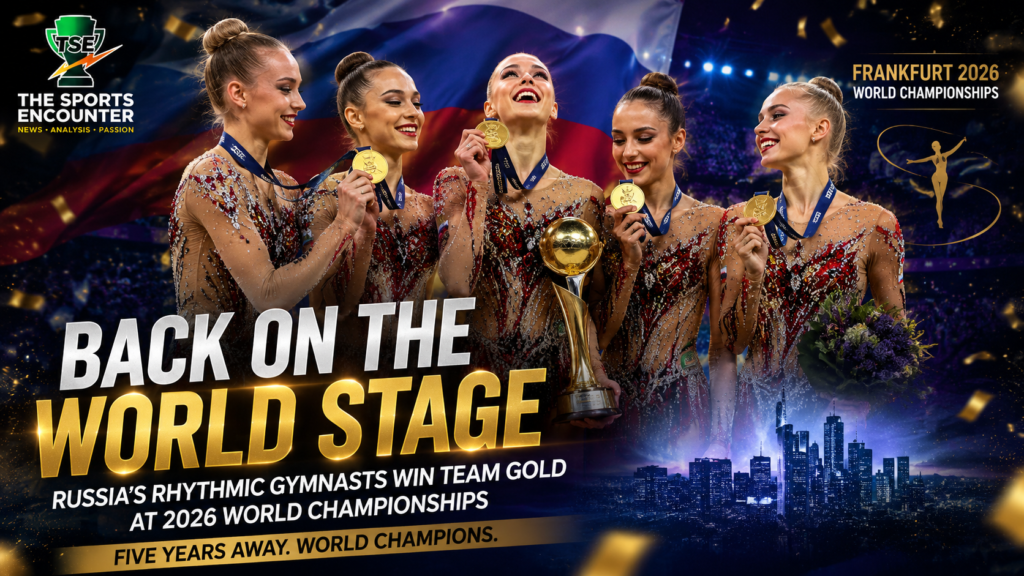
For five years, a generation of Russian rhythmic gymnasts trained for a stage they could not be certain they would ever reach.
They learned routines, rebuilt them, competed wherever opportunities existed, watched the international hierarchy change, and grew from promising juniors into senior athletes while the World Championships continued without them.
Then Frankfurt finally gave them their measuring stick.
Russia returned to the Rhythmic Gymnastics World Championships in August 2026 for the first time since 2021. Most of the athletes carrying the country’s expectations had never experienced a senior World Championship themselves.
By the end of the competition, they had something considerably stronger than nostalgia to take home.
They had a world title.
Russia won the team competition at the 42nd Rhythmic Gymnastics World Championships in Frankfurt, scoring 278.300 points to finish ahead of Bulgaria and China.
The result immediately turned a long-awaited return into a story of resilience, regeneration and a new generation proving that Russian rhythmic gymnastics could still compete at the highest level after five years away from the sport’s biggest annual championship.
The Russian Gymnastics Federation framed the moment as a fresh start rather than a destination.
Russian gymnasts struck gold in the team competition at their first World Championship after a five-year break
— RT (@RT_com) August 17, 2026
For the gymnasts, it was their Worlds debut
The Russian Gymnastics Federation called it a fresh start — not the finish, but a new chapter on the world stage pic.twitter.com/BrwFv4Q6nJ
That interpretation fits what happened in Germany.
Frankfurt did not restore rhythmic gymnastics to the world Russia had left in 2021. Five years had changed the competitive landscape. New champions had emerged. Rival programs had strengthened. Judging expectations evolved. Athletes who developed during Russia’s absence had built reputations of their own.
Russia therefore had to enter a different sport and find out where it belonged.
The answer from the team standings was immediate.
At the first World Championships back, Russia finished on top.
Russia’s 2026 Rhythmic Gymnastics Worlds at a Glance
| Competition | 42nd Rhythmic Gymnastics World Championships |
| Venue | Festhalle Frankfurt, Frankfurt am Main, Germany |
| Dates | August 12-16, 2026 |
| Significance | Russia’s first Rhythmic Gymnastics World Championships appearance in five years |
| Team competition | Russia, gold |
| Russia team score | 278.300 |
| Team silver | Bulgaria, 276.050 |
| Team bronze | China, 275.400 |
| Mariia Borisova | Three individual apparatus bronze medals |
| Sofiia Ilteriakova | Silver medal in ball final |
| Russia medal total | Five medals, including team gold |
Official championship information, schedules and results are available through World Gymnastics’ event page for the Frankfurt World Championships.
Five Years Is Long Enough to Lose an Entire Sporting Generation
Five years can consume a significant part of any elite sporting career.
In rhythmic gymnastics, it can represent something even larger.
The sport traditionally produces senior international athletes at a young age. Careers evolve quickly. Junior prospects can become world medal contenders within a relatively short period, while established champions may disappear from the competitive landscape before the next generation fully arrives.
Russia’s absence therefore did not simply create a gap in its World Championship record.
It interrupted continuity.
The team that returned to Frankfurt was not the team that had last competed at the Worlds in 2021.
A different generation walked onto the floor.
🇷🇺 #Russia made a triumphant return to the European Artistic Gymnastics Championships, dominating the competition in #Zagreb.
— Russia 🇷🇺 (@Russia) August 17, 2026
Our girls topped the medal table with six medals: three 🥇, one 🥈 & two 🥉
⭐️ Angelina #Melnikova shone brightest – now a SEVEN-time European champion. pic.twitter.com/mUS5Q8kNgD
That makes the achievement more compelling.
These gymnasts inherited one of rhythmic gymnastics’ biggest reputations without personally having the recent World Championship experience traditionally associated with it.
They carried history but had to create their own evidence.
Mariia Borisova Became the Clearest Symbol of the New Generation
Mariia Borisova’s week in Frankfurt captured almost everything that made Russia’s return interesting.
She entered the championships without previous senior Worlds experience and immediately demonstrated remarkable breadth.
Borisova became the only gymnast in Frankfurt to qualify for all four individual apparatus finals.
That matters because rhythmic gymnastics punishes imbalance.
A gymnast may possess one extraordinary apparatus routine and still struggle to maintain the same technical and artistic standard across the full program. Hoop, ball, clubs and ribbon each present different demands.
Borisova reached every final.
She did not win the individual all-around title. Germany’s Darja Varfolomeev remained the benchmark and celebrated another world championship in front of her home crowd.
Borisova finished fifth.
What happened afterward may reveal more about her competitive character than an uncomplicated medal would have done.
She returned for the apparatus finals and collected bronze in ball, clubs and ribbon.
World Gymnastics confirmed that Borisova’s qualification across all four apparatus finals translated into three podium finishes by the end of the championships.
Her response reflects a theme that runs through many breakthrough athletes. One result cannot be allowed to determine the next one.
The Sports Encounter saw a similar psychological pattern when Mirra Andreeva turned pressure into her first Grand Slam title at the French Open. Different sports demand different skills, but elite competition repeatedly rewards athletes who can process expectation without letting it disrupt the next performance.
Borisova did that in Frankfurt.
Sofiia Ilteriakova Found Her Own Path to a World Medal
Sofiia Ilteriakova provided another sign that Russia’s return was deeper than one athlete.
Her individual all-around campaign did not produce a medal, but she remained in contention across the apparatus events and eventually won silver in the ball final.
The medal gave Russia another international podium performer and reinforced an important point about rebuilding a national program.
One exceptional gymnast can create a headline.
Several athletes reaching finals and winning medals create depth.
That distinction is important if Frankfurt is to become the start of something sustainable.
Ilteriakova’s ball silver, confirmed through the official Olympic movement’s Frankfurt coverage, showed that Russia’s new international generation is already capable of competing for major individual medals.
Team Gold Carried a Different Meaning
The individual medals created recognizable faces.
The team title said something broader.
It measured the strength of a national program rather than one athlete’s exceptional week.
Russia’s winning score of 278.300 placed it ahead of Bulgaria and China in the team competition, giving the returning squad an immediate world title.
There is an important distinction here for readers following the championship.
The team competition should not be confused with the separate group all-around event.
Spain won the 2026 World Championships group all-around title, with Japan taking silver and Brazil bronze. Those three nations also secured the first group quota places for the Los Angeles 2028 Olympics.
Russia’s gold came in the broader team classification.
That clarification does not diminish the achievement.
It makes the story more precise.
The official Frankfurt 2026 World Championships platform brought together 350 gymnasts, including 101 individual athletes and 42 groups from 73 countries.
Russia returned to an enormous field and left with its name at the top of one of the championship’s major team classifications.
The Sport Did Not Wait for Russia
One of the weakest ways to interpret Frankfurt would be to imagine Russia simply returned to reclaim a place that had remained untouched.
Rhythmic gymnastics had moved forward.
Germany developed a defining champion in Varfolomeev.
Italy’s Sofia Raffaeli became an established global force.
Bulgaria remained deeply competitive.
China continued investing in both individual and group performance.
Brazil produced one of the great breakthroughs of the Frankfurt championships, winning its first World Championship gold medals in rhythmic gymnastics.
Spain won the group all-around world title.
Japan returned to an Olympic qualification position.
The international field became wider during the years Russia was absent.
Reuters had already identified that effect before the Paris Olympics, noting that the Russian absence created opportunities for other federations to invest, develop and push their athletes closer to the podium.
That is why Frankfurt was a meaningful test.
Russia was not competing against history.
It was competing against programs that had used the previous five years to improve.
Russia’s Return Began Before Frankfurt
The World Championships represented the biggest stage of the comeback, but the wider return had already begun.
In May 2026, World Gymnastics removed the remaining restrictions on Russian and Belarusian athletes, allowing them to return fully to international competitions under national identity.
The governing body’s decision reversed restrictions that had initially excluded athletes and later permitted participation only under neutral conditions.
World Gymnastics defended the decision on the principle of equal treatment and its position that sporting competition should remain a neutral platform.
That policy change reopened the pathway to competitions such as Frankfurt and created a completely different international calendar for Russian gymnasts.
Readers can review the governing body’s championship structure and competition details through the official World Gymnastics website.
Returning to Competition Is Different From Returning to Pressure
There is a difference between competing internationally and experiencing a World Championship.
Worlds compress pressure.
Qualifying scores matter immediately.
Judges come from different systems.
Training halls are unfamiliar.
A gymnast may have only one opportunity to produce the routine she has repeated thousands of times in practice.
A dropped apparatus, unstable balance or imprecise catch can alter an entire championship within seconds.
Those conditions cannot be fully simulated domestically.
Frankfurt therefore gave Russia something training alone could not provide.
Evidence.
The young gymnasts finally had a way to measure themselves directly against the athletes who had dominated the international circuit in their absence.
The answer was encouraging without being perfect.
Frankfurt Was a Resurgence, Not a Restoration
Russia did not sweep the championship.
That point matters.
Varfolomeev remained superior in the individual all-around and collected more major titles.
Spain won the group all-around.
Brazil enjoyed a historic apparatus breakthrough.
Borisova finished outside the all-around medals.
Ilteriakova also found areas where the world’s strongest gymnasts were better.
Those results create a healthier picture than a simplistic story of instant domination.
Russia demonstrated that it remains a major rhythmic gymnastics nation.
It also discovered exactly how strong the rest of the field has become.
That is why the federation’s fresh-start message feels appropriate.
Frankfurt provided confirmation that the system survived five years away from the Worlds.
It did not guarantee another era of dominance.
Other Sports Show Why the First Breakthrough Can Matter So Much
Sport repeatedly produces moments when a new generation needs one performance to change its relationship with expectation.
At the Glasgow 2026 Commonwealth Games, Ruby Evans became Wales’ first Commonwealth Games artistic gymnastics champion while Felix Dolci completed the meet with six gymnastics medals.
The significance was larger than the medals themselves.
A breakthrough creates evidence that the next objective is possible.
The same pattern appeared when Goodness Nwachukwu shattered the Para discus world record in Glasgow. Her performance reflected years of technical progression rather than one sudden afternoon of brilliance.
Russia’s Frankfurt gold belongs to a similar sporting logic.
The visible result arrived in a few minutes.
The preparation existed for years.
Five Years of Training Without the Usual Destination
Elite athletes typically build their lives around calendars.
A World Cup leads to a continental championship.
A national championship leads to selection.
Selection leads toward the Worlds or Olympics.
Progress has dates attached to it.
Russia’s young gymnasts spent part of their development without that normal certainty.
They could improve their difficulty.
They could refine choreography.
They could train repetition.
They could compete domestically or in whatever events were available.
What they could not know was exactly when the traditional world stage would fully reopen.
That changes the psychology of preparation.
Training becomes partly an investment in an uncertain future.
The athlete has to believe that when opportunity eventually appears, the work will still matter.
Frankfurt validated that patience.
A Generation Carrying a Reputation It Did Not Create
Russian rhythmic gymnastics has one of the strongest historical reputations in the sport.
That history can inspire.
It can also become heavy.
The athletes returning in 2026 did not create the results of previous generations, yet every performance was inevitably going to be compared with them.
A weak championship could have been interpreted as evidence that the international gap had damaged Russia permanently.
A dominant championship could have been treated as evidence that nothing had changed.
Reality landed somewhere more useful.
Russia returned highly competitive.
Its athletes won a world team title and four additional medals.
They also encountered opponents who had developed during their absence and who were capable of beating them.
That gives the next generation a clearer target.
Borisova’s Three Bronzes May Be More Valuable Than One Easy Gold
Bronze medals are sometimes treated as consolation prizes.
For Borisova, the three bronzes tell a different story.
She reached final after final.
She remained competitive after missing an all-around podium.
She repeatedly produced medal-level routines across different apparatus.
That is evidence of range and psychological recovery.
The world’s best athletes often distinguish themselves through what happens after disappointment.
Jannik Sinner showed another version of that quality during his demanding road to the Wimbledon 2026 title, where difficult matches forced him repeatedly to reset rather than rely on an uninterrupted path through the tournament.
Gymnastics compresses that reset into hours.
Borisova responded by collecting three medals.
Ilteriakova’s Silver Added Proof of Depth
Ilteriakova’s ball silver mattered for the same reason.
It prevented Russia’s individual medal story from becoming entirely dependent on Borisova.
A strong national program needs multiple athletes capable of reaching podium level.
That does not guarantee future success.
It creates options.
Russia now leaves Frankfurt knowing more than it knew before arriving.
Borisova can contend across the full apparatus program.
Ilteriakova can win a world silver medal.
The team can win a major collective championship.
Those are useful facts for coaches building toward the next cycle.
The Los Angeles 2028 Cycle Changes the Meaning of Every Result
Frankfurt also marked the opening stages of the competitive road toward the Los Angeles 2028 Olympics.
Spain, Japan and Brazil used the group all-around podium to secure early Olympic quota places.
Other qualification opportunities will come through future World Cups, World Championships and continental competitions.
That means Russia’s comeback is entering a more difficult phase almost immediately.
The question is no longer whether its athletes can return.
They have.
The next question is how quickly they can convert their return into Olympic qualification and medal contention.
The international landscape will continue moving.
The same countries Russia faced in Frankfurt will keep upgrading routines.
New juniors will arrive.
Difficulty values will be pushed.
Execution standards will remain unforgiving.
The gold medal therefore creates opportunity rather than comfort.
Frankfurt Showed How Much International Sport Has Changed
There was another reason the championship felt different from the world Russia left five years ago.
The range of nations competing for major results has widened.
Brazil’s historic golds were one of the clearest examples.
Japan’s group silver secured a return to Olympic rhythmic gymnastics after missing Paris 2024.
Spain’s group world title reinforced years of development.
Germany’s Varfolomeev remained the dominant individual star.
The broader trend resembles what fans have seen across other global sports.
At Glasgow 2026, The Sports Encounter’s Day 6 coverage documented historic achievements across several nations and disciplines, from world records to breakthrough medals.
Our Day 7 report showed the same pattern continuing as athletes from smaller programs turned opportunity into championship moments.
Rhythmic gymnastics is experiencing its own version of that competitive expansion.
Russia’s Return Makes the Sport More Competitive
The strongest future for rhythmic gymnastics is not one in which old hierarchies automatically return.
It is one in which established powers have to solve stronger opponents.
Varfolomeev against Borisova.
Bulgaria defending its place against returning Russian athletes.
Spain’s group competing with Japan, Brazil, China and others.
Russia trying to translate team strength into more individual golds.
That creates uncertainty.
Uncertainty creates compelling sport.
Russia’s absence allowed several programs to grow. Russia’s return now forces those programs to defend what they built.
Neither side of that equation should be dismissed.
Why the Federation’s “Fresh Start” Message Matters
The temptation after a five-year wait and immediate gold medal is obvious.
Treat it as vindication.
Declare the old order restored.
Move directly from absence to triumph.
The federation’s framing was more measured.
A new chapter.
That language acknowledges something important about elite sport.
No result survives unchanged into the next event.
Scores return to zero.
The gymnast must perform again.
Frankfurt demonstrated that Russia’s program remains capable of producing world-level routines.
The next championships will ask for proof again.
The Medal Table Was Important, but the Composure Was More Interesting
The medals will dominate the historical record.
The manner of the performances may prove more useful for Russia’s future.
Borisova recovered from an all-around result below her qualifying position and won three apparatus medals.
Ilteriakova converted another final into silver.
The athletes experienced the atmosphere of a major World Championship without appearing overwhelmed by the occasion.
That emotional control is difficult to teach without exposure.
The Sports Encounter saw another example of athletes handling unfamiliar championship pressure when teenager Filip Nowacki converted a breakthrough summer into European swimming gold.
Each success reduces the mystery around the next big event.
Russia’s young gymnasts now know what a World Championship feels like.
Some also know what it feels like to leave with medals.
The Comeback Also Belongs to the Athletes Who Kept Training
Return stories often focus on the moment competition resumes.
The more difficult part happens earlier.
There is no crowd during the months of repetition.
No medal ceremony accompanies technical corrections.
Training continues whether an international championship is six months away or uncertain.
That is why Frankfurt carries emotional meaning beyond the scoreboard.
Russia’s younger athletes maintained the standard required to re-enter elite international competition when the opportunity came.
Their circumstances were unique, but the broader sporting principle is familiar.
Preparation has to survive uncertainty.
The Australian women’s 3×3 basketball team provided another version of resilience at Glasgow when, with only three available players, it still defeated Uganda for gold. The Sports Encounter chronicled that performance in Australia’s Glasgow 2026 championship victory over the Gazelles.
Different sport. Different adversity.
The common thread is a team adapting to what it cannot control.
Russia Now Has Evidence, and Evidence Changes Expectations
Before Frankfurt, Russian rhythmic gymnastics could believe it remained internationally competitive.
After Frankfurt, it knows.
There is a meaningful difference.
Belief comes from training.
Evidence comes from competition.
Russia returned to a World Championship containing hundreds of athletes from 73 countries and finished with a team gold and four individual apparatus medals.
That is enough to establish relevance.
It is not enough to guarantee dominance.
Which is precisely why the next stage becomes interesting.
TSE Verdict: The Gold Was an Arrival, Not a Finish Line
Five years away could have created a lost generation.
Instead, Frankfurt introduced a new one.
Mariia Borisova arrived at her first World Championships and qualified for every apparatus final.
She left with three bronze medals.
Sofiia Ilteriakova won silver with the ball.
The broader Russian squad combined for the team world title.
None of that erased the five-year absence.
It transformed what those years meant.
They became preparation rather than disappearance.
Russia returned to a sport that had grown more competitive without it. Germany had a superstar. Spain had a world-class group. Brazil had reached historic territory. Japan was rebuilding toward the Olympics. Bulgaria and China remained major forces.
The Russians were therefore forced to prove their place against the present.
They did.
That may be why the idea of a fresh start feels more appropriate than any declaration of restoration.
Frankfurt did not settle the future of Russian rhythmic gymnastics.
It reopened it.
The athletes now have medals, international experience and a much clearer understanding of what the next two years will require.
The Los Angeles 2028 cycle will bring tougher qualification stakes. Rival nations will keep improving. Borisova will want to turn bronze into gold. Ilteriakova will want to build from one apparatus podium into a broader championship challenge.
For the first time in years, those questions can be answered where they should be answered.
On the competition floor.
The team gold in Frankfurt therefore represents something bigger than a medal around the neck.
It is proof that five years away did not end the story.
It created a new chapter.
Frequently Asked Questions
Did Russia win the 2026 Rhythmic Gymnastics World Championships?
Russia won the team competition at the 2026 Rhythmic Gymnastics World Championships in Frankfurt with a reported total of 278.300 points, ahead of Bulgaria and China.
Did Russia win the group all-around title?
No. The group all-around was a separate competition. Spain won that world title, followed by Japan and Brazil.
Why was Frankfurt 2026 important for Russian rhythmic gymnastics?
It marked Russia’s first appearance at the Rhythmic Gymnastics World Championships in five years and gave a new generation of Russian gymnasts their first senior Worlds experience.
How did Mariia Borisova perform?
Borisova finished fifth in the individual all-around and became the only gymnast to qualify for all four apparatus finals. She won bronze medals in ball, clubs and ribbon.
What medal did Sofiia Ilteriakova win?
Ilteriakova won the silver medal in the individual ball final.
How many medals did Russia win in Frankfurt?
Russia finished the championships with five medals: one team gold, one individual silver and three individual bronze medals.
Where were the 2026 Rhythmic Gymnastics World Championships held?
The championships took place at Festhalle Frankfurt in Frankfurt am Main, Germany, from August 12 to 16, 2026.
How many athletes competed at Frankfurt 2026?
The official organizers said approximately 350 gymnasts, including 101 individuals and 42 groups from 73 countries, competed at the World Championships.
Who won the women’s individual all-around world title?
Germany’s Darja Varfolomeev won the individual all-around championship in front of her home crowd.
What comes next for Russia’s rhythmic gymnasts?
The next major objective will be building on the Frankfurt results through upcoming international competitions and the qualification pathway toward the Los Angeles 2028 Olympic Games.
The Sports Encounter follows major global championships, breakthrough athletes and the performances that reveal how competitors respond to pressure, setbacks and the challenge of proving themselves on the world stage.