


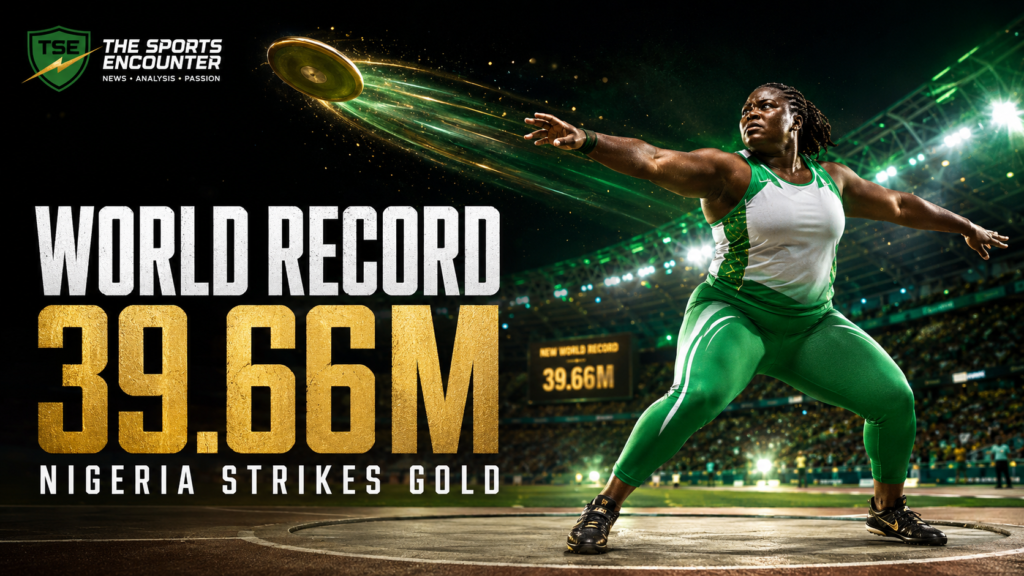
Nigeria’s Goodness Chiemerie Nwachukwu defended her Commonwealth Games women’s discus title with a stunning F42 world-record throw of 39.66 meters at Glasgow 2026.
Nwachukwu saved her finest throw for the final round at Scotstoun Stadium. The discus traveled more than three meters beyond her previous world record of 36.56m, giving Team Nigeria another gold medal and completing one of the most commanding title defenses of the Games.
Welsh throwers Funmi Oduwaiye and Bree Cronin secured silver and bronze respectively in the combined women’s F42-44/F61-64 event. Oduwaiye had led during the competition before Nwachukwu transformed the final standings with her last attempt.
The throw confirmed Nwachukwu as the leading F42 discus athlete of her era. She had already broken the world record twice while winning gold at Birmingham 2022. Four years later, she returned to the Commonwealth stage and pushed the record into new territory.
The result also strengthened Nigeria’s impressive Glasgow campaign. The country had already converted a high proportion of its medal opportunities into gold, particularly in weightlifting and Para sport. Nwachukwu’s performance extended that pattern while giving Nigeria one of the most significant individual achievements of the entire competition.
Her victory formed part of a wider Day 6 program that included athletics, swimming, basketball, wheelchair basketball, weightlifting, netball, and boxing. Yet few performances carried the statistical authority of a world record improved by 3.10m.
Goodness Nwachukwu’s World-Record Performance At A Glance
| Category | Information |
|---|---|
| Athlete | Goodness Chiemerie Nwachukwu |
| Nation | Nigeria |
| Event | Women’s Discus F42-44/F61-64 |
| Sport Class | F42 |
| Winning Throw | 39.66m |
| Previous F42 World Record | 36.56m |
| Improvement | 3.10m |
| Previous Record Location | Birmingham 2022 Commonwealth Games |
| Gold Medalist | Goodness Nwachukwu, Nigeria |
| Silver Medalist | Funmi Oduwaiye, Wales |
| Bronze Medalist | Bree Cronin, Wales |
| Venue | Scotstoun Stadium, Glasgow |
| Date | July 29, 2026 |
Nwachukwu’s gold followed several Nigerian successes across the opening half of the Games. The Sports Encounter’s Glasgow 2026 Day 4 report detailed how Nigerian weightlifters helped the country climb into fourth place with six gold medals.
A Final Throw That Changed The Entire Competition
The women’s combined-class discus final had developed into a contest led by Wales before Nwachukwu stepped into the throwing area for the last time.
Oduwaiye had established the early standard and remained in position to claim gold as the competition approached its conclusion. Her control reflected the progress she has made since representing Great Britain at the Paris 2024 Paralympic Games and winning bronze at the 2025 World Para Athletics Championships in New Delhi.
Cronin also placed herself inside the medal positions, giving Wales the possibility of a one-two finish at its first Glasgow Commonwealth appearance.
Nwachukwu still had one throw remaining.
The Nigerian settled herself inside the circle, created the required rotational force despite the balance challenges associated with her classification, and released a throw that immediately looked different. The discus carried beyond the previous distances and landed at 39.66m.
The measurement confirmed a new F42 world record.
It was 3.10m longer than Nwachukwu’s previous mark, an enormous improvement in an event where elite progress often comes through centimeters. The distance also represented an increase of almost 8.5 percent over her 36.56m record from Birmingham.
The timing intensified its impact. Nwachukwu had no later attempt to correct an error, while her rivals had no remaining opportunity to respond. She converted the final throw of her title defense into the greatest measured performance of her career.
World records often arrive when athletes build momentum through several strong rounds. Nwachukwu’s finish carried a different pressure. She needed to produce her best throw while the competition was reaching its decisive point.
Her execution transformed a Welsh-led final into another Nigerian Commonwealth triumph.
Why The 39.66m Distance Represents A Major Leap
Nwachukwu entered the final as the F42 world-record holder at 36.56m. She had set that mark at Birmingham 2022 after improving her own record twice during the same competition.
Adding 3.10m to an established world mark is rare at the highest level. The increase suggests that her training has improved several connected areas, including release speed, stability, rotational control, throwing angle, and confidence under competitive pressure.
Her progression becomes clearer when viewed against the 32.95m record she held before Birmingham 2022. She has now advanced the F42 world standard by 6.71m across two Commonwealth Games cycles.
| Competition | Record Distance | Improvement From Previous Mark |
|---|---|---|
| World Para Athletics Grand Prix, Tunis 2021 | 32.95m | Starting Reference |
| Birmingham 2022 Commonwealth Games | 36.56m | 3.61m |
| Glasgow 2026 Commonwealth Games | 39.66m | 3.10m |
Across those two advances, Nwachukwu has improved her record by more than 20 percent. That development reflects sustained technical progress rather than a marginal statistical adjustment.
How The Combined-Class Discus Competition Works
The Glasgow final brought together athletes from the F42, F43, F44, F61, F62, F63, and F64 classifications. These classes cover athletes with different forms and levels of lower-limb impairment.
F42 athletes generally compete with coordination or movement limitations affecting one or both lower limbs. F44 athletes typically have a lower-limb impairment but compete without a prosthesis. The F61-64 classifications include athletes with limb deficiencies who compete using prostheses or comparable equipment.
A combined-class event cannot always be ranked by raw distance alone because athletes from different classifications face different functional challenges. Organizers use a points-based system derived from classification-specific records and performance standards to compare results.
A throw is therefore assessed in relation to the athlete’s classification. This allows competitors from several eligible classes to share one medal event while preserving a more equitable method of determining the podium.
Why Nwachukwu’s Throw Remains A Specific F42 World Record
Although Glasgow staged a combined F42-44/F61-64 final, records remain tied to each athlete’s individual sport class.
Nwachukwu competes in F42. Her 39.66m performance therefore established a new women’s F42 discus world record. It did not replace the separate F44 or F64 records, which belong to athletes competing under different classifications.
This distinction matters when describing the result. Nwachukwu became the combined Commonwealth champion while breaking the world record for her own F42 class.
Readers can follow other classifications, medal events, and daily developments through The Sports Encounter’s dedicated Glasgow 2026 coverage hub.
Nwachukwu Defends The Title She Won At Birmingham 2022
Glasgow represented a title defense as well as a pursuit of another record.
Nwachukwu arrived at Birmingham 2022 as a developing athlete with a 32.95m F42 world record. Her opening two throws at Alexander Stadium both surpassed that mark. The second reached 36.56m and delivered the gold medal.
That performance introduced her to a much larger international audience. She left Birmingham as a Commonwealth champion, world-record holder, and visible example of Nigeria’s strength in Para athletics.
The four years between Birmingham and Glasgow brought sporting and personal challenges. Nwachukwu lost her father and completed his burial earlier in 2026. She then returned her attention to training and qualification for Glasgow.
In an interview published by Commonwealth Sport before the Games, she spoke about wanting to work harder, inspire younger athletes, and build upon the opportunities created by her Birmingham victory.
Her Glasgow performance gave those ambitions a measurable outcome. She returned as the defending champion, faced an expanded field, and delivered a mark far beyond anything she had previously achieved.
Nwachukwu’s sustained success has also been connected to the Commonwealth Sport GAPS program. The initiative supports athletes and coaches from Commonwealth nations that may lack the resources, competition access, or specialist development structures available to larger sporting systems.
She entered the program as an athlete with potential and developed into one of its clearest competitive success stories. Her results show what targeted access, structured coaching, and international opportunity can produce when combined with an athlete’s own discipline.
Who Is Goodness Chiemerie Nwachukwu?
Goodness Chiemerie Nwachukwu is a Nigerian Para athlete who specializes in the discus throw and competes in the F42 classification.
Born on October 6, 1998, she emerged internationally through Para athletics events before producing her breakthrough at the Birmingham 2022 Commonwealth Games.
She competes with limited movement affecting her lower limbs. Discus throwing requires athletes to generate force through the legs, hips, torso, shoulder, and throwing arm in a connected sequence. Any limitation in balance or lower-body movement changes how that sequence must be built.
Nwachukwu has developed a technique suited to her functional ability. Her throwing depends on controlled balance, upper-body power, release timing, and the ability to maintain direction while rotating inside the circle.
Her Glasgow result suggests that her technical model continues to evolve. A 3.10m improvement cannot come from strength alone. The throw required several mechanical elements to work together at precisely the right moment.
She is now a two-time Commonwealth champion and a multiple world-record breaker. Her record progression has occurred on two of the largest integrated sporting stages available to Commonwealth Para athletes.
Nwachukwu’s success belongs within a Nigerian campaign that has repeatedly produced high-value gold medals. Our Glasgow 2026 Day 5 wrap-up examined how Nigeria’s achievements formed part of an increasingly broad medal map across the Games.
Why The Result Matters For Team Nigeria
Nigeria entered Glasgow with realistic medal expectations in weightlifting, Para powerlifting, athletics, Para athletics, and boxing. Nwachukwu’s victory strengthened the country in an area where it had already established Commonwealth credibility.
The gold carried additional value because it came with a world record. Medal tables measure first-place finishes equally, but world-record performances create a deeper legacy. They connect the national result to the highest recognized standard in the athlete’s classification.
Nwachukwu also gave Nigeria another prominent female champion. Nigerian women have played a central role in the country’s Glasgow campaign, particularly through strength and Para events.
That visibility can influence funding decisions, athlete recruitment, federation planning, and media interest. It gives younger athletes a recognizable national figure whose progress can be studied rather than treated as a distant international example.
Nigeria’s results at Glasgow have also challenged simplistic assumptions about African sporting success. The country’s strongest performances have arrived across sprinting, throwing, weightlifting, Para powerlifting, and swimming development.
Abduljabar Adama’s progress into a Commonwealth swimming final, discussed in our Day 5 analysis, showed another side of that expanding profile. Nwachukwu’s gold provided a more established expression of the same idea: Nigeria’s competitive identity extends across conventional and Para sport.
Wales Takes Two Medals Through Oduwaiye And Cronin
Nwachukwu’s world record decided the title, but Wales still produced an excellent team result.
Oduwaiye claimed silver after leading during part of the final. The F44 thrower had already represented Great Britain at Paris 2024 and won a World Para Athletics Championships bronze medal in New Delhi in 2025.
Cronin completed the podium for Wales. She had finished fifth at the 2025 World Para Athletics Championships and entered Glasgow as one of the developing athletes capable of challenging for a Commonwealth medal.
Both athletes are connected to Cardiff Athletics, giving their shared podium a strong local development story. Their results showed that Wales has built genuine depth in women’s Para throwing.
The silver and bronze also carried broader value for a Welsh team that had already created Games history through other disciplines. Glasgow has repeatedly given smaller national programs and developing athletes a stage on which one performance can alter wider expectations.
A similar dynamic appeared when 16-year-old Amalie Smith turned junior success into a senior Commonwealth swimming medal, explored in The Sports Encounter’s profile of England’s emerging individual medley star.
African Women Continue To Shape Glasgow 2026
Nwachukwu’s gold joined a wider series of influential performances by African women across the Games.
Nigeria’s strength athletes have contributed major medals. Uganda reached the women’s 3×3 basketball final on its Commonwealth Games debut. African swimmers, boxers, runners, and team-sport athletes have also created several national milestones.
These results matter because the Commonwealth Games provides visibility across sports that do not always receive consistent global coverage. An athlete who performs well in Glasgow can return home with stronger public recognition, increased commercial value, and a clearer case for institutional support.
For Para athletes, that visibility has another function. It helps audiences understand elite classification-based competition through performance rather than limiting the discussion to disability.
Nwachukwu’s 39.66m throw demands analysis in athletic terms. It required power, balance, technique, composure, and the ability to produce a career-best result under championship pressure.
Gazelles Show Why African Progress To A Major Final Matters
Uganda’s Gazelles offered another important African story by reaching the Glasgow 2026 women’s 3×3 basketball final.
Uganda defeated New Zealand 21-9 in the semifinal before losing 21-11 to Australia in the gold-medal game. The silver was earned during the Gazelles’ first Commonwealth Games appearance.
Their progress matters for many of the same structural reasons that make Nwachukwu’s record important. High-level results create evidence. They show federations, sponsors, young athletes, and national decision-makers that investment can produce international competitiveness.
Uganda entered Glasgow without Australia’s basketball resources or established 3×3 infrastructure. The Gazelles still reached the final through physical defense, interior scoring, rebounding, and collective confidence.
Nwachukwu followed with a world record for Nigeria in Para athletics. Together, the performances showed two different forms of African progress: a developing team reaching a historic final and an established individual champion redefining the global standard in her event.
Readers can follow wider developments in the sport through The Sports Encounter’s basketball coverage. The growing audience for women’s basketball is also examined in our analysis of rising WNBA demand and ticket prices.
Para Sport Holds A Central Place At Glasgow 2026
Glasgow 2026 features 10 sports and six Para sports, with the Para program integrated into the main schedule rather than separated into a secondary competition.
Nwachukwu competed at Scotstoun Stadium during the same athletics program that featured leading sprinters, distance runners, throwers, jumpers, and multi-event athletes.
This integrated model gives Para champions access to the same Games audience, medal ceremonies, national attention, and event atmosphere as other Commonwealth competitors.
The women’s discus final illustrated the competitive value of that model. Oduwaiye led, two Welsh athletes moved into medal contention, and Nwachukwu needed a world record to secure the title.
Glasgow has also included Para swimming, Para powerlifting, wheelchair basketball, Para bowls, and track racing. These events have supplied several of the competition’s most important records and home-nation moments.
The presence of 16 Para athletics medal events gives athletes across multiple classifications a meaningful Commonwealth target between Paralympic cycles. It also broadens the number of nations capable of earning medals and building sustainable performance programs.
The Sports Encounter’s swimming coverage follows the major conventional and Para results from Tollcross, while our boxing section tracks another sport producing national breakthroughs in Glasgow.
What Comes Next For Goodness Nwachukwu?
The immediate outcome is another Commonwealth gold medal and a substantially improved world record.
The longer-term challenge involves carrying this form into World Para Athletics competition and the Los Angeles 2028 Paralympic cycle.
Nwachukwu’s Glasgow distance offers a stronger performance benchmark, but remaining at the top will require continued technical development. Record holders become the target for every emerging athlete in their classification.
Her experience should help. She has now managed the pressure of defending a title, competing after personal loss, and producing a record when another athlete appeared to have control of the final.
There is also room for her influence to grow beyond her own results. Nwachukwu has spoken about becoming an inspiration to upcoming athletes. Her work through the GAPS pathway gives her experience of the development barriers faced by competitors from countries with limited specialist resources.
Athletes can influence sporting systems most effectively when their public message rests on clear competitive authority. Two Commonwealth gold medals and multiple world records give Nwachukwu that authority.
Final Verdict
Goodness Nwachukwu arrived at Scotstoun Stadium as the defending Commonwealth champion and F42 world-record holder. She left with another gold medal and a record of 39.66m.
The final demanded patience. Oduwaiye established herself at the front of the competition, Cronin placed Wales in position for a second medal, and Nwachukwu reached her last attempt with the title still undecided.
Her response was the finest throw of her career.
The 39.66m mark improved her former record by 3.10m and extended the development she began before Birmingham 2022. Across five years, she has advanced the F42 world standard from 32.95m to 39.66m.
That progression reflects athletic power, technical learning, structured support, and competitive resilience. It also gives Nigeria a world record that carries significance beyond the Glasgow medal standings.
Wales left the final with silver and bronze through Oduwaiye and Cronin. Nigeria left with the champion. Para athletics gained another performance capable of drawing attention to the standard of competition rather than the limitations assigned to its participants.
Official schedules, results, athlete information, and Games updates are available through the official Glasgow 2026 Commonwealth Games website.
Frequently Asked Questions About Goodness Nwachukwu
Who Broke The Women’s Discus World Record At Glasgow 2026?
Nigeria’s Goodness Chiemerie Nwachukwu broke the women’s F42 discus world record at the Glasgow 2026 Commonwealth Games. She threw 39.66m to win gold.
What Was Goodness Nwachukwu’s World-Record Throw?
Nwachukwu recorded a distance of 39.66 meters in the women’s F42-44/F61-64 discus final.
Who Won The Glasgow 2026 Women’s Para Discus Gold Medal?
Goodness Nwachukwu of Nigeria won the combined women’s F42-44/F61-64 discus title. Funmi Oduwaiye of Wales took silver, while Welsh teammate Bree Cronin earned bronze.
How Much Did Goodness Nwachukwu Improve The World Record?
She improved her previous F42 world record by 3.10m, moving the mark from 36.56m to 39.66m.
When Did Goodness Nwachukwu Set Her Previous World Record?
Nwachukwu set the previous record of 36.56m while winning the women’s discus title at the Birmingham 2022 Commonwealth Games.
Is Flora Ugwunwa The Athlete Who Broke The Discus Record?
No. Goodness Chiemerie Nwachukwu broke the F42 discus world record at Glasgow 2026. Flora Ugwunwa is a different Nigerian Para athlete who primarily competes in the F54 javelin throw.
What Classification Does Goodness Nwachukwu Compete In?
Nwachukwu competes in the F42 classification. This class includes athletes with lower-limb movement or coordination impairments.
Why Were Different Classifications Included In One Discus Final?
The Commonwealth Games combined eligible F42-44 and F61-64 athletes into one medal event. A classification-based points system allows performances from different classes to be compared.
How Many Commonwealth Games Gold Medals Has Goodness Nwachukwu Won?
Nwachukwu has won two Commonwealth Games gold medals. She won the women’s discus title at Birmingham 2022 and successfully defended it at Glasgow 2026.
Where Was The Glasgow 2026 Discus Final Held?
The women’s F42-44/F61-64 discus final took place at Scotstoun Stadium in Glasgow, Scotland, on July 29, 2026.
Who Is Goodness Nwachukwu?
Goodness Chiemerie Nwachukwu is a Nigerian Para athlete and F42 discus specialist. She is a two-time Commonwealth champion and multiple world-record breaker.
Who Finished Second And Third Behind Nwachukwu?
Funmi Oduwaiye won silver and Bree Cronin claimed bronze. Both athletes represented Wales.
What Was The F42 Discus Record Before Glasgow 2026?
The previous record was 36.56m, also held by Nwachukwu. She established it at Birmingham 2022.
Could Goodness Nwachukwu Compete At The Los Angeles 2028 Paralympics?
Nwachukwu’s Glasgow performance places her among the leading athletes in her classification heading toward the Los Angeles 2028 cycle. Selection will depend on qualification standards, future results, and Nigeria’s final team decisions.