


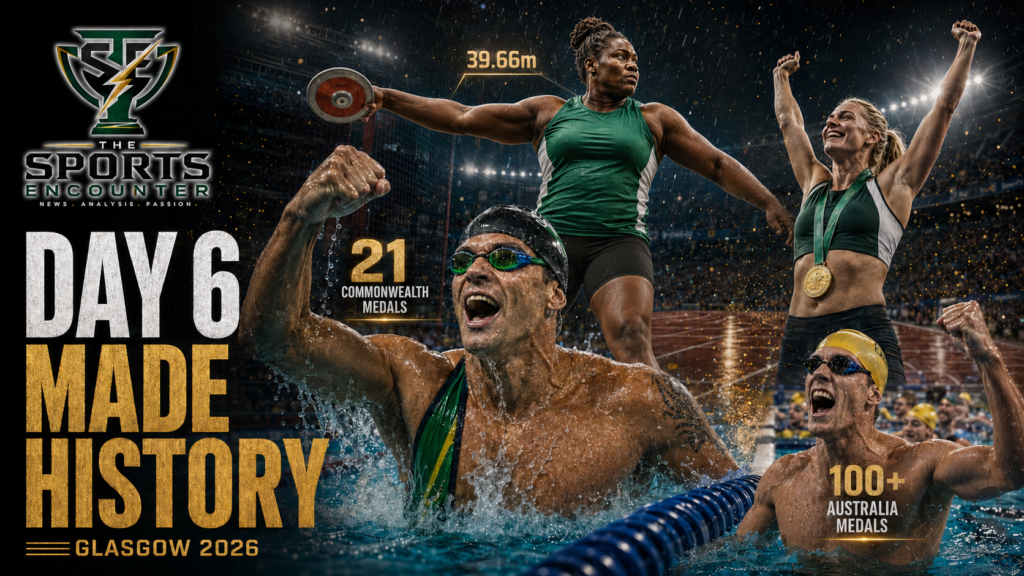
Australia passed 100 medals, Chad le Clos became the most decorated athlete in Commonwealth Games history, Goodness Nwachukwu shattered a world record, and four basketball championships were decided during an extraordinary sixth day of competition at Glasgow 2026.
Day 6 brought the swimming program to a spectacular conclusion at Tollcross, completed the 3×3 basketball tournaments at the SEC Centre, produced major Para athletics performances at Scotstoun Stadium, and extended Australia’s dominance of the overall medal table.
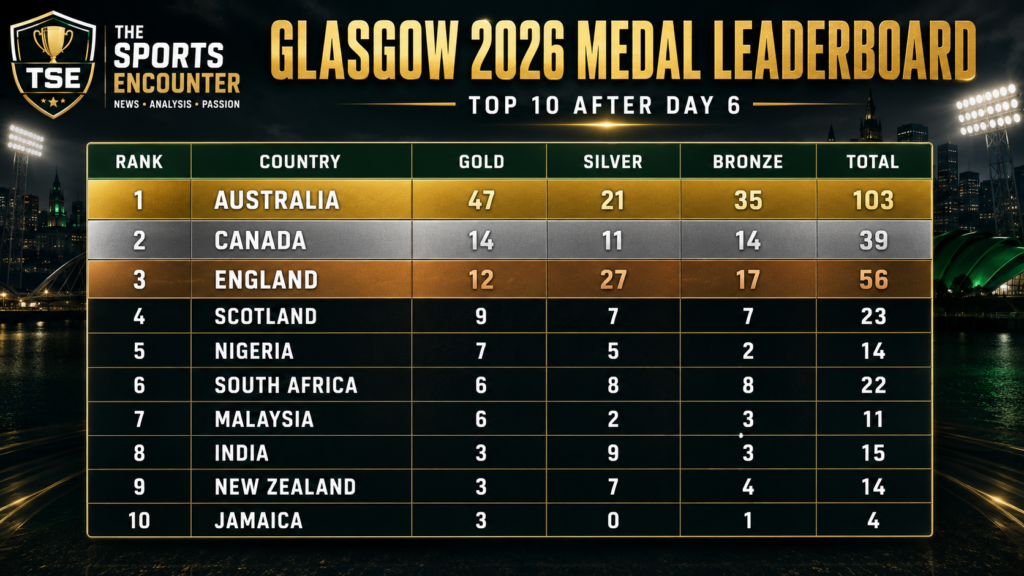
Australia finished the day with 47 gold, 21 silver and 35 bronze medals for a total of 103. Canada remained second on gold medals with 14, while England moved to 12 golds and 56 medals overall. Host nation Scotland strengthened its campaign through home victories and emotional podium finishes.
The raw totals capture Australia’s superiority but cannot explain everything that made the day important.
South Africa’s le Clos moved beyond Emma McKeon to stand alone with 21 career Commonwealth medals. Nigeria’s Nwachukwu improved her own world record by more than three meters. Northern Ireland’s Kate O’Connor completed a commanding heptathlon victory. Samoa and Malaysia added weightlifting titles, while India secured a Para athletics one-two.
England retained the men’s 3×3 basketball title and won women’s wheelchair basketball gold. Australia claimed the women’s able-bodied and men’s wheelchair competitions. Uganda’s Gazelles earned a historic silver medal during their first Commonwealth basketball campaign.
Readers can retrace how the medal race reached this point through The Sports Encounter’s complete Glasgow 2026 Day 5 report.
Glasgow 2026 Day 6 At A Glance
| Category | Day 6 Highlight | Why It Mattered |
|---|---|---|
| Leading Nation | Australia | Passed 100 total medals and ended swimming with 76 medals |
| Historic Achievement | Chad le Clos | Became the most decorated Commonwealth Games athlete with 21 medals |
| Performance Of The Day | Goodness Nwachukwu | Broke the women’s Para discus world record with 39.66m |
| Home-Nation Highlight | Melanie Woods | Won Scotland’s women’s T54 1500m title in a Games record |
| Multi-Event Champion | Kate O’Connor | Won Northern Ireland’s first gold of Glasgow 2026 in the heptathlon |
| Swimming Milestone | Australia | Finished the meet with 37 gold medals and 76 medals overall |
| Basketball Breakthrough | Uganda Women | Won silver during their Commonwealth 3×3 debut |
| Weightlifting Breakthrough | Seine Stowers | Delivered Samoa’s first Glasgow 2026 gold |
| Medal-Table Milestone | Australia | Reached 103 medals after beginning Day 6 with 80 |
All 26 Medal Events Decided On Day 6
| Sport | Event | Gold Medalist | Leading Result |
|---|---|---|---|
| Swimming | Men’s 100m Backstroke | Pieter Coetze, South Africa | Games record |
| Swimming | Women’s 200m Breaststroke | Angharad Evans, Scotland | 2:23.79 |
| Swimming | Men’s 200m Freestyle | Kai Taylor, Australia | 1:45.22 |
| Swimming | Women’s 50m Freestyle | Meg Harris, Australia | Australian podium sweep |
| Swimming | Men’s 50m Butterfly | Kyle Chalmers and Ben Armbruster, Australia | Joint Games record, 22.73 |
| Para Swimming | Women’s S9 100m Freestyle | Lakeisha Patterson, Australia | 1:02.99 |
| Para Swimming | Men’s S7 50m Freestyle | Australia | Final-session gold |
| Swimming | Women’s 200m Butterfly | Brittany Castelluzzo, Australia | Beat Keanna MacInnes |
| Swimming | Men’s 1500m Freestyle | Sam Short, Australia | Completed freestyle treble |
| Swimming | Women’s 4x100m Medley Relay | Australia | 3:54.25 |
| Swimming | Men’s 4x100m Medley Relay | Australia | Games record, 3:28.71 |
| Athletics | Women’s Heptathlon | Kate O’Connor, Northern Ireland | Controlled competition after record javelin |
| Athletics | Men’s Long Jump | Tajay Gayle, Jamaica | 8.15m |
| Athletics | Women’s Shot Put | Sarah Mitton, Canada | 19.88m |
| Athletics | Women’s 3000m Steeplechase | Faith Cherotich, Kenya | Games record |
| Para Athletics | Women’s T54 1500m | Melanie Woods, Scotland | Games record, 3:33.39 |
| Para Athletics | Men’s T47 100m | Dilip Mahadu Gavit, India | India one-two |
| Para Athletics | Women’s F42-44/F61-64 Discus | Goodness Nwachukwu, Nigeria | World record, 39.66m |
| Para Athletics | Men’s F42-44/F61-64 Discus | Day 6 champion | Cross-classification final |
| Weightlifting | Women’s 77kg | Seine Stowers, Samoa | 237kg total |
| Weightlifting | Men’s 94kg | Mohamad Syahmi Nor-Ghazali, Malaysia | 347kg total |
| Weightlifting | Women’s 86kg | Eileen Cikamatana, Australia | 248kg total |
| 3×3 Basketball | Men’s Final | England | Beat Australia 19-17 |
| 3×3 Basketball | Women’s Final | Australia | Beat Uganda 21-11 |
| Wheelchair 3×3 Basketball | Men’s Final | Australia | Gold-medal victory |
| Wheelchair 3×3 Basketball | Women’s Final | England | Beat Scotland 18-10 |
Chad Le Clos Stands Alone With 21 Commonwealth Medals
The final swimming race delivered the day’s most important career milestone.
South Africa finished third in the men’s 4x100m medley relay behind Australia and England. That bronze gave Chad le Clos his 21st Commonwealth Games medal, moving him beyond Australian swimming great Emma McKeon’s total of 20.
Le Clos had drawn level with McKeon earlier in the meet. His relay bronze placed him alone at the top of the all-time list.
The achievement spans several editions of the Games and reflects unusual durability in a sport where careers can turn quickly. Le Clos has competed against different generations of swimmers, adapted his program as his body changed, and remained valuable enough to contribute to South Africa’s medal-winning relay team.
His record also carries more weight because Commonwealth swimming attracts many of the strongest programs in the world. Australia, England, Canada, Scotland, South Africa and New Zealand regularly bring Olympic and world championship medalists.
Le Clos’ 21st medal did not arrive with another individual victory. The bronze still represented something larger: a career that has remained relevant across changing events, rivals and competitive cycles.
Australia Breaks The Men’s Medley Relay Games Record
Australia won the final race of the swimming program in 3:28.71, setting a Commonwealth Games record. England secured silver, while South Africa’s bronze completed le Clos’ historic collection.
The women’s relay produced another Australian title. The team clocked 3:54.25 to beat Scotland, with South Africa taking bronze.
Those victories completed an unbeaten Australian relay campaign. The country won every men’s, women’s and mixed relay available across freestyle and medley competition.
Relay supremacy demonstrates more than one exceptional athlete. A program requires depth across all four strokes, quality reserves for the heats, reliable exchanges, and enough fitness to survive a congested schedule.
Australia had every component.
Australia Finishes Swimming With 76 Medals
Australia ended the Glasgow swimming program with 37 gold, 16 silver and 23 bronze medals. Its total of 76 was more than three times South Africa’s second-best swimming return of 22.
Day 6 added another series of clean sweeps, records and breakthrough champions.
Meg Harris won the women’s 50m freestyle ahead of Alex Perkins and Shayna Jack, giving Australia all three medals. Harris completed the meet with six golds after succeeding in individual sprints and relays.
Kyle Chalmers and Ben Armbruster touched together in the men’s 50m butterfly at 22.73 seconds. Both received gold medals after matching the Games record, while Cameron McEvoy completed another Australian sweep with bronze.
Chalmers entered the event after losing the 100m freestyle title to younger teammate Flynn Southam. His 50m butterfly success showed that the established star could still respond within a team experiencing a generational shift.
Kai Taylor supplied one of the session’s finest surprises. Swimming from an outside lane, he won the men’s 200m freestyle in 1:45.22. England’s James Guy and Wales’ Matt Richards recorded the same 1:45.72 time behind him.
Taylor’s victory carried a family connection. His mother, Hayley Lewis, won five Commonwealth Games gold medals during her career. The younger Taylor earned his first senior individual international title by trusting his race from lane one and preventing the central favorites from controlling him.
Sam Short won the men’s 1500m freestyle ahead of Northern Ireland Olympic champion Daniel Wiffen and Australian teammate Benjamin Goedemans. The result completed a 400m, 800m and 1500m freestyle treble for Short.
Angharad Evans Gives Scotland A Breaststroke Double
Australia controlled the overall swimming table, but some of Tollcross’ loudest moments belonged to Scotland.
Angharad Evans won the women’s 200m breaststroke in 2:23.79, defeating South Africa’s Kaylene Corbett and Northern Ireland’s Ellie McCartney. The result completed a breaststroke double after Evans had already won the 100m title.
Her complete Glasgow return included two individual gold medals and bronze in Scotland’s mixed medley relay. The Sports Encounter’s profile of Angharad Evans’ second Commonwealth title examines her progression, technical strengths and growing international reputation.
Brittany Castelluzzo restored Australian control in the women’s 200m butterfly. Scotland’s Keanna MacInnes took silver, with Lizzy Dekkers earning bronze for Australia.
South Africa’s Pieter Coetze completed his sweep of the men’s backstroke events by winning the 100m in a Games record. England’s Oliver Morgan claimed silver and South Africa’s Ruard van Renen took bronze.
Lakeisha Patterson led an Australian one-two in the women’s S9 100m freestyle, beating Emily Beecroft. Scotland’s Toni Shaw collected bronze in front of the home crowd.
Why Australia’s Swimming Total Changed The Entire Medal Race
Australia began Day 6 with 35 gold medals and ended it with 47. Much of that movement came from the pool.
The country possessed leading contenders in almost every discipline, but its real advantage emerged through medal density. When Australia missed gold, another Australian frequently took it. When one swimmer won, teammates often filled the remaining podium positions.
This pattern limited the gains available to every rival. England, Scotland, South Africa and Canada could produce world-class performances and still collect only one medal from an event dominated by Australian depth.
The swimming program ended on Day 6, meaning Australia’s rate of accumulation will now slow. Its advantage has already become large enough to survive that transition.
Goodness Nwachukwu Smashes Her Own World Record
Nigeria’s Goodness Nwachukwu produced the most statistically significant performance of the day in the women’s F42-44/F61-64 discus final.
Her final throw traveled 39.66m, improving her previous world record by more than three meters. Funmi Oduwaiye of Wales won silver, while Welsh teammate Bree Cronin took bronze.
Nwachukwu entered the competition as the defending Commonwealth champion and world-record holder. Those credentials created a different challenge. She was expected to win, leaving improvement as the main measure of her performance.
The Nigerian responded with the finest throw of her career.
Her world record strengthened Nigeria’s Glasgow campaign and confirmed the value of the integrated Para sport program. The result occupied the same evening session and medal-table space as the long jump, shot put, heptathlon and distance races.
A detailed account of the performance appears in The Sports Encounter’s report on Goodness Nwachukwu’s 39.66m world record.
Kate O’Connor Completes A Commanding Heptathlon Victory
Kate O’Connor delivered Northern Ireland’s first gold medal of Glasgow 2026 by winning the women’s heptathlon.
O’Connor began the second day with a narrow lead over England’s Jade O’Dowda. She then changed the shape of the competition through the long jump and javelin.
An outdoor personal best of 6.37m strengthened her position before she threw 52.85m in the javelin. That effort established a Commonwealth Games heptathlon record and gave her a 258-point advantage before the closing 800m.
The final race became a celebration rather than a desperate defense. O’Connor crossed the line first and secured gold, with O’Dowda taking silver and Australia’s Tori West earning bronze.
Her victory continued an exceptional multi-event sequence. O’Connor had won medals at five consecutive major championships before Glasgow, including world indoor bronze and Commonwealth silver.
The progression from Birmingham runner-up to Glasgow champion showed how effectively she had strengthened the events that once limited her overall total.
Melanie Woods Creates A Home Para Athletics Memory
Scotland’s Melanie Woods won the women’s T54 1500m in a Games-record 3:33.39.
The race was affected by contact and a crash behind the leader. Woods had positioned herself near the front, which kept her clear of the worst trouble and allowed her to maintain momentum.
Canadian Nandini Sharma initially finished second but was disqualified. England’s Ellis Kottas moved to silver, while Australia’s Mikaela Dingley received bronze.
Woods described the crowd’s roar along the back straight as a physical boost. Her victory became one of the clearest examples of home support influencing the emotional shape of a race without changing its competitive demands.
India also enjoyed a major Para athletics result. Dilip Mahadu Gavit won the men’s T47 100m, followed by compatriot Mohammed Basil Morssinganakath. England’s Kevin Santos took bronze.
Tajay Gayle And Faith Cherotich Deliver Major Athletics Titles
Jamaica’s Tajay Gayle won a high-quality men’s long jump final with a season-best 8.15m.
India’s Murali Sreeshankar led during the early rounds after jumping 8.09m. Gayle overtook him in the fourth round, while Scotland’s Stephen Mackenzie secured bronze with 8.08m.
The margins were extremely small. Six centimeters separated gold and silver, with Mackenzie finishing another centimeter behind Sreeshankar.
Gayle’s title added to Jamaica’s growing Glasgow athletics campaign. The former world champion entered the event with greater international pedigree than most of the field, but he still needed a late technical correction after an uneven opening sequence.
Faith Cherotich gave Kenya victory in the women’s 3000m steeplechase with a Games-record performance. Uganda’s Peruth Chemutai challenged through much of the race before England’s Elise Thorner passed her late to take silver. Chemutai finished with bronze.
Canada’s Sarah Mitton controlled the women’s shot put. Her winning throw of 19.88m placed her comfortably ahead of Nigeria’s Jessica Oji and Jamaica’s Lloydricia Cameron.
England And Australia Divide The 3×3 Basketball Titles
Four basketball finals produced two gold medals for England and two for Australia.
England retained the men’s 3×3 title by defeating Australia 19-17. The final remained undecided until the closing possession, with Australia still capable of forcing overtime through a successful two-point shot.
Dwayne Lautier-Ogunleye led England with seven points, while Jamell Anderson contributed a critical late dunk. England completed the tournament without losing and became champion for the second time in as many Commonwealth appearances.
The full tactical story appears in The Sports Encounter’s report on England’s 19-17 victory over Australia.
Scotland defeated New Zealand 18-16 in the bronze-medal game, giving the host nation its first men’s Commonwealth 3×3 medal.
Australia won the women’s final 21-11 against Uganda. Marena Whittle scored 15 points despite Australia entering the game without an available substitute following Emma Clarke’s injury.
Uganda’s silver carried enormous significance. The Gazelles were making their Commonwealth 3×3 debut and reached the final after defeating New Zealand in the semifinal.
The Sports Encounter’s analysis of Australia’s gold and Uganda’s historic silver explains how the final developed and why the result matters for African women’s basketball.
Wheelchair Basketball Adds Two Different Champions
England won the women’s wheelchair 3×3 final by beating Scotland 18-10. Joy Haizelden, Charlotte Moore, Jade Atkin and Lucy Robinson converted their defensive control into a clear victory.
Scotland’s silver still represented a successful home campaign and delivered another medal in front of an invested SEC crowd.
Australia won the men’s wheelchair title, completing its share of the four basketball championships. The split reflected the wider Day 6 pattern: Australia owned the medal volume, while England remained especially effective in high-pressure team finals.
Samoa, Malaysia And Australia Win Weightlifting Gold
Seine Stowers delivered Samoa’s first gold medal of Glasgow 2026 in the women’s 77kg competition.
The 18-year-old completed all six successful lifts and totaled 237kg through a 107kg snatch and 130kg clean and jerk. Both marks established Games records in the new weight category.
England’s Isabella Brown won silver with 229kg, while Wales’ Laura Hughes took bronze with 224kg.
Malaysia’s Mohamad Syahmi Nor-Ghazali won the men’s 94kg title through a dramatic one-kilogram margin. He totaled 347kg after lifting 150kg in the snatch and a Games-record 197kg in the clean and jerk.
Canada’s Alex Bellemarre finished second with 346kg, while Australia’s Oliver Saxton took bronze on 336kg.
Eileen Cikamatana completed Australia’s Day 6 weightlifting success by winning the women’s 86kg class with a 248kg total. England’s Madias Ngake led after a 108kg snatch but finished second with 239kg. Canada’s Rose Beaudoin earned bronze with 230kg.
Ngake’s silver completed one of the Games’ most compelling personal stories. She represented Cameroon at the London 2012 Olympics, left the national setup after facing persecution over her sexuality, spent years away from elite competition, and returned to the sport in Britain.
Boxing Creates New National Milestones
Day 6 boxing did not award gold medals, but its quarterfinals guaranteed a series of podium finishes.
England secured six medals through its successful quarterfinalists. Scotland’s Caitlin Rainey continued her historic campaign by ensuring the host nation would win its first Commonwealth women’s boxing medal.
Jasmine Daunakamakama defeated Sri Lanka’s Keshani Hansika in the women’s 57kg quarterfinal, becoming Fiji’s first female boxer to secure a Commonwealth Games medal.
Those results continued the widening medal story established on Day 5, when Pakistan’s Fatima Zahra became the first woman from her country to guarantee a Commonwealth boxing medal.
The importance of a quarterfinal victory in Commonwealth boxing differs from most sports. With two bronze medals awarded in each division, reaching the semifinal guarantees a place on the podium.
Netball Pool Races Tighten Before The Knockout Stage
Jamaica survived its sternest challenge from host nation Scotland, winning 45-43 after being forced to recover from a difficult start.
Scotland’s performance did not produce a victory, but it showed the progress made since finishing ninth at Birmingham 2022. The hosts matched one of the world’s strongest teams through defensive pressure, disciplined possession and an energized home crowd.
New Zealand defeated Wales 65-37 to retain control of its qualification route. The Silver Ferns gradually separated after Wales competed well during the opening stages.
England faced Tonga, while Australia and South Africa met in the central Pool A contest. The Diamonds were pushed harder than in their earlier victories, with a strong second quarter providing the platform for a 10-goal Australian win.
The result preserved Australia’s unbeaten record and reinforced its status as the tournament favorite. South Africa remained dangerous enough to make the later medal rounds far less predictable.
Glasgow 2026 Medal Table After Day 6
Australia added 23 medals to the 80 it held after Day 5, becoming the first nation to pass 100 at Glasgow 2026.
| Rank | Nation | Gold | Silver | Bronze | Total |
|---|---|---|---|---|---|
| 1 | Australia | 47 | 21 | 35 | 103 |
| 2 | Canada | 14 | 11 | 14 | 39 |
| 3 | England | 12 | 27 | 17 | 56 |
| 4 | Scotland | 9 | 7 | 7 | 23 |
| 5 | Nigeria | 7 | 5 | 2 | 14 |
| 6 | South Africa | 6 | 8 | 8 | 22 |
| 7 | Malaysia | 6 | 2 | 3 | 11 |
| 8 | India | 3 | 9 | 3 | 15 |
| 9 | New Zealand | 3 | 7 | 4 | 14 |
| 10 | Jamaica | 3 | 0 | 1 | 4 |
Medal standings are ordered by gold medals, followed by silver and bronze. Canada therefore remained second despite England possessing 17 more medals overall.
Australia began the previous day with 35 golds and 80 total medals. Its Day 6 surge increased those numbers to 47 and 103, respectively.
The change from the Glasgow 2026 Day 4 standings, when Australia held 26 golds and 59 medals, demonstrates how rapidly swimming and the early athletics program transformed the competition.
Official schedules, complete results, medal standings and subsequent updates are available through the official Glasgow 2026 results platform.
What Day 6 Revealed About The Medal Race
Australia has effectively removed suspense from the contest for first place.
The more competitive questions concern the order behind it, the ability of smaller nations to convert limited opportunities into gold, and whether Scotland can remain inside the leading group after swimming ends.
Canada has built an efficient campaign through gymnastics, weightlifting, swimming and field events. England has greater overall depth but continues to collect more silver and bronze medals than golds.
Scotland’s nine titles represent a strong return for the host nation. The team has produced home champions in swimming, Para swimming, athletics and bowls while adding important team medals in basketball.
Nigeria and Malaysia remain among the most efficient delegations. Their medal totals are smaller than those of England, Canada, Scotland or South Africa, but weightlifting and Para sport have given both countries a high gold conversion rate.
Swimming accounted for 76 of Australia’s 103 medals. The end of that program changes the daily balance, although track cycling now gives Australia another traditionally strong discipline.
Fans can follow every daily report and athlete feature through The Sports Encounter’s Glasgow 2026 coverage hub.
Final Verdict: Records Gave Day 6 Its Identity
Australia owned the numbers again. Its swimmers finished with 76 medals, the national team passed 100 overall, and the gold total reached 47.
Day 6 will still be remembered through individual records and national breakthroughs.
Chad le Clos became the most decorated athlete in Commonwealth Games history. Goodness Nwachukwu extended the limits of her Para athletics classification. Kate O’Connor moved from Birmingham silver to Glasgow gold. Melanie Woods gave the home crowd another performance to keep.
England defended the men’s 3×3 basketball title, while Uganda’s Gazelles turned a debut campaign into a silver medal. Samoa found its first Glasgow champion through an 18-year-old weightlifter. Fiji entered a new chapter in women’s boxing.
The medal table showed a dominant nation extending its lead. The competition itself showed something broader.
A compact Commonwealth Games can still create space for established stars, new champions, smaller delegations and Para athletes to share the same stage without becoming secondary stories.
Day 6 offered the clearest evidence yet.
Frequently Asked Questions About Glasgow 2026 Day 6
Who Led The Glasgow 2026 Medal Table After Day 6?
Australia led the medal table with 47 gold, 21 silver and 35 bronze medals. Its overall total reached 103.
What Happened On Day 6 Of The Commonwealth Games 2026?
Day 6 included 26 medal events across swimming, Para swimming, athletics, Para athletics, weightlifting, 3×3 basketball and wheelchair 3×3 basketball. Boxing and netball also continued with quarterfinal and pool-stage competition.
Who Became The Most Decorated Commonwealth Games Athlete?
South African swimmer Chad le Clos became the most decorated athlete in Commonwealth Games history after winning his 21st career medal in the men’s 4x100m medley relay.
How Many Medals Did Australia Win In Swimming At Glasgow 2026?
Australia completed the swimming and Para swimming program with 76 medals: 37 gold, 16 silver and 23 bronze.
What World Record Was Broken On Glasgow 2026 Day 6?
Nigeria’s Goodness Nwachukwu set a women’s F42 discus world record of 39.66m in the combined F42-44/F61-64 final.
Who Won The Glasgow 2026 Women’s Heptathlon?
Kate O’Connor won the heptathlon for Northern Ireland. England’s Jade O’Dowda took silver and Australia’s Tori West earned bronze.
Who Won The Men’s 3×3 Basketball Gold Medal?
England defeated Australia 19-17 to retain the Commonwealth Games men’s 3×3 basketball title.
Who Won The Women’s 3×3 Basketball Final?
Australia defeated Uganda 21-11. Marena Whittle scored 15 points for the champions, while Uganda earned a historic silver medal.
Who Won The Glasgow 2026 Men’s Long Jump?
Jamaica’s Tajay Gayle won gold with a jump of 8.15m. India’s Murali Sreeshankar took silver with 8.09m, and Scotland’s Stephen Mackenzie won bronze with 8.08m.
Who Won The Women’s 200m Breaststroke At Glasgow 2026?
Scotland’s Angharad Evans won in 2:23.79, completing a Glasgow breaststroke double after also winning the 100m event.
How Many Gold Medals Did Meg Harris Win At Glasgow 2026?
Meg Harris completed the swimming meet with six gold medals, including the women’s 50m and 100m freestyle titles and several relay victories.
Who Won The Men’s 1500m Freestyle?
Australia’s Sam Short won gold ahead of Northern Ireland’s Daniel Wiffen and Australian teammate Benjamin Goedemans. Short completed a 400m, 800m and 1500m freestyle treble.
Which Country Was Second In The Medal Table After Day 6?
Canada ranked second with 14 gold medals. England had more medals overall but ranked third because it had won 12 golds.
When Did Australia Pass 100 Medals At Glasgow 2026?
Australia passed 100 total medals during Day 6. It finished the day with 103 medals.
Where Can Fans Find The Official Glasgow 2026 Results?
Fans can find live schedules, event results and medal standings on the official Glasgow 2026 results platform.
What Sports Were Still To Come After Day 6?
Track cycling and Para track cycling were due to begin on the following competition day. Athletics, boxing, bowls, netball, weightlifting and later judo events also remained on the Glasgow 2026 program.