


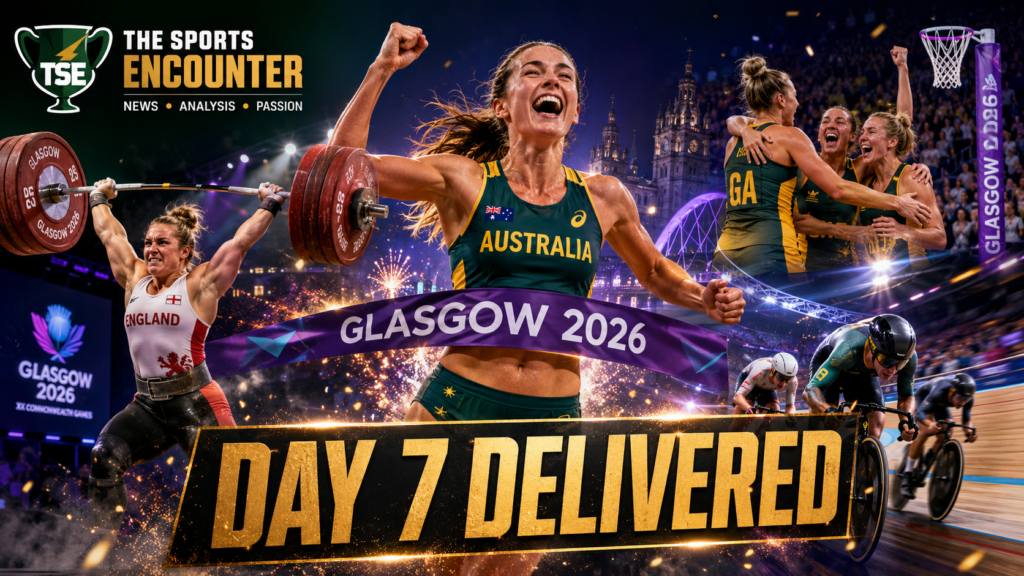
Glasgow 2026 changed character on Day 7.
The swimming program had finished. Artistic gymnastics and 3×3 basketball had already handed over their medals. Attention moved toward Scotstoun Stadium, the Sir Chris Hoy Velodrome, the weightlifting platform, and a netball group stage that refused to end quietly.
Rose Davies produced the day’s defining result by beating fellow Australian Jessica Hull in the women’s 5,000m, becoming the first woman to complete the 5,000m and 10,000m double at a Commonwealth Games.
Emily Campbell gave England another unforgettable moment by defending her women’s +86kg weightlifting title with a commanding Games-record performance. Track cycling began with world records, national rivalries, and packed stands, while England recovered from a six-goal first-quarter deficit to defeat South Africa and reach the netball semifinals.
Elsewhere, Thea LaFond delivered another major triple jump title for Dominica, Devynne Charlton ruled the sprint hurdles, Samantha Hall won discus gold, and Nigeria’s Chukwuebuka Enekwechi controlled the men’s shot put.
Day 7 also produced controversy in the boxing ring, where Ugandan heavyweight Aziz Abdul was disqualified for an illegal headbutt against England’s Damar Thomas.
For full tournament coverage, visit The Sports Encounter’s Glasgow 2026 Commonwealth Games hub.
Glasgow 2026 Day 7 at a Glance
| Sport | Day 7 Headline |
|---|---|
| Athletics | Rose Davies completed the women’s 5,000m and 10,000m double |
| Weightlifting | Emily Campbell retained the women’s +86kg title with a Games-record total |
| Track Cycling | Australia and England won team pursuit golds as Tara Neyland broke world records |
| Netball | England fought back to beat South Africa 58-54 and reach the semifinals |
| Para Athletics | Zac Shaw claimed an emotional men’s T12 100m gold |
| Boxing | Aziz Abdul was disqualified for an illegal headbutt against Damar Thomas |
| Bowls | Sectional competition continued in men’s pairs, women’s singles and Para events |
The full schedule and official event results can be followed through the Glasgow 2026 results center.
Rose Davies Completes a Commonwealth First
Rose Davies had already given Australia one of the Games’ strongest athletics performances by winning the women’s 10,000m.
She returned for the 5,000m facing a field containing Olympic silver medalist Jessica Hull, Scotland’s Megan Keith, and several experienced East African distance runners.
Davies handled the tactical contest with patience. She stayed connected through the early stages, resisted the temptation to force the pace too soon, and remained close enough to Hull to strike when the race tightened.
Australia emerged with gold and silver as Davies beat Hull in the closing stages. The result made Davies the first woman to win both the 5,000m and 10,000m at the same Commonwealth Games.
That achievement carried weight beyond Australia’s already dominant medal total.
Distance doubles require endurance, recovery, tactical control, and the confidence to race two very different finals. The 10,000m places a premium on sustained concentration. The 5,000m often becomes sharper and more unpredictable, particularly when several athletes believe they can win through a fast final kilometer.
Davies adapted to both.
Her gold also extended Australia’s success beyond the pool. The nation’s swimmers had built the lead, but victories in athletics and cycling showed that the wider team had no intention of slowing after the aquatic program ended.
The development continues a trend identified in The Sports Encounter’s Glasgow 2026 Day 4 wrap-up, when Davies first announced herself with 10,000m gold.
Jessica Hull Shows Her Range With Silver
Hull’s silver should not be lost inside Davies’ history.
The Australian entered Glasgow with a reputation built largely around the 1,500m and mile. Taking silver over 5,000m underlined the range that has made her one of the world’s most complete middle-distance athletes.
Hull had also progressed through the Commonwealth Mile heats earlier in the day, leaving her to manage speed, endurance, and recovery across two events.
Australia’s one-two finish demonstrated how far its women’s distance program has developed. Once viewed primarily as a swimming and cycling power, Australia now carries serious depth across the track program.
Thea LaFond Returns to Glasgow and Wins Again
Thea LaFond already had a special relationship with Glasgow.
She won the world indoor triple jump title in the city in 2024, becoming Dominica’s first global athletics champion. Two years later, she returned and added Commonwealth gold.
LaFond entered the competition as one of the world’s leading jumpers and performed with the authority of an athlete comfortable carrying the favorite’s status.
Her victory gave Dominica a major place in the Day 7 story and continued one of the most inspiring careers in Commonwealth athletics.
Smaller nations often rely on a handful of world-class athletes to create moments that reshape national sporting identity. LaFond has become that figure for Dominica.
Her medal was therefore more than another result in the athletics program. It was further proof that her Olympic and world-level success belongs to a sustained era rather than one perfect season.
Charlton Controls the Women’s 100m Hurdles
Devynne Charlton delivered a clean, controlled performance to win the women’s 100m hurdles for the Bahamas.
The sprint hurdles leave almost no room for recovery. A slow start, clipped barrier, or broken rhythm can end a medal challenge within seconds.
Charlton avoided those mistakes.
She attacked the first hurdle sharply, maintained her cadence through the middle, and carried enough speed off the final barrier to secure gold.
Her victory added another major title to a career already shaped by world-class sprint-hurdling performances and reinforced the Bahamas’ continued ability to produce elite track athletes far beyond the nation’s population size.
Samantha Hall Gives Jamaica Discus Gold
Jamaica’s athletics reputation is usually built around sprinting, yet Samantha Hall shifted attention toward the throwing circle.
Hall won the women’s discus with a best throw of 61.66 meters, placing herself beyond the rest of the field and delivering another important medal for Jamaica.
The result reflected Jamaica’s broader development in field events. The country no longer arrives at major championships relying only on 100m, 200m, and relay medals.
Seema Punia secured bronze for India despite recording three fouls during the latter part of the competition. Her medal added to India’s improving athletics return after Murali Sreeshankar’s long jump silver and Dilip Mahadu Gavit’s Para athletics gold earlier in the Games.
Enekwechi Leads Nigeria’s Strength-Sport Surge
Chukwuebuka Enekwechi won the men’s shot put and continued Nigeria’s impressive Glasgow campaign.
Nigeria had already built a clear identity through Para powerlifting and weightlifting. Enekwechi carried that strength into the athletics arena.
His victory mattered because it added range to Nigeria’s medal profile. The nation’s early success came from lifting platforms, but the shot put gold showed that its power athletes could also command the field events.
India’s Tejinderpal Singh Toor remained consistent but could not reach the podium. His series contained several throws around the 19-meter mark, although he was unable to produce the 20-meter-plus effort required to challenge the leaders.
Zac Shaw Converts Birmingham Silver Into Glasgow Gold
Zac Shaw provided one of England’s most emotional athletics moments by winning the men’s T12 100m.
Shaw had taken silver at Birmingham 2022. Four years later, he returned and completed the journey to the top of the podium.
His celebration captured what the Commonwealth Games can still offer at their best. The result connected one edition with the next, gave Para athletics a prominent place in the evening program, and rewarded an athlete who had spent four years carrying the memory of finishing second.
Para athletics remains central to the Glasgow model. The 2026 Games feature the largest integrated Para sport program in Commonwealth Games history, with Para medals presented as part of the main competition rather than as a separate event.
Emily Campbell Owns the Weightlifting Stage
Emily Campbell entered the SEC Armadillo carrying the expectations of the home nations and left with another Commonwealth title.
The English heavyweight lifted 115kg in the snatch and followed with a Games-record 163kg clean and jerk. Her combined total of 278kg placed her 25kg ahead of her nearest challenger.
The margin told only part of the story.
Campbell turned the final into one of Glasgow’s most entertaining individual performances. Her confidence, interaction with the crowd, distinctive presentation, and complete control of the competition created the sense that the arena belonged to her.
She defended the title she won at Birmingham 2022 and added another major achievement to a career that includes Olympic silver and bronze medals as well as multiple European titles.
Campbell later admitted she remains uncertain about pursuing another Olympic cycle toward Los Angeles 2028. The physical demands of heavyweight lifting have required years of sacrifice, recovery, and pain management.
That uncertainty gave the victory additional emotional weight. Glasgow may have witnessed her final Commonwealth Games appearance.
Regardless of what comes next, Campbell ended the weightlifting program as its biggest personality and most commanding champion.
Track Cycling Opens With Records and Rivalries
The Sir Chris Hoy Velodrome came alive as track cycling and Para track cycling began their four-day program.
Australia successfully defended the women’s 4,000m team pursuit title. Georgia Baker, Claudia Marcks, Alyssa Polites, and Felicity Wilson-Haffenden recovered from an early deficit against New Zealand and pulled away through the closing laps.
Wilson-Haffenden’s role carried a remarkable backstory. She moved from hockey to cycling after responding to a talent-identification opportunity during the pandemic and has since developed into one of Australia’s leading endurance prospects.
England claimed the men’s 4,000m team pursuit gold and set a Commonwealth Games record after producing a qualifying time of 3:50.892 earlier in the program.
The performance showed the depth of British track cycling despite the absence of Matthew Richardson, whose withdrawal removed one of the most anticipated rivalries of the Games.
Richardson had been expected to face former Australian teammates after switching allegiance to Great Britain. An injury suffered in a crash during racing in Japan ended that possibility before the competition began.
Australia still found gold in the men’s team sprint through Ryan Elliott, Leigh Hoffman, and Daniel Barber, while Wales defeated England in the women’s team sprint final. Scotland claimed bronze by beating Australia.
The results and competition details are available through the official UCI Commonwealth Games track cycling page.
Tara Neyland Breaks the World Record Twice
Tara Neyland produced the standout Para cycling performance of the opening day.
The Australian broke the women’s C4-C5 individual pursuit world record in qualifying, then returned and improved the mark again in the final.
Breaking a world record once can define an entire Games. Doing it twice in the same day showed that Neyland had arrived at the velodrome in extraordinary condition.
Her performance strengthened Australia’s grip on the medal table and reinforced the importance of the integrated Para program.
Jessica Gallagher and pilot Jacqueline Mengler-Mohr added silver in the women’s tandem B sprint after a dramatic competition involving a crash and rerun against New Zealand.
England Survive South Africa’s Netball Storm
England’s netball team entered its final group match needing to secure a semifinal place.
South Africa threatened to derail that plan immediately.
The Proteas led 17-11 after the first quarter, moving the ball quickly and punishing England’s defensive uncertainty. The Roses looked uncomfortable, rushed in possession, and vulnerable to South Africa’s pressure around the circle.
England gradually settled.
Changes in defensive intensity disrupted South Africa’s supply, while the attack became more patient. England reduced the deficit, took control during the second half, and completed a 58-54 comeback victory.
The result secured a semifinal against New Zealand.
Australia completed its group campaign against Northern Ireland and remained the tournament favorite, while Jamaica and New Zealand also advanced into the knockout picture.
Fixtures, results, and standings can be followed through the official World Netball Glasgow 2026 hub.
The increasingly serious knockout race follows the trends covered in The Sports Encounter’s Glasgow 2026 Day 6 report.
Boxing Headbutt Creates Day 7’s Biggest Controversy
The most controversial moment occurred in the heavyweight boxing competition.
Uganda’s Aziz Abdul was disqualified after headbutting England’s Damar Thomas during a third-round clinch.
The referee immediately stopped the contest and awarded Thomas the victory. Abdul reacted angrily and disputed the decision, arguing that the contact was accidental and that he had been treated unfairly.
The ruling ended Uganda’s hopes of securing its first Commonwealth boxing medal since 1990 and moved Thomas into the medal rounds.
Thomas admitted that advancing through a disqualification was not how he wanted to win, though the incident left officials with little room for interpretation. Deliberate or dangerous use of the head represents a serious violation because it can cause cuts, concussion, and facial injuries.
The controversy will remain one of the tournament’s strangest stories, but it should not obscure the wider boxing competition. Semifinal places have now guaranteed medals for several nations, with India building one of the deepest remaining squads.
Australia Keeps Finding New Ways to Lead
Australia entered Day 7 with a commanding advantage created largely through its extraordinary swimming campaign.
The transition into athletics and cycling could have slowed the medal machine.
Instead, Davies, Hull, the women’s pursuit team, the men’s sprint team, and Neyland kept Australia moving.
The wider significance is clear. Australia’s lead is built on depth rather than one isolated program. Swimming supplied the volume, while athletics, gymnastics, basketball, weightlifting, and cycling have prevented rivals from closing the gap.
England strengthened second place through Campbell, Shaw, the men’s pursuit team, and additional podium finishes. Canada remains competitive through its balanced team, while Scotland continues to draw energy from the home crowd.
Nigeria’s gold conversion remains one of the Games’ major stories. The country may not match Australia’s overall medal volume, but it has repeatedly turned podium opportunities into victories.
What to Watch on Day 8
Day 8 will introduce judo and continue the track cycling program, while athletics moves toward another major finals session.
The men’s and women’s 200m finals will command attention at Scotstoun Stadium. The women’s 800m, hurdles events, and the second day of the decathlon will also shape the athletics narrative.
At the velodrome, medals will be decided in the men’s keirin, elimination race, women’s sprint, and Para time trial events.
Judo enters the Games with five medal events on its opening day, offering England, Scotland, Canada, Australia, and several African nations new opportunities to climb the standings.
The netball semifinals will sharpen the pressure further. Australia remains the standard, but England’s comeback against South Africa showed that the Roses can survive difficulty.
Saturday will then bring the busiest day of Glasgow 2026, with 44 gold medals scheduled across athletics, boxing, cycling, and judo.
Final Verdict
Day 7 showed that Glasgow 2026 could survive the end of swimming and still produce a full night of compelling sport.
Rose Davies made history through patience and finishing strength. Jessica Hull demonstrated remarkable range. Emily Campbell dominated the platform and gave the crowd a performance filled with personality.
The velodrome added speed, noise, and world records. Tara Neyland’s two record-breaking rides gave Para cycling its first major headline, while Australia and England traded pursuit and sprint success.
England’s netball comeback kept its medal challenge alive. LaFond, Charlton, Hall, Enekwechi, and Shaw expanded the athletics story across nations and disciplines.
The boxing headbutt supplied controversy, but the day’s lasting images will belong elsewhere.
Davies driving through the final lap. Campbell smiling beneath the weight. Neyland looking at another world-record time. England’s netball players celebrating after turning a six-goal deficit into a semifinal place.
Day 7 belonged to athletes who understood the moment and refused to let it pass.
The Sports Encounter’s Glasgow 2026 coverage focuses on verified results, medal-table movement, athlete stories, tactical context, national trends, and the moments that shape the Commonwealth Games beyond the podium.