Glasgow 2026 Day 9 Wrap-Up: India Rules the Ring, Australia Owns the Track and Jamaica Stuns the Diamonds
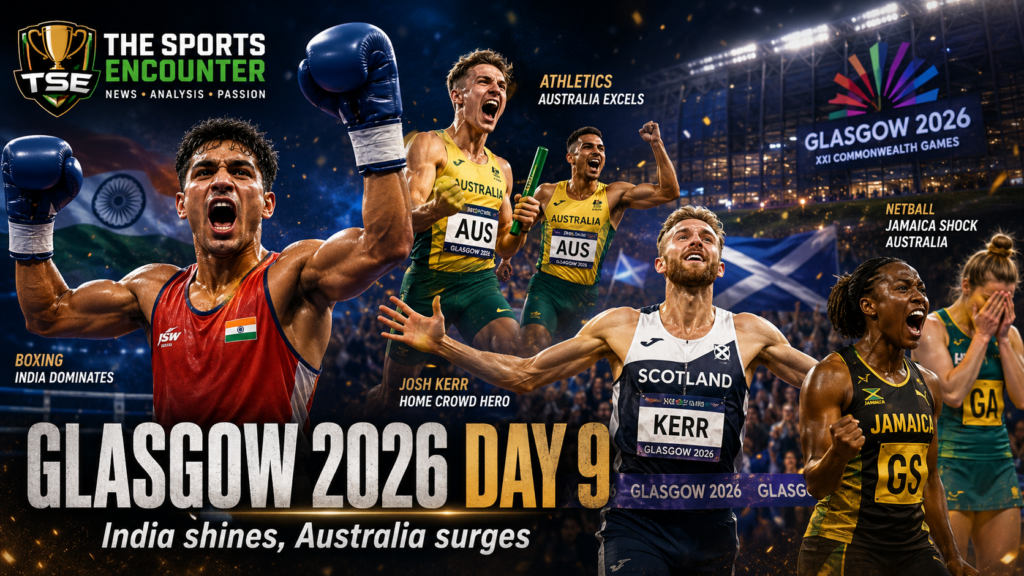
India delivered a record boxing campaign, Australia produced a historic athletics haul, Josh Kerr won the men’s mile, and Jamaica shocked Australia in a dramatic Glasgow 2026 Day 9.
Glasgow 2026 saved one of its most dramatic days for the penultimate stage of the Commonwealth Games.
India produced a record-breaking boxing campaign, Australia delivered its greatest single day of Commonwealth athletics, Josh Kerr gave Scotland a home victory in the blue-riband mile, Jamaica removed the defending champions from the netball gold-medal match, and Neil Fachie ended a historic Para-cycling career with one final title.
Nineteen athletics medals were decided on Saturday, August 1, while boxing, track cycling, judo, and netball transformed the wider medal race before Sunday’s final program.
Australia remained untouchable at the top, reaching 63 gold medals and 154 overall. India’s extraordinary 16-medal day lifted it to fourth place, while England and Canada retained their positions inside the top three.
For schedules, official results, athlete information, and final-day updates, readers can visit the official Glasgow 2026 Commonwealth Games website.
Glasgow 2026 Day 9 at a Glance
| Day 9 storyline | What happened |
|---|---|
| India’s boxing surge | India won seven of its 10 boxing finals and finished with 10 boxing medals |
| Australia’s athletics record | Australia claimed seven athletics gold medals, its best single-day Commonwealth track-and-field haul |
| Josh Kerr’s home title | The Scottish star won the men’s mile with a decisive final-lap finish |
| Netball shock | Jamaica defeated Australia 46-45 to reach the gold-medal match |
| Neil Fachie’s farewell | The Scottish Para-cyclist won his seventh Commonwealth gold in his final race |
| Judo history | Malaysia and Mauritius won their first Commonwealth Games judo titles |
| India’s medal position | India climbed to fourth with 13 gold, 17 silver, and nine bronze medals |
| Medal-table leader | Australia ended the day with 63 gold medals and 154 overall |
India Turns the Boxing Ring Into Its Strongest Arena
India entered Day 9 with 10 boxers preparing for gold-medal bouts.
Seven left the SEC Centre as Commonwealth champions.
The scale of that success made this India’s finest boxing performance at a Commonwealth Games and turned a relatively modest overall campaign into a fourth-place medal-table position.
Sachin Siwach delivered one of the most dramatic victories of the evening in the men’s 60kg final against Namibia’s Tryagain Morning Ndevelo.
Ndevelo appeared to be moving toward victory before Sachin produced a knockdown with the final punch of the contest. That late intervention helped the Indian boxer secure a narrow decision and captured the emotional volatility of the entire finals session.
Jaismine Lamboria defeated Northern Ireland’s Michaela Walsh in the women’s 57kg final. The result denied Walsh gold, although the Northern Irish boxer still created history by becoming the first athlete to win four Commonwealth Games boxing medals.
Preeti Pawar won the women’s 54kg title, Sakshi Chaudhary claimed the women’s 51kg crown, Priya Ghanghas took gold at 60kg, Arundhati Choudhary won the women’s 70kg division, and Ankush Panghal defeated England’s Dimeji Shittu in the men’s 80kg final.
India finished the boxing competition with seven gold medals and three silvers.
That conversion rate mattered more than the overall volume. Ten finalists guaranteed India a strong return, but winning seven of those bouts transformed the team’s position in the wider Games.
The country began Day 9 outside the leading group. By the end of the night, India had climbed above Scotland and entered the final day with 39 medals.
The rise continued the momentum created by India’s historic opening victories in judo, covered in The Sports Encounter’s Glasgow 2026 Day 8 wrap-up.
India’s Success Was Bigger Than Boxing
Boxing supplied the headlines, but India’s 16-medal day stretched across several disciplines.
Para athletes helped the country complete its best Commonwealth Para-sport campaign, with India collecting three gold, two silver, and two bronze medals across the Games.
Strong results in athletics and Para athletics added further value on Saturday. India produced podium finishes in the triple jump and distance events, while Unnati Sharma collected bronze in the women’s -63kg judo competition.
The wider significance is difficult to miss.
Several sports that have traditionally strengthened India’s Commonwealth medal total were absent from Glasgow’s streamlined program. Shooting, wrestling, badminton, and hockey were not part of the 10-sport schedule.
India therefore needed boxing, athletics, weightlifting, judo, and Para sport to compensate.
Day 9 showed what was possible when those disciplines converted opportunities into gold.
The country’s rise also followed the world-record excellence seen earlier in the Games, when Nigeria’s Goodness Nwachukwu rewrote the Para discus record during a medal-rich sixth day.
Australia Produces a Historic Athletics Masterclass
Australia had already dominated swimming, topped the medal table, and passed 100 overall medals before the final weekend.
Day 9 proved that its authority extended far beyond the pool.
Australia won seven athletics gold medals, the country’s best single-day track-and-field return in Commonwealth Games history.
The men’s 4x100m relay provided the most dramatic Australian victory.
Lachlan Kennedy, Josh Azzopardi, Calab Law, and Rohan Browning completed the race in 38.07 seconds, edging Canada by four hundredths of a second. Nigeria finished only one hundredth behind Canada in third.
Australia had not won the Commonwealth men’s sprint relay since 1974.
That 52-year wait ended through clean exchanges, composure under pressure, and Browning’s ability to protect the smallest of margins on the anchor leg.
The women’s mile produced another remarkable result as Australia swept all three medals.
Abbey Caldwell won gold, Jess Hull collected silver, and Claudia Hollingsworth completed the podium. A clean sweep in a major athletics final represented the depth of Australian middle-distance running rather than a single breakthrough performance.
Kurtis Marschall added pole-vault gold with a Commonwealth Games record of 5.85 meters.
Australia’s earlier dominance had been driven by swimming, including the medal rush detailed in The Sports Encounter’s Glasgow 2026 Day 6 results and medal-table analysis.
Saturday changed the interpretation of that success. Australia was no longer leading because of one exceptional program. It was producing champions across athletics, cycling, boxing, gymnastics, basketball, swimming, weightlifting, and Para sport.
Josh Kerr Gives Scotland the Race It Wanted
Josh Kerr arrived at Glasgow 2026 carrying expectations few athletes could escape.
The Scottish crowd wanted a home champion. Kerr entered the men’s mile as the central figure, only two weeks removed from a world-record performance in London.
He delivered through patience rather than reckless aggression.
Kerr remained inside the pack during the early stages, resisted the temptation to control the race from the front, and waited until the final lap before making his decisive move.
Australia’s Cameron Myers took silver, while Kenya’s Timothy Cheruiyot earned bronze.
The victory gave Scotland one of the loudest moments of the Games and confirmed Kerr’s ability to adjust from a record-paced race to a tactical championship final.
A fast time proves physical quality. A crowded final requires positioning, nerve, and the confidence to act before the opening disappears.
Kerr found the right moment.
His success continued a strong home campaign that included Angharad Evans’ memorable swimming double. The Scottish breaststroker’s second title is examined in our feature on how Angharad Evans completed her Glasgow 2026 golden double.
Samuel Ogazi Announces Himself in the Men’s 400m
Nigeria’s Samuel Ogazi delivered one of the most commanding individual victories of Day 9.
Ogazi won the men’s 400m by 0.57 seconds, defeating Trinidad and Tobago’s defending Commonwealth champion Jereem Richards.
The margin stood out because championship 400m finals are often decided by fractions.
Ogazi controlled the race with a strong opening 200 meters, maintained his form around the final bend, and entered the home straight with enough strength to prevent the field from closing.
Afterward, the Nigerian spoke openly about his desire to win Olympic and world titles and become one of the greatest athletes in the sport.
Those ambitions will require years of development, but his Glasgow performance gave them a credible foundation.
Nigeria’s Games had already been shaped by weightlifting, Para athletics, throwing events, and boxing. Ogazi provided the country with a major men’s track title and another potential global star.
Jamaica Ends Australia’s Netball Final Streak
The greatest team-sport shock of Day 9 came at The Hydro.
Jamaica defeated Australia 46-45 in the netball semifinal, eliminating the defending champions and preventing the Diamonds from reaching the Commonwealth gold-medal match for the first time.
The final seconds carried almost unbearable tension.
Australia’s Sophie Dwyer had an opportunity to level the contest and force extra time, but her shot did not fall. Jamaica protected the rebound and survived the closing moments.
The result was not built on one missed Australian attempt.
Jamaica’s defensive pressure disrupted the Diamonds’ usual rhythm, reduced the quality of their feeding into the circle, and forced Australia to operate under scoreboard pressure.
The Sunshine Girls also showed greater composure during the decisive possessions.
Jamaica advanced to face New Zealand, which defeated England in the other semifinal. The Silver Ferns controlled that contest more comfortably, denying England the chance to challenge for gold.
Australia’s loss reshaped the final weekend. The pre-tournament favorite must now recover for the bronze-medal match, while Jamaica has an opportunity to win one of the most significant titles in its netball history.
The semifinal drama followed England’s difficult route through the pool stage, discussed in our Glasgow 2026 Day 7 wrap-up.
Neil Fachie Ends a Historic Career With Gold
Neil Fachie’s final race could hardly have carried more emotional weight.
The Scottish Para-cycling great and pilot Aaron Pope won the men’s tandem B sprint at the Sir Chris Hoy Velodrome, securing Fachie’s seventh Commonwealth Games gold medal.
The home crowd understood the meaning immediately.
Fachie had already established himself among Scotland’s most accomplished Commonwealth athletes. Winning his farewell race in Glasgow allowed him to close the story in the venue, city, and atmosphere that made the moment feel complete.
His success carried significance beyond the medal.
Para events were integrated across six sports at Glasgow 2026, giving athletes such as Fachie the same central Games platform, medal ceremony, broadcast attention, and home-crowd emotion as their non-Para counterparts.
Fachie’s victory became one of the strongest examples of why that integration matters.
Wales also enjoyed an excellent cycling session. Anna Morris won the women’s 25km points race, with teammate Jessica Roberts taking silver.
The one-two finish formed part of a four-medal Welsh day at the velodrome and strengthened Wales’ position inside the top 10.
Malaysia and Mauritius Make Judo History
Day 9 created two first-time Commonwealth judo champions for their nations.
Amir Daniel Bin Abdul Majeed won Malaysia’s first Commonwealth Games judo gold in the men’s -81kg division.
The 21-year-old defeated South Africa’s Timothy Meuwsen with a decisive waza-ari. Their history added unusual depth to the final because the two judokas had previously trained together when neither could find suitable sparring partners before Birmingham 2022.
Remi Feuillet then gave Mauritius its first Commonwealth judo title.
Feuillet defeated Canada’s Guillaume Gaulin by a single yuko in the men’s -90kg final, upgrading the silver medal he won at Birmingham four years earlier.
Canada’s Laurence Biron won the women’s -63kg title, securing Canada’s third judo gold of the Games.
England added two more championships through Ethan Nairne in the men’s -73kg category and Kelly Petersen-Pollard in the women’s -70kg final.
Petersen-Pollard’s win carried particular value because she defeated Australia’s defending champion Aoife Coughlan, who had beaten her in all five of their previous meetings.
The judo session also produced deeply personal bronze medals.
England’s Jemima Yeats-Brown earned her third Commonwealth bronze four years after losing her sister Jenny to brain cancer. Yeats-Brown announced her retirement after the competition and is preparing for a fourth anterior cruciate ligament operation.
Scotland’s Scott Cusack won bronze in the men’s -90kg category, following the family path established by his parents, Loretta and Billy Cusack, who won Commonwealth medals in 1990.
Glasgow 2026 Medal Table After Day 9
Australia remained far ahead of the field after adding gold medals across athletics, cycling, boxing, and other events.
England stayed second by combining a strong overall medal volume with 25 golds. Canada held third, while India’s record Saturday moved it above Scotland into fourth.
| Rank | Nation | Gold | Silver | Bronze | Total |
|---|---|---|---|---|---|
| 1 | Australia | 63 | 40 | 51 | 154 |
| 2 | England | 25 | 40 | 34 | 99 |
| 3 | Canada | 18 | 19 | 21 | 58 |
| 4 | India | 13 | 17 | 9 | 39 |
| 5 | Scotland | 12 | 8 | 17 | 37 |
| 6 | Nigeria | 10 | 6 | 5 | 21 |
| 7 | Wales | 8 | 10 | 12 | 30 |
| 8 | New Zealand | 8 | 10 | 9 | 27 |
| 9 | Malaysia | 8 | 3 | 3 | 14 |
| 10 | South Africa | 7 | 10 | 10 | 27 |
Medal tables are ordered by gold medals, followed by silver and bronze. That system explains why India ranked fourth despite Scotland and several other nations remaining competitive in total-medal volume.
Australia’s progress has been relentless. The team held 26 golds and 59 total medals after the program analyzed in The Sports Encounter’s Day 4 wrap-up.
By Day 6, Australia had passed 100 medals. Three days later, it had reached 154.
How Day 9 Changed the Games
The penultimate day settled several major narratives.
Australia confirmed that its Glasgow dominance cannot be explained by swimming alone. Seven athletics golds gave the team one of the greatest track-and-field sessions in its Commonwealth history.
India found the event capable of changing its entire medal position. The country moved from a respectable campaign to fourth place through one exceptional boxing session and wider podium contributions.
Scotland gained two powerful home memories through Kerr and Fachie. One represented a global middle-distance star meeting expectation. The other marked the closing chapter of an extraordinary Para-sport career.
Jamaica broke the expected netball script, while Malaysia and Mauritius created national history in judo.
Earlier stages of the Games had already produced Australian basketball success and Uganda’s breakthrough silver. That final is revisited in our report on Australia’s victory over the Uganda Gazelles.
England also retained the men’s 3×3 basketball crown, as detailed in our analysis of England’s tense 19-17 victory over Australia.
What to Watch on the Final Day
Sunday’s closing program will decide the remaining titles before the closing ceremony brings Glasgow 2026 to an end.
The netball final between Jamaica and New Zealand carries the greatest team-sport interest. Jamaica enters with momentum after removing Australia, while New Zealand looked composed and efficient against England.
Australia and England will contest bronze, a matchup few expected before the semifinals.
Bowls and Para bowls will complete several medal contests, including England, Northern Ireland, Australia, New Zealand, Scotland, Malaysia, Canada, Guernsey, and Norfolk Island.
Judo will conclude with the heavier weight categories, while the remaining track-cycling program offers further opportunities for Australia, England, Scotland, India, and other leading nations.
The medal-table winner is already clear.
The final day will instead decide the last national breakthroughs, career farewells, and podium positions beneath Australia.
Conclusion
Glasgow 2026 Day 9 delivered the kind of range that gives the Commonwealth Games their identity.
India turned 10 boxing finals into seven gold medals and climbed to fourth in the standings. Australia produced a record athletics day, ended a 52-year wait in the men’s sprint relay, and pushed its overall medal total beyond 150.
Kerr gave Scotland the mile title its crowd desperately wanted. Fachie ended his career with gold. Jamaica defeated the most successful force in Commonwealth netball, while Malaysia and Mauritius heard their anthems after historic judo victories.
The medal table still belonged overwhelmingly to Australia.
The memories belonged to many more nations.
With one day remaining, Glasgow had already shown that a streamlined Commonwealth Games could still produce scale, emotion, historic firsts, and sporting stories capable of surviving long after the closing ceremony.
Frequently Asked Questions About Glasgow 2026 Day 9
Who led the Glasgow 2026 medal table after Day 9?
Australia led the medal table with 63 gold, 40 silver, and 51 bronze medals. Its overall total stood at 154.
How many medals did India win on Day 9?
India won 16 medals on Day 9, its largest single-day haul at Glasgow 2026. The surge lifted India to fourth place with 39 medals overall.
How many boxing gold medals did India win at Glasgow 2026?
India won seven boxing gold medals and three silvers from 10 finals, completing its best Commonwealth Games boxing campaign.
Which Indian boxers won gold on Day 9?
Sachin Siwach, Ankush Panghal, Jaismine Lamboria, Preeti Pawar, Sakshi Chaudhary, Priya Ghanghas, and Arundhati Choudhary won boxing gold medals for India.
Who won the men’s mile at Glasgow 2026?
Scotland’s Josh Kerr won the men’s mile. Australia’s Cameron Myers took silver, while Kenya’s Timothy Cheruiyot earned bronze.
Who won the Glasgow 2026 men’s 4x100m relay?
Australia won the men’s 4x100m relay in 38.07 seconds, defeating Canada by 0.04 seconds. It was Australia’s first Commonwealth title in the event since 1974.
How many athletics gold medals did Australia win on Day 9?
Australia won seven athletics gold medals on Day 9, its highest single-day Commonwealth Games athletics total.
Who won the women’s mile at Glasgow 2026?
Abbey Caldwell won the women’s mile as Australia completed a podium sweep. Jess Hull earned silver and Claudia Hollingsworth took bronze.
What happened in the Jamaica vs Australia netball semifinal?
Jamaica defeated defending champion Australia 46-45. Sophie Dwyer missed a late opportunity to force extra time, sending Jamaica into the final against New Zealand.
Who will play in the Glasgow 2026 netball final?
Jamaica will face New Zealand in the gold-medal match. Australia and England will contest bronze.
How many Commonwealth gold medals did Neil Fachie win?
Neil Fachie finished his career with seven Commonwealth Games gold medals after winning the men’s tandem B sprint with pilot Aaron Pope.
Which nations won their first Commonwealth judo gold medals on Day 9?
Malaysia and Mauritius won their first Commonwealth Games judo titles. Amir Daniel Bin Abdul Majeed won for Malaysia, while Remi Feuillet secured Mauritius’ historic gold.
Where did India rank after Day 9?
India ranked fourth with 13 gold, 17 silver, and nine bronze medals for a total of 39.
When does Glasgow 2026 end?
The Glasgow 2026 Commonwealth Games conclude on Sunday, August 2, following the final medal events and closing ceremony.
Editor's Choice
The Golden Generation Saying Goodbye After the FIFA World Cup 2026
The 2026 World Cup did more than crown a champion. It marked the emotional farewell of a generation that shaped modern soccer, from Messi and Ronaldo to Modrić, Neymar, Neuer, Ochoa, Lewandowski, Mané, Mahrez and beyond.
The 2026 FIFA World Cup did more than crown a champion. It quietly closed the international chapter for one of soccer’s most recognizable generations, from Lionel Messi and Cristiano Ronaldo to Luka Modrić, Neymar, Manuel Neuer, Guillermo Ochoa, Robert Lewandowski, Sadio Mané, Riyad Mahrez, and others who carried the game through its most global, social, and commercially explosive era.
Every World Cup produces farewells.
Some come with tears. Some come with applause. Some arrive through a substituted captain walking slowly toward the touchline, waving to supporters who understand what they are watching. Others arrive without ceremony, hidden inside a quarterfinal defeat, a missed penalty, an injury, a group-stage exit, or a post-match interview that sounds ordinary until the words settle.
The 2026 FIFA World Cup felt different because the goodbye was not limited to one player, one country, or one golden generation. It felt like an entire era of football was stepping away at the same time.
Lionel Messi was 39 during the tournament. Cristiano Ronaldo was 41. Luka Modrić was 40. Guillermo Ochoa was 40. Neymar, Manuel Neuer, Robert Lewandowski, Sadio Mané, Riyad Mahrez, Nicolás Otamendi, Enner Valencia, Marko Arnautović, Craig Gordon, Edin Džeko, Yuto Nagatomo, and others belonged to a generation that shaped how modern fans watched, argued about, consumed, and emotionally understood international soccer.
Some of them formally retired from international duty after the tournament. Others have not needed a formal announcement for the message to feel clear. By 2030, most will either be gone from the World Cup stage or present only as coaches, ambassadors, pundits, mentors, or memories.
The 2026 World Cup was not only a tournament. It was a closing credits sequence.
For The Sports Encounter’s wider football coverage, this farewell matters because it connects directly with the emotional scale of modern tournament football. We have already explored how the 2026 tournament could reshape the game’s commercial future through World Cup 2026’s impact on soccer’s rise in the United States, fan identity through the FIFA World Cup 2026 fan-voted dream team, and national heartbreak through England’s World Cup 2026 semifinal defeat.
This story sits in the same emotional universe.
It asks a simple question with a difficult answer: what happens when the players who defined the modern World Cup finally leave it behind?
TL;DR: The 2026 World Cup Farewell Generation
| Player | Country | 2026 Age | Why 2026 Felt Like a Goodbye |
|---|---|---|---|
| Lionel Messi | Argentina | 39 | Played in a sixth World Cup and reached another final deep into his late-career chapter. |
| Cristiano Ronaldo | Portugal | 41 | His 2026 appearance carried the emotional weight of a final World Cup pursuit. |
| Luka Modrić | Croatia | 40 | Reached another major milestone after leading Croatia’s golden era across multiple tournaments. |
| Neymar | Brazil | 34 | Injury and Brazil’s exit turned his international chapter into one of the tournament’s most painful endings. |
| Manuel Neuer | Germany | 40 | Returned for another World Cup before Germany’s latest disappointment ended his international run. |
| Guillermo Ochoa | Mexico | 40 | Closed one of the most beloved goalkeeper stories in modern World Cup culture. |
| Robert Lewandowski | Poland | 37 | Reached the end of an era as Poland’s defining modern striker. |
| Sadio Mané | Senegal | 34 | His farewell carried the weight of Senegal’s modern rise and African football’s changing identity. |
| Riyad Mahrez | Algeria | 35 | Stepped away after shaping Algeria’s most technically gifted modern era. |
| Nicolás Otamendi | Argentina | 38 | Closed a long Argentina chapter built on resilience, edge, and late-career redemption. |
The World Cup Changed With This Generation
To understand why this farewell feels so big, we need to remember what this generation changed.
Messi and Ronaldo did not simply play football. They turned football into a 15-year global comparison machine. Their rivalry moved across La Liga, the Champions League, Ballon d’Or debates, social media arguments, international tournaments, commercial campaigns, and generational identity. Fans did not only support them. They built football personalities around them.
Modrić gave Croatia a football soul that traveled far beyond population size. Neymar carried Brazilian flair into the streaming and social-media age. Neuer changed how many people understood goalkeeping. Lewandowski became the model of finishing efficiency. Ochoa became the World Cup’s cult goalkeeper, the man casual fans somehow rediscovered every four years as if the tournament had a secret contract with him.
There were others too.
Di María gave Argentina clutch moments across multiple eras. Otamendi survived criticism to become part of a world champion’s defensive backbone. Mané became Senegal’s global face. Mahrez gave Algeria style, touch, and continental pride. Džeko carried Bosnia and Herzegovina’s football identity for years. Nagatomo became a symbol of Japanese consistency. Arnautović finally tasted a World Cup late in his career. Neuer, even after injuries and retirement questions, remained tied to Germany’s modern goalkeeping revolution.
This generation did not grow up inside today’s football ecosystem. They helped create it.
They began in a world where YouTube compilations were still rough, tactical data was less public, social media did not drive every debate, and international football still felt separated from the daily club-content machine. By 2026, they were playing in a tournament shaped by streaming clips, fan votes, data graphics, fantasy games, tactical breakdowns, instant outrage, and global conversations across every platform.
They were the bridge.
Messi: The Last World Cup Chapter of the Game’s Quiet Genius
Lionel Messi’s 2026 World Cup did not need to be perfect to matter.
By the time he arrived in North America, his legacy had already escaped normal football measurement. The 2022 World Cup win in Qatar changed the emotional conversation around him forever. Before that triumph, every Argentina tournament carried the same question: could the greatest club footballer of his era finally win the World Cup?
After Qatar, the pressure shifted.
Messi no longer had to complete anything. He was playing with the strange freedom of a man whose greatest burden had already lifted. That made 2026 feel less like a chase and more like a final public appearance by a figure who had spent two decades bending football toward his rhythm.
His sixth World Cup carried historic weight. Very few players even survive long enough to play across that many cycles. Fewer still remain emotionally central to their country’s story at that age.
Argentina’s 2026 run added another layer to his final World Cup image. The country no longer looked like a team waiting for Messi to rescue it in the old way. It looked like a modern football nation still shaped by him, but increasingly prepared to live beyond him.
That may be the real beauty of Messi’s goodbye.
He leaves Argentina with memories, trophies, belief, and a new standard for what the shirt can mean. The sadness is obvious. The stability he leaves behind matters even more.
Ronaldo: The Final World Cup Chase of Football’s Great Competitor
Cristiano Ronaldo’s World Cup story has always carried a different emotional rhythm.
Messi’s international arc was often framed around destiny. Ronaldo’s was framed around defiance. He pushed against age, criticism, tactical change, role reduction, selection debate, and the biological limits that catch every athlete eventually.
At 41, Ronaldo’s 2026 World Cup appearance was already remarkable. Playing at that level, on that stage, at that age, says something about obsession. It also says something about the modern athlete’s ability to extend elite careers through nutrition, recovery, training science, mentality, and ruthless personal discipline.
Ronaldo’s greatest international achievement remains Portugal’s Euro 2016 triumph. Yet the World Cup always sat as the one prize missing from his record. That absence gave every tournament a sharper edge.
By 2026, the question had changed. It was no longer whether Ronaldo could dominate a World Cup in his prime. That version of the conversation belonged to another decade. The question became whether he could still force one last meaningful moment from a tournament that had never fully belonged to him.
That made his farewell powerful in a different way.
Ronaldo’s World Cup ending reminds fans that greatness does not guarantee closure. Some careers end with the trophy. Others end with pursuit itself. His career has always been built on hunger, and perhaps the most honest version of his final World Cup image is not victory, but refusal.
He kept chasing until the tournament moved on without him.
Modrić: Croatia’s Golden Era Reaches Its Natural Sunset
Luka Modrić may be the purest example of a player who changed what a small football nation could imagine.
Croatia had history before him, of course. The 1998 team left a major mark. But Modrić’s era turned Croatia from a dangerous tournament side into a country that repeatedly forced itself into the final stages of global football.
The 2018 World Cup final run was one of the great modern tournament stories. Croatia did not have the population, financial scale, or player pool of the biggest nations. It had midfield courage, emotional toughness, technical control, and a captain who could make a match feel manageable even when his team looked physically exhausted.
Then came another deep run in 2022, when Croatia again showed that tournament football rewards mentality as much as talent.
By 2026, Modrić was no longer simply a midfielder. He was a national artifact. Every touch carried memory. Every pass reminded fans of Russia 2018, Qatar 2022, Real Madrid nights, Ballon d’Or recognition, and that rare ability to make pressure feel elegant.
His farewell is not only personal. It raises a national question for Croatia.
How does a country replace not just a player, but an operating system?
Modrić gave Croatia rhythm, authority, tactical intelligence, emotional composure, and global respect. Future Croatian teams may still be strong. They may still produce brilliant players. But replacing Modrić is not a recruitment issue. It is a football identity issue.
Neymar: The Most Complicated Goodbye
Neymar’s World Cup farewell, if 2026 proves to be the last one, may be the hardest to process.
Messi’s international story found fulfillment. Ronaldo’s found defiant longevity. Modrić’s found national transcendence. Neymar’s story feels more wounded.
Brazil has always carried a different kind of expectation. Every great Brazilian attacker enters a conversation shaped by Pelé, Zico, Romário, Ronaldo Nazário, Rivaldo, Ronaldinho, Kaká, and the country’s long romance with beauty and pressure. Neymar inherited that burden in the social-media age, when every dribble could become a clip and every defeat could become a character trial.
He gave Brazil many moments of brilliance. He became Brazil’s all-time leading men’s scorer. He carried the national team through multiple cycles. He absorbed fouls, criticism, adoration, injury trauma, tactical imbalance, and impossible expectations.
Yet the World Cup never gave him the ending his talent seemed to deserve.
That is why Neymar’s farewell hurts. It feels unfinished, even after everything he achieved.
Brazil’s 2026 exit and Neymar’s injury-limited role sharpened the sadness. The world did not get the clean goodbye. Brazilian fans did not get the final dazzling tournament run. Instead, they got something more human: a great player caught between brilliance, pain, timing, and the cruel arithmetic of tournament football.
Neymar’s legacy will always divide people because his career asked fans to hold two truths together. He was one of the most gifted players of his generation. He also leaves the World Cup without the defining team triumph that would have quieted many of the arguments around him.
That tension will follow his name for years.
The Goalkeepers Saying Goodbye: Neuer and Ochoa
World Cup nostalgia often belongs to attackers, but 2026 also closed major goalkeeper chapters.
Manuel Neuer changed the position. Before him, goalkeepers could be good with their feet. After him, elite goalkeeping had a new tactical vocabulary. His sweeping, passing, starting positions, courage outside the box, and confidence under pressure influenced how clubs and national teams judged the role.
Germany’s 2014 World Cup win remains the great Neuer image. He was not only saving shots. He was controlling space. He was defending behind a high line like an extra outfield player. That version of Neuer felt modern before modern goalkeeping became a requirement.
By 2026, Neuer’s final international chapter carried the weight of a German team still searching for full stability after years of uneven tournament performances. His goodbye was not as triumphant as 2014. Few farewells are. Still, his influence on the position remains secure.
Guillermo Ochoa’s story is different, and that is what makes it special.
Ochoa became a World Cup figure in the most World Cup way possible. He turned tournament appearances into folklore. He produced saves that lived longer than many match reports. He became a player whom neutral fans associated with June and July, with Mexico, with reflexes, with survival, with the strange magic of a goalkeeper who seemed to rise every four years.
His 2026 farewell mattered deeply because Mexico co-hosted the tournament. That gave his final appearance a home-continent emotion few players ever receive.
Ochoa’s greatness was never only statistical. It was cinematic. He looked built for tournament memory.
Lewandowski, Mané and Mahrez: National Icons Without the Perfect World Cup Ending
Not every great player gets a World Cup run that matches his club career.
Robert Lewandowski knows that better than most.
At club level, Lewandowski built one of the finest scoring careers in modern football. He combined movement, timing, finishing technique, strength, discipline, and ruthless efficiency. At international level, he carried Poland through years in which the national team often depended heavily on his finishing.
The World Cup never fully unlocked him in the way the Champions League and domestic football did.
That does not weaken his status as Poland’s defining modern footballer. It actually explains the burden. Some players represent great teams. Others carry imperfect ones. Lewandowski spent much of his international career doing the second job.
Sadio Mané’s farewell carries a different emotional charge. Senegal’s modern rise cannot be understood without him. He brought elite-level credibility, attacking quality, and global recognition to a national team that became one of Africa’s most important football stories. His journey connected club brilliance with national pride in a way that mattered far beyond individual numbers.
Riyad Mahrez gave Algeria another kind of beauty. His touch, balance, left foot, and calm made him one of the most stylish players of his generation. His international legacy will always connect with Algeria’s 2019 Africa Cup of Nations triumph, a tournament that gave his country a night of continental glory.
These players remind us that World Cup greatness has layers.
A player can be a national legend without winning the tournament. He can lift a country’s expectations, change its global image, inspire a generation, and still leave the World Cup with some sadness attached.
The South American Farewell: Otamendi, Valencia and the End of Old Edges
South American football also said goodbye to important figures after 2026.
Nicolás Otamendi’s Argentina career is a study in survival. He lived through criticism, tactical changes, painful defeats, and the long shadow of Argentina’s pre-2021 frustration. Then he became part of the group that helped the country win the Copa América and the World Cup, changing the emotional frame around an entire generation.
Otamendi’s final years with Argentina were not about perfection. They were about edge, experience, and the ability to keep fighting inside tournament pressure.
Enner Valencia’s Ecuador farewell belongs to the same category of national importance. He gave Ecuador goals, leadership, visibility, and belief. For countries outside the traditional title-winning powers, players like Valencia matter because they become reference points. They show younger players what an international career can look like.
South American football has always understood the emotional weight of national-team identity. Club careers matter, but the shirt carries family, neighborhood, language, history, and pride. When players like Otamendi and Valencia walk away, countries lose more than minutes on the pitch.
They lose emotional continuity.
Why the 2026 Goodbye Feels Bigger Than Past Farewells
World Cups have always created generational endings.
2006 closed chapters for icons such as Zinedine Zidane and several members of older European and South American cores. 2014 marked the end or decline of major figures from Spain’s golden generation. 2018 and 2022 reshaped multiple national teams.
But 2026 feels bigger because the departing players belonged to football’s first fully global digital generation.
Fans did not only watch Messi, Ronaldo, Neymar, Modrić and others during tournaments. They watched their training clips, interviews, transfer sagas, endorsements, family posts, tactical breakdowns, arguments, stats graphics, fan edits, goal compilations, and live reactions. These players became part of daily football life in a way previous generations did not.
That changed the emotional relationship.
A fan in Karachi, Lagos, Los Angeles, London, Buenos Aires, Zagreb, Lisbon, Mexico City, São Paulo, Riyadh, Jakarta, or Sydney could build a football identity around the same player. The World Cup then became the one stage where all those private attachments became public again.
That is why the goodbye feels personal even for fans who never saw these players live.
They grew up with them through screens.
The New Generation Has Already Arrived
The hardest part of any football farewell is that the game never waits long enough for grief.
As Messi, Ronaldo, Modrić, Neymar, Ochoa, Neuer and others step away, the next era is already visible. Kylian Mbappé, Erling Haaland, Jude Bellingham, Vinícius Júnior, Lamine Yamal, Jamal Musiala, Florian Wirtz, Pedri, Gavi, Rodri, Endrick, Benjamin Šeško, Michael Olise, and many others now carry the sport’s next set of arguments.
The 2026 World Cup made that transition sharper.
Haaland’s tournament pushed Norway into a new global conversation. Mbappé continued to chase World Cup history. Bellingham’s profile kept expanding. Spain’s younger core showed how quickly a national team can combine technical quality, tactical discipline, and competitive maturity. Emerging teams from Africa, Asia, and smaller football nations made the tournament feel wider than ever.
The expanded 48-team format also changed the emotional landscape. More nations created stories. More players reached the stage. More fan bases found themselves inside the World Cup conversation.
That matters because the next era will not belong to one rivalry in quite the same way Messi vs Ronaldo did.
The future may be more scattered, more global, more positionally diverse, and more tournament-driven. Instead of two names dominating everything, fans may follow a wider cast of stars across more countries and more tactical roles.
That could be healthy for the sport.
It will still feel strange.
What National Teams Lose When Legends Leave
When a great player retires from international football, the loss is rarely limited to output.
Goals can be replaced. Minutes can be redistributed. Captaincy can be reassigned. Shirts can be handed to younger players. Tactical systems can adapt.
Presence is harder.
Argentina without Messi will still have talent, but it will no longer have the player around whom the country built 20 years of emotional weather. Portugal without Ronaldo will no longer carry the same obsessive pursuit. Croatia without Modrić loses the midfielder who made the impossible feel organized. Brazil without Neymar loses a player who absorbed both the fantasy and the criticism of an entire football culture.
Mexico without Ochoa loses one of its most familiar World Cup faces. Germany without Neuer loses a goalkeeper who changed the language of the position. Poland without Lewandowski loses a striker whose standard may be impossible to match for decades.
This is the invisible work of legends.
They give teammates certainty. They give fans identity. They give opponents a mental problem before the match begins. They give broadcasters a story. They give tournaments a face.
When they leave, football becomes younger, faster, and possibly fresher. It also becomes less familiar.
Why Fans Should Celebrate Instead of Only Mourn
There is sadness in this transition, but there should also be gratitude.
This generation gave fans extraordinary football volume. Messi and Ronaldo stretched the idea of prime years. Modrić made midfield intelligence feel beautiful. Neymar kept Brazilian individualism alive in a colder tactical age. Neuer changed goalkeeping. Ochoa turned World Cup goalkeeping into theatre. Lewandowski showed the craft of elite finishing. Mané and Mahrez expanded the emotional map of African football. Otamendi, Valencia, Džeko, Nagatomo and others gave their countries years of commitment.
They also gave fans arguments that made football feel alive.
Who was greater, Messi or Ronaldo? Did Neymar fulfill his talent? Was Modrić the best midfielder of his era? Did Neuer redefine goalkeeping more than any modern keeper? Was Lewandowski underrated because he played for Poland? Did Mané’s national-team impact deserve more global attention? How much should World Cup success shape a player’s legacy?
These debates can be exhausting, but they are also part of football’s social bloodstream.
The Sports Encounter has leaned into these comparison-driven legacy questions across sports, from LeBron James vs Michael Jordan vs Kareem Abdul-Jabbar to the 10 best NHL players ever ranked. Soccer now has its own version of that turning point.
The arguments will not end because the players leave. They may become sharper.
The 2030 World Cup Will Feel Like a Different Sport
By 2030, the World Cup will likely look emotionally different.
Messi will be 43. Ronaldo will be 45. Modrić will be 44. Ochoa will be 44. Neuer will be 44. Lewandowski will be 41. Neymar will be 38. Some may remain around football in other roles, but the central playing stage will almost certainly belong to another cast.
That does not mean the 2030 World Cup will be weaker. It may be spectacular. New stars will arrive. New rivalries will form. New nations will rise. New heartbreaks will create new memories.
Still, something will be missing.
For nearly two decades, fans could enter any World Cup conversation and immediately locate themselves through familiar names. Messi. Ronaldo. Neymar. Modrić. Neuer. Ochoa. Lewandowski. Mané. These names gave tournaments continuity.
2030 will not have the same emotional security blanket.
That may be good for football. It will force fans to watch differently. It will push attention toward teams, systems, new stories, and emerging nations. It will create room for new heroes instead of endlessly measuring younger players against impossible shadows.
But for those who grew up with this generation, the first World Cup without them will feel like walking into a childhood room after the furniture has been moved.
Final Verdict: 2026 Was the End of the World Cup’s Modern Superstar Era
The 2026 FIFA World Cup will be remembered for many things.
It was the first 48-team edition. It stretched across the United States, Canada, and Mexico. It created new commercial records, new fan experiences, new tournament debates, and new global visibility for teams outside the usual elite circle. It gave the game fresh stars, fresh stories, and a glimpse of soccer’s next decade.
Yet emotionally, it may be remembered most clearly as the tournament where the modern superstar generation began saying goodbye.
Messi’s sixth World Cup. Ronaldo’s final chase. Modrić’s last dance with Croatia. Neymar’s painful closing chapter. Neuer’s goalkeeping sunset. Ochoa’s final tournament theatre. Lewandowski’s fading Poland era. Mané and Mahrez stepping away from national-team centrality. Otamendi and Valencia closing South American chapters built on grit and pride.
This generation did not simply play in World Cups. It taught millions of fans how to feel World Cups in the digital age.
They gave us debates, memories, arguments, heartbreaks, clips, tears, celebrations, and impossible standards. They carried their countries and, at times, carried the sport’s global imagination.
The next generation will bring speed, power, tactical intelligence, fresh personalities, and new emotional attachments. Football will survive because football always does. The game never pauses for nostalgia, even when fans need a moment.
But 2026 deserves that moment.
It was the tournament where many of the faces that defined modern soccer looked at the World Cup stage one last time and began walking away.
For official tournament information, fixtures, records, and competition updates, visit the official FIFA World Cup 2026 website.
For more football analysis, legacy debates, and World Cup coverage, follow The Sports Encounter’s football section, including our work on the rise of soccer viewership in America, the World Cup 2026 fan-voted dream team, Argentina vs Spain’s final preview, and France vs England’s third-place match.
Cricket
Charith Asalanka, Mohammad Nawaz Power Galle Gallants Into LPL Qualifier 1
Charith Asalanka scored 58 before Mohammad Nawaz claimed three wickets as Galle Gallants defeated Colombo Kaps by 13 runs, finished top of the LPL 2026 table, and secured a place in Qualifier 1 against Jaffna Kings.
Galle Gallants finished the Lanka Premier League 2026 league stage exactly where every team wanted to be: at the top of the table, with a second chance built into their playoff route.
Their 13-run victory over Colombo Kaps in Match 19 at Pallekele was built on Charith Asalanka’s authority with the bat, Mohammad Nawaz’s control through the middle overs, and a tactical contrast that became more obvious as the night unfolded.
Galle posted 201 for six after being asked to bat first, then dismissed Colombo for 188 in 19.4 overs. The result moved the Gallants to first place and confirmed a Qualifier 1 meeting with Jaffna Kings, while Colombo were pushed into the Eliminator.
Asalanka earned Player of the Match honors for his 58 from 37 balls, but Nawaz produced the most decisive bowling performance. His four overs cost only 24 runs and brought three wickets, including Sadeera Samarawickrama, Kamindu Mendis, and Ashen Bandara.
Colombo had raced to 62 for one in the powerplay. Once the field spread and Nawaz entered the contest, the chase changed completely.
Readers can follow every result, playoff development, team update, and tactical storyline through The Sports Encounter’s Lanka Premier League coverage hub.
Galle Gallants vs Colombo Kaps: Match Summary
| Match detail | Information |
|---|---|
| Competition | Lanka Premier League 2026 |
| Match | Match 19 |
| Venue | Pallekele International Cricket Stadium |
| Date | August 1, 2026 |
| Galle Gallants | 201/6 in 20 overs |
| Colombo Kaps | 188 all out in 19.4 overs |
| Result | Galle Gallants won by 13 runs |
| Player of the Match | Charith Asalanka, 58 from 37 balls |
| Best bowling | Mohammad Nawaz, 3/24 |
| Top Colombo scorer | Ben McDermott, 38 from 28 balls |
| Playoff impact | Galle advanced to Qualifier 1 against Jaffna Kings |
| Colombo’s route | Colombo moved into the Eliminator |
Galle Attack Early Despite Losing Rogers
Colombo captain Kamindu Mendis chose to bowl first because of the weather conditions, a decision he continued to defend after the match.
The call was understandable. Night matches at Pallekele can create uncertainty around moisture, dew, and chasing conditions. Mendis believed bowling first offered the safer route and insisted afterward that he would make the same choice again.
Galle immediately challenged that plan.
Thomas Rogers struck his first ball for four before Mujeeb Ur Rahman trapped him leg before for four from two deliveries. The early wicket did not slow the innings.
Sam Harper attacked from the other end, scoring 28 from 16 balls with four fours and one six. His approach forced Colombo’s bowlers to defend rather than settle into disciplined new-ball lengths.
Galle reached 49 for two by the end of the fourth over after Wanuja Sahan removed Harper, but the innings had already gained its desired tempo.
The powerplay ended at 71 for two.
That rate gave Galle room to absorb quieter overs later without losing control of the innings.
Harper had already played a major role in Galle’s earlier victory over Colombo, when he scored 65 during a successful pursuit of 190. That match is revisited in our report on how Harper and Sahan Arachchige completed Galle’s first win over the Kaps.
Asalanka Reads the Surface Better Than Colombo
Asalanka’s innings was the central batting performance because it matched aggression with awareness.
He made 58 from 37 balls at a strike rate of 156.75, hitting seven fours and two sixes. His half-century came from 31 deliveries.
The Galle batter admitted afterward that the pitch did not behave like a typical Kandy surface. Despite reaching 201, he occasionally wondered whether the total would be enough.
“We were really happy about the score because we saw that this is not a typical Kandy pitch. But still, sometimes I thought that 200 was not enough.”
The comment reflected the uncertainty of the conditions.
The ball traveled well during the powerplay, yet the pitch later offered grip, turn, drift, and extra bounce. The challenge was identifying when to attack and when to preserve wickets.
Asalanka managed that balance better than anyone else in the top order.
Dinura Kalupahana required 21 balls for his 20, while Chamika Karunaratne fell for two. Galle were 103 for four after 10.4 overs, with the innings at risk of losing the advantage created during the powerplay.
Asalanka did not allow the slowdown to become a collapse.
He found a valuable partner in Sahan Arachchige, who scored 43 from 29 balls. Their fifth-wicket stand added 66 runs and restored control through the middle and closing phases.
Asalanka had also shaped Galle’s opening victory over Jaffna Kings with 65 before Eshan Malinga took four wickets. That performance can be revisited in our report on how Asalanka and Malinga launched Galle’s LPL campaign.
Arachchige and Shanaka Turn a Strong Total Into 201
Arachchige’s innings carried considerable tactical value.
He struck four fours and two sixes, rotated the strike effectively, and ensured Asalanka did not have to manufacture every scoring opportunity.
Their 50-run partnership came from 32 balls.
Colombo eventually removed Arachchige at 169, followed by Asalanka two runs later. At 171 for six after 18.1 overs, the Kaps had an opportunity to keep Galle below 190.
Dasun Shanaka closed that door.
The Galle captain struck 21 not out from eight balls, including one four and two sixes. Nawaz added an unbeaten seven from four, and the Gallants reached 200 with one ball remaining.
They collected 48 runs from the final four overs.
That finish was especially damaging because Colombo had not used its slow-bowling resources as effectively as the conditions demanded.
Ripon Mondol endured a difficult LPL debut, conceding 34 runs from two overs. Mujeeb gave away 37 from four, while Kamindu’s three overs cost 27.
Milan Rathnayaka was Colombo’s most economical bowler, conceding 14 runs from two overs and removing Asalanka.
Arachchige has repeatedly provided Galle with middle-order stability during the tournament. He also led their recovery during the 60-run victory over Jaffna, covered in our analysis of how Galle overwhelmed the Kings after an uncertain start.
Colombo’s Bowling Plan Misses the Surface Clues
The first innings exposed a tactical problem that became even clearer during Galle’s defense.
The surface increasingly rewarded slower pace and spin, yet Colombo relied heavily on pace and did not maximize the overs available from its slower bowlers.
Malsha Tharupathi bowled only two overs and claimed one for 16. Wanuja Sahan took two for 28 from three. Kamindu delivered three overs without taking a wicket.
Colombo’s spinners and slower options had eight overs remaining in their combined allocations.
Galle later demonstrated what a more spin-focused plan could achieve.
Kamindu defended the toss decision after the match, pointing to the weather and insisting he would make the same choice again. The bigger concern was not the toss. It was the deployment of the attack after the pitch began revealing its character.
“Considering the weather, we felt bowling first was the right decision. I don’t take it back. We made the choice and backed it.”
Galle adapted. Colombo stayed closer to its original script.
That difference helped produce a target above 200.
Samarawickrama Gives Colombo a Flying Start
Colombo’s chase began with the required urgency.
Rubin Hermann fell for five in the second over, caught off Akif Javed, but Samarawickrama immediately transformed the powerplay.
He struck 37 from 19 deliveries, hitting five fours and two sixes. His strike rate of 194.73 brought Colombo back ahead of the required pace.
With Ben McDermott supporting him, the Kaps reached 50 in 5.4 overs and completed the powerplay at 62 for one.
At that stage, the chase was alive.
Colombo required 140 from 14 overs with nine wickets available. The scoring rate was demanding but manageable, particularly with McDermott settled and Kamindu, Bandara, James Neesham, and Janith Liyanage still to come.
Then Nawaz took the ball.
Nawaz’s First Over Breaks the Chase
The seventh over decided the match.
Samarawickrama attempted a reverse sweep and chipped Nawaz directly to short third. The shot had delivered runs earlier, but the field placement and surface made it a high-risk option immediately after the powerplay.
He departed for 37.
Three balls later, Nawaz trapped Kamindu leg before for one.
Colombo had moved from 62 for one to 65 for three.
The psychological damage was as important as the wickets. Their most aggressive batter was gone, the captain had failed, and the momentum built during the powerplay disappeared before the middle overs had properly begun.
Nawaz struck again in the ninth over.
He drew Bandara forward with a beautifully flighted delivery, beat him in the air and off the pitch, and allowed Harper to complete the stumping.
Colombo were 74 for four.
Nawaz’s opening spell had removed three batters for almost no cost and forced the Kaps to rebuild when they needed to keep attacking.
McDermott Cannot Carry the Middle Order
McDermott tried to stabilize the chase while keeping the required rate within reach.
He scored 38 from 28 balls with four fours and one six, but his innings never fully escaped the pressure created by the wickets around him.
Sachindu Colombage removed him in the 11th over, with Rogers completing the catch.
The dismissal left Colombo at 93 for five.
Janith Liyanage briefly attacked with a boundary but fell leg before for five. Neesham made 20 from 15 before Malinga dismissed him at 121 for seven.
The chase had lost six wickets for 59 runs after the powerplay.
That phase captured the tactical difference between the teams.
Galle’s spinners varied their pace, challenged both edges, and forced the batters to hit against turn. Colombo’s middle order responded with hurried strokes rather than calculated partnerships.
Nawaz completed his four overs with figures of three for 24 and 12 dot balls.
In a match where both sides scored quickly overall, his economy rate of six was exceptional.
Colombo’s middle order had previously demonstrated its ability to rescue difficult chases. Liyanage and Neesham added an unbeaten 115 against Kandy, as detailed in our report on how Colombo recovered from 67 for four to punish Kandy.
No comparable partnership emerged against Galle.
Tharupathi Gives Colombo One Final Chance
Malsha Tharupathi nearly dragged Colombo back into the match.
He attacked immediately, scoring 36 from 15 balls with three fours and three sixes. His strike rate of 240 gave the Kaps their first serious momentum since Samarawickrama’s dismissal.
Milan Rathnayaka supported him with 21 from 19 deliveries.
Their eighth-wicket partnership added 52 runs from 28 balls and took Colombo from 121 for seven to 173 for eight.
The stand briefly changed the equation.
With 29 needed from 13 balls and Tharupathi striking cleanly, Galle could not relax.
Malinga ended the threat by dismissing Tharupathi for 36. Akif then removed Rathnayaka in the following over.
Colombo entered the final over needing 21.
The innings ended chaotically at 188 when Ripon Mondol failed to respond to Wanuja Sahan’s call for a second run. Both batters finished at the same end, completing a difficult debut for Mondol and a frustrating night for the Kaps.
Sahan had already produced a dramatic lower-order assault against Jaffna earlier in the season, although Colombo fell five runs short. That match is covered in our report on how Jaffna survived Sahan’s late charge.
Eshan Malinga Takes the Purple Cap
Malinga finished with two for 43 from 3.4 overs.
His spell was expensive, particularly during Tharupathi’s assault, but the wickets of Neesham and Tharupathi carried major value.
The second dismissal moved Malinga to the top of the LPL 2026 wicket-taking list, earning him the Purple Cap at the end of Match 19.
His rise continues a strong tournament for the young Sri Lankan fast bowler. Malinga has provided pace, wicket-taking threat, and the willingness to return during the most demanding stages of an innings.
His ability to remove Tharupathi after being attacked showed why Galle continue to trust him in high-pressure overs.
Galle’s bowling figures also demonstrated the importance of shared responsibility.
Akif took two for 42, Colombage claimed one for 34, and Tharindu Ratnayake conceded 37 while removing Liyanage.
The collective attack survived the late hitting because Nawaz had created such a large advantage earlier.
Why Galle Gallants Won
Three tactical areas separated the teams.
First, Galle maximized the powerplay. Their 71 for two gave the innings a strong base even when the scoring rate slowed.
Second, Asalanka and Arachchige rebuilt without surrendering intent. Their partnership prevented the middle overs from becoming a period of control for Colombo.
Third, Galle used spin more intelligently.
Nawaz’s spell was the clearest example, but Colombage also benefited from the surface. The Gallants understood that the pitch offered more once the ball aged and the field spread.
Colombo missed the same opportunity during the first innings.
Kamindu acknowledged that his side had areas to refine in both batting and bowling. His decision to bowl first was defensible. The greater concern was the failure to adjust quickly enough once the pitch began favoring spin.
“The boys have been doing really well, but there are areas we need to refine in both batting and bowling. Mistakes are bound to happen. The important thing is that we learn from them and come back stronger in the next round.”
Galle Finish First and Earn Two Chances
The victory lifted Galle to the top of the standings and confirmed their place in Qualifier 1.
They will face Jaffna Kings, with the winner advancing directly to the final.
The loser will receive another opportunity in Qualifier 2 against the winner of the Eliminator.
That safety net explains why Asalanka emphasized the importance of finishing in the top two.
“That’s what we were aiming for, to take one of the first two spots, because then we get two chances to qualify for the final.”
Galle have earned two possible routes to the championship match rather than facing immediate elimination.
Schedules, match information, standings, and official tournament updates are available through the official Lanka Premier League website.
Galle’s Qualifier 1 opponent will arrive with confidence from several close victories, including Jaffna’s recovery against Dambulla. That match is covered in our analysis of how Bhanuka Rajapaksa rescued the Kings from 35 for three.
Colombo Head Into the Eliminator
Colombo’s defeat leaves them facing a more dangerous path.
They will meet either Kandy Royals or Dambulla Sixers in the Eliminator, depending on the outcome of the final league match.
One poor evening will now end their season.
Kamindu struck the right tone after the defeat. He defended the toss decision, accepted that mistakes had been made, and focused on learning before the playoffs.
Colombo have played several close matches during the tournament. That experience may help in the Eliminator, but their middle-order collapses and bowling adjustments remain serious concerns.
The Kaps cannot afford to rely on repeated recoveries from Tharupathi, Rathnayaka, or the lower order.
Their top six must carry more of the chase.
Kandy and Dambulla have both produced dangerous performances during the league stage. Kandy’s first victory came through Wanindu Hasaranga and Nuwan Thushara, as covered in our report on how Kandy defeated Dambulla by 43 runs.
Asalanka Demands More Despite Finishing First
Asalanka’s post-match comments showed why Galle remain dangerous.
He praised the fielding and welcomed the top-two finish, but he also identified death bowling and fielding as areas requiring continued improvement.
“We are playing good cricket at the moment, but I still think there are certain areas we can really improve, like our death bowling and especially our fielding. But today, I think our fielding was fantastic.”
That may sound overly critical after a win, yet Galle did allow Colombo to recover from 121 for seven to 173 for eight.
A stronger opponent could punish those late overs more severely.
The Gallants have reached the playoffs with momentum, balance, and a batting order capable of scoring 200. Nawaz gives them control through the middle, while Malinga offers wicket-taking pace at the death.
They are leading the table because they have solved more match situations than their rivals.
Qualifier 1 will demand another level.
Galle’s Campaign Has Combined Power With Recovery
Galle have rarely depended on a single batting formula.
Asalanka and Shanaka powered them beyond 200 in the tournament opener. Harper and Arachchige then completed a chase against Colombo. Arachchige and Nawaz rebuilt the innings during the 60-run victory over Jaffna.
The Gallants also experienced setbacks, including a defeat to Dambulla Sixers when Reeza Hendricks punished their attack. That performance is examined in our report on how Hendricks drove Dambulla past Galle.
The defeat did not derail Galle because their lineup retained several methods of winning.
They can attack inside the powerplay, recover through Asalanka and Arachchige, finish through Shanaka and Nawaz, and use spin to control the middle overs.
That adaptability has placed them at the top of the standings.
Key Statistics From Galle Gallants vs Colombo Kaps
- Galle Gallants scored 201 for six at a run rate of 10.05 per over.
- Charith Asalanka made 58 from 37 balls with seven fours and two sixes.
- Sahan Arachchige scored 43 from 29 deliveries.
- Dasun Shanaka finished unbeaten on 21 from eight balls.
- Galle scored 71 runs during the six-over powerplay.
- Sadeera Samarawickrama struck 37 from 19 balls for Colombo.
- Mohammad Nawaz took three wickets for 24 runs from four overs.
- Nawaz dismissed Samarawickrama and Kamindu Mendis in the same over.
- Ben McDermott top-scored for Colombo with 38 from 28 deliveries.
- Malsha Tharupathi made 36 from only 15 balls.
- Tharupathi and Milan Rathnayaka added 52 runs for the eighth wicket.
- Eshan Malinga claimed two wickets and finished the match as the tournament’s leading wicket-taker.
- Colombo were bowled out for 188 with two balls remaining.
Conclusion
Galle Gallants won because they understood the conditions faster and used them more intelligently.
Asalanka’s 58 gave the innings control. Arachchige ensured the middle overs remained productive. Shanaka turned a strong score into 201.
Colombo then started brilliantly but lost the chase in one devastating phase.
Nawaz removed Samarawickrama and Kamindu in the same over, dismissed Bandara shortly afterward, and left the Kaps rebuilding against a required rate that kept climbing.
Tharupathi’s 15-ball 36 restored drama, but the repair job was too large.
Galle finished the league stage on top and secured the protection of Qualifier 1. Colombo remain alive, although their next mistake could end the campaign.
The Gallants did more than win by 13 runs at Pallekele.
They earned the most valuable advantage available before an LPL final: a second chance.
Breaking News
Archer Destroys London Spirit as Southern Brave Survive Nervous Chase
Jofra Archer claimed 4/9 before David Miller steadied a difficult chase as Southern Brave defeated London Spirit by five wickets at Lord’s.
London Spirit had reached 103 for five with Jonny Bairstow still at the crease and enough deliveries left to build a competitive total. Twenty balls later, their innings was over.
Jofra Archer triggered a collapse that transformed the match at Lord’s. His pace, control, and late accuracy carried him to remarkable figures of 4 for 9 from 20 balls, leaving Southern Brave with a target of only 106.
The chase became uncomfortable when Brave slipped to 60 for five, but David Miller absorbed the pressure and finished unbeaten on 39. Southern Brave reached 111 for five from 97 balls to secure a five-wicket victory and move back into serious contention for the knockout stage of The Hundred 2026.
TL;DR
- Southern Brave beat London Spirit by five wickets at Lord’s.
- London Spirit collapsed from 103 for five to 105 all out in 92 balls.
- Jofra Archer claimed 4 for 9 and received the Match Hero award.
- Jonny Bairstow scored 56 from 43 balls, more than half of Spirit’s total.
- Jamie Smith struck 36 from 22 before David Miller finished the chase with an unbeaten 39.
- Brave moved to eight points, while Spirit’s qualification prospects suffered another major setback.
London Spirit vs Southern Brave Scorecard
| Detail | Information |
|---|---|
| Competition | The Hundred Men’s Competition 2026 |
| Match | Match 16 |
| Date | August 1, 2026 |
| Venue | Lord’s Cricket Ground, London |
| Toss | Southern Brave elected to bowl |
| London Spirit | 105 all out from 92 balls |
| Southern Brave | 111/5 from 97 balls |
| Result | Southern Brave won by five wickets |
| Top Spirit Batter | Jonny Bairstow, 56 from 43 balls |
| Top Brave Batters | David Miller 39*, Jamie Smith 36 |
| Top Bowler | Jofra Archer, 4/9 from 20 balls |
| Match Hero | Jofra Archer |
| Turning Point | London Spirit collapsed from 103/5 to 105 all out |
| Tournament Impact | Brave moved to eight points; Spirit remained on four |
Archer Turns a Recoverable Innings Into a Collapse
London Spirit’s innings depended almost entirely on Bairstow. The opener scored 56 from 43 deliveries, hitting five fours and two sixes while wickets disappeared around him.
Lhuan-dre Pretorius gave Spirit an aggressive start with 11 from eight balls, but Marcus Stoinis removed him with the score on 14. James Rew added 11, while Liam Livingstone managed only five before Adil Rashid dismissed both batters.
Spirit’s middle order then failed to support Bairstow. Dewald Brevis scored one, James Coles made two, and Jamie Overton’s 10 represented the only other double-figure contribution.
At 68 for five, Bairstow and Overton began a necessary recovery. Their partnership carried the total to 103 and gave Spirit a chance of reaching something close to 125, a score that could have tested Brave on a surface offering help to pace and spin.
Archer closed that route immediately.
He removed Bairstow for 56, caught by Chris Jordan, before dismissing David Willey and trapping Andrew Tye leg before on consecutive deliveries. Stoinis then claimed the final two wickets as Spirit lost five wickets for two runs.
Archer finished with four wickets while conceding only nine runs from his full allocation. Stoinis collected 3 for 17 from 17 balls, and Rashid added 2 for 17. The performance strengthened a Brave attack that had already shown its ability to control difficult games when Marcus Stoinis inspired the record defense against Birmingham Phoenix.
Jamie Smith Attacks Before Spirit Fight Back
A target of 106 appeared modest, but Southern Brave quickly discovered that the Lord’s surface still demanded careful batting.
David Willey bowled Ben McKinney for a duck and later removed Nikhil Chaudhary for five. Jamie Smith prevented Spirit from taking complete control by scoring 36 from 22 balls, including four fours and two sixes.
Smith’s aggression gave Brave 38 runs from the 25-ball powerplay. His approach mattered because the rest of the top order struggled to rotate the strike or find boundaries.
James Coles dismissed Smith with the score on 55. Adam Zampa then removed Moeen Ali for nine before a run-out ended Stoinis’ innings on three. Brave had fallen to 60 for five, and Spirit suddenly had a realistic chance of defending one of the lowest totals in the competition.
That pressure exposed a familiar weakness in Brave’s batting. Their earlier last-ball defeat to MI London showed how quickly control could disappear during a tight chase.
Miller refused to allow another collapse.
David Miller Brings Calm to a Nervous Chase
Miller combined calculation with selective aggression. He scored an unbeaten 39 from 28 balls, striking four fours and two sixes while Tristan Stubbs concentrated on survival at the other end.
Stubbs made only 12 from 20 deliveries, but his role carried considerable value. He protected his wicket, helped build an unbroken 51-run partnership, and allowed Miller to target favorable matchups.
The pair required 45 balls to complete their stand, reflecting the difficulty of the pitch and the tension created by Spirit’s bowlers. Miller supplied 38 of those partnership runs from 25 balls.
Willey finished with 2 for 28, while Zampa conceded only 14 from 20 deliveries. Coles also produced a controlled spell of 1 for 13 from 20 balls. Spirit’s bowlers gave the team a chance, but their batters had left them with almost no margin.
Readers can follow further English and franchise coverage through The Sports Encounter’s cricket hub and its wider collection of breaking sports stories.
What the Result Means for Qualification
Southern Brave entered the match with four points from four games after one win and three defeats. Their second consecutive victory lifted them to eight points from five matches, placing them firmly inside the group competing for the three knockout positions.
Brave still have work ahead. Trent Rockets and Welsh Fire occupied the leading positions before this result, while Manchester Super Giants, SunRisers Leeds, and MI London were also clustered around the qualification race. With three league matches remaining, Brave can now influence their own future rather than relying entirely on other results.
Their next match against Welsh Fire on August 3 carries immediate importance. Victory would move Brave to 12 points and strengthen their challenge for the Eliminator. The improved bowling form of Archer, Stoinis, and Rashid gives them a reliable foundation even while the batting remains inconsistent.
London Spirit’s position looks far more dangerous. They remain on four points after one win and three defeats, with five matches still available. Qualification remains mathematically possible, but Spirit will probably need at least four victories and a significant improvement in net run rate.
Their batting must become less dependent on individual rescue efforts. Livingstone had previously produced a major all-round performance, while Bairstow carried this innings almost alone. The repeated lack of middle-order support has become a structural problem rather than an isolated bad night.
The result also arrives during a broader discussion over The Hundred’s connection with English cricket fans. At Lord’s, Archer supplied the kind of high-quality individual performance the competition needs, while the fluctuating chase kept the contest alive until its closing stages.
Final Verdict
Southern Brave won because Archer destroyed London Spirit’s chance of building a defendable total and Miller managed the chase when five wickets created genuine pressure.
Bairstow’s 56 and Spirit’s disciplined bowling deserved more support. A collapse from 103 for five to 105 all out proved too damaging to overcome.
Brave now have consecutive victories and a clear route back into the qualification race. Spirit still have time, but their margin for another batting failure has almost disappeared.