


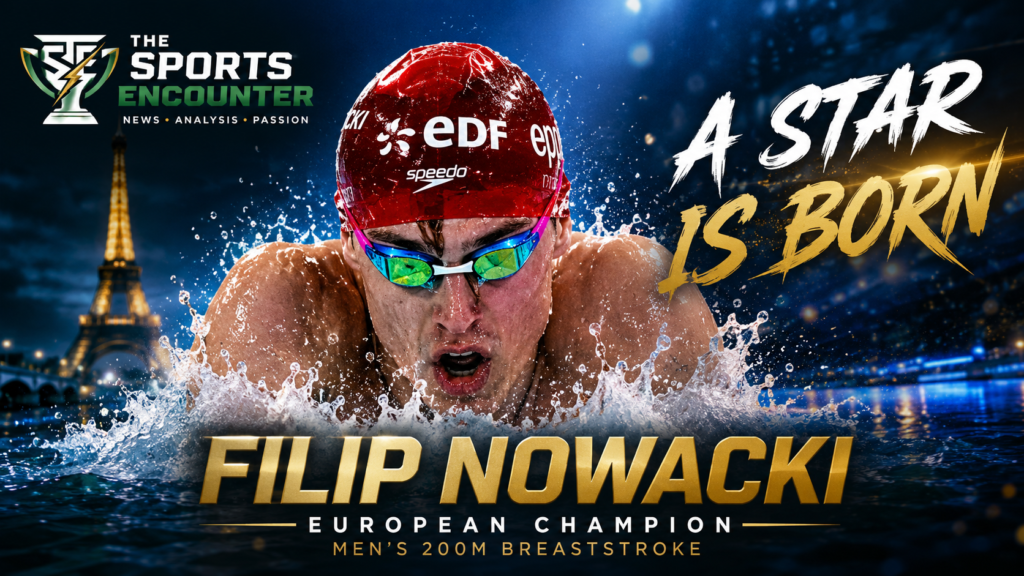
Filip Nowacki arrived in Paris carrying the label that follows almost every exceptional teenager in elite sport: future star.
He may have just outgrown it.
The 18-year-old produced a superb final-length surge to win the men’s 200m breaststroke title at the 2026 European Aquatics Championships on Thursday, touching in 2:07.70 to beat the Netherlands’ Caspar Corbeau by only 0.08 seconds.
Austria’s Luka Mladenovic took bronze in 2:08.91, but the story at the Olympic Aquatic Centre belonged to the young swimmer from Jersey who has turned one remarkable summer into a sequence of results that now demands attention well beyond British swimming.
Less than three weeks ago, Nowacki won Commonwealth gold for Jersey in the same event in Glasgow. Before that came his first senior British title. Last year, he completed 100m and 200m breaststroke doubles at both the European and World Junior Championships.
Paris supplied the missing step.
His first senior international championship medal for Great Britain is gold.
For readers who have followed The Sports Encounter’s swimming coverage through Glasgow and Paris, Nowacki’s rise has been visible for weeks. What happened Thursday changed the scale of the conversation.
Filip Nowacki Wins European 200m Breaststroke Gold: Key Results
| Position | Swimmer | Nation | Time | Margin |
|---|---|---|---|---|
| 1 | Filip Nowacki | Great Britain | 2:07.70 | Gold |
| 2 | Caspar Corbeau | Netherlands | 2:07.78 | +0.08 |
| 3 | Luka Mladenovic | Austria | 2:08.91 | +1.21 |
Official results and championship information are available through European Aquatics.
Corbeau Had the Race Until Nowacki Found Another Gear
This was very different from Nowacki’s Commonwealth victory.
In Glasgow, he took command early and controlled the men’s 200m breaststroke final from the front. Paris forced him to solve the race another way.
Corbeau, an Olympic bronze medalist and the short-course world record holder in the event, gave the teenager a target rather than allowing him to dictate terms.
Nowacki sat sixth at the first turn and remained sixth at halfway. There was no panic. He stayed close enough to the leading group to keep the race recoverable and began moving into contention on the third length.
Corbeau still had the advantage entering the decisive final 50 meters.
That was where Nowacki’s patience became dangerous.
European Aquatics reported that the British swimmer knew his finishing speed was one of his greatest weapons. He needed all of it.
Over the final 25 meters, he pulled alongside Corbeau and drove for the wall. The Dutchman held almost everything together, but Nowacki found eight hundredths of a second more.
Eight hundredths.
At 18, against an Olympic medalist seven years older than him, in his first senior European final.
That finish tells us more about Nowacki than another comfortable victory might have done.
Paris Was the Senior Test His Résumé Still Needed
Junior swimming can identify extraordinary ability. It cannot guarantee that ability will transfer cleanly against established senior athletes.
Nowacki had already built an outstanding junior record.
At the 2025 European Junior Championships, he won the 100m and 200m breaststroke titles, setting a European junior record of 2:08.32 over 200 meters. Weeks later at the World Junior Championships, he completed the same double and lowered the 200m mark again to 2:07.32.
Aquatics GB described him as one of Britain’s standout performers of the meet after that world junior campaign.
Then came 2026.
His first senior Aquatics GB Championships brought victory in the 200m breaststroke and silver medals in the 50m and 100m events. He was suddenly racing Adam Ramsay-Peaty rather than simply being compared with him.
The transition continued at Glasgow 2026.
The Sports Encounter’s Commonwealth Games Day 5 coverage followed the moment Nowacki gave Jersey its first Commonwealth swimming gold and ended the island’s 36-year wait for a gold medal in any sport.
He had already taken 100m breaststroke silver earlier in the Games.
Paris has now answered the next question.
Could he beat Europe’s best when the field included an Olympic medalist and the pressure came with a Great Britain cap rather than a junior championship?
Yes.
The Summer Has Changed Faster Than Anyone Expected
| Competition | Event | Result | Significance |
|---|---|---|---|
| Aquatics GB Championships, April 2026 | 200m breaststroke | Gold | First senior British title |
| Commonwealth Games, July 2026 | 100m breaststroke | Silver | First Commonwealth medal for Jersey in 36 years |
| Commonwealth Games, July 2026 | 200m breaststroke | Gold | Jersey’s first Commonwealth swimming gold |
| European Championships, August 2026 | 200m breaststroke | Gold | First senior international championship medal for Great Britain |
Athlete development rarely follows such a tidy upward line.
Nowacki’s 2026 has.
In April, winning the British 200m title established him domestically. Glasgow showed he could deal with a major multi-sport championship and the expectation of carrying Jersey’s medal hopes. Paris has now produced his strongest evidence yet that he belongs at the front of senior international breaststroke.
He did not need a personal best to prove it.
His 2:07.70 remains slower than the 2:07.32 he produced while winning the 2025 world junior title. That almost makes the Paris result more useful when assessing his progress.
Championship swimming is not a time trial.
It asks whether an athlete can read the field, manage rounds, respond to pressure and reach the wall first when somebody of Corbeau’s quality refuses to disappear.
Nowacki did exactly that.
He Qualified Fastest, Then Won a Completely Different Race
There had already been a warning in Wednesday’s semifinals.
Nowacki qualified fastest for the final in 2:08.60, ahead of Mladenovic’s 2:08.85. The Sports Encounter noted in its Paris 2026 Day 3 report that the teenager had earned his first genuine opportunity to convert junior dominance into a senior European title.
Twenty-four hours later, he converted it.
The manner of victory also matters.
Fastest qualifiers sometimes become trapped by the expectation that the final must resemble the semifinal. Nowacki did not force the early pace merely because he owned the fastest qualifying time.
He allowed the race to form, stayed connected and trusted his back half.
That is mature championship swimming.
British Breaststroke Has Another Serious Name
Any young British breaststroker inevitably enters a conversation dominated by Adam Ramsay-Peaty.
That comparison can become lazy very quickly.
Peaty changed the 100m breaststroke technically and statistically, broke world records repeatedly and became one of Britain’s greatest Olympic swimmers. Asking an 18-year-old to inherit that career would be unreasonable.
Nowacki does not need to.
He is developing his own profile, particularly over 200 meters.
His relationship with Ramsay-Peaty is more useful as a developmental reference. Nowacki has trained within the AP Race environment and has spoken about learning from the Olympic champion. At the British Championships this year, they were already racing each other for senior titles.
The Commonwealth Games then brought both generations into the same championship, a meet The Sports Encounter tracked throughout its Glasgow Day 4 coverage.
Now Paris has provided something different.
This medal belongs entirely to Nowacki.
Britain’s 200m Breaststroke Tradition Adds Another Champion
Nowacki also joins a significant British history in the European men’s 200m breaststroke.
Britain has produced champions across different generations, including Roy Romain, Nick Gillingham, Ross Murdoch and James Wilby. The 2026 victory gives Great Britain its ninth European title in the event since the championships began in 1926.
For Nowacki, the historical company is valuable without being burdensome.
He is still at the beginning of his senior career.
His result simply places a new name at the end of an old list.
Jersey Has Watched This Transformation Up Close
Nowacki’s rise has particular meaning in Jersey because the island experienced the breakthrough before the wider European audience did.
His Commonwealth performance was historic on two levels.
The 100m silver ended Jersey’s 36-year wait for a Commonwealth Games medal. His 200m victory then delivered the island’s first swimming gold at the Games.
The result was one of the defining stories of a Glasgow swimming program otherwise dominated by Australia. The Sports Encounter’s final Glasgow swimming review placed Jersey’s breakthrough within a meet that included 76 Australian medals and major performances from established Olympic stars.
Nowacki still stood out.
That is increasingly becoming a pattern.
A Wider British Youth Movement Is Emerging
Nowacki is not developing in isolation.
British swimming currently has several young athletes forcing their way toward senior relevance.
Sixteen-year-old Amalie Smith turned her Commonwealth 400m individual medley silver into one of Glasgow’s clearest teenage breakthroughs. The Sports Encounter examined her rapid progression in Who’s Amalie Smith? The 16-Year-Old Swimmer Turning Silver Into a Warning Shot.
Angharad Evans has moved in the opposite direction of the age curve, converting experience and technical development into major senior breaststroke success. She won two individual Commonwealth titles before arriving in Paris and has continued producing championship-level performances. Her Glasgow 200m victory is detailed in The Sports Encounter’s analysis of her breaststroke double.
Paris itself has become a showcase for emerging talent across Europe.
Italy’s Sara Curtis arrived as an exciting prospect and became the fastest woman in history over 50m backstroke. The Sports Encounter covered her breakthrough when she broke the world record in the semifinals.
Ireland’s Ellen Walshe produced another example of a swimmer moving from potential to championship delivery, winning the 400m individual medley after a brilliant final 50 meters. Her race is analyzed in The Sports Encounter’s report on Walshe’s European gold.
Nowacki belongs inside that generational story, but Thursday night also separated him from simple prospect status.
He is already winning senior titles.
The A-Level Results Waiting Outside the Pool Say Everything About His Age
There is a wonderfully ordinary detail behind an extraordinary week.
While Nowacki was preparing to become European champion, his A-level results in mathematics, physics and economics were waiting for him.
He chose not to open them before the final because he did not want another distraction.
After beating Corbeau, he admitted he was arguably more nervous about the exam results than the race.
It is an almost perfect reminder of where he actually is in life.
On Thursday evening, Nowacki was calculating how to close down an Olympic medalist over the final 25 meters of a European championship race.
A few hours later, he still had school results to worry about.
Elite sport grows teenagers quickly. It does not stop them from being teenagers.
TSE Analysis: The Most Important Thing Nowacki Did Was Repeat It
Sport produces young sensations every year.
The difficult part comes after the first breakthrough.
Opponents learn the name. Expectations rise. Races become less forgiving. A swimmer who once entered major meets with little pressure starts appearing on preview lists as someone expected to win.
Nowacki has already moved through that transition unusually quickly.
European junior champion.
World junior champion.
British senior champion.
Commonwealth champion.
European senior champion.
The progression matters because each title has asked a slightly different question.
Paris asked the hardest one so far.
Could he deliver against established senior opposition when the race did not go perfectly from the beginning?
His answer came over the final length.
Nowacki was sixth early. Corbeau looked stronger through the middle of the race. The margin at the wall was almost invisible.
Yet the teenager reached it first.
What Comes Next for Filip Nowacki?
Los Angeles 2028 will inevitably enter the discussion.
It should, but there is no need to rush the story.
Nowacki is 18. Two years remain before the Olympic Games. Senior breaststroke is deep, technical and unforgiving, and one European title does not guarantee Olympic selection or an Olympic medal.
What Paris changes is the level at which those ambitions can reasonably be discussed.
Nowacki no longer needs projections based entirely on junior records.
He has beaten senior championship fields.
He has won under different race conditions.
He has handled the expectation of arriving as a favorite and the pressure of chasing from behind.
Those experiences will matter when the stakes increase again.
Frequently Asked Questions
Who won the men’s 200m breaststroke at the 2026 European Aquatics Championships?
Great Britain’s Filip Nowacki won the men’s 200m breaststroke European title in Paris with a time of 2:07.70.
How old is Filip Nowacki?
Nowacki is 18 years old.
Who finished second behind Filip Nowacki?
Netherlands swimmer Caspar Corbeau won silver in 2:07.78, finishing only 0.08 seconds behind Nowacki.
Who won bronze?
Austria’s Luka Mladenovic took bronze in 2:08.91.
Was this Filip Nowacki’s first senior European medal?
Yes. His 200m breaststroke victory delivered his first senior international championship medal, and it was gold.
Did Filip Nowacki win at the 2026 Commonwealth Games?
Yes. Representing Jersey, Nowacki won the men’s 200m breaststroke gold medal at Glasgow 2026 after also collecting silver in the 100m breaststroke.
What is Filip Nowacki’s personal best in the 200m breaststroke?
Nowacki’s long-course personal best is 2:07.32, recorded when he won the world junior title in 2025.
What junior titles has Filip Nowacki won?
He completed the men’s 100m and 200m breaststroke double at both the 2025 European Junior Championships and the 2025 World Junior Championships.
Does Filip Nowacki represent Jersey or Great Britain?
Nowacki represents Jersey at the Commonwealth Games, where Jersey competes independently, and Great Britain at European and wider international swimming championships.
Could Filip Nowacki compete at the 2028 Los Angeles Olympics?
His recent performances put him firmly in the conversation for future Great Britain Olympic selection, but qualification for Los Angeles 2028 will depend on selection standards and performances closer to the Games.
From Prospect to European Champion
There will be faster swims in Filip Nowacki’s career if his current development continues.
There may be bigger finals too.
Thursday’s 2:07.70 still feels important because of what it settled.
Nowacki entered Paris as a world junior champion, Commonwealth champion and one of the most exciting young breaststrokers in Europe.
He leaves the 200m final as something simpler and more substantial.
A senior European champion.
The future-star label can wait.
Filip Nowacki is already winning now.