


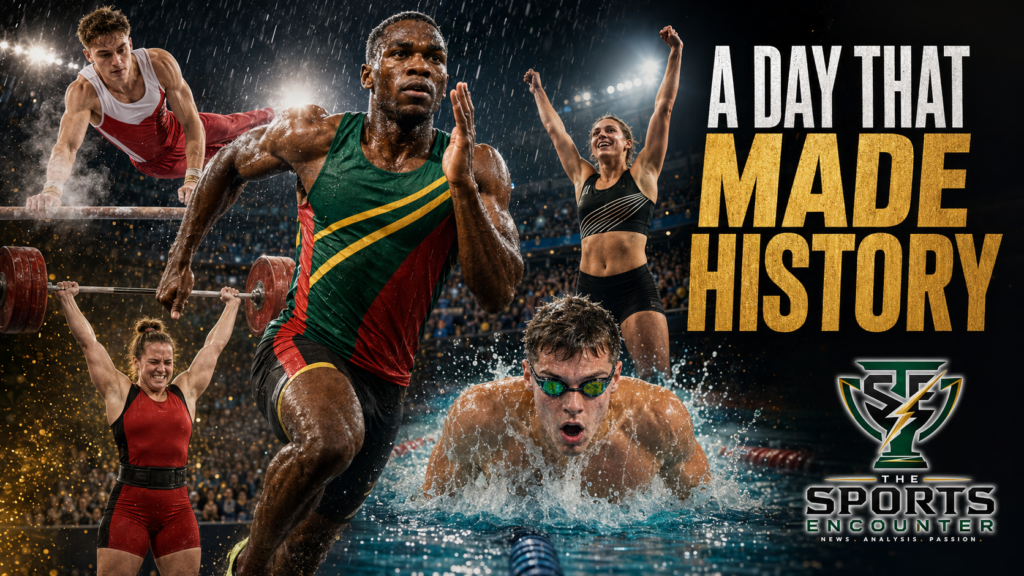
Australia strengthened its control of the Glasgow 2026 Commonwealth Games on a rain-soaked Day 5, but Filip Nowacki’s historic Jersey gold, Emmanuel Eseme’s record-breaking sprint and landmark boxing medals for Pakistan and Scotland gave the day a much wider meaning.
Day 5 of the Glasgow 2026 Commonwealth Games was expected to clarify the medal race. Instead, it revealed how many different versions of success can exist within the same sporting day.
Australia continued to overwhelm the competition through swimming, gymnastics and athletics. Canada collected gold through technical excellence, strength and the extraordinary consistency of Felix Dolci. England converted its bowls tradition into two titles, while Scotland found a home victory through one of the finest pressure shots of the Games.
Yet the moments that will probably last longest belonged to countries and territories with much smaller teams.
Filip Nowacki, an 18-year-old swimmer from Jersey, won the men’s 200m breaststroke to secure the island’s first Commonwealth Games gold medal in 36 years. Cameroon’s Emmanuel Eseme ran 9.83 seconds through heavy rain to become the fastest man in Commonwealth Games history. Zoe Hobbs gave New Zealand the women’s 100m crown in an Oceania record.
Pakistan’s Fatima Zahra and Scotland’s Caitlin Rainey guaranteed their countries’ first Commonwealth Games medals in women’s boxing. Nigeria produced its first swimming finalist in Games history. Wales celebrated its first Commonwealth artistic gymnastics title through Ruby Evans. Nauru placed a 17-year-old weightlifter on the podium.
The medal table still tells a story of Australian control. Day 5 itself told a richer one about athletes and nations changing what they believed was possible.
TL;DR: What Happened on Day 5 of Glasgow 2026?
- Australia won nine gold medals across swimming, gymnastics and athletics, taking its reported overall total to 35 golds.
- Emmanuel Eseme of Cameroon won the men’s 100m in a Commonwealth Games record of 9.83 seconds.
- New Zealand’s Zoe Hobbs claimed the women’s 100m in an Oceania record of 10.93.
- Jersey’s Filip Nowacki, 18, won the men’s 200m breaststroke in 2:07.32, ending the island’s 36-year wait for a Commonwealth title.
- Lani Pallister dominated the women’s 800m freestyle in a Games record of 8:11.12.
- Felix Dolci won the men’s vault and horizontal bar, finishing Glasgow’s gymnastics competition with six medals, including four golds.
- Wales’ Ruby Evans became her country’s first Commonwealth Games artistic gymnastics champion.
- Maude Charron won a third consecutive Commonwealth weightlifting title for Canada.
- Scotland defeated England in a dramatic Para mixed pairs bowls tiebreak.
- England won the women’s pairs and men’s singles bowls titles.
- Pakistan’s Fatima Zahra and Scotland’s Caitlin Rainey secured historic first women’s boxing medals.
- Uganda reached the women’s 3×3 basketball semifinals, while South Africa remained unbeaten in netball.
- Australia remained far ahead in the medal standings, with Canada and England leading the pursuit.
Glasgow 2026 Day 5 at a Glance
| Category | Day 5 highlight | Why it mattered |
|---|---|---|
| Athlete of the day | Felix Dolci | Won two golds and one bronze, finishing gymnastics with six medals |
| Performance of the day | Emmanuel Eseme, 9.83 in the men’s 100m | Commonwealth Games record in torrential rain |
| Breakthrough of the day | Filip Nowacki | Jersey’s first Games gold since 1990 |
| Women’s sprint highlight | Zoe Hobbs, 10.93 | Personal best and Oceania record |
| Australian statement | Nine Day 5 gold medals | Extended an already commanding medal-table lead |
| Home-nation moment | Scotland’s Para mixed pairs bowls gold | Won through a final-ball tiebreak shot |
| Historic boxing result | Fatima Zahra | Pakistan’s first Commonwealth women’s boxing medal |
| Gymnastics breakthrough | Ruby Evans | Wales’ first Commonwealth artistic gymnastics gold |
| Weightlifting milestone | Maude Charron | Third consecutive Commonwealth title |
| Para sport highlight | Stephen Clegg | Won Scotland’s men’s S13 50m freestyle title |
| Emerging-nation breakthrough | Abduljabar Adama | Became Nigeria’s first Commonwealth swimming finalist |
The Real Day 5 Story Was the Widening Medal Map
Australia’s supremacy is the easiest Day 5 story to identify. It is also only part of what happened.
The deeper development was the widening of the Glasgow medal map.
Jersey moved from celebrating a long-awaited silver to possessing a Commonwealth champion. Cameroon entered the medal table through the most prestigious race in athletics. Pakistan and Scotland reached new territory in women’s boxing. Nauru returned to the weightlifting podium through one of the youngest medalists of the day. Singapore won its first Glasgow 2026 medal through 16-year-old gymnast Amanda Yap.
Nigeria’s Abduljabar Adama won a swim-off to reach the men’s 50m butterfly final, becoming the first Nigerian swimmer to contest a Commonwealth Games final. That result will not appear as a medal, but its developmental importance could be greater than many bronze medals won by established powers.
This is where the Commonwealth Games still possesses a distinct sporting value.
World championships and the Olympics often measure success through global supremacy. The Commonwealth Games can provide an intermediate stage on which smaller programs gain belief, public recognition and funding. An athlete reaching one final can alter the expectations of an entire national federation.
The official Commonwealth Sport review of the widening Glasgow 2026 medal map identified Jersey, Pakistan, Nigeria, Singapore and Nauru as central examples of that wider breakthrough.
Australia dominated the quantity. Day 5’s smaller delegations supplied much of its meaning.
Emmanuel Eseme Produces the Race of the Games
The rain at Scotstoun Stadium could have slowed the men’s 100m final into a battle of survival.
Emmanuel Eseme turned it into history.
The 32-year-old Cameroonian entered the final after running a lifetime-best 9.89 in the semifinal. He improved again under heavier pressure, winning in 9.83 to break the Commonwealth Games record and claim Cameroon’s first medal of Glasgow 2026.
Australia’s Lachlan Kennedy took silver, while Nigeria’s Kayinsola Ajayi secured bronze.
Eseme’s performance deserves to be understood within the conditions. Sprinting relies on clean acceleration, confidence through the drive phase and the ability to apply force without tightening. Torrential rain can disrupt each part of that sequence. Athletes must also manage the psychological risk of slipping or losing control.
Eseme did not produce the best start in the field. His race developed through patience.
He allowed the early leaders to open a small advantage, stayed composed through the transition and closed powerfully over the second half. His post-race explanation was revealing: he expected others to lead through the opening 50 meters but trusted himself to catch them.
That is precisely what happened.
The result was Cameroon’s first Glasgow medal, a Games record and one of the strongest sprint performances ever witnessed at a Commonwealth Games.
Running 9.83 in ideal weather would have been exceptional. Achieving it on a drenched Glasgow track gave the performance a different level of authority.
The official Glasgow 2026 athletics report on the men’s and women’s 100m finals confirmed that Eseme lowered his personal best twice during the day.
Zoe Hobbs Finally Gets Her Championship Moment
New Zealand’s Zoe Hobbs arrived in Glasgow with years of international experience and a reputation as one of Oceania’s fastest women. A major senior title had remained out of reach.
That changed in 10.93 seconds.
Hobbs produced an excellent start in the women’s 100m final, established control early and maintained her technique when England’s Amy Hunt and Australia’s Torrie Lewis tried to close the gap.
Her 10.93 was a personal best and an Oceania record. Hunt took silver, while Lewis earned bronze with an Australian record.
Hobbs’ winning margin was only 0.05 seconds, but the race never felt out of her control once she found her upright running position. She resisted the tension that often appears in the closing meters of a championship final and continued driving through the line.
The emotional response after the finish suggested how much the result meant. Hobbs looked toward the scoreboard before allowing herself to celebrate. Years of marginal improvements had finally produced the medal she had chased.
Her victory also gave New Zealand a second major Day 5 swimming and athletics storyline, complementing Lewis Clareburt’s success in the pool.
Readers can follow more performances, records and tactical analysis through The Sports Encounter’s athletics coverage and results hub.
Australia Keeps Winning, but Its Day 5 Strength Went Beyond Swimming
Australia began Day 5 with a substantial medal-table lead after finishing Glasgow 2026 Day 4 with 26 gold medals and 59 medals overall.
By the end of Tuesday, the gap had grown again.
The Australian team reportedly collected nine gold medals during the day, moving to 35 golds and 80 medals overall. Swimming remained its primary engine, but gymnastics and athletics ensured the campaign did not depend entirely on Tollcross.
Jesse Moore won the men’s parallel bars. Breanna Scott took the women’s balance beam. Ky Robinson delivered gold in the men’s 10,000m. Eleanor Patterson reclaimed the women’s high jump title 12 years after winning it at Glasgow 2014.
Australia’s day showed something more significant than medal volume. Its athletes kept winning different types of contests.
Pallister controlled a long-distance swimming race from the front. Southam defeated an established champion in a sprint. Patterson survived a delayed, rain-disrupted high jump final lasting more than three hours. Robinson navigated a crowded and physical 10,000m.
That versatility is why Australia has separated itself.
England and Canada continue reaching podiums across many sports. Australia is converting more of those opportunities into gold.
Flynn Southam Signals a Changing of the Guard
The men’s 100m freestyle final offered one of Day 5’s most compelling internal Australian contests.
Kyle Chalmers entered as the defending Commonwealth champion and one of the defining swimmers of his generation. Flynn Southam arrived as the younger challenger who had already produced a 47.09 lead-off split in the 4x100m freestyle relay.
Southam won in 47.13.
Wales’ Matt Richards claimed silver, while Chalmers took bronze.
The victory was important because Southam did not inherit the title through Chalmers’ absence or a poor field. He defeated the established champion in direct competition.
Southam built the race through his speed and held his technique during the final 25 meters. Chalmers is renowned for late surges, so any swimmer facing him must balance early aggression with enough control to resist the closing attack.
Southam got that balance right.
The result did not diminish Chalmers’ career. It demonstrated that Australia’s freestyle succession plan is already producing championship-level outcomes.
Filip Nowacki Turns Jersey’s Long Wait Into Gold
No Day 5 victory altered a nation’s sporting history more directly than Filip Nowacki’s men’s 200m breaststroke title.
Jersey had waited 36 years for another Commonwealth Games gold medal. Colin Mallett’s shooting victory at Auckland 1990 remained the island’s most recent title.
Nowacki ended that wait at 18.
He entered Glasgow as the world and European junior champion and had already won silver in the 100m breaststroke, Jersey’s first Commonwealth medal since 1990. The 200m was considered his stronger event, but fulfilling that expectation required him to defeat a field containing established senior swimmers, including Australian Olympic champion Zac Stubblety-Cook.
Nowacki led with conviction and finished in 2:07.32. Canada’s Oliver Dawson took silver, while Stubblety-Cook earned bronze.
The winning time moved Nowacki into elite international territory and confirmed that his junior success can translate onto the senior stage. His progression also demonstrated the value of the Commonwealth pathway. He won three medals at the 2023 Commonwealth Youth Games before reaching the senior podium in Glasgow.
For Jersey, the result carries a scale that Australia’s latest swimming gold cannot match.
Large delegations can absorb sporting success into a wider medal campaign. Small territories experience it collectively. One title can become national history, a recruitment tool and an argument for further investment in sport.
Nowacki arrived in Glasgow as an emerging breaststroker. He leaves as one of Jersey’s most important Commonwealth athletes.
Lani Pallister Makes the 800m Look Almost Routine
Lani Pallister’s victory in the women’s 800m freestyle was far less surprising. The scale of her control still demanded attention.
Pallister won in a Commonwealth Games record of 8:11.12, finishing well ahead of New Zealand’s Erika Fairweather. Australia’s Molly Walker collected bronze.
The race was effectively decided before its closing stages. Pallister established a demanding rhythm, stretched the field and continued pressing when the gold medal was already secure.
That last detail matters.
Great distance swimmers do not measure themselves only against the people in neighboring lanes. They race the clock, their preparation and the technical standard they believe they can reach.
Pallister’s 800m title joined her earlier successes and reinforced her status as one of the central figures behind Australia’s pool dominance.
Australia later completed the swimming program with another record when its mixed 4x100m medley relay won in 3:40.46. South Africa claimed silver, while Duncan Scott produced a dramatic freestyle anchor to bring Scotland past England and Canada for bronze.
More swimming results and athlete analysis are available in The Sports Encounter’s international swimming coverage.
Forrester, Masse, Van Niekerk and Clareburt Defend Their Territory
The pool did not belong exclusively to Australia.
Canada’s Kylie Masse successfully defended the women’s 50m backstroke title. South Africa’s Lara van Niekerk retained the women’s 50m breaststroke crown. New Zealand’s Lewis Clareburt repeated as men’s 400m individual medley champion.
Australia’s Jenna Forrester won the women’s 200m individual medley, giving her a third individual gold of the Games.
Each victory involved a different type of championship pressure.
Masse carried the expectation associated with a long international career. Van Niekerk had to execute within one of swimming’s shortest and least forgiving events. Clareburt faced a 400m test requiring control across all four strokes. Forrester entered with momentum but also a growing workload.
Their victories prevented the session from becoming a simple Australian procession and gave Canada, South Africa and New Zealand important gold-medal movement.
Scotland’s Stephen Clegg added one of the home crowd’s strongest swimming moments by winning the men’s S13 50m freestyle. Australia’s Kiralee Hayes took the women’s S13 title.
Felix Dolci Leaves Glasgow With a One-Man Medal Campaign
Canada’s Felix Dolci produced the most complete individual performance of Day 5.
He won gold in the men’s vault and horizontal bar before collecting bronze in the parallel bars. Those results took his Glasgow tally to six medals, including four golds.
At the time his competition ended, Dolci’s personal medal return would have placed him among the leading nations on the medal table if he had been competing as a country.
His vault victory came with an average score of 13.766. He later scored 14.233 on horizontal bar, beating Cyprus’ Marios Georgiou, with Canadian teammate William Émard taking bronze.
Dolci’s success was built on durability as much as skill.
Multi-event gymnasts must repeatedly reset their concentration while managing physical fatigue, apparatus differences and the emotional consequences of previous routines. A mistake on one piece can follow an athlete into the next final.
Dolci kept producing.
His medal haul helped Canada move ahead of England on gold medals in the Day 5 standings and positioned him as one of the leading individual athletes of Glasgow 2026.
Ruby Evans Gives Wales Its First Artistic Gymnastics Gold
Ruby Evans’ women’s floor exercise title carried national significance.
Her 13.500 score defeated England’s Abigail Martin and Shantae-Eve Amankwaah, making Evans the first Welsh artistic gymnast to win Commonwealth Games gold.
The victory followed a difficult week in which Evans had endured inconsistent results and disappointment. Her floor routine offered the response athletes hope to produce after a competition has begun slipping away.
She combined difficulty with cleaner landings and enough expressive control to separate herself from the English challengers.
Wales entered Day 5 without a gold medal. Evans supplied one in an event built for visibility and emotion.
Australia’s Breanna Scott won the balance beam with 13.933, while 16-year-old Amanda Yap earned Singapore’s first medal of the Games with silver. Jesse Moore completed Australia’s apparatus success in the parallel bars.
The apparatus medals were distributed widely, even while Dolci remained the dominant individual force.
Maude Charron Completes a Commonwealth Three-Peat
Canadian weightlifter Maude Charron extended one of the Games’ most impressive active streaks.
Charron won the women’s 63kg competition, adding Glasgow 2026 to her Gold Coast 2018 and Birmingham 2022 titles. She set Games records in the snatch at 102kg and clean and jerk at 130kg.
England’s Sarah Davies Smale took silver. Nauru’s Femily-Crystie Notte, only 17, claimed bronze.
Charron’s third consecutive title represented longevity at the highest level. Weightlifting careers can be interrupted by injuries, bodyweight changes and shifting competition categories. Remaining the Commonwealth standard across eight years requires far more than maintaining raw strength.
Her technique stayed dependable when the weight increased, and her record lifts removed any doubt about the title.
Malaysia’s Erry Hidayat won the men’s 79kg division with a 331kg total, edging India’s Ajaya Babu by a single kilogram. England’s Chris Murray took bronze with 325kg after a frightening moment during the clean and jerk.
Murray appeared to faint after abandoning a 174kg attempt and required immediate attention. He recovered sufficiently to return minutes later and complete 177kg, securing bronze following an injury-ravaged two-year period.
Scotland’s Final Bowl Turns Pressure Into Gold
Scotland’s Para mixed pairs B2-B3 final against England delivered one of the best home moments of the day.
England won the opening set 7-2 through Ron Homer and Sally-Ann Lewis-Wall. Scotland responded to force a single-end tiebreak.
Robert Barr then delivered the decisive bowl.
With the title resting on one final shot, Barr found the line and weight required to give Scotland gold alongside Mary Stevenson and their directors. Stevenson won her first Commonwealth medal at 63.
The celebration inside the SEC reflected the pressure release. Bowls can appear measured and quiet from a distance, but its compressed indoor format creates sudden shifts. A match developed over two sets came down to one athlete controlling his hand and judgment for a few seconds.
England recovered to win both remaining bowls titles.
Amy Pharaoh and Sian Honnor defeated Malaysia’s Aleena Ahmad Nawawi and Syafiqa Abdul Rahman in the women’s pairs. Sam Tolchard beat Malaysia’s Izzat Shameer Dzulkeple in the men’s singles after taking the opening set 8-0.
Tolchard became emotional after winning, remembering his father, who died when the English bowler was 15. Northern Ireland collected bronze in both the women’s pairs and men’s singles.
The official Glasgow 2026 bowls review captured a session shaped by tight finishes, family memories and three different nations leaving with medals.
Fatima Zahra Changes Pakistan’s Women’s Boxing History
Fatima Zahra became the first Pakistani woman to guarantee a Commonwealth Games boxing medal.
She defeated New Zealand’s Jordan Wilson by unanimous decision in the women’s 60kg quarterfinal, securing at least bronze before her semifinal against Canada’s Marie-Bathoul Al-Ahmadieh.
Pakistan entered a women’s team in international boxing for the first time only in 2016. Ten years later, Zahra has placed the country on a Commonwealth podium.
Her victory is important for reasons extending beyond one tournament.
Women’s boxing programs need visible proof that international progress is possible. A first medal can help attract athletes, persuade federations to protect funding and challenge assumptions about which sports women from a particular country can pursue.
Zahra described the result as a first step and immediately turned her attention toward gold.
Scotland also secured its first Commonwealth women’s boxing medal when Caitlin Rainey stopped Papua New Guinea’s Flora Loga in the 65kg quarterfinal. She will face Northern Ireland’s Kaci Rock in the semifinals.
Lesotho guaranteed its first Commonwealth medal in 20 years after Pooana Khoahli defeated Mauritius’ Ziggy Agathe in the men’s 65kg division.
These quarterfinal results did not produce gold medals on Tuesday, but they created some of the day’s most consequential national milestones. The official Glasgow 2026 boxing report confirmed the historic achievements for Pakistan and Scotland.
Further results, profiles and fight analysis can be found through The Sports Encounter’s boxing news and analysis section.
Uganda Advances in 3×3 Basketball
Uganda’s women defeated Tonga 21-12 to qualify for the 3×3 basketball semifinals.
New Zealand, unbeaten through the competition, now stands between Uganda and the gold-medal game.
Jamila Nansikombi and her teammates have brought the same fearless energy that has characterized Uganda’s wider Games performance. The semifinal presents a more difficult tactical test because New Zealand has combined physicality with efficient outside shooting.
Uganda must protect possession and prevent the Kiwis from turning defensive rebounds into rapid two-point opportunities. In a game played to 21, a short scoring burst can decide the contest before a team has time to adjust.
Reaching the final four already represents progress. Defeating New Zealand would become one of the tournament’s defining team-sport upsets.
South Africa and Australia Prepare for a Netball Collision
South Africa maintained its perfect netball record by defeating Northern Ireland 78-30.
The Proteas were less convincing early but increased their intensity after halftime, outscoring Northern Ireland by 17 points in both the third and fourth quarters.
Australia followed with a 68-32 victory over Malawi, maintaining its own unbeaten start.
Those results created one of Day 6’s most important matchups. South Africa and Australia will meet before the Proteas finish the pool phase against England.
South Africa’s greatest positive has been lineup flexibility. Coach Jenny van Dyk has rotated players without losing control against the weaker teams. The unanswered question concerns whether those combinations can function against Australia’s defensive pressure and transition speed.
In Pool B, Wales earned its first victory by beating Trinidad and Tobago 74-30. Uganda pushed world No. 2 New Zealand before losing 58-50, further evidence of its growing status within international netball.
Glasgow 2026 Medal Table After Day 5
The available post-session standings showed Australia extending its lead significantly. Canada moved into second place on gold medals, while England remained ahead of Canada in overall medal volume.
| Rank | Nation | Gold | Silver | Bronze | Total |
|---|---|---|---|---|---|
| 1 | Australia | 35 | 18 | 27 | 80 |
| 2 | Canada | 13 | 10 | 12 | 35 |
| 3 | England | 10 | 18 | 15 | 43 |
Medal standings are ordered by gold medals, followed by silver and bronze. Figures reflect the reported table after Day 5. Readers should consult the official Glasgow 2026 medal standings for subsequent results or corrections.
Australia’s advantage is now severe enough that the main overall question may no longer concern which nation will finish first.
The more competitive contest sits behind it.
Canada’s gymnastics, swimming, athletics and weightlifting golds have improved its conversion rate. England continues to collect more medals overall but has too many silvers and bronzes compared with Canada’s title count.
That distinction explains the rankings. Commonwealth standings prioritize gold medals rather than total podium finishes.
Glasgow 2026 Day 5 Scorecard
| Category | Leading athlete or nation | Editorial assessment |
|---|---|---|
| Overall performance | Australia | Continued converting finals into gold across three major sports |
| Best individual campaign | Felix Dolci | Six gymnastics medals, including four golds |
| Best single performance | Emmanuel Eseme | Games-record 9.83 in extremely difficult conditions |
| Biggest national breakthrough | Jersey | First Commonwealth gold in 36 years |
| Most significant women’s milestone | Fatima Zahra | Pakistan’s first women’s Commonwealth boxing medal |
| Best home moment | Scotland’s Para mixed pairs | Won a tiebreak with the final bowl |
| Emerging talent | Filip Nowacki | Senior gold at 18 after Commonwealth Youth Games success |
| Strongest title defense | Maude Charron | Third successive weightlifting gold |
| Team-sport momentum | South Africa netball | Three wins before facing Australia and England |
| Day 6 team to watch | Uganda women’s 3×3 | One victory from the gold-medal game |
What Most Glasgow 2026 Day 5 Coverage Missed
The obvious conclusion from Day 5 is that Australia keeps winning.
The more interesting conclusion concerns how Glasgow’s compact Games model is distributing importance.
With 10 sports, six integrated Para sports and four main venues, Glasgow 2026 does not possess the scale or variety of Birmingham 2022. Several popular Commonwealth sports were removed to make the event financially and operationally possible.
That reduction created legitimate criticism. It also concentrated attention.
Jersey’s swimming title did not disappear beneath dozens of simultaneous finals. Pakistan’s women’s boxing breakthrough became a central Games story. Para bowls received a loud, emotionally invested crowd. Nigeria’s first swimming finalist gained official recognition even without a medal.
A streamlined Commonwealth Games will ultimately be judged on sustainability, competitive quality and whether the omitted sports can return in future editions. Day 5 nevertheless demonstrated that a smaller program can still create broad international relevance when the competition remains accessible to developing nations and territories.
Australia may leave Glasgow with an overwhelming medal total.
Nowacki, Zahra, Adama, Evans, Notte and Eseme showed why the Games cannot be evaluated only by looking at the top of the table.
Final Verdict: Australia Owned the Numbers, but History Belonged to Everyone
Day 5 strengthened Australia’s control of Glasgow 2026.
Flynn Southam defeated Kyle Chalmers. Lani Pallister dismantled the 800m field. Jenna Forrester won another individual medley. The mixed medley relay broke the Games record. Jesse Moore, Breanna Scott, Ky Robinson and Eleanor Patterson extended the gold rush beyond the pool.
Canada produced the day’s leading individual athlete through Felix Dolci and another three-time champion in Maude Charron. England swept the two non-Para bowls titles. Scotland found home glory through Robert Barr’s final shot and Stephen Clegg’s Para swimming victory.
Those achievements shaped the medal race.
The day’s identity came from somewhere else.
It came from Jersey ending a 36-year wait through an 18-year-old swimmer. Cameroon won the men’s 100m with the fastest performance in Commonwealth Games history. Pakistan entered a new chapter in women’s boxing. Wales found its first artistic gymnastics champion. Nigeria reached a swimming final for the first time.
These were not side stories surrounding Australia’s dominance. They were the reason Day 5 mattered.
The medal table tells us which country is winning Glasgow 2026.
Day 5 reminded us that the Commonwealth Games becomes valuable when success reaches places that rarely occupy the center of the global sporting stage.
Readers can follow schedules, results and tournament announcements through the official Glasgow 2026 website and find wider institutional information through the official Commonwealth Sport platform.
Frequently Asked Questions
Who led the Glasgow 2026 medal table after Day 5?
Australia led the medal standings with a reported 35 gold medals and 80 medals overall. Canada occupied second place on gold medals, while England had won more total medals than Canada but fewer titles.
Who won the Glasgow 2026 men’s 100m final?
Cameroon’s Emmanuel Eseme won the men’s 100m in 9.83 seconds. His performance established a Commonwealth Games record and delivered Cameroon’s first medal of Glasgow 2026.
Why was Filip Nowacki’s swimming gold historic?
Filip Nowacki won Jersey’s first Commonwealth Games gold medal since Colin Mallett’s shooting victory at Auckland 1990. The 18-year-old took the men’s 200m breaststroke title in 2:07.32.
What record did Zoe Hobbs break?
New Zealand’s Zoe Hobbs won the women’s 100m in 10.93 seconds, setting a personal best and an Oceania record.
How did Fatima Zahra make history for Pakistan?
Fatima Zahra became the first Pakistani woman to secure a Commonwealth Games boxing medal after winning her women’s 60kg quarterfinal by unanimous decision.
How many medals did Felix Dolci win at Glasgow 2026?
Canadian gymnast Felix Dolci completed his competition with six medals, including four golds. He won the men’s vault and horizontal bar titles on Day 5 and added bronze on the parallel bars.