Connect with us
Ruben Santos | The Sports Encounter

Published

on

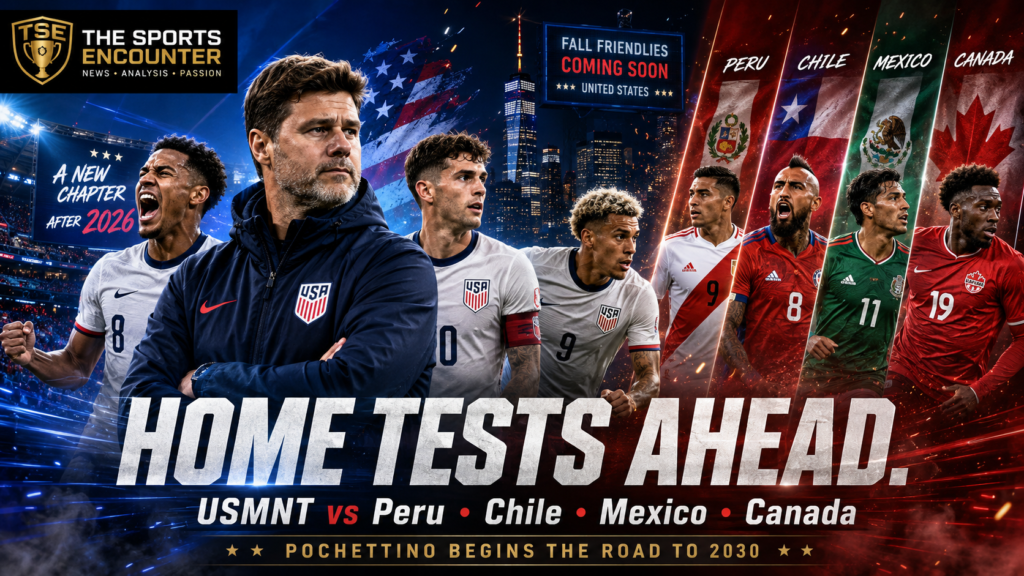
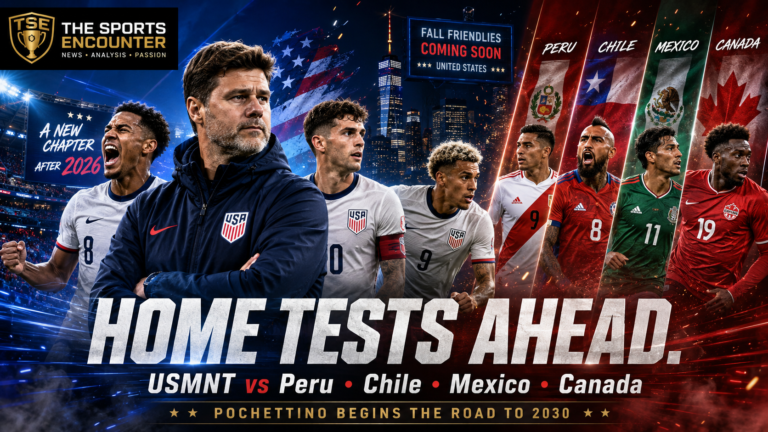
The United States men’s national team will return to action this fall with four home friendlies against Peru, Chile, Mexico, and Canada, giving Mauricio Pochettino an immediate opportunity to reshape the squad after its painful FIFA World Cup 2026 exit.

The Americans will face Peru in Orlando on September 26 before meeting Chile in St. Louis three days later. The schedule then shifts toward two familiar Concacaf rivalries, with Mexico awaiting in Glendale, Arizona, on October 3 and Canada completing the four-match window in St. Paul, Minnesota, on October 6.

These games will be the USMNT’s first since Belgium ended its home World Cup campaign with a decisive 4-1 victory in the Round of 16. They will also open Pochettino’s new contract cycle after U.S. Soccer extended the Argentine coach’s tenure through the 2030 World Cup.

The opponents have been chosen with purpose. Peru and Chile offer contrasting South American challenges. Mexico remains the match that carries the greatest emotional pressure for American players and supporters. Canada has grown into a direct regional competitor capable of questioning the United States’ position in North American soccer.

Four matches across 11 days will leave limited training time, which means Pochettino must arrive with a clear plan. The window offers a chance to reward the players who strengthened their reputations during the World Cup, test younger options and begin addressing the weaknesses Belgium exposed in Seattle.

The next World Cup remains four years away. The evaluation process starts now.

USMNT Fall 2026 Friendly Schedule

Date Match Venue City Kickoff
September 26, 2026 United States vs Peru Inter&Co Stadium Orlando, Florida 4:30 p.m. ET
September 29, 2026 United States vs Chile Energizer Park St. Louis, Missouri 8 p.m. ET
October 3, 2026 United States vs Mexico State Farm Stadium Glendale, Arizona 10 p.m. ET
October 6, 2026 United States vs Canada Allianz Field St. Paul, Minnesota 8 p.m. ET

Supporters can follow ticket information, broadcasting updates, squad announcements and official match coverage through the official U.S. Soccer announcement.

A New Cycle Begins With an Unfinished World Cup Story

The phrase “new cycle” can make international soccer sound cleaner than it really is.

The USMNT is moving toward 2030, but it has not escaped the questions left behind by 2026. Pochettino’s team produced encouraging moments during the tournament, finished first in its group and earned six points, the highest group-stage total in the program’s World Cup history.

The Americans then defeated Bosnia and Herzegovina 2-0 in the Round of 32 despite playing the final portion of the match with 10 men. Folarin Balogun opened the scoring before being sent off, while Malik Tillman’s late free kick secured progression.

That result appeared to show a team learning how to manage knockout pressure. The Sports Encounter’s report on the USA’s victory over Bosnia highlighted the discipline and defensive maturity the Americans showed after losing a player.

Belgium provided a harsher assessment four days later.

The United States conceded early, briefly equalized through Tillman and then lost control as Charles De Ketelaere, Hans Vanaken and Romelu Lukaku punished defensive mistakes. The 4-1 defeat to Belgium exposed a familiar gap between competing confidently and controlling a major knockout match.

Pochettino now has the security of a contract through 2030, but the extension also raises the standard by which his work will be judged. U.S. Soccer has chosen continuity. The next task is proving that continuity can produce evolution.

Why These Four Opponents Make Sense

The sequence gives the United States four different types of examination.

Peru can test the Americans’ patience against a South American opponent likely to protect central spaces and demand careful possession. Chile traditionally brings technical confidence, pressure around the ball and a willingness to compete aggressively in midfield.

Mexico changes the emotional environment. Tactical details remain important, but form can become secondary when the United States and Mexico meet. Every duel, foul, mistake and refereeing decision carries additional meaning.

Canada presents another problem. Its pace, athleticism and transition threat make it capable of attacking the spaces the USMNT sometimes leaves when pushing numbers forward.

Pochettino said the objective was to play the strongest opponents available and give his group a variety of experiences. This schedule follows that principle.

The two South American games can help determine whether the Americans have improved when facing technically secure opponents outside their own confederation. The final two matches will show where the United States currently stands within Concacaf.

Peru Offers the First Test of the Rebuild

The Peru match will carry less emotional noise than the games against Mexico and Canada, which may make it the most useful starting point for Pochettino.

He can evaluate the structure of his team without every selection decision becoming a referendum on regional supremacy.

The United States should expect to control long stretches of possession in Orlando. That places responsibility on the midfield and fullbacks to create advantages without leaving the defense exposed.

Breaking down an organized opponent has not always come naturally to the USMNT. The team can look dangerous when space opens for Balogun, Christian Pulisic or its other runners. Matches requiring slower construction often become crowded and predictable.

Peru can therefore reveal whether Pochettino has developed better solutions against a compact defensive block.

Central combinations, movement between the lines and the quality of the final pass will matter more than the possession percentage. The Americans must learn to move opponents before trying to play through them.

The game could also give Pochettino room to introduce emerging players without placing them immediately into the emotional intensity of USA-Mexico.

Chile Can Challenge the USMNT’s Midfield Authority

The match against Chile arrives only three days later, making rotation unavoidable.

Pochettino will need to decide whether to treat the opening two games as separate lineups or maintain a core group while changing selected positions. That choice will offer an early clue about his objectives for the window.

Chile can make the United States uncomfortable through midfield pressure and technical exchanges. The Americans must show they can receive the ball under contact, escape pressure and avoid turning every difficult phase into a rushed vertical pass.

The match should offer particular value for Tillman, Weston McKennie, Tyler Adams and the other midfielders competing for long-term roles.

Tillman left the World Cup with a stronger reputation after scoring against Bosnia and Belgium. His ability to operate between midfield and attack gives the United States a different type of creativity.

The next step is consistency. Pochettino needs Tillman and the wider midfield group to influence complete matches rather than isolated moments.

Chile will also test the defensive transition. When the United States loses possession after committing players forward, the first reaction must be coordinated. Belgium showed how quickly a confident opponent can turn loose positioning into clear chances.

USA vs Mexico Remains the Match That Defines the Window

No American friendly against Mexico feels entirely friendly.

The October 3 meeting at State Farm Stadium will carry the biggest crowd, the heaviest attention and the most immediate consequences for how supporters judge the window.

Mexico also enters the post-World Cup period with its own unresolved emotions. El Tri reached the Round of 16 on home soil before its tournament ended, leaving another cycle of pressure around a national team expected to compete at a higher level.

The Sports Encounter followed Mexico’s World Cup progress closely, including its controlled 2-0 knockout victory over Ecuador. That performance showed Mexico’s ability to control tense matches through defensive discipline and timely finishing.

The rivalry will give Pochettino a clear measurement of mentality.

Mexico will press, compete for second balls and try to control the emotional rhythm. The United States cannot allow intensity to become disorder. Its best recent performances against Mexico have combined aggression with tactical patience.

Individual battles will draw attention, particularly in midfield and wide areas. Pulisic will remain central to the American attack, but Pochettino must continue reducing the team’s dependence on him to create every important moment.

Balogun’s movement, Tillman’s intelligence and the support provided by the fullbacks can prevent Mexico from loading its defensive attention toward one side.

The result will not decide the 2030 cycle. It will shape how the first week of that cycle feels.

Canada Is No Longer a Secondary Rival

The final game against Canada should not be treated as an exhibition after the Mexico match.

Canadian soccer has changed. The national team carries greater speed, confidence and international experience than it did a decade ago. Its leading players operate in major European leagues, while the wider program has grown more comfortable challenging the United States and Mexico directly.

Canada’s World Cup ended with a 3-0 Round of 16 defeat to Morocco, a result covered in The Sports Encounter’s report on how the Atlas Lions eliminated the Canadians.

The scoreline was painful, but Canada’s tournament also included a historic 6-0 group-stage victory powered by Jonathan David’s hat trick. That performance showed the damage the Canadians can cause when their transition game gains space, as detailed in our coverage of Canada’s record-breaking win.

Against the United States, Canada is likely to attack quickly rather than compete for sterile possession.

Pochettino’s side must manage the space behind its fullbacks and prevent turnovers from becoming open-field races. That challenge becomes harder in the fourth match of an 11-day window, when fatigue can affect defensive recovery and decision-making.

The final game may therefore reveal the squad’s depth more clearly than the first three.

Pochettino Has Earned More Time, but Expectations Are Rising

U.S. Soccer’s decision to extend Pochettino through 2030 reflects belief in the wider direction of the program.

He took charge in 2024 and gradually moved the team toward a more aggressive, high-pressing approach. The World Cup group stage provided evidence that the work was producing results.

Finishing ahead of Australia, Paraguay and Türkiye was meaningful. Six points established a new USMNT group-stage high, while the Bosnia victory delivered the program’s first knockout success of the tournament.

The Belgium defeat placed those gains in perspective.

Pochettino is no longer preparing a young host nation for a home World Cup. He is now responsible for taking a tested group toward the next level.

The 2030 project should include more than waiting for the existing core to mature. Squad competition must increase. Tactical flexibility must improve. New leaders must emerge before injuries or declining form force change.

Extending the coach early gives him authority to make difficult decisions without treating every friendly as a short-term survival test.

That freedom should lead to experimentation with purpose rather than experimentation for its own sake.

Which Players Should Form the Core?

The World Cup established several players as central to the next phase.

Christian Pulisic

Pulisic remains the most influential American attacker and the player opponents plan around first. His movement, directness and experience make him difficult to replace.

Pochettino must still find ways to protect him from carrying too much creative responsibility. The United States becomes easier to defend when every meaningful attack needs Pulisic to beat the first opponent.

Malik Tillman

Tillman’s World Cup performances changed his standing within the squad. Goals against Bosnia and Belgium showed his composure in major moments.

He can become the connector between midfield and attack, particularly when opponents compress the center. His development may be one of the most important stories of the new cycle.

Folarin Balogun

Balogun gives the attack depth and penalty-area presence. His goal against Bosnia showed the instinct Pochettino needs from a central striker.

The red card in that same match also underlined the need for greater control. He must become an emotional and tactical reference point rather than merely the most direct runner.

Tyler Adams and Weston McKennie

Both midfielders bring experience, competitiveness and familiarity with high-pressure Concacaf games.

The question is how the midfield evolves around them. The United States needs technical security as well as energy, especially against opponents capable of controlling possession.

Matt Freese and the Defensive Unit

The goalkeeper and back line left the World Cup with mixed evaluations. They contributed to important wins, but Belgium exposed positioning and decision-making problems.

Pochettino must use the fall window to test whether those errors were tournament-specific or evidence of a wider structural weakness.

New Faces Must Enter Before the Squad Becomes Comfortable

The danger after a respectable World Cup is that a national team mistakes familiarity for progress.

Pochettino should retain a strong core, but every position needs genuine competition.

Sebastian Berhalter is one player whose trajectory deserves attention. The midfielder appeared in all five U.S. World Cup matches before completing a move to Middlesbrough.

The Sports Encounter’s report on Berhalter’s four-year Middlesbrough contract examined how his World Cup role and MLS form earned him a European opportunity.

Players developing overseas should not receive automatic selection, but regular competition in demanding environments can strengthen the national team.

The fall games may also give Pochettino a chance to assess young MLS players and members of the youth national-team structure. The 2030 squad will not be built only from the names that appeared in 2026.

Four years provide time, but international windows disappear quickly. A coach may receive only a handful of meaningful gatherings each season.

Every camp must move the selection process forward.

Four Cities Get Their Post-World Cup Moment

Orlando, St. Louis, Glendale and St. Paul did not host matches during the 2026 World Cup.

U.S. Soccer’s schedule gives supporters in those markets a chance to reconnect with a national team that spent the summer performing in front of enormous home crowds.

The decision also spreads the post-tournament momentum beyond the World Cup host cities.

The tournament was staged across 16 cities in the United States, Canada and Mexico. Its scale, transportation demands and regional differences were central to The Sports Encounter’s guide to the 11 U.S. World Cup host cities.

The fall friendlies now offer a different kind of opportunity. They can bring national-team soccer into strong regional markets without the pricing, travel pressure and global demand associated with the World Cup.

Orlando’s match against Peru has been designated as a Fan Appreciation Match. St. Louis will host Chile in an Impact Match, while Glendale receives the marquee Mexico fixture.

Allianz Field in St. Paul should offer a strong setting for the Canada game, particularly if both teams use competitive lineups.

What the USMNT Must Improve Before 2030

The four friendlies should begin a broader process focused on several clear weaknesses.

Control After Scoring

The United States responded well in several World Cup matches, but Belgium showed how quickly momentum can disappear. After Tillman equalized, the Americans conceded again almost immediately.

Strong tournament teams understand when to accelerate and when to calm the match.

Defending Transitions

Pochettino wants an aggressive team, which naturally creates space. The issue is whether the midfield and back line are positioned to manage that risk when possession is lost.

Chance Creation Against Compact Teams

Peru may provide the first test. The United States must develop more varied methods of creating chances when opponents refuse to leave space behind the defense.

Depth Beyond the Starting XI

Four games in 11 days will expose the quality of the wider squad. Pochettino needs substitutes who can change matches rather than simply preserve the original plan.

Emotional Control in Rivalry Games

Mexico and Canada will challenge the Americans physically and psychologically. Discipline must remain part of the team’s identity.

The Bigger North American Picture

The 2026 World Cup was expected to change soccer’s standing across the United States, Canada and Mexico.

The tournament’s commercial impact became visible even before it ended. When all three host nations were eliminated, ticket demand and resale prices around later matches changed sharply.

The Sports Encounter explored that effect in its analysis of why World Cup ticket prices fell after the host nations exited.

Now the three countries begin the quieter work of turning tournament attention into long-term national-team growth.

For the United States, that means maintaining fan interest after the spectacle has moved on. Mexico must rebuild confidence after another World Cup that ended earlier than supporters expected. Canada must prove that its progress can survive beyond one home tournament.

The October matches will bring those three programs back into direct comparison.

What Would Make This Window Successful?

Four wins would look impressive, but results alone should not define the window.

A successful series would provide evidence that Pochettino has identified the right core while opening space for new players. The Americans should show improved control in possession, cleaner defensive transitions and enough attacking variety to avoid becoming dependent on Pulisic.

The Mexico game will naturally attract the most attention. The Canada match may be equally important from a development perspective because it arrives at the end of a demanding schedule.

Pochettino should also leave the window with clearer answers about goalkeeper, center-back depth, midfield balance and the hierarchy among his forwards.

The team does not need to look ready for 2030 in October 2026.

It should look like it has started moving toward it.

The Sports Encounter View

The USMNT’s fall schedule offers the right balance for the first step after a complicated home World Cup.

Peru and Chile will test different parts of the Americans’ possession game. Mexico will bring the rivalry pressure that no training session can recreate. Canada will challenge the squad’s depth, transition defense and regional authority.

Pochettino has been given four more years because U.S. Soccer believes the progress shown in 2026 can become something larger.

That belief is reasonable. The United States won its group, earned a record six points and survived a tense knockout match against Bosnia.

The Belgium loss remains the more useful reference.

A team hoping to become a global contender cannot accept that its World Cup ceiling ends whenever it meets an opponent with greater tactical calm and knockout experience.

The next phase should build on the energy of the home tournament without becoming trapped by it. Some World Cup players will become long-term leaders. Others will be replaced as Pochettino searches for a stronger squad.

Peru, Chile, Mexico and Canada will not decide the success of the 2030 project.

They will reveal how seriously that project has begun.

Follow The Sports Encounter’s soccer coverage for USMNT updates, international match reports, tactical analysis and the major stories shaping the next World Cup cycle.

USMNT Fall Friendlies FAQs

Who will the USMNT play in September and October 2026?

The United States will face Peru, Chile, Mexico and Canada in four home friendlies.

When is USA vs Peru?

The match will be played on September 26, 2026, at Inter&Co Stadium in Orlando, with kickoff scheduled for 4:30 p.m. ET.

When is USA vs Chile?

The United States will host Chile on September 29 at Energizer Park in St. Louis. Kickoff is scheduled for 8 p.m. ET.

When is the next USA vs Mexico match?

The Concacaf rivals will meet on October 3 at State Farm Stadium in Glendale, Arizona. Kickoff is scheduled for 10 p.m. ET.

When will the USMNT play Canada?

The United States will host Canada on October 6 at Allianz Field in St. Paul, Minnesota, at 8 p.m. ET.

Will Mauricio Pochettino remain USMNT coach?

Yes. Pochettino has agreed to a new contract that will keep him in charge through the 2030 World Cup.

How did the United States perform at the 2026 World Cup?

The Americans finished first in their group with a national-record six points, defeated Bosnia and Herzegovina in the Round of 32 and lost 4-1 to Belgium in the Round of 16.

Where can fans watch the USMNT friendlies?

U.S. Soccer has confirmed television and streaming coverage across TNT, truTV, HBO Max, Telemundo, Universo and Peacock, although the exact combination varies by match.

Sports Writer, North America. Ruben Santos covers North American sports for The Sports Encounter, including the NBA, NHL, MLS, MLB, and major international events across the United States, Canada, and Mexico. His work focuses on game stories, league developments, fan experience, tournament logistics, American sports culture, and the major storylines shaping the region. Coverage areas: NBA, NHL, MLS, MLB, North American sports, FIFA World Cup 2026, league analysis.

Breaking News

Nguyễn Đình Bắc Answers Cambodia’s Challenge as Vietnam Win Group A

Nguyễn Đình Bắc scored twice as Vietnam survived Cambodia’s second-half fightback, won 3-1 in Hanoi and secured first place in ASEAN Championship Group A.

Published

on

Nguyễn Đình Bắc Answers Cambodia’s Challenge as Vietnam Win Group A

Cambodia’s equalizer forced Mỹ Đình National Stadium to confront an uncomfortable possibility. Vietnam had controlled the ball, created the better chances and led for most of the evening, yet one sharp Cambodian attack had suddenly placed top spot in Group A back in jeopardy.

The defending champions responded with the composure expected from a team planning another deep tournament run.

Vakhim Im’s 84th-minute own goal restored Vietnam’s advantage before Nguyễn Đình Bắc completed his two-goal performance five minutes later, sealing a 3-1 victory in Hanoi on Friday, August 7.

Vietnam finished the group stage unbeaten with 10 points and advanced to the ASEAN Hyundai Cup 2026 semifinals as Group A winners. Cambodia ended its campaign in fourth place with three points, but Iago Bento Fernandes’ equalizer and the resistance surrounding it made Vietnam work far harder than the final score suggests.

Fans can follow The Sports Encounter’s continuing regional coverage through our soccer news and analysis hub.

TL;DR

  • Vietnam defeated Cambodia 3-1 at Mỹ Đình National Stadium.
  • Nguyễn Đình Bắc scored in the 18th and 89th minutes.
  • Substitute Iago Bento Fernandes equalized for Cambodia in the 71st minute.
  • Vakhim Im’s 84th-minute own goal became the decisive turning point.
  • Vietnam won Group A with 10 points and qualified for the semifinals.
  • Cambodia received one yellow card. Vietnam received none, and no red cards were shown.

Vietnam vs Cambodia Match Information

DetailInformation
MatchVietnam vs Cambodia
CompetitionASEAN Hyundai Cup 2026, Group A
ResultVietnam 3-1 Cambodia
VenueMỹ Đình National Stadium, Hanoi
DateFriday, August 7, 2026
Vietnam goalsNguyễn Đình Bắc 18’, 89’; Vakhim Im own goal 84’
Cambodia goalIago Bento Fernandes 71’
Top performerNguyễn Đình Bắc, two goals and four shots on target
Turning pointVakhim Im’s own goal restored Vietnam’s lead in the 84th minute
Yellow cardsVietnam 0; Cambodia 1
Red cardsNone
Group impactVietnam won Group A; Cambodia were eliminated

Dình Bắc Gives Vietnam Early Control

Vietnam entered the match knowing a draw would secure qualification, but coach Kim Sang-sik had made his intention clear beforehand. He wanted victory and first place after the frustration of the team’s earlier goalless draw with Singapore.

Dình Bắc delivered the opening goal after 18 minutes. The forward received possession inside the penalty area and produced a forceful finish past Koy Salim, giving Vietnam the reward their territorial control deserved.

The hosts held 75.2 percent possession and attempted 16 shots compared with Cambodia’s six. Their passing repeatedly moved Cambodia’s compact 4-4-2 shape from side to side, while Nguyễn Quang Hải and Nguyễn Hoàng Đức helped control the central spaces.

Dình Bắc remained the most direct threat. All four of his attempts tested the goalkeeper, extending a tournament that began with his hat trick in Vietnam’s 7-0 opening victory over Timor-Leste.

Yet Vietnam failed to turn its control into a second goal before halftime. Salim made timely saves, while Cambodia protected the central route toward goal better than it had during the 5-1 defeat against Indonesia.

Cambodia’s Halftime Change Creates a Real Contest

Cambodia coach Koji Gyotoku introduced Iago Bento Fernandes for Hav Soknet at halftime, sacrificing the scorer of two goals in the 3-0 win over Timor-Leste for a quicker, more mobile attacking option.

The change paid off in the 71st minute.

Iago found the space Cambodia had spent most of the match trying to create and beat Patrik Lê Giang to make it 1-1. Vietnam had conceded for the first time in the tournament, and Cambodia suddenly had a result capable of disrupting the top of Group A.

The equalizer exposed the only serious concern in Vietnam’s performance. Heavy possession can create comfort, and comfort can reduce defensive alertness. Cambodia completed far fewer passes and produced only three shots on target, but one well-timed attack was enough to change the emotional temperature inside Mỹ Đình.

For 13 minutes, Cambodia had belief.

Two Late Goals Separate the Group Winner From the Eliminated Side

Vietnam’s winning goal arrived cruelly for the visitors. With six minutes remaining, pressure around Cambodia’s penalty area ended with Vakhim Im turning the ball into his own net.

The own goal reflected the strain Vietnam had built across the match. Cambodia spent long periods defending close to its goal, making 12 fouls and repeatedly clearing attacks before the hosts could find a clean final shot.

Dình Bắc then removed any remaining uncertainty in the 89th minute. His second goal completed Vietnam’s recovery and moved him further into the tournament’s individual scoring conversation.

The forward’s development has given Kim another reliable match-winner alongside Nguyễn Xuân Son, Đỗ Hoàng Hên and Quang Hải. Vietnam’s depth had already driven its 3-0 victory over Indonesia. Against Cambodia, Dình Bắc supplied both the early finish and the late assurance.

Updated ASEAN Championship Group A Table

Singapore’s draw with Indonesia completed the final Group A standings.

Pos.TeamPWDLGFGAGDPts
1Vietnam4310131+1210
2Singapore422052+38
3Indonesia421195+47
4Cambodia4103610-43
5Timor-Leste4004015-150

Vietnam and Singapore advance to the two-legged semifinals. Indonesia miss out despite collecting seven points, while Cambodia and Timor-Leste leave the competition.

The final standings confirm the possibilities outlined in The Sports Encounter’s final group-stage qualification preview. Vietnam will face the Group B runner-up, whose identity will be decided after the remaining matches.

Official tournament schedules and semifinal updates are available through the ASEAN United FC competition portal.

What Vietnam and Cambodia Take From the Group Stage

Vietnam reached the semifinals through three different types of performance. It overwhelmed Timor-Leste, endured Singapore’s defensive resistance and clinically punished Indonesia before surviving Cambodia’s late challenge.

That range matters in knockout football. Kim’s team has scored 13 goals, conceded only once and shown it can win through sustained possession, pressing and rapid transitions.

Cambodia leave with fewer rewards, but their campaign contained useful signs. Soknet’s two goals against Timor-Leste, Iago’s impact in Hanoi and the team’s willingness to keep attacking stronger opponents offer a base for future development.

Vietnam move forward as Group A’s strongest team. Cambodia head home after proving, for a tense second-half spell in Hanoi, that they could still make the defending champions feel the pressure.https://chatgpt.com/backend-api/sentinel/frame.html?sv=20260423af3c

Continue Reading

Editor's Choice

Premier League 2026–27 Curtain Raiser: Fixtures, Teams, Title Contenders, Transfers and Season Predictions

The 2026–27 Premier League season begins with Arsenal hosting Coventry City on August 21. Explore the full opening weekend schedule, all 20 clubs, promoted teams, title contenders, major transfers, new managers, relegation battle, key dates and early predictions.

Published

on

Cinematic Premier League 2026–27 season preview graphic featuring stylized players in red, sky blue, blue, black-and-white, and claret kits inside a floodlit stadium, with Arsenal represented in the foreground, the headline “Premier League 2026–27,” the message “A New Race Begins,” the opening-night fixture Arsenal vs Coventry on August 21, and The Sports Encounter logo.

The 2026–27 Premier League season begins on Friday, August 21, when defending champions Arsenal host newly promoted Coventry City at the Emirates Stadium.

That opening match brings together two of the season’s defining stories before the first weekend has properly begun.

Arsenal enter the campaign as English champions for the first time since 2004. Coventry return to the Premier League under Frank Lampard after more than two decades outside the top flight.

The wider season promises a title race shaped by managerial change, major transfers, nine English clubs competing in Europe, three ambitious promoted teams and the physical after-effects of the expanded 2026 FIFA World Cup.

Manchester City begin a new era under Enzo Maresca. Liverpool have replaced Arne Slot with Andoni Iraola. Chelsea are rebuilding again, this time under Xabi Alonso. Michael Carrick has earned the permanent Manchester United job after guiding the club to third place, while Matthias Jaissle arrives at Newcastle United following Eddie Howe’s departure.

Every club will play 38 matches across 380 fixtures before the season concludes on Sunday, May 30, 2027.

This complete Premier League 2026–27 preview covers the full opening weekend fixture list, all 20 teams, promoted and relegated clubs, title contenders, new managers, important transfers, players to watch, relegation candidates, European qualification, Fantasy Premier League considerations and the major dates supporters need to know.

Premier League 2026–27 at a Glance

Season DetailInformation
CompetitionEnglish Premier League
Season2026–27
Opening matchArsenal vs Coventry City
Start dateFriday, August 21, 2026
Opening weekendAugust 21–24, 2026
Final match roundSunday, May 30, 2027
Number of clubs20
Total matches380
Defending championsArsenal
Promoted clubsCoventry City, Ipswich Town and Hull City
Relegated clubs from 2025–26West Ham United, Burnley and Wolverhampton Wanderers
Transfer window closesTuesday, September 1, 2026, at 23:00 BST

Why Is the 2026–27 Premier League Starting Later?

The Premier League normally begins earlier in August, but the 2026–27 campaign has been delayed by one week to accommodate player recovery after the FIFA World Cup in the United States, Canada and Mexico.

The World Cup final took place on July 19, leaving only 33 clear days before the new Premier League season begins.

That recovery period remains shorter than many managers would prefer, particularly for players who reached the later knockout rounds.

Footballers returning from the tournament have had to manage travel, reduced holidays, medical assessments and shortened preseason programs. Some may enter August without completing the same physical preparation as teammates who did not participate.

The World Cup workload could influence early team selection, injury management and Fantasy Premier League decisions. Managers may protect high-minute international players during the opening weeks instead of immediately using them for complete matches.

Readers can revisit the tournament through The Sports Encounter’s FIFA World Cup 2026 coverage hub, which includes results, tactical analysis and player performances from across the competition.

Premier League 2026–27 Opening Weekend Fixtures

The first matchweek runs from Friday evening through Monday night. All times below are British Summer Time and remain subject to broadcast or competition-related changes.

DateTimeFixture
Friday, August 2120:00Arsenal vs Coventry City
Saturday, August 2212:30Hull City vs Manchester United
Saturday, August 2215:00Everton vs Crystal Palace
Saturday, August 2215:00Ipswich Town vs Sunderland
Saturday, August 2215:00Nottingham Forest vs Leeds United
Saturday, August 2217:30Brentford vs Tottenham Hotspur
Sunday, August 2314:00Brighton & Hove Albion vs Aston Villa
Sunday, August 2314:00Manchester City vs AFC Bournemouth
Sunday, August 2316:30Newcastle United vs Liverpool
Monday, August 2420:00Fulham vs Chelsea

The complete schedule for all 380 matches is available through the official Premier League fixture list.

Opening Weekend Matches to Watch

Arsenal vs Coventry City

Arsenal will raise the curtain as defending champions in front of their own supporters.

Mikel Arteta’s team ended a 22-year wait for the league title in 2025–26 and also reached the Champions League final. Their opening assignment appears favorable, but Coventry will arrive without the fear normally associated with a promoted team.

Frank Lampard has already managed in the Premier League with Chelsea and Everton. His team will understand that Arsenal are expected to dominate possession, press high and attack through structured combinations.

Coventry’s first challenge will be surviving the opening emotional surge. Arsenal’s supporters will treat the evening as both a celebration and the beginning of a title defence.

Hull City vs Manchester United

Hull return to the top flight with one of the most commercially attractive home fixtures of the season.

Manchester United enter under different expectations after Carrick guided them to third place. The former midfielder now has the job permanently and begins with a squad strengthened by the arrivals of Youri Tielemans and Andrey Santos.

Hull will look to turn the atmosphere into pressure. United must show they can control the occasion rather than allow the promoted club’s energy to dictate the match.

Newcastle United vs Liverpool

The first major heavyweight match arrives on Sunday afternoon.

Both clubs begin with new head coaches. Newcastle appointed Jaissle only weeks before the campaign, while Liverpool selected Iraola after his impressive work at Bournemouth.

Iraola’s aggressive pressing and vertical football could suit Liverpool’s squad. Jaissle has had much less time to establish his own ideas.

Newcastle’s decision to appoint the former Al-Ahli coach followed a complicated recruitment process covered in The Sports Encounter’s report on Matthias Jaissle’s path to the Newcastle job.

Fulham vs Chelsea

Monday night offers a west London derby and a managerial subplot.

Fulham have appointed Alvaro Arbeloa, while Chelsea begin their first Premier League season under Xabi Alonso. The two former Real Madrid and Spain teammates now meet as opposing managers.

Chelsea have built their summer around Alonso’s preferred 3-4-2-1 structure. Morgan Rogers, Geovany Quenda, Marco Palestra, Maxence Lacroix and Emmanuel Emegha are among the players added to reshape the squad.

Which Teams Are Playing in the 2026–27 Premier League?

The 20 Premier League clubs for the new season are:

Club2026–27 ManagerSeason Context
AFC BournemouthMarco RoseEuropean qualifiers with a new coach
ArsenalMikel ArtetaDefending champions
Aston VillaUnai EmeryChampions League qualifiers and Europa League holders
BrentfordKeith AndrewsSeeking to build on another top-half challenge
Brighton & Hove AlbionFabian HurzelerConference League qualifiers
ChelseaXabi AlonsoMajor rebuild under a new coach
Coventry CityFrank LampardPromoted as Championship winners
Crystal PalacePierre SageNew coach after Oliver Glasner’s departure
EvertonDavid MoyesSeeking stability and progress
FulhamAlvaro ArbeloaBeginning a new tactical era
Hull CitySergej JakirovicPromoted through the playoffs
Ipswich TownGary O’NeilPromoted as Championship runners-up
Leeds UnitedDaniel FarkeSecond season after surviving their return
LiverpoolAndoni IraolaNew manager after finishing fifth
Manchester CityEnzo MarescaRunners-up entering the post-Guardiola era
Manchester UnitedMichael CarrickThird-place finishers with renewed momentum
Newcastle UnitedMatthias JaissleLate managerial change before kickoff
Nottingham ForestOliver GlasnerNew coach with European trophy pedigree
SunderlandRegis Le BrisEuropa League qualifiers after finishing seventh
Tottenham HotspurManagerial continuity projectEscaped relegation on the final day in 2025–26

Who Were Promoted to the Premier League?

Coventry City, Ipswich Town and Hull City were promoted from the Championship.

Coventry City

Coventry return to the Premier League as Championship champions.

Lampard has restored his managerial reputation by building a team capable of handling the pressure of a promotion race. The club’s return carries considerable emotional importance because Coventry last played in the English top flight in 2001.

German-based center back Aurele Amenda adds Bundesliga and Champions League experience to a squad that will spend long periods defending against stronger opponents.

Survival will depend on Coventry keeping their structure when matches become difficult. Promoted teams often compete well for 60 minutes and then lose control once the physical and technical pressure accumulates.

Ipswich Town

Ipswich earned automatic promotion by finishing second.

Their return comes with another managerial change after Kieran McKenna stepped down. Gary O’Neil now inherits a team that must adapt quickly without losing the principles that earned promotion.

O’Neil has already managed Bournemouth and Wolves in the division. That survival experience could become important during difficult stretches.

Ipswich begin at home against Sunderland, giving them a realistic opportunity to collect points before the schedule becomes more demanding.

Hull City

Hull secured the final promotion place through the Championship playoffs.

Jakirovic delivered promotion in his first season and will now attempt to keep the club in the Premier League.

The opening match against Manchester United will immediately reveal whether Hull can defend their penalty area, survive transitions and maintain possession against higher-quality pressure.

Who Were Relegated From the Premier League?

West Ham United, Burnley and Wolverhampton Wanderers were relegated at the end of 2025–26.

West Ham’s fall was the most surprising. Their relegation was confirmed on the final day after Tottenham collected enough points to remain two places above the bottom.

Burnley and Wolves had already been relegated before the final match round.

Their departures remove three familiar clubs but also underline the league’s lack of patience. History, stadium size and previous European achievement offer no protection when recruitment, management and results move in the wrong direction.

Premier League Title Contenders for 2026–27

1. Arsenal

Arsenal begin as the team everyone must catch.

Arteta’s side won the title with 85 points and combined defensive control with enough attacking quality to survive the difficult periods that had cost them in previous campaigns.

The central question is whether they can defend the trophy while managing another Champions League campaign.

Christos Tzolis arrives from Club Brugge after producing 17 goals and 23 assists in Belgium. His directness gives Arsenal another left-sided threat following Leandro Trossard’s move to Besiktas.

Piero Hincapie’s permanent signing strengthens the defensive group. Arsenal have also retained the tactical familiarity, coaching stability and core players that ended their title drought.

The difficult part begins when opponents treat every meeting as a chance to defeat the champions.

2. Manchester City

City finished second and remain one of the strongest squads in England.

The greater uncertainty surrounds the transition from Pep Guardiola to Maresca.

Maresca knows the club, having coached its development team and worked within Guardiola’s staff. He also won the Conference League and Club World Cup during his time at Chelsea.

His possession principles should reduce the scale of the tactical transition. Replacing Guardiola’s authority, adaptability and emotional influence remains a much larger assignment.

City’s title chances will depend on how quickly Maresca establishes control and whether the squad responds to a different voice after years under one of the game’s most demanding coaches.

3. Manchester United

United enter with their strongest league momentum in several seasons.

Carrick took over in January and guided the team to third place, earning the position permanently.

His challenge is converting a strong recovery into a full title challenge.

Youri Tielemans adds experience, passing and long-range threat. Andrey Santos brings athleticism and ball progression after leaving Chelsea.

Cinematic Manchester United celebration graphic showing players in red kits lifting the Premier League trophy under stadium lights, with confetti, cheering fans, the headline “United Are Champions,” the subheading “Title Match Glory,” and The Sports Encounter logo.

United must still prove they can dominate matches against compact opponents instead of depending on transitions, individual finishing or late momentum.

4. Aston Villa

Villa have qualified for the Champions League in two of the past three seasons and enter as Europa League holders.

Emery remains one of the strongest tournament and tactical coaches in Europe.

The midfield has changed significantly. Morgan Rogers has joined Chelsea, Tielemans has moved to Manchester United and Amadou Onana suffered a serious World Cup injury.

Villa responded by adding Alejandro Garnacho, Johan Manzambi and Joao Gomes.

The new midfield must develop quickly because Champions League football will stretch the squad’s physical and tactical resources.

5. Chelsea

Chelsea have enough talent to enter the conversation, although another coaching transition creates uncertainty.

Alonso’s tactical system requires precise wing-back positioning, strong buildup and two intelligent creators behind the striker.

Morgan Rogers looks suited to one of those advanced roles. Quenda and Palestra provide options at wing-back, while Lacroix strengthens the back three.

The club has also taken the unusual step of signing Danny Welbeck, introducing experienced Premier League leadership into a squad historically built around younger players.

Chelsea’s preparation arrives against the backdrop of continued scrutiny over previous ownership-era payments and transfer governance. The Sports Encounter examined that issue in its report on Chelsea’s fine and suspended transfer sanction.

6. Liverpool

Liverpool finished fifth and return to the Champions League, but they enter without Arne Slot and after a summer of significant change.

Iraola’s appointment is fascinating because his Bournemouth teams played with aggression, intensity and tactical courage.

Liverpool supporters will recognize elements of that approach. The team’s best modern periods have been built around pressing, speed and emotional momentum.

The new coach must balance those strengths with control across a 38-game season.

The departure of Mohamed Salah also removes one of the most productive players in Premier League history. Liverpool must redistribute goals rather than expecting one replacement to reproduce his output.

Premier League Top-Four and European Race

The race for Champions League qualification may be even tighter than the title contest.

Arsenal, Manchester City, Manchester United, Aston Villa and Liverpool represented England in the 2026–27 Champions League after occupying the top five positions last season.

Bournemouth and Sunderland qualified for the Europa League, while Brighton earned a Conference League place.

Nine Premier League clubs are competing in UEFA tournaments this season. That success creates scheduling problems as well as opportunity.

European matches can force domestic fixture changes, limit recovery time and make squad depth decisive from September onward.

Chelsea, Newcastle and Tottenham will attempt to move back into the leading European positions. Brighton, Bournemouth, Sunderland and Brentford will try to prove their recent progress can survive greater expectations.

Biggest Premier League Transfers to Watch

Christos Tzolis to Arsenal

Tzolis arrives as a direct left winger with outstanding production from Belgium.

Arsenal need him to stretch deep defenses, attack fullbacks and provide output beyond the established right-sided combinations.

Morgan Rogers to Chelsea

Rogers gives Alonso a powerful ball carrier who can play behind a striker or move from wider positions into central spaces.

His development at Aston Villa established him as one of the most valuable English attacking players in the league.

Youri Tielemans to Manchester United

Tielemans offers control, experience and creativity to Carrick’s midfield.

United need him to accelerate attacks without making the team vulnerable when possession is lost.

Andrey Santos to Manchester United

Santos provides a younger and more mobile midfield profile. His ability to cover ground could support Tielemans and allow United to vary their midfield structure.

Alejandro Garnacho to Aston Villa

Villa have acquired Garnacho from Chelsea on an initial loan with conditions that could turn the deal permanent.

His direct running suits Emery’s transition attacks, but he must become more consistent when Villa control possession.

Antonio Silva to Bournemouth

Bournemouth lost Marcos Senesi to Tottenham and responded by signing Portugal defender Antonio Silva.

His adaptation will matter because Marco Rose is inheriting a team balancing domestic football with its first European campaign.

The financial scale of modern Premier League recruitment was explored in The Sports Encounter’s analysis of the most expensive Premier League signings and the market behind them.

Eight New Premier League Managers

The coaching changes give the season an unusually fresh tactical identity.

  • Marco Rose, Bournemouth: Replaces Iraola after spells with Salzburg, Gladbach, Dortmund and Leipzig.
  • Xabi Alonso, Chelsea: Begins a high-pressure Premier League project with a squad rebuilt around his 3-4-2-1 system.
  • Pierre Sage, Crystal Palace: Arrives after winning the Coupe de France with Lens.
  • Alvaro Arbeloa, Fulham: Moves into English management after coaching Real Madrid’s youth, reserve and senior teams.
  • Gary O’Neil, Ipswich: Returns to the Premier League with previous survival experience.
  • Andoni Iraola, Liverpool: Takes his pressing and attacking principles to Anfield.
  • Enzo Maresca, Manchester City: Succeeds Guardiola in one of football’s most difficult jobs.
  • Matthias Jaissle, Newcastle: Joins shortly before the season following his successful spell at Al-Ahli.
  • Oliver Glasner, Nottingham Forest: Moves from Palace after winning the FA Cup and Conference League in consecutive seasons.

The league’s official managerial list describes eight new appointments, although Glasner’s move between Premier League clubs contributes another major change in the technical landscape.

Players to Watch in the Premier League 2026–27

Bukayo Saka

Saka remains central to Arsenal’s attack and title defence. Opponents understand his patterns, but his timing, decision-making and relationship with Arsenal’s right-sided players continue to produce chances.

Erling Haaland

City’s transition under Maresca will be judged partly by how consistently the team supplies Haaland. Any tactical system containing one of the world’s most efficient penalty-area scorers must create enough opportunities for him.

Morgan Rogers

Rogers moves into a Chelsea team that has invested heavily in his ability. His combination of strength, carrying and final-third decision-making could make him one of the season’s most influential transfers.

Christos Tzolis

His Belgian numbers were exceptional. The Premier League will test whether he can produce the same output against faster defenders and more compact spaces.

Alejandro Garnacho

Villa could provide the structure that turns Garnacho’s flashes of brilliance into more consistent production.

Bruno Guimarães

The Brazilian midfielder’s future was one of the summer’s biggest stories after Arsenal intensified their interest. The Sports Encounter followed the situation through its coverage of Bruno Guimarães and the reported £75 million Arsenal move.

Coventry’s Promotion Core

Promoted teams often survive because several Championship players adapt together, rather than because one expensive signing transforms the squad.

Coventry’s established group must carry its confidence into the Premier League without losing the discipline that made promotion possible.

Premier League Relegation Battle

The promoted teams will naturally appear in most preseason relegation predictions.

Coventry, Ipswich and Hull face the largest financial and squad-quality gaps. Their survival chances will depend on home form, defensive organization and results against direct rivals.

Tottenham also enter under scrutiny after surviving on the final day last season. Their resources should keep them away from the bottom three, but the 2025–26 campaign showed that reputation cannot protect a dysfunctional team.

Nottingham Forest, Leeds, Fulham, Everton and Crystal Palace may also be pulled into the bottom half if managerial transitions or injuries undermine their early form.

What Usually Decides Relegation?

  • Results against the bottom eight
  • Home points
  • Goalkeeper performance
  • Set-piece defending
  • Availability of the leading scorer
  • January recruitment
  • Response to losing runs
  • Managerial stability

Promoted teams rarely survive through attacking ambition alone. They need to turn balanced matches into points and avoid allowing one difficult defeat to become a six-week collapse.

Key Premier League Fixtures and Dates

DateKey Fixture or Event
August 21, 2026Arsenal vs Coventry opens the season
August 24, 2026Fulham vs Chelsea closes Matchweek 1
September 1, 2026Summer transfer window closes at 23:00 BST
September 6, 2026Arsenal vs Chelsea
September 13, 2026Manchester United vs Manchester City
October 10, 2026Liverpool vs Manchester City
October 31, 2026Liverpool vs Arsenal
November 21, 2026Liverpool vs Manchester United
November 28, 2026Arsenal vs Manchester City and Everton vs Liverpool
December 5, 2026Tottenham vs Arsenal
December 19, 2026Arsenal vs Manchester United
December 26, 2026Boxing Day match round
January 23, 2027Manchester United vs Liverpool
January 30, 2027Manchester City vs Arsenal and Liverpool vs Everton
February 6, 2027Arsenal vs Liverpool and Manchester United vs Chelsea
March 20, 2027Manchester City vs Manchester United
May 1, 2027Arsenal vs Tottenham
May 8, 2027Manchester City vs Liverpool
May 30, 2027Premier League final day

Christmas and New Year Premier League Schedule

The league has committed to giving clubs at least 60 hours between matches during the Christmas and New Year period.

A full Boxing Day program will take place on December 26, including Newcastle vs Manchester City, Crystal Palace vs Arsenal and Hull City vs Liverpool.

Another full round follows on December 30 before the league resumes on January 2 and January 6.

The schedule remains demanding, but the minimum recovery commitment should reduce the most extreme examples of teams playing with inadequate rest.

How to Watch the Premier League in 2026–27

UK broadcast selections for the opening round include Sky Sports and TNT Sports.

International broadcast arrangements vary by country, while fixture dates and kickoff times may change because of television selection, European competition or domestic cup scheduling.

Supporters should check the official league website and their local rights holder before making travel arrangements.

Fans can follow wider English and European football developments through The Sports Encounter’s soccer news and analysis section.

Fantasy Premier League 2026–27: Early Strategy

The delayed start and World Cup recovery create unusual FPL risks.

Check World Cup Minutes

Players who reached the semifinals or final may receive a slower introduction to the domestic season.

Prioritize Confirmed Starters

New signings may need time to understand tactical systems. Early FPL teams should favor players with clear roles and reliable minutes.

Watch the Promoted Clubs

Low-cost Coventry, Ipswich and Hull players could provide value, particularly defenders with set-piece threat or attackers involved in penalties.

Do Not Chase Every New Transfer

A player’s reputation does not guarantee immediate Premier League production. Fixtures, role, fitness and adaptation remain more important than the announcement fee.

Plan for Fixture Changes

Nine clubs are competing in Europe. Rotation and late fixture movement will matter throughout the season.

Premier League 2026–27 Predictions

The following predictions represent editorial judgment before the transfer window closes and should be treated as an early forecast rather than certainty.

CategoryEarly Prediction
Premier League championsArsenal
Strongest title challengerManchester City
Dark-horse title challengerManchester United
Champions League contendersArsenal, Manchester City, Manchester United, Chelsea, Aston Villa and Liverpool
Potential surprise teamBournemouth
Promoted club with strongest survival caseCoventry City
Most unpredictable major clubChelsea
Manager under greatest pressureEnzo Maresca
Transfer to watchMorgan Rogers to Chelsea

Arsenal deserve to begin as favorites because their championship came from a stable structure rather than a temporary scoring run.

City possess the strongest institutional challenge but must navigate life after Guardiola. United appear closer to the title conversation after Carrick’s impact, while Chelsea’s ceiling could be extremely high if Alonso’s system settles quickly.

Liverpool may need time under Iraola, particularly after losing Salah’s goals and assists. Villa remain dangerous but face a complicated midfield rebuild and Champions League workload.

What Will Define the 2026–27 Premier League Season?

The season is likely to be shaped by five central forces.

Post-World Cup Fatigue

The strongest squads may need to protect important players during the opening month.

Managerial Change

City, Liverpool, Chelsea and Newcastle are among the clubs beginning significant new coaching projects.

Squad Depth

Nine teams have European commitments, making rotation quality more important than the strength of the preferred starting eleven.

The Promoted Teams’ Home Form

Coventry, Ipswich and Hull must make their stadiums difficult places to visit.

Arsenal’s Response to Being Champions

Winning the title required Arsenal to overcome years of pressure. Defending it requires a different mentality.

Final Verdict

The 2026–27 Premier League season begins with more structural change than the final 2025–26 table initially suggests.

Arsenal remain stable at the top, but most of their leading rivals are changing managers, reshaping midfields or redefining their attacking systems.

Manchester City must prove their dominance can survive Guardiola’s departure. Liverpool are betting that Iraola can translate Bournemouth’s intensity to a far larger stage. Chelsea have given Alonso another expensive squad to shape, while Manchester United believe Carrick’s recovery can become a title challenge.

Coventry, Ipswich and Hull bring fresh stories to the competition. Each promoted team has a credible coach, but all three must overcome the financial, physical and technical gap between the Championship and the Premier League.

The delayed start offers some protection after the World Cup, although player fatigue will remain one of the season’s most important hidden variables.

Arsenal vs Coventry will begin the campaign as a celebration of the champions and a homecoming for one of English football’s historic clubs.

By May 30, the league will have answered much larger questions about succession, survival, tactical change and whether Arsenal’s title represented the beginning of a new era or one brief interruption to the established order.

Premier League 2026–27 FAQs

When does the 2026–27 Premier League season start?

The season begins on Friday, August 21, 2026, when Arsenal host Coventry City at the Emirates Stadium.

When does the 2026–27 Premier League season end?

The final round will be played on Sunday, May 30, 2027. All 10 matches are scheduled to kick off simultaneously.

Why is the Premier League starting late in 2026?

The start was delayed by one week to provide additional recovery time following the 2026 FIFA World Cup, which ended on July 19.

Who are the defending Premier League champions?

Arsenal are the defending champions after winning the 2025–26 title and ending a 22-year wait for the trophy.

Who were promoted to the Premier League for 2026–27?

Coventry City, Ipswich Town and Hull City were promoted from the Championship.

Who were relegated from the Premier League in 2025–26?

West Ham United, Burnley and Wolverhampton Wanderers were relegated.

What is the opening Premier League fixture?

Arsenal vs Coventry City is the opening fixture. It begins at 20:00 BST on Friday, August 21.

What are the biggest fixtures on opening weekend?

Newcastle vs Liverpool is the main heavyweight contest, while Fulham vs Chelsea provides a west London derby. Arsenal begin their title defence against Coventry, and Hull host Manchester United.

Who are the Premier League title favorites?

Arsenal and Manchester City begin as the strongest candidates. Manchester United, Chelsea, Liverpool and Aston Villa form the next group of challengers.

Who is the new Manchester City manager?

Enzo Maresca has succeeded Pep Guardiola as Manchester City head coach.

Who is the new Liverpool manager?

Andoni Iraola replaced Arne Slot after leaving Bournemouth.

Who is the Chelsea manager for 2026–27?

Xabi Alonso is Chelsea’s head coach and is expected to use a 3-4-2-1 tactical system.

Who is the Manchester United manager?

Michael Carrick holds the job permanently after guiding Manchester United to third place during the second half of the 2025–26 season.

When does the 2026 Premier League transfer window close?

The summer transfer window closes at 23:00 BST on Tuesday, September 1, 2026.

How many Premier League teams qualify for the Champions League?

The standard qualification places go to the top four. England may receive an additional place depending on UEFA’s European Performance Spot and the results of English clubs in continental competitions.

How many Premier League matches are played in a season?

The 20 clubs play 380 matches in total. Every team plays 38 league fixtures, facing each opponent once at home and once away.

When is the Manchester derby?

Manchester United host Manchester City on September 13, 2026. City host the return fixture on March 20, 2027.

When is the north London derby?

Tottenham host Arsenal on December 5, 2026. Arsenal host Tottenham on May 1, 2027.

When is the Merseyside derby?

Everton host Liverpool on November 28, 2026. Liverpool host Everton on January 30, 2027.

Where can supporters find the complete Premier League fixture schedule?

The full schedule and all later broadcast amendments are available on the official Premier League website.

Continue Reading

Breaking News

Pakistan Leave Trinidad With Relief, West Indies With Regret After a Series That Exposed Both

Hamad Hussain | The Sports Encounter

Published

on

Pakistan Leave Trinidad With Relief, West Indies With Regret After a Series That Exposed Both

Pakistan needed 75 runs to prevent Babar Azam’s return as Test captain from beginning with another overseas series defeat. West Indies needed early wickets to protect a home summer that had finally restored some belief in their red-ball cricket.

By the time Babar launched Jomel Warrican for consecutive sixes at Queen’s Park Oval, the pressure had found its answer. Pakistan had won the second Test by eight wickets, ended their longest away losing streak and leveled a closely contested series 1-1.

The scoreline suited the cricket. West Indies handled the seam-friendly conditions better in Tarouba. Pakistan read the turning surface more accurately in Port of Spain. Both teams found players capable of changing Tests, yet neither produced enough consistency to claim the series.

Readers can revisit the original expectations in our West Indies vs Pakistan series preview and follow further international coverage through The Sports Encounter’s Cricket Hub.

TL;DR

  • West Indies won the first Test at Tarouba by 90 runs before Pakistan answered with an eight-wicket victory in Port of Spain.
  • Justin Greaves produced a historic five-wicket spell and shared Player of the Series honors with Babar Azam.
  • Abdullah Shafique marked his unexpected recall with an unbeaten 160 and earned Player of the Match in the second Test.
  • Babar and head coach Sarfaraz Ahmed made four changes, including the surprising omission of Mohammad Abbas.
  • Roston Chase admitted West Indies underestimated how early the second-Test pitch would turn and should have selected another spinner.
  • Babar sustained a bruised finger during Pakistan’s final chase, but there is currently no indication that he will miss the first Test against England.

West Indies vs Pakistan 2026 Test Series Results

DetailFirst TestSecond Test
VenueBrian Lara Cricket Academy, TaroubaQueen’s Park Oval, Port of Spain
DatesJuly 25-28, 2026August 2-5, 2026
West Indies totals311 and 181344 and 117
Pakistan totals282 and 120387 and 77/2
ResultWest Indies won by 90 runsPakistan won by eight wickets
Player of the MatchJustin GreavesAbdullah Shafique
Defining performanceGreaves took 5/27 and 2/12Shafique scored 160 not out
Series resultDrawn 1-1Drawn 1-1
Players of the SeriesBabar Azam and Justin GreavesBabar Azam and Justin Greaves

Tarouba: Pakistan Created Chances, West Indies Took Them

The opening Test gave Pakistan several opportunities to control the match. That made the eventual 90-run defeat more troubling than the margin alone suggested.

West Indies made 311 after Kavem Hodge scored 84 and Shai Hope contributed 92. Pakistan’s seamers kept the innings within reach, with Mohammad Ali taking 4/50 and Mohammad Abbas collecting 3/63.

Shan Masood answered with 109, the first Test century recorded at Brian Lara Cricket Academy. His 155-run partnership with Imam-ul-Haq, who made 63, brought Pakistan back into the contest after an early setback.

Masood’s innings carried added meaning because he had recently lost the captaincy. He responded as an experienced batter should, focusing on the match rather than turning his hundred into a public statement about the leadership change.

Pakistan reached a position from which they could have secured a first-innings advantage. Greaves changed the direction of the match with one of the most productive spells seen in recent Test cricket.

Justin Greaves Finds the Length That Pakistan Could Not Handle

Greaves took five wickets during five consecutive wicket-maiden overs, becoming the first bowler in Test history to achieve that sequence. His 5/27 restricted Pakistan to 282 and protected a 29-run West Indies lead.

The all-rounder later revealed that he had watched Abbas and copied the Pakistan seamer’s fuller length. That small technical adjustment delivered a historic spell.

Greaves added two wickets in the second innings to finish with match figures of 7/39. Our first-Test report from Tarouba explains how his control and Jayden Seales’ pace turned Pakistan’s promising positions into another painful defeat.

West Indies’ Tail Changes the Chase

Pakistan regained control through Abbas in West Indies’ second innings. He took 5/22, repeatedly challenging the stumps and making scoring difficult. Mohammad Ali supported him with two wickets as the hosts slipped to 93/7.

Shamar Joseph then attacked his way to 38 from 27 balls. Kemar Roach and the remaining lower order provided enough support to push West Indies to 181, leaving Pakistan 211 to win.

Those lower-order runs became one of the series’ major turning points. A chase closer to 160 would have felt manageable. Passing 200 increased the pressure on a batting side with a damaging recent record in second innings.

Seales exploited that vulnerability by taking 5/20. Pakistan collapsed for 120 while Babar remained stranded on 58 not out. The captain showed patience and resilience, but no partnership survived long enough to support him.

West Indies deserved the victory because they controlled the final exchanges of each innings. Pakistan played good cricket in long stretches, yet their inability to remove the tail and protect Babar in the chase proved decisive.

Four Changes Reveal the Intent Behind Babar 2.0

The defeat left Babar and head coach Sarfaraz Ahmed with a difficult decision. They could retain the same combination and demand better execution, or reshape the team for a Queen’s Park Oval surface expected to offer more assistance to spin.

They chose change.

Shan’s fractured left index finger ruled him out, creating an opening for Abdullah Shafique. Pakistan also brought in Awais Zafar, Sajid Khan and Ubaid Shah. Awais and Ubaid received their Test debuts.

Aamer Jamal, Khurram Shahzad, Mohammad Abbas and the injured Shan made way. Abbas’ omission attracted the most attention because he had taken eight wickets in Tarouba and almost rescued the opening match.

The selection made sense once the surface began to turn. Pakistan strengthened the batting order, added an experienced off-spinner and retained Ali Usman as the left-arm option.

Those who followed our earlier analysis of Babar Azam’s return as Test captain will recognize why the decision mattered. His second tenure needed a visible tactical identity. Port of Spain provided the first convincing evidence of one.

Sajid Khan Prevents West Indies From Escaping

West Indies still reached a respectable 344 after winning the toss. Greaves made 73, Chase scored 70 and Brandon King contributed 46.

Sajid prevented a larger total with 4/85. He bowled long spells, changed pace intelligently and gave Babar enough control to rotate Mohammad Ali, Ubaid and Ali Usman around him.

The decision to select two specialist spinners had already started working. West Indies would later regret failing to make the same adjustment.

Abdullah Shafique Turns an Unexpected Recall Into a Series-Saving Innings

Shafique had not entered the tour as an automatic selection. Shan’s injury created the opening, and the recalled batter treated it like a fresh start.

“This comeback match felt like a debut for me,” Shafique said. “I had been working hard for the last one year.”

His unbeaten 160 came from 323 balls and included 15 fours and three sixes. The innings carried patience, technical discipline and a clear understanding of the match situation. Shafique became the first Pakistan batter since 1977 to score more than 150 in a Test innings in the West Indies.

Azan Awais also justified Pakistan’s faith with 55. The young opener handled the new ball carefully and helped establish a platform before Shafique and Babar took command.

Babar’s 88 Restores Authority but Extends His Century Drought

Babar joined Shafique with Pakistan still needing a substantial stand. Their 183-run third-wicket partnership became the central passage of the match.

The captain scored 88 from 147 balls, striking 10 fours and a six. He appeared set for his first Test hundred since making 161 against New Zealand in December 2022 before a mix-up with Shafique ended in King’s direct-hit run-out.

That dismissal extended Babar’s Test century drought beyond three and a half years. His wider contribution still carried significant weight. He finished the series with 193 runs, more than any other batter, and earned a share of the Player of the Series award.

Pakistan reached 387, with Sajid’s 30 helping secure a 43-run lead. The advantage looked modest, but it forced West Indies to bat against two spinners on a deteriorating surface.

Roston Chase Admits West Indies Got Their Balance Wrong

West Indies retained an unchanged XI despite moving from a seam-dominated Tarouba pitch to a surface offering increasing turn at Queen’s Park Oval.

That decision became one of the defining mistakes of the series.

Warrican remained the only specialist spinner in the team. Chase could normally have provided another off-spin option, but his finger injury prevented him from bowling a meaningful number of overs. Greaves then sustained a leg injury and could not bowl at all.

In his post-match interview, Chase admitted that West Indies had underestimated the conditions.

“I don’t want to say we misread the pitch, but we didn’t think that it was going to spin as much from so early,” he said.

The captain also accepted that West Indies should have found room for another spinner.

“We probably would have gone with an extra spinner,” Chase said while reconsidering the team combination.

Joshua Bishop had earned his first Test call-up after taking 119 wickets in 25 first-class matches, but West Indies left him out. His inclusion would have given the team another specialist spin option as the pitch deteriorated.

Chase also felt his fast bowlers took too long to adapt. They continued searching aggressively for wickets when the surface required patience, changes of pace and control of one side of the field.

Pakistan selected for the conditions before the match. West Indies started adjusting after Shafique and Babar had already taken control.

Sajid Khan and Ali Usman Finish the Job

Pakistan’s 43-run lead became decisive when Sajid and Ali Usman attacked together in West Indies’ second innings.

Sajid varied his pace and challenged the right-handed batters around the front pad. Ali Usman created a different angle from the opposite end and kept the stumps involved.

West Indies fell to 103/6 by stumps on Day 3 and lasted less than half an hour the following morning. Sajid took 4/32, Ali Usman returned 4/39, and the hosts were dismissed for 117.

Mohammad Ali added another wicket and ended the series as its leading bowler with nine dismissals.

King could not bat after sustaining a lower-back injury while completing the run-out of Babar. His absence hurt, although the remaining batters still failed to negotiate Pakistan’s spin pair with enough clarity.

The collapse left Pakistan requiring only 75. For a complete account of the series-leveling victory, read our Pakistan vs West Indies second-Test report.

Babar’s Injury Creates a Question Before England

Pakistan’s victory came with one late concern. Babar hurt his finger during the final chase and required treatment before continuing his innings.

The injury did not prevent him from batting. He remained unbeaten on 24 and finished the match with consecutive sixes off Warrican. Babar later described the problem as soreness and bruising.

“Right now it’s a bit sore, but I think it’s fine. It’s a little bit bruised,” he said during the presentation ceremony.

Based on that assessment, the injury currently appears minor. Pakistan have not reported a fracture, announced further medical tests or listed Babar as doubtful for the opening Test against England at Headingley on August 19.

Almost two weeks separate the Trinidad Test from the start of the England series. That recovery window should be sufficient for a minor bruise, although Pakistan’s medical staff will monitor his grip, pain level and ability to train.

English conditions make complete recovery important. Movement and bounce can expose a sore bottom hand or finger, particularly when fast bowlers attack the body.

Babar’s availability appears safe at this stage. His case also looks far less serious than Shan’s fractured finger, which could affect the former captain’s participation at Headingley.

The Seven Turning Points of the Series

Turning pointWhy it mattered
Shan Masood and Imam-ul-Haq added 155Pakistan recovered from an early wicket and threatened to take control in Tarouba
Greaves took five wickets in five consecutive maidensWest Indies protected a valuable 29-run first-innings lead
Shamar Joseph scored 38 from 27 ballsThe West Indies tail pushed Pakistan’s target to 211
Seales took 5/20Pakistan collapsed for 120 and lost the opening Test
Pakistan made four changesBabar and Sarfaraz rebuilt the team for Port of Spain’s spin-friendly conditions
Shafique and Babar added 183Pakistan moved past West Indies and created a decisive first-innings lead
Sajid and Ali Usman took four wickets eachWest Indies fell for 117, leaving Pakistan only 75 to win

What West Indies Learned From Their Home Summer

West Indies finished their 2026 home Test season with a 1-0 series victory over Sri Lanka and a 1-1 draw against Pakistan. After years of frequent red-ball disappointment, that represents progress.

Amir Jangoo’s 233 against Sri Lanka gave the team a potential long-term middle-order anchor. His 401-run sixth-wicket partnership with Chase set a Test record and showed that West Indies can build matches through sustained batting.

Hope supplied stability and led West Indies’ run-scoring against Pakistan with 146. Greaves established himself as a valuable all-round option. Seales reached 100 Test wickets during the Sri Lanka series before collecting eight against Pakistan. Shamar Joseph continued to provide express pace and fearless lower-order hitting.

Chase also enhanced his standing as captain. He scored important runs, communicated a clear ambition to improve West Indies at home and guided the team through an unbeaten Test summer.

His selection in Port of Spain deserves scrutiny, but his honest post-match assessment showed accountability. West Indies now need to turn those lessons into greater adaptability.

The emotional significance of the summer also connected with the passing of a Caribbean icon. Our tribute to Sir Garfield Sobers and his unmatched all-round legacy provides the wider historical context behind West Indies’ dedication in Tarouba.

What Pakistan Found and What Still Needs Repair

Pakistan leave Trinidad with several useful answers. Shafique has reopened the selection conversation. Azan showed the temperament required of a Test opener. Mohammad Ali produced nine wickets through persistence and control. Sajid and Ali Usman proved they can operate as an effective pairing when conditions suit spin.

Babar’s captaincy also gained credibility. Leaving Abbas out after an eight-wicket match carried risk, but Pakistan selected for the new surface rather than rewarding the previous scorecard.

Serious questions remain. Pakistan were bowled out for 120 while chasing 211 in Tarouba. Their management of opposition tailenders remains inconsistent. Babar’s century drought continues, while Mohammad Rizwan and Salman Agha did not make the sustained contributions expected from senior middle-order batters.

Pakistan’s broader fast-bowling direction also remains unsettled. The omission of Shaheen Afridi and the decision to rest Abbas in Port of Spain show how quickly the hierarchy has changed, an issue examined in our analysis of Shaheen Afridi’s red-ball career crossroads.

England Will Give Babar 2.0 a Harder Examination

Pakistan begin a three-Test series against England at Headingley on August 19. Lord’s hosts the second Test from August 27, with the final match scheduled at Edgbaston from September 9.

England are also entering a leadership transition. Joe Root has returned as Test captain, while Marcus Trescothick will oversee the Pakistan series before Stephen Fleming takes permanent charge. Our report on Joe Root’s captaincy return and England’s red-ball reset explains the challenge awaiting Pakistan.

English conditions will require a different balance. Abbas could return immediately, while Sajid’s place may depend on the Headingley surface. Shan’s recovery will affect whether Shafique retains his position, although dropping the Player of the Match after an unbeaten 160 would create another difficult selection debate.

The series forms part of the ICC World Test Championship 2025-27. Pakistan remain well outside the leading qualification positions, making the search for a reliable Test identity more realistic than talk of reaching the final.

Final Takeaway: A Fair Draw With Unequal Emotions

West Indies can feel encouraged by an unbeaten home Test summer, the growth of Chase’s captaincy and the emergence of several dependable performers. They can also regret allowing a 1-0 lead to disappear through an inflexible selection and a second-innings collapse.

Pakistan leave with greater relief. Their eight-match away losing streak has ended, Babar’s leadership has its first meaningful result, and Shafique has returned with an innings that could revive his career.

The 1-1 scoreline reflected an evenly fought series. It also left both teams with work ahead. West Indies need a batting order and selection strategy that adapt more quickly to changing conditions. Pakistan must prove that Port of Spain represented the beginning of better decision-making rather than another brief recovery between crises.

England will provide the next answer. Until then, Trinidad belongs equally to Greaves’ historic spell, Shan’s landmark hundred, Shafique’s comeback and Babar’s two winning sixes.

Visit The Sports Encounter for more match reports, series reviews and international cricket analysis.

West Indies vs Pakistan Test Series FAQs

Who won the West Indies vs Pakistan Test series in 2026?

The two-match series ended 1-1. West Indies won the opening Test by 90 runs, while Pakistan won the second Test by eight wickets.

Who was named Player of the Series?

Pakistan captain Babar Azam and West Indies all-rounder Justin Greaves shared the Player of the Series award.

Who scored the most runs?

Babar led the series with 193 runs. Shai Hope topped the West Indies batting list with 146.

Who took the most wickets?

Pakistan fast bowler Mohammad Ali finished with a series-high nine wickets. Jayden Seales led West Indies with eight.

Will Babar Azam play the first Test against England?

Babar described his finger injury as soreness and bruising. Pakistan have not reported a fracture or listed him as doubtful, so he is currently expected to play at Headingley.

When does the England vs Pakistan Test series begin?

The first Test begins at Headingley on August 19, 2026.

Continue Reading

FIFA World Cup 2026 Hub

Cinematic FIFA governance graphic showing a somber football executive at a FIFA Congress podium, a glowing FA letter stamped “Support Withdrawn,” the headline “FA Turns Against Infantino,” international flags, a connected globe, and The Sports Encounter logo. Cinematic FIFA governance graphic showing a somber football executive at a FIFA Congress podium, a glowing FA letter stamped “Support Withdrawn,” the headline “FA Turns Against Infantino,” international flags, a connected globe, and The Sports Encounter logo.
Breaking News22 hours ago

English FA Turns Its Back on Gianni Infantino, Withdraws Support for Re-Election

The English FA has formally withdrawn its support for Gianni Infantino’s bid for another term as FIFA president, adding major...

A suited FIFA official bows at a crisis meeting beneath a fractured world football graphic, surrounded by delegates, torn $4.2 billion deal papers and the headline “World Cup Not for Sale.” A suited FIFA official bows at a crisis meeting beneath a fractured world football graphic, surrounded by delegates, torn $4.2 billion deal papers and the headline “World Cup Not for Sale.”
Editor's Choice1 day ago

FIFA President Apologizes to Member Nations After FIFA World Cup Selloff Plan Fails to Inspire

FIFA has apologized to its member associations after abandoning a controversial plan to sell a 20% stake in a new...

Gianni Infantino stands under pressure as FIFA officials hold crisis talks in Morocco following the rejected World Cup commercial stake sale proposal. Gianni Infantino stands under pressure as FIFA officials hold crisis talks in Morocco following the rejected World Cup commercial stake sale proposal.
Breaking News2 days ago

Infantino in Survival Mode After World Cup Stake Sale Idea Results in Global Revolt

Gianni Infantino’s abandoned World Cup commercial rights proposal has triggered an internal FIFA revolt, lost European support, and drawn a...

Gianni Infantino stands isolated at a FIFA podium as Arsène Wenger, Mattias Grafstrom, Prince Ali and divided football officials surround him, with fractured blue-and-red VFX imagery, The Sports Encounter logo, and the headline “Allies Break Ranks.” Gianni Infantino stands isolated at a FIFA podium as Arsène Wenger, Mattias Grafstrom, Prince Ali and divided football officials surround him, with fractured blue-and-red VFX imagery, The Sports Encounter logo, and the headline “Allies Break Ranks.”
Editor's Choice2 days ago

Crisis Plagues FIFA as Wenger, Grafstrom and Federations Break Ranks

Gianni Infantino’s grip on FIFA is under growing pressure after senior officials, European federations and former allies distanced themselves from...

Gianni Infantino stands between representatives of smaller football nations and the rejected UEFA and CONCACAF blocs, with a glowing world map, voting imagery, and the headline “Small Nations, Big Power” beneath The Sports Encounter logo. Gianni Infantino stands between representatives of smaller football nations and the rejected UEFA and CONCACAF blocs, with a glowing world map, voting imagery, and the headline “Small Nations, Big Power” beneath The Sports Encounter logo.
Editor's Choice4 days ago

Infantino Looks to Smaller Nations After UEFA, CONCACAF Snub

Gianni Infantino’s FIFA future may depend on smaller and emerging nations after UEFA and CONCACAF lost confidence in his leadership....

Gianni Infantino appears under a fractured World Cup trophy as UEFA, AFC, and other football stakeholders reject FIFA’s failed private investment stake plan. Gianni Infantino appears under a fractured World Cup trophy as UEFA, AFC, and other football stakeholders reject FIFA’s failed private investment stake plan.
Editor's Choice4 days ago

FIFA’s World Cup Stake Plan Failed in Three Days. The Damage to Gianni Infantino May Last Much Longer

FIFA’s attempt to sell a 20% stake in a new World Cup commercial entity collapsed within days after a global...

Cinematic tribute to Cristiano Ronaldo’s World Cup career, showing his rise, record-breaking goals and six-tournament journey on one side, and his emotional final farewell with Portugal on the other, under the headline “Goals. Records. Farewell.” with The Sports Encounter logo. Cinematic tribute to Cristiano Ronaldo’s World Cup career, showing his rise, record-breaking goals and six-tournament journey on one side, and his emotional final farewell with Portugal on the other, under the headline “Goals. Records. Farewell.” with The Sports Encounter logo.
Editor's Choice5 days ago

Cristiano Ronaldo’s World Cup Career: Goals, Records and Final Farewell

Cristiano Ronaldo became the first man to score in six FIFA World Cups, but football’s greatest tournament never gave him...

Cinematic VFX featured image showing fictionalized World Cup legend silhouettes walking toward a glowing stadium tunnel, with farewell confetti, The Sports Encounter logo, and the headline “The Last Dance: World Cup Legends Say Goodbye.” Cinematic VFX featured image showing fictionalized World Cup legend silhouettes walking toward a glowing stadium tunnel, with farewell confetti, The Sports Encounter logo, and the headline “The Last Dance: World Cup Legends Say Goodbye.”
Editor's Choice5 days ago

The Golden Generation Saying Goodbye After the FIFA World Cup 2026

The 2026 World Cup did more than crown a champion. It marked the emotional farewell of a generation that shaped...

Cinematic tribute to Neymar Jr.’s World Cup journey, showing his Brazilian flair and rainbow-flick skill on one side and his pain, injuries and emotional heartbreak on the other, with the headline “Skill. Pain. Legacy.” and The Sports Encounter logo. Cinematic tribute to Neymar Jr.’s World Cup journey, showing his Brazilian flair and rainbow-flick skill on one side and his pain, injuries and emotional heartbreak on the other, with the headline “Skill. Pain. Legacy.” and The Sports Encounter logo.
Editor's Choice7 days ago

Neymar’s World Cup Career: Skill, Pain, and the Rainbow Flick Legacy

Neymar carried Brazil’s World Cup hopes across four tournaments, producing unforgettable goals while enduring injuries, criticism and elimination heartbreak. His...

Cinematic FIFA World Cup 2030 graphic showing the golden trophy at the center of a global football revolt, with protesting delegates, distressed executives, collapsing financial charts, torn investment documents, and the headline “World Cup 2030: Not for Sale?” alongside The Sports Encounter logo. Cinematic FIFA World Cup 2030 graphic showing the golden trophy at the center of a global football revolt, with protesting delegates, distressed executives, collapsing financial charts, torn investment documents, and the headline “World Cup 2030: Not for Sale?” alongside The Sports Encounter logo.
Editor's Choice7 days ago

Is the FIFA World Cup 2030 Not for Sale Anymore?

FIFA’s proposal to sell a minority stake in a $20 billion World Cup commercial company appears to have collapsed after...

A cinematic World Cup 2030 graphic compares a 48-team format with a proposed 64-team expansion, surrounded by national teams, global flags, the trophy, and contrasting calls to grow or protect the tournament. A cinematic World Cup 2030 graphic compares a 48-team format with a proposed 64-team expansion, surrounded by national teams, global flags, the trophy, and contrasting calls to grow or protect the tournament.
Editor's Choice7 days ago

FIFA Explores 64-Nation World Cup for 2030: Is Another Expansion Worth It?

FIFA is examining whether the 2030 World Cup should expand from 48 to 64 teams. The proposal could increase global...

Gianni Infantino faces mounting internal opposition at FIFA as Carlos Cordeiro resigns and Kevin Lamour publicly challenges the proposed World Cup stake sale. Gianni Infantino faces mounting internal opposition at FIFA as Carlos Cordeiro resigns and Kevin Lamour publicly challenges the proposed World Cup stake sale.
Editor's Choice7 days ago

FIFA Revolt Moves Inside Infantino’s Office as Cordeiro Quits and Kevin Lamour Condemns World Cup Selloff

FIFA’s World Cup stake crisis has moved inside the organization. Carlos Cordeiro has resigned in protest, while chief operating officer...

Gianni Infantino faces mounting opposition to FIFA’s proposed World Cup stake sale as UEFA officials threaten a boycott and private investors circle the tournament’s commercial future. Gianni Infantino faces mounting opposition to FIFA’s proposed World Cup stake sale as UEFA officials threaten a boycott and private investors circle the tournament’s commercial future.
Editor's Choice7 days ago

Infantino’s World Cup Selloff Crisis Deepens as Adviser Quits and UEFA Backs FIFA Boycott

Gianni Infantino’s plan to bring private investors into a $20 billion FIFA commercial company has triggered a global soccer revolt....

Cinematic VFX-style featured image showing a cracked FIFA World Cup trophy chained at the center beneath a fractured globe as CONCACAF rejects FIFA’s World Cup stake sale proposal. A CONCACAF flag with a red “Rejected” stamp faces a FIFA flag in a storm-lit stadium, with the headline “CONCACAF Rejects FIFA Stake Plan” and the official The Sports Encounter logo in the top-left. Cinematic VFX-style featured image showing a cracked FIFA World Cup trophy chained at the center beneath a fractured globe as CONCACAF rejects FIFA’s World Cup stake sale proposal. A CONCACAF flag with a red “Rejected” stamp faces a FIFA flag in a storm-lit stadium, with the headline “CONCACAF Rejects FIFA Stake Plan” and the official The Sports Encounter logo in the top-left.
Editor's Choice1 week ago

CONCACAF Rejects FIFA’s World Cup Stake Plan as Infantino Faces a Global Governance Revolt

CONCACAF has unanimously rejected FIFA’s proposal to bring private investors into a new company controlling the commercial business of the...

Cinematic graphic showing a cracked World Cup trophy between UEFA and FIFA, symbolizing Europe’s boycott threat and the possibility of a rival international tournament. Cinematic graphic showing a cracked World Cup trophy between UEFA and FIFA, symbolizing Europe’s boycott threat and the possibility of a rival international tournament.
Breaking News1 week ago

Could UEFA Create Its Own World Cup? Kaveh Solhekol’s Warning Shows How Far the FIFA Crisis Could Go

UEFA’s threat to boycott FIFA competitions has opened a much bigger question for world soccer: if Europe walks away from...

European football representatives confront FIFA’s World Cup investment proposal across a fractured stadium pitch, with the headline “Europe Draws the Line.” European football representatives confront FIFA’s World Cup investment proposal across a fractured stadium pitch, with the headline “Europe Draws the Line.”
Breaking News1 week ago

UEFA Votes 55-0 for FIFA Boycott as Infantino’s World Cup Plan Sparks Open Revolt

UEFA’s 55 member associations have unanimously threatened to withdraw their national teams from FIFA competitions unless Gianni Infantino abandons plans...

Cinematic illustration of a global football trophy caught between passionate fans and private investors, symbolizing FIFA’s proposed $20 billion World Cup commercial stake sale. Cinematic illustration of a global football trophy caught between passionate fans and private investors, symbolizing FIFA’s proposed $20 billion World Cup commercial stake sale.
Editor's Choice1 week ago

Why FIFA Selling Stakes in the World Cup Isn’t a Good Idea

FIFA plans to raise up to $4.2 billion by selling minority stakes in a new commercial company valued at $20...

Cinematic FIFA vs UEFA confrontation with rival soccer executives facing off across a fractured pitch as global federation delegates gather around the World Cup trophy. Cinematic FIFA vs UEFA confrontation with rival soccer executives facing off across a fractured pitch as global federation delegates gather around the World Cup trophy.
Breaking News1 week ago

FIFA and UEFA at Loggerheads: Could the $20 Billion World Cup Plan Trigger a Global Soccer Revolt?

UEFA has opened a direct confrontation with FIFA over its proposed $20 billion World Cup company. The decisive battle will...

VFX cinematic featured image showing Cape Verde’s Sidny Lopes Cabral-inspired footballer celebrating a dramatic long-range goal against Argentina, with The Sports Encounter logo and the headline “Goal of a Nation.” VFX cinematic featured image showing Cape Verde’s Sidny Lopes Cabral-inspired footballer celebrating a dramatic long-range goal against Argentina, with The Sports Encounter logo and the headline “Goal of a Nation.”
Breaking News2 weeks ago

Sidny Lopes Cabral’s World Cup Wonder Goal Gave Cape Verde a Moment No One Can Take Away

Sidny Lopes Cabral’s stunning 25-yard strike against Argentina gave Cape Verde its defining World Cup 2026 moment. The 23-year-old left-back...

Gianni Infantino angrily addresses reporters at a tense press conference as cameras flash, alongside The Sports Encounter logo and the headline “FIFA Fires Back.” Gianni Infantino angrily addresses reporters at a tense press conference as cameras flash, alongside The Sports Encounter logo and the headline “FIFA Fires Back.”
Editor's Choice2 weeks ago

Gianni Infantino Defends FIFA World Cup 2026 Decisions in an Open Letter

Gianni Infantino says critics allowed hate to obscure the joy of FIFA World Cup 2026. Fans, players, officials, and national...

ASEAN Championship 2026

English Premier League 2026

NHL 2026

The Hundred 2026

Wimbledon 2026

French Open 2026

Lanka Premier League 2026

Global Super League 2026

The World of LeBron James

NFL 2026-27

Boxing Gloves On

US Open 2026

Breaking News