


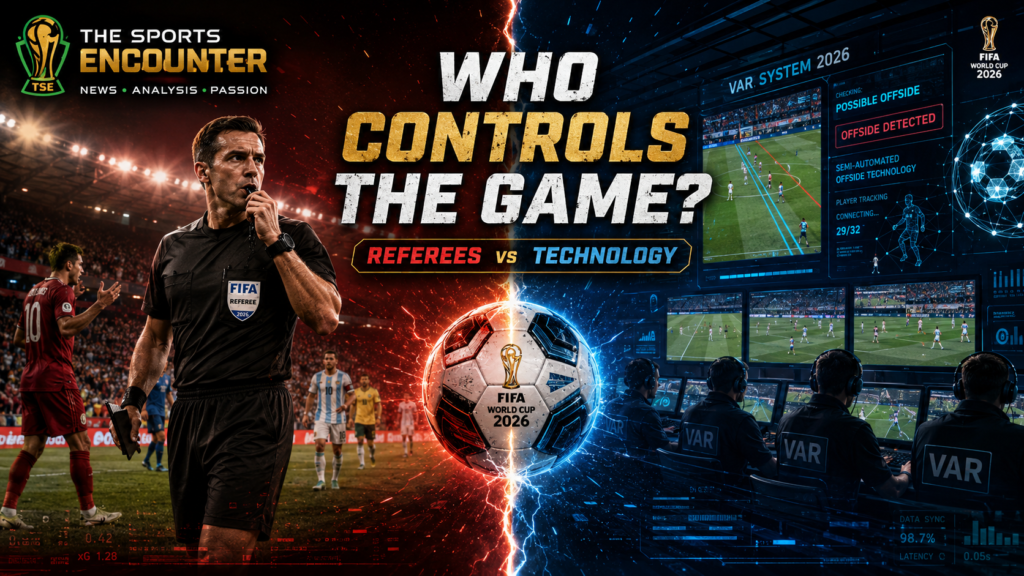
VAR was introduced to stop a FIFA World Cup from being decided by an obvious refereeing mistake.
At the 2026 tournament, it became part of the argument almost every time a major decision changed a match.
Goals disappeared because sensors detected touches few viewers could see. Officials travelled backward through long attacking moves to identify earlier fouls. Penalties were awarded after light contact in one game and rejected after apparently stronger contact in another.
Red cards were given, overturned, reinstated, or debated long after the final whistle. Coaches accused officials of inconsistency. National federations demanded explanations. Supporters created claims of favoritism, while FIFA defended its referees and warned against attacks on their integrity.
The dispute was no longer limited to whether one decision was technically correct.
Players, officials, broadcasters, federations, and fans were fighting over a bigger question: how much control should technology have over football?
VAR had become a WAR.
TL;DR | Tug of VAR
- FIFA used connected-ball technology, semi-automated offside systems, and an expanded VAR protocol at World Cup 2026.
- Croatia had a late equalizer against Portugal cancelled after a sensor detected a slight touch during the move.
- Germany had an extra-time goal ruled out against Paraguay for goalkeeper obstruction before losing on penalties.
- Egypt had a goal disallowed and a penalty appeal rejected during its dramatic defeat by Argentina.
- Switzerland’s Breel Embolo received a second yellow for simulation after an expanded VAR intervention.
- Belgium received a decisive late penalty against Senegal, while Ghana and France had major penalty appeals rejected in other matches.
- Iran lost a potential qualification-winning goal to a marginal offside call.
- Vinícius Júnior had a goal cancelled for a foul against Scotland.
- England experienced a denied Harry Kane penalty, an overturned Djed Spence penalty, and a separate camera-cable controversy against Norway.
- Folarin Balogun’s red card and suspension reversal moved the debate from video officiating into FIFA governance and political influence.
- The main problem was not accuracy alone. Fans lost trust in VAR’s scope, consistency, and transparency.
World Cup 2026 VAR Controversies at a Glance
| Match or Incident | Decision | Main Dispute | Impact |
|---|---|---|---|
| Portugal vs Croatia | Late Croatia equalizer disallowed after connected-ball technology detected a touch | Microscopic contact invisible to most viewers | Portugal advanced and Croatia were eliminated |
| Germany vs Paraguay | Jonathan Tah’s extra-time goal ruled out for goalkeeper obstruction | Whether light contact justified cancelling the goal | Paraguay survived and won on penalties |
| Argentina vs Egypt | Egypt goal cancelled for a foul earlier in the move | How far VAR should travel backward through an attack | Argentina recovered to win 3-2 |
| Argentina vs Switzerland | Breel Embolo received a second yellow for simulation | Whether VAR had moved into full re-refereeing | Switzerland played with 10 men before losing in extra time |
| Belgium vs Senegal | Belgium awarded a late extra-time penalty | Low threshold for VAR intervention | Belgium completed a 3-2 comeback |
| France vs Senegal | Mbappé penalty appeal rejected after an on-field review | Referee rejected the video official’s interpretation | Renewed debate over contact initiated by attackers |
| England vs Ghana | Ghana penalty appeal rejected | VAR did not intervene after apparent defensive contact | A possible group-changing decision went against Ghana |
| Brazil vs Scotland | Vinícius Júnior goal disallowed for a foul in the buildup | Whether slight contact materially affected the goal | The decision added to concerns over review thresholds |
| Iran vs Egypt | Stoppage-time Iran goal disallowed for marginal offside | Millimeter-level accuracy versus the spirit of the law | Iran lost its chance to reach the knockout stage |
| England penalty incidents | Kane appeal rejected and Spence penalty overturned | Inconsistent interpretation of goalkeeper and defender contact | England experienced both sides of VAR intervention |
| England vs Norway cable dispute | FIFA data rejected Norway’s claim that the ball hit a camera cable | Trust in connected-ball and stadium technology | The argument continued after FIFA’s technical explanation |
| Folarin Balogun suspension | Red card issued through VAR, but suspension later lifted | Governance, transparency, and alleged political pressure | National federations questioned FIFA’s disciplinary authority |
The incidents involved different laws and review mechanisms. Together, they explain why refereeing technology became one of the defining stories of World Cup 2026.
VAR Was Originally Meant to Correct Obvious Errors
The original case for video assistance was difficult to oppose.
A referee cannot see every incident clearly from one angle and at full speed. Video could correct a missed handball, an obvious offside, a mistaken red card, or a serious foul that escaped attention.
Football had already produced World Cup decisions that lived for decades. Diego Maradona’s “Hand of God” against England in 1986 remained the obvious example of an injustice modern technology should prevent.
VAR entered the World Cup in 2018 with four main review categories:
- Goals and offenses during the attacking phase
- Penalty decisions
- Direct red cards
- Mistaken identity
The phrase “clear and obvious error” was meant to protect the authority of the on-field referee.
By 2026, the system had become more technologically advanced and operationally ambitious.
World Cup 2026 Gave Officials More Technology and More Power
FIFA equipped match officials with an advanced semi-automated offside system, connected-ball technology, goal-line technology, multiple video angles, and new camera systems.
FIFA confirmed the tournament’s refereeing technology before the World Cup, describing the tools as support systems for match officials.
The connected ball could register touches that did not produce an obvious visual change. Semi-automated offside technology could map player positions with extraordinary precision. Video officials could review several phases of play from different angles.
Better information did not automatically create greater trust.
Supporters often learned the practical boundaries of the system only after a decision damaged their team.
The Sports Encounter explored that changing relationship in our analysis of why World Cup 2026 fans became obsessed with referees.
Portugal vs Croatia Became the Symbol of Sensor Football
Croatia thought they had forced extra time against Portugal when Joško Gvardiol scored deep into stoppage time.
The celebration ended after VAR examined an earlier touch during the move.
Connected-ball technology detected contact before the ball reached Gvardiol. The touch affected the offside calculation and caused the goal to be disallowed.
Most viewers could not identify the contact through normal replays. The ball’s movement appeared unchanged, creating speculation that the sensor had detected only the slightest brush.
Croatia described the intervention as an abuse of technology. Luka Modrić questioned whether VAR had moved beyond correcting an obvious mistake and into searching for technical reasons to erase a goal.
Portugal won 2-1, ending Croatia’s tournament and possibly Modrić’s final World Cup appearance.
The Sports Encounter documented the full drama in our report on Portugal’s victory over Croatia after four disallowed goals and a late winner.
Germany’s Disallowed Goal Saved Paraguay
Germany’s Round of 32 match against Paraguay produced another debate over how much contact VAR should punish.
Jonathan Tah appeared to score an extra-time goal that would have put Germany ahead. VAR reviewed the move and decided that Waldemar Anton had obstructed goalkeeper Orlando Gill.
The contact looked limited, and critics questioned whether Gill had a realistic chance of reaching the ball regardless of Anton’s position.
The goal was cancelled. Paraguay survived extra time and eliminated Germany on penalties.
This decision belonged in the wider VAR debate because it combined interpretation with direct tournament consequences. Technology did not identify a simple factual error. Officials had to judge whether contact was meaningful enough to invalidate a potentially match-winning goal.
Our analysis of how Paraguay progressed farther than the other Lucky 8 teams provides more context on the resilience that carried them through the knockout stage.
Argentina vs Egypt Tested How Far Back VAR Can Look
Egypt believed they had scored a second goal against Argentina during the Round of 16.
VAR reviewed the attacking possession and identified Marwan Attia stepping on Lisandro Martínez’s foot earlier in the move. The goal was disallowed.
The controversy centered on time and consequence.
The foul did not occur immediately before the finish. Egypt had continued moving the ball through several actions before scoring. Critics argued that Argentina had opportunities to reorganize, making the earlier contact too distant from the final goal.
Egypt also appealed for a penalty shortly before Argentina completed a dramatic 3-2 comeback.
The Egyptian Football Association filed a formal complaint and questioned the consistency of VAR’s application. FIFA refereeing chief Pierluigi Collina maintained that a foul remains relevant if it forms part of the attacking possession that produces a goal.
Reuters reported widespread criticism of the decisions and the EFA’s demand for greater transparency. Read Reuters’ report on Egypt’s formal VAR complaint.
The Sports Encounter also explained the Egypt coach’s protest gesture and accusations after the Argentina defeat.
Embolo’s Red Card Raised the Re-Refereeing Question
Switzerland’s Breel Embolo received a second yellow card for simulation during the quarterfinal against Argentina.
The initial incident involved a possible foul and questions over player identity. Once VAR entered the process, officials reconsidered the entire action and concluded that Embolo had simulated contact.
Swiss coach Murat Yakin called the decision unacceptable. Former FIFA referee Christina Unkel argued that the expanded protocol had opened the door to complete re-refereeing.
The distinction matters.
VAR correcting the identity of an offending player is a factual intervention. Reinterpreting the full incident and producing a new yellow card moves beyond identification into football judgment.
Switzerland had just equalized and were pushing for another goal. Embolo’s dismissal changed the balance before Argentina won 3-1 after extra time.
The decision strengthened the “VARgentina” narrative, although no evidence established deliberate favoritism. Reuters reported both the Swiss complaint and FIFA’s defense of referee independence.
Belgium’s Late Penalty Against Senegal Changed a Knockout Match
Senegal appeared close to completing an important World Cup victory before a late VAR review changed the direction of the match.
Youri Tielemans went down after contact, and Belgium received an extra-time penalty following a lengthy review.
Critics considered the contact light and questioned why the incident met the threshold for video intervention.
Belgium converted the penalty and completed a 3-2 comeback.
This controversy became more damaging when compared with penalty appeals that VAR ignored or rejected elsewhere in the tournament.
Mbappé’s Denied Penalty Showed the Referee Still Had Authority
Kylian Mbappé believed Sadio Mané had fouled him inside the penalty area during France’s meeting with Senegal.
VAR recommended an on-field review after replays showed that Mané had not clearly played the ball.
The referee watched the incident and still rejected the penalty, deciding that Mbappé had initiated or exaggerated the contact.
The decision demonstrated that the on-field official retained the power to reject a VAR recommendation.
It also created another argument over consistency. Supporters compared Mbappé’s denied appeal with softer-looking incidents that resulted in penalties elsewhere.
Ghana’s Denied Penalty Against England Became a Non-Intervention Controversy
VAR controversies are not limited to decisions the system changes.
Its silence can provoke the same level of anger.
Ghana appealed for a penalty after Ezri Konsa appeared to make contact with Prince Adu inside the area. The referee allowed play to continue, and VAR did not recommend a review.
A converted penalty could have affected the result and the final Group L standings.
The incident became an example of the central VAR contradiction. Supporters saw officials examine minor contact in some matches while stronger contact elsewhere failed to trigger visible intervention.
Vinícius Júnior’s Goal Against Scotland Was Cancelled for Earlier Contact
Vinícius Júnior thought he had scored for Brazil against Scotland before VAR identified a foul against Jack Hendry during the buildup.
The contact appeared slight, and the decision had limited effect on the final outcome because Brazil still won comfortably.
It remained important to the wider VAR debate.
Supporters again questioned whether the system was correcting a clear mistake or searching through an attacking move until it found a reason to cancel the goal.
Iran’s Marginal Offside Ended a World Cup Dream
Iran appeared to score a stoppage-time winner against Egypt that could have taken the team into the knockout stage.
Semi-automated offside technology found a marginal infringement.
The decision may have been technically accurate. Its tournament consequence was enormous.
Iran’s players and supporters moved from celebration to elimination after a margin no referee or fan could have detected naturally.
Offside technology creates a difficult philosophical question. If the system can measure the position precisely, officials must apply the law. Yet the law was created to stop attackers gaining an unfair advantage, not necessarily to punish differences too small to affect the play.
Harry Kane and Djed Spence Experienced Opposite VAR Outcomes
England’s tournament included several penalty controversies.
Harry Kane went down after contact with a goalkeeper, but the referee rejected the appeal and VAR supported the decision.
In another knockout incident, England initially received a penalty after Djed Spence went down inside the area. The decision was overturned following video review.
England therefore experienced both sides of the system: a possible penalty denied and another award removed.
The two incidents reinforced the difficulty of evaluating contact. Replays can show where bodies touched, but they cannot automatically determine whether the contact caused the fall, prevented a legal action, or justified a penalty.
Cable-Gate Showed That Fans Distrusted More Than VAR
Norway claimed that a goal kick struck an overhead camera cable before England’s equalizer in their quarterfinal.
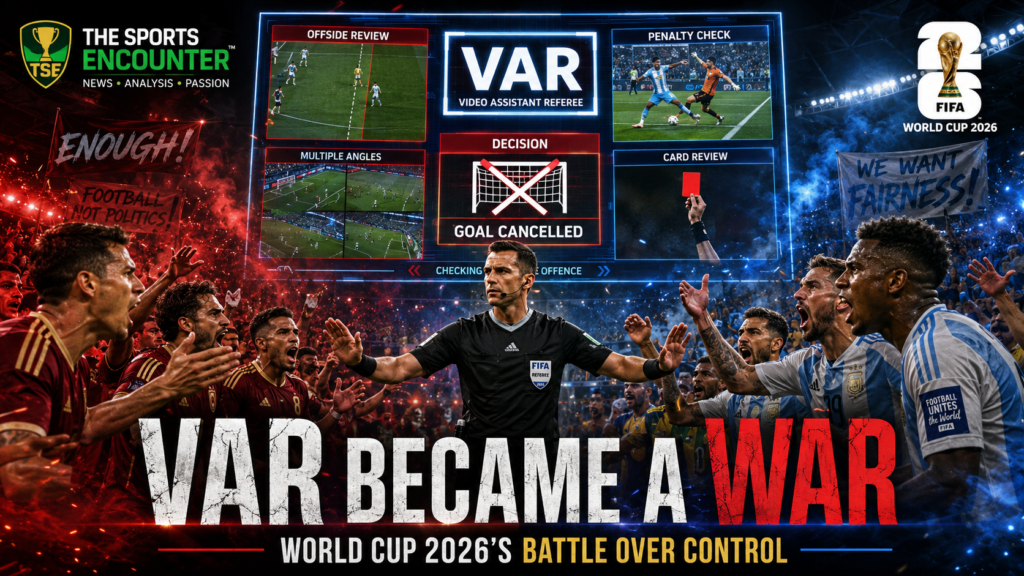
The claim created another technology-driven controversy because it involved stadium equipment that supporters believed may have interfered with live play.
FIFA later released connected-ball data indicating that the ball had not touched the cable.
The technical explanation should have ended the issue. Many fans remained skeptical.
That reaction showed how far trust had declined. Once supporters believe the process lacks transparency, even sensor data can look like part of the dispute rather than an independent answer.
Our England vs Norway quarterfinal report explains how Jude Bellingham’s two goals eventually ended Norway’s historic run.
The Balogun Suspension Turned VAR Into a Governance Crisis
Folarin Balogun received a red card after a VAR review during the United States’ match against Bosnia and Herzegovina.
The review concluded that his boot had made dangerous contact with an opponent’s ankle.
The controversy intensified when FIFA later lifted the resulting suspension, allowing Balogun to play against Belgium.
U.S. President Donald Trump publicly criticized the original decision and said he had contacted FIFA President Gianni Infantino. FIFA denied that political pressure influenced the disciplinary outcome and defended referee Raphael Claus.
Other national federations questioned the reversal and its effect on the authority of match officials.
Reuters reported that the case raised wider concerns about governance, transparency, and whether high-level access could influence disciplinary processes.
VAR did not make the later suspension decision. Fans still viewed the full episode as one chain: review, red card, political criticism, FIFA intervention, and reversal.
Argentina Became the Center of the Bias Allegations
Argentina’s progress generated several refereeing complaints.
Algeria objected after Lionel Messi avoided a possible red card during the group stage. Egypt challenged the disallowed goal and denied penalty. Switzerland protested Embolo’s dismissal.
Supporters combined the incidents into the label “VARgentina.”
FIFA rejected the accusation.
“We are not influenced by anyone,” Collina said while defending the independence of the refereeing team.
Criticism of individual decisions remains a legitimate part of football. Claims of corruption require evidence.
FIFA still faced a credibility problem. Once several controversial decisions involved the same team, each new incident strengthened the public narrative regardless of the legal explanation.
The Real Problem Was Inconsistency
Many individual World Cup decisions could be defended under the laws.
A sensor-detected touch can change offside. An earlier foul can invalidate a goal. Goalkeeper obstruction can affect a scoring opportunity. Simulation may deserve a caution.
Supporters judged the system across matches rather than one incident at a time.
Why did light contact produce Belgium’s penalty against Senegal while Ghana’s appeal against England received no intervention? Why did VAR invite a review for Mbappé but allow the referee to reject the recommendation? Why did officials travel backward through Egypt’s attack but appear more restrained elsewhere?
The Sports Encounter’s guide to what counts as a foul in soccer explains why contact alone cannot settle these decisions.
Referees must assess force, consequence, position, control, intent, and whether the challenge fits the law.
Technology provides evidence. Human judgment still determines its meaning.
Stadium Fans Paid the Emotional Price
Television viewers receive slow-motion replays, diagrams, commentary, and expert analysis.
Fans inside the stadium often receive silence and delay.
A goal goes in. Players run toward the corner. Supporters hug, scream, and believe the match has changed.
Then everyone waits.
The review may produce the legally correct outcome. The original emotional moment cannot be restored.
Celebration becomes conditional. Supporters begin watching the referee after every goal before deciding whether they can enjoy it.
That hesitation changes football’s rhythm.
What VAR Got Right at World Cup 2026
VAR also corrected genuine mistakes.
Serious fouls that escaped the referee could be identified. Semi-automated offside technology produced faster decisions than manual line drawing. Mistaken identity could be resolved. Goalkeeper obstruction and illegal movement received closer scrutiny.
FIFA’s technology was not useless. The problem came from its widening scope and inconsistent public explanation.
The debate should therefore move beyond keeping or abolishing VAR.
Football needs to decide where video review improves justice and where it damages the game without delivering enough benefit.
How FIFA Can Stop the Next VAR War
Three reforms would improve the system.
1. Set a clearer limit on attacking-phase reviews
VAR should not travel indefinitely backward unless the earlier offense directly creates the scoring opportunity.
2. Release review audio after major controversies
Supporters and federations should hear what officials saw, which law they applied, and why the review crossed the intervention threshold.
3. Apply a stricter “clear and obvious” standard
Subjective decisions should remain with the on-field referee unless video shows a significant and unmistakable error.
4. Explain connected-ball evidence visually
When a sensor decides a World Cup match, FIFA should publish a clear visual explanation rather than expect supporters to accept unseen data.
5. Separate disciplinary appeals from political access
Suspension decisions need a transparent process that protects referees and avoids any appearance that outside influence matters.
Fan Poll: Did VAR Improve or Damage World Cup 2026?
What is your verdict on VAR at the FIFA World Cup 2026?
- It improved the tournament by correcting major mistakes
- It was useful, but FIFA allowed it to intervene too often
- It damaged the tournament through inconsistency
- It should only decide factual calls such as offside and goal-line incidents
- Football should remove VAR completely
Share your vote in the comments and name the decision that most strongly shaped your opinion.
Final Verdict
VAR did not become a war because every decision was wrong.
The conflict grew because the boundaries became harder to understand.
Croatia lost a goal to a sensor-detected touch. Germany saw an extra-time winner cancelled for goalkeeper obstruction. Egypt lost a goal because of an earlier foul. Belgium received a decisive penalty while Ghana’s appeal brought no intervention.
Iran were eliminated by a marginal offside. Switzerland lost Embolo after a review expanded beyond mistaken identity. England and Norway argued over a camera cable, while the Balogun case created questions about political access and FIFA governance.
The technology became more precise. Public confidence moved in the opposite direction.
Football cannot solve a trust problem by adding more cameras, sensors, and officials without defining clear limits.
Accuracy matters. Consistency, restraint, transparency, and emotional continuity matter too.
VAR was designed to protect football from obvious injustice. At World Cup 2026, the fight over its power became one of the tournament’s defining stories.
Follow more tournament reporting through The Sports Encounter’s FIFA World Cup 2026 hub and complete soccer news and analysis.
Readers can also revisit our Round of 16 analysis of VAR drama and the Lucky 8 teams for more context on how officiating shaped the knockout stage.
The Sports Encounter covers World Cup refereeing through verified match details, official laws, tactical context, and the effects of major decisions on players and supporters.