


Egypt left the World Cup with a scoreline, a grievance, and a gesture that instantly became part of the tournament’s biggest refereeing debate.
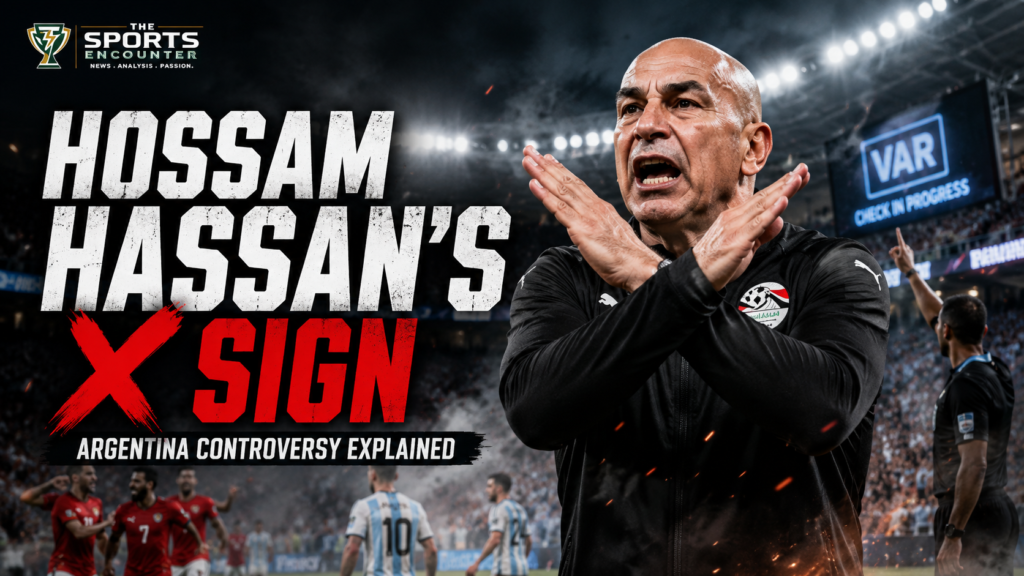
Hossam Hassan’s crossed-arm “X” sign during and after Egypt’s 3-2 defeat to Argentina in the FIFA World Cup 2026 Round of 16 did more than express anger. It pulled FIFA’s anti-racism protocol into the center of a match already boiling with VAR controversy, disputed calls, emotional reactions, and questions about whether officials handled one of the tournament’s most intense knockout games with enough control.
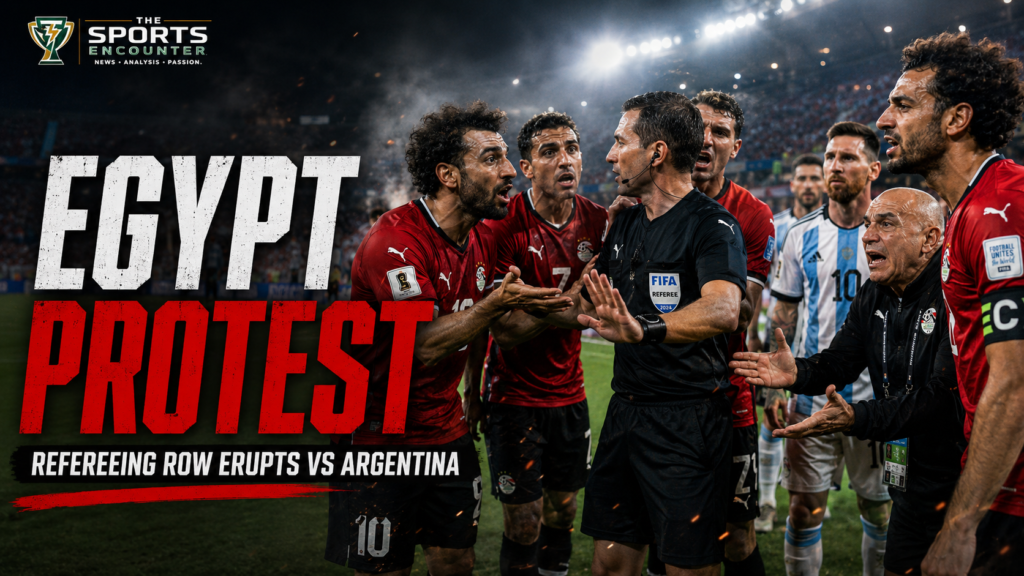
Argentina advanced to face Switzerland in the quarterfinals, but the post-match conversation did not move cleanly toward the next round. Egypt had led 2-0, saw a goal ruled out after VAR intervention, appealed for penalties, and then conceded late as Argentina completed a dramatic comeback. Sky Sports reported that Egypt coach Hossam Hassan called the officiating “unfair”, while Egypt also lodged a formal complaint with FIFA over the refereeing in the defeat.
The X sign added a different layer.
It raised a simple question with a complicated answer: was Hassan protesting refereeing, signaling discrimination, or attempting to activate FIFA’s anti-racism process?
Key Facts
| Detail | Information |
|---|---|
| Match | Argentina 3-2 Egypt |
| Competition | FIFA World Cup 2026 Round of 16 |
| Main controversy | Egypt’s disallowed goal, penalty appeals, VAR use, late Argentina winner |
| Coach involved | Hossam Hassan |
| Gesture | Crossed-arm “X” sign |
| FIFA meaning | “No Racism Gesture” linked to anti-discrimination protocol |
| FIFA/IFAB referee principle | Referee makes the final decision |
| Egypt’s response | Formal complaint to FIFA reported after the defeat |
| Next match | Argentina vs Switzerland in the quarterfinals |
What Does the X Sign Mean Under FIFA Rules?
The crossed-arm X is not a normal protest gesture in FIFA competitions anymore. It has a specific meaning inside FIFA’s anti-discrimination framework.
FIFA’s “No Racism Gesture” allows players, team officials, and referees to signal alleged racist abuse by crossing their hands at the wrists. FIFA says the gesture is designed to empower players, officials, and referees to take a stand against racism.
The system sits inside FIFA’s wider Global Stand Against Racism initiative. FIFA says tournament officials and security staff receive training on the No Racism Gesture and the three-step anti-discrimination procedure.
That matters because Hassan’s gesture cannot be treated as a random touchline signal if he clearly crossed his arms in the official X shape. In FIFA’s current framework, that action points toward an allegation of racist or discriminatory conduct, or at least a demand that officials treat something as such.
The New Arab reported that Hassan’s use of the crossed-arm signal drew attention because the gesture was introduced by FIFA in 2024 as part of the Global Stand Against Racism initiative, approved by all 211 member associations at FIFA’s Congress in Bangkok.
What Happens When the Gesture Is Made?
FIFA’s anti-racism process follows a three-step model.
First, the referee can stop the match. A stadium announcement can warn supporters or relevant parties that racist abuse has been reported and must stop.
Second, if abuse continues, the referee can suspend the match and send players toward the dressing rooms.
Third, if the situation still does not stop, the referee can abandon the match.
Reports after the Argentina-Egypt match noted that the crossed-arm X can trigger FIFA’s three-step anti-racism protocol once recognized by the referee.
This is why Hassan’s gesture created such a large reaction. The sign carries a heavier meaning than normal frustration with a referee. A coach waving his arms after a decision is common. A coach using FIFA’s No Racism Gesture during a World Cup knockout match is very different.
Why Did Hossam Hassan Make the X Sign?
The safest reading is this: Hassan appeared to use the gesture because Egypt felt wronged during the match and believed the treatment crossed beyond normal refereeing frustration.
Several outlets reported that Hassan was furious after the match, especially over VAR decisions, the disallowed Egypt goal, and penalty appeals that did not lead to intervention. Reuters reported that the Egyptian Football Association criticized VAR after the 3-2 defeat and submitted a formal complaint to FIFA against referee François Letexier.
The exact target of Hassan’s gesture remains unclear. Some reports connected the moment to a heated exchange involving Lionel Messi, while others framed it more broadly as part of Egypt’s protest over perceived unfair treatment. The Business Standard reported that there was no confirmed audio or official transcript of what Messi said, and that neither Hassan nor FIFA had publicly clarified whether the gesture was directed at Messi, Argentina’s bench, the officials, or the broader situation.
That distinction matters.
If Hassan intended the gesture as a formal racism complaint, FIFA may need to examine what he reported, who he reported it against, and whether officials followed the correct process.
If he used it mainly as an emotional symbol of unfair treatment, FIFA could still view the moment through a disciplinary lens, especially if the gesture created confusion or escalated tension near the officials.
Was It a VAR Signal?
No. The X sign should not be confused with the VAR “TV signal.”
Under the IFAB VAR protocol, the referee uses a TV-shaped signal before an on-field review or before announcing a VAR-related final decision. The protocol says the referee stops play in a neutral situation and shows the TV signal when initiating a review. It also states that the referee remains the only person who can make the final decision, while the VAR can only assist.
Coaches cannot formally demand a VAR review by making their own hand sign. They can protest, ask questions, or complain to the fourth official, but the laws do not give them a coach’s challenge system.
So Hassan’s crossed-arm X was not a valid VAR request. It either carried anti-racism meaning under FIFA’s protocol, or it functioned as a protest gesture that drew attention because it resembled FIFA’s official No Racism signal.
What Does FIFA Say About Refereeing Decisions?
FIFA’s disciplinary code gives referees very strong protection over match decisions.
Article 9 of the FIFA Disciplinary Code says decisions taken by the referee on the field of play are final and may not be reviewed by FIFA judicial bodies. It adds that disciplinary consequences can be reviewed only in limited cases, such as obvious mistaken identity.
This means Egypt’s complaint may force FIFA to review conduct, procedure, reporting, and disciplinary questions, but it is unlikely to change the result of the match based only on disagreement with referee decisions.
The IFAB VAR protocol also limits when VAR can intervene. VAR can recommend a review for a potential “clear and obvious error” or “serious missed incident,” but the referee decides whether to initiate a review and makes the final call.
That framework leaves room for frustration. A decision can feel inconsistent to fans and still survive within the technical limits of VAR.
Why Egypt Felt the Refereeing Was Below Standard
Egypt’s anger came from the pattern of decisions, not one isolated whistle.
The biggest flashpoint was the disallowed Egypt goal. Al Jazeera reported that Egypt felt injustice after a VAR decision ruled out a Mostafa Ziko goal while Egypt were leading 1-0. The same report noted that the match also included a string of yellow cards for Egypt and strong contrasting emotions after the final whistle.
Another major complaint focused on consistency. Al Jazeera reported that analysts questioned why VAR intervened on the buildup to Egypt’s disallowed goal but did not intervene over a later incident involving Mohamed Salah before Argentina’s third goal. One analyst said the foul before the disallowed Egyptian goal was “indisputable,” but questioned how far VAR should go back in the attacking phase.
That is the heart of the controversy.
A referee can defend one decision by pointing to the laws. Fans can still question why similar levels of contact receive different treatment in the same match.
In a knockout game with Argentina, Egypt, Messi, Salah, late goals, and huge emotional pressure, consistency becomes more important than usual. Players can accept strict officiating if it remains strict for both sides. They struggle when one team feels VAR has a microscope on its attacks and a softer lens on the opponent’s.
For readers tracking the wider knockout picture, Egypt’s anger also mattered because Argentina’s win set up a quarterfinal against Switzerland, who advanced after a tense penalty shootout in the Switzerland vs Colombia Round of 16 report.
Was the Standard of Refereeing Good Enough?
The standard of refereeing did not match the emotional and competitive weight of the game.
That does not mean every controversial decision was automatically wrong. Some calls may have had technical support. The disallowed goal, for example, appears to have involved contact in the buildup that VAR considered relevant. Under the laws, VAR can intervene when officials believe there has been a clear and obvious error in a match-changing attacking phase.
But elite refereeing is not only about finding a legal explanation afterward. It is also about control, consistency, communication, and trust.
On those measures, the match looked damaged.
The referee and VAR team allowed too many moments to become interpretive battles. Egypt left the field believing the same standard did not apply both ways. Hassan’s X gesture then turned a refereeing dispute into a wider governance issue. Once that happens, the officials have already lost the room.
The debate sits alongside other high-pressure knockout flashpoints in this World Cup, including Spain’s late win in the Portugal vs Spain Round of 16 report and Belgium’s dominant performance in the USA vs Belgium Round of 16 report.
Could Hassan Face Action?
Possibly, depending on what FIFA finds.
If Hassan made a genuine anti-racism complaint, FIFA must assess the allegation and whether the protocol should have been activated. If the gesture was used without a clear basis or in a confrontational way toward opponents or officials, FIFA could review it as misconduct by a team official.
IFAB’s Laws of the Game allow referees to discipline team officials who fail to act responsibly. IFAB specifically states that a coach acting provocatively during penalties can be cautioned or sent off depending on the circumstances.
FIFA will likely care about context. That matters because AP reported that FIFA recently cleared an official over a separate gesture controversy after concluding there was no evidence of a disciplinary breach.
So the gesture alone may not decide the issue. FIFA will need context, footage, reports from match officials, any audio available, and any complaint submitted by Egypt.
The Bigger Issue: FIFA’s New Gesture Faces a Real Stress Test
FIFA created the No Racism Gesture to give players and officials a clear way to report racist abuse in real time. That is valuable. Football needed a visible process that did not leave abused players waiting for post-match statements.
But the Argentina-Egypt controversy shows the challenge.
If the gesture appears during a furious refereeing dispute, FIFA must separate three things quickly:
- Was there an allegation of racist abuse?
- Was the gesture aimed at a person, an official, a crowd, or the general situation?
- Did the referee and match officials follow the anti-discrimination procedure correctly?
Without clarity, the sign can become another source of confusion instead of protection.
Final Take
Hossam Hassan’s X sign should not be dismissed as ordinary frustration. Under FIFA’s current framework, crossed wrists carry anti-racism meaning. That gives the moment serious weight.
At the same time, the gesture came inside a match already overwhelmed by VAR anger, late drama, and Egypt’s belief that key decisions went against them. FIFA now faces two separate questions. It must examine whether the X sign raised a valid discrimination issue, and it must also assess why the refereeing performance left one team feeling the process had failed.
Argentina survived and moved on.
Egypt left with one of the tournament’s strongest complaints.
The X sign ensured this match will be remembered for more than the comeback.
For more tournament analysis, follow The Sports Encounter’s complete FIFA World Cup 2026 coverage.