Connect with us
Marcos Wetherfield | The Sports Encounter

Published

on

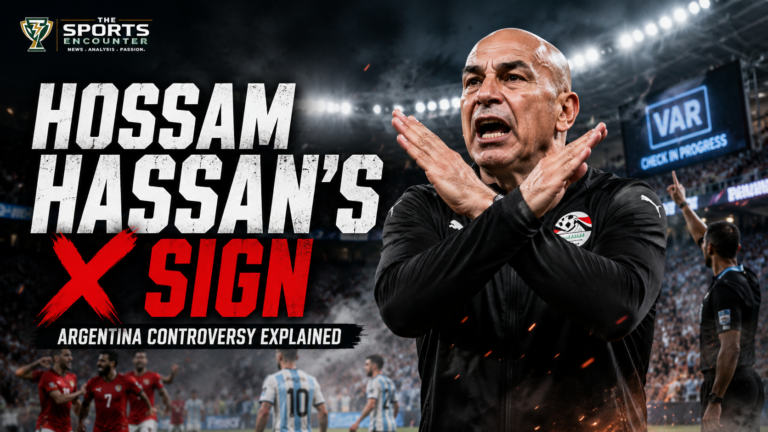
Egypt left the World Cup with a scoreline, a grievance, and a gesture that instantly became part of the tournament’s biggest refereeing debate.

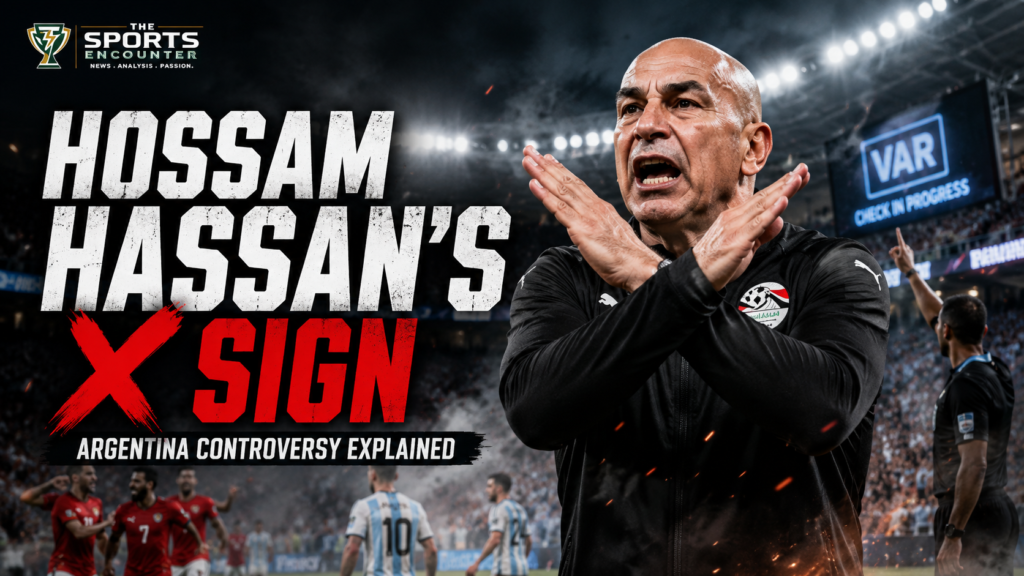
Hossam Hassan’s crossed-arm “X” sign during and after Egypt’s 3-2 defeat to Argentina in the FIFA World Cup 2026 Round of 16 did more than express anger. It pulled FIFA’s anti-racism protocol into the center of a match already boiling with VAR controversy, disputed calls, emotional reactions, and questions about whether officials handled one of the tournament’s most intense knockout games with enough control.

Argentina advanced to face Switzerland in the quarterfinals, but the post-match conversation did not move cleanly toward the next round. Egypt had led 2-0, saw a goal ruled out after VAR intervention, appealed for penalties, and then conceded late as Argentina completed a dramatic comeback. Sky Sports reported that Egypt coach Hossam Hassan called the officiating “unfair”, while Egypt also lodged a formal complaint with FIFA over the refereeing in the defeat.

The X sign added a different layer.

It raised a simple question with a complicated answer: was Hassan protesting refereeing, signaling discrimination, or attempting to activate FIFA’s anti-racism process?

Key Facts

DetailInformation
MatchArgentina 3-2 Egypt
CompetitionFIFA World Cup 2026 Round of 16
Main controversyEgypt’s disallowed goal, penalty appeals, VAR use, late Argentina winner
Coach involvedHossam Hassan
GestureCrossed-arm “X” sign
FIFA meaning“No Racism Gesture” linked to anti-discrimination protocol
FIFA/IFAB referee principleReferee makes the final decision
Egypt’s responseFormal complaint to FIFA reported after the defeat
Next matchArgentina vs Switzerland in the quarterfinals

What Does the X Sign Mean Under FIFA Rules?

The crossed-arm X is not a normal protest gesture in FIFA competitions anymore. It has a specific meaning inside FIFA’s anti-discrimination framework.

FIFA’s “No Racism Gesture” allows players, team officials, and referees to signal alleged racist abuse by crossing their hands at the wrists. FIFA says the gesture is designed to empower players, officials, and referees to take a stand against racism.

The system sits inside FIFA’s wider Global Stand Against Racism initiative. FIFA says tournament officials and security staff receive training on the No Racism Gesture and the three-step anti-discrimination procedure.

That matters because Hassan’s gesture cannot be treated as a random touchline signal if he clearly crossed his arms in the official X shape. In FIFA’s current framework, that action points toward an allegation of racist or discriminatory conduct, or at least a demand that officials treat something as such.

The New Arab reported that Hassan’s use of the crossed-arm signal drew attention because the gesture was introduced by FIFA in 2024 as part of the Global Stand Against Racism initiative, approved by all 211 member associations at FIFA’s Congress in Bangkok.

What Happens When the Gesture Is Made?

FIFA’s anti-racism process follows a three-step model.
First, the referee can stop the match. A stadium announcement can warn supporters or relevant parties that racist abuse has been reported and must stop.

Second, if abuse continues, the referee can suspend the match and send players toward the dressing rooms.

Third, if the situation still does not stop, the referee can abandon the match.

Reports after the Argentina-Egypt match noted that the crossed-arm X can trigger FIFA’s three-step anti-racism protocol once recognized by the referee.

This is why Hassan’s gesture created such a large reaction. The sign carries a heavier meaning than normal frustration with a referee. A coach waving his arms after a decision is common. A coach using FIFA’s No Racism Gesture during a World Cup knockout match is very different.

Why Did Hossam Hassan Make the X Sign?

The safest reading is this: Hassan appeared to use the gesture because Egypt felt wronged during the match and believed the treatment crossed beyond normal refereeing frustration.

Several outlets reported that Hassan was furious after the match, especially over VAR decisions, the disallowed Egypt goal, and penalty appeals that did not lead to intervention. Reuters reported that the Egyptian Football Association criticized VAR after the 3-2 defeat and submitted a formal complaint to FIFA against referee François Letexier.

The exact target of Hassan’s gesture remains unclear. Some reports connected the moment to a heated exchange involving Lionel Messi, while others framed it more broadly as part of Egypt’s protest over perceived unfair treatment. The Business Standard reported that there was no confirmed audio or official transcript of what Messi said, and that neither Hassan nor FIFA had publicly clarified whether the gesture was directed at Messi, Argentina’s bench, the officials, or the broader situation.

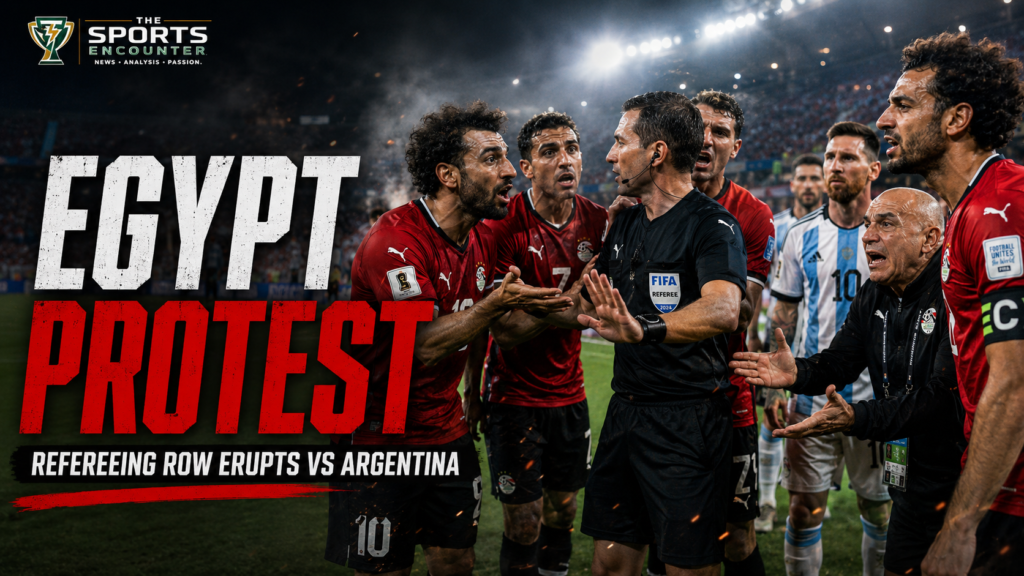
Egyptian players and coaching staff protest to the referee during the Argentina World Cup match after disputed calls and VAR controversy.

That distinction matters.

If Hassan intended the gesture as a formal racism complaint, FIFA may need to examine what he reported, who he reported it against, and whether officials followed the correct process.

If he used it mainly as an emotional symbol of unfair treatment, FIFA could still view the moment through a disciplinary lens, especially if the gesture created confusion or escalated tension near the officials.

Was It a VAR Signal?

No. The X sign should not be confused with the VAR “TV signal.”

Under the IFAB VAR protocol, the referee uses a TV-shaped signal before an on-field review or before announcing a VAR-related final decision. The protocol says the referee stops play in a neutral situation and shows the TV signal when initiating a review. It also states that the referee remains the only person who can make the final decision, while the VAR can only assist.

Coaches cannot formally demand a VAR review by making their own hand sign. They can protest, ask questions, or complain to the fourth official, but the laws do not give them a coach’s challenge system.

So Hassan’s crossed-arm X was not a valid VAR request. It either carried anti-racism meaning under FIFA’s protocol, or it functioned as a protest gesture that drew attention because it resembled FIFA’s official No Racism signal.

What Does FIFA Say About Refereeing Decisions?

FIFA’s disciplinary code gives referees very strong protection over match decisions.

Article 9 of the FIFA Disciplinary Code says decisions taken by the referee on the field of play are final and may not be reviewed by FIFA judicial bodies. It adds that disciplinary consequences can be reviewed only in limited cases, such as obvious mistaken identity.

This means Egypt’s complaint may force FIFA to review conduct, procedure, reporting, and disciplinary questions, but it is unlikely to change the result of the match based only on disagreement with referee decisions.

The IFAB VAR protocol also limits when VAR can intervene. VAR can recommend a review for a potential “clear and obvious error” or “serious missed incident,” but the referee decides whether to initiate a review and makes the final call.

That framework leaves room for frustration. A decision can feel inconsistent to fans and still survive within the technical limits of VAR.

Why Egypt Felt the Refereeing Was Below Standard

Egypt’s anger came from the pattern of decisions, not one isolated whistle.

The biggest flashpoint was the disallowed Egypt goal. Al Jazeera reported that Egypt felt injustice after a VAR decision ruled out a Mostafa Ziko goal while Egypt were leading 1-0. The same report noted that the match also included a string of yellow cards for Egypt and strong contrasting emotions after the final whistle.

Another major complaint focused on consistency. Al Jazeera reported that analysts questioned why VAR intervened on the buildup to Egypt’s disallowed goal but did not intervene over a later incident involving Mohamed Salah before Argentina’s third goal. One analyst said the foul before the disallowed Egyptian goal was “indisputable,” but questioned how far VAR should go back in the attacking phase.

That is the heart of the controversy.

A referee can defend one decision by pointing to the laws. Fans can still question why similar levels of contact receive different treatment in the same match.

In a knockout game with Argentina, Egypt, Messi, Salah, late goals, and huge emotional pressure, consistency becomes more important than usual. Players can accept strict officiating if it remains strict for both sides. They struggle when one team feels VAR has a microscope on its attacks and a softer lens on the opponent’s.

For readers tracking the wider knockout picture, Egypt’s anger also mattered because Argentina’s win set up a quarterfinal against Switzerland, who advanced after a tense penalty shootout in the Switzerland vs Colombia Round of 16 report.

Was the Standard of Refereeing Good Enough?

The standard of refereeing did not match the emotional and competitive weight of the game.

That does not mean every controversial decision was automatically wrong. Some calls may have had technical support. The disallowed goal, for example, appears to have involved contact in the buildup that VAR considered relevant. Under the laws, VAR can intervene when officials believe there has been a clear and obvious error in a match-changing attacking phase.

But elite refereeing is not only about finding a legal explanation afterward. It is also about control, consistency, communication, and trust.

On those measures, the match looked damaged.

The referee and VAR team allowed too many moments to become interpretive battles. Egypt left the field believing the same standard did not apply both ways. Hassan’s X gesture then turned a refereeing dispute into a wider governance issue. Once that happens, the officials have already lost the room.

The debate sits alongside other high-pressure knockout flashpoints in this World Cup, including Spain’s late win in the Portugal vs Spain Round of 16 report and Belgium’s dominant performance in the USA vs Belgium Round of 16 report.

Could Hassan Face Action?

Possibly, depending on what FIFA finds.

If Hassan made a genuine anti-racism complaint, FIFA must assess the allegation and whether the protocol should have been activated. If the gesture was used without a clear basis or in a confrontational way toward opponents or officials, FIFA could review it as misconduct by a team official.

IFAB’s Laws of the Game allow referees to discipline team officials who fail to act responsibly. IFAB specifically states that a coach acting provocatively during penalties can be cautioned or sent off depending on the circumstances.

FIFA will likely care about context. That matters because AP reported that FIFA recently cleared an official over a separate gesture controversy after concluding there was no evidence of a disciplinary breach.

So the gesture alone may not decide the issue. FIFA will need context, footage, reports from match officials, any audio available, and any complaint submitted by Egypt.

The Bigger Issue: FIFA’s New Gesture Faces a Real Stress Test

FIFA created the No Racism Gesture to give players and officials a clear way to report racist abuse in real time. That is valuable. Football needed a visible process that did not leave abused players waiting for post-match statements.

But the Argentina-Egypt controversy shows the challenge.

If the gesture appears during a furious refereeing dispute, FIFA must separate three things quickly:

  • Was there an allegation of racist abuse?
  • Was the gesture aimed at a person, an official, a crowd, or the general situation?
  • Did the referee and match officials follow the anti-discrimination procedure correctly?

Without clarity, the sign can become another source of confusion instead of protection.

Final Take

Hossam Hassan’s X sign should not be dismissed as ordinary frustration. Under FIFA’s current framework, crossed wrists carry anti-racism meaning. That gives the moment serious weight.

At the same time, the gesture came inside a match already overwhelmed by VAR anger, late drama, and Egypt’s belief that key decisions went against them. FIFA now faces two separate questions. It must examine whether the X sign raised a valid discrimination issue, and it must also assess why the refereeing performance left one team feeling the process had failed.

Argentina survived and moved on.

Egypt left with one of the tournament’s strongest complaints.

The X sign ensured this match will be remembered for more than the comeback.

For more tournament analysis, follow The Sports Encounter’s complete FIFA World Cup 2026 coverage.
Marcos Wetherfield is a Boca Raton-based fitness expert covering WWE, soccer, baseball, NHL, NBA, and major American sports for The Sports Encounter. His work focuses on athletic conditioning, strength, mobility, recovery, injury prevention, performance habits, and the physical demands behind elite competition. Coverage areas: fitness, sports performance, WWE, soccer, baseball, NHL, NBA, athlete conditioning, recovery, and American sports culture.

Editor's Choice

Most Underrated NFL Offseason Signings for 2026: Seven Sneaky Moves That Could Matter

The 2026 NFL offseason was shaped by more than blockbuster trades and headline contracts. These underrated signings, from Reed Blankenship and Coby Bryant to Kevin Byard, L’Jarius Sneed, Dre Greenlaw, and Johnny Hekker, could quietly influence playoff races once training camp turns into the regular season.

Caleb Dugue | The Sports Encounter

Published

on

Football players in different team-style uniforms run across the field in a cinematic NFL offseason graphic highlighting sneaky moves to watch, with The Sports Encounter logo.

The biggest NFL offseason moves always dominate the first wave of conversation.

Blockbuster trades get the graphics. Star receivers get the debate shows. Quarterback contracts take over timelines. Fans spend weeks arguing over who won the offseason before anyone has taken a snap in training camp.

Then the regular season starts, and the quieter moves begin to matter.

Editor’s Note: This guest contributor article has been edited for clarity, structure, sourcing, and The Sports Encounter’s editorial style.

A veteran safety stabilizes the back end of a defense. A No. 3 receiver becomes a weekly chain-mover. A cornerback returns to a system that already knows how to use him. A punter flips field position in a one-score game. Those signings rarely win March, but they can shape December.

The defending champion Seattle Seahawks offered a reminder last season. DeMarcus Lawrence’s move to Seattle before the 2025 campaign did not carry the same noise as a quarterback trade, yet his presence helped the Seahawks’ run defense improve sharply and contributed to a title-winning defense that held New England under 20 points in Super Bowl LX.

That is the spirit of this list.

These are the most underrated, sneaky NFL offseason signings for 2026. They may not all become Pro Bowl-level moves, but each signing gives its team a specific kind of value entering training camp and the new season.

For more football coverage, analysis, and offseason stories, follow The Sports Encounter’s NFL coverage.

Quick Answer: Which 2026 NFL Offseason Signings Are Most Underrated?

The most underrated NFL offseason signings for 2026 include Reed Blankenship to the Houston Texans, Dontayvion Wicks to the Philadelphia Eagles, Coby Bryant to the Chicago Bears, Romeo Doubs and Kevin Byard III to the New England Patriots, L’Jarius Sneed to the Kansas City Chiefs, Dre Greenlaw back to the San Francisco 49ers, and Johnny Hekker to the Minnesota Vikings.

Underrated NFL Signings to Watch in 2026

PlayerNew teamPositionWhy the move matters
Reed BlankenshipHouston TexansSafetyTackling, durability, and secondary depth for a physical defense
Dontayvion WicksPhiladelphia EaglesWide receiverReliable depth after major changes in the receiver room
Coby BryantChicago BearsDefensive backSuper Bowl experience, versatility, and takeaways
Romeo DoubsNew England PatriotsWide receiverRoute reliability and inside-out passing-game value
Kevin Byard IIINew England PatriotsSafetyVeteran leadership, takeaways, and Mike Vrabel familiarity
L’Jarius SneedKansas City ChiefsCornerbackLow-cost reunion with a championship defensive system
Dre GreenlawSan Francisco 49ersLinebackerDefensive reunion and recovery upside
Johnny HekkerMinnesota VikingsPunterField-position value for a team chasing postseason margins

Houston Texans: S Reed Blankenship

Houston’s defense entered the offseason with a clear identity. Matt Burke’s unit played physical football in 2025, and the Texans kept several key pieces from that core, including Will Anderson Jr., Danielle Hunter, Azeez Al-Shaair, Sheldon Rankins, and M.J. Stewart.

Adding Reed Blankenship gives that defense another dependable piece in the secondary.

Blankenship built his reputation in Philadelphia as a reliable safety who tackles well, plays with discipline, and rarely looks overwhelmed by the moment. He was part of the Eagles’ Super Bowl LIX-winning team and now joins a Houston roster that already has young defensive talent around him.

The financial side also shows how much Houston valued the move. NBC Sports Philadelphia reported that Blankenship agreed to a three-year, $24.75 million deal with the Texans. Over The Cap lists the deal at $24.75 million in total value, with $16.5 million fully guaranteed.

That is a serious investment without being a flashy one.

Calen Bullock and Jalen Pitre already give Houston athleticism and range. Blankenship adds steadiness, tackling, and championship experience. For a team trying to turn defensive promise into a deeper AFC run, that kind of signing can age well.

Why Blankenship Could Outperform the Headlines

Safety play often gets judged only when something goes wrong. Blankenship’s value is different. He can clean up missed tackles, reduce explosive plays, and make Houston’s defense more reliable on third down and in the red zone.

Those details do not always lead SportsCenter. They help teams win January football.

Philadelphia Eagles: WR Dontayvion Wicks

Philadelphia’s receiver room looks different after the A.J. Brown trade to New England.

DeVonta Smith remains the leading option. Rookie Makai Lemon adds fresh talent. Dallas Goedert still gives the Eagles a proven tight end. Even so, a serious offense needs more than star power. It needs receivers who can get open on schedule, catch passes in traffic, and convert routine downs before drives become difficult.

That is where Dontayvion Wicks fits.

Wicks was not always the first option in Green Bay, but his skill set translates well to a supporting role. He can work quick-game concepts, find space in tight windows, and give Jalen Hurts another route runner who does not need the offense built around him.

The Eagles’ offseason has already drawn attention from analysts. Bleeding Green Nation summarized an ESPN offseason review that credited Philadelphia for adding Wicks and rookie Makai Lemon while reshaping the receiver room after Brown’s departure.

Wicks may not replace Brown’s star production. That is not the point.

His value comes from giving Philadelphia a useful, affordable, and flexible receiver who can become more important if injuries hit or younger players need time. The Eagles still have enough talent to threaten defenses, but Wicks gives the offense a safer floor.

Why Wicks Matters for Philadelphia

Every playoff offense needs someone beyond the obvious names. Wicks can become that player if he wins intermediate routes, improves after the catch, and builds trust with Hurts during training camp.

Philadelphia did not need him to be a headline signing. The Eagles need him to be available, precise, and useful when defenses tilt toward Smith.

Chicago Bears: DB Coby Bryant

The Chicago Bears moved aggressively to add defensive value, and Coby Bryant may become one of their most important additions.

Chicago signed Bryant after his Super Bowl-winning season in Seattle. ESPN reported that Bryant agreed to a three-year, $40 million deal with the Bears, giving Chicago a defensive back with championship experience and takeaway production.

Bryant brings versatility to a young secondary. He can play with confidence, understand route combinations, and give the Bears a defender who has already lived inside a winning environment.

That matters because Chicago’s project has moved beyond patience. Caleb Williams and the offense took steps forward. The defense became more productive. After a playoff push ended in the Divisional Round, Ryan Poles had to add players who fit the team’s timeline while also raising its immediate ceiling.

Bryant checks both boxes.

Windy City Gridiron recently ranked him among Chicago’s most important players for 2026, pointing to his takeaways and coverage production in Seattle. The same analysis noted that Bryant is expected to pair with rookie Dillon Thieneman, giving the Bears an intriguing safety combination.

The Risk With Bryant

Bryant’s tackling consistency remains the key question. Caleb’s original submission noted his missed-tackle concerns, and that remains fair. If Chicago gets the playmaker without the tackling leaks, this signing could look better every week.

At 27, Bryant is old enough to lead but young enough to remain in his prime. That balance makes him one of the better sneaky defensive signings of the offseason.

New England Patriots: WR Romeo Doubs and S Kevin Byard III

New England’s offseason deserves a two-player section because Romeo Doubs and Kevin Byard III address different needs in a team trying to repeat as AFC East champion.

The Patriots made the biggest receiver move of the offseason by acquiring A.J. Brown from the Eagles, but Brown alone does not complete a passing game. New England also needed route balance, secondary options, and receivers who can win the snaps defenses do not build their entire week around.

Doubs fits that role.

Yahoo Sports reported in March that Romeo Doubs agreed to a four-year deal with New England. In Green Bay, he played in an offense that spread production across several targets. That experience could help him in New England, where Brown will draw primary attention and Doubs can operate as a reliable secondary receiver.

His strength is not only deep speed. Doubs can work slants, intermediate routes, and contested situations. That gives the Patriots a receiver who can help keep the offense on schedule.

Byard gives New England something different: experience, communication, and ball production.

The Patriots highlighted Byard’s reunion with Mike Vrabel, who previously coached him in Tennessee. That familiarity is important. Safeties must communicate, disguise coverage, and understand what the coach wants before the snap. Byard already knows Vrabel’s standards.

Last season in Chicago, Byard remained productive and showed he still had enough playmaking value to help a contender. He turns 33 in August, so New England cannot treat him like a long-term building block. The Patriots can still use him as a present-tense stabilizer for a defense trying to win immediately.

Why the Patriots’ Two Moves Work Together

Doubs helps the offense avoid becoming too dependent on Brown. Byard helps the defense add experience in the back end.

Neither player needs to carry the roster. New England needs both to make the roster less fragile.

NFL players in multiple team-style uniforms compete under dramatic stadium lights in a VFX graphic about underrated 2026 NFL offseason signings, with The Sports Encounter logo.

Kansas City Chiefs: CB L’Jarius Sneed

Championship windows depend on timing.

Kansas City understands that better than most teams. The Chiefs have spent the 2020s proving that roster-building is not only about stars. It is about knowing when to pay, when to reload, and when to bring back a player who already understands the building.

L’Jarius Sneed returning to Kansas City is exactly that kind of move.

The official NFL free agency tracker listed Sneed as signing a one-year deal worth up to $5 million. That is not a massive financial swing, but it could become one of the offseason’s better bargains if Sneed returns near his previous Kansas City level.

His stint in Tennessee did not go the way many expected. Injuries, off-field distractions, and inconsistent performance limited the impact. A return to Kansas City gives him something valuable: familiarity.

Steve Spagnuolo already knows what Sneed can do. Andy Reid knows the player. The locker room knows the standard. For Sneed, this is less about learning a new environment and more about proving he can still play winning football inside one he understands.

There is also a roster need. Kansas City moved on from key cornerback pieces, leaving a younger room with upside but less certainty. Sneed can give the Chiefs experience, physicality, and championship memory while younger defensive backs develop.

Why Sneed Could Be the Best Bargain on the List

If Sneed looks like his old Kansas City self, this signing becomes a major win. Cornerback depth is expensive, and trustworthy playoff corners are difficult to find.

The Chiefs did not need to win the press conference. They needed to protect themselves against uncertainty. Sneed gives them that chance.

San Francisco 49ers: LB Dre Greenlaw

Dre Greenlaw’s return to San Francisco feels like more than a roster transaction.

It is a reunion with unfinished business.

Greenlaw’s Achilles injury in Super Bowl LVIII changed the feel of that game and became one of the painful “what if” moments of the 49ers’ recent run. Since then, he has tried to regain his old form, including a stop in Denver that did not fully restore his previous reputation.

Now he is back with the 49ers on a one-year deal. The NFL’s 2026 free agency tracker listed Greenlaw’s San Francisco deal at one year and $7.5 million.

This move fits the 49ers because the defense needs both recovery and edge. San Francisco dealt with major defensive injuries, including issues around Fred Warner and Nick Bosa, yet still reached the Divisional Round. A healthy Greenlaw gives the unit a familiar tone-setter next to Warner.

Niners Nation recently named Greenlaw among the defensive players under the most pressure for San Francisco in 2026, pointing to his importance in helping the defense rebound. That pressure is real.

Greenlaw does not need to become a new player. The 49ers need him to look like the old one often enough to restore their linebacker identity.

The Greenlaw Question

Health decides everything here.

If Greenlaw is explosive, decisive, and confident again, San Francisco’s defense looks different. Should the injuries linger, the signing becomes more emotional than impactful. That risk is exactly why it belongs on this list. The upside is much larger than the noise around the deal.

Minnesota Vikings: P Johnny Hekker

Punters rarely make underrated signing lists. That is exactly why Johnny Hekker belongs here.

Field position matters, especially for teams living near the playoff line. A good punter can turn a stalled drive into a defensive advantage. A great holder can stabilize the kicking operation. A veteran specialist can calm a unit that does not get attention until something goes wrong.

Minnesota lost Ryan Wright in free agency and responded by adding Hekker. The Minnesota Star Tribune reported that the Vikings signed Hekker to a one-year contract, noting that he replaced Wright after Wright joined the New Orleans Saints.

Hekker brings one of the most accomplished specialist résumés in modern football. He is a former Super Bowl champion, a four-time Pro Bowler, and one of the best-known punters of his generation. He also has value as a holder and emergency passer, which gives Minnesota extra layers of special teams trust.

For a Vikings team trying to stay in the postseason conversation, hidden yards matter. Hekker can provide them.

Why a Punter Can Matter

Fans often remember touchdowns and turnovers first. Coaches remember field position.

A 55-yard punt from deep territory can change a drive before the opposing offense takes the field. In tight NFC games, that can be the difference between a short field and a long march.

What These Signings Have in Common

This list is not about the biggest contracts. It is about targeted roster value.

Blankenship gives Houston a steady safety. Wicks gives Philadelphia receiver depth. Bryant gives Chicago a playmaker with championship experience. Doubs gives New England route reliability. Byard gives the Patriots veteran leadership. Sneed gives Kansas City a familiar cornerback. Greenlaw gives San Francisco a defensive heartbeat if healthy. Hekker gives Minnesota field-position stability.

None of those descriptions sound like offseason fireworks.

That is why they matter.

Final Take

The NFL offseason is easy to judge through the loudest moves.

History often rewards the quieter ones.

Training camp will decide how quickly these players settle into their new roles. Injuries, scheme fit, coaching trust, and early-season confidence will matter more than offseason predictions. Still, each signing on this list carries a clear path to relevance.

Reed Blankenship can help Houston’s defense become more complete. Dontayvion Wicks can give Philadelphia a useful receiver beyond the obvious names. Coby Bryant can help Chicago turn promise into playoff stability. Romeo Doubs and Kevin Byard can support New England on both sides of the ball. L’Jarius Sneed can become a bargain if Kansas City gets the old version back. Dre Greenlaw can restore part of San Francisco’s defensive identity. Johnny Hekker can quietly tilt field position for Minnesota.

Those moves may not dominate offseason headlines.

They may matter when the games get tight.

FAQs About Underrated NFL Offseason Signings in 2026

What is an underrated NFL offseason signing?

An underrated NFL offseason signing is a move that does not dominate national headlines but can still help a team through depth, scheme fit, leadership, field position, or specific role value.

Who are the most underrated NFL signings for 2026?

Some of the most underrated signings include Reed Blankenship to the Texans, Dontayvion Wicks to the Eagles, Coby Bryant to the Bears, Romeo Doubs and Kevin Byard III to the Patriots, L’Jarius Sneed to the Chiefs, Dre Greenlaw to the 49ers, and Johnny Hekker to the Vikings.

Why is Reed Blankenship important for the Texans?

Blankenship gives Houston a reliable tackling safety with championship experience. He can help strengthen a secondary that already includes young talent such as Calen Bullock and Jalen Pitre.

Why could Coby Bryant matter for the Bears?

Bryant brings Super Bowl experience, takeaway production, and versatility to a Bears defense trying to become more consistent after a playoff push.

Why did the Chiefs bring back L’Jarius Sneed?

Kansas City brought back Sneed on a low-cost one-year deal, giving the Chiefs a familiar cornerback who already knows Steve Spagnuolo’s system and has championship experience.

Can Dre Greenlaw help the 49ers again?

Yes, if he stays healthy. Greenlaw knows San Francisco’s defensive culture and can restore some of the physicality and speed the 49ers have missed when injuries hit the unit.

Why does Johnny Hekker belong on this list?

Hekker belongs because punting and field position can matter in close games. Minnesota added a veteran specialist with a strong résumé after losing Ryan Wright in free agency.

Where can fans follow official NFL offseason moves?

Fans can follow the official NFL free agency tracker for signings, trades, and contract updates across all 32 teams.

Continue Reading

Editor's Choice

What Counts as a Foul in Soccer? A Simple Guide for World Cup Fans

What counts as a foul in soccer? This simple World Cup fan guide explains common fouls, shirt pulling, body pushing, dangerous tackles, penalties, yellow cards, red cards, VAR decisions, and why referee calls create so much controversy.

Ruben Santos | The Sports Encounter

Published

on

A referee signals a foul during a World Cup soccer match as players protest a physical challenge, with The Sports Encounter logo and a clean rules-explainer design.

A soccer foul can look obvious in real time and still become a debate five seconds later.

One fan sees a clean tackle. Another sees a dangerous challenge. A defender thinks he used his shoulder fairly. The forward wants a penalty. VAR slows everything down, and suddenly the same contact looks different from every camera angle.

That is why “what counts as a foul in soccer” has become one of the most searched questions around major tournaments. The FIFA World Cup 2026 has only made the debate louder, especially with penalty controversies, disallowed goals, VAR checks, shirt pulling, late tackles, stutter-step penalties, and arguments over whether similar contact gets judged the same way across different matches.

The official answer starts with IFAB Law 12 on fouls and misconduct. IFAB, the body that maintains the Laws of the Game, says direct free kicks are awarded when a player commits certain offenses against an opponent in a manner the referee considers careless, reckless, or using excessive force.

That sounds simple. In a live match, it becomes complicated because referees must judge speed, force, intent, ball position, body position, advantage, and danger almost instantly.

This guide explains the basics clearly, then connects them to the World Cup controversies fans are already arguing about. For more tournament coverage, visit The Sports Encounter’s FIFA World Cup 2026 section.

Quick Answer: What Counts as a Foul in Soccer?

A foul in soccer usually happens when a player unfairly stops, trips, pushes, holds, kicks, charges, jumps into, strikes, or tackles an opponent. The referee judges whether the action was careless, reckless, or used excessive force. Common fouls include shirt pulling, body pushing, tripping, dangerous tackles, handball, holding, and charging unfairly. A foul can lead to a direct free kick, indirect free kick, penalty kick, yellow card, or red card depending on where it happened and how serious it was.

Who Decides What Counts as a Foul?

The referee makes the final decision on the field. Assistant referees, the fourth official, and VAR can help in specific situations, but the main referee remains the central authority during the match.

IFAB’s Laws of the Game provide the official framework. FIFA competitions, including the World Cup, use those laws along with competition-specific procedures and disciplinary rules. For most fans, the most important rule is Law 12 because it explains fouls, misconduct, free kicks, cards, and disciplinary action.

Law 12 separates many decisions into three levels of seriousness:

Referee judgmentSimple meaningLikely punishment
CarelessThe player showed a lack of attention or caution while challengingFree kick or penalty if inside the box
RecklessThe player acted with disregard for the danger or consequences to an opponentFree kick or penalty plus yellow card
Excessive forceThe player endangered an opponent’s safety or used more force than neededFree kick or penalty plus red card

This is the heart of most foul debates. The same tackle can look careless to one viewer, reckless to another, and dangerous enough for a red card to someone else. Referees have to apply the law, not the crowd reaction.

Most Common Fouls in Soccer Fans Should Know

Fans often focus on spectacular tackles, but many fouls come from small physical actions that interrupt movement. Shirt pulling, body pushing, holding, and late contact can decide matches, especially inside the penalty area.

Common foulWhat it meansUsual restart or punishment
Body pushingUsing the body or arms to shove an opponent unfairly off the ballDirect free kick or penalty if inside the box
Shirt pullingGrabbing or tugging a player’s shirt to slow, stop, or unbalance themDirect free kick, possible yellow card
HoldingUsing hands or arms to stop an opponent’s movementDirect free kick, often yellow if it stops a promising attack
TrippingUsing the foot or leg to make an opponent fall or lose balanceDirect free kick or penalty
Kicking or attempting to kickStriking or trying to strike an opponent with the footDirect free kick, yellow or red depending on force
Dangerous tackleA challenge that risks hurting an opponent, especially with high studs or late contactFree kick, yellow card, or red card
Charging unfairlyCrashing into an opponent without a fair shoulder-to-shoulder challengeDirect free kick
Jumping into an opponentLeaping into a player instead of fairly contesting the ballDirect free kick
Striking or elbowingHitting or attempting to hit an opponent with the arm, elbow, hand, or headYellow or red card depending on severity
HandballIllegal contact between the hand or arm and the ball under the Laws of the GameDirect free kick or penalty
Impeding or obstructionBlocking an opponent’s path without playing the ballUsually indirect free kick
Goalkeeper interferenceBlocking, charging, or challenging the goalkeeper unfairlyFree kick to the defending team
Simulation or divingPretending to be fouled or exaggerating contact to deceive the refereeYellow card for unsporting behavior
DissentArguing aggressively or showing disrespect toward the refereeYellow card
Delaying the restartWasting time before a free kick, throw-in, corner, or goal kickYellow card

Simple Visual Guide: Common Soccer Fouls by Match Impact

Some fouls stop play. Others change the whole match. This simple guide shows how common fouls usually affect a game.

Common Fouls and Their Typical Match Impact

Higher impact means the foul is more likely to lead to a card, penalty, or major VAR debate.

Dangerous tackleVery high

Shirt pulling inside the boxHigh

Handball in penalty areaHigh

Body pushingMedium

Impeding without contactLower

Editorial guide based on IFAB foul categories. Actual punishment depends on the referee’s judgment, location, severity, and match context.

Direct Free Kick, Indirect Free Kick, or Penalty?

Many fans know when a foul has happened, but they are less sure about what happens next. The restart depends on the type of offense and where it occurred.

Referee shows a red card to a player during a heated World Cup soccer match as opponents protest the decision, with The Sports Encounter logo and dramatic stadium lighting.

IFAB Law 12 lists several offenses that lead to a direct free kick when committed against an opponent, including charging, jumping at, kicking, pushing, striking, tackling, tripping, holding, and handball. If a direct free kick offense happens inside the offending player’s own penalty area, IFAB Law 14 explains that a penalty kick is awarded.

DecisionWhen it usually happensCan a goal be scored directly?
Direct free kickA player commits a physical foul such as tripping, pushing, holding, kicking, or handball outside the boxYes
Penalty kickA defending player commits a direct free kick offense inside their own penalty areaYes
Indirect free kickCertain technical or non-contact offenses, including some goalkeeper violations, impeding without contact, or verbal offensesNo, another player must touch the ball first

This is why shirt pulling inside the box creates so much anger. A small tug can become a penalty if it stops a player from moving freely while the ball is in play.

Why Body Pushing Causes So Much Confusion

Body contact is legal in soccer when it is fair, controlled, and part of a genuine challenge for the ball. A shoulder-to-shoulder contest can be allowed if both players have a realistic chance to play the ball.

Pushing becomes a foul when a player uses the arms, hands, hip, or body to unfairly move an opponent away from the ball. Referees also look at whether the challenge comes from the side, from behind, or with too much force.

That difference frustrates fans because two incidents can look similar on television. One may be a fair physical challenge. Another may be a clear push because the player never had a realistic chance to play the ball.

Why Shirt Pulling Is a Foul Even When It Looks Small

Shirt pulling often looks minor, but it directly affects movement. A small tug can slow a striker, stop a defender from jumping, or prevent a player from reaching a cross.

Inside the penalty area, shirt pulling can become one of the most expensive fouls in soccer. Referees do not need to see a player thrown to the ground. If the holding clearly affects movement or prevents a fair challenge, the referee can award a penalty.

This is also why set pieces create so many arguments. Defenders and attackers often grab, block, and wrestle before corners and free kicks. VAR may check clear penalty incidents, but it will not re-referee every bit of contact.

What Makes a Tackle Legal or Illegal?

A legal tackle usually wins the ball without unfairly taking the opponent, using dangerous force, or endangering safety. An illegal tackle may come late, hit the opponent first, use studs, make high contact, or arrive with uncontrolled speed.

The referee asks several questions:

  • Did the player have a realistic chance to play the ball?
  • Did the player make contact with the opponent before or after the ball?
  • Was the challenge careless, reckless, or excessive?
  • Did the tackle endanger the opponent’s safety?
  • Did the contact stop a promising attack or deny a clear goal-scoring opportunity?

Those details decide whether the outcome is play-on, free kick, yellow card, or red card.

Yellow Card vs Red Card: What Is the Difference?

A yellow card is a caution. The player stays on the field but risks being sent off if they receive a second yellow card.

A red card removes the player from the match. The team must continue with fewer players, and the player may face suspension.

CardCommon reasonsMatch impact
Yellow cardReckless foul, tactical foul, dissent, delaying restart, simulation, repeated foulsPlayer stays on but is one caution away from dismissal
Second yellow cardA player already booked commits another cautionable offensePlayer is sent off
Red cardSerious foul play, violent conduct, excessive force, denying an obvious goal-scoring opportunity, offensive or abusive behaviorPlayer leaves the match and team plays short-handed

The hardest debate usually comes between yellow and red. A slow-motion replay can make contact look worse, but referees must still judge the action in full speed and match context.

How VAR Checks Fouls and Penalty Decisions

VAR does not check every foul. The IFAB VAR protocol limits reviews to major match-changing situations: goals, penalty decisions, direct red-card incidents, and mistaken identity.

That means VAR can recommend a review for a possible penalty, a possible red card, or a foul in the attacking phase before a goal. It generally does not intervene for ordinary free kicks, minor contact, or routine yellow-card decisions.

VAR can reviewVAR usually cannot review
Possible penaltyNormal midfield fouls
Possible direct red cardMost yellow-card decisions
Possible foul before a goalEvery small shirt pull or push
Mistaken identityGeneral complaints from players or coaches

This is where many fans get frustrated. VAR can fix obvious match-changing errors, but it cannot make every referee call feel consistent. Soccer still depends on human judgment.

Why World Cup Foul Controversies Keep Exploding

World Cup foul debates grow quickly because every incident carries national emotion. A normal league foul becomes a global argument when a team’s tournament future is involved.

The Sports Encounter has already covered several connected flashpoints. The debate around stutter-step penalties at the World Cup showed how fans can disagree even when players stay within the laws. Our explainer on Hossam Hassan’s X sign after Argentina vs Egypt connected referee frustration, VAR controversy, and FIFA’s anti-racism gesture framework. The earlier analysis of Egypt’s disallowed goal and offside law controversy showed how one technical call can dominate the story of a match.

Penalty decisions create the loudest arguments because the punishment is so large. A push, pull, trip, or handball inside the box can decide a knockout match. Red cards create similar anger because they change the number of players on the field and often affect the next match through suspension.

That is why fans keep asking the same question after every major decision: was that really a foul?

Careless, Reckless, or Excessive: The Fan Checklist

When judging a foul at home, fans can use the same basic ladder referees use under Law 12.

QuestionWhat to look for
Was there contact?Some fouls involve contact, but impeding and dangerous play can also matter without heavy contact
Was the player challenging for the ball?A genuine challenge is judged differently from grabbing, blocking, or striking away from the ball
Was the contact careless?The player lacked caution but did not show serious disregard for safety
Was it reckless?The player acted with disregard for danger or consequences
Was excessive force used?The player endangered an opponent’s safety
Where did it happen?The same foul inside the penalty area can become a penalty
Did it stop an attack?Tactical fouls and denial of goal-scoring chances can bring cards

This checklist does not remove debate. It makes the debate smarter.

What Counts as Hurting a Player?

Soccer is a contact sport, so getting hurt does not automatically mean a foul happened. A player can be injured in a fair collision, an accidental landing, or a clean challenge.

The referee looks at the action that caused the injury. A late tackle, high boot, elbow, reckless jump, or excessive-force challenge can become a serious foul even if the player was trying to play the ball.

Intent also matters, but it is not the only factor. A player can receive a red card for endangering an opponent even without trying to injure them. Safety remains central to the referee’s decision.

What Counts as Handball?

Handball remains one of soccer’s most confusing rules because fans often expect every arm contact to be punished. The law is more detailed than that.

A handball offense can involve deliberate contact, a player making the body unnaturally bigger, or an arm position that creates an unfair barrier. Referees also consider body movement, distance, reaction time, and whether the arm position was justifiable for the player’s action.

Inside the box, a handball decision can become a penalty, which is why VAR checks often focus on arm position and whether contact clearly affected play.

Why Similar Fouls Get Different Decisions

Fans often ask why one shirt pull leads to a penalty while another goes unpunished. The answer usually sits in the details.

Three soccer players become tangled during a physical challenge in a World Cup-style stadium as the referee runs toward the foul, with The Sports Encounter logo and “Foul Play” text.

Referees consider force, impact, angle, ball distance, player movement, and whether the foul clearly affected the opponent’s ability to play. VAR adds another layer because it only intervenes when the incident falls into a reviewable category and reaches the “clear and obvious error” threshold.

That does not mean fans must agree with every decision. It does explain why soccer’s laws produce debates even when everyone is watching the same replay.

Why This Matters for World Cup Fans

Understanding fouls makes World Cup viewing better.

A penalty appeal becomes easier to judge. A red-card review makes more sense. A shirt pull inside the box looks less harmless. A dangerous tackle feels different from a strong but fair challenge. VAR frustration becomes easier to separate from the actual laws.

World Cup matches often turn on tiny physical actions. A defender grabs a shirt for half a second. A striker leans into contact. A midfielder trips someone to stop a counterattack. A goalkeeper gets blocked at a corner. Each moment can change a tournament.

For more explainers around rules, penalties, VAR, and referee debates, follow The Sports Encounter’s World Cup 2026 coverage.

Final Take

A foul in soccer is not only about contact. It is about fairness, danger, force, position, and impact.

Body pushing, shirt pulling, holding, tripping, dangerous tackles, handball, elbowing, and unfair charging are all common fouls. The punishment depends on severity and location. A small foul near midfield may only stop play. The same type of foul inside the penalty area can decide a World Cup knockout match.

That is why soccer refereeing creates so much emotion.

The laws give the framework. The referee applies the judgment. VAR checks only the biggest moments. Fans then debate everything else.

Once you understand Law 12, the game becomes easier to read. It also becomes clearer why one whistle can change a World Cup.

FAQs About Fouls in Soccer

What counts as a foul in soccer?

A foul in soccer happens when a player unfairly trips, pushes, holds, kicks, charges, jumps into, strikes, tackles, or blocks an opponent. Handball and dangerous play can also count as fouls depending on the situation.

Is body pushing a foul in soccer?

Body pushing is a foul when a player uses the body, hands, arms, or hips to unfairly shove an opponent away from the ball. Fair shoulder-to-shoulder contact can be allowed when both players are challenging for the ball.

Is shirt pulling a foul?

Yes. Shirt pulling is a foul because it unfairly restricts an opponent’s movement. If it happens inside the penalty area and affects play, it can lead to a penalty kick.

Is hurting a player always a foul?

No. A player can get hurt in a fair challenge or accidental collision. The referee judges whether the action was careless, reckless, or used excessive force.

What is a dangerous tackle?

A dangerous tackle is a challenge that risks an opponent’s safety. Late tackles, high studs, uncontrolled speed, or forceful contact can lead to a yellow or red card.

What is the difference between a yellow card and red card?

A yellow card is a caution, while a red card sends the player off. Reckless fouls often bring yellow cards. Serious foul play, violent conduct, or excessive force can bring a red card.

When does a foul become a penalty?

A foul becomes a penalty when a defending player commits a direct free kick offense inside their own penalty area while the ball is in play.

Can VAR review every foul?

No. VAR can review major match-changing incidents, including goals, penalty decisions, direct red-card incidents, and mistaken identity. It does not review every normal foul.

Is handball always a foul?

No. Handball depends on factors such as deliberate movement, arm position, body shape, distance, and whether the player made the body unnaturally bigger.

Why do referees allow some contact?

Soccer is a contact sport. Referees allow fair challenges when players compete for the ball without careless, reckless, or excessive force.

What is obstruction in soccer?

Obstruction, often called impeding, happens when a player blocks an opponent’s path without playing the ball. It usually leads to an indirect free kick.

Can arguing with the referee be a foul?

Arguing itself is misconduct rather than a normal playing foul. Dissent can lead to a yellow card if the player shows disrespect or protests aggressively.

Continue Reading

Editor's Choice

Know All About Erling Haaland: Records, Goals, Career, and Norway’s World Cup Hope

Erling Haaland has turned Norway’s World Cup 2026 run into one of football’s biggest stories. Here is everything fans need to know about his goals, records, career, playing style, Manchester City rise, and why England now face one of the world’s most dangerous strikers.

Miley Rumer | The Sports Encounter

Published

on

Erling Haaland-inspired Norway striker celebrates with teammates after a World Cup 2026 victory as Norway flags wave across a packed stadium with The Sports Encounter logo.

Erling Haaland had already conquered club football before he ever kicked a ball at the FIFA World Cup 2026.

That is what makes this tournament feel different.

For years, football fans watched him turn league seasons into shooting drills. Manchester City gave him the platform, and Haaland gave them goals with ridiculous regularity. Yet the biggest international stage had remained the missing chapter in his story.

Now Norway are in the FIFA World Cup 2026 quarterfinals, Haaland is chasing the Golden Boot, and England are next. This is no longer only a player profile. It is the story of a striker who arrived at his first World Cup under heavy expectation and made the tournament bend toward him.

Norway’s 2-1 win over Brazil in the Round of 16 gave the world the clearest version of Haaland’s international value. He scored twice late, first with a header and then with a low finish, while goalkeeper Ørjan Nyland’s performance gave Norway the platform to survive Brazil’s pressure. The Sports Encounter covered that wider Norway story in detail in Ørjan Nyland: Norway’s Last Man Standing vs Brazil.

Haaland finished the job. Norway believed the job was possible.

That combination is why England’s quarterfinal against Norway now feels like one of the most fascinating matches of the tournament. For wider tournament coverage, visit The Sports Encounter’s FIFA World Cup 2026 section.

Quick Answer: Why Is Erling Haaland Trending?

Erling Haaland is trending because Norway have reached the FIFA World Cup 2026 quarterfinals, he is among the Golden Boot contenders, and his goals have turned Norway into one of the tournament’s most dangerous knockout teams. Fans are also searching for his records, Manchester City career, playing style, height, and role before Norway’s quarterfinal against England.

Erling Haaland Key Facts

CategoryDetails
Full nameErling Braut Haaland
Date of birthJuly 21, 2000
NationalityNorwegian
PositionStriker
Height1.94 meters, around 6 feet 4 inches
ClubManchester City
National teamNorway
Senior clubsBryne, Molde, Red Bull Salzburg, Borussia Dortmund, Manchester City
Playing stylePowerful penalty-box striker, elite finisher, explosive runner, aerial threat
World Cup 2026 storylineNorway’s first World Cup run since 1998, Haaland’s debut tournament, Golden Boot chase

Who Is Erling Haaland?

Erling Haaland is a Norwegian striker who plays for Manchester City and the Norway national team. He is known for his pace, strength, movement, aerial power, and almost machine-like ability to turn half-chances into goals.

He was born in Leeds, England, while his father, Alfie Haaland, was playing professionally in the Premier League. Raised in Norway, Haaland came through Bryne before moving to Molde, where his scoring talent became impossible to ignore. From there, his career accelerated quickly through Red Bull Salzburg, Borussia Dortmund, and Manchester City.

FIFA’s profile on Erling Haaland frames him as one of Norway’s biggest World Cup hopes and highlights his scoring records, club achievements, and long-awaited arrival on the tournament stage.

The simple version is this: Haaland is the striker modern football built toward.

He is fast enough to run behind high defensive lines, strong enough to hold off center-backs, tall enough to dominate aerial duels, and clinical enough to make defenders pay for one bad step.

Why Erling Haaland Matters to Norway

Norway had waited 28 years to return to the World Cup. That wait carried history, frustration, and a quiet question: could a country with Haaland and Martin Ødegaard finally turn promise into a tournament run?

International football is not club football. Manchester City can dominate possession, pin opponents back, and feed Haaland through rehearsed patterns. Norway have to survive longer spells without the ball. They need structure, discipline, goalkeeping, and moments.

Haaland gives them the moments.

The Sports Encounter saw this coming before the knockout rounds. In our preview of Norway’s Round of 32 clash, we asked whether Haaland could carry Norway past Côte d’Ivoire’s power test. That match was about whether Norway had more than one star. The Brazil match answered a bigger question: could Norway survive elite pressure long enough for Haaland to decide it?

They could.

Norway’s World Cup 2026 Path So Far

StageOpponentResultHaaland storyline
Group stageSenegalNorway advanced with Haaland among the scorersHaaland pushed himself into the Golden Boot race
Round of 32Côte d’IvoireNorway 2-1 Côte d’IvoireNorway proved they could survive a physical knockout test
Round of 16BrazilNorway 2-1 BrazilHaaland scored twice late to send Norway into the quarterfinals
QuarterfinalEnglandScheduledHaaland faces defenders who know him from Premier League football

Visual Chart: World Cup 2026 Golden Boot Race

By the quarterfinal stage, Haaland was firmly inside the World Cup Golden Boot race. Al Jazeera’s Golden Boot tracker listed Lionel Messi ahead after reaching eight goals, with Haaland and Kylian Mbappé close behind.

Golden Boot Race Before Quarterfinals

Goals scored at the FIFA World Cup 2026 before the quarterfinal stage.

Messi 8 goals
Haaland 7 goals
Mbappé 7 goals
Kane 6 goals

Source: Al Jazeera and Reuters tournament reporting. Figures should be updated after each knockout match.

Erling Haaland’s World Cup 2026 Run

Haaland’s first World Cup has not been a gentle introduction. It has been a test of expectation from the first match.

He scored early in the tournament and helped Norway move through the knockout picture. Then came the deeper pressure. Norway’s rotation against France raised questions. The knockout draw brought Côte d’Ivoire, then Brazil. Against Brazil, Haaland delivered the kind of late-match brutality that separates elite strikers from highlight players.

He did not need ten chances. He needed the match to stay alive.

That is Haaland’s danger. A quiet 75 minutes does not protect the opponent. It only delays the problem.

Reuters reported before the England quarterfinal that Haaland had seven goals and was competing for the Golden Boot, while Norway prepared for one of the biggest matches in the country’s World Cup history.

The number matters, but the timing matters more. Haaland’s goals have not arrived only in comfortable group-stage situations. He has scored when Norway’s tournament has needed a finishing blow.

Why England vs Norway Is Now a Haaland Test

England’s quarterfinal against Norway is not only about England managing possession or Norway defending deep. It is about whether England can control the one striker who changes a tactical plan with one run.

England reached the quarterfinal after a wild 3-2 win over Mexico, with Jude Bellingham scoring twice, Harry Kane converting from the spot, and Jordan Pickford helping ten-man England survive. The Sports Encounter covered that match in England Outlast Mexico in Azteca Battle to Set Up Norway Quarterfinal.

Now England must prepare for a different kind of danger.

Mexico tested England’s nerve. Norway will test England’s concentration.

Haaland does not need to dominate every minute. He needs one cross, one transition, one loose touch, one defender caught square, or one set-piece mismatch. That is why he is such a brutal knockout opponent.

Norway coach Ståle Solbakken has also played down the idea that Premier League familiarity gives either side a simple advantage. Reuters reported that Solbakken pointed out that England’s top scorers in the tournament, Harry Kane and Jude Bellingham, play outside the Premier League. His larger point was clear: familiarity is not the same as control.

Erling Haaland’s Club Career: From Norway to Manchester City

Haaland’s career has followed a rare pattern: every move looked like a step up, and every step became a scoring platform.

At Bryne, he was a teenage prospect. At Molde, he became a serious name. At Red Bull Salzburg, he turned into a European phenomenon, especially through his Champions League scoring burst. Borussia Dortmund then gave him the perfect bridge: a bigger league, elite development, huge pressure, and enough attacking space to sharpen his finishing.

Manchester City turned him from a terrifying talent into a record-breaking centerpiece.

At City, Haaland joined a team already built to dominate the ball. The question was whether he would disrupt their flow or complete it. The answer came quickly. His movement inside the box, near-post timing, back-post hunger, and penalty-area calm turned City’s possession into even more punishment.

The Premier League confirmed that Haaland became the fastest player to reach 100 Premier League goals, doing it in 111 matches. That is not just a record. It is a statement about rate.

Visual Chart: Fastest to 100 Premier League Goals

Fastest Players to 100 Premier League Goals

Fewer matches means a faster scoring pace.

Erling Haaland 111 matches
Alan Shearer 124 matches

Source: Premier League. Haaland reached 100 Premier League goals in 111 matches, beating Alan Shearer’s previous pace of 124 matches.

Haaland’s Biggest Records

Haaland’s record list is already long, and he is still in his mid-20s.

RecordAchievementWhy it matters
Premier LeagueFastest player to 100 Premier League goalsShows his scoring pace across one of football’s most competitive leagues
Premier League36 goals in a single Premier League seasonSet a new single-season benchmark for the competition
Champions LeagueFastest player to 50 Champions League goalsConfirms his scoring rate against Europe’s strongest clubs
Champions LeagueQuickest player to 40 Champions League goalsUEFA lists him among the competition’s great scoring milestone leaders
World Cup 2026Seven goals before the quarterfinal stagePlaced him firmly in the Golden Boot race during his debut World Cup

UEFA’s Champions League milestone tracker lists Haaland as the quickest player to reach 50 Champions League goals. FIFA’s own World Cup profile also highlights his Premier League scoring record, Champions League speed, and status as one of football’s defining modern forwards.

What Makes Haaland So Difficult to Defend?

Haaland is often described as a goal machine, but that phrase can make his game sound simpler than it is.

His scoring comes from several layers.

First, his movement is ruthless. He does not wander for touches when the ball is not in dangerous areas. He saves energy for the sprint that matters.

Second, his body shape is elite inside the box. He opens his hips quickly, adjusts to low crosses, and finishes with both feet. A defender may block the obvious lane, but Haaland often scores from the second lane.

Third, his aerial power changes how teams defend crosses. Fullbacks cannot relax at the back post. Center-backs cannot lose contact. Goalkeepers have to read crosses earlier because Haaland attacks space before the ball arrives.

Fourth, his transition threat stretches the pitch. If a team presses too high, Haaland can run behind. If it drops too deep, he becomes a penalty-box target.

That is why he changes the geometry of a match. He does not simply score within a system. He forces opponents to adjust their system around him.

Is Haaland Only a Scorer?

The easy criticism is that Haaland does not touch the ball as much as other elite forwards.

That is partly true. He is not Lionel Messi. He is not Kylian Mbappé drifting wide to beat three defenders. He is not Harry Kane dropping deep to pass like a No. 10.

That comparison misses the point.

Haaland’s value is not measured by how often he joins the game. It is measured by how brutally he ends it.

In a possession-heavy team, he gives the final action. In a lower-possession national team, he gives belief that one clean attack can be enough. That is especially valuable in World Cup knockout football, where matches often become tense, narrow, and emotionally heavy.

Norway do not need Haaland to look elegant for 90 minutes.

They need him to be awake when the chance arrives.

Haaland vs Messi, Mbappé, and Kane in the Golden Boot Race

The 2026 World Cup Golden Boot race has become one of the tournament’s biggest storylines.

Messi’s goals are tied to Argentina’s last-dance energy. Mbappé’s goals are tied to France’s modern dominance. Kane’s goals are tied to England’s hunt for the trophy. Haaland’s goals feel different because Norway are not a traditional World Cup superpower.

Erling Haaland-inspired Norway striker smiles calmly in a cinematic World Cup 2026 stadium scene with Norway colors and The Sports Encounter logo.

If Haaland wins the Golden Boot, it will not only be a personal award. It will be a sign that Norway’s tournament was more than a surprise run.

How Haaland Changed Norway’s Ceiling

Before Haaland, Norway could be organized, disciplined, and competitive.

With Haaland, Norway can be feared.

That is the difference.

Tournament football is often decided by the player opponents spend the week worrying about. Norway now have that player. Brazil felt it. England know it. Every defender left in the competition understands that Haaland is not a normal striker.

He gives Norway margin.

They can be under pressure and still have a way back. They can be outshot and still have the most dangerous finisher on the field. They can defend for long stretches and still make opponents nervous about one transition.

That is what elite strikers do for national teams. They do not solve every problem, but they change the opponent’s emotional state.

What Fans Should Watch Next

The quarterfinal against England will reveal more about Haaland’s World Cup legacy than any group-stage scoring burst.

  • Can England deny service into him?
  • Can Norway release him early enough?
  • Can Haaland beat England’s center-backs in the air?
  • Can he drag defenders away and create space for Ødegaard?
  • Can he handle a match where England may dominate the ball?

Those are the questions that will shape the night.

For readers following Norway’s full knockout journey, The Sports Encounter’s earlier coverage of Vini Jr vs Haaland before Brazil vs Norway and Haaland turning Brazil’s missed penalty into a World Cup nightmare gives the clearest path into this quarterfinal story.

The bigger picture is simple.

Haaland came to the World Cup with club records. He may leave it with international mythology.

Final Take

Erling Haaland is already one of the most feared strikers in world football. His club numbers at Manchester City, his Champions League records, and his Premier League scoring pace have already placed him in rare company.

The 2026 World Cup is giving him something different.

It is giving him a national story.

Norway are not only watching a superstar score goals. They are watching him pull their football identity into a new place. The country that waited 28 years to return to the World Cup now stands one win from a semifinal, with England in the way and Haaland carrying the danger every opponent fears.

Club football made Haaland famous.

This tournament could make him historic.

FAQs About Erling Haaland

Who is Erling Haaland?

Erling Haaland is a Norwegian striker who plays for Manchester City and the Norway national team. He is known for his pace, strength, movement, aerial power, and elite finishing inside the penalty area.

How old is Erling Haaland?

Erling Haaland was born on July 21, 2000. He is 25 during the FIFA World Cup 2026.

How tall is Erling Haaland?

Erling Haaland is 1.94 meters tall, or about 6 feet 4 inches. His height, strength, and timing make him one of the most dangerous aerial forwards in world football.

Which club does Erling Haaland play for?

Erling Haaland plays for Manchester City in the English Premier League.

What country does Erling Haaland represent?

Erling Haaland represents Norway at international level.

How many goals has Haaland scored at the 2026 World Cup?

By the quarterfinal stage of the FIFA World Cup 2026, Haaland had scored seven goals and was competing for the Golden Boot.

Why is Haaland important to Norway?

Haaland gives Norway one of the best finishers in world football. His goals, movement, and physical presence allow Norway to compete with stronger teams, especially in knockout matches where one chance can decide the result.

What are Haaland’s biggest records?

Haaland became the fastest player to reach 100 Premier League goals and the fastest player to reach 50 Champions League goals. He also set the Premier League single-season scoring record with 36 goals.

Has Haaland won the World Cup?

No. Haaland has not won the World Cup. The 2026 tournament is his first World Cup appearance with Norway.

Who will Norway play next in the World Cup?

Norway will face England in the FIFA World Cup 2026 quarterfinal after beating Brazil 2-1 in the Round of 16.

Can Haaland win the 2026 Golden Boot?

Yes. Haaland is firmly in the Golden Boot race after scoring seven goals by the quarterfinal stage, putting him among the tournament’s leading scorers.

Continue Reading

Breaking News