Breaking News
England Outlast Mexico in Azteca Battle to Set Up Norway Quarterfinal
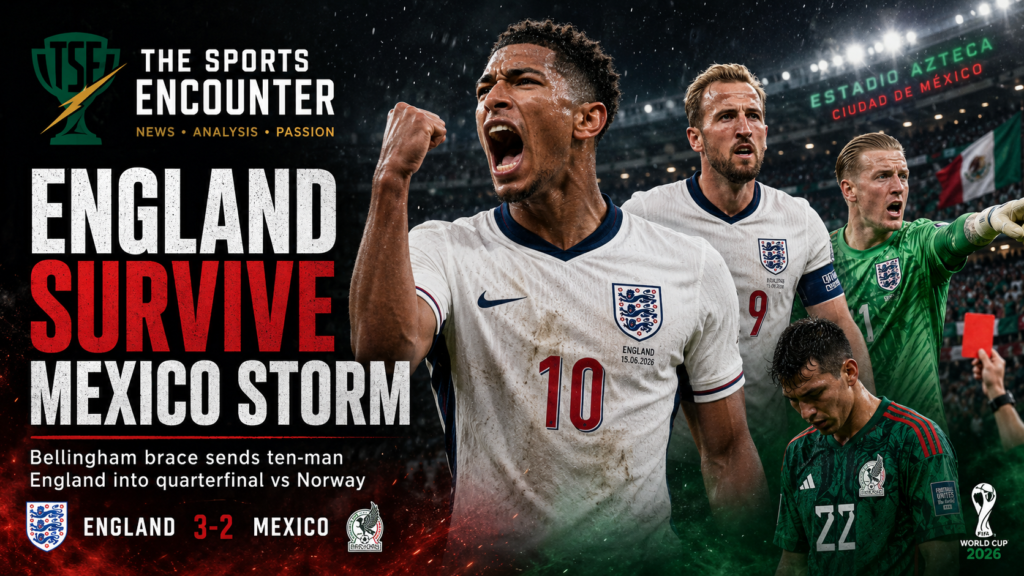
Jude Bellingham scored twice, Harry Kane struck from the spot, and Jordan Pickford helped ten-man England survive Mexico’s late storm to reach the quarterfinals.
TL;DR
- England beat Mexico 3-2 in a fierce FIFA World Cup 2026 Round of 16 match at the Azteca.
- Jude Bellingham scored twice in the first half and produced one of his strongest knockout performances for England.
- Jarell Quansah’s red card in the 54th minute turned the match into a survival test for the Three Lions.
- Harry Kane scored England’s third from the penalty spot and again shaped the result with leadership, movement, and composure.
- Jordan Pickford played a vital role late on, commanding his box and helping England survive Mexico’s pressure after the red card.
- England now move into a quarterfinal against Norway, who stunned Brazil through Erling Haaland’s late double.
| Detail | Information |
|---|---|
| Match | Mexico vs England |
| Result | England beat Mexico 3-2 |
| Venue | Estadio Azteca, Mexico City |
| Date | July 5, 2026 |
| Top Performer | Jude Bellingham, two goals and major influence in both penalty boxes |
| Key Defensive Figure | Jordan Pickford, command of the box and late-game control under pressure |
| Turning Point | Jarell Quansah’s 54th-minute red card, followed by Harry Kane’s penalty |
| What It Means | England reach the FIFA World Cup 2026 quarterfinals against Norway |
England walked into the Azteca carrying more than a knockout fixture. They carried altitude, noise, history, a hostile crowd, and the uncomfortable memory of how close their World Cup had come to slipping away against DR Congo.
This time, the pressure arrived before the result.
Mexico had momentum, home support, and a tournament run built on belief. England had questions about control, rhythm, and whether their biggest players could keep dragging them through the hardest moments. By the final whistle, those questions had a clearer answer, even if the match itself had almost everything a team fears in a knockout tie.
England beat Mexico 3-2 in a bruising, breathless Round of 16 clash that felt closer to a street fight than a clean tactical contest. Jude Bellingham scored twice, Harry Kane converted a decisive penalty, and Thomas Tuchel’s ten-man side survived a Mexican comeback that turned the final half-hour into a test of nerve.
For full tournament context, this result belongs inside a wider knockout phase that has already delivered shocks, VAR drama, late goals, and heavyweight exits. The full bracket picture was already building through The Sports Encounter’s FIFA World Cup 2026 Round of 16 preview, but England vs Mexico raised the emotional temperature again.
Bellingham Took Control When England Needed Authority
Bellingham’s two goals in quick succession changed the entire match. England had spent the early stages trying to absorb Mexico’s energy, manage the conditions, and survive the first major wave from the stands. That was sensible, because Mexico were sharp, aggressive, and determined to turn the Azteca into a furnace.
Then Bellingham stepped forward.
His first goal came from a well-built England move, with Bukayo Saka creating the delivery and Bellingham arriving with the timing and force that separate elite midfielders from passengers. The second was even more telling. England won the ball high, Kane linked the move, and Bellingham continued his run with the hunger of a player who understood the moment before anyone else.
That brace gave England a 2-0 lead, but his performance was larger than the goals. He pressed, carried the ball, protected space, and even produced an important defensive intervention before halftime when Mexico threatened to level from a set-piece situation.
Bellingham has often been discussed as England’s future. At the Azteca, he looked like their present.
His performance also mattered because England’s attack has leaned heavily on Kane throughout the tournament. Kane’s late rescue act against DR Congo had already been analyzed in Kane’s late brilliance against DR Congo. Against Mexico, Bellingham gave England a second match-winner at the exact time the tournament demanded one.
Mexico Refused to Fold
Mexico could have broken after Bellingham’s double. Instead, they found a way back before halftime.
Julián Quiñones punished England’s loose defending from a set-piece situation, striking through the chaos to make it 2-1. That goal changed the emotional feel of the match. Mexico were no longer chasing a distant game. They were back within touching distance, backed by a crowd that sensed England might wobble.
Javier Aguirre’s side played with the urgency of a host nation trying to keep its World Cup alive. They moved the ball well in wide areas, attacked second balls, and forced England into uncomfortable clearances. Raúl Jiménez remained a physical and aerial problem, while Gilberto Mora and Luis Romo helped Mexico compete through midfield.
This was Mexico’s best kind of chaos. They wanted the match to become emotional, physical, and territorial. For long periods, they succeeded.
Their earlier knockout win over Ecuador had shown the structure and confidence behind this run, as covered in Mexico’s shutout win over Ecuador. Against England, they showed a different quality: refusal.
Quansah Red Card Turned the Match Into a Survival Test
The match’s turning point came in the 54th minute when Jarell Quansah was sent off after a VAR review for a high challenge on Jesús Gallardo. The red card changed England’s night instantly.
Until then, England had started the second half with enough control to suggest they could push for a third goal. Nico O’Reilly had even struck the post from range. Quansah’s dismissal changed the geometry of the match. England lost their right-back, lost their balance, and had to decide whether to defend deep or keep enough attacking threat to stop Mexico from camping permanently in their half.
The answer came through Tuchel’s adjustments.
John Stones came on for Saka, giving England an extra defensive organizer. Later, Dan Burn and Djed Spence were introduced as England shifted into a deeper protective shape. It was not pretty, but knockout football rarely rewards vanity in moments like that.
The red card also added to the match’s harsh physical edge. This was a ruthless contest, full of collisions, pressure, protests, and emotional spikes. England had to show restraint after going down to 10 men. Mexico had to show patience while chasing the game. Neither side gave an inch.
Hydration Breaks Again Became a Tactical Reset for England
This was the second straight England knockout match in which hydration breaks became more than medical pauses. Against DR Congo, England looked like a different side after those stoppages. Tuchel used them as short tactical windows, calming the team, changing the angles of attack, and making sure the players understood where the spaces were opening.
At the Azteca, the conditions made those breaks even more important.
Mexico City’s altitude and the delayed kickoff after thunderstorms created an unusual rhythm. England needed the first hydration break to settle. Tuchel’s side looked more composed after it, started finding better spacing, and eventually turned that control into Bellingham’s double.
After Quansah’s red card, the breaks and substitutions carried a different purpose. They became survival huddles. England had to defend as a unit, keep Mexico wide, avoid reckless challenges near the box, and use Kane as an outlet whenever possible.
Tuchel deserves credit here. His decisions were reactive, but they were not panicked. England lost a player and still found a way to protect the result.
Kane’s Role Was Bigger Than the Penalty
Kane’s goal from the spot made it 3-1 and gave England the cushion they desperately needed. Anthony Gordon’s pressure forced the penalty after Raúl Rangel brought him down, and Kane did what Kane does in major moments: he slowed the noise, picked his spot, and finished.
That was his sixth goal of the tournament, continuing a World Cup campaign where he has carried both scoring responsibility and emotional weight for England.
Yet Kane’s influence went beyond the penalty. His movement helped Bellingham’s second goal. His hold-up play gave England moments to breathe when Mexico were pressing. His leadership mattered after the red card, when England needed senior players to organize, slow the game, and manage the emotional spikes.
There was one costly moment too. Kane conceded the penalty that allowed Raúl Jiménez to make it 3-2 in the 69th minute. That made the final phase far more dangerous for England. Still, the broader picture remained clear: Kane had again shaped an England knockout win.
Readers following England’s tournament arc can connect this performance with Kane’s earlier scoring role against Panama, where the early signs of England’s Kane dependence were already visible.
Pickford Turned Late Pressure Into Quarterfinal Survival
The final stretch belonged to England’s defenders and Jordan Pickford.
Mexico sent crosses into the box, forced clearances, and tried to turn every loose ball into one last chance. England responded with blocks, headers, and deep concentration, but Pickford’s role was just as important as the bodies in front of him.
The England goalkeeper gave his team control in moments when Mexico wanted panic. He claimed dangerous balls into the area, organized the defensive line, and stayed alert as the match became stretched after Jarell Quansah’s red card. His handling under pressure mattered because Mexico were no longer building patient attacks. They were throwing bodies forward, attacking second balls, and trying to make the final minutes chaotic.
Pickford also had to manage the rhythm of the game. With England down to 10 men, every catch, clearance, and delayed restart helped his team breathe. That kind of goalkeeping rarely dominates the headline, but it often decides knockout matches.
His performance carried extra weight because this was also a milestone night. Pickford moved level with Peter Shilton as England’s joint-highest World Cup appearance maker, adding another layer of authority to a display built on experience and composure.
John Stones brought calm after entering from the bench. Dan Burn gave England added height and defensive security. Marc Guéhi fought through a difficult second half after being booked. Still, Pickford was the voice and presence behind them, making sure England did not lose shape when Mexico’s pressure was at its loudest.
England’s possession dropped and their clearances rose because the match demanded sacrifice. Mexico had turned the final minutes into an assault. Pickford helped England live inside it.
That is why his contribution matters to the bigger story. Bellingham scored the goals that gave England control. Kane scored the penalty that became the winner. Pickford helped make sure those moments survived long enough to carry England into the quarterfinals.
Red and Yellow Cards
The disciplinary record reflected the match’s intensity. England received one red card and four yellow cards, while Mexico received two yellow cards.
Jarell Quansah’s straight red card in the 54th minute was the defining disciplinary moment. After a VAR review, he was sent off for a serious foul play challenge on Jesús Gallardo, forcing England to protect their lead with 10 men for the rest of the match.
England had already been walking a tightrope from the opening minute after Declan Rice was booked early. Marc Guéhi and Nico O’Reilly were also shown yellow cards during a tense second half, while Jordan Henderson was booked late from the bench in stoppage time.
Mexico’s two bookings went to Jorge Sánchez and Johan Vásquez, both coming during a heated final phase as the home side pushed hard for an equalizer.
| Card | Team | Player | Minute | Incident |
| Yellow | England | Declan Rice | 1’ | Serious foul play |
| Red | England | Jarell Quansah | 54’ | Serious foul play after VAR review |
| Yellow | England | Marc Guéhi | 68’ | Unsporting behavior |
| Yellow | Mexico | Jorge Sánchez | 71’ | Unsporting behavior |
| Yellow | England | Nico O’Reilly | 72’ | Serious foul play |
| Yellow | Mexico | Johan Vásquez | 90+7’ / 98’ | Unsporting behavior |
| Yellow | England | Jordan Henderson | 90+8’ / 98’ | Booked from the bench |
Disciplinary summary:
England: 1 red card, 4 yellow cards
Mexico: 2 yellow cards
What This Means for England and Mexico
For Mexico, this is a painful exit. They gave their supporters a serious World Cup run, defended their home stage with pride, and pushed one of the tournament favorites to the limit. Their campaign ends with regret, but not embarrassment.
For England, this victory changes the tone of the tournament.
They have now survived DR Congo and Mexico in very different ways. The first required late attacking rescue. The second required early brilliance, tactical adjustment, ten-man defensive resistance, and reliable goalkeeping under pressure. That range matters in a World Cup.
The next test is Norway, and that matchup already has its own dangerous storyline. Erling Haaland’s two late goals against Brazil sent Norway into the quarterfinals, a result covered in Haaland turning Brazil’s missed penalty into a World Cup nightmare. England now have to deal with a striker who can change a game with almost no warning.
The wider knockout picture also shows why this result carries weight. England are now part of a quarterfinal field shaped by favorites under pressure, surprise runs, and heavyweight exits. Fans can follow more of that broader tournament path through The Sports Encounter’s FIFA World Cup 2026 coverage.
For official fixtures, match details, and tournament updates, the main source remains FIFA’s World Cup 2026 coverage.
Final Word
England left the Azteca with a win that felt bruising, imperfect, and deeply valuable. Bellingham gave them the spark. Kane gave them the cushion. Tuchel gave them structure when the red card threatened to pull the match away.
Pickford gave them calm when Mexico tried to turn the final minutes into chaos.
Mexico gave England a fight that will not fade quickly. The hosts chased the game with pride, aggression, and belief, but England found enough quality and control to survive the storm.
That is why this result matters. England did more than reach another quarterfinal. They survived the kind of night that tells a team whether its World Cup dream has real weight behind it.
The Sports Encounter’s World Cup 2026 coverage focuses on fixtures, team news, match analysis, fan stories, tournament trends, and the biggest talking points from football’s global stage.

Breaking News
Kobel Breaks Colombia Hearts as Switzerland Reach World Cup Quarterfinals
Switzerland beat Colombia 4-3 on penalties after 120 goalless minutes at BC Place Vancouver, with Gregor Kobel’s shootout save sending the Swiss into an Argentina quarterfinal.
The last Round of 16 match had no goal to separate Colombia from Switzerland, but it still found a way to leave one team frozen on the pitch and the other running toward history.
After 120 minutes of pressure, missed chances, brave goalkeeping, tired legs, and rising tension at BC Place Vancouver, Switzerland beat Colombia 4-3 on penalties following a 0-0 draw. Gregor Kobel became the central figure of the night, saving Cucho Hernández’s penalty after Davinson Sánchez had already hit the bar, before Ruben Vargas sent the decisive kick past Camilo Vargas.
It was Switzerland’s first FIFA World Cup quarterfinal appearance since 1954, and it came through the kind of match that tests far more than attacking rhythm. Colombia had possession, energy, and the larger attacking volume. Switzerland had shape, patience, Kobel, and enough composure from the spot to survive one of the tensest nights of the tournament.
For readers following the wider knockout story, this match completed the path first mapped in The Sports Encounter’s FIFA World Cup 2026 Round of 16 preview, where Colombia’s clash with Switzerland already looked like one of the round’s most physically demanding matchups.
TL;DR
- Switzerland beat Colombia 4-3 on penalties after a 0-0 draw through extra time.
- Gregor Kobel made the decisive shootout save from Cucho Hernández and delivered a huge all-round goalkeeping performance.
- Camilo Vargas also kept Colombia alive with important saves across regular and extra time.
- Colombia created more shots and pushed hard, but could not turn pressure into a goal.
- Switzerland will face Argentina in the quarterfinal at Kansas City Stadium on Saturday, July 11 local time.
- Switzerland received three yellow cards, Colombia received two, and no red cards were reported.
Key Match Information
| Detail | Information |
|---|---|
| Match | Switzerland vs Colombia |
| Competition | FIFA World Cup 2026, Round of 16 |
| Result | Switzerland 0-0 Colombia, Switzerland won 4-3 on penalties |
| Venue | BC Place Vancouver, Vancouver |
| Date | July 7, 2026 local time, July 8 IST |
| Top Performer | Gregor Kobel, decisive penalty save and key saves across the match |
| Turning Point | Kobel saved Cucho Hernández’s penalty after Davinson Sánchez hit the bar |
| What It Means | Switzerland reached their first World Cup quarterfinal since 1954 and will face Argentina |
Colombia Had the Ball, Switzerland Had the Nerve
Colombia looked more comfortable with the ball for long stretches. Their midfield tried to move Switzerland sideways, Luis Díaz kept asking questions from wide areas, and the second-half changes brought fresh running into the final third.
The numbers reflected that pressure. Colombia had more possession, more shots, and more corners. Their problem was the final touch. The attacks kept reaching dangerous zones without producing the one clean finish that could break Switzerland’s defensive block.
That has been one of Colombia’s strengths in this tournament: they rarely panic when matches become difficult. Their 1-0 win over Ghana in the previous round showed a mature knockout temperament, and that same discipline appeared again in Vancouver. The difference this time was that Switzerland refused to open up. You can revisit that build-up in our report on Colombia’s Round of 32 win over Ghana.
Switzerland did not dominate the ball, but Murat Yakin’s side managed the match with patience. They defended the box well, slowed Colombia’s rhythm when needed, and kept the game close enough to make penalties feel like a realistic route rather than a desperate escape.
Gregor Kobel Gives Switzerland the Match They Needed
Kobel’s night will be remembered for the penalty save, but his influence started much earlier.
Colombia forced Switzerland into uncomfortable defensive phases, especially when they moved the ball quickly into wide channels and attacked second balls near the box. Kobel gave the Swiss back line confidence by staying sharp on crosses, reading danger early, and making the saves that kept the match scoreless.
His biggest moment arrived in the shootout. After Sánchez struck the bar, Switzerland had an opening. Akanji then missed, and the pressure returned. That was when Kobel stepped forward.
Hernández went low. Kobel read it, got across, and made the save that changed the shootout. Moments later, Ruben Vargas finished the job.
Switzerland have played enough major-tournament knockout matches where small margins went against them. This time, their goalkeeper owned the margin.
Camilo Vargas Deserved Better Than Defeat
Colombia’s pain will be sharper because Camilo Vargas also played an exceptional match.
Switzerland did not create as many chances as Colombia, but Vargas still had to stay alert through long periods where the match rhythm kept shifting. He handled deliveries, protected his area, and kept Colombia alive when Swiss attacks threatened to open space around the box.
His penalty-shootout night ended cruelly. He went the wrong way for the decisive Ruben Vargas kick, then sat on the goal line as Switzerland celebrated. That image told the story of Colombian heartbreak, but it should not erase his work across the match.
Goalkeepers often become visible only when they make the final save or miss the final moment. This match had two goalkeepers who shaped the entire contest. Kobel got the winning image. Vargas still gave Colombia every chance to take the game deeper.
Switzerland’s Bench Helped Drag the Match Toward Penalties
Yakin’s substitutions mattered because Switzerland needed fresh legs more than attacking poetry.
Zeki Amdouni, Cedric Itten, Ruben Vargas, Miro Muheim, Silvan Widmer, and Djibril Sow all entered at different stages, giving Switzerland energy in a match that became more stretched after 90 minutes. Amdouni, Itten, Xhaka, and Ruben Vargas converted their penalties, which also showed how much trust Switzerland placed in players who had to enter a match already loaded with pressure.
That is often where knockout football becomes a squad test. Starting elevens build the platform. Substitutes decide whether a tired team still has enough calm left for the final act.
Colombia’s Exit Hurts Because the Performance Had Belief
Colombia will leave this World Cup with frustration, but not embarrassment.
They finished the match with 15 shots to Switzerland’s seven, forced Kobel into work, and carried the stronger attacking intent through several phases. James Rodríguez started and helped Colombia control some early rhythm before Juan Fernando Quintero replaced him and later scored the first penalty of the shootout.
Luis Díaz also converted his penalty under huge pressure, but Colombia’s two misses proved decisive. Sánchez hit the bar. Hernández was stopped by Kobel. In a match without goals, those two moments became the difference between a quarterfinal place and a painful flight home.
This result also connects with the wider pattern of a knockout round shaped by tension, late drama, and emotional exits. Switzerland’s survival now sits beside Argentina’s rescue act against Egypt, covered in our report on Messi saving Argentina after Egypt pushed the champions to the brink.
Penalties Decide the Final Round of 16 Match
| Penalty Order | Team | Player | Outcome |
| 1 | Colombia | Juan Fernando Quintero | Scored |
| 2 | Switzerland | Granit Xhaka | Scored |
| 3 | Colombia | Davinson Sánchez | Missed, hit bar |
| 4 | Switzerland | Zeki Amdouni | Scored |
| 5 | Colombia | Jaminton Campaz | Scored |
| 6 | Switzerland | Manuel Akanji | Missed |
| 7 | Colombia | Cucho Hernández | Saved by Gregor Kobel |
| 8 | Switzerland | Cedric Itten | Scored |
| 9 | Colombia | Luis Díaz | Scored |
| 10 | Switzerland | Ruben Vargas | Scored |
The shootout had everything: an early Colombian lead, a Swiss response, a defender’s miss from each side, a goalkeeper’s defining save, and Ruben Vargas turning a difficult night into one of Switzerland’s biggest World Cup moments.
This was also a reminder of why penalty technique has become one of the tournament’s most discussed themes. For more context on modern spot-kick debates, read our explainer on why stutter-step penalties are dividing World Cup 2026 fans.
Cards and Discipline
| Team | Yellow Cards | Players Booked | Red Cards |
| Switzerland | 3 | Granit Xhaka 51’, Denis Zakaria 59’, Miro Muheim 105’ | 0 |
| Colombia | 2 | Luis Suárez 60’, Davinson Sánchez 95’ | 0 |
The match carried plenty of physical pressure, but it never fully lost control. The five yellow cards reflected the edge of the contest, especially after halftime and during extra time, but no player was sent off.
That disciplinary control mattered in a Round of 16 already shaped by refereeing conversations. The wider tournament debate around officials has grown louder, especially after fan scrutiny in other knockout matches. The Sports Encounter covered that trend in our feature on why FIFA World Cup 2026 fans are suddenly obsessed with referees.
Switzerland vs Argentina Quarterfinal: Where and When?
Switzerland will now face Argentina in the FIFA World Cup 2026 quarterfinal.
| Detail | Information |
| Match | Argentina vs Switzerland |
| Round | Quarterfinal |
| Venue | Kansas City Stadium, Kansas City |
| Local Date | Saturday, July 11, 2026 |
| Local Time | 8:00 PM CDT |
| Pakistan Time | Sunday, July 12, 2026, 6:00 AM PKT |
| India Time | Sunday, July 12, 2026, 6:30 AM IST |
Argentina arrive after surviving Egypt in one of the most emotional matches of the tournament. Switzerland arrive with belief, a clean sheet, and a goalkeeper who has already won one knockout match with his hands and his nerve.
The winner of Argentina vs Switzerland will face Norway or England in the semifinal, which gives the Swiss a clear but brutal path. Beat Colombia on penalties. Face Messi’s Argentina. Then possibly deal with England’s tournament muscle or Erling Haaland’s Norway.
For readers tracking the full quarterfinal picture, Switzerland’s next match now belongs beside Belgium’s 4-1 win over the USA and Spain’s late win over Portugal as part of a final eight loaded with storylines.
What This Win Says About Switzerland
Switzerland did not produce a dazzling attacking performance. They produced something more useful in a knockout match: survival with structure.
They absorbed pressure without collapsing. They managed fatigue without losing shape. They trusted their goalkeeper. They recovered after Akanji’s missed penalty. They found a final taker in Ruben Vargas who could walk into the most important kick of the night and finish it cleanly.
That is why this win matters. It was not built on one brilliant attacking spell. It was built on a team understanding exactly what the match had become and staying alive long enough for Kobel to decide it.
The official FIFA World Cup 2026 stage now moves toward the quarterfinals with Switzerland still standing. Colombia leave with regret, but Switzerland leave Vancouver with history, a clean sheet, and the belief that Argentina will have to break them the hard way.
Breaking News
India Hit New T20I Low as England Storm to 125-Run Win
England posted 201-7 at Trent Bridge before Jofra Archer and Josh Tongue ripped through India’s chase in a record 125-run T20I defeat.
Trent Bridge had seen enough before India’s chase even reached the halfway mark.
England had already done their job with the bat, posting 201-7 after Phil Salt gave the innings authority, Jos Buttler supplied early force, and Sam Curran finished with calm aggression. The chase demanded clarity, courage, and control from India. Instead, it produced panic.
India were bowled out for 76 in 11.4 overs, losing by 125 runs. According to the full scorecard available on ESPNcricinfo and live score updates on Google Cricket feeds, this is now India’s worst ever defeat in T20I cricket by margin of runs.
For a team with India’s depth, talent pool, and financial muscle, this was not an ordinary bad night. It was a public breakdown.
For more coverage of international cricket, visit The Sports Encounter’s Cricket Hub.
TL;DR
- England beat India by 125 runs in the 3rd T20I at Trent Bridge, Nottingham.
- England posted 201-7 after Phil Salt’s 70, Jos Buttler’s 36, and Sam Curran’s unbeaten 41.
- India were bowled out for 76 in 11.4 overs, their worst T20I defeat by runs.
- Jofra Archer and Josh Tongue destroyed India’s power play, taking five wickets between them before the chase had any shape.
- India’s top order collapsed again after another confused batting display.
- England now lead the five-match series 2-0 after the opening match was washed out.
Scorecard and Key Information
| Detail | Information |
|---|---|
| Match | England vs India, 3rd T20I |
| Result | England won by 125 runs |
| Venue | Trent Bridge, Nottingham |
| Date | July 7, 2026 |
| England Score | 201-7 in 20 overs |
| India Score | 76 all out in 11.4 overs |
| Top Performer | Phil Salt, 70 off 44 balls |
| Bowling Impact | Jofra Archer and Josh Tongue broke India inside the power play |
| Turning Point | India collapsed to 52-5 after five overs |
| What It Means | England lead the series 2-0 and India’s T20I reset looks increasingly unstable |
England’s 201 Was More Than Enough After Salt Sets the Base
England’s innings had balance even when it was not perfect.
India won the toss and chose to bowl first, a decision that looked reasonable for a short period. Arshdeep Singh began with rare control, and England did not immediately run away with the game. The innings changed once Buttler and Salt found rhythm.
Buttler’s 36 from 21 balls gave England an aggressive launch. He attacked early, forced India to adjust their fields, and helped England move through the first phase without being trapped by the new ball.
Phil Salt then turned England’s innings into a proper match-winning platform. His 70 from 44 balls included seven fours and three sixes, and it came at exactly the right tempo. He did not throw away the start. He stretched the innings deep enough to make India chase the game.
Salt’s dismissal at 158-5 in the 17th over briefly gave India a chance to keep England below 190, but Sam Curran closed that door.
Curran’s unbeaten 41 from 24 balls was the finishing hand England needed. He found gaps, punished anything loose, and helped England cross 200 despite a few late wickets and run-outs. Will Jacks added a useful 14 from seven balls, while England’s lower order kept the board moving.
India’s bowling had moments. Prince Yadav, brought into the side in place of Ravi Bishnoi, finished with 2-30 on debut. Harshit Rana picked up two wickets as well. Still, England’s 201-7 told the real story. India had taken wickets, but they had not controlled the innings.
For readers following the wider series, England’s win came after Jacob Bethell’s match-winning effort in Manchester. Read more in The Sports Encounter’s report on Jacob Bethell inspiring England’s victory over India in the 2nd T20I.
Archer and Tongue Turned the Chase Into a Wreck
India needed a sharp start. They got a collapse.
The target was 202, but the chase was effectively dead after five overs. Jofra Archer and Josh Tongue bowled with pace, bounce, and purpose. India’s top order answered with rushed shots, loose judgment, and the kind of batting that looked aggressive only on the surface.
Abhishek Sharma began with intent, hitting Tongue for six, but he soon fell for 10. Vaibhav Sooryavanshi briefly flashed his talent with two sixes in a 13-run cameo, yet Archer hurried him with pace and bounce. Ishan Kishan made 13 but picked out the fielder. Shreyas Iyer’s dismissal for 5 was one of the ugliest moments of the chase because the captain needed to calm the innings, not add to the chaos.
Axar Patel came out swinging and made 10 from four balls. His wicket left India 52-5 after exactly five overs.
That was the match.
Archer and Tongue’s first five power-play overs produced five wickets for 52 runs between them. Archer had 3-29 from his first three overs. Tongue struck three times in his opening spell and kept hitting the hard length that India’s batters kept misreading.
The bowling was outstanding, but India helped England far too much.
India’s Top Order Played Brainless Cricket When Calm Was Needed
This was not fearless cricket. It was careless cricket.
India’s top order never looked interested in building a chase. Abhishek, Sooryavanshi, Kishan, Iyer, and Axar all fell before India had completed six overs. Some shots came from pressure. Others came from poor awareness. A few were simply awful choices for the match situation.
A 202-run chase does require risk. It also requires thought.
India’s batters looked as if they wanted to win the match inside the power play. That mindset might create highlight clips on a good day, but against Archer and Tongue on a lively Trent Bridge surface, it became self-destruction.
Shreyas Iyer’s wicket will invite the most scrutiny. Captains are judged harshly in collapses, and rightly so. When the top order is falling around him, the captain has to bring a little sense to the crease. Instead, Iyer played a poor leg-side shot and gave England another easy moment.
Tilak Varma, Harshit Rana, Shivam Dube, Arshdeep Singh, Prince Yadav, and Varun Chakaravarthy were left with a chase that no longer existed. India eventually folded for 76 in 11.4 overs.
For wider context on India’s recent struggles, read The Sports Encounter’s analysis of India’s defeat against England in the 2nd T20I.
Selection Chaos Continues for India
India’s defeat at Trent Bridge cannot be separated from the larger pattern.
They have now lost four of their last five completed T20Is. That run includes a whitewash against Ireland and two straight defeats in England after the opening match of this series was washed out.
The numbers are bad. The cricket looks worse.
India’s selection thinking continues to look unsettled. The batting order has changed, the balance of the side keeps inviting debate, and the role clarity is poor. Vaibhav Sooryavanshi is an exciting young talent, but India cannot simply depend on teenage fearlessness to solve senior-level batting problems. Ishan Kishan has not given India enough stability. Abhishek Sharma remains dangerous, yet his shot selection under pressure remains a concern. Iyer’s leadership is now under serious examination.
Axar Patel’s promotion, Harshit Rana’s batting position ahead of Shivam Dube, and the overall shape of the order all raised the same uncomfortable question: did India know exactly how they wanted to chase 202?
At Trent Bridge, the answer looked painfully clear.
They did not.
India’s Worst T20I Defeats by Runs
India’s 125-run loss to England is now their heaviest T20I defeat by runs. The previous worst was an 80-run defeat against New Zealand in Wellington in 2019.
| Rank | Margin | Opponent | Venue | Year |
| 1 | 125 runs | England | Trent Bridge, Nottingham | 2026 |
| 2 | 80 runs | New Zealand | Wellington | 2019 |
| 3 | 76 runs | South Africa | Ahmedabad | 2026 |
| 4 | 51 runs | South Africa | New Chandigarh | 2025 |
| 5 | 50 runs | New Zealand | Visakhapatnam | 2016 |
| 6 | 49 runs | Australia | Bridgetown | 2010 |
This table matters because it puts the Trent Bridge collapse into proper historical perspective.
India have had bad T20I nights before. They have been outplayed, out-hit, and out-thought. This defeat sits above all of them by margin. A 125-run defeat in a 20-over match is not a routine loss. It is a structural warning.
England Looked Clear, India Looked Confused
England’s performance was not flawless, but it was coherent.
Their batters understood the surface. Salt anchored and accelerated. Buttler set the tempo. Curran gave the innings a final push. With the ball, Archer and Tongue attacked the stumps, ribs, and judgment of India’s batters. Their fields were sharp, their catching was clean, and their intensity never dropped once the collapse began.
India looked like a side stuck between slogans and systems.
They talk about intent, but intent without shot selection becomes recklessness. They talk about depth, but depth does not matter if the top order burns the game inside five overs. They talk about transition, but transition needs structure.
England had a plan. India had movement without direction.
For more England coverage, visit The Sports Encounter’s England cricket section.
What This Means for the Series
England now lead the five-match series 2-0 after three scheduled games. The opener was washed out after India made 189-7 in Durham. England then won the second T20I in Manchester before producing this ruthless performance at Trent Bridge.
India can no longer win the series. At best, they can draw it 2-2 by winning the final two matches.
That is the immediate damage.
The deeper concern is what this result says about India’s T20I direction. Their batting order looks fragile. Their selection choices lack clarity. Their captain is under pressure. Their young players are being asked to carry too much emotional weight in an unstable structure.
England, meanwhile, will feel they have found a sharper white-ball rhythm. Salt’s return to form, Curran’s finishing, Archer’s power-play hostility, and Tongue’s new-ball threat give them a strong base for the rest of the series.
For India, Trent Bridge will not fade quickly.
A defeat like this stays in selection meetings. It follows captains into press conferences. It becomes part of the public argument about who belongs, who leads, and what kind of T20 cricket the team actually wants to play.
India did not simply lose the 3rd T20I.
They suffered their worst T20I defeat by runs, and the scoreboard exposed a team still searching for order in the middle of its reset.
Breaking News
Messi Saves Argentina After Egypt Push Champions to the Brink
Argentina survived Egypt’s brave upset bid with three late goals in Atlanta, as Messi recovered from a penalty miss to lead an emotional World Cup escape.
Atlanta had already seen Egypt believe. By the 78th minute, that belief looked strong enough to shake a world champion.
Egypt were two goals up, compact without being passive, brave without becoming reckless, and close to writing the biggest result of their football history. Argentina looked frustrated. Lionel Messi had missed a first-half penalty. Mostafa Shobeir had turned into a wall. The Pharaohs had survived wave after wave and still found the nerve to threaten on the break.
Then the match cracked.
Cristian Romero scored in the 79th minute. Messi equalized five minutes later. Enzo Fernández completed the comeback in stoppage time. In just over 13 minutes of football, Argentina dragged themselves from the edge of elimination into the FIFA World Cup 2026 quarterfinals.
After the final whistle, Messi was crying and emotional after one of the hardest knockout wins of Argentina’s title defense. His reaction told its own story. This was not a routine champion’s victory. Egypt had pushed Argentina to the limit and deserved full credit for a performance built on courage, discipline and belief.
For readers following the full tournament path, this result now sits beside Argentina’s tense extra-time escape against Cabo Verde as another warning sign wrapped inside another survival story.
TL;DR
- Argentina beat Egypt 3-2 in a dramatic FIFA World Cup 2026 Round of 16 match at Atlanta Stadium.
- Egypt led 2-0 deep into the second half before Argentina scored three late goals.
- Mostafa Shobeir produced a heroic first-half display, including a penalty save from Lionel Messi.
- Egypt had a second-half goal disallowed, a decision that shifted the emotional temperature of the match.
- Emam Ashour’s injury before halftime hurt Egypt’s midfield control after the break.
- Egypt received four yellow cards in a volatile knockout match, but there was no red card.
Match Information
| Detail | Information |
|---|---|
| Match | Argentina vs Egypt |
| Result | Argentina 3-2 Egypt |
| Competition | FIFA World Cup 2026 |
| Stage | Round of 16 |
| Venue | Atlanta Stadium, Atlanta |
| Date | July 7, 2026 |
| Top Performer | Lionel Messi, one goal and key creative influence after missing a penalty |
| Egypt Standout | Mostafa Shobeir, penalty save and several major first-half stops |
| Turning Point | Cristian Romero’s 79th-minute header cut Egypt’s lead and shifted the pressure |
| Discipline | Egypt received four yellow cards; no red cards were shown |
| What It Means | Argentina move into the quarterfinals, while Egypt exit after their bravest World Cup knockout performance |
Egypt Were Brave, Organized and Almost Ruthless
Egypt did not treat Argentina like a team to admire. They treated them like a team to trouble.
Yasser Ibrahim’s opening goal in the 15th minute gave Egypt more than a lead. It gave them emotional control. The header came from a set-piece, and it punished Argentina’s early lack of sharpness in the box. From there, Egypt leaned into their best qualities: numbers behind the ball, quick outlets toward Mohamed Salah and Mostafa Zico, and disciplined pressure around Argentina’s central midfield.
Their second goal, scored by Zico after a swift counter-attacking move, pushed the match into shock territory. Egypt were not merely hanging on by then. They had found a route through Argentina’s structure and made the defending champions look exposed in transition.
Credit must go to Egypt here. They were not lucky passengers in a dramatic match. They were organized, fearless and tactically sharp for long periods. Their players ran themselves into exhaustion, their goalkeeper gave them a platform, and their attack kept Argentina worried until the very end.
This was the same Egypt team that had already shown its nerve in the penalty shootout win over Australia. Against Argentina, the Pharaohs added another layer: they showed they could hurt elite opposition before fatigue, pressure and controversy pulled the match away from them.
Shobeir Gave Egypt a First-Half Platform
Mostafa Shobeir’s first half deserved a different ending.
The Egypt goalkeeper saved Messi’s penalty in the 20th minute, reading the low effort and stretching across his line to protect the lead. That moment could have broken a weaker team’s concentration. For Egypt, it deepened belief.
Shobeir then denied Alexis Mac Allister with a sharp reaction save, handled pressure from wide deliveries, and produced a superb low stop from Julián Álvarez before halftime. Argentina created enough openings to equalize early, but Shobeir kept closing the door.
His performance mattered because it turned Egypt’s lead into a tactical weapon. Argentina had the ball, but Egypt had the scoreboard. Every save made Argentina more anxious. Every missed chance made Egypt’s counters feel more dangerous.
The goalkeeper could not hold out forever, but he gave Egypt a real chance to eliminate the defending champions.
Did the Disallowed Egypt Goal Change the Match?
Yes, it changed the match’s emotional and tactical rhythm.
Egypt thought they had scored a stunning counter-attacking goal around the hour mark, only for VAR to intervene and rule it out. The move had everything Egypt wanted: a fast release, Salah’s intelligence, Zico’s timing, and a composed finish before the celebrations were cut short.
The decision did not directly decide the final score on its own, because Egypt later restored a two-goal cushion. Still, the disallowed goal mattered. It denied Egypt the chance to stretch the match into a far more dangerous psychological space for Argentina. At 2-0 earlier, or potentially 3-0 depending on the sequence and timing, the champions would have faced a completely different game state.
Zico’s yellow card after the disallowed goal added another layer of frustration. Egypt had gone from euphoria to punishment in the same passage of play, and that emotional swing fed into the volatility that later consumed the match.
For tournament context, this controversy belongs in the same wider discussion as the VAR-heavy knockout drama covered in The Sports Encounter’s Round of 16 preview.
Ashour’s Injury Hurt Egypt’s Second-Half Control
Emam Ashour’s injury just before halftime hurt Egypt in a very specific way.
Hamdi Fathy brought strength and defensive bite after replacing him, but Egypt lost some of the midfield timing that had helped them survive the first half. Ashour had given Egypt a bridge between pressure resistance and forward movement. Without him, Egypt became more reactive after the break.
That mattered once Argentina increased the tempo.
The Pharaohs still defended with courage, but their second-half possessions became shorter. Salah and Zico had fewer clean support angles. Marwan Attia had more ground to cover. Argentina sensed that Egypt’s midfield legs were beginning to stretch, and Lionel Scaloni’s side pushed more players forward.
Ashour’s absence did not cause Egypt’s collapse by itself. It reduced their ability to slow the match when Argentina needed chaos.
Messi Missed, Then Took Over
Messi’s night looked wounded before it became historic.
The missed penalty could have shaped the whole post-match conversation. Shobeir had denied him, Egypt had the lead, and Argentina’s captain looked visibly frustrated during a first half when his free kick struck the woodwork and his finishing lacked its usual calm.
Then came the late surge.
Messi’s cross helped Argentina find momentum through Romero’s header. Soon after, he scored the equalizer, turning a night of frustration into another defining World Cup scene. The goal also made Messi the only player to score in nine consecutive World Cup finals matches, underlining how long he has remained decisive at the highest level.
This was not the smooth Messi of highlight reels. It was the stubborn Messi of survival football, the version who absorbs a miss, waits for one more opening, and changes a knockout match when the air feels tight.
His emotion after the final whistle made sense. Argentina had been pushed to the edge by a team that refused to shrink. Messi’s tears felt less like celebration and more like release. The captain knew how close Argentina had come to losing control of their World Cup defense.
Argentina have leaned heavily on that quality throughout this tournament. Their group-stage rhythm, covered in the Day 12 World Cup highlights, already showed Messi’s scoring influence. The knockouts have now shown something more uncomfortable: Argentina still need him to rescue games they should control earlier.
Argentina’s Comeback Was Brilliant, but the Warning Signs Remain
Romero’s 79th-minute goal did more than cut the score. It changed Egypt’s body language.
Argentina suddenly attacked with belief instead of desperation. Egypt’s defensive line dropped deeper. The midfield gaps widened. Messi started receiving the ball closer to the box, and Argentina’s runners attacked crosses with greater conviction.
The equalizer arrived with the kind of inevitability that only pressure can create. By the time Enzo Fernández scored in stoppage time, Egypt were no longer playing the same match they had controlled for nearly 80 minutes. They were surviving inside Argentina’s final wave.
Still, this was not a clean Argentine performance. The defending champions again looked vulnerable to direct transitions. Their defensive concentration from set-pieces remains a concern. Their dependence on late moments has become a pattern, not an isolated scare.
For fans tracking the tournament’s broader heavyweight drama, this match now belongs beside the World Cup’s growing list of emotional swings, from Egypt’s historic first win earlier in the tournament to the expanded-format pressure explained in The Sports Encounter’s World Cup curtain raiser.
Cards, Discipline and Late Chaos
This match carried the emotional temperature of a final, and the discipline record reflected Egypt’s rising frustration as Argentina’s comeback gathered pace.
The correct disciplinary summary was four yellow cards to Egypt and no red card in the match. Egypt’s bookings came during a second half that became increasingly tense after the disallowed goal, Argentina’s late pressure, and the stoppage-time winner.
That detail matters because the story should focus on Egypt’s brave fight and emotional frustration without overstating the disciplinary chaos. The Pharaohs were intense, angry at key moments, and heartbroken by the finish, but they were not reduced to ten men, and no red-card dismissal shaped the result.
What This Means for Argentina and Egypt
Argentina move on, but they move on with questions.
Their comeback showed championship nerve. Their first 78 minutes showed why their title defense remains fragile. A team with Messi, Enzo Fernández, Julián Álvarez and Lautaro Martínez can always find a goal. A team that keeps giving opponents belief can also run out of escapes.
Egypt leave with pain, but also with proof.
They led the defending champions by two goals in a World Cup knockout match. They forced Messi into a missed penalty. Their goalkeeper produced one of the tournament’s great individual performances. Their structure, courage and counter-attacking threat gave Argentina more problems than many expected.
Salah’s World Cup run ends in heartbreak, yet Egypt’s tournament should not be reduced to the final 13 minutes. This was a team that turned belief into results, then nearly turned a Round of 16 tie into a national football landmark.
Messi’s emotional reaction after the final whistle captured the real weight of the night. Argentina survived, but Egypt made them suffer for every inch.
Argentina advanced because Messi found one more answer.
Egypt exited because knockout football can punish even the bravest team when control slips for a few minutes.
The Sports Encounter’s World Cup 2026 coverage focuses on fixtures, team news, match analysis, fan stories, tournament trends, and the biggest talking points from football’s global stage.