


TL;DR
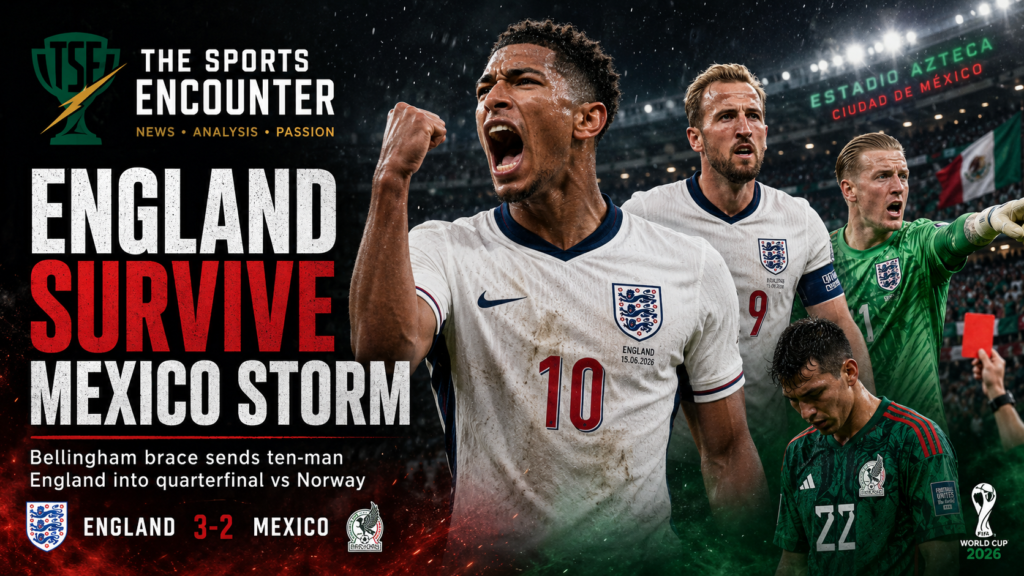
- England beat Mexico 3-2 in a fierce FIFA World Cup 2026 Round of 16 match at the Azteca.
- Jude Bellingham scored twice in the first half and produced one of his strongest knockout performances for England.
- Jarell Quansah’s red card in the 54th minute turned the match into a survival test for the Three Lions.
- Harry Kane scored England’s third from the penalty spot and again shaped the result with leadership, movement, and composure.
- Jordan Pickford played a vital role late on, commanding his box and helping England survive Mexico’s pressure after the red card.
- England now move into a quarterfinal against Norway, who stunned Brazil through Erling Haaland’s late double.
| Detail | Information |
|---|---|
| Match | Mexico vs England |
| Result | England beat Mexico 3-2 |
| Venue | Estadio Azteca, Mexico City |
| Date | July 5, 2026 |
| Top Performer | Jude Bellingham, two goals and major influence in both penalty boxes |
| Key Defensive Figure | Jordan Pickford, command of the box and late-game control under pressure |
| Turning Point | Jarell Quansah’s 54th-minute red card, followed by Harry Kane’s penalty |
| What It Means | England reach the FIFA World Cup 2026 quarterfinals against Norway |
England walked into the Azteca carrying more than a knockout fixture. They carried altitude, noise, history, a hostile crowd, and the uncomfortable memory of how close their World Cup had come to slipping away against DR Congo.
This time, the pressure arrived before the result.
Mexico had momentum, home support, and a tournament run built on belief. England had questions about control, rhythm, and whether their biggest players could keep dragging them through the hardest moments. By the final whistle, those questions had a clearer answer, even if the match itself had almost everything a team fears in a knockout tie.
England beat Mexico 3-2 in a bruising, breathless Round of 16 clash that felt closer to a street fight than a clean tactical contest. Jude Bellingham scored twice, Harry Kane converted a decisive penalty, and Thomas Tuchel’s ten-man side survived a Mexican comeback that turned the final half-hour into a test of nerve.
For full tournament context, this result belongs inside a wider knockout phase that has already delivered shocks, VAR drama, late goals, and heavyweight exits. The full bracket picture was already building through The Sports Encounter’s FIFA World Cup 2026 Round of 16 preview, but England vs Mexico raised the emotional temperature again.
Bellingham Took Control When England Needed Authority
Bellingham’s two goals in quick succession changed the entire match. England had spent the early stages trying to absorb Mexico’s energy, manage the conditions, and survive the first major wave from the stands. That was sensible, because Mexico were sharp, aggressive, and determined to turn the Azteca into a furnace.
Then Bellingham stepped forward.
His first goal came from a well-built England move, with Bukayo Saka creating the delivery and Bellingham arriving with the timing and force that separate elite midfielders from passengers. The second was even more telling. England won the ball high, Kane linked the move, and Bellingham continued his run with the hunger of a player who understood the moment before anyone else.
That brace gave England a 2-0 lead, but his performance was larger than the goals. He pressed, carried the ball, protected space, and even produced an important defensive intervention before halftime when Mexico threatened to level from a set-piece situation.
Bellingham has often been discussed as England’s future. At the Azteca, he looked like their present.
His performance also mattered because England’s attack has leaned heavily on Kane throughout the tournament. Kane’s late rescue act against DR Congo had already been analyzed in Kane’s late brilliance against DR Congo. Against Mexico, Bellingham gave England a second match-winner at the exact time the tournament demanded one.
Mexico Refused to Fold
Mexico could have broken after Bellingham’s double. Instead, they found a way back before halftime.
Julián Quiñones punished England’s loose defending from a set-piece situation, striking through the chaos to make it 2-1. That goal changed the emotional feel of the match. Mexico were no longer chasing a distant game. They were back within touching distance, backed by a crowd that sensed England might wobble.
Javier Aguirre’s side played with the urgency of a host nation trying to keep its World Cup alive. They moved the ball well in wide areas, attacked second balls, and forced England into uncomfortable clearances. Raúl Jiménez remained a physical and aerial problem, while Gilberto Mora and Luis Romo helped Mexico compete through midfield.
This was Mexico’s best kind of chaos. They wanted the match to become emotional, physical, and territorial. For long periods, they succeeded.
Their earlier knockout win over Ecuador had shown the structure and confidence behind this run, as covered in Mexico’s shutout win over Ecuador. Against England, they showed a different quality: refusal.
Quansah Red Card Turned the Match Into a Survival Test
The match’s turning point came in the 54th minute when Jarell Quansah was sent off after a VAR review for a high challenge on Jesús Gallardo. The red card changed England’s night instantly.
Until then, England had started the second half with enough control to suggest they could push for a third goal. Nico O’Reilly had even struck the post from range. Quansah’s dismissal changed the geometry of the match. England lost their right-back, lost their balance, and had to decide whether to defend deep or keep enough attacking threat to stop Mexico from camping permanently in their half.
The answer came through Tuchel’s adjustments.
John Stones came on for Saka, giving England an extra defensive organizer. Later, Dan Burn and Djed Spence were introduced as England shifted into a deeper protective shape. It was not pretty, but knockout football rarely rewards vanity in moments like that.
The red card also added to the match’s harsh physical edge. This was a ruthless contest, full of collisions, pressure, protests, and emotional spikes. England had to show restraint after going down to 10 men. Mexico had to show patience while chasing the game. Neither side gave an inch.
Hydration Breaks Again Became a Tactical Reset for England
This was the second straight England knockout match in which hydration breaks became more than medical pauses. Against DR Congo, England looked like a different side after those stoppages. Tuchel used them as short tactical windows, calming the team, changing the angles of attack, and making sure the players understood where the spaces were opening.
At the Azteca, the conditions made those breaks even more important.
Mexico City’s altitude and the delayed kickoff after thunderstorms created an unusual rhythm. England needed the first hydration break to settle. Tuchel’s side looked more composed after it, started finding better spacing, and eventually turned that control into Bellingham’s double.
After Quansah’s red card, the breaks and substitutions carried a different purpose. They became survival huddles. England had to defend as a unit, keep Mexico wide, avoid reckless challenges near the box, and use Kane as an outlet whenever possible.
Tuchel deserves credit here. His decisions were reactive, but they were not panicked. England lost a player and still found a way to protect the result.
Kane’s Role Was Bigger Than the Penalty
Kane’s goal from the spot made it 3-1 and gave England the cushion they desperately needed. Anthony Gordon’s pressure forced the penalty after Raúl Rangel brought him down, and Kane did what Kane does in major moments: he slowed the noise, picked his spot, and finished.
That was his sixth goal of the tournament, continuing a World Cup campaign where he has carried both scoring responsibility and emotional weight for England.
Yet Kane’s influence went beyond the penalty. His movement helped Bellingham’s second goal. His hold-up play gave England moments to breathe when Mexico were pressing. His leadership mattered after the red card, when England needed senior players to organize, slow the game, and manage the emotional spikes.
There was one costly moment too. Kane conceded the penalty that allowed Raúl Jiménez to make it 3-2 in the 69th minute. That made the final phase far more dangerous for England. Still, the broader picture remained clear: Kane had again shaped an England knockout win.
Readers following England’s tournament arc can connect this performance with Kane’s earlier scoring role against Panama, where the early signs of England’s Kane dependence were already visible.
Pickford Turned Late Pressure Into Quarterfinal Survival
The final stretch belonged to England’s defenders and Jordan Pickford.
Mexico sent crosses into the box, forced clearances, and tried to turn every loose ball into one last chance. England responded with blocks, headers, and deep concentration, but Pickford’s role was just as important as the bodies in front of him.
The England goalkeeper gave his team control in moments when Mexico wanted panic. He claimed dangerous balls into the area, organized the defensive line, and stayed alert as the match became stretched after Jarell Quansah’s red card. His handling under pressure mattered because Mexico were no longer building patient attacks. They were throwing bodies forward, attacking second balls, and trying to make the final minutes chaotic.
Pickford also had to manage the rhythm of the game. With England down to 10 men, every catch, clearance, and delayed restart helped his team breathe. That kind of goalkeeping rarely dominates the headline, but it often decides knockout matches.
His performance carried extra weight because this was also a milestone night. Pickford moved level with Peter Shilton as England’s joint-highest World Cup appearance maker, adding another layer of authority to a display built on experience and composure.
John Stones brought calm after entering from the bench. Dan Burn gave England added height and defensive security. Marc Guéhi fought through a difficult second half after being booked. Still, Pickford was the voice and presence behind them, making sure England did not lose shape when Mexico’s pressure was at its loudest.
England’s possession dropped and their clearances rose because the match demanded sacrifice. Mexico had turned the final minutes into an assault. Pickford helped England live inside it.
That is why his contribution matters to the bigger story. Bellingham scored the goals that gave England control. Kane scored the penalty that became the winner. Pickford helped make sure those moments survived long enough to carry England into the quarterfinals.
Red and Yellow Cards
The disciplinary record reflected the match’s intensity. England received one red card and four yellow cards, while Mexico received two yellow cards.
Jarell Quansah’s straight red card in the 54th minute was the defining disciplinary moment. After a VAR review, he was sent off for a serious foul play challenge on Jesús Gallardo, forcing England to protect their lead with 10 men for the rest of the match.
England had already been walking a tightrope from the opening minute after Declan Rice was booked early. Marc Guéhi and Nico O’Reilly were also shown yellow cards during a tense second half, while Jordan Henderson was booked late from the bench in stoppage time.
Mexico’s two bookings went to Jorge Sánchez and Johan Vásquez, both coming during a heated final phase as the home side pushed hard for an equalizer.
| Card | Team | Player | Minute | Incident |
| Yellow | England | Declan Rice | 1’ | Serious foul play |
| Red | England | Jarell Quansah | 54’ | Serious foul play after VAR review |
| Yellow | England | Marc Guéhi | 68’ | Unsporting behavior |
| Yellow | Mexico | Jorge Sánchez | 71’ | Unsporting behavior |
| Yellow | England | Nico O’Reilly | 72’ | Serious foul play |
| Yellow | Mexico | Johan Vásquez | 90+7’ / 98’ | Unsporting behavior |
| Yellow | England | Jordan Henderson | 90+8’ / 98’ | Booked from the bench |
Disciplinary summary:
England: 1 red card, 4 yellow cards
Mexico: 2 yellow cards
What This Means for England and Mexico
For Mexico, this is a painful exit. They gave their supporters a serious World Cup run, defended their home stage with pride, and pushed one of the tournament favorites to the limit. Their campaign ends with regret, but not embarrassment.
For England, this victory changes the tone of the tournament.
They have now survived DR Congo and Mexico in very different ways. The first required late attacking rescue. The second required early brilliance, tactical adjustment, ten-man defensive resistance, and reliable goalkeeping under pressure. That range matters in a World Cup.
The next test is Norway, and that matchup already has its own dangerous storyline. Erling Haaland’s two late goals against Brazil sent Norway into the quarterfinals, a result covered in Haaland turning Brazil’s missed penalty into a World Cup nightmare. England now have to deal with a striker who can change a game with almost no warning.
The wider knockout picture also shows why this result carries weight. England are now part of a quarterfinal field shaped by favorites under pressure, surprise runs, and heavyweight exits. Fans can follow more of that broader tournament path through The Sports Encounter’s FIFA World Cup 2026 coverage.
For official fixtures, match details, and tournament updates, the main source remains FIFA’s World Cup 2026 coverage.
Final Word
England left the Azteca with a win that felt bruising, imperfect, and deeply valuable. Bellingham gave them the spark. Kane gave them the cushion. Tuchel gave them structure when the red card threatened to pull the match away.
Pickford gave them calm when Mexico tried to turn the final minutes into chaos.
Mexico gave England a fight that will not fade quickly. The hosts chased the game with pride, aggression, and belief, but England found enough quality and control to survive the storm.
That is why this result matters. England did more than reach another quarterfinal. They survived the kind of night that tells a team whether its World Cup dream has real weight behind it.
The Sports Encounter’s World Cup 2026 coverage focuses on fixtures, team news, match analysis, fan stories, tournament trends, and the biggest talking points from football’s global stage.