Connect with us
Hamad Hussain | The Sports Encounter

Published

on

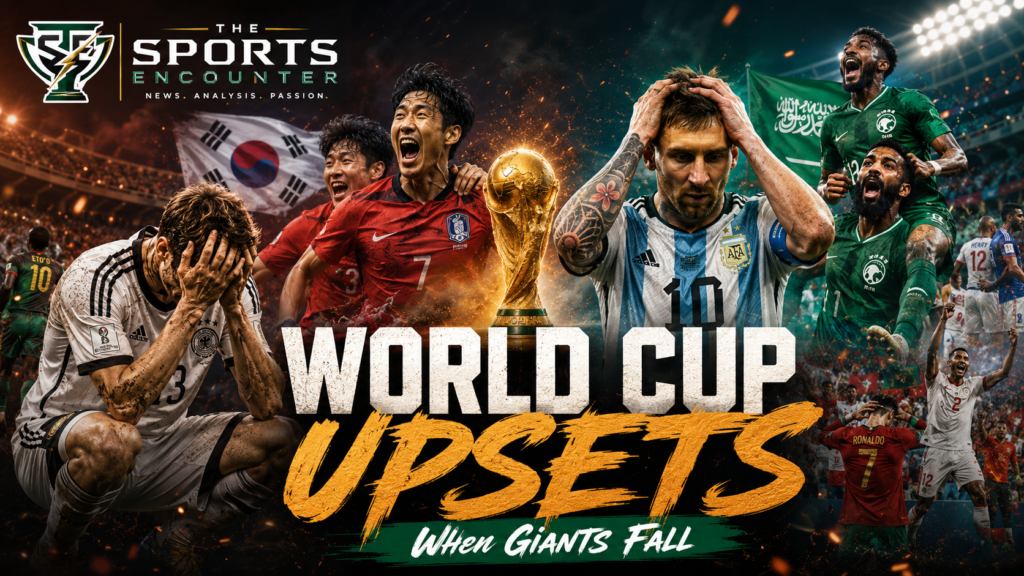
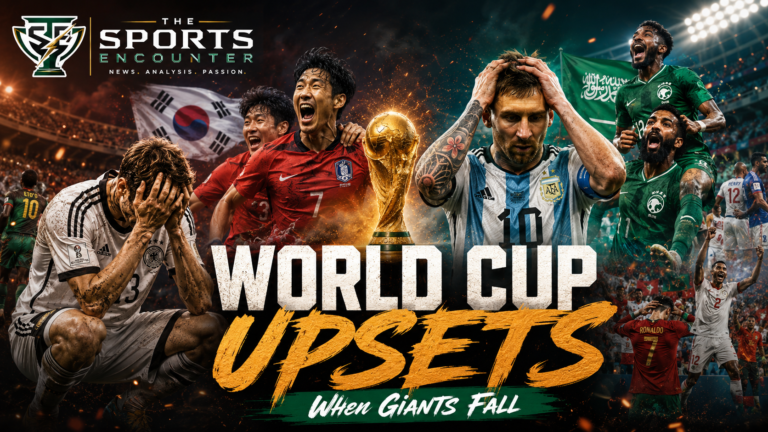
The World Cup does not only crown champions. It also humbles them. From England’s 1950 shock against the United States to Germany’s 2018 collapse against South Korea and Argentina’s 2022 defeat to Saudi Arabia, football’s greatest tournament has always saved room for the impossible.

When the World Cup Stops Making Sense

Every World Cup begins with predictions.

Fans study squads. Pundits talk about form. Bookmakers set odds. Former players explain why one team has too much experience, too much quality, too much history, too much everything.

Then the whistle blows.

Suddenly, all that logic starts sweating.

That is the great beauty of the FIFA World Cup. It does not care how famous your badge is. It does not care how many Champions League winners are standing in your midfield. It does not care if your captain is Lionel Messi, Diego Maradona, Zinedine Zidane, Paolo Maldini, or Manuel Neuer.

For 90 minutes, reputation has to defend corners, track runners, handle nerves, and survive the one moment that can turn a tournament upside down.

That is why fans return to the World Cup again and again. The tournament gives football its grandest stage, but it also gives the underdog one perfect night.

As The Sports Encounter continues its full FIFA World Cup 2026 coverage, the current tournament has already reminded fans of a familiar truth. Football giants do not walk through World Cups. They survive them.

And sometimes, they do not.

Saudi Arabia 2-1 Argentina, 2022: The Day Messi’s Last Dance Almost Ended Before It Began

Argentina arrived in Qatar with swagger, rhythm, and belief. Lionel Scaloni’s side had gone 36 matches unbeaten. Lionel Messi was chasing the one trophy that still sat outside his empire. The mood around Argentina felt almost ceremonial.

Saudi Arabia had other plans.

Messi scored from the penalty spot. Argentina had goals ruled out for offside. For a while, the match looked like it was following the expected script. Then Saudi Arabia ripped up the paper.

Saleh Al-Shehri equalized early in the second half. Salem Al-Dawsari then curled in a stunning winner that froze Argentina, shook Lusail Stadium, and sent shockwaves across the football world.

It was not only the result. It was the timing.

Argentina were expected to begin their coronation. Instead, they opened with panic. Messi looked stunned. Saudi players celebrated like men who knew they had just written themselves into football folklore.

The twist, of course, made the story even better. Argentina recovered, grew stronger, and eventually lifted the World Cup. That made Saudi Arabia’s win even stranger in hindsight. They became the only team to beat the eventual world champions in Qatar.

That is the kind of result that keeps fans honest.

Saudi Arabia’s modern World Cup toughness has not disappeared either. Their gritty 1-1 draw with Uruguay in 2026 showed again that the Green Falcons can make bigger names uncomfortable, as covered in Saudi Arabia Hold Uruguay in Gritty 1-1 World Cup Opener.

South Korea 2-0 Germany, 2018: The Night the Champions Finished Last

Germany do not usually collapse quietly.

They are supposed to be the team that finds structure when others lose their heads. They are supposed to calculate pressure better than anyone else. In 2018, they arrived in Russia as defending world champions.

They left the group stage at the bottom.

South Korea’s 2-0 win over Germany in Kazan remains one of the most stunning modern World Cup results because of what it destroyed. Germany did not only lose a match. They lost their aura.

The game stayed goalless deep into stoppage time. Germany pushed forward desperately, knowing they needed a goal to survive. Then Kim Young-gwon struck. VAR confirmed the goal. Germany panicked. Manuel Neuer, playing almost like an outfield player, lost possession far from his goal. Son Heung-min ran onto the long ball and scored into an empty net.

South Korea were eliminated too, but they walked out with pride. Germany walked out with questions that still follow them in World Cup conversations.

A defending champion, beaten 2-0 by a team already on the brink, finishing bottom of the group. That was not a bad day at the office. That was a football earthquake.

The 2026 tournament has already shown how quickly group-stage pressure can build. With the expanded format and a packed calendar, fans can follow every fixture through The Sports Encounter’s FIFA World Cup 2026 schedule.

Cameroon 1-0 Argentina, 1990: Nine Men, One Header, and a World Cup Shockwave

Italia 90 began with one of the most dramatic opening matches in World Cup history.

Argentina were defending champions. Diego Maradona was still football’s most magnetic figure. Cameroon were not expected to bully the champions on such a stage.

Then they did exactly that.

Cameroon played with fire, nerve, and physical courage. François Omam-Biyik scored the only goal with a header that Argentina goalkeeper Nery Pumpido should have saved. The ball slipped through, and the world watched the champions fall.

The madness did not end there. Cameroon finished the match with nine men after two red cards. Argentina pressed. Maradona tried to drag them back. Cameroon refused to break.

It was raw. It was chaotic. It was far from perfect football. But it was unforgettable.

That win did more than shock Argentina. It changed how African football was viewed at the World Cup. Cameroon went on to reach the quarterfinals and came close to beating England. For many fans, that team became the first African side to truly make the football world stop and listen.

Sometimes an upset does more than change a scoreline. It changes perception.

Senegal 1-0 France, 2002: The Champions Walked Into a Trap

France entered the 2002 World Cup with one of the most glamorous squads in football.

They were defending world champions. They were European champions. Their squad had Thierry Henry, Patrick Vieira, Marcel Desailly, David Trezeguet, and other elite names. Even without an injured Zinedine Zidane in the opener, France were expected to handle Senegal.

Senegal were making their World Cup debut.

That debut became a national epic.

Papa Bouba Diop scored the famous winner after El Hadji Diouf caused chaos down the flank. Senegal’s players danced around Diop’s shirt near the corner flag. France looked confused, then increasingly desperate.

The result was not treated as a one-match accident for long. France never recovered. They failed to score a single goal in the tournament and crashed out in the group stage.

Senegal, meanwhile, reached the quarterfinals and became one of the great underdog stories in World Cup history.

That match remains a classic reminder that tournament football punishes tired legs and relaxed minds. France had the names. Senegal had the hunger.

On that night, hunger won.

France faced Senegal again in the 2026 World Cup and handled the pressure better this time, with Kylian Mbappe leading the way in France’s 3-1 win over Senegal. That contrast makes the 2002 upset feel even more powerful. Big teams do learn, but only after the World Cup teaches them harsh lessons.

USA 1-0 England, 1950: The Result That Sounded Like a Typo

Before World Cup upsets became television moments and social media explosions, there was USA 1-0 England in 1950.

England entered the tournament with enormous confidence. They saw themselves as football royalty. The United States were treated as outsiders with no serious chance.

Then Joe Gaetjens scored.

The United States won 1-0. England were stunned. Reports around the result became part of football legend because many people simply could not believe the score was real.

This upset still feels powerful because of its simplicity. No complex tactical debate is needed. England, proud and established, lost to a team they were expected to beat comfortably.

It remains one of the purest World Cup shocks because it came before modern global scouting, before nonstop coverage, before fans could instantly pull up highlights.

The result traveled like a rumor.

And the rumor was true.

North Korea 1-0 Italy, 1966: The Unknown Team That Sent Italy Home

Italy had prestige, history, and expectation.

North Korea had mystery.

At the 1966 World Cup in England, that mystery became danger. Pak Doo-ik scored the goal that beat Italy 1-0 and sent one of Europe’s giants crashing out of the tournament.

For Italy, it was humiliation. For North Korea, it was immortality.

The result stunned football because it exposed how little reputation matters once a smaller team finds belief. Italy had the bigger names, but North Korea had the moment.

That win also carried into another remarkable story. North Korea later raced into a 3-0 lead against Portugal in the quarterfinals before Eusebio inspired a famous comeback. Even in defeat, they had already become one of the tournament’s great legends.

World Cup history has many upsets. Few are as surreal as North Korea eliminating Italy in 1966.

Algeria 2-1 West Germany, 1982: The Debutants Who Embarrassed a Powerhouse

Algeria arrived at the 1982 World Cup as debutants.

West Germany arrived as European champions and one of the tournament favorites.

That should have been enough to decide the match before kickoff. Instead, Algeria produced one of the great World Cup performances by an African team.

Rabah Madjer gave Algeria the lead. West Germany equalized. Many expected the favorite to take control from there.

Algeria answered almost immediately.

Lakhdar Belloumi scored the winner, and Algeria beat West Germany 2-1. The result stunned football because Algeria did not simply defend and pray. They attacked with confidence, played with personality, and punished a major football power.

The wider group later became controversial because West Germany and Austria played out a result that eliminated Algeria, leading to long-term changes in how final group matches are scheduled.

That only added to Algeria’s place in World Cup memory. They were not only an underdog who won. They were an underdog who forced the tournament to rethink fairness.

East Germany 1-0 West Germany, 1974: Politics, Pressure, and One Historic Goal

Some upsets are about rankings. Some are about footballing imbalance. This one carried something heavier.

East Germany beat West Germany 1-0 at the 1974 World Cup in a match loaded with political tension. The two German teams met at a time when the Cold War gave every contest between them extra meaning.

Jürgen Sparwasser scored the goal that decided the match.

West Germany would go on to win the tournament, which softened the sporting damage. But the defeat itself became one of the most symbolic results in World Cup history.

That is what makes this upset different. It did not stop the eventual champions. It did not ruin West Germany’s tournament. But it created a moment that lived beyond football.

For one night, East Germany had the scoreboard, the story, and the bragging rights.

Bulgaria 2-1 Germany, 1994: Stoichkov and the Summer of Surprise

Germany were defending world champions in 1994. Bulgaria had never won a World Cup knockout match before that tournament.

Then Hristo Stoichkov and company changed the script.

Germany led through Lothar Matthäus. The match looked like it was drifting toward familiar territory. Then Stoichkov equalized with a brilliant free kick. Minutes later, Yordan Letchkov scored with a diving header that became one of the iconic images of USA 94.

Bulgaria won 2-1 and reached the semifinals.

This was not a small football nation hiding for 90 minutes. Bulgaria had flair, edge, and a golden generation with real personality. Still, beating defending champions Germany in a World Cup quarterfinal was a massive shock.

Some upsets feel lucky. This one felt like a team discovering its highest ceiling at exactly the right time.

Japan 2-1 Germany, 2022: The Warning Germany Did Not Heed

Before Germany’s 2022 World Cup ended in another group-stage failure, Japan fired the first warning shot.

Germany controlled much of the match and led through Ilkay Gündogan’s penalty. Japan adjusted, waited, and struck late. Ritsu Doan equalized. Takuma Asano then scored from a tight angle with a finish full of power and nerve.

Japan won 2-1.

At first, it looked like a shock result Germany might recover from. Instead, it became the first crack in another German collapse. Japan later beat Spain too, topping the group and proving the Germany result was no accident.

This upset matters because it captured a modern World Cup trend. Smaller football nations are no longer intimidated by famous shirts. They arrive with players from Europe’s top leagues, detailed tactical plans, and enough self-belief to punish slow favorites.

Germany learned that lesson twice in two tournaments.

Morocco 1-0 Portugal, 2022: The Upset That Became a Continental Landmark

Morocco’s 2022 win over Portugal was not a group-stage shock. It came in a quarterfinal, with a semifinal place at stake.

That made it historic.

Youssef En-Nesyri rose above Portugal goalkeeper Diogo Costa and headed Morocco into the lead. Portugal pushed, Cristiano Ronaldo entered from the bench, and the pressure grew. Morocco defended with discipline, courage, and a sense of destiny.

The final whistle made Morocco the first African nation to reach a World Cup semifinal.

This result deserves a place among the great upsets because it carried continental weight. It was about Morocco, but it was also about Africa, the Arab world, and every team told for decades that the final stages belonged to the same old powers.

Portugal had the stars. Morocco had the wall.

The wall held.

That kind of defensive courage has already echoed into 2026, where teams like DR Congo have shown that famous opponents can still be made uncomfortable, as seen in DR Congo Stun Portugal as Ronaldo’s World Cup Question Grows Louder.

Cape Verde 0-0 Spain, 2026: The Newcomers Who Refused to Blink

Not every World Cup upset needs a winning goal.

Sometimes, the shock is in the refusal.

Cape Verde’s 0-0 draw against Spain in the 2026 World Cup was one of those matches. Spain had the pedigree, the ball, and the expectation. Cape Verde had the discipline, patience, and emotional control to survive wave after wave of pressure.

For a debutant nation, that kind of result matters. It sends a message to the group. It tells bigger teams that reputation alone will not open the door.

Spain left with questions. Cape Verde left with belief.

The result also fits perfectly into the long World Cup tradition of smaller teams making favorites uncomfortable on the biggest stage. You can read more on that match in Cape Verde Stun Spain With Historic World Cup Draw.

Why World Cup Upsets Hit Harder Than Club Football Shocks

Club football gives teams another match next week.

The World Cup does not always offer that mercy.

That is why upsets feel sharper here. A single bad night can damage four years of planning. One missed clearance can destroy a generation’s dream. One underdog goal can change how a country remembers a summer.

The World Cup also brings emotional imbalance. Favorites carry pressure. Underdogs carry freedom. A favorite plays to avoid embarrassment. An underdog plays to create memory.

That gap matters.

When Saudi Arabia beat Argentina, the football world asked how Messi’s team would recover. When South Korea beat Germany, the question was how Germany had fallen so far. When Senegal beat France, the champions suddenly looked old, tired, and exposed.

Upsets do not only create joy for the smaller team. They reveal weakness in the giant.

That is why readers love them. They remind everyone that football is still alive. Still dangerous. Still capable of making experts look silly.

The 2026 Reminder: Nobody Is Too Big to Be Tested

The 2026 World Cup has already shown signs of the same old danger. Expanded format or not, the tournament still carries enough tension to punish complacency.

Ghana had to wait until stoppage time before breaking Panama’s resistance, another reminder that World Cup matches rarely care about easy predictions. That late drama is covered in Ghana Leave It Late as Yirenkyi Breaks Panama Hearts in World Cup Opener.

The lesson is simple.

The group stage is not a warm-up. It is a trapdoor.

Big teams have more quality, deeper squads, and better records. That still matters. But every World Cup gives smaller teams one powerful weapon: 90 minutes where history cannot help the favorite.

That is enough time to ruin a plan.

Final Verdict: The World Cup Belongs to the Brave

The greatest World Cup upsets survive because they do something rare. They make football feel young again.

They take a sport analyzed by data, tactics, money, rankings, and reputation, then remind everyone that one ball, one mistake, one save, one counterattack, or one fearless header can still change everything.

USA over England. North Korea over Italy. Algeria over West Germany. Cameroon over Argentina. Senegal over France. South Korea over Germany. Saudi Arabia over Argentina. Morocco over Portugal.

Different decades. Different teams. Same magic.

The World Cup crowns champions, but it also protects football’s oldest promise.

On the right day, with enough nerve, the giant can fall.
Hamad Hussain is the Dubai-based Founder and Senior Editor of The Sports Encounter, where he leads editorial direction, coverage standards, and the publication’s reader-first approach to sports journalism. His primary focus is cricket, with additional work across sports opinion, athlete performance, team selection, match analysis, tournament developments, and major international sporting stories. Hamad brings more than 22 years of leadership experience across corporate governance, operations, finance, HR, administration, and business development. That background shapes a structured, decision-focused approach to sports analysis, particularly when examining team strategy, selection calls, leadership, performance trends, and the wider consequences of results. Before taking on his current editorial leadership role, Hamad worked with The Sports Encounter as a Sports Analyst from 2010 to 2015. Today, his writing combines fan perspective with statistical context, historical comparison, and practical analysis of the decisions that shape teams, players, and competitions.

Breaking News

Saudi Arabia Transfers 25% Stakes in Four Football Giants as Privatization Push Enters New Phase

Saudi Arabia has begun transferring the remaining nonprofit stakes in four of its biggest football clubs, pushing Al-Nassr, Al-Ittihad, Al-Ahli and Al-Hilal deeper into the Kingdom’s evolving privatization strategy.

Published

on

Saudi football ownership shake-up involving Al-Nassr, Al-Hilal, Al-Ittihad and Al-Ahli as privatization enters a new phase.

Saudi Arabia has begun transferring the remaining 25 percent stakes held by nonprofit entities in Al-Nassr, Al-Ittihad, Al-Ahli and Al-Hilal to the Public Investment Fund, marking another major step in the Kingdom’s effort to reshape the ownership and governance of its biggest football clubs.

The Ministry of Sport said the process had started after the completion of the required regulatory procedures. The boards of directors of the nonprofit entities connected with the four clubs are also being dissolved as part of the transition.

The change matters because those nonprofit bodies had retained 25 percent stakes when Saudi Arabia reorganized the four clubs under a PIF-led model in 2023. PIF took 75 percent stakes at the time, providing the financial and institutional foundation for one of the most aggressive football expansion projects in the world.

Three years later, the structure is changing again.

The development should not be read as a simple permanent move toward 100 percent PIF ownership across all four clubs. Al-Hilal are already following a different path after PIF signed a binding agreement in April 2026 for Kingdom Holding Company to acquire a 70 percent controlling stake in Al-Hilal Club Company.

The broader direction is becoming clearer. Saudi Arabia is moving its leading football clubs toward more commercial ownership models, stronger corporate governance and greater private-sector participation.

Saudi Club Ownership Shake-Up at a Glance

Club 2023 Ownership Structure Latest Development
Al-Nassr PIF 75%, nonprofit entity 25% Nonprofit 25% stake being transferred to PIF
Al-Ittihad PIF 75%, nonprofit entity 25% Nonprofit 25% stake being transferred to PIF
Al-Ahli PIF 75%, nonprofit entity 25% Nonprofit 25% stake being transferred to PIF
Al-Hilal PIF 75%, nonprofit entity 25% Nonprofit stake transfer begins alongside separate Kingdom Holding transaction

The ownership structures above reflect the 2023 framework and subsequent officially announced transactions. Al-Hilal requires separate treatment because of the Kingdom Holding agreement announced in April 2026.

What Saudi Arabia Is Changing

The fresh development concerns the remaining 25 percent stakes held by nonprofit foundations associated with Saudi Arabia’s four highest-profile clubs.

Those organizations formed part of the original ownership model created when the Kingdom launched the Sports Clubs Investment and Privatization Project.

The Saudi Press Agency’s official announcement of the original privatization project confirms that the initiative was launched in June 2023 as part of a broader effort to increase investment in Saudi sport and move clubs toward more commercially sustainable structures.

PIF subsequently acquired 75 percent stakes in Al-Hilal, Al-Nassr, Al-Ittihad and Al-Ahli, while the nonprofit foundations retained the remaining 25 percent.

The transfer of those remaining stakes removes another layer from that original structure.

It also gives Saudi authorities greater flexibility as they determine what the long-term ownership model for each club should eventually look like.

The 2023 Model Was Always Part of a Larger Transformation

The 2023 restructuring became best known internationally because of what followed in the transfer market.

Saudi clubs began recruiting players with global recognition while simultaneously expanding their commercial reach, infrastructure and international profile.

Cristiano Ronaldo had already transformed Al-Nassr’s visibility, while the arrival of other elite names dramatically increased attention around the Saudi Pro League.

The Sports Encounter has followed Ronaldo’s late-career evolution closely, including our detailed look at Cristiano Ronaldo’s World Cup career, records and final tournament.

That global attention created an obvious commercial opportunity for Saudi football.

The more difficult challenge has always been converting international visibility into durable football businesses.

Why the Remaining 25% Stakes Matter

The nonprofit stakes were never merely symbolic.

They represented a distinct governance layer inside club companies that were otherwise controlled by PIF.

Transferring those holdings can simplify ownership, reduce administrative overlap and make future transactions easier to structure.

That becomes particularly important if private investors eventually acquire larger stakes in individual clubs.

Saudi Arabia has already demonstrated that privatization is moving from policy language into actual transactions.

On August 12, the Ministry of Sport announced that five more clubs, Al-Riyadh, Abha, Al-Fateh, Al-Tai and Al-Shoulla, were being offered for investment under the continuing privatization initiative.

The Saudi Press Agency’s official report on the five-club investment offering provides further evidence that private-sector ownership is becoming a central part of the Kingdom’s sports strategy.

Al-Hilal Are Already Showing What the Next Phase Can Look Like

Al-Hilal provide the strongest example of where this process could eventually lead.

On April 16, PIF announced a binding agreement for Kingdom Holding Company to acquire 70 percent of Al-Hilal Club Company.

The transaction valued Al-Hilal’s total share capital at an enterprise value of SAR 1.4 billion.

The official PIF announcement on the Al-Hilal-Kingdom Holding agreement states that the fund will remain a shareholder after completion and describes the transaction as part of its strategy to maximize returns and redeploy capital within the Saudi economy.

That is a crucial point.

PIF’s role in Saudi football increasingly looks less like permanent ownership and more like institutional transformation followed by value realization.

Al-Hilal’s Transformation Is Already Visible on the Football Side

The ownership story is unfolding at the same time as Al-Hilal continue making aggressive sporting decisions.

The Riyadh club are currently pursuing Aston Villa striker Ollie Watkins, with The Sports Encounter reporting on Al-Hilal’s reported £38 million bid for Ollie Watkins.

That pursuit illustrates the scale at which Saudi clubs continue to operate despite the ownership model itself evolving.

The Saudi Pro League’s next stage therefore involves two processes happening simultaneously.

Clubs are still trying to compete aggressively for elite talent, while the institutions behind those clubs are being restructured for a more commercially mature future.

Why Al-Nassr Could Become the Most Globally Valuable Test Case

Few clubs would generate more international attention from a future ownership transaction than Al-Nassr.

Ronaldo turned the Riyadh club into a globally recognized football brand almost overnight.

His influence extends beyond match results.

Al-Nassr now possess commercial reach through sponsorships, social media, merchandising, international tours and global broadcast interest that would have been difficult to imagine before his arrival.

That creates a fundamentally different investment proposition.

A potential buyer would not simply be acquiring a Saudi football club. It would be acquiring an internationally visible sports property with a huge digital audience.

The Sports Encounter has also examined Ronaldo’s extraordinary ability to remain relevant deep into his career through our analysis of Ronaldo’s continued profile as an active Al-Nassr player after his final World Cup.

Al-Ahli Bring Something Different: Continental Dominance

Al-Ahli enter this ownership transition from arguably the strongest sporting position of the four clubs.

They have won consecutive AFC Champions League Elite titles and begin the 2026-27 campaign attempting to complete an unprecedented three-peat in the modern era.

The Sports Encounter recently analyzed their next continental challenge in Al-Ahli vs Al-Ain and the expanded AFC Champions League Elite draw.

That success gives Al-Ahli a commercial story that goes beyond domestic popularity.

Continental champions gain international visibility, stronger sponsorship leverage and a broader audience across Asia.

Those factors matter when investors assess football clubs as long-term assets.

Al-Ittihad Offer Traditional Power and a Major Market

Al-Ittihad’s investment appeal comes from a different source.

The Jeddah club possesses one of Saudi Arabia’s deepest traditional supporter bases and represents a major sporting market on the Red Sea coast.

That kind of heritage is difficult to manufacture.

Modern football investors increasingly evaluate clubs across several dimensions:

  • Supporter loyalty
  • Stadium demand
  • Merchandising potential
  • Sponsorship revenue
  • Digital audience
  • International competition
  • City and regional economics

Al-Ittihad therefore offer a different investment profile from Al-Nassr’s Ronaldo-driven global visibility or Al-Ahli’s recent continental dominance.

The Saudi Pro League Is Moving Beyond Its Superstar Phase

The first phase of Saudi football’s transformation was easy to understand.

The world’s biggest names arrived, global attention followed and television audiences increased.

The next phase is considerably more complex.

Saudi clubs now have to prove that the attention can produce sustained commercial value.

That requires stronger revenues, clearer governance and more disciplined investment decisions.

Recent Saudi interest in younger elite players reinforces that shift.

The Sports Encounter explored that changing recruitment philosophy in our analysis of Saudi Arabia’s long-running interest in Vinicius Jr.

Vinicius represented exactly the type of player Saudi football increasingly wants: globally recognizable, commercially valuable and still in his prime.

That story later evolved when Vinicius committed his future to Real Madrid, but the Saudi interest itself demonstrated how the market had changed.

Private Ownership Could Create Stronger Club Identities

A future in which Saudi Arabia’s leading clubs are controlled by different private owners could also change the competitive character of the league.

Different ownership groups bring different priorities.

Some may prefer superstar transfers.

Others may focus on academies, data-led recruitment, infrastructure or commercial expansion.

That strategic separation could eventually give each club a clearer football identity.

It could also reduce questions associated with several direct competitors sharing the same majority shareholder.

PIF’s New Strategy Helps Explain the Timing

The restructuring also fits PIF’s broader strategic direction.

In April 2026, PIF approved its strategy for 2026-30, moving from what it described as a period of rapid growth toward a phase focused more heavily on sustained value creation.

The strategy emphasizes maximizing long-term returns, improving investment efficiency and increasing private-sector participation.

That language closely matches what is now happening in Saudi football.

Clubs were transformed, capital was deployed and commercial value was created.

The next stage increasingly involves bringing private investors into assets whose foundations have already been strengthened.

Saudi Arabia Is Already Creating a Football Ownership Market

The privatization project is no longer limited to the country’s four biggest teams.

Saudi authorities have steadily moved additional clubs into acquisition or investment processes.

That creates something that barely existed in Saudi football a few years ago: a genuine market for club ownership.

As more investors enter, club valuations should become easier to benchmark.

That could eventually give Saudi football clearer commercial measurements around:

  • Club enterprise values
  • Revenue multiples
  • Sponsorship growth
  • Matchday income
  • Player asset values
  • Media rights
  • International commercial reach

Those metrics will ultimately determine whether the Saudi football project becomes economically sustainable.

The Timing Matters Because Saudi Clubs Are Becoming More Important in Asia

Saudi Arabia’s leading clubs are also increasingly central to Asian football.

Al-Ahli are defending continental champions.

Al-Hilal remain one of the region’s most powerful clubs.

Al-Nassr bring Ronaldo’s enormous international audience into AFC competition.

The expanded AFC Champions League Elite gives Saudi clubs an even larger platform.

The Sports Encounter’s coverage of the 2026-27 AFC Champions League Elite draw explains how the competition has expanded to 32 teams, with the final stages again scheduled for Saudi Arabia.

That continental visibility increases the value of successful Saudi clubs to future owners.

Saudi Football’s Global Strategy Extends Beyond Clubs

The Kingdom’s football ambitions also connect with its broader international sporting strategy.

Saudi Arabia’s national team competed at the 2026 FIFA World Cup, while the country continues preparing for the long-term development of its football ecosystem.

The Sports Encounter followed Saudi Arabia throughout the World Cup, including its tactical challenge against elite opponents in our World Cup Day 11 preview featuring Saudi Arabia.

Club investment, national-team development, infrastructure and global sporting events increasingly sit inside the same long-term strategy.

What PIF Has Already Changed at Al-Hilal

The official Al-Hilal transaction announcement provides useful evidence of what PIF believes it has achieved during its ownership period.

PIF pointed to improvements in:

  • Governance
  • Operational performance
  • Infrastructure
  • Sponsorship revenue
  • Merchandise sales
  • Matchday revenue
  • Overall commercial value

Those are precisely the areas that influence a football club’s attractiveness to private investors.

The Al-Hilal transaction therefore offers a possible blueprint.

PIF enters, restructures the asset, strengthens governance and commercial performance, and later sells part of its holding while retaining an economic interest.

The Hardest Test Comes After the Superstar Spending

The next few years will tell us far more about the Saudi football project than the first transfer boom did.

Recruiting famous players creates headlines.

Building profitable football companies is considerably harder.

Saudi clubs will now be judged by measurable commercial indicators rather than only sporting ambition.

Can they continue growing sponsorship income?

Can they convert global social-media followers into paying supporters?

Can matchday and hospitality revenue grow?

Can broadcasters justify higher rights fees?

Can clubs become valuable enough for private investors to generate long-term returns?

Those questions sit at the heart of the current ownership restructuring.

TSE Ownership Scorecard

DevelopmentStatus
Original PIF ownership model75% PIF, 25% nonprofit foundations
Clubs coveredAl-Nassr, Al-Ittihad, Al-Ahli and Al-Hilal
Remaining nonprofit stakesBeing transferred as part of latest restructuring
Nonprofit boardsBeing dissolved under the transition
Al-Hilal private ownership transaction70% Kingdom Holding agreement announced in April 2026
Al-Hilal enterprise value in transactionSAR 1.4 billion
Broader privatization programActive across multiple Saudi clubs
Long-term objectiveGreater private investment, stronger governance and sustainable commercial growth

What Happens Next?

The immediate process involves completing the ownership and governance restructuring around the nonprofit stakes.

The more important developments will come afterward.

Al-Hilal already have a major private ownership transaction moving through the regulatory process.

That inevitably raises questions about whether Al-Nassr, Al-Ittihad and Al-Ahli could eventually follow similar paths.

No specific private buyers for those clubs should be treated as confirmed unless official agreements emerge.

But Saudi Arabia’s direction is increasingly difficult to miss.

The country is trying to build football clubs that can attract investment because of their commercial value rather than depending indefinitely on state-backed spending.

Why This Story Matters

Saudi football’s international transformation has usually been explained through players.

The ownership story may ultimately matter more.

Transfers can increase a club’s profile for a few seasons.

A successful ownership model can determine its direction for decades.

Saudi Arabia now appears to be testing whether the enormous attention generated since 2023 can be converted into valuable, commercially sustainable football companies.

If that works, the Saudi Pro League’s influence on global football will become much harder to dismiss as a temporary spending cycle.

Final Word

Saudi Arabia’s football transformation is entering a more complicated and potentially more important phase.

The first stage brought capital, elite players and global attention.

The next stage is about ownership, governance, commercial value and sustainability.

Transferring the remaining nonprofit stakes connected with Al-Nassr, Al-Ittihad, Al-Ahli and Al-Hilal removes another piece of the structure created in 2023.

Al-Hilal have already provided the first major indication of where the process can lead through their Kingdom Holding agreement.

Now attention turns toward Saudi Arabia’s other football giants.

If Al-Nassr, Al-Ittihad and Al-Ahli eventually attract major private owners of their own, the most consequential chapter of Saudi football’s revolution may end up taking place away from the transfer window.

It may happen in the boardroom.

Frequently Asked Questions

What is changing with Al-Nassr, Al-Ittihad, Al-Ahli and Al-Hilal?

The remaining 25 percent stakes associated with nonprofit foundations are being transferred as Saudi Arabia restructures the ownership framework created around the four clubs in 2023.

How were the four clubs owned after the 2023 restructuring?

PIF acquired 75 percent stakes in Al-Hilal, Al-Nassr, Al-Ittihad and Al-Ahli, while nonprofit foundations retained the remaining 25 percent.

Does PIF now permanently own 100% of the four clubs?

No. The situation should not be described that way. Al-Hilal already have a separate transaction under which Kingdom Holding Company agreed to acquire 70 percent of the club. The broader Saudi strategy also increasingly emphasizes private investment and capital recycling.

How much is Al-Hilal valued at under the Kingdom Holding agreement?

PIF’s official announcement placed an enterprise value of SAR 1.4 billion on Al-Hilal’s total share capital.

Why is Saudi Arabia privatizing football clubs?

The broader Sports Clubs Investment and Privatization Project aims to attract private capital, improve governance, strengthen commercial performance and make Saudi sports organizations more financially sustainable.

Could Al-Nassr be sold to a private investor?

The wider privatization strategy makes future private investment possible, but no specific sale or buyer should be treated as confirmed without an official announcement.

Why does Al-Hilal have a different ownership situation?

PIF and Kingdom Holding Company signed a binding agreement in April 2026 for Kingdom Holding to acquire 70 percent of Al-Hilal Club Company, making Al-Hilal the clearest example so far of the next stage of Saudi football privatization.

How does this affect the Saudi Pro League?

The restructuring could eventually create more independent ownership models, stronger commercial competition between clubs and greater pressure for teams to generate sustainable revenue rather than rely mainly on capital injections.

Continue Reading

Breaking News

NFL Injury Update: Jayden Higgins Lost for 2026 as Chargers and Eagles Face Major Week 1 Questions

The Texans have lost Jayden Higgins for the entire 2026 season, while the Chargers wait for clarity on Tyler Biadasz’s knee injury and the Eagles face uncertainty over Jonathan Greenard’s Week 1 availability.

Marcos Wetherfield | The Sports Encounter

Published

on

NFL injury update graphic featuring Jayden Higgins, Tyler Biadasz and Jonathan Greenard with the Texans, Chargers and Eagles.

Three teams entered August 19 thinking about the final stretch of preseason preparation.

By the end of the day, Houston had lost a young receiver for the season, Los Angeles was confronting uncertainty at the center of its offensive line, and Philadelphia was openly questioning whether one of its biggest offseason defensive additions would be ready for Week 1.

Jayden Higgins has suffered a torn ACL and is expected to miss the entire 2026 season. Chargers center Tyler Biadasz has sustained ACL damage and additional injuries to his left knee, leaving his timetable unclear. Eagles edge rusher Jonathan Greenard remains on the physically unable to perform list with a pectoral injury and could miss the start of the regular season.

The injuries are different in severity, timing and roster impact, but together they underline the same uncomfortable reality of NFL August.

Training camp can reshape a season before Week 1 ever arrives.

Follow The Sports Encounter’s NFL coverage for continuing injury, roster and preseason developments around the league.

NFL Injury Update: August 19 at a Glance

PlayerTeamPositionInjuryCurrent Outlook
Jayden HigginsHouston TexansWide receiverTorn ACLExpected to miss entire 2026 season
Tyler BiadaszLos Angeles ChargersCenterACL damage plus additional left-knee injuriesOut indefinitely, further evaluation pending
Jonathan GreenardPhiladelphia EaglesEdge rusher / linebackerPectoral injuryCould miss Week 1 and potentially more time

The contrast between the three cases matters. Higgins already has the clearest and most damaging diagnosis. Biadasz still requires further medical assessment before Los Angeles can establish a recovery plan. Greenard has avoided a newly reported setback, but Philadelphia is running out of preparation time before the regular season begins.

Jayden Higgins’ Torn ACL Changes Houston’s Receiving Plan

The most definitive blow came in Houston.

Jayden Higgins suffered a torn ACL during a red-zone drill in Tuesday’s joint practice with the Las Vegas Raiders and is expected to miss the entire 2026 season.

For a 23-year-old receiver entering his second NFL campaign, the timing is brutal.

Higgins had already established himself as a meaningful part of the Texans’ offense during his rookie year. NFL statistics show he recorded 41 receptions for 525 yards and six touchdowns in 17 regular-season games after Houston selected him in the second round of the 2025 NFL Draft. NFL.com lists his full rookie production.

He also contributed during the postseason, including six catches for 59 yards against New England in the AFC Divisional Round.

Houston was entering 2026 expecting another developmental jump.

That plan is gone.

Why Higgins’ Loss Hurts More Than the Raw Numbers Suggest

Higgins gave Houston something difficult to replace internally.

At 6-foot-4 and 214 pounds, he offered size on the perimeter and inside the red zone. Six touchdowns as a rookie already showed how effectively he could convert limited opportunities near the goal line.

The Texans do not simply lose 525 receiving yards.

They lose a developing target whose role could have expanded considerably in Year 2.

Young receivers often make one of their biggest jumps between their first and second seasons because route timing improves, quarterback trust grows and the offense begins using them in more specialized situations.

Houston will never get to see what that jump looked like in 2026.

Nico Collins Now Carries Even More Weight

Nico Collins was already the focal point of Houston’s passing attack.

Higgins’ absence pushes even more responsibility toward him.

The Texans also have Tank Dell returning, alongside Xavier Hutchinson, Jaylin Noel and Justin Watson.

That group still gives Houston options.

The problem is role distribution.

Replacing Higgins’ snaps is one task. Replacing the specific things he did well is another.

Houston needs someone who can win in traffic, threaten defensive backs with size and provide another credible scoring option when coverage tilts toward Collins.

Dell offers explosiveness and separation, but he is a different type of receiver.

Noel and Hutchinson may now receive larger opportunities than originally expected.

Houston’s Depth Will Be Tested Earlier Than Expected

Training camp depth charts often look deep until a major injury forces the next player into a role he was not originally expected to handle.

That is now Houston’s reality.

The Sports Encounter previously identified Texans safety Reed Blankenship among the NFL’s most underrated offseason additions. Houston’s defense may indeed be stronger, but the offense now has to absorb one of the preseason’s most damaging injuries.

TSE Analysis: Houston Should Resist Overloading One Receiver

The natural response would be to push more targets toward Collins.

That can work in individual games.

It becomes dangerous as an entire offensive philosophy.

Defenses know how to tilt coverage toward a dominant receiver. Houston will need variety to prevent Collins from seeing constant brackets and safety help.

Dell’s return becomes more important. Noel’s development matters more. Tight ends and running backs may also need to absorb additional short-area targets.

The best response to losing Higgins is not finding another Higgins.

It is redistributing the offense intelligently enough that opponents cannot identify where his missing production must come from.

Tyler Biadasz Injury Creates a Different Kind of Crisis for the Chargers

Houston knows exactly what it has lost.

The Chargers are still trying to determine the full extent of their problem.

Center Tyler Biadasz suffered damage to his ACL along with additional injuries to his left knee during Tuesday’s joint practice with San Francisco.

The 28-year-old went down after getting tangled during the play, with 49ers defensive tackle Sebastian Valdez falling across his lower body.

Biadasz remained on the ground while trainers evaluated him and ultimately could not put weight on his left leg before leaving the field on a medical cart.

Further testing and specialist consultations are expected to establish the full diagnosis and treatment plan.

For now, he is out indefinitely.

The Chargers Signed Biadasz to Stabilize This Exact Position

That context makes the injury particularly painful.

Los Angeles signed Biadasz in March specifically to give Justin Herbert an experienced center in front of a relatively young offensive line.

The Chargers officially announced his arrival earlier this year after he agreed to a three-year contract.

Biadasz brought substantial experience.

He started 49 games for Dallas from 2021 through 2023 before adding 31 regular-season starts across two seasons with Washington. He also earned Pro Bowl recognition with the Cowboys in 2022.

Los Angeles was buying reliability.

Now it may have to begin the season without it.

Center Injuries Affect More Than One Blocking Assignment

The center’s value is easy to underestimate because most fans naturally watch quarterbacks, receivers and tackles first.

Inside an offense, the position carries far more responsibility.

Centers identify fronts, communicate protection adjustments, handle interior pass rushers and establish clean exchanges with the quarterback on every snap.

When a veteran center disappears, the disruption spreads.

The replacement must block.

He must also communicate.

That difference makes Biadasz’s injury more consequential than simply losing one offensive lineman.

Jake Slaughter Is Suddenly in the Spotlight

Rookie Jake Slaughter replaced Biadasz after the injury.

The 23-year-old was a second-round pick out of Florida and now faces the possibility of being pushed into a major role much earlier than expected.

There is talent there.

There is also a massive experience gap.

The Chargers entered camp with a line that included Rashawn Slater, Joe Alt and several veterans, as outlined in the team’s official offensive-line training camp preview.

Replacing Biadasz would force Los Angeles to change the center of that structure.

Justin Herbert Feels the Consequences Too

Any instability in the middle of the offensive line immediately becomes a quarterback issue.

Edge pressure can sometimes be avoided by stepping up.

Interior pressure removes that escape route.

It also disrupts timing faster because the shortest path to the quarterback runs directly through the middle.

For Herbert, continuity with his center matters before the snap as much as after it.

If Slaughter takes over, every remaining practice rep becomes valuable.

Biadasz Injury Makes Jacksonville’s Faalele Trade Look Even More Understandable

Across the NFL, teams are already reacting aggressively to offensive-line problems.

Jacksonville’s decision to acquire Daniel Faalele from the Giants after Patrick Mekari’s back surgery offers a useful comparison.

The Jaguars did not wait for their depth issue to become a September emergency.

That same urgency may now confront Los Angeles.

The Sports Encounter has also examined how offensive-line injuries drive late roster moves through our broader analysis of overlooked NFL roster additions.

If Biadasz faces an extended absence, the Chargers may need more than an internal promotion.

Jonathan Greenard Could Miss Philadelphia’s Season Opener

Philadelphia’s concern is different because Jonathan Greenard’s injury did not occur this week.

The concern comes from the calendar.

Greenard remains on the physically unable to perform list after suffering a pectoral injury during a weightlifting session before training camp.

Eagles defensive coordinator Vic Fangio acknowledged Wednesday that he is concerned Greenard may not be ready for the start of the regular season.

Philadelphia opens against Washington on September 13.

That leaves little more than three weeks for Greenard to receive clearance, rebuild conditioning and become comfortable enough within Fangio’s defense to handle regular-season snaps.

The Eagles placed Greenard on the PUP list when training camp opened.

The PUP Decision Could Become Critical

The next roster decision carries real consequences.

If Greenard remains on the PUP list when Philadelphia establishes its initial 53-man roster, he must miss at least the first four regular-season games.

That makes the next few weeks more than a rehabilitation window.

They could determine whether Philadelphia loses its major offseason pass-rush acquisition for one game or an entire opening block of the season.

Greenard Was One of Philadelphia’s Biggest Offseason Bets

The Eagles paid heavily to acquire him.

Philadelphia traded third-round selections in 2026 and 2027 to Minnesota for Greenard and later signed him to a four-year, $98 million contract with $50 million guaranteed.

The Eagles’ official 2026 transaction log confirms the April trade.

This was not a depth acquisition.

Philadelphia expected Greenard to become a significant part of Fangio’s pass rush.

That is why uncertainty around Week 1 matters.

Greenard’s Recent Injury History Adds Another Layer

The pectoral issue does not exist in isolation.

Greenard was limited to 12 games last season and underwent shoulder surgery during the offseason.

He had previously established himself as a major edge threat, recording double-digit sacks in consecutive seasons with Houston in 2023 and Minnesota in 2024.

Last year was more difficult.

He finished with three sacks, 38 tackles and 12 quarterback hits.

Across his career, Greenard has accumulated 38 sacks, 217 tackles, 75 quarterback hits and eight forced fumbles.

Philadelphia invested in the possibility that he could regain his earlier level.

First, he has to get healthy enough to play.

Greenard Sounded Optimistic Earlier This Summer

Before training camp, Greenard had discussed his recovery from shoulder surgery and said he felt confident in Philadelphia’s plan to bring him back gradually.

The Eagles published Greenard’s comments in July, when he was working toward full participation.

The subsequent pectoral injury altered that timeline.

That is another reminder of how difficult NFL rehabilitation can be.

Returning from one injury does not protect a player from another.

Philadelphia Has More Flexibility Than Houston or Los Angeles

Of the three teams dealing with these injuries, Philadelphia may be best positioned to absorb a short absence.

The Eagles still have Nolan Smith, Jalyx Hunt and other edge options within Fangio’s defense.

That does not make Greenard replaceable.

It means Philadelphia can survive a limited absence more easily than Houston can replace Higgins for an entire season or Los Angeles can casually remove its starting center.

The Sports Encounter previously highlighted Philadelphia’s roster depth while examining Dontayvion Wicks among the offseason’s underrated signings.

Depth is now being tested on the other side of the ball.

Which Injury Hurts the Most?

PlayerImmediate SeverityTeam ImpactReplacement Difficulty
Jayden HigginsVery highLost for entire 2026 seasonHigh because of size, red-zone role and Year 2 upside
Tyler BiadaszPotentially very highStarting center out indefinitelyHigh because of protection calls and veteran experience
Jonathan GreenardModerate to highWeek 1 and early-season availability uncertainManageable short term, significant if absence extends

TSE Analysis: Higgins Is the Biggest Confirmed Loss, Biadasz Could Become the Most Disruptive

Higgins’ injury is currently the most damaging because there is no uncertainty about his season.

It is effectively over before it begins.

Houston must rework its receiver rotation for 17 games.

Biadasz presents a different danger.

If further testing confirms a major long-term knee injury, his absence could alter the mechanics of the Chargers’ entire offense.

A starting center affects protection, communication and quarterback comfort on every offensive snap.

Greenard’s situation remains the least catastrophic for now because he could still return early in the season.

The risk grows considerably if Philadelphia has to keep him on PUP through roster cuts.

Joint Practices Are Becoming an Uncomfortable Part of the Story

Two of these injuries occurred during joint practices.

Higgins was injured against Las Vegas.

Biadasz went down against San Francisco.

That does not automatically make joint practices unsafe or unnecessary.

Teams value them because starters can receive controlled competitive repetitions without the same exposure associated with preseason games.

The problem is that controlled does not mean risk-free.

Players still collide.

Bodies still fall awkwardly.

Ligaments do not care whether the snap occurs on Sunday afternoon or Tuesday morning.

The Sports Encounter has been following the way injuries reshape preseason planning through its wider NFL news coverage.

Why August Injuries Can Hurt More Than Midseason Injuries

The calendar creates a particular kind of damage.

A September injury removes a player from a roster that has already established roles.

An August injury forces teams to establish those roles again.

Coaches have to redistribute repetitions.

Young players are promoted earlier than expected.

Quarterbacks lose timing partners.

Offensive linemen lose communication partners.

Defensive coordinators lose planned packages.

The emotional effect also matters because teams have spent months preparing around players who suddenly disappear just before the real games begin.

What Houston Must Do Next

The Texans do not have the luxury of waiting for Higgins’ return.

Their 2026 receiving rotation must now be built without him.

Expect Collins to remain the centerpiece while Dell’s role becomes even more important.

Noel, Hutchinson and Watson should receive additional opportunities through the final weeks of camp.

Houston may also examine the veteran market if it believes the current group lacks enough size or red-zone reliability.

What the Chargers Must Do Next

Los Angeles first needs medical clarity.

The difference between a partial ACL injury, multiple ligament damage and a complete tear can radically change treatment and recovery expectations.

Until doctors complete the evaluation, any return timetable would be premature.

Football planning cannot wait indefinitely, though.

Slaughter needs first-team repetitions immediately.

The front office also has to determine whether another veteran center or interior lineman should be added before Week 1.

What Philadelphia Must Do Next

The Eagles face a deadline rather than a diagnosis.

Greenard has to progress quickly enough for Philadelphia to decide whether activating him before final roster cuts makes sense.

That decision must balance urgency against reinjury risk.

Rushing an edge defender with a pectoral problem into regular-season contact would solve little if it creates a longer absence.

Philadelphia built enough defensive depth to be patient for a short period.

The calculation becomes harder if Greenard’s rehabilitation stretches beyond September.

Three Injuries, Three Very Different Seasons Suddenly at Risk

Higgins was supposed to take his second-year step.

Biadasz was supposed to become the veteran stabilizer in front of Herbert.

Greenard was supposed to arrive in Philadelphia and immediately strengthen a championship-caliber defense.

August has complicated all three plans.

Houston already knows it must move on without Higgins.

The Chargers are waiting to learn how much of their offensive-line plan has been disrupted.

Philadelphia is watching the calendar as closely as Greenard’s rehabilitation.

That is the unforgiving side of the NFL preseason.

Depth charts can look complete in July.

By late August, one practice rep can force an entire organization to redraw them.

Frequently Asked Questions

What happened to Jayden Higgins?

Houston Texans wide receiver Jayden Higgins suffered a torn ACL during a red-zone drill in a joint practice with the Las Vegas Raiders. He is expected to miss the entire 2026 season.

How did Jayden Higgins perform as a rookie?

Higgins caught 41 passes for 525 yards and six touchdowns in 17 regular-season games during the 2025 season.

Who will replace Jayden Higgins for Houston?

Houston is expected to rely more heavily on Nico Collins and returning receiver Tank Dell, with Jaylin Noel, Xavier Hutchinson and Justin Watson competing for larger roles.

What is Tyler Biadasz’s injury?

Biadasz sustained ACL damage and additional injuries to his left knee during a Chargers joint practice with the San Francisco 49ers. He remains out indefinitely while undergoing further evaluation.

Who could replace Tyler Biadasz?

Rookie second-round pick Jake Slaughter stepped in after Biadasz left practice and is the most immediate internal option.

Will Jonathan Greenard play in Week 1?

That remains uncertain. Eagles defensive coordinator Vic Fangio has expressed concern that Greenard may not be ready for Philadelphia’s September 13 opener against Washington.

What happens if Greenard stays on the PUP list?

If he remains on PUP when Philadelphia sets its initial 53-man roster, Greenard must miss at least the first four regular-season games.

Where can fans follow NFL injury updates?

Readers can follow The Sports Encounter’s NFL section for continuing injury reports, roster changes, signings and preseason analysis.

Continue Reading

Breaking News

NFL 2026: Seahawks Bet on Trevon Diggs as Jaguars Trade for Daniel Faalele

Seattle is betting on Trevon Diggs’ upside with a one-year deal, while Jacksonville has traded for Daniel Faalele to strengthen an injury-hit offensive line. The two moves show how quickly NFL roster priorities are shifting late in the preseason.

Marcos Wetherfield | The Sports Encounter

Published

on

Trevon Diggs in a Seattle Seahawks-themed NFL signing graphic alongside Daniel Faalele in a Jacksonville Jaguars trade graphic.

The NFL’s late-summer roster market is starting to look less like cleanup and more like emergency problem-solving.

Seattle is taking a calculated shot on one of the league’s most recognizable ball-hawking cornerbacks. Jacksonville, meanwhile, has moved quickly to reinforce an offensive line hit by injury.

The Seahawks are signing two-time Pro Bowl cornerback Trevon Diggs to a one-year deal after bringing him in for a workout, while the Jaguars are acquiring massive guard Daniel Faalele from the New York Giants for a late-round 2027 draft pick.

The moves solve very different problems.

Seattle is chasing upside in the secondary.

Jacksonville needs playable protection now.

Both transactions also reveal how quickly NFL roster priorities change once training camp starts exposing injuries, depth issues and uncertainty that looked manageable in May.

Fans can follow the broader wave of roster movement through The Sports Encounter’s NFL coverage, where signings, injuries, trades and training-camp developments are tracked throughout the preseason.

NFL Signings and Trades Update: Diggs and Faalele at a Glance

PlayerPositionMoveNew TeamKey Context
Trevon DiggsCornerbackOne-year signingSeattle SeahawksFormer All-Pro and two-time Pro Bowler trying to revive career after injuries
Daniel FaaleleGuardTrade from GiantsJacksonville JaguarsAdded after Patrick Mekari underwent back surgery

The NFL’s official 2026 roster tracker provides league-wide context for offseason signings and trades. :contentReference[oaicite:0]{index=0}

Trevon Diggs Is Heading to Seattle on a One-Year Deal

Trevon Diggs is getting another chance to show that the playmaker who once terrorized quarterbacks has not disappeared.

The Seahawks are signing the veteran cornerback to a one-year contract after he worked out for the team on Tuesday, according to reports confirmed Wednesday.

Financial terms were not immediately disclosed.

Seattle’s decision makes sense once Diggs’ career is viewed in full rather than through the injuries that have defined his last three seasons.

At his peak, he was one of the NFL’s most dangerous takeaway specialists.

In 2021, Diggs intercepted 11 passes, led the league in that category, returned two for touchdowns and earned both Pro Bowl and All-Pro recognition.

That season turned him into one of the biggest defensive names in football and eventually helped him secure a five-year, $97 million extension with Dallas in 2023.

The Seahawks are now betting that some portion of that player still exists.

Seattle Is Buying Upside, Not Certainty

This is not the same Trevon Diggs who signed that Cowboys extension.

Injuries changed the trajectory.

He tore his ACL two games into the 2023 season and later missed the final six games of 2024 with another left knee problem.

Right-knee issues disrupted the following campaign as well.

Across the last three seasons, Diggs appeared in only 22 games.

That availability record is why the one-year structure matters.

Seattle does not have to treat him as a long-term cornerstone.

The Seahawks can evaluate the knees, the movement, the tackling and the coverage consistency in real time.

If the old instincts return, they may have found a veteran playmaker at exactly the right moment.

If they do not, the commitment is limited.

Diggs Still Has 20 Career Interceptions

The ball production remains impossible to ignore.

Diggs has recorded 20 interceptions in 67 career regular-season games, including 64 starts.

He also owns 63 passes defended and 242 tackles.

Those numbers explain why Seattle was willing to bring him into the building despite the physical concerns.

Interception production can be volatile, but anticipation, route recognition and confidence around the football are difficult traits to manufacture.

Diggs has already proved he owns them.

Seattle’s Secondary Makes This a Fascinating Fit

The Seahawks are not signing Diggs because they lack defensive ambition.

They are signing him because the defending champions understand how much secondary depth matters over a 17-game season.

Seattle has already spent the offseason reshaping parts of its defensive backfield.

The Sports Encounter previously highlighted the Seahawks’ roster philosophy while examining the NFL’s most underrated 2026 offseason signings, including former Seattle defensive back Coby Bryant’s move to Chicago.

Diggs gives the Seahawks another experienced option inside a cornerback room that cannot assume everyone will remain healthy.

Reports also say Seattle plans to sign former Detroit Lions cornerback Terrion Arnold, although that situation carries separate roster and league-status complications.

The Most Interesting Part of the Diggs Deal Is Familiarity

Seattle is not introducing Diggs to a completely unfamiliar coaching environment.

Secondary coach Karl Scott previously worked with him at Alabama, while Seahawks defensive coordinator Aden Durde spent time with Diggs in Dallas.

That familiarity may shorten the adjustment period.

Coaches already understand the strengths.

They also understand the weaknesses.

That matters with a veteran player trying to rediscover his best football.

A new team does not have to spend weeks learning why certain techniques work for him or where he needs help.

Seattle can begin with a much clearer picture.

TSE Analysis: Diggs Does Not Need to Become 2021 Diggs Again

This signing will be judged incorrectly if the standard becomes 11 interceptions.

Seattle does not need that.

What the Seahawks need is a healthy defensive back who can survive NFL coverage snaps, create occasional takeaways and provide veteran depth when injuries inevitably hit.

Even six or seven competent games at a high level could become valuable over a championship defense’s season.

The larger question is whether Diggs can still move confidently enough after multiple knee problems.

Cornerbacks live on acceleration, recovery speed and trust in their lower body.

Hesitation is expensive.

That makes his physical condition more important than his résumé.

Diggs’ Exit From Dallas Ended an Unusual Chapter

His Cowboys tenure ended with more than injury questions.

Dallas waived Diggs late last season after a period that included concerns over his availability and a widely discussed travel issue following a win over Washington.

Head coach Brian Schottenheimer said at the time that the decision involved multiple factors.

Green Bay then added Diggs late in the season.

He appeared in the regular-season finale and played one snap in the Packers’ wild-card loss to Chicago.

That short Packers stint never became a meaningful reset.

Seattle now provides the real opportunity.

The Sports Encounter recently covered another veteran comeback discussion through Aaron Donald’s workout with the Rams. Diggs’ circumstances are obviously different, but the underlying preseason question is similar: how much of a former star’s peak physical level still remains?

Jacksonville Solves a Different Problem With Daniel Faalele

While Seattle is chasing defensive upside, Jacksonville is reacting directly to injury.

The Jaguars are acquiring Daniel Faalele from the New York Giants in exchange for a late-round pick in the 2027 NFL Draft.

Multiple reports identify the compensation as a sixth-round selection. :contentReference[oaicite:1]{index=1}

The timing is straightforward.

Jacksonville guard Patrick Mekari recently underwent back surgery, creating immediate uncertainty on the offensive line.

Faalele gives the Jaguars something they badly needed.

Experience.

And a lot of size.

Daniel Faalele Is One of the Biggest Players in the NFL

Faalele stands 6-foot-8 and weighs around 370 pounds.

That size made him one of the most physically unusual offensive-line prospects in recent draft history.

The Australian entered the NFL as a fourth-round pick by Baltimore in 2022 after playing college football at Minnesota.

He initially worked as a reserve tackle before moving inside.

The transition eventually turned him into a full-time guard.

Faalele started all 17 regular-season games for Baltimore in 2024 and did it again in 2025.

Across four NFL seasons, he has made 66 regular-season appearances and 35 starts. :contentReference[oaicite:2]{index=2}

Jacksonville Needed a Guard Who Has Actually Played NFL Snaps

That distinction matters.

Training-camp depth can look acceptable until a starter goes down.

Then coaches discover how quickly the talent gap widens between developmental reserves and players who have started meaningful NFL games.

Faalele has lived through full seasons as a starting guard.

He understands blitz pickups, defensive-line games, protection changes and the physical grind of playing every week.

Jacksonville does not need to teach him how an NFL Sunday feels.

The Jaguars need to integrate him into their terminology and determine whether he can stabilize an injury-hit interior.

Patrick Mekari’s Surgery Changed the Equation

The Faalele trade is best understood as an injury response.

Mekari’s back surgery created uncertainty at a position Jacksonville could not afford to leave exposed.

Other offensive linemen have also dealt with availability issues during camp, increasing the pressure on the Jaguars to find help before the regular season begins.

The Sports Encounter recently explored how fast offensive-line depth can become a roster priority when covering San Francisco’s signing of Kion Smith.

The principle applies here on a larger scale.

An offensive line can lose one player and survive.

Multiple injuries can change the entire offense.

Why Jacksonville Could Justify Giving Up a Draft Pick

A sixth-round pick in 2027 sounds like future value.

Jacksonville is buying present certainty.

Late-round picks matter, but they also carry significant developmental uncertainty.

Faalele has already played four NFL seasons.

He has already started 35 games.

The Jaguars know the approximate floor they are acquiring.

For a team trying to protect its quarterback and keep the offense functional, that immediate value can outweigh the possibility of finding a contributor with a future Day 3 selection.

The Giants Had a Different Calculation

New York could afford to move Faalele because its guard depth had evolved.

Veteran Jon Runyan and 2026 first-round pick Francis Mauigoa are positioned as starters.

That pushed Faalele toward a reserve role.

He had only signed with the Giants as a free agent in April after leaving Baltimore.

Instead of carrying a veteran backup who might have struggled to justify his place on the final roster, New York converted him into future draft capital.

That is efficient roster management.

Jacksonville receives a player it needs more.

New York receives an asset for a player it needs less.

Faalele Also Reunites the Debate Around Interior Protection

Guards are becoming more valuable across the NFL.

The rise of dominant interior pass rushers has changed how teams think about protection.

Quarterbacks cannot step up when pressure arrives directly through the A and B gaps.

The Sports Encounter examined that changing market through Peter Skoronski’s record-setting $100 million Titans extension.

Faalele obviously does not operate at Skoronski’s contractual level.

The positional logic still matters.

Teams cannot treat guards as replaceable bodies when interior pressure can ruin an entire passing structure.

What Faalele Must Prove in Jacksonville

Size alone will not secure him a long-term role.

At 370 pounds, Faalele can absorb power and create movement when his technique is clean.

The challenge comes against quicker interior defenders.

Modern defensive tackles attack edges, change direction and force large guards to redirect.

Jacksonville must determine whether Faalele can remain balanced enough in pass protection while still using his mass as an advantage in the run game.

Conditioning Will Matter

August trades create a particular challenge for offensive linemen.

They must learn a new playbook while already deep into training camp.

Terminology changes.

Protection calls change.

Footwork rules can change.

Faalele’s previous starting experience helps, but Jacksonville still faces a race against time if Mekari remains unavailable into the regular season.

Seattle and Jacksonville Are Solving Two Different Types of Risk

TeamRiskResponsePotential Reward
Seattle SeahawksSecondary depth and uncertaintySign Trevon Diggs for one yearPossible high-upside veteran ball production
Jacksonville JaguarsOffensive-line injuriesTrade a 2027 sixth-round pick for Daniel FaaleleExperienced guard depth with starting background

This is the part of NFL roster building that often receives less attention than free agency in March.

Teams enter camp with plans.

Practice begins exposing weaknesses.

Injuries arrive.

Depth charts change.

Suddenly a veteran cornerback or backup guard becomes considerably more valuable than he looked two weeks earlier.

The Sports Encounter’s recent NFL training-camp roundup has already shown how quickly preseason developments can alter roster priorities around the league.

Seattle’s Move Has the Bigger Name, Jacksonville’s May Be More Necessary

Diggs will generate more attention.

That is natural.

He has an All-Pro season, 20 career interceptions and a recognizable name from years in Dallas.

Faalele’s acquisition carries less glamour.

Jacksonville may ultimately need him more.

If Mekari misses meaningful time, the Jaguars require somebody who can handle starting snaps.

Protection failures can derail an offense far faster than most roster weaknesses.

A cornerback signing might create turnovers.

A guard acquisition may prevent the quarterback from being hit before the play develops.

The Deals Fit a Busy NFL August

The Diggs and Faalele moves continue a period of aggressive roster churn across the league.

The Sports Encounter recently covered Stefon Diggs joining Washington amid a wider wave of NFL roster changes, while Deebo Samuel’s return to San Francisco showed how veteran names can suddenly re-enter the market late in the offseason.

Injuries have added another layer of urgency.

The latest NFL injury roundup highlighted how rapidly availability questions are reshaping depth charts before Week 1.

That is why August transactions deserve more attention than the calendar sometimes gives them.

What Happens Next for Trevon Diggs?

The first challenge is physical.

Seattle must determine how Diggs’ knees respond to consecutive practices, live coverage work and preseason preparation.

The second challenge is competitive.

A former Pro Bowler does not automatically receive a starting job because of his résumé.

Diggs has to earn snaps.

If his movement returns, Seattle suddenly owns another cornerback capable of changing games with one read.

If his recovery remains incomplete, he may simply become experienced depth.

What Happens Next for Daniel Faalele?

Jacksonville has less time for experimentation.

The Jaguars need to integrate Faalele quickly and establish whether he can help cover Mekari’s absence.

He brings the physical profile.

He brings starting experience.

The remaining work involves fit.

Can he learn the protections quickly?

Can he handle Jacksonville’s preferred run concepts?

Can he remain effective against faster interior rushers?

Those answers will determine whether this becomes a temporary depth move or something more significant.

TSE Verdict: August Roster Moves Are About Problems, Not Headlines

Seattle and Jacksonville entered Wednesday with different concerns.

The Seahawks saw an opportunity to add a former All-Pro cornerback without making a long-term commitment.

The Jaguars saw an offensive-line problem becoming too dangerous to ignore.

Both reacted.

That is what competent NFL roster management looks like in August.

Teams stop worrying about whether a transaction wins social media and start worrying about whether the roster can survive September.

Diggs could become one of the more interesting comeback stories of the 2026 season.

Faalele could become a far quieter addition whose value shows up every time Jacksonville’s quarterback gets another second in the pocket.

The names are different.

The logic is the same.

Training camp exposed a need, and two teams refused to wait for the regular season to punish them for it.

Frequently Asked Questions

Did the Seahawks sign Trevon Diggs?

Seattle is signing Trevon Diggs to a one-year deal after the veteran cornerback worked out for the Seahawks. Financial terms were not immediately disclosed. :contentReference[oaicite:3]{index=3}

How many interceptions does Trevon Diggs have?

Diggs has recorded 20 interceptions in 67 career regular-season games.

What was Trevon Diggs’ best NFL season?

His best season came in 2021, when he led the NFL with 11 interceptions, returned two for touchdowns and earned Pro Bowl and All-Pro honors.

Why are the Jaguars trading for Daniel Faalele?

Jacksonville needed additional offensive-line depth after guard Patrick Mekari underwent back surgery. Faalele brings 35 career starts and two full seasons of starting experience at guard.

What are the Jaguars giving the Giants for Daniel Faalele?

Reports say Jacksonville is sending New York a 2027 sixth-round draft pick. :contentReference[oaicite:4]{index=4}

How big is Daniel Faalele?

Faalele is listed at 6-foot-8 and approximately 370 pounds. :contentReference[oaicite:5]{index=5}

Where did Daniel Faalele play before the Giants?

Faalele spent his first four NFL seasons with the Baltimore Ravens. He started every regular-season game at guard in both 2024 and 2025 before signing with New York in 2026.

Where can fans follow the latest NFL roster moves?

Fans can follow The Sports Encounter’s NFL section for roster news, signings, trades, injuries and training-camp updates, alongside the official NFL roster tracker.

Continue Reading

FIFA World Cup 2026 Hub

AFC President Sheikh Salman and Qatar football officials depicted in a dramatic split-screen graphic as the Gianni Infantino crisis deepens divisions inside Asian football. AFC President Sheikh Salman and Qatar football officials depicted in a dramatic split-screen graphic as the Gianni Infantino crisis deepens divisions inside Asian football.
Editor's Choice1 day ago

AFC-Qatar Rift Deepens as Infantino Crisis Divides Asian Football

AFC President Sheikh Salman bin Ebrahim Al-Khalifa has hit back at Qatar after its football federation challenged the confederation’s stance...

Kevin Lamour and Gianni Infantino feature in a FIFA governance graphic highlighting Lamour’s departure after criticism of the abandoned World Cup investment plan. Kevin Lamour and Gianni Infantino feature in a FIFA governance graphic highlighting Lamour’s departure after criticism of the abandoned World Cup investment plan.
Breaking News2 days ago

Why FIFA COO Kevin Lamour Was Shown the Exit Way

FIFA COO Kevin Lamour has left the organization weeks after accusing staff of being deceived over the abandoned FIFA Forward...

Gianni Infantino pictured against an Ireland football backdrop as the FAI withdraws support for his FIFA re-election campaign. Gianni Infantino pictured against an Ireland football backdrop as the FAI withdraws support for his FIFA re-election campaign.
Breaking News6 days ago

Ireland Turns on Infantino as FIFA Election Revolt Spreads Beyond Europe’s Heavyweights

Ireland has withdrawn its support for Gianni Infantino’s re-election as FIFA president, adding another national association to a widening governance...

Donald Trump backs Gianni Infantino as UEFA, AFC and CONCACAF intensify pressure on the FIFA president ahead of the 2027 election. Donald Trump backs Gianni Infantino as UEFA, AFC and CONCACAF intensify pressure on the FIFA president ahead of the 2027 election.
Breaking News1 week ago

Donald Trump Comes to Gianni Infantino’s Rescue as FIFA Crisis Turns Political

Donald Trump has thrown his support behind Gianni Infantino as UEFA, AFC and CONCACAF deepen their challenge to the FIFA...

Gianni Infantino appears under intense scrutiny as UEFA, AFC and CONCACAF challenge his FIFA leadership over the abandoned World Cup commercial rights stake-sale plan. Gianni Infantino appears under intense scrutiny as UEFA, AFC and CONCACAF challenge his FIFA leadership over the abandoned World Cup commercial rights stake-sale plan.
Editor's Choice1 week ago

UEFA, AFC and CONCACAF Turn on Infantino as FIFA Crisis Becomes a Fight for His Presidency

UEFA, the AFC and CONCACAF have jointly accused FIFA President Gianni Infantino of breaking trust over the abandoned World Cup...

Gianni Infantino stands under intense scrutiny in a cinematic FIFA leadership crisis scene, surrounded by press cameras, officials, global football imagery, and the headline “Infantino Under Pressure.” Gianni Infantino stands under intense scrutiny in a cinematic FIFA leadership crisis scene, surrounded by press cameras, officials, global football imagery, and the headline “Infantino Under Pressure.”
Editor's Choice2 weeks ago

FIFA Says Infantino Is Being Undermined as Leadership Crisis Turns Into a Battle Over Legitimacy

FIFA has escalated its defense of Gianni Infantino, warning of a concerted effort to undermine its president as the fallout...

Lionel Messi raises both index fingers toward the sky in Argentina’s No. 10 jersey during a match, illustrating the uncertainty around when the 39-year-old legend will retire from international football. Lionel Messi raises both index fingers toward the sky in Argentina’s No. 10 jersey during a match, illustrating the uncertainty around when the 39-year-old legend will retire from international football.
Editor's Choice2 weeks ago

When Will Lionel Messi Retire? Argentina President Says Only Messi Has the Answer

Lionel Messi’s retirement remains an open question after his eight-goal 2026 World Cup. Argentina president Claudio Tapia says only Messi...

Cinematic FIFA governance graphic showing a somber football executive at a FIFA Congress podium, a glowing FA letter stamped “Support Withdrawn,” the headline “FA Turns Against Infantino,” international flags, a connected globe, and The Sports Encounter logo. Cinematic FIFA governance graphic showing a somber football executive at a FIFA Congress podium, a glowing FA letter stamped “Support Withdrawn,” the headline “FA Turns Against Infantino,” international flags, a connected globe, and The Sports Encounter logo.
Breaking News2 weeks ago

English FA Turns Its Back on Gianni Infantino, Withdraws Support for Re-Election

The English FA has formally withdrawn its support for Gianni Infantino’s bid for another term as FIFA president, adding major...

A suited FIFA official bows at a crisis meeting beneath a fractured world football graphic, surrounded by delegates, torn $4.2 billion deal papers and the headline “World Cup Not for Sale.” A suited FIFA official bows at a crisis meeting beneath a fractured world football graphic, surrounded by delegates, torn $4.2 billion deal papers and the headline “World Cup Not for Sale.”
Editor's Choice2 weeks ago

FIFA President Apologizes to Member Nations After FIFA World Cup Selloff Plan Fails to Inspire

FIFA has apologized to its member associations after abandoning a controversial plan to sell a 20% stake in a new...

Gianni Infantino stands under pressure as FIFA officials hold crisis talks in Morocco following the rejected World Cup commercial stake sale proposal. Gianni Infantino stands under pressure as FIFA officials hold crisis talks in Morocco following the rejected World Cup commercial stake sale proposal.
Breaking News2 weeks ago

Infantino in Survival Mode After World Cup Stake Sale Idea Results in Global Revolt

Gianni Infantino’s abandoned World Cup commercial rights proposal has triggered an internal FIFA revolt, lost European support, and drawn a...

Gianni Infantino stands isolated at a FIFA podium as Arsène Wenger, Mattias Grafstrom, Prince Ali and divided football officials surround him, with fractured blue-and-red VFX imagery, The Sports Encounter logo, and the headline “Allies Break Ranks.” Gianni Infantino stands isolated at a FIFA podium as Arsène Wenger, Mattias Grafstrom, Prince Ali and divided football officials surround him, with fractured blue-and-red VFX imagery, The Sports Encounter logo, and the headline “Allies Break Ranks.”
Editor's Choice2 weeks ago

Crisis Plagues FIFA as Wenger, Grafstrom and Federations Break Ranks

Gianni Infantino’s grip on FIFA is under growing pressure after senior officials, European federations and former allies distanced themselves from...

Gianni Infantino stands between representatives of smaller football nations and the rejected UEFA and CONCACAF blocs, with a glowing world map, voting imagery, and the headline “Small Nations, Big Power” beneath The Sports Encounter logo. Gianni Infantino stands between representatives of smaller football nations and the rejected UEFA and CONCACAF blocs, with a glowing world map, voting imagery, and the headline “Small Nations, Big Power” beneath The Sports Encounter logo.
Editor's Choice2 weeks ago

Infantino Looks to Smaller Nations After UEFA, CONCACAF Snub

Gianni Infantino’s FIFA future may depend on smaller and emerging nations after UEFA and CONCACAF lost confidence in his leadership....

Gianni Infantino appears under a fractured World Cup trophy as UEFA, AFC, and other football stakeholders reject FIFA’s failed private investment stake plan. Gianni Infantino appears under a fractured World Cup trophy as UEFA, AFC, and other football stakeholders reject FIFA’s failed private investment stake plan.
Editor's Choice2 weeks ago

FIFA’s World Cup Stake Plan Failed in Three Days. The Damage to Gianni Infantino May Last Much Longer

FIFA’s attempt to sell a 20% stake in a new World Cup commercial entity collapsed within days after a global...

Cinematic tribute to Cristiano Ronaldo’s World Cup career, showing his rise, record-breaking goals and six-tournament journey on one side, and his emotional final farewell with Portugal on the other, under the headline “Goals. Records. Farewell.” with The Sports Encounter logo. Cinematic tribute to Cristiano Ronaldo’s World Cup career, showing his rise, record-breaking goals and six-tournament journey on one side, and his emotional final farewell with Portugal on the other, under the headline “Goals. Records. Farewell.” with The Sports Encounter logo.
Editor's Choice2 weeks ago

Cristiano Ronaldo’s World Cup Career: Goals, Records and Final Farewell

Cristiano Ronaldo became the first man to score in six FIFA World Cups, but football’s greatest tournament never gave him...

Cinematic VFX featured image showing fictionalized World Cup legend silhouettes walking toward a glowing stadium tunnel, with farewell confetti, The Sports Encounter logo, and the headline “The Last Dance: World Cup Legends Say Goodbye.” Cinematic VFX featured image showing fictionalized World Cup legend silhouettes walking toward a glowing stadium tunnel, with farewell confetti, The Sports Encounter logo, and the headline “The Last Dance: World Cup Legends Say Goodbye.”
Editor's Choice3 weeks ago

The Golden Generation Saying Goodbye After the FIFA World Cup 2026

The 2026 World Cup did more than crown a champion. It marked the emotional farewell of a generation that shaped...

Cinematic tribute to Neymar Jr.’s World Cup journey, showing his Brazilian flair and rainbow-flick skill on one side and his pain, injuries and emotional heartbreak on the other, with the headline “Skill. Pain. Legacy.” and The Sports Encounter logo. Cinematic tribute to Neymar Jr.’s World Cup journey, showing his Brazilian flair and rainbow-flick skill on one side and his pain, injuries and emotional heartbreak on the other, with the headline “Skill. Pain. Legacy.” and The Sports Encounter logo.
Editor's Choice3 weeks ago

Neymar’s World Cup Career: Skill, Pain, and the Rainbow Flick Legacy

Neymar carried Brazil’s World Cup hopes across four tournaments, producing unforgettable goals while enduring injuries, criticism and elimination heartbreak. His...

Cinematic FIFA World Cup 2030 graphic showing the golden trophy at the center of a global football revolt, with protesting delegates, distressed executives, collapsing financial charts, torn investment documents, and the headline “World Cup 2030: Not for Sale?” alongside The Sports Encounter logo. Cinematic FIFA World Cup 2030 graphic showing the golden trophy at the center of a global football revolt, with protesting delegates, distressed executives, collapsing financial charts, torn investment documents, and the headline “World Cup 2030: Not for Sale?” alongside The Sports Encounter logo.
Editor's Choice3 weeks ago

Is the FIFA World Cup 2030 Not for Sale Anymore?

FIFA’s proposal to sell a minority stake in a $20 billion World Cup commercial company appears to have collapsed after...

A cinematic World Cup 2030 graphic compares a 48-team format with a proposed 64-team expansion, surrounded by national teams, global flags, the trophy, and contrasting calls to grow or protect the tournament. A cinematic World Cup 2030 graphic compares a 48-team format with a proposed 64-team expansion, surrounded by national teams, global flags, the trophy, and contrasting calls to grow or protect the tournament.
Editor's Choice3 weeks ago

FIFA Explores 64-Nation World Cup for 2030: Is Another Expansion Worth It?

FIFA is examining whether the 2030 World Cup should expand from 48 to 64 teams. The proposal could increase global...

Gianni Infantino faces mounting internal opposition at FIFA as Carlos Cordeiro resigns and Kevin Lamour publicly challenges the proposed World Cup stake sale. Gianni Infantino faces mounting internal opposition at FIFA as Carlos Cordeiro resigns and Kevin Lamour publicly challenges the proposed World Cup stake sale.
Editor's Choice3 weeks ago

FIFA Revolt Moves Inside Infantino’s Office as Cordeiro Quits and Kevin Lamour Condemns World Cup Selloff

FIFA’s World Cup stake crisis has moved inside the organization. Carlos Cordeiro has resigned in protest, while chief operating officer...

Gianni Infantino faces mounting opposition to FIFA’s proposed World Cup stake sale as UEFA officials threaten a boycott and private investors circle the tournament’s commercial future. Gianni Infantino faces mounting opposition to FIFA’s proposed World Cup stake sale as UEFA officials threaten a boycott and private investors circle the tournament’s commercial future.
Editor's Choice3 weeks ago

Infantino’s World Cup Selloff Crisis Deepens as Adviser Quits and UEFA Backs FIFA Boycott

Gianni Infantino’s plan to bring private investors into a $20 billion FIFA commercial company has triggered a global soccer revolt....

ASEAN Championship 2026

English Premier League 2026

NHL 2026

The Hundred 2026

Wimbledon 2026

French Open 2026

Lanka Premier League 2026

Global Super League 2026

The World of LeBron James

NFL 2026-27

Boxing Gloves On

US Open 2026

Breaking News