Breaking News
FIFA World Cup 2026 Schedule
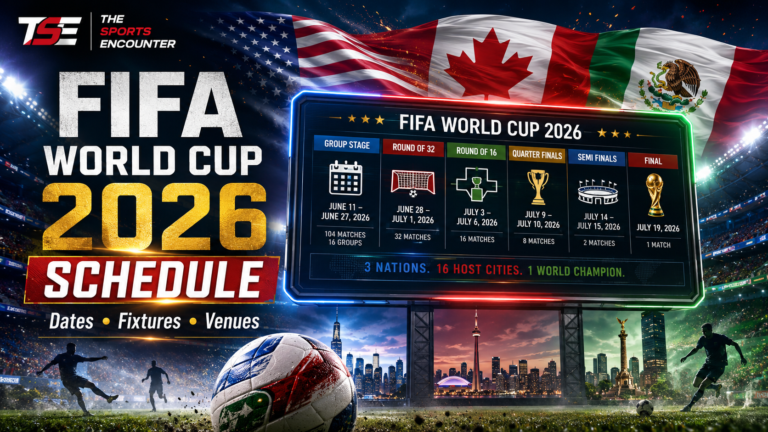
The FIFA World Cup 2026 schedule features 104 matches across the United States, Canada, and Mexico, making it the largest match calendar in tournament history.
The tournament begins on June 11, 2026, with the opening match in Mexico City and continues through July 19, 2026, when the final will be played at MetLife Stadium in East Rutherford, New Jersey.
The group stage runs from June 11 to June 27, followed by the Round of 32 from June 28 to July 3. The Round of 16 will be played from July 4 to July 7, before the quarterfinals take place from July 9 to July 11. The semifinals are scheduled for July 14 and July 15, while the third-place match will be played on July 18.
Use the full FIFA World Cup 2026 schedule below to check match dates, fixtures, kickoff times, venues, host cities, and knockout-round details.
FIFA World Cup 2026 Group Stage Schedule
| Date | Group | Fixture | Time | Venue | City |
|---|---|---|---|---|---|
| June 11 | A | Mexico vs South Africa | 1:00 PM | Estadio Azteca | Mexico City |
| June 11 | A | South Korea vs Czech Republic | 8:00 PM | Estadio Akron | Zapopan |
| June 12 | B | Canada vs Bosnia and Herzegovina | 3:00 PM | BMO Field | Toronto |
| June 12 | D | United States vs Paraguay | 6:00 PM | SoFi Stadium | Inglewood |
| June 13 | C | Brazil vs Morocco | 6:00 PM | MetLife Stadium | East Rutherford |
| June 13 | C | Haiti vs Scotland | 9:00 PM | Gillette Stadium | Foxborough |
| June 13 | B | Qatar vs Switzerland | 12:00 PM | Levi’s Stadium | Santa Clara |
| June 13 | D | Australia vs Turkey | 9:00 PM | BC Place | Vancouver |
| June 14 | E | Germany vs Curaçao | 12:00 PM | NRG Stadium | Houston |
| June 14 | E | Ivory Coast vs Ecuador | 7:00 PM | Lincoln Financial Field | Philadelphia |
| June 14 | F | Netherlands vs Japan | 3:00 PM | AT&T Stadium | Arlington |
| June 14 | F | Sweden vs Tunisia | 8:00 PM | Estadio BBVA | Guadalupe |
| June 15 | G | Belgium vs Egypt | 12:00 PM | Lumen Field | Seattle |
| June 15 | G | Iran vs New Zealand | 6:00 PM | SoFi Stadium | Inglewood |
| June 15 | H | Spain vs Cape Verde | 12:00 PM | Mercedes-Benz Stadium | Atlanta |
| June 15 | H | Saudi Arabia vs Uruguay | 6:00 PM | Hard Rock Stadium | Miami Gardens |
| June 16 | I | France vs Senegal | 3:00 PM | MetLife Stadium | East Rutherford |
| June 16 | I | Iraq vs Norway | 6:00 PM | Gillette Stadium | Foxborough |
| June 16 | J | Argentina vs Algeria | 8:00 PM | Arrowhead Stadium | Kansas City |
| June 16 | J | Austria vs Jordan | 9:00 PM | Levi’s Stadium | Santa Clara |
| June 17 | K | Portugal vs DR Congo | 12:00 PM | NRG Stadium | Houston |
| June 17 | K | Uzbekistan vs Colombia | 8:00 PM | Estadio Azteca | Mexico City |
| June 17 | L | England vs Croatia | 3:00 PM | AT&T Stadium | Arlington |
| June 17 | L | Ghana vs Panama | 7:00 PM | BMO Field | Toronto |
| June 18 | A | Czech Republic vs South Africa | 12:00 PM | Mercedes-Benz Stadium | Atlanta |
| June 18 | A | Mexico vs South Korea | 7:00 PM | Estadio Akron | Zapopan |
| June 18 | B | Switzerland vs Bosnia and Herzegovina | 12:00 PM | SoFi Stadium | Inglewood |
| June 18 | B | Canada vs Qatar | 3:00 PM | BC Place | Vancouver |
| June 19 | C | Scotland vs Morocco | 6:00 PM | Gillette Stadium | Foxborough |
| June 19 | C | Brazil vs Haiti | 8:30 PM | Lincoln Financial Field | Philadelphia |
| June 19 | D | United States vs Australia | 12:00 PM | Lumen Field | Seattle |
| June 19 | D | Turkey vs Paraguay | 8:00 PM | Levi’s Stadium | Santa Clara |
| June 20 | E | Germany vs Ivory Coast | 4:00 PM | BMO Field | Toronto |
| June 20 | E | Ecuador vs Curaçao | 7:00 PM | Arrowhead Stadium | Kansas City |
| June 20 | F | Netherlands vs Sweden | 12:00 PM | NRG Stadium | Houston |
| June 20 | F | Tunisia vs Japan | 10:00 PM | Estadio BBVA | Guadalupe |
| June 21 | G | Belgium vs Iran | 12:00 PM | SoFi Stadium | Inglewood |
| June 21 | G | New Zealand vs Egypt | 6:00 PM | BC Place | Vancouver |
| June 21 | H | Spain vs Saudi Arabia | 12:00 PM | Mercedes-Benz Stadium | Atlanta |
| June 21 | H | Uruguay vs Cape Verde | 6:00 PM | Hard Rock Stadium | Miami Gardens |
| June 22 | I | France vs Iraq | 5:00 PM | Lincoln Financial Field | Philadelphia |
| June 22 | I | Norway vs Senegal | 8:00 PM | MetLife Stadium | East Rutherford |
| June 22 | J | Argentina vs Austria | 12:00 PM | AT&T Stadium | Arlington |
| June 22 | J | Jordan vs Algeria | 8:00 PM | Levi’s Stadium | Santa Clara |
| June 23 | K | Portugal vs Uzbekistan | 12:00 PM | NRG Stadium | Houston |
| June 23 | K | Colombia vs DR Congo | 8:00 PM | Estadio Akron | Zapopan |
| June 23 | L | England vs Ghana | 4:00 PM | Gillette Stadium | Foxborough |
| June 23 | L | Panama vs Croatia | 7:00 PM | BMO Field | Toronto |
| June 24 | C | Scotland vs Brazil | 6:00 PM | Hard Rock Stadium | Miami Gardens |
| June 24 | C | Morocco vs Haiti | 6:00 PM | Mercedes-Benz Stadium | Atlanta |
| June 24 | B | Switzerland vs Canada | 12:00 PM | BC Place | Vancouver |
| June 24 | B | Bosnia and Herzegovina vs Qatar | 12:00 PM | Lumen Field | Seattle |
| June 24 | A | Czech Republic vs Mexico | 7:00 PM | Estadio Azteca | Mexico City |
| June 24 | A | South Africa vs South Korea | 7:00 PM | Estadio BBVA | Guadalupe |
| June 25 | E | Curaçao vs Ivory Coast | 4:00 PM | Lincoln Financial Field | Philadelphia |
| June 25 | E | Ecuador vs Germany | 4:00 PM | MetLife Stadium | East Rutherford |
| June 25 | F | Japan vs Sweden | 6:00 PM | AT&T Stadium | Arlington |
| June 25 | F | Tunisia vs Netherlands | 6:00 PM | Arrowhead Stadium | Kansas City |
| June 25 | D | Turkey vs United States | 7:00 PM | SoFi Stadium | Inglewood |
| June 25 | D | Paraguay vs Australia | 7:00 PM | Levi’s Stadium | Santa Clara |
| June 26 | I | Norway vs France | 3:00 PM | Gillette Stadium | Foxborough |
| June 26 | I | Senegal vs Iraq | 3:00 PM | BMO Field | Toronto |
| June 26 | G | Egypt vs Iran | 8:00 PM | Lumen Field | Seattle |
| June 26 | G | New Zealand vs Belgium | 8:00 PM | BC Place | Vancouver |
| June 26 | H | Cape Verde vs Saudi Arabia | 7:00 PM | NRG Stadium | Houston |
| June 26 | H | Uruguay vs Spain | 6:00 PM | Estadio Akron | Zapopan |
| June 27 | L | Panama vs England | 5:00 PM | MetLife Stadium | East Rutherford |
| June 27 | L | Croatia vs Ghana | 5:00 PM | Lincoln Financial Field | Philadelphia |
| June 27 | J | Algeria vs Austria | 9:00 PM | Arrowhead Stadium | Kansas City |
| June 27 | J | Jordan vs Argentina | 9:00 PM | AT&T Stadium | Arlington |
| June 27 | K | Colombia vs Portugal | 7:30 PM | Hard Rock Stadium | Miami Gardens |
| June 27 | K | DR Congo vs Uzbekistan | 7:30 PM | Mercedes-Benz Stadium | Atlanta |
The group stage runs from June 11 to June 27, followed by the Round of 32 from June 28 to July 3, Round of 16 from July 4 to July 7, quarterfinals from July 9 to July 11, semifinals on July 14 and July 15, the third-place match on July 18, and the final on July 19. The Sports Encounter will cover the whole tournament for its readers and followers.
FIFA World Cup 2026 Knockout Schedule
| Date | Round | Fixture | Time | Venue | City |
|---|---|---|---|---|---|
| June 28 | Round of 32 | Runner-up Group A vs Runner-up Group B | 12:00 PM | SoFi Stadium | Inglewood |
| June 29 | Round of 32 | Winner Group C vs Runner-up Group F | 12:00 PM | NRG Stadium | Houston |
| June 29 | Round of 32 | Winner Group E vs 3rd Group A/B/C/D/F | 4:30 PM | Gillette Stadium | Foxborough |
| June 29 | Round of 32 | Winner Group F vs Runner-up Group C | 7:00 PM | Estadio BBVA | Guadalupe |
| June 30 | Round of 32 | Runner-up Group E vs Runner-up Group I | 12:00 PM | AT&T Stadium | Arlington |
| June 30 | Round of 32 | Winner Group I vs 3rd Group C/D/F/G/H | 5:00 PM | MetLife Stadium | East Rutherford |
| June 30 | Round of 32 | Winner Group A vs 3rd Group C/E/F/H/I | 7:00 PM | Estadio Azteca | Mexico City |
| July 1 | Round of 32 | Winner Group L vs 3rd Group E/H/I/J/K | 12:00 PM | Mercedes-Benz Stadium | Atlanta |
| July 1 | Round of 32 | Winner Group G vs 3rd Group A/E/H/I/J | 1:00 PM | Lumen Field | Seattle |
| July 1 | Round of 32 | Winner Group D vs 3rd Group B/E/F/I/J | 5:00 PM | Levi’s Stadium | Santa Clara |
| July 2 | Round of 32 | Winner Group H vs Runner-up Group J | 12:00 PM | SoFi Stadium | Inglewood |
| July 2 | Round of 32 | Runner-up Group K vs Runner-up Group L | 7:00 PM | BMO Field | Toronto |
| July 2 | Round of 32 | Winner Group B vs 3rd Group E/F/G/I/J | 8:00 PM | BC Place | Vancouver |
| July 3 | Round of 32 | Runner-up Group D vs Runner-up Group G | 1:00 PM | AT&T Stadium | Arlington |
| July 3 | Round of 32 | Winner Group J vs Runner-up Group H | 6:00 PM | Hard Rock Stadium | Miami Gardens |
| July 3 | Round of 32 | Winner Group K vs 3rd Group D/E/I/J/L | 8:30 PM | Arrowhead Stadium | Kansas City |
| July 4 | Round of 16 | Winner Match 73 vs Winner Match 75 | 12:00 PM | NRG Stadium | Houston |
| July 4 | Round of 16 | Winner Match 74 vs Winner Match 77 | 5:00 PM | Lincoln Financial Field | Philadelphia |
| July 5 | Round of 16 | Winner Match 76 vs Winner Match 78 | 4:00 PM | MetLife Stadium | East Rutherford |
| July 5 | Round of 16 | Winner Match 79 vs Winner Match 80 | 6:00 PM | Estadio Azteca | Mexico City |
| July 6 | Round of 16 | Winner Match 83 vs Winner Match 84 | 2:00 PM | AT&T Stadium | Arlington |
| July 6 | Round of 16 | Winner Match 81 vs Winner Match 82 | 5:00 PM | Lumen Field | Seattle |
| July 7 | Round of 16 | Winner Match 86 vs Winner Match 88 | 12:00 PM | Mercedes-Benz Stadium | Atlanta |
| July 7 | Round of 16 | Winner Match 85 vs Winner Match 87 | 1:00 PM | BC Place | Vancouver |
| July 9 | Quarterfinal | Winner Match 89 vs Winner Match 90 | 4:00 PM | Gillette Stadium | Foxborough |
| July 10 | Quarterfinal | Winner Match 93 vs Winner Match 94 | 12:00 PM | SoFi Stadium | Inglewood |
| July 11 | Quarterfinal | Winner Match 91 vs Winner Match 92 | 5:00 PM | Hard Rock Stadium | Miami Gardens |
| July 11 | Quarterfinal | Winner Match 95 vs Winner Match 96 | 8:00 PM | Arrowhead Stadium | Kansas City |
| July 14 | Semifinal | Winner Match 97 vs Winner Match 98 | 2:00 PM | AT&T Stadium | Arlington |
| July 15 | Semifinal | Winner Match 99 vs Winner Match 100 | 3:00 PM | Mercedes-Benz Stadium | Atlanta |
| July 18 | Third-place match | Loser Match 101 vs Loser Match 102 | 5:00 PM | Hard Rock Stadium | Miami Gardens |
| July 19 | Final | Winner Match 101 vs Winner Match 102 | 3:00 PM | MetLife Stadium | East Rutherford |
The knockout structure includes the newly added Round of 32, which reflects the expanded 48-team format. The FIFA World Cup 2026 final is scheduled for July 19 at MetLife Stadium in East Rutherford, New Jersey.
Breaking News
Roberto Baggio: The Man Who Died Standing
Some footballers are remembered for lifting trophies. Some are remembered for goals, medals, celebrations, and parades. Roberto Baggio is remembered for silence.
A painful silence.
The kind of silence that falls over a stadium when one man realizes that the whole world will remember him for the one thing he failed to do, not for everything he had done before it, The Sports Encounter observed.
At the 1994 FIFA World Cup, Baggio did not simply play for Italy. He carried Italy. He dragged a nervous, unconvincing, struggling side through danger, doubt, and near elimination. He gave his country life when the tournament looked lost. He turned broken matches into miracles.
Then, in the final, football did something cruel.
It reduced his entire World Cup to one missed penalty.
Brazil celebrated. Italy froze. Baggio stood alone in the middle of the Rose Bowl in Pasadena, head down, hands on hips, the ball gone over the bar and a lifetime of pain suddenly written across his face.
That image became history.
But it was never the full truth.
Roberto Baggio was not the villain of the 1994 World Cup final.
He was the reason Italy reached it.
Italy Were Falling Before Roberto Baggio Lifted Them
Italy arrived at USA 1994 with pride, tradition, and expectation, but their tournament began badly. A 1-0 defeat to the Republic of Ireland immediately placed the Azzurri under pressure.
They were not playing like champions. They looked tense. They looked heavy. They looked like a team carrying history rather than writing it.
For large parts of that tournament, Italy did not flow.
They survived.
And survival needed someone special.
That someone was Roberto Baggio.
He was not loud. He was not physically imposing. He did not need to dominate with anger or arrogance. Baggio carried a different kind of strength. He had softness in his feet and steel in his mind. He played like a man who could hear football differently from everyone else.
ALSO READ: Mexico vs South Africa Analysis: 5 Takeaways from the 2026 World Cup Opener
When Italy reached the knockout stage, their World Cup nearly ended against Nigeria.
Italy trailed 1-0. Gianfranco Zola had been sent off. Time was running out. The Italians were almost gone.
Then Baggio appeared.
In the 88th minute, with Italy standing on the edge of elimination, he scored.
Not a wild strike. Not a desperate swing. A calm finish under impossible pressure.
That was Baggio.
When others panicked, he breathed.
When Italy were dying, he gave them air.
He then scored again from the penalty spot in extra time. Italy won 2-1 and stayed alive.
That match should have been remembered as one of the greatest rescue acts in Italian football history. Instead, it became one chapter that many people forgot because the ending of the tournament was louder than the journey.
Spain Felt His Genius
Against Spain in the quarterfinal, Italy again needed someone to break the tension.
The match was level at 1-1. The clock was moving toward extra time. Every touch mattered. Every mistake could become fatal.
Then Baggio made his move.
He slipped through, rounded the goalkeeper, and finished from a tight angle. It was not just a goal. It was a moment of cold courage.
Many players can score when a team is already flying.
Baggio scored when a nation was holding its breath.
That is what made him different.
He did not decorate Italy’s World Cup. He saved it.
Bulgaria Saw the Divine Ponytail at His Best
By the semifinal, Baggio had already rescued Italy twice.
Still, he was not finished.
Bulgaria had become one of the stories of the tournament. They had beaten Germany. Hristo Stoichkov was playing with fire in his boots. Bulgaria believed destiny had opened a door for them.
Baggio closed it.
Two first-half goals. Two moments of technical beauty. Two reminders that some players do not need many chances to change history.
Italy won 2-1.
Baggio had taken them to the final.
By that point, his 1994 World Cup had already become legendary. He had scored five goals in the knockout rounds. He had rescued Italy against Nigeria. He had punished Spain. He had stopped Bulgaria.
He had done what only the very greatest players do.
He had made an imperfect team believe it could touch glory.
Then Came Pasadena
The final against Brazil was tense, cautious, and exhausting.
Brazil had Romario, Bebeto, Dunga, and a team full of power, discipline, and belief. Italy had defensive pride, tactical structure, and one tired genius carrying too much emotional weight.
The match ended 0-0 after extra time.
Then came penalties.
Football can be beautiful for 120 minutes and brutal in five kicks.
Franco Baresi missed for Italy.
Daniele Massaro missed for Italy.
Brazil moved ahead.
Then Baggio walked toward the penalty spot.
This is the part that still hurts.
Because that walk was not just a football moment. It looked like a man walking into judgment.
He had carried Italy for weeks. He had answered every emergency. He had turned fear into hope. But now, with his body tired and the World Cup almost gone, Italy still needed him to save them one more time.
One more miracle.
One more rescue.
One more act of genius.
He struck the ball.
It flew over the bar.
Brazil were world champions.
Baggio stood still.
No fall. No scream. No dramatic collapse.
Just stillness.
His head lowered. His hands on his hips. His body upright, but something inside him clearly broken.
That is why he became the man who died standing.
Roberto Baggio: The Cruelty of One Image
Football can be unfair in the way it remembers.
It loves simple stories. Winners and losers. Heroes and villains. Glory and failure.
Baggio’s story was too complex for that.
So football made it simple.
It took one image from Pasadena and allowed it to swallow the whole tournament.
The miss became bigger than the miracle.
The final became bigger than the road to the final.
The pain became bigger than the greatness.
That is the tragedy.
ALSO READ: FIFA World Cup 2026 Curtain Raiser: The B(oldest) Event Ever?
People remember the ball going over the bar before they remember the goal against Nigeria.
They remember the silence before they remember the winner against Spain.
They remember the heartbreak before they remember the two goals against Bulgaria.
They remember the failure of one kick before they remember the courage of an entire World Cup.
But truth does not disappear just because memory becomes lazy.
Roberto Baggio did not lose Italy the World Cup.
Roberto Baggio gave Italy a World Cup final.
Roberto Baggio: A Hero Without Full Recognition
Baggio is loved. No one can deny that.
But love is not always the same as recognition.
He is admired as a beautiful footballer. He is respected as a genius. He is remembered as one of Italy’s greats.
Still, his 1994 World Cup is not honored with the full weight it deserves.
If another player had carried a nation through the knockout rounds and won the trophy, that campaign would be treated as immortal.
Baggio did almost everything except lift the cup.
That missing final step changed the way history judged him.
And that is painfully unfair.
Because greatness should not always depend on the last kick.
Sometimes greatness is found in the burden carried before that kick ever happens.
Baggio’s burden was enormous.
He played with the expectation of a football nation. He played through pressure, pain, and exhaustion. He became Italy’s answer to every problem. Then, when he finally missed, the same football world that had relied on him allowed him to stand alone with the blame.
There is something deeply human in that.
Many people know that feeling.
You can do ten things right, then one mistake becomes your identity.
You can carry people through difficult days, then they remember the one day you could not carry them anymore.
That is why Baggio’s story still hurts.
It is not only about football.
It is about how cruel memory can be to those who gave everything.
The Divine Ponytail Was Still Human
His nickname, Il Divin Codino, “The Divine Ponytail,” made him sound untouchable.
But he was not untouchable.
He was human.
That is what made the moment so painful.
The man who looked so calm with the ball at his feet suddenly looked completely alone. The player who had given Italy belief now stood as the face of national heartbreak.
There was no hiding place in Pasadena.
The camera found him. History froze him. The world judged him.
But maybe that stillness was also his final act of courage.
He did not run from the moment.
He did not turn away.
He stood there and took the pain.
That image is often treated as failure.
Maybe it should be seen differently.
Maybe it was dignity.
Maybe it was a man accepting the most painful moment of his career without asking anyone else to carry it for him.
The Final Verdict
Roberto Baggio’s 1994 World Cup story should not be remembered as the story of a missed penalty.
It should be remembered as the story of a man who carried Italy as far as his body and soul could take them.
He saved them against Nigeria.
He punished Spain.
He broke Bulgaria.
He gave Italy a final they probably had no right to reach.
Then, at the very end, he missed.
That is the painful truth. But it is not the whole truth.
The whole truth is that Roberto Baggio was Italy’s hero before football turned him into its scapegoat.
He was the miracle before he became the memory.
He was the light before the shadow.
He was the man who stood alone while others celebrated, carrying not just defeat, but the weight of being misunderstood forever.
History gave Brazil the trophy.
But it gave Baggio something different.
A wound that never fully healed.
A legacy that still makes football fans emotional.
A silence that still speaks.
Roberto Baggio did not die as a villain in Pasadena.
He died standing as a hero football never fully thanked.
Breaking News
Balogun Brace Powers Dream World Cup Start for Co-Hosts
The United States did not ease into its home World Cup. It announced itself.
According to The Sports Encounter, in front of a charged Los Angeles crowd, the USMNT opened its FIFA World Cup 2026 campaign with a commanding 4-1 win over Paraguay, turning a dangerous Group D opener into a statement of intent. For a team carrying the pressure of hosting, expectation, and years of “golden generation” talk, this was the kind of night American soccer had been waiting for.
Folarin Balogun scored twice, the U.S. attack pressed Paraguay into early mistakes, and Gio Reyna added the final touch late on as Mauricio Pochettino’s side collected three points with authority.
Paraguay did find a second-half response through substitute Maurício, but the goal only briefly interrupted the American rhythm. The U.S. had already built the match on intensity, fast movement, aggressive pressing, and a first-half performance that left Paraguay chasing shadows.
USA Strike Early and Set the Tone
The first major blow came from American pressure rather than a long spell of patient possession. The U.S. pushed Paraguay backward, forced uncertainty in the defensive third, and turned that pressure into the opening goal.
ENTER THE FIFA WORLD CUP 2026 HUB
That early breakthrough changed the game. Paraguay had arrived with the intention of staying compact, slowing the tempo, and making the co-hosts carry the emotional weight of the occasion. Instead, the U.S. scored early enough to remove the nerves and force Paraguay into a more open match than they wanted.
Christian Pulisic looked sharp from the start. His movement between lines caused Paraguay problems, while Weston McKennie’s energy helped the U.S. win second balls and sustain attacks. Tyler Adams and Malik Tillman gave the midfield balance, allowing the Americans to attack with numbers without losing control of the center.
Once the first goal went in, the U.S. played with confidence. The passing became sharper, the runs became braver, and Paraguay’s defensive structure began to stretch.
Balogun Turns the Night Into His Stage
The defining figure of the match was Balogun.
His first goal showed the value of a striker who does not wait for perfect service. He attacked space, stayed alive inside the box, and gave the U.S. the kind of penalty-area presence it has often lacked in major tournaments.
His second goal before halftime gave the match its decisive shape. At 3-0, Paraguay were not just behind on the scoreboard. They were behind in tempo, confidence, and control.
Balogun’s brace mattered beyond the goals. It gave the U.S. a reliable attacking reference point. Pulisic, Reyna, McKennie, and Tillman all become more dangerous when the striker stretches defenders and creates space behind the midfield line. Paraguay struggled to decide whether to step forward or drop deeper, and that hesitation kept opening gaps.
For Balogun, this was more than a strong individual performance. It was a World Cup arrival.
Paraguay Improve, But Too Late
Paraguay were better after halftime. They played with more aggression, committed more bodies forward, and finally found moments where they could test the American back line.
Maurício’s goal gave Paraguay something to hold on to and exposed a small concern for the U.S. defense. The Americans looked less secure when Paraguay attacked directly and pushed runners into the channels. That will matter later in the group, especially against teams with more pace and cleaner final-third execution.
Still, Paraguay’s response came too late. They had already allowed the U.S. too much control in the first half, and they never built enough sustained pressure to make the final stretch truly uncomfortable.
Their biggest issue was not only defensive. Paraguay lacked the composure to keep the ball long enough to slow the U.S. rhythm. Too many attacks ended early. Too many clearances invited pressure back. Against a home team feeding off crowd energy, that became a dangerous cycle.
Gio Reyna Closes It Out
Gio Reyna’s late goal gave the scoreline its final shine and reflected the difference between the two teams.
ALSO READ: Bench Hero Larin Delivers Canada’s Historic World Cup Equalizer
Paraguay’s goal could have created a nervous finish, but the U.S. did not retreat into survival mode. Instead, it found another attacking moment, restored control, and ended the night with the type of scoreline that will travel across the tournament.
Reyna’s finish also mattered symbolically. The U.S. did not rely on one player or one pattern. Balogun delivered the goals, Pulisic helped set the rhythm, McKennie brought force, Adams added structure, Tillman connected play, and Reyna finished the job.
That balance may be the most encouraging part of the result.
Pochettino’s USA Looked Prepared for the Moment
The biggest question before the match was not talent. It was temperament.
Could the U.S. handle a home World Cup opener without becoming tense? Could the players turn the crowd into fuel rather than pressure? Could Pochettino quickly shape this group into a side with enough structure to support its attacking ambition?
On this evidence, the answer is yes.
The U.S. pressed with purpose. The midfield stayed connected. The forwards attacked space instead of waiting for Paraguay to make obvious mistakes. Most importantly, the team looked prepared for the emotional weight of the night.
This was not a perfect performance. Paraguay’s second-half goal showed that the U.S. can still be exposed when the defensive line loses concentration. There will also be concern over Pulisic after he was withdrawn at halftime with reported calf tightness. His fitness will become one of the major storylines before the next match.
But opening games are often about control, clarity, and confidence. The U.S. delivered all three.
What This Result Means for Group D
The win puts the United States in a strong early position in Group D. With Australia and Turkey still to come, three points and a healthy goal difference give Pochettino’s team valuable breathing room.
That matters in a World Cup group stage. A strong opening win changes everything. It reduces panic. It allows rotation decisions to be made with a clearer head. It puts pressure on the rest of the group.
For Paraguay, the task becomes harder immediately. They now need a response against Turkey, and they cannot afford another slow start. Their second-half improvement offered some hope, but the defensive problems from the first half cannot continue.
Key Takeaways
The United States opened with a complete attacking performance and showed the confidence expected from a host nation.
Folarin Balogun was the clear standout after scoring twice and giving the U.S. a true World Cup No. 9 presence.
Christian Pulisic’s influence was obvious before his halftime substitution, but his fitness will need monitoring.
Paraguay improved after the break, yet their first-half defensive problems left them too far behind.
Gio Reyna’s late goal gave the U.S. a statement scoreline and added further belief to an already impressive opening night.
Final Verdict
This was not just a win for the United States. It was a message.
The US has often been described as talented, promising, or dangerous on its day. Against Paraguay, it looked like something more useful at a World Cup: prepared.
Balogun gave the attack a cutting edge. The midfield gave the team control. The crowd gave the night emotion. Pochettino gave the performance structure.
One match does not define a tournament, but it can define belief. For the United States men’s soccer team, this 4-1 win felt like the first real proof that home advantage can become something powerful.
Breaking News
Bench Hero Larin Delivers Canada’s Historic World Cup Equalizer
Canada did not get the dream winning start it wanted on home soil, but it still walked away with something historic.
A late equalizer from Cyle Larin rescued a 1-1 draw for Canada against Bosnia and Herzegovina in their FIFA World Cup 2026 Group B opener, giving the co-hosts their first-ever point in a senior men’s World Cup.
For much of the match, Bosnia looked ready to spoil Canada’s landmark night. Jovo Lukić silenced the home crowd in the 21st minute with a sharp finish that put Bosnia ahead and forced Canada into a long, uncomfortable chase.
Canada pushed, missed chances, adjusted its tempo, and kept asking questions. The answer finally arrived in the 78th minute when Larin, introduced from the bench, delivered the moment the country had been waiting for.
It was not just an equalizer. It was Canada’s first World Cup goal on Canadian soil. It was also the goal that turned a frustrating night into a memory Canada fans will hold for years.
Bosnia Strike First and Test Canada’s Nerve
Canada started with energy, helped by a loud Toronto crowd that understood the weight of the occasion. This was not just another group-stage match. It was Canada’s first World Cup match at home, and the atmosphere carried both excitement and pressure.
ENTER THE FIFA WORLD CUP 2026 HUB
Bosnia handled that pressure better in the early stages.
The European side stayed compact, slowed the game when needed, and looked dangerous whenever it broke forward. In the 21st minute, Bosnia found its reward. Lukić made Canada pay with a composed finish, giving Bosnia a 1-0 lead and changing the mood inside the stadium.
That goal exposed the first major challenge for Canada. Playing at home can lift a team, but it can also tighten legs when the match starts slipping away. For a while, Canada looked caught between urgency and control.
Jonathan David and Richie Laryea both had moments where Canada looked close to finding a response, but Bosnia defended with discipline and forced Canada into rushed decisions around the box.
Canada Keep Pushing but Bosnia Refuse to Break Early
Canada’s best spell before the equalizer came from pressure rather than precision.
Stephen Eustáquio’s set-piece delivery kept Bosnia working. Canada won corners, pushed bodies forward, and tried to stretch Bosnia from wide areas. Yet Bosnia’s defensive shape stayed alive. They blocked shooting lanes, dealt with second balls, and forced Canada to restart attacks from deeper positions.
Bosnia also carried a threat of its own. Even after taking the lead, they did not completely disappear into a defensive shell. Their counters forced Canada to stay alert, and Maxime Crépeau had to make an important second-half save to keep the deficit at one.
That save mattered. Without it, Canada may have been chasing two goals instead of one. In a World Cup opener, that difference can decide a group campaign before it truly starts.
Larin Changes the Match From the Bench
The match turned when Canada’s substitutions gave the attack fresh legs and a sharper focal point.
ALSO READ: Mexico vs South Africa Analysis: 5 Takeaways from the 2026 World Cup Opener
Cyle Larin came on and wasted little time making an impact. In the 78th minute, he found the finish Canada had been chasing all night.
The timing made the goal even more powerful. Canada had been pressing for nearly an hour after falling behind, but the equalizer came late enough to feel dramatic and early enough to give the crowd hope of a winner.
Larin’s goal carried several layers of meaning.
It saved Canada from defeat in its opening match. It gave the country its first-ever World Cup point. It marked Canada’s first World Cup goal on home soil. It also reminded Jesse Marsch that his bench may become a major weapon in this tournament.
For Bosnia, the equalizer will hurt. They had defended with commitment, managed the game well for long stretches, and looked close to stealing a massive opening win. One late lapse changed the story.
Interesting Facts About the Late Equalizer
Cyle Larin’s goal was more than a normal 78th-minute equalizer.
First, it gave Canada its first point in men’s World Cup history. Canada had played in the 1986 and 2022 editions before this tournament but had never earned a draw or win.
Second, it was Canada’s first men’s World Cup goal scored on Canadian soil. That makes it a landmark moment in the country’s football history, not just a result-saving strike.
Third, the goal came from a substitute, which makes Marsch’s in-game management a major talking point. Canada needed a different rhythm, and the bench delivered it.
Fourth, the timing protected Canada’s Group B campaign. A home defeat in the opener would have created immediate pressure before matches against Qatar and Switzerland. A draw keeps Canada alive, confident, and emotionally connected to its fans.
Fifth, the equalizer turned what could have been remembered as a flat home opener into a national football milestone. Canada did not win, but the emotional value of that goal was much bigger than one point.
What the Result Means for Group B
This result leaves Group B wide open.
Canada will feel it dropped two points because it played at home and created enough pressure to chase a win. Bosnia will feel the same because it led for most of the match and came close to a disciplined opening victory.
That is what makes the draw so fascinating. Both teams can see opportunity in it. Both can also see regret.
Canada’s next match against Qatar now becomes crucial. A win there would turn this draw into a strong platform. Anything less would put pressure on Canada before facing Switzerland.
Bosnia will move on to face Switzerland, knowing it already proved it can stay organized under pressure. Still, dropping a lead late means Bosnia must find a way to manage closing stages better, especially against teams with stronger attacking depth.
Final Verdict
Canada wanted a win. Bosnia almost took one. In the end, the night belonged to the moment rather than the result.
Cyle Larin’s late equalizer gave Canada a historic first World Cup point and turned Toronto into the scene of a breakthrough that Canadian football had waited decades to experience.
The performance was not perfect. Canada lacked sharpness at times, started chasing too early, and needed a late rescue. Yet World Cups are not built only on perfect performances. They are built on moments that survive long after the final whistle.
For Canada, this was one of those moments.